LEGGOS I: The JWST LEGGOS Survey -- LEnsing and Galaxy Growth: Observing Substructures -- Unpacks the Nature of Clumpy Star Formation and Quenching in Gravitationally Lensed Galaxies beyond Cosmic Noon
Pith reviewed 2026-06-26 16:11 UTC · model grok-4.3
The pith
The LEGGOS survey introduces a joint lensing-photometry-spectroscopy framework that disentangles multiple stellar populations inside individual clumps of z~2-4 galaxies.
A machine-rendered reading of the paper's core claim, the machinery that carries it, and where it could break.
Core claim
The full survey dataset, with simultaneous flux and morphology constraints on clumpy source-plane regions, and a flexible spectrophotometric SPS modeling approach, provides a direct bridge between parsec-scale star formation physics and galaxy assembly at and beyond cosmic noon.
What carries the argument
The uniform analysis framework that jointly models lensing reconstruction, multi-band photometry, and integral field spectroscopy to disentangle multiple stellar populations within individual clumps and their surrounding diffuse regions.
If this is right
- Spectroscopy identifies recent quenching in galaxies previously classified as UV star-forming based on photometry alone.
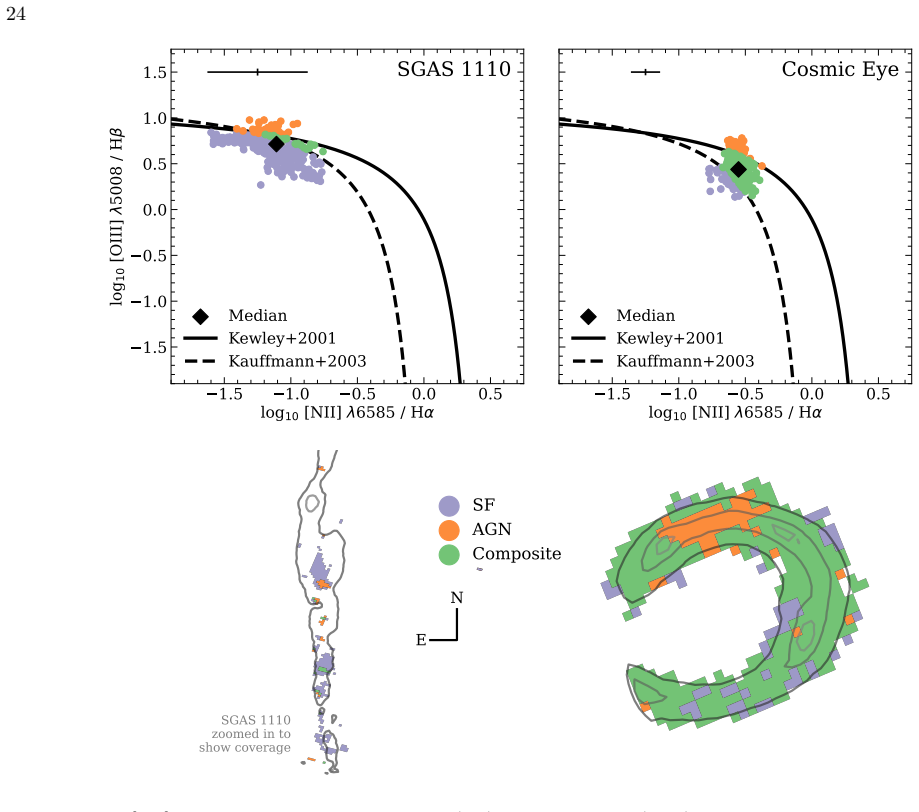
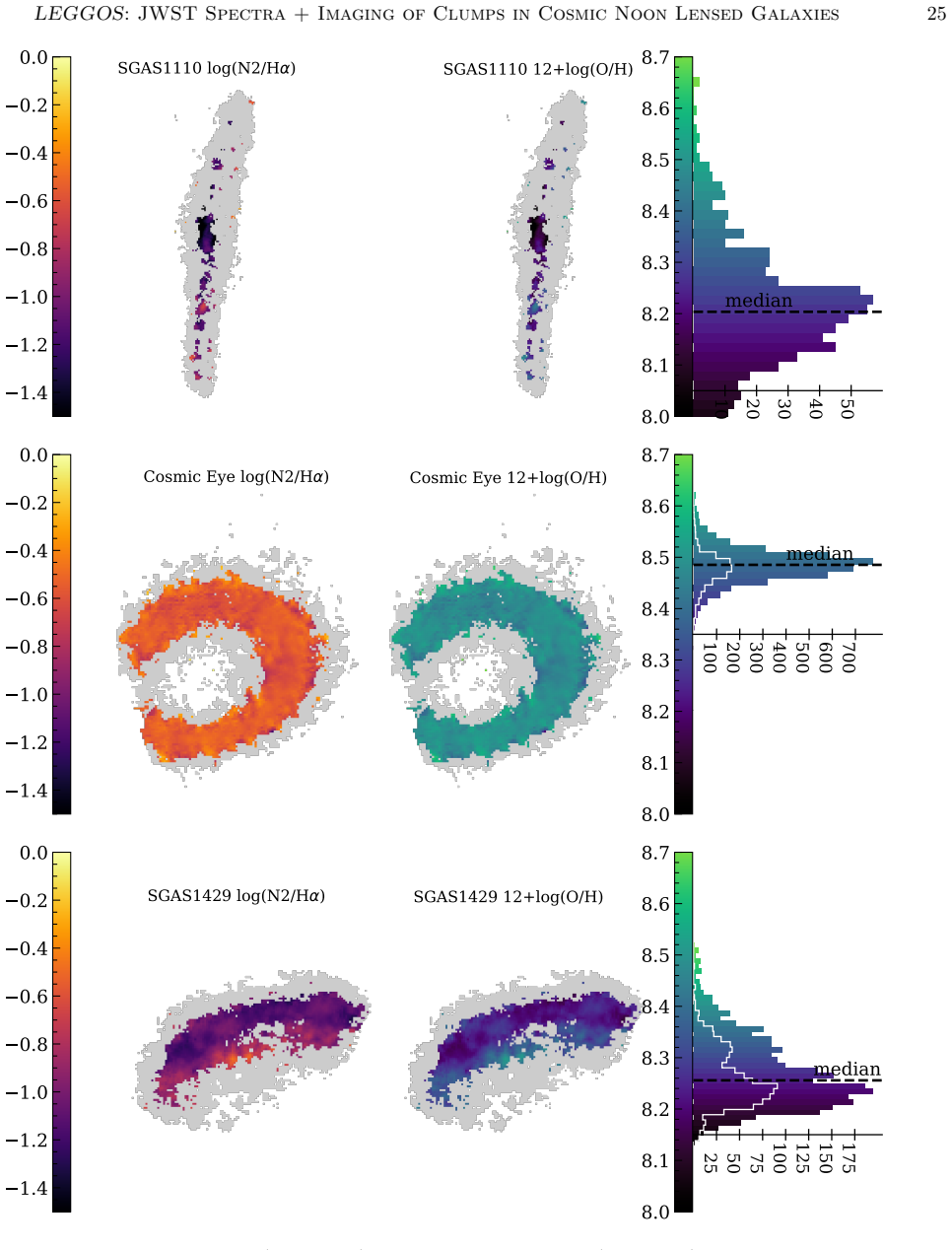
- Some galaxies show uniform metallicities across the entire system while others have higher metallicities and harder ionization conditions in clumps relative to diffuse regions.
- Maps of Balmer recombination lines and diagnostic ratios connect star formation histories, dust attenuation, and nebular conditions on sub-kpc scales.
Where Pith is reading between the lines
- The method could be extended to compare clump properties in lensed versus unlensed systems at similar redshifts to test for selection effects.
- Similar joint modeling might be applied to even higher-redshift galaxies once deeper integral-field data become available.
Load-bearing premise
The joint lensing reconstruction plus multi-band photometry plus integral-field spectroscopy modeling can reliably disentangle multiple stellar populations inside individual clumps without significant residual degeneracies.
What would settle it
If applying the joint modeling to the same clumps produces stellar population parameters that are inconsistent across independent emission-line diagnostics or yield large residual degeneracies in age, metallicity, or dust, the reliability of the disentangling would be undermined.
Figures




read the original abstract
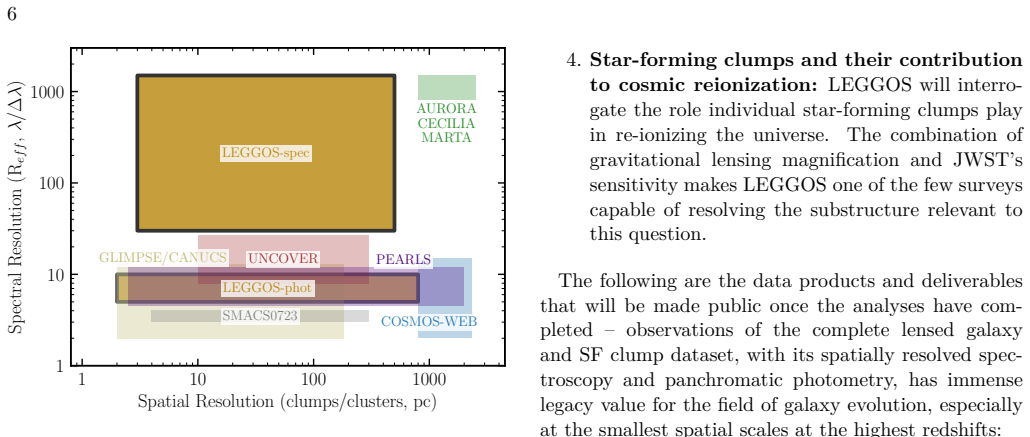
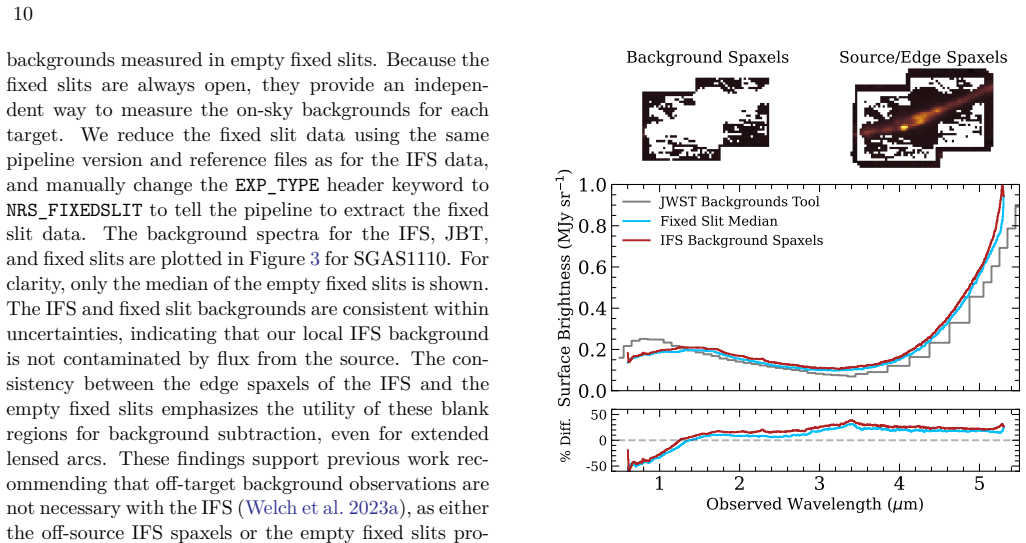
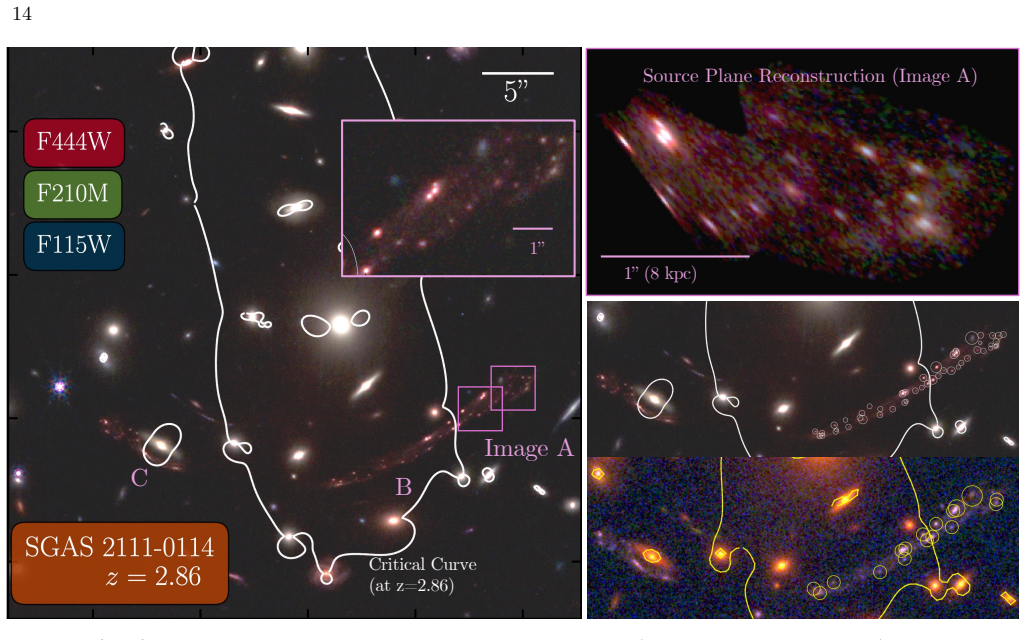
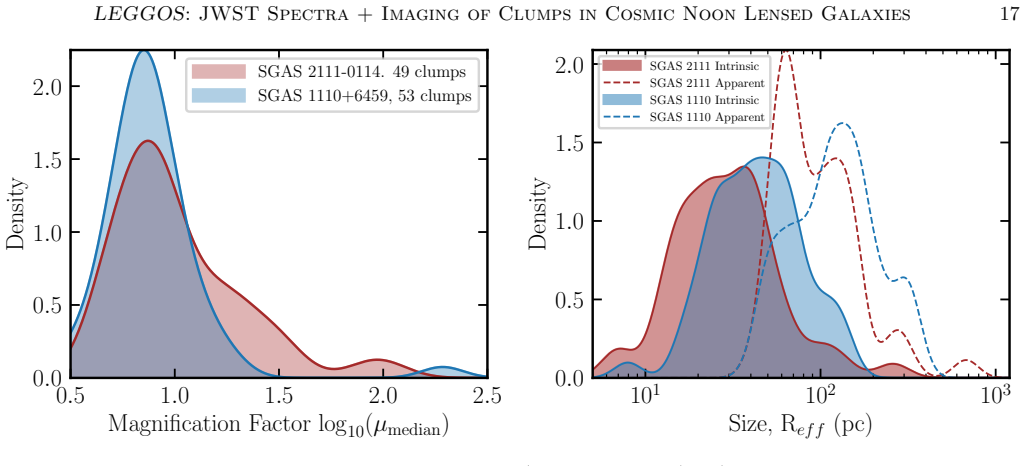
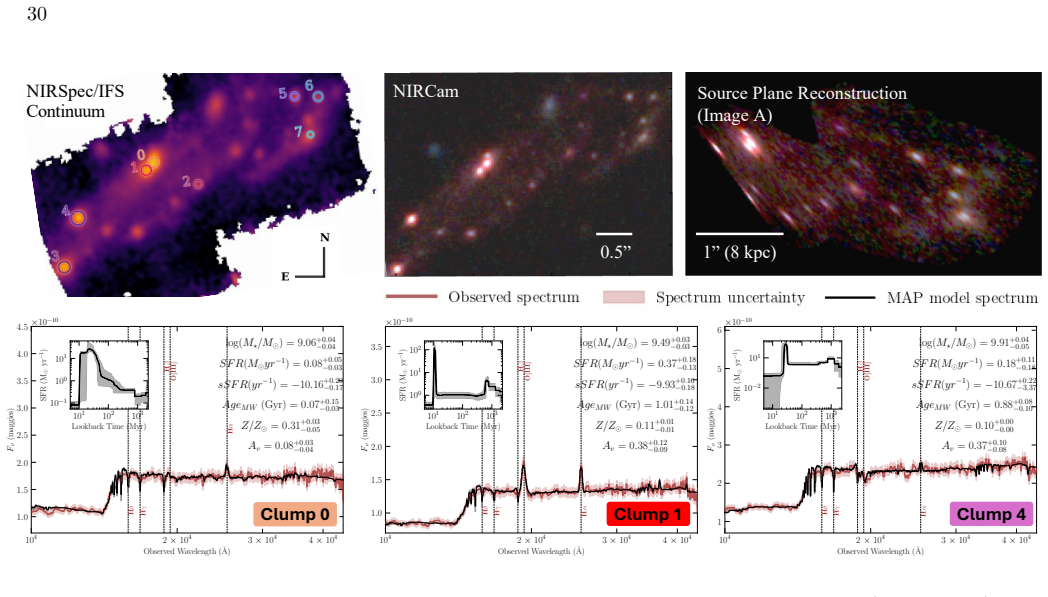
We present first results from the JWST LEGGOS Survey (LEnsing and Galaxy Growth: Observing Substructures), aimed at studying the physics of clumpy star formation and quenching in eight lensed galaxies at $z\sim2$--4. LEGGOS combines multiple Cycle 2 JWST GO programs (GO 4125, GO 3843) and Cycle 1 archival data, and utilizes strong gravitational lensing with NIRCam imaging and NIRSpec integral-field spectroscopy. LEGGOS targets UV-bright, highly magnified systems to resolve $\sim$10--200 pc regions in both rest-frame optical continuum and nebular emission. This overview paper describes the survey design, data reduction and calibration strategy, and science-quality data products, and highlights early examples demonstrating how spectroscopy breaks key degeneracies inherent to photometry-only clump studies, including identifying recent quenching in previously-thought UV star forming galaxies. We introduce a uniform analysis framework that jointly models lensing reconstruction, multi-band photometry, and integral field spectroscopy to disentangle multiple stellar populations within individual clumps and their surrounding diffuse regions. Using maps of Balmer recombination lines and key emission line diagnostic ratios, we connect star formation histories, dust attenuation, and nebular conditions on sub-kpc scales -- LEGGOS galaxies range from uniform metallicities across the whole galaxy, to having higher clump metallicities and harder ionization conditions relative to diffuse regions. The full survey dataset, with simultaneous flux and morphology constraints on clumpy source-plane regions, and a flexible spectrophotometric SPS modeling approach, provides a direct bridge between parsec-scale star formation physics and galaxy assembly at and beyond cosmic noon, offering a robust and efficient means of resolving star formation in the first galaxies.
Editorial analysis
A structured set of objections, weighed in public.
Referee Report
Summary. The paper presents the JWST LEGGOS Survey overview, targeting eight strongly lensed galaxies at z~2-4 with NIRCam imaging and NIRSpec IFS. It describes survey design, data reduction/calibration, science-quality products, and early examples of a uniform joint lensing-photometry-IFS analysis framework using flexible spectrophotometric SPS modeling. The central claim is that this framework, combined with Balmer line maps and emission-line diagnostics, breaks photometry-only degeneracies to disentangle multiple stellar populations in clumps versus diffuse regions, thereby bridging parsec-scale star formation physics to galaxy assembly beyond cosmic noon.
Significance. If the joint modeling framework can be shown to deliver the claimed degeneracy reduction with quantified uncertainties, the survey would supply a high-value, publicly useful dataset of resolved clump properties in lensed systems at cosmic noon. The emphasis on uniform analysis across multiple programs and the release of science-quality data products are positive contributions to the field.
major comments (2)
- [§4] §4 (Uniform Analysis Framework): The claim that the joint lensing reconstruction + multi-band photometry + IFS modeling 'reliably disentangles multiple stellar populations' and that 'spectroscopy breaks key degeneracies' is load-bearing for the central bridge-to-physics assertion, yet the section provides only a high-level description without mock recovery tests, degeneracy metrics, or covariance matrices demonstrating residual uncertainties in age, dust, metallicity, or ionization parameters.
- [§5.1] §5.1 (Early Examples): The statement that spectroscopy identifies 'recent quenching in previously-thought UV star forming galaxies' and that galaxies show 'higher clump metallicities and harder ionization conditions' rests on the framework's performance, but no quantitative validation (e.g., recovery fractions from simulated clumps or comparison to photometry-only results) is presented to support these interpretations against source-plane reconstruction uncertainties.
minor comments (2)
- [Abstract, §2] The abstract and §2 would benefit from an explicit statement of the total number of clumps analyzed across the sample and the typical magnification factors achieved.
- [Figure captions] Figure captions for the early-example maps should include the spatial resolution in the source plane and the wavelength ranges used for the Balmer and diagnostic line maps.
Simulated Author's Rebuttal
We thank the referee for their constructive comments and for recognizing the potential value of the LEGGOS dataset and uniform analysis approach. We address each major comment below and outline targeted revisions to strengthen the quantitative support for the framework's performance.
read point-by-point responses
-
Referee: [§4] §4 (Uniform Analysis Framework): The claim that the joint lensing reconstruction + multi-band photometry + IFS modeling 'reliably disentangles multiple stellar populations' and that 'spectroscopy breaks key degeneracies' is load-bearing for the central bridge-to-physics assertion, yet the section provides only a high-level description without mock recovery tests, degeneracy metrics, or covariance matrices demonstrating residual uncertainties in age, dust, metallicity, or ionization parameters.
Authors: We agree that §4 would benefit from additional quantitative context to support the claims. As this is an overview paper, the full mock recovery tests and detailed covariance analysis are reserved for a companion methods paper. However, we will revise §4 to include example covariance matrices derived from the current spectrophotometric fits, a brief summary of internal consistency checks performed on the joint modeling, and explicit discussion of how the addition of IFS data reduces specific degeneracies (e.g., age-dust) relative to photometry-only constraints. These additions will be supported by the early results already shown. revision: partial
-
Referee: [§5.1] §5.1 (Early Examples): The statement that spectroscopy identifies 'recent quenching in previously-thought UV star forming galaxies' and that galaxies show 'higher clump metallicities and harder ionization conditions' rests on the framework's performance, but no quantitative validation (e.g., recovery fractions from simulated clumps or comparison to photometry-only results) is presented to support these interpretations against source-plane reconstruction uncertainties.
Authors: The interpretations in §5.1 are presented as early illustrative results from the joint framework. We acknowledge the value of direct quantitative comparisons. We will revise §5.1 to add side-by-side parameter comparisons (star-formation history, metallicity, ionization) between the joint lensing-photometry-IFS model and photometry-only fits for the example galaxies, along with a short discussion of how source-plane reconstruction uncertainties are propagated and mitigated by the simultaneous use of IFS constraints. Full end-to-end mock recovery tests for the specific science claims will appear in follow-up science papers. revision: partial
Circularity Check
No circularity: survey overview with descriptive claims only
full rationale
This is a survey design and data-products paper. The central claim is that the LEGGOS dataset and uniform analysis framework (joint lensing + photometry + IFS + SPS) supplies a bridge from parsec-scale physics to galaxy assembly. No derivation chain, fitted parameters, or predictions are presented that reduce to the inputs by construction. No equations, no self-citation load-bearing uniqueness theorems, and no renaming of known results as new derivations. The abstract and overview text are purely descriptive; the reader's circularity score of 2.0 is consistent with the absence of any load-bearing mathematical or predictive step. The paper is self-contained against external benchmarks as a methods and early-results description.
Axiom & Free-Parameter Ledger
Reference graph
Works this paper leans on
-
[1]
Astrophysics of gaseous nebulae and active galactic nuclei
-
[2]
A Window on the Earliest Star Formation: Extreme Photoionization Conditions of a High-ionization, Low-metallicity Lensed Galaxy at z 2*. , keywords =. doi:10.3847/1538-4357/aab7fa , archivePrefix =. 1803.02340 , primaryClass =
work page internal anchor Pith review Pith/arXiv arXiv doi:10.3847/1538-4357/aab7fa
-
[3]
The MOSDEF Survey: Electron Density and Ionization Parameter at $z\sim2.3$
The MOSDEF Survey: Electron Density and Ionization Parameter at z -0.5ex 2.3. , keywords =. doi:10.3847/0004-637X/816/1/23 , archivePrefix =. 1509.03636 , primaryClass =
work page internal anchor Pith review Pith/arXiv arXiv doi:10.3847/0004-637x/816/1/23
-
[5]
NIRCam point spread functions and the first JWST colour-magnitude diagrams of a globular cluster
Photometry and astrometry with JWST - I. NIRCam point spread functions and the first JWST colour-magnitude diagrams of a globular cluster. , keywords =. doi:10.1093/mnras/stac2659 , archivePrefix =. 2209.06547 , primaryClass =
-
[6]
Efficient Point-spread Function Modeling with ShOpt.jl: A Point-spread Function Benchmarking Study with JWST NIRCam Imaging. , keywords =. doi:10.3847/1538-3881/ad6a0f , archivePrefix =. 2401.11625 , primaryClass =
-
[7]
Simulating point spread functions for the James Webb Space Telescope with WebbPSF. Space Telescopes and Instrumentation 2012: Optical, Infrared, and Millimeter Wave , year = 2012, editor =. doi:10.1117/12.925230 , adsurl =
-
[8]
JADES + JEMS: A Detailed Look at the Buildup of Central Stellar Cores and Suppression of Star Formation in Galaxies at Redshifts 3 < z < 4.5. , keywords =. doi:10.3847/1538-4357/ad6e7f , archivePrefix =. 2305.18518 , primaryClass =
-
[9]
Is missing Fe I opacity in stellar atmospheres a significant problem?. , keywords =. doi:10.1051/0004-6361:20040079 , adsurl =
-
[10]
COOL-LAMPS. VIII. Known Wide-separation Lensed Quasars and Their Host Galaxies Reveal a Lack of Evolution in M _ BH /M _ Since z 3. , keywords =. doi:10.3847/1538-4357/addabf , archivePrefix =. 2408.03379 , primaryClass =
-
[11]
The structure of star clusters. I. an empirical density law. , year = 1962, month = oct, volume =. doi:10.1086/108756 , adsurl =
-
[12]
The structure of star clusters. III. Some simple dynamical models. , year = 1966, month = feb, volume =. doi:10.1086/109857 , adsurl =
-
[13]
2010 Space Telescope Science Institute Calibration Workshop , year = 2010, month = jul, pages =
BetaDrizzle: A Redesign of the MultiDrizzle Package. 2010 Space Telescope Science Institute Calibration Workshop , year = 2010, month = jul, pages =
2010
-
[14]
American Astronomical Society Meeting Abstracts , year = 2021, series =
New Drizzlepac Handbook Version 2.0 Released In Hdox: Updated Documentation For HST Image Analysis. American Astronomical Society Meeting Abstracts , year = 2021, series =
2021
-
[15]
Detailed Structural Decomposition of Galaxy Images. , keywords =. doi:10.1086/340952 , archivePrefix =. astro-ph/0204182 , primaryClass =
work page internal anchor Pith review Pith/arXiv arXiv doi:10.1086/340952
-
[16]
Research Notes of the American Astronomical Society , keywords =
TEMPLATES: Tests of NIRSpec Observing Strategy, using SGAS1723. Research Notes of the American Astronomical Society , keywords =. doi:10.3847/2515-5172/acb686 , adsurl =
-
[17]
RELICS: Small-scale Star Formation in Lensed Galaxies at z = 6-10. , keywords =. doi:10.3847/1538-4357/aca8a8 , archivePrefix =. 2207.03532 , primaryClass =
-
[18]
TEMPLATES: Direct Abundance Constraints for Two Lensed Lyman-break Galaxies. , keywords =. doi:10.3847/1538-4357/ad79ec , archivePrefix =. 2401.13046 , primaryClass =
-
[19]
The Sparkler: Evolved High-redshift Globular Cluster Candidates Captured by JWST. , keywords =. doi:10.3847/2041-8213/ac90ca , archivePrefix =. 2208.02233 , primaryClass =
-
[20]
Formation of a low-mass galaxy from star clusters in a 600-million-year-old Universe. , keywords =. doi:10.1038/s41586-024-08293-0 , archivePrefix =. 2402.08696 , primaryClass =
-
[21]
Discovery of A Very Bright, Strongly-Lensed z=2 Galaxy in the SDSS DR5
Discovery of a Very Bright, Strongly Lensed z = 2 Galaxy in the SDSS DR5. , keywords =. doi:10.1088/0004-637X/699/2/1242 , archivePrefix =. 0809.4475 , primaryClass =
work page internal anchor Pith review Pith/arXiv arXiv doi:10.1088/0004-637x/699/2/1242
-
[22]
Convolution kernels for multi-wavelength imaging , DOI= "10.1051/0004-6361/201629080", url= "https://doi.org/10.1051/0004-6361/201629080", journal =
-
[23]
A Detailed Study of Gas and Star Formation in a Highly Magnified Lyman Break Galaxy at z=3.07
A Detailed Study of Gas and Star Formation in a Highly Magnified Lyman Break Galaxy at z = 3.07. , keywords =. doi:10.1086/519789 , archivePrefix =. 0705.1721 , primaryClass =
work page internal anchor Pith review Pith/arXiv arXiv doi:10.1086/519789
-
[24]
Resolved spectroscopy of gravitationally lensed galaxies: global dynamics and star-forming clumps on 100 pc scales at 1 < z < 4. , year = 2015, volume =. doi:10.1093/mnras/stv686 , adsurl =
-
[25]
Star Formation at z = 2.481 in the Lensed Galaxy SDSS J1110+6459. I. Lens Modeling and Source Reconstruction. , year = 2017, volume =. doi:10.3847/1538-4357/aa7756 , adsurl =
-
[26]
Star Formation at z = 2.481 in the Lensed Galaxy SDSS J1110+6459. II. What is Missed at the Normal Resolution of the Hubble Space Telescope?. , keywords =. doi:10.3847/1538-4357/aa775e , archivePrefix =. 1707.00704 , primaryClass =
work page internal anchor Pith review Pith/arXiv arXiv doi:10.3847/1538-4357/aa775e
-
[27]
Star Formation at z = 2.481 in the Lensed Galaxy SDSS J1110+6459: Star Formation Down to 30 pc Scales. , keywords =. doi:10.3847/2041-8213/aa7516 , archivePrefix =. 1707.00706 , primaryClass =
work page internal anchor Pith review Pith/arXiv arXiv doi:10.3847/2041-8213/aa7516 2041
-
[28]
A Physical Approach to the Alignment Effect in the BELLS GALLERY Survey. , year = 2018, volume =. doi:10.3847/1538-4357/aaa025 , adsurl =
-
[29]
Science , year = 2019, volume =
Gravitational lensing reveals ionizing ultraviolet photons escaping from a distant galaxy. Science , year = 2019, volume =. doi:10.1126/science.aaw0978 , adsurl =
-
[30]
Performance of NIRCam on JWST in Flight. , keywords =. doi:10.1088/1538-3873/acac53 , archivePrefix =. 2212.12069 , primaryClass =
-
[31]
The Near-Infrared Spectrograph (NIRSpec) on the James Webb Space Telescope. III. Integral-field spectroscopy. , keywords =. doi:10.1051/0004-6361/202142589 , archivePrefix =. 2202.03308 , primaryClass =
-
[32]
Starburst in a compact massive galaxy at z = 2 with a complete Einstein ring. , year = 2020, volume =. doi:10.1093/mnrasl/slaa046 , adsurl =
-
[33]
Lens Model and Source Reconstruction Reveal the Morphology and Star Formation Distribution in the Cool Spiral LIRG SGAS J143845.1+145407. , year = 2021, volume =. doi:10.3847/1538-4357/abf4a6 , adsurl =
-
[34]
A New Bright Strongly Lensed Galaxy Discovered in the SDSS. , year = 2007, volume =. doi:10.1086/519495 , adsurl =
-
[35]
The Cosmic Horseshoe: Discovery of an Einstein Ring around a Giant Elliptical Galaxy. , year = 2007, volume =. doi:10.1086/524948 , adsurl =
-
[36]
Stellar Populations of Highly Magnified Lensed Galaxies: Young Starbursts at z~2
Stellar Populations of Highly Magnified Lensed Galaxies: Young Starbursts at z -0.5ex 2. , keywords =. doi:10.1088/0004-637X/745/1/86 , archivePrefix =. 1110.2833 , primaryClass =
work page internal anchor Pith review Pith/arXiv arXiv doi:10.1088/0004-637x/745/1/86
-
[37]
A New Survey for Giant Arcs. , keywords =. doi:10.1088/0004-6256/135/2/664 , archivePrefix =. astro-ph/0610061 , primaryClass =
work page internal anchor Pith review Pith/arXiv arXiv doi:10.1088/0004-6256/135/2/664
-
[38]
Two Lensed z~3 Lyman Break Galaxies Discovered in the SDSS Giant Arcs Survey
Two Lensed z -0.5ex = 3 Lyman Break Galaxies Discovered in the SDSS Giant Arcs Survey. , keywords =. doi:10.1088/2041-8205/723/1/L73 , archivePrefix =. 1003.0030 , primaryClass =
work page internal anchor Pith review Pith/arXiv arXiv doi:10.1088/2041-8205/723/1/l73 2041
-
[39]
E., Stalder, B., de Haan, T., et al
Galaxy Clusters Discovered via the Sunyaev-Zel'dovich Effect in the 2500-Square-Degree SPT-SZ Survey. , year = 2015, volume =. doi:10.1088/0067-0049/216/2/27 , adsurl =
-
[40]
The SPTpol Extended Cluster Survey. , year = 2020, volume =. doi:10.3847/1538-4365/ab6993 , adsurl =
-
[41]
RELICS: Reionization Lensing Cluster Survey. , year = 2019, volume =. doi:10.3847/1538-4357/ab412b , adsurl =
-
[42]
The Frontier Fields: Survey Design and Initial Results. , year = 2017, volume =. doi:10.3847/1538-4357/837/1/97 , adsurl =
-
[43]
The 16th Data Release of the Sloan Digital Sky Surveys: First Release from the APOGEE-2 Southern Survey and Full Release of eBOSS, ELG and SPIDERS Targeting Catalogs. , year = 2020, volume =. doi:10.3847/1538-4365/ab929e , adsurl =
-
[44]
The Aerial: A Giant z = 0.8 Arc in the SDSS. , year = 2010, volume =. doi:10.1088/2041-8205/724/1/L65 , adsurl =
-
[45]
SDSS Giant Arcs Survey. I. Spectroscopic Redshifts and Lensing Statistics of Clusters in the SDSS. , year = 2011, volume =. doi:10.1088/0067-0049/193/1/8 , adsurl =
-
[46]
The formation and assembly of a typical star-forming galaxy at z~3
The formation and assembly of a typical star-forming galaxy at redshift z -0.5ex 3. , keywords =. doi:10.1038/nature07294 , archivePrefix =. 0810.1471 , primaryClass =
work page internal anchor Pith review Pith/arXiv arXiv doi:10.1038/nature07294
-
[47]
The CASSOWARY spectroscopy survey: a new sample of gravitationally lensed galaxies in SDSS. , year = 2013, volume =. doi:10.1093/mnras/stt1624 , adsurl =
-
[48]
The Ultraviolet Spectrum of MS 1512-cB58: An Essentially Unobscured Lyman Break Galaxy at z = 2.723. , year = 2000, volume =. doi:10.1086/308176 , adsurl =
-
[49]
Disentangling nature from nurture: tracing the origin of seeds of supermassive black holes. , year = 2014, volume =. doi:10.1093/mnras/stu287 , adsurl =
-
[50]
Magellan Evolution of Galaxies Spectroscopic and Ultraviolet Reference Atlas (MegaSaura). I. The Sample and Overview. , year = 2018, volume =. doi:10.3847/1538-3881/aaa2ff , adsurl =
-
[51]
Magellan Evolution of Galaxies Spectroscopic and Ultraviolet Reference Atlas (MegaSaura). II. Stacked Spectra. , year = 2018, volume =. doi:10.3847/1538-4357/aaa2fc , adsurl =
-
[52]
Rest-Frame Ultraviolet Spectra of z 3 Lyman Break Galaxies. , year = 2003, volume =. doi:10.1086/373922 , adsurl =
-
[53]
Reconciling the Stellar and Nebular Spectra of High-Redshift Galaxies. , year = 2016, volume =. doi:10.3847/0004-637X/826/2/159 , adsurl =
-
[54]
A New z = 4.88 Galaxy Lensed by the Rich Cluster RCS 0224-0002. , year = 2002, volume =. doi:10.1086/324232 , adsurl =
-
[55]
A Pair of Lensed Galaxies at z = 4.92 in the Field of CL 1358+62. , year = 1997, volume =. doi:10.1086/310844 , adsurl =
-
[56]
Spectral Evidence for an Arc at z = 4.87 behind the Cluster Lens AC 114. , year = 2002, volume =. doi:10.1086/338978 , adsurl =
-
[57]
RELICS: High-resolution Constraints on the Inner Mass Distribution of the z = 0.83 Merging Cluster RXJ0152.7-1357. , year = 2020, volume =. doi:10.3847/1538-4357/ab5a8e , adsurl =
-
[58]
The MUSE Hubble Ultra Deep Field Survey. II. Spectroscopic Detection of Star-forming Galaxies up to z = 6.64. , year = 2017, volume =. doi:10.1051/0004-6361/201731195 , adsurl =
-
[59]
Near-Infrared and Optical Photometry of the Gravitationally Lensed System MS 1512+36. , year = 1998, volume =. doi:10.1086/311461 , adsurl =
-
[60]
doi:10.5281/zenodo.17515973 , version =
JWST Calibration Pipeline. doi:10.5281/zenodo.17515973 , version =
-
[61]
The emission line properties of gravitationally lensed 1.5 < z < 5 galaxies. , keywords =. doi:10.1111/j.1365-2966.2010.18161.x , archivePrefix =. 1011.6413 , primaryClass =
-
[62]
A first GLIMPSE into star clusters populations across cosmic time. arXiv e-prints , keywords =. doi:10.48550/arXiv.2601.16281 , archivePrefix =. 2601.16281 , primaryClass =
-
[63]
Strong LensIng and Cluster Evolution (SLICE) with JWST: Early Results, Lens Models, and High-redshift Detections. , keywords =. doi:10.3847/1538-4357/ae41b0 , archivePrefix =. 2503.17498 , primaryClass =
work page internal anchor Pith review Pith/arXiv arXiv doi:10.3847/1538-4357/ae41b0
-
[64]
JWST's GLIMPSE: an overview of the deepest probe of early galaxy formation and cosmic reionization. arXiv e-prints , keywords =. doi:10.48550/arXiv.2511.07542 , archivePrefix =. 2511.07542 , primaryClass =
-
[65]
The JWST UNCOVER Treasury Survey: Ultradeep NIRSpec and NIRCam Observations before the Epoch of Reionization. , keywords =. doi:10.3847/1538-4357/ad66cf , archivePrefix =. 2212.04026 , primaryClass =
-
[66]
JWST & the Waz Arc I: Spatially Resolving the Physical Conditions within a Post-Starburst Galaxy at Redshift 5 with NIRSpec IFS. arXiv e-prints , keywords =. doi:10.48550/arXiv.2512.02000 , archivePrefix =. 2512.02000 , primaryClass =
-
[67]
Lens models and magnification maps of the six Hubble Frontier Fields clusters
Lens Models and Magnification Maps of the Six Hubble Frontier Fields Clusters. , keywords =. doi:10.1088/0004-637X/797/1/48 , archivePrefix =. 1405.0222 , primaryClass =
work page internal anchor Pith review Pith/arXiv arXiv doi:10.1088/0004-637x/797/1/48
-
[68]
The Detection and Statistics of Giant Arcs Behind CLASH Clusters
The Detection and Statistics of Giant Arcs behind CLASH Clusters. , keywords =. doi:10.3847/0004-637X/817/2/85 , archivePrefix =. 1511.04002 , primaryClass =
work page internal anchor Pith review Pith/arXiv arXiv doi:10.3847/0004-637x/817/2/85
-
[69]
The KLEVER Survey: spatially resolved metallicity maps and gradients in a sample of 1.2 < z < 2.5 lensed galaxies. , keywords =. doi:10.1093/mnras/stz3379 , archivePrefix =. 1910.13451 , primaryClass =
-
[70]
Why do high-redshift galaxies show diverse gas-phase metallicity gradients?
Why do high-redshift galaxies show diverse gas-phase metallicity gradients?. , keywords =. doi:10.1093/mnras/stx034 , archivePrefix =. 1610.03498 , primaryClass =
work page internal anchor Pith review Pith/arXiv arXiv doi:10.1093/mnras/stx034
-
[71]
Gas-phase metallicity gradients of TNG50 star-forming galaxies. , keywords =. doi:10.1093/mnras/stab1803 , archivePrefix =. 2007.10993 , primaryClass =
-
[72]
The Science Performance of JWST as Characterized in Commissioning. , keywords =. doi:10.1088/1538-3873/acb293 , archivePrefix =. 2207.05632 , primaryClass =
-
[73]
The GLASS-JWST Early Release Science Program. I. Survey Design and Release Plans. , keywords =. doi:10.3847/1538-4357/ac8158 , archivePrefix =. 2206.07978 , primaryClass =
-
[74]
Bayliss, M. B. and Johnson, T. and Gladders, M. D. and Sharon, K. and Oguri, M. , title =. , year =
-
[75]
Bayliss, M. B. and Hennawi, J. F. and Gladders, M. D. and Koester, B. P. and Sharon, K. and Dahle, H. and Oguri, M. , title =. , year =
-
[76]
and Bayliss, M
Sharon, K. and Bayliss, M. B. and Dahle, H. and Dunham, S. J. and Florian, M. K. and Gladders, M. D. and Johnson, T. L. and Mahler, G. and Paterno-Mahler, R. and Rigby, J. R. and Whitaker, K. E. and Akhshik, M. and Koester, B. P. and Murray, K. and Remolina Gonzalez, J. D. and Wuyts, E. , title =. , year =
-
[77]
NSClean: An Algorithm for Removing Correlated Noise from JWST NIRSpec Images. , keywords =. doi:10.1088/1538-3873/ad1b36 , archivePrefix =. 2306.03250 , primaryClass =
-
[78]
A 3D Drizzle Algorithm for JWST and Practical Application to the MIRI Medium Resolution Spectrometer. , keywords =. doi:10.3847/1538-3881/acdddc , archivePrefix =. 2306.05520 , primaryClass =
-
[79]
TEMPLATES: A Robust Outlier Rejection Method for JWST/NIRSpec Integral Field Spectroscopy. , keywords =. doi:10.1088/1538-3873/ad34fd , archivePrefix =. 2312.12518 , primaryClass =
-
[80]
How Dark the Sky: The JWST Backgrounds. , keywords =. doi:10.1088/1538-3873/acbcf4 , archivePrefix =. 2211.09890 , primaryClass =
-
[81]
The O3N2 and N2 abundance indicators revisited: improved calibrations based on CALIFA and T _ e -based literature data. , keywords =. doi:10.1051/0004-6361/201321956 , archivePrefix =. 1307.5316 , primaryClass =
work page internal anchor Pith review Pith/arXiv arXiv doi:10.1051/0004-6361/201321956
discussion (0)
Sign in with ORCID, Apple, or X to comment. Anyone can read and Pith papers without signing in.