Silicon Nanostructures for Biosensing: From Field-Effect Transistors to Photonic Resonators, and the Long Road to the Clinic
Pith reviewed 2026-06-26 15:54 UTC · model grok-4.3
The pith
Silicon biosensor platforms achieve high lab sensitivity but clinical use hinges on integration and benchmarking rather than new nanostructures.
A machine-rendered reading of the paper's core claim, the machinery that carries it, and where it could break.
Core claim
The paper claims that silicon's material advantages have enabled multiple transduction mechanisms with impressive laboratory performance across ion-sensitive transistors, ultrasensitive nanowires, refractive-index films, photonic resonators, cantilevers, quantum dots, and nanopores, yet clinical deployment remains rare because of well-characterized platform-specific bottlenecks and the need for better system-level solutions rather than additional nanostructure discoveries.
What carries the argument
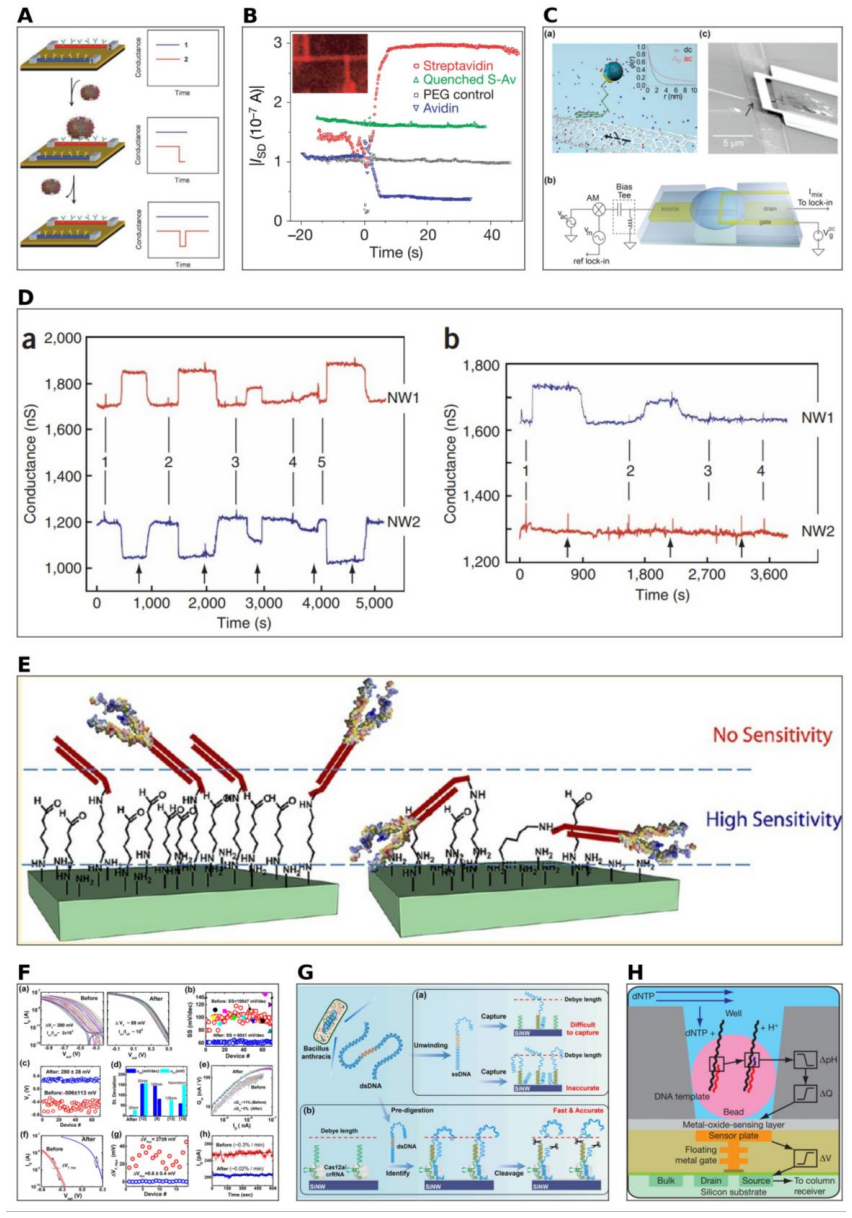
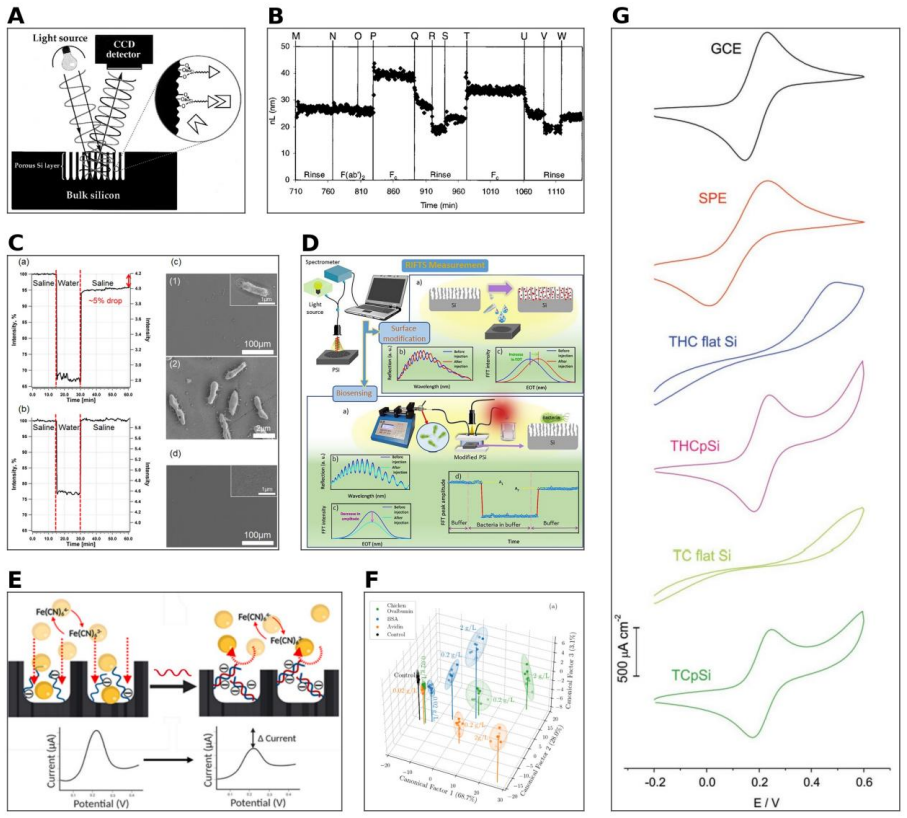
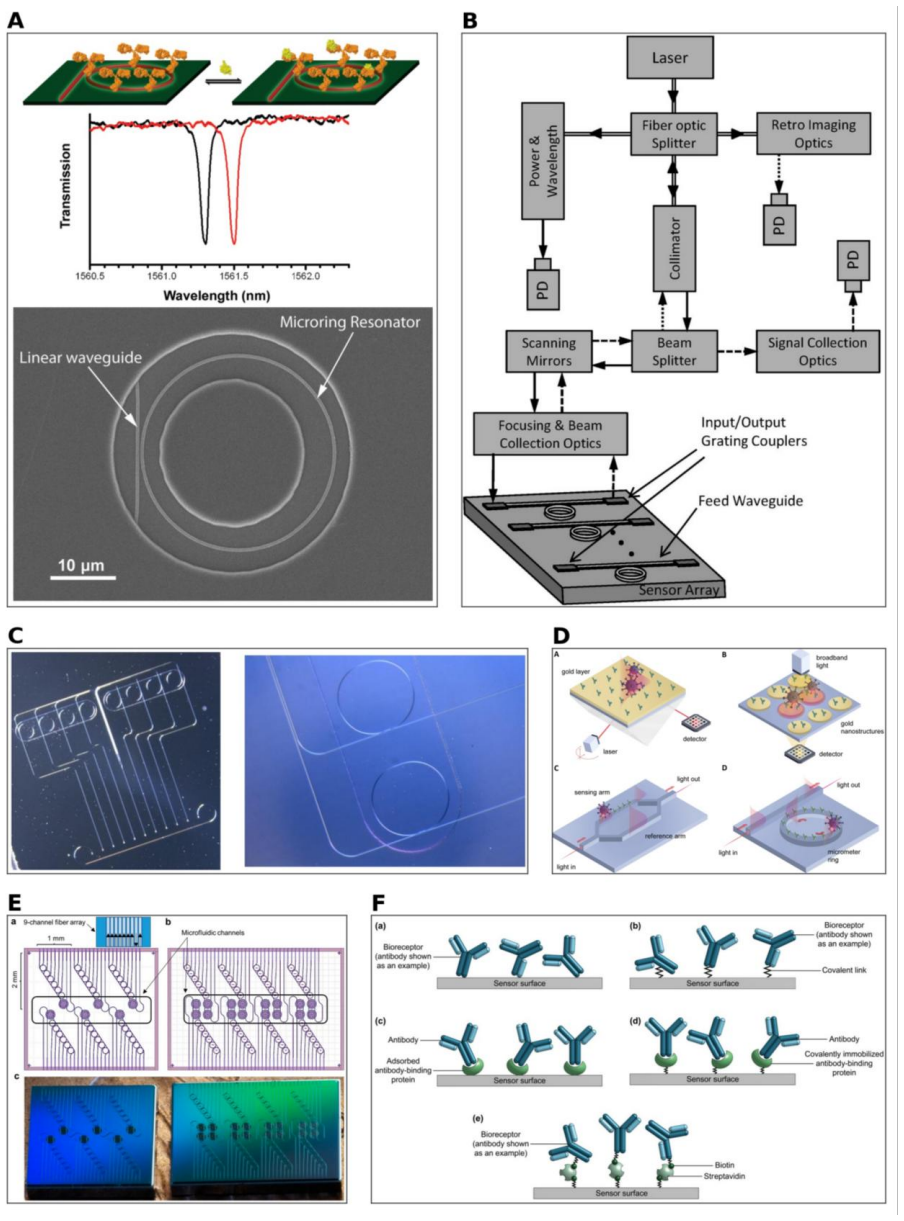
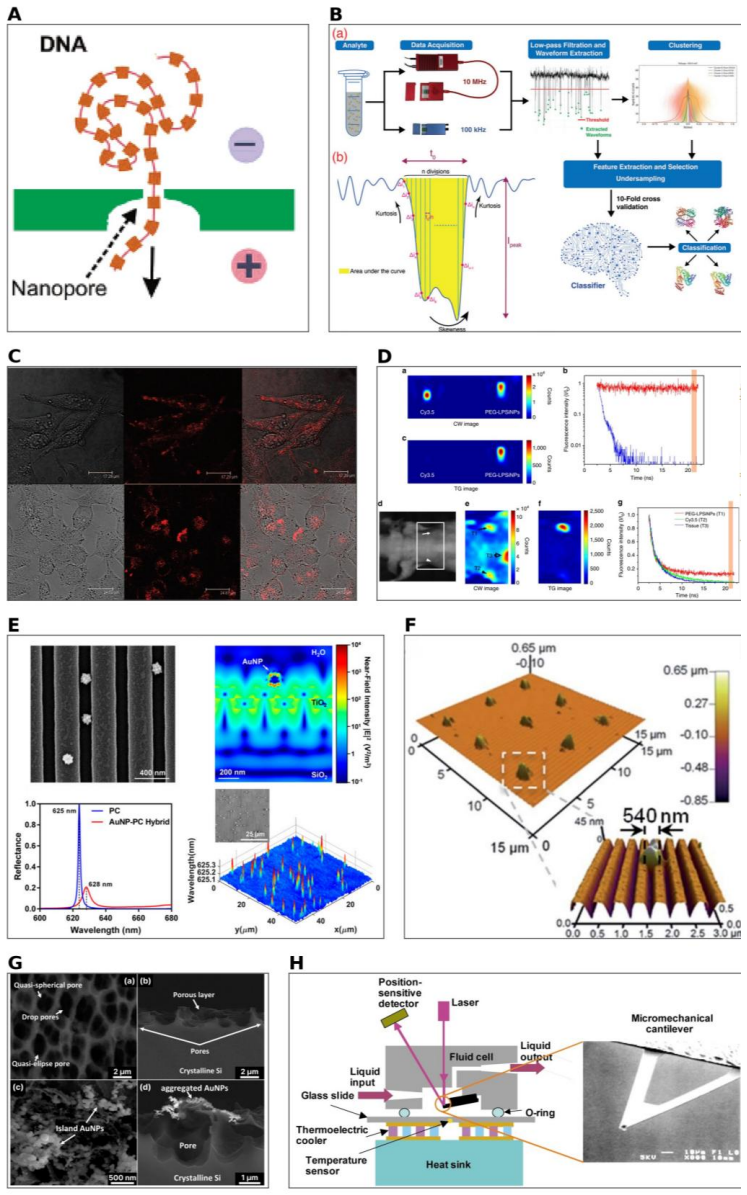
The comparative synthesis of performance metrics and bottlenecks across nanowire BioFETs, porous silicon, silicon photonics, and emerging directions.
If this is right
- Solutions to device variability and Debye screening will raise nanowire BioFET performance in real biofluids.
- Better antifouling coatings and pore stability will extend porous silicon sensor lifetime and reliability.
- Reduced thermal drift and improved packaging will make silicon photonic resonators more practical for continuous monitoring.
- Standardized calibration and validation protocols will increase reproducibility across all silicon biosensor families.
Where Pith is reading between the lines
- The same emphasis on interface engineering may apply to non-silicon nanostructure biosensors facing similar biofluid challenges.
- Integrated readout approaches could shorten the path from lab prototype to point-of-care devices in other sensing fields.
- Systematic benchmarking data might reveal transferable design rules for any label-free biosensor platform.
Load-bearing premise
The listed bottlenecks in variability, screening, fouling, drift, and validation are the dominant barriers to clinical use and can be overcome more effectively by integration and benchmarking than by new nanostructure discovery.
What would settle it
A demonstration that a newly discovered silicon nanostructure reaches widespread clinical use without corresponding gains from integration or benchmarking on existing platforms.
Figures
read the original abstract
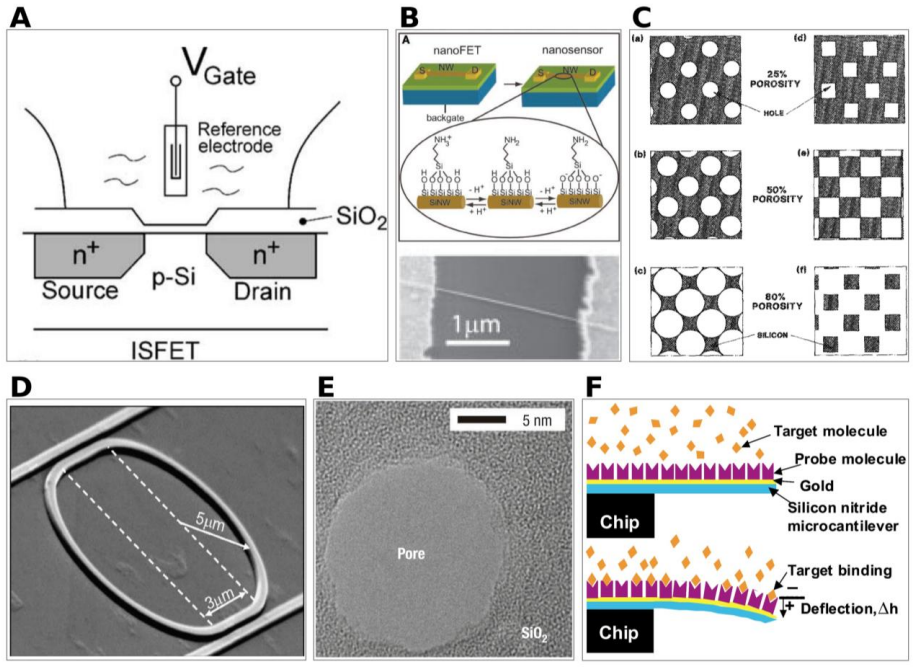
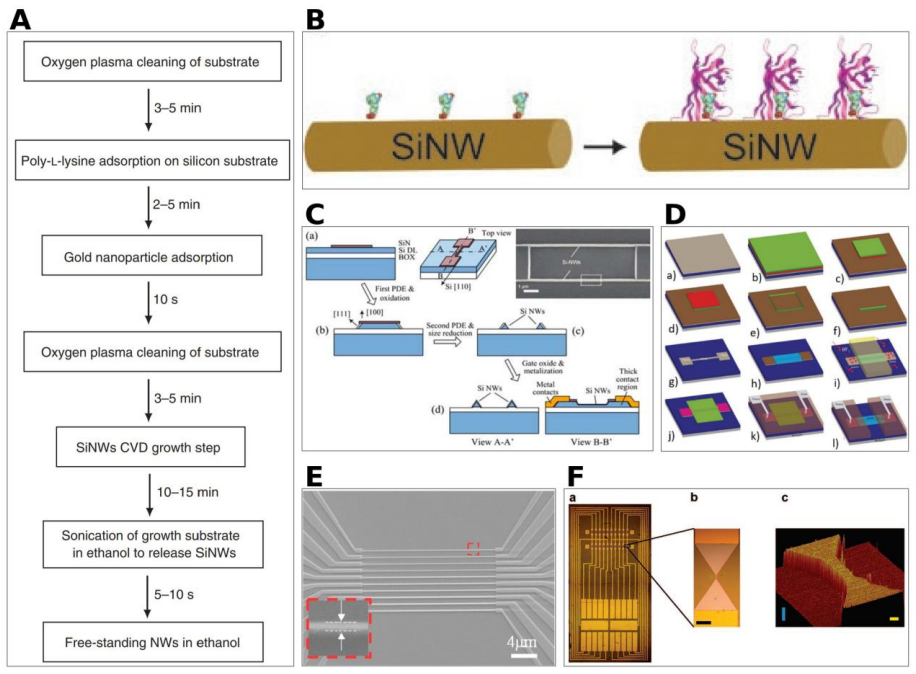
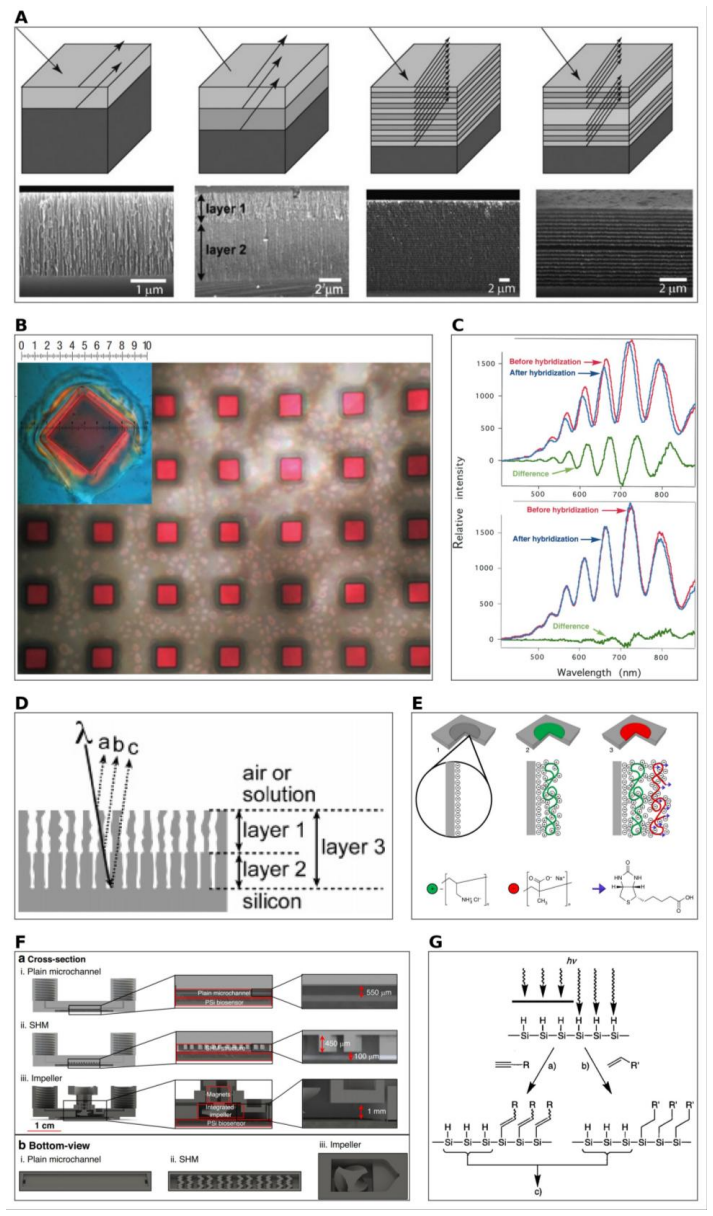
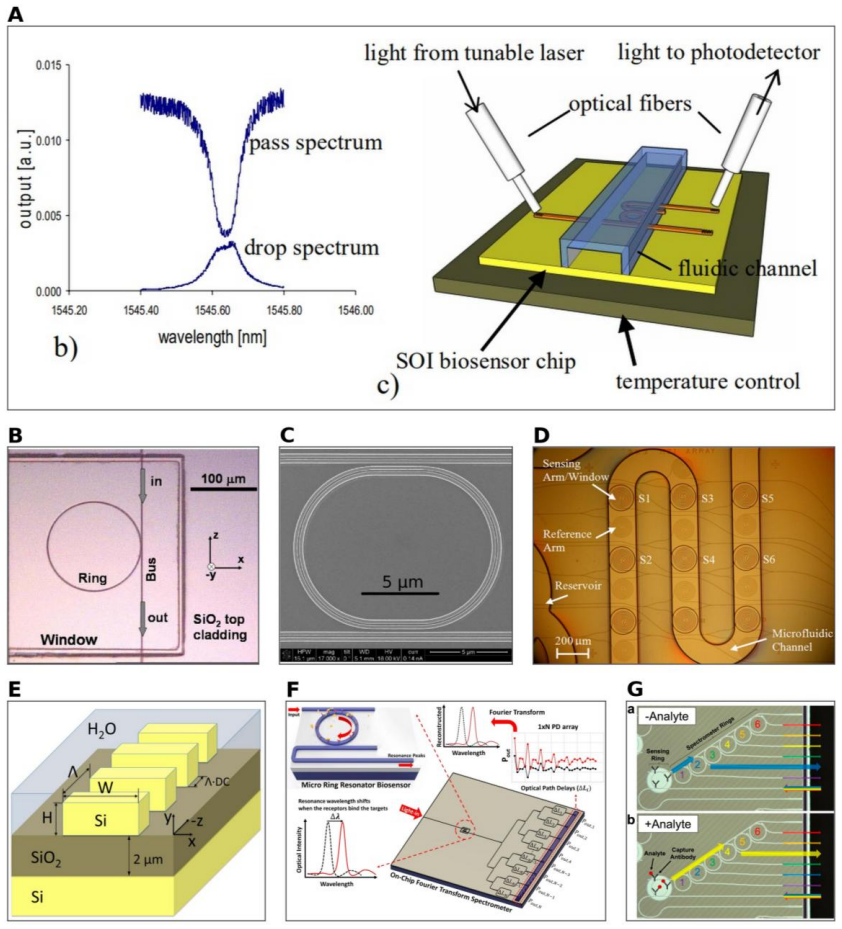
Silicon has a unique combination of properties that makes it one of the best material choices for biosensor platforms: it is inexpensive, its native oxide is atomically smooth, its fabrication processes are CMOS-compatible and have been refined for more than three decades, and it can support many transduction mechanisms in biosensor design. Over the past thirty years, researchers and engineers have used silicon nanostructures to produce ion-sensitive transistors, ultrasensitive nanowire field-effect biosensors, refractive-index-based porous silicon films, microring photonic resonators, suspended cantilevers, luminescent quantum dots, and solid-state nanopores. These device families have demonstrated successful sensing capabilities at the single-molecule, single-virus, or sub-femtomolar level under laboratory conditions; however, they have rarely been widely deployed in clinical assays. This gap is mainly caused by several well-characterized bottlenecks: for nanowire BioFETs, device variability and Debye screening; for porous silicon, fouling, pore wetting, and surface stability; for silicon photonics, thermal drift, spectral readout, and packaging; and across all platforms, calibration, reproducibility, and validation in real biofluids. In this review, we trace the development of silicon biosensors from their early stages to their current state, search and organize the literature focusing on the three most mature platforms and a set of emerging directions, summarize and compare the performance and bottlenecks of different platforms, and argue that progress over the next decade will come primarily from integrated readout, interface engineering, and systematic benchmarking rather than from the discovery of new silicon nanostructures.
Editorial analysis
A structured set of objections, weighed in public.
Referee Report
Summary. The manuscript is a review tracing the development of silicon nanostructures for biosensing over thirty years, covering platforms including nanowire BioFETs, porous silicon films, microring photonic resonators, and others. It summarizes laboratory demonstrations of high sensitivity (single-molecule to sub-femtomolar levels) but notes the lack of widespread clinical deployment, attributing this to well-documented bottlenecks such as device variability and Debye screening (BioFETs), fouling and pore stability (porous silicon), thermal drift and packaging (photonics), plus cross-platform issues of calibration and real-biofluid validation. The central argument is that future progress will derive primarily from integrated readout, interface engineering, and systematic benchmarking rather than discovery of new silicon nanostructures.
Significance. If the literature synthesis and identification of dominant bottlenecks hold, the review offers a structured consolidation of performance data across mature silicon biosensor families that could usefully redirect research emphasis toward translational engineering. Explicit credit is due for the platform-by-platform organization of limitations and the falsifiable framing of the forward-looking claim around integration versus new materials.
minor comments (3)
- [Introduction / Methods] The abstract states that the authors 'search and organize the literature focusing on the three most mature platforms'; the methods or introduction section should explicitly describe the search strategy, inclusion criteria, and time window used, as is standard for reproducible reviews.
- [Platform-specific sections] When summarizing bottlenecks (e.g., 'device variability and Debye screening' for nanowire BioFETs), the text should cross-reference specific tables or cited performance metrics that quantify the severity of each issue across studies, rather than relying solely on narrative description.
- [Discussion / Outlook] The claim that 'progress over the next decade will come primarily from integrated readout...' is presented without a dedicated comparison subsection; adding a short table contrasting reported gains from integration efforts versus new-nanostructure papers would make the argument more concrete.
Simulated Author's Rebuttal
We thank the referee for their thorough and positive evaluation of our review. We appreciate the recognition that the manuscript provides a structured consolidation of performance data across silicon biosensor platforms and correctly identifies the dominant translational bottlenecks. The recommendation for minor revision is noted, and we will incorporate any editorial suggestions in the revised version.
Circularity Check
No significant circularity; review paper with no derivations
full rationale
This is a literature review that organizes performance data and bottlenecks across silicon biosensor platforms from cited external sources. No equations, fitted parameters, predictions, or first-principles derivations are present. The central assessment—that future gains will come from integration and benchmarking—is a synthesis of known limitations rather than a reduction to self-defined inputs or self-citations. No load-bearing steps reduce by construction to the paper's own content.
Axiom & Free-Parameter Ledger
Reference graph
Works this paper leans on
-
[1]
Development of an Ion -Sensitive Solid-State Device for Neurophysiological Measurements
Bergveld, P. Development of an Ion -Sensitive Solid-State Device for Neurophysiological Measurements. IEEE Trans. Biomed. Eng. 1970, BME-17 (1), 70–71
1970
-
[2]
Thirty Years of ISFETOLOGY: What Happened in the Past 30 Years and What May Happen in the Next 30 Years
Bergveld, P. Thirty Years of ISFETOLOGY: What Happened in the Past 30 Years and What May Happen in the Next 30 Years. Sens. Actuators B Chem. 2003, 88 (1), 1–20
2003
-
[3]
J.; Poghossian, A
Schöning, M. J.; Poghossian, A. Recent Advances in Biologically Sensitive Field -Effect Transistors (BioFETs). Analyst 2002, 127 (9), 1137–1151
2002
-
[4]
A Review of BioFET's Basic Principles and Materials for Biomedical Applications
Sung, D.; Koo, J. A Review of BioFET's Basic Principles and Materials for Biomedical Applications. Biomed. Eng. Lett. 2021, 11, 85–96
2021
-
[5]
A.; Lo Faro, M
Leonardi, A. A.; Lo Faro, M. J.; Irrera, A. Biosensing Platforms Based on Silicon Nanostructures: A Critical Review. Anal. Chim. Acta 2021, 1160, 338393
2021
-
[6]
Silicon -Based Biosensors: A Critical Review of Silicon's Role in Enhancing Biosensing Performance
Muhammad, W., et al. Silicon -Based Biosensors: A Critical Review of Silicon's Role in Enhancing Biosensing Performance. Biosensors 2025, 15, 119
2025
-
[7]
Silicon Nanowire Biosensor and Its Applications in Disease Diagnostics: A Review
Zhang, G.-J.; Ning, Y. Silicon Nanowire Biosensor and Its Applications in Disease Diagnostics: A Review. Anal. Chim. Acta 2012, 749, 1–15
2012
-
[8]
A., et al
Morales, M. A., et al. Guide to Selecting a Biorecognition Element for Biosensors. Bioconjugate Chem. 2018, 29 (10), 3231–3239
2018
-
[9]
M.; Shopova, S
Fan, X.; White, I. M.; Shopova, S. I.; Zhu, H.; Suter, J. D.; Sun, Y. Sensitive Optical Biosensors for Unlabeled Targets: A Review. Anal. Chim. Acta 2008, 620 (1–2), 8–26
2008
-
[10]
Canham, L. T. Silicon Quantum Wire Array Fabrication by Electrochemical and Chemical Dissolution of Wafers. Appl. Phys. Lett. 1990, 57 (10), 1046–1048
1990
-
[11]
P.; Buriak, J
Stewart, M. P.; Buriak, J. M. Photopatterned Hydrosilylation on Porous Silicon. Angew. Chem. Int. Ed. 1998, 37, 3257–3260
1998
-
[12]
Buriak, J. M. Lewis Acid Mediated Hydrosilylation on Porous Silicon Surfaces. J. Am. Chem. Soc. 1999, 121, 11491–11502
1999
-
[13]
Patolsky, F.; Zheng, G.; Lieber, C. M. Fabrication of Silicon Nanowire Devices for Ultrasensitive, Label -Free, Real-Time Detection of Biological and Chemical Species. Nat. Protoc. 2006, 1 (4), 1711 –1724
2006
-
[14]
P.; Williams, R
Park, I.; Li, Z.; Pisano, A. P.; Williams, R. S. Top -Down Fabricated Silicon Nanowire Sensors for Real -Time Chemical Detection. Nanotechnology 2010, 21 (1), 015501
2010
-
[15]
Process Variability in Top-Down Fabrication of Silicon Nanowire-Based Biosensors
Tintelott, M., et al. Process Variability in Top-Down Fabrication of Silicon Nanowire-Based Biosensors. Sensors 2021, 21 (15), 5153
2021
-
[16]
P., et al
Tran, D. P., et al. CMOS -Compatible Silicon Nanowire Field -Effect Transistor Biosensor: Technology Development toward Commercialization. Materials 2018, 11 (5), 785
2018
-
[17]
Cui, Y.; Wei, Q.; Park, H.; Lieber, C. M. Nanowire Nanosensors for Highly Sensitive and Selective Detection of Biological and Chemical Species. Science 2001, 293 (5533), 1289–1292
2001
-
[18]
Patolsky, F.; Zheng, G.; Hayden, O.; Lakadamyali, M.; Zhuang, X.; Lieber, C. M. Electrical Detection of Single Viruses. Proc. Natl. Acad. Sci. U.S.A. 2004, 101 (39), 14017–14022
2004
-
[19]
U.; Lieber, C
Zheng, G.; Patolsky, F.; Cui, Y.; Wang, W. U.; Lieber, C. M. Multiplexed Electrical Detection of Cancer Markers with Nanowire Sensor Arrays. Nat. Biotechnol. 2005, 23 (10), 1294 –1301
2005
-
[20]
F.; Routenberg, D
Stern, E.; Klemic, J. F.; Routenberg, D. A.; Wyrembak, P. N.; Turner-Evans, D. B.; Hamilton, A. D.; LaVan, D. A.; Fahmy, T. M.; Reed, M. A. Label -Free Immunodetection with CMOS -Compatible Semiconducting Nanowires. Nature 2007, 445 (7127), 519–522
2007
-
[21]
E.; Linnros, J
Elfström, N.; Karlström, A. E.; Linnros, J. Silicon Nanoribbons for Electrical Detection of Biomolecules. Nano Lett. 2008, 8 (3), 945–949
2008
-
[22]
Nernst Limit in Dual-Gated Si-Nanowire FET Sensors
Knopfmacher, O.; Tarasov, A.; Fu, W.; Wipf, M.; Niesen, B.; Calame, M.; Schönenberger, C. Nernst Limit in Dual-Gated Si-Nanowire FET Sensors. Nano Lett. 2010, 10, 2268–2274
2010
-
[23]
Silicon-Nanowire-Based CMOS-Compatible Field- Effect Transistor Nanosensors for Ultrasensitive Electrical Detection of Nucleic Acids
Gao, A.; Lu, N.; Dai, P.; Li, T.; Gao, X.; Wang, Y.; Fan, C. Silicon-Nanowire-Based CMOS-Compatible Field- Effect Transistor Nanosensors for Ultrasensitive Electrical Detection of Nucleic Acids. Nano Lett. 2011, 11, 3974–3978
2011
-
[24]
Biorecognition Layer Engineering: Overcoming Screening Limitations of Nanowire -Based FET Devices
Elnathan, R.; Kwiat, M.; Pevzner, A.; Engel, Y.; Burstein, L.; Khatchtourints, A.; Lichtenstein, A.; Kantaev, R.; Patolsky, F. Biorecognition Layer Engineering: Overcoming Screening Limitations of Nanowire -Based FET Devices. Nano Lett. 2012, 12 (10), 5245–5254
2012
-
[25]
S.; Zhong, Z
Kulkarni, G. S.; Zhong, Z. Detection beyond the Debye Screening Length in a High -Frequency Nanoelectronic Biosensor. Nano Lett. 2012, 12 (2), 719–723
2012
-
[26]
K.; Routenberg, D
Duan, X.; Li, Y.; Rajan, N. K.; Routenberg, D. A.; Modis, Y.; Reed, M. A. Quantification of the Affinities and Kinetics of Protein Interactions Using Silicon Nanowire Biosensors. Nat. Nanotechnol. 2012, 7 (6), 401 –407
2012
-
[27]
-M.; Lieber, C
Gao, N.; Zhou, W.; Jiang, X.; Hong, G.; Fu, T. -M.; Lieber, C. M. General Strategy for Biodetection in High Ionic Strength Solutions Using Transistor-Based Nanoelectronic Sensors. Nano Lett. 2015, 15 (3), 2143–2148
2015
-
[28]
Silicon Nanowire Field Effect Transistor Sensors with Minimal Sensor - to-Sensor Variations and Enhanced Sensing Characteristics
Zafar, S.; D'Emic, C.; Alzate, R., et al. Silicon Nanowire Field Effect Transistor Sensors with Minimal Sensor - to-Sensor Variations and Enhanced Sensing Characteristics. ACS Nano 2018, 12, 6577 –6587
2018
-
[29]
A Calibration Strategy for Silicon Nanowire Field-Effect Transistor Biosensors and Its Application in Ultra-Sensitive, Label-Free Biosensing
Chen, D.; Xu, T.; Dou, Y.; Li, T. A Calibration Strategy for Silicon Nanowire Field-Effect Transistor Biosensors and Its Application in Ultra-Sensitive, Label-Free Biosensing. ACS Nano 2024, 18 (33), 21873–21885
2024
-
[30]
Exosomal Membrane Proteins Analysis Using a Silicon Nanowire Field Effect Transistor Biosensor
Qin, M., et al. Exosomal Membrane Proteins Analysis Using a Silicon Nanowire Field Effect Transistor Biosensor. Talanta 2024, 278, 126534
2024
-
[31]
CRISPR/Cas12a -Functionalized Silicon Nanowires Field -Effect Transistor Sensor for Ultra - Sensitive Detection of Pathogen Nucleic Acids
Li, Y., et al. CRISPR/Cas12a -Functionalized Silicon Nanowires Field -Effect Transistor Sensor for Ultra - Sensitive Detection of Pathogen Nucleic Acids. Biosens. Bioelectron. 2025, 276, 117936
2025
-
[32]
A Highly Sensitive Silicon Nanowire Array Field Effect Transistor Biosensor for Detecting HBV- DNA and AFP
Sun, P., et al. A Highly Sensitive Silicon Nanowire Array Field Effect Transistor Biosensor for Detecting HBV- DNA and AFP. Sensors 2025, 25 (20), 6385
2025
-
[33]
M.; Hinz, W.; Rearick, T
Rothberg, J. M.; Hinz, W.; Rearick, T. M.; Schultz, J.; Mileski, W.; Davey, M.; Leamon, J. H.; Johnson, K.; Milgrew, M. J.; Edwards, M., et al. An Integrated Semiconductor Device Enabling Non -Optical Genome Sequencing. Nature 2011, 475 (7356), 348–352
2011
-
[34]
M.; Reed, S
Toumazou, C.; Shepherd, L. M.; Reed, S. C., et al. Simultaneous DNA Amplification and Detection Using a pH- Sensing Semiconductor System. Nat. Methods 2013, 10 (7), 641 –646
2013
-
[35]
Arshavsky-Graham, S.; Massad-Ivanir, N.; Segal, E.; Weiss, S. M. Porous Silicon -Based Photonic Biosensors: Current Status and Emerging Applications. Anal. Chem. 2019, 91 (1), 441 –467
2019
-
[36]
Lin, V. S. -Y.; Motesharei, K.; Dancil, K. -P. S.; Sailor, M. J.; Ghadiri, M. R. A Porous Silicon -Based Optical Interferometric Biosensor. Science 1997, 278 (5339), 840–843
1997
-
[37]
Dancil, K. -P. S.; Greiner, D. P.; Sailor, M. J. A Porous Silicon Optical Biosensor: Detection of Reversible Binding of IgG to a Protein A-Modified Surface. J. Am. Chem. Soc. 1999, 121, 7925–7930
1999
-
[38]
A.; Link, J
Cunin, F.; Schmedake, T. A.; Link, J. R.; Li, Y.-Y.; Koh, J.; Bhatia, S. N.; Sailor, M. J. Biomolecular Screening with Encoded Porous-Silicon Photonic Crystals. Nat. Mater. 2002, 1 (1), 39–41
2002
-
[39]
J.; Cunin, F.; Miskelly, G
Pacholski, C.; Sartor, M.; Sailor, M. J.; Cunin, F.; Miskelly, G. M. Biosensing Using Porous Silicon Double - Layer Interferometers: Reflective Interferometric Fourier Transform Spectroscopy. J. Am. Chem. Soc. 2005, 127 (33), 11636–11645
2005
-
[40]
Jane, A.; Dronov, R.; Hodges, A.; Voelcker, N. H. Porous Silicon Biosensors on the Advance. Trends Biotechnol. 2009, 27 (4), 230–239
2009
-
[41]
A.; Segal, E
Massad-Ivanir, N.; Shtenberg, G.; Tzur, A.; Krepker, M. A.; Segal, E. Porous Silicon-Based Biosensors: Towards Real-Time Optical Detection of Target Bacteria in the Food Industry. Sci. Rep. 2016, 6, 38099
2016
-
[42]
A Lectin -Coupled Porous Silicon -Based Biosensor: Label-Free Optical Detection of Bacteria in a Real-Time Mode
Yaghoubi, M.; Gholizadeh, S.; Faridi -Majidi, R., et al. A Lectin -Coupled Porous Silicon -Based Biosensor: Label-Free Optical Detection of Bacteria in a Real-Time Mode. Sci. Rep. 2020, 10, 16017
2020
-
[43]
Enhancing the Performance of Porous Silicon Biosensors: The Interplay of Nanostructure Design and Microfluidic Integration
Awawdeh, K., et al. Enhancing the Performance of Porous Silicon Biosensors: The Interplay of Nanostructure Design and Microfluidic Integration. Microsyst. Nanoeng. 2024, 10, 100
2024
-
[44]
Layer -by-Layer Biofunctionalization of Nanostructured Porous Silicon for High -Sensitivity and High-Stability Affinity Sensing in Complex Matrices
Mariani, S., et al. Layer -by-Layer Biofunctionalization of Nanostructured Porous Silicon for High -Sensitivity and High-Stability Affinity Sensing in Complex Matrices. Nat. Commun. 2018, 9, 5256
2018
-
[45]
Zhao, Y.; Gaur, G.; Retterer, S. T.; Laibinis, P. E.; Weiss, S. M. Flow -Through Porous Silicon Membranes for Real-Time Label-Free Biosensing. arXiv 2016, 1607.04666
Pith/arXiv arXiv 2016
-
[46]
J.; Cao, T.; Zhou, X.; Chang, C.; Weiss, S
Ward, S. J.; Cao, T.; Zhou, X.; Chang, C.; Weiss, S. M. Capture Agent Free Biosensing Using Porous Silicon Arrays and Machine Learning. arXiv 2022, 2201.11671
arXiv 2022
-
[47]
Porous Silicon-Based Electrochemical Biosensors
Setzu, S., et al. Porous Silicon-Based Electrochemical Biosensors. In Electrochemical Sensors, Technology and Applications; IntechOpen, 2011
2011
-
[48]
A Review on Porous Silicon Based Electrochemical Biosensors: Beyond Surface Area Enhancement Factor
RoyChaudhuri, C. A Review on Porous Silicon Based Electrochemical Biosensors: Beyond Surface Area Enhancement Factor. Sens. Actuators B Chem. 2015, 210, 310–323
2015
-
[49]
Porous Silicon Nanostructures as Effective Faradaic Electrochemical Sensing Platforms
Guo, K., et al. Porous Silicon Nanostructures as Effective Faradaic Electrochemical Sensing Platforms. Adv. Funct. Mater. 2019, 29, 1809206
2019
-
[50]
Designing Electrochemical Biosensing Platforms Using Layered Carbon-Stabilized Porous Silicon Nanostructures with Site-Specific Chemistries
Guo, K., et al. Designing Electrochemical Biosensing Platforms Using Layered Carbon-Stabilized Porous Silicon Nanostructures with Site-Specific Chemistries. ACS Appl. Mater. Interfaces 2022, 14, 17787 –17798
2022
-
[51]
P., et al
Chin, G. P., et al. Carbon-Stabilized Porous Silicon Biosensor for the Ultrasensitive Label-Free Electrochemical Detection of Bacterial RNA Gene Fragments. Biosens. Bioelectron. X 2024, 16, 100438
2024
-
[52]
Recent Advances in Silicon Quantum Dot -Based Fluorescent Biosensors
Zhang, Y.; Cai, N.; Chan, V. Recent Advances in Silicon Quantum Dot -Based Fluorescent Biosensors. Biosensors 2023, 13 (3), 311
2023
-
[53]
Water Soluble Silicon Quantum Dot Based Fluorescence Immunoassay Probe for C -Reactive Protein (CRP) Detection
Sebastian, D.; Arif, M.; Ramakrishnan, K. Water Soluble Silicon Quantum Dot Based Fluorescence Immunoassay Probe for C -Reactive Protein (CRP) Detection. J. Photochem. Photobiol. A Chem. 2023, 443, 114894
2023
-
[54]
N.; Swihart, M
Erogbogbo, F.; Yong, K.-T.; Roy, I.; Xu, G.; Prasad, P. N.; Swihart, M. T. Biocompatible Luminescent Silicon Quantum Dots for Imaging of Cancer Cells. ACS Nano 2008, 2 (5), 873 –878
2008
-
[55]
N.; Sailor, M
Park, J.-H.; Gu, L.; von Maltzahn, G.; Ruoslahti, E.; Bhatia, S. N.; Sailor, M. J. Biodegradable Luminescent Porous Silicon Nanoparticles for In Vivo Applications. Nat. Mater. 2009, 8 (4), 331 –336
2009
-
[56]
J.; Qin, Z.; Anglin, E.; Joo, J.; Mooney, D
Gu, L.; Hall, D. J.; Qin, Z.; Anglin, E.; Joo, J.; Mooney, D. J.; Howell, S. B.; Sailor, M. J. In Vivo Time -Gated Fluorescence Imaging with Biodegradable Luminescent Porous Silicon Nanoparticles. Nat. Commun. 2013, 4, 2326
2013
-
[57]
J.; Golovchenko, J
Li, J.; Stein, D.; McMullan, C.; Branton, D.; Aziz, M. J.; Golovchenko, J. A. Ion-Beam Sculpting at Nanometre Length Scales. Nature 2001, 412 (6843), 166–169
2001
-
[58]
J.; Chen, J
Storm, A. J.; Chen, J. H.; Ling, X. S.; Zandbergen, H. W.; Dekker, C. Fabrication of Solid-State Nanopores with Single-Nanometre Precision. Nat. Mater. 2003, 2 (8), 537–540
2003
-
[59]
S.; Golovchenko, J
Fologea, D.; Gershow, M.; Ledden, B.; McNabb, D. S.; Golovchenko, J. A.; Li, J. Detecting Single Stranded DNA with a Solid State Nanopore. Nano Lett. 2005, 5 (10), 1905–1909
2005
-
[60]
Towards Rapid DNA Sequencing: Detecting Single-Stranded DNA with a Solid-State Nanopore
Yan, H.; Xu, B. Towards Rapid DNA Sequencing: Detecting Single-Stranded DNA with a Solid-State Nanopore. Small 2006, 2 (3), 310–312
2006
-
[61]
Solid-State Nanopores
Dekker, C. Solid-State Nanopores. Nat. Nanotechnol. 2007, 2 (4), 209–215
2007
-
[62]
W.; Marziali, A.; Bayley, H.; Benner, S
Branton, D.; Deamer, D. W.; Marziali, A.; Bayley, H.; Benner, S. A.; Butler, T.; Di Ventra, M.; Garaj, S.; Hibbs, A.; Huang, X., et al. The Potential and Challenges of Nanopore Sequencing. Nat. Biotechnol. 2008, 26 (10), 1146–1153
2008
-
[63]
Nanopores: A Journey Towards DNA Sequencing
Wanunu, M. Nanopores: A Journey Towards DNA Sequencing. Phys. Life Rev. 2012, 9 (2), 125 –158
2012
-
[64]
N.; Ivanov, A
Miles, B. N.; Ivanov, A. P.; Wilson, K. A.; Dogan, F.; Japrung, D.; Edel, J. B. Single Molecule Sensing with Solid-State Nanopores: Novel Materials, Methods, and Applications. Chem. Soc. Rev. 2013, 42 (1), 15 –28
2013
-
[65]
Data Analysis Methods for Solid-State Nanopores
Plesa, C.; Dekker, C. Data Analysis Methods for Solid-State Nanopores. Nanotechnology 2015, 26 (8), 084003
2015
-
[66]
Dutt, S.; Shao, H.; Karawdeniya, B.; Bandara, Y. M. N. D. Y.; Daskalaki, E.; Suominen, H.; Kluth, P. High Accuracy Protein Identification: Fusion of Solid-State Nanopore Sensing and Machine Learning. Small Methods 2023
2023
-
[67]
V.; Jain, S.; Kistermann, K.; Sakurai, K.; Stemme, G.; Herland, A.; Mayer, J.; Niklaus, F.; Raja, S
Leva, C. V.; Jain, S.; Kistermann, K.; Sakurai, K.; Stemme, G.; Herland, A.; Mayer, J.; Niklaus, F.; Raja, S. N. Localized Nanopore Fabrication in Silicon Nitride Membranes by Femtosecond Laser Exposure and Subsequent Controlled Breakdown. ACS Appl. Mater. Interfaces 2025, 17 (5), 8737–8748
2025
-
[68]
Ramirez-Priego, P.; Alonso-Fernández, A.; Soler, M.; Lechuga, L. M. Silicon Photonic Biosensors in Clinical Diagnostics: Emerging Opportunities and Challenges. Annu. Rev. Biomed. Eng. 2026, 28, 25 –51
2026
-
[69]
Silicon -on-Insulator Microring Resonator for Sensitive and Label-Free Biosensing
De Vos, K.; Bartolozzi, I.; Schacht, E.; Bienstman, P.; Baets, R. Silicon -on-Insulator Microring Resonator for Sensitive and Label-Free Biosensing. Opt. Express 2007, 15 (12), 7610–7615
2007
-
[70]
A.; Gylfason, K
Barrios, C. A.; Gylfason, K. B.; Sánchez, B.; Griol, A.; Sohlström, H.; Holgado, M.; Casquel, R. Slot-Waveguide Biochemical Sensor. Opt. Lett. 2007, 32 (21), 3080–3082
2007
-
[71]
A.; Bañuls, M
Barrios, C. A.; Bañuls, M. J.; González -Pedro, V.; Gylfason, K. B.; Sánchez, B.; Griol, A.; Maquieira, A.; Sohlström, H.; Holgado, M.; Casquel, R. Label-Free Optical Biosensing with Slot-Waveguides. Opt. Lett. 2008, 33 (7), 708–710
2008
-
[72]
Label -Free Biosensing with a Slot-Waveguide-Based Ring Resonator in Silicon on Insulator
Claes, T.; Bogaerts, W.; Bienstman, P.; Vernier, N.; De Vos, K.; Van Thourhout, D.; Baets, R. Label -Free Biosensing with a Slot-Waveguide-Based Ring Resonator in Silicon on Insulator. IEEE Photonics J. 2009, 1 (3), 197–204
2009
-
[73]
-X.; Janz, S.; Ma, R.; Li, Y
Densmore, A.; Vachon, M.; Xu, D. -X.; Janz, S.; Ma, R.; Li, Y. -H.; Lopinski, G.; Delâge, A.; Lapointe, J.; Luebbert, C. C.; Liu, Q. Y.; Cheben, P.; Schmid, J. H. Silicon Photonic Wire Biosensor Array for Multiplexed Real-Time and Label-Free Molecular Detection. Opt. Lett. 2009, 34 (23), 3598–3600
2009
-
[74]
L.; Gunn, L
Washburn, A. L.; Gunn, L. C.; Bailey, R. C. Label-Free Quantitation of a Cancer Biomarker in Complex Media Using Silicon Photonic Microring Resonators. Anal. Chem. 2009, 81 (22), 9499 –9506
2009
-
[75]
A.; Spaugh, B.; Tybor, F.; Gunn, W
Iqbal, M.; Gleeson, M. A.; Spaugh, B.; Tybor, F.; Gunn, W. G.; Hochberg, M.; Baehr -Jones, T.; Bailey, R. C.; Gunn, L. C. Label-Free Biosensor Arrays Based on Silicon Ring Resonators and High -Speed Optical Scanning Instrumentation. IEEE J. Sel. Top. Quantum Electron. 2010, 16 (3), 654–661
2010
-
[76]
-C.; Alvarez, M.; Lechuga, L
Estevez, M. -C.; Alvarez, M.; Lechuga, L. M. Integrated Optical Devices for Lab -on-a-Chip Biosensing Applications. Laser Photonics Rev. 2012, 6 (4), 463–487
2012
-
[77]
G.; Cheben, P.; Ortega-Moñux, A.; Alonso-Ramos, C.; Pérez-Galacho, D.; Halir, R.; Xu, D.-X.; Schmid, J
Wangüemert-Pérez, J. G.; Cheben, P.; Ortega-Moñux, A.; Alonso-Ramos, C.; Pérez-Galacho, D.; Halir, R.; Xu, D.-X.; Schmid, J. H.; Molina -Fernández, I. Evanescent Field Waveguide Sensing with Subwavelength Grating Structures in Silicon-on-Insulator. Opt. Lett. 2014, 39, 4442–4445
2014
-
[78]
-C.; Cardenosa-Rubio, M.; Astua, A.; Lechuga, L
Soler, M.; Estevez, M. -C.; Cardenosa-Rubio, M.; Astua, A.; Lechuga, L. M. How Nanophotonic Label -Free Biosensors Can Contribute to Rapid and Massive Diagnostics of Respiratory Virus Infections: COVID-19 Case. ACS Sensors 2020, 5 (9), 2663–2678
2020
-
[79]
M.; Hlaing, M.; Jain, S.; Fan, J.; An, Y.; Chen, R
Yoo, K. M.; Hlaing, M.; Jain, S.; Fan, J.; An, Y.; Chen, R. T. Lab-on-a-Chip Optical Biosensor Platform: Micro Ring Resonator Integrated with Near-Infrared Fourier Transform Spectrometer. arXiv 2022, 2207.07754
arXiv 2022
-
[80]
S., et al
Puumala, L. S., et al. Biofunctionalization of Multiplexed Silicon Photonic Biosensors. Biosensors 2023, 13 (1), 53
2023
discussion (0)
Sign in with ORCID, Apple, or X to comment. Anyone can read and Pith papers without signing in.