Globular Clusters in the Time of the JWST. I. Survey Design and First Results on Multiple Populations and Beyond
Pith reviewed 2026-06-26 16:04 UTC · model grok-4.3
The pith
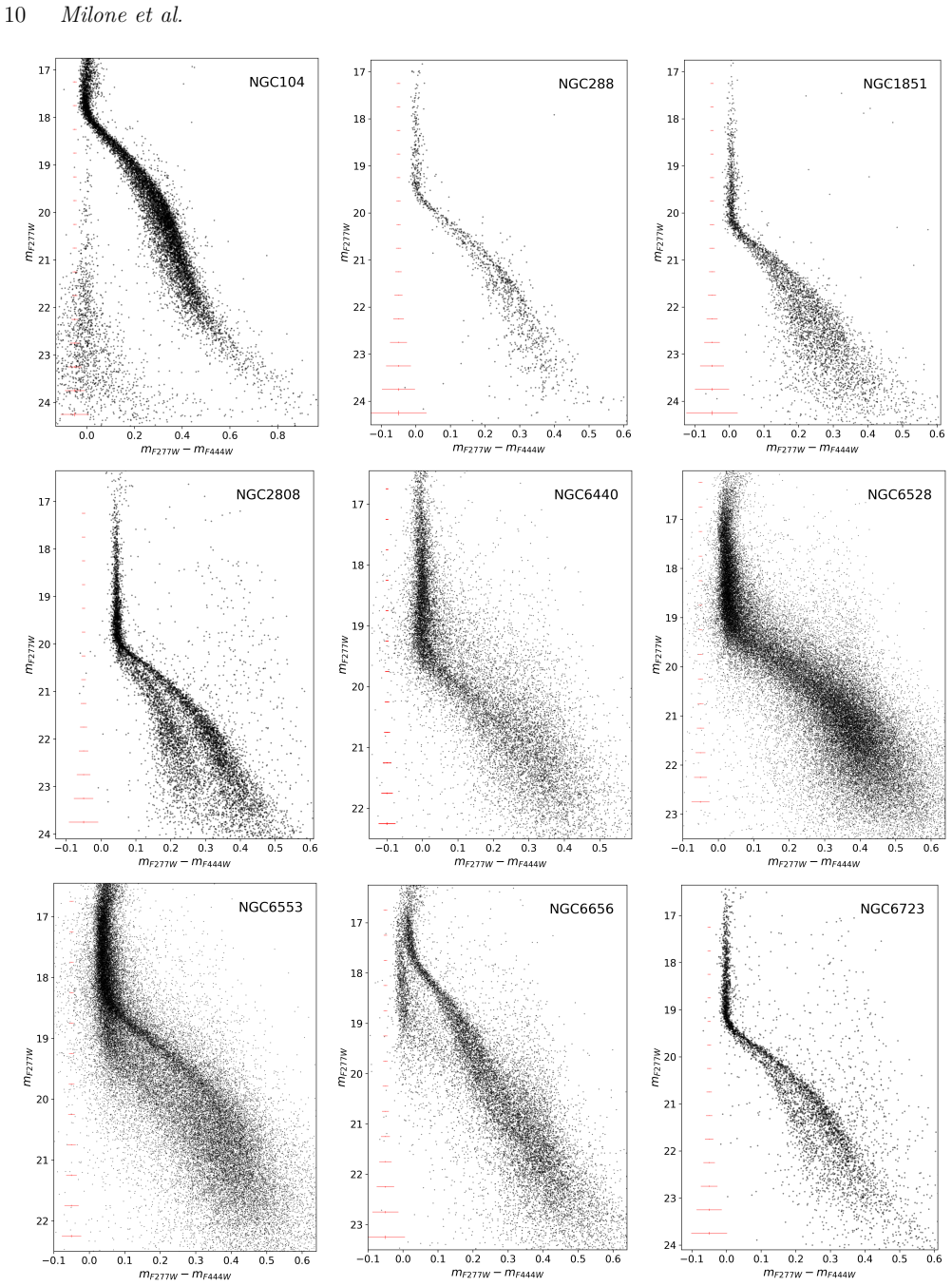
JWST detects multiple stellar populations among low-mass stars in all eleven observed globular clusters.
A machine-rendered reading of the paper's core claim, the machinery that carries it, and where it could break.
Core claim
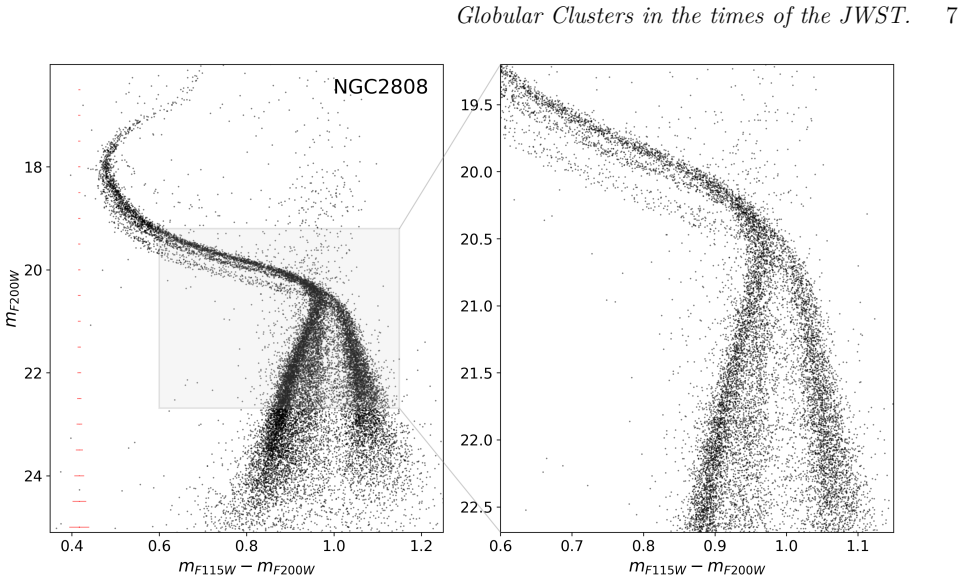
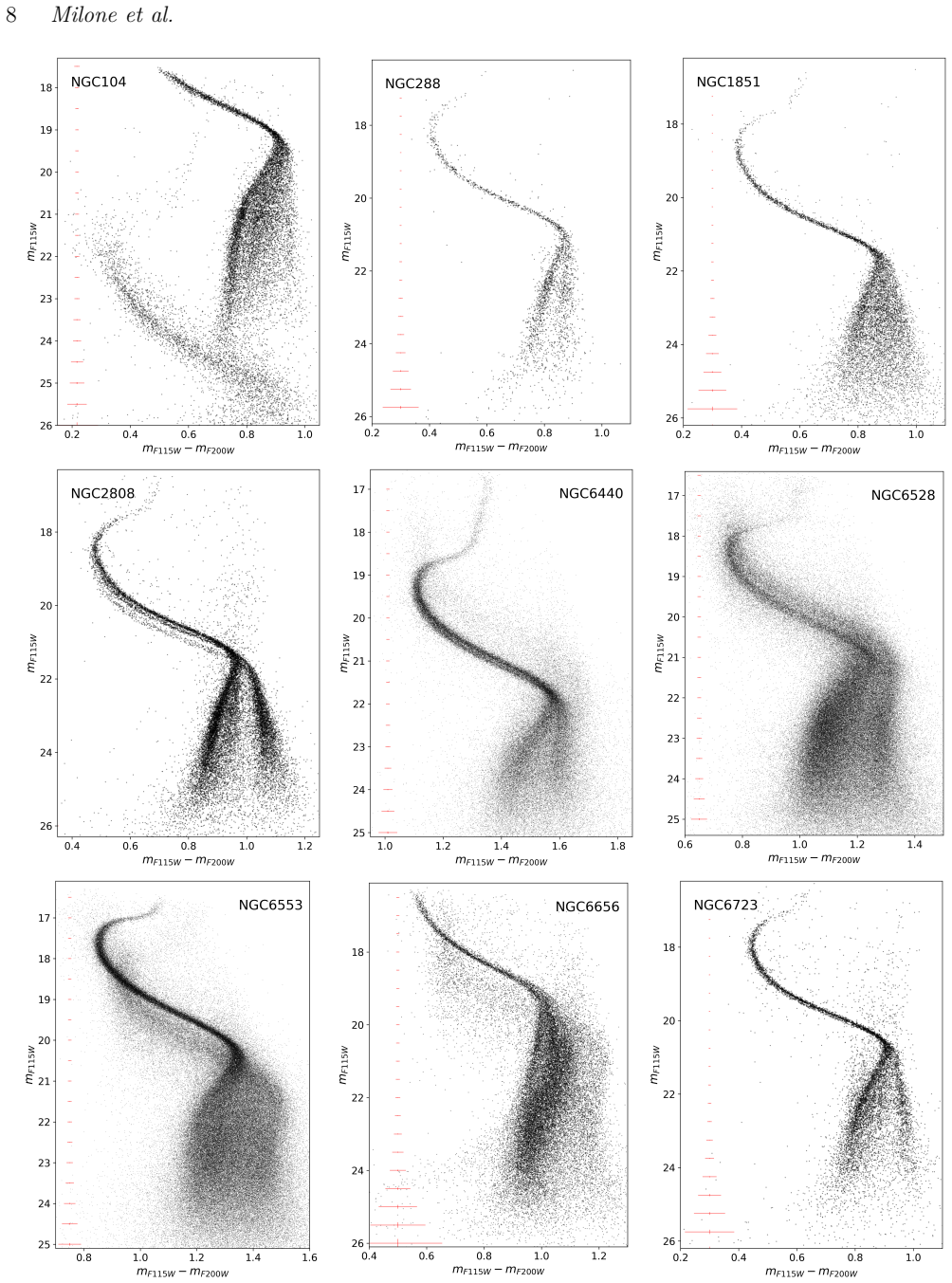
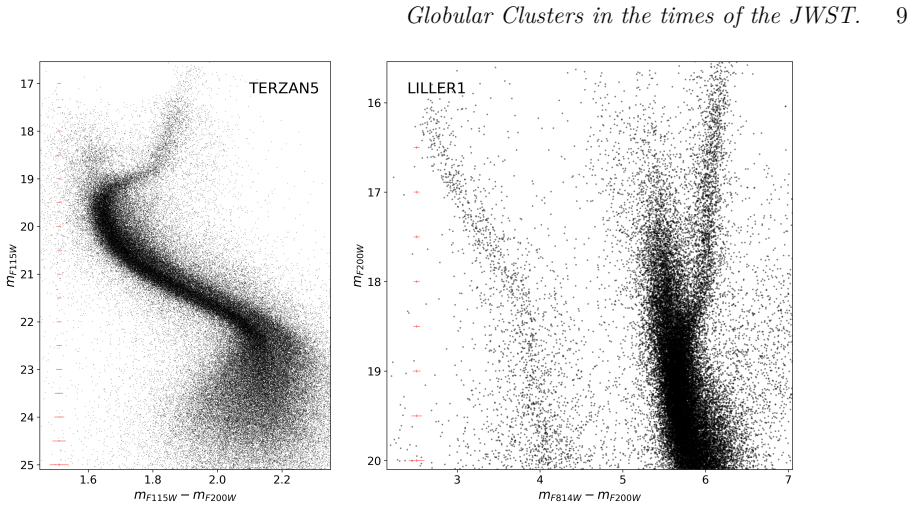
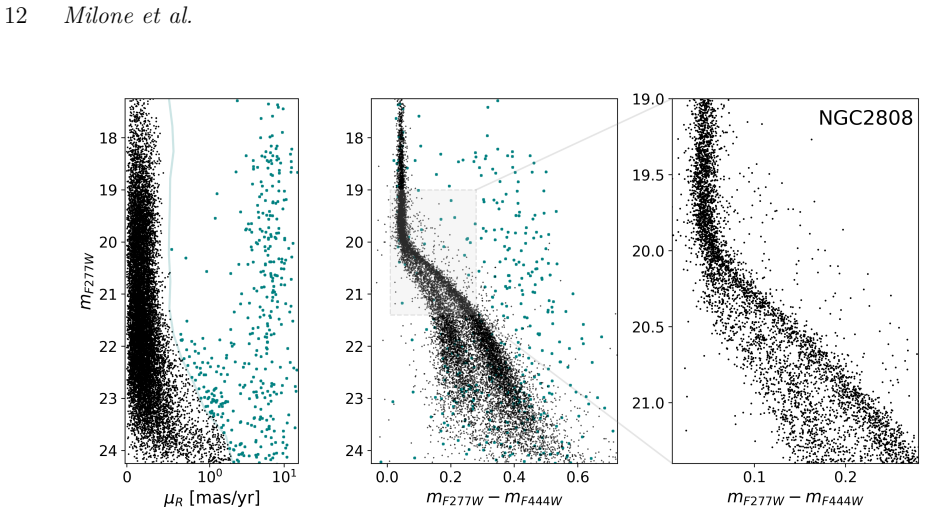
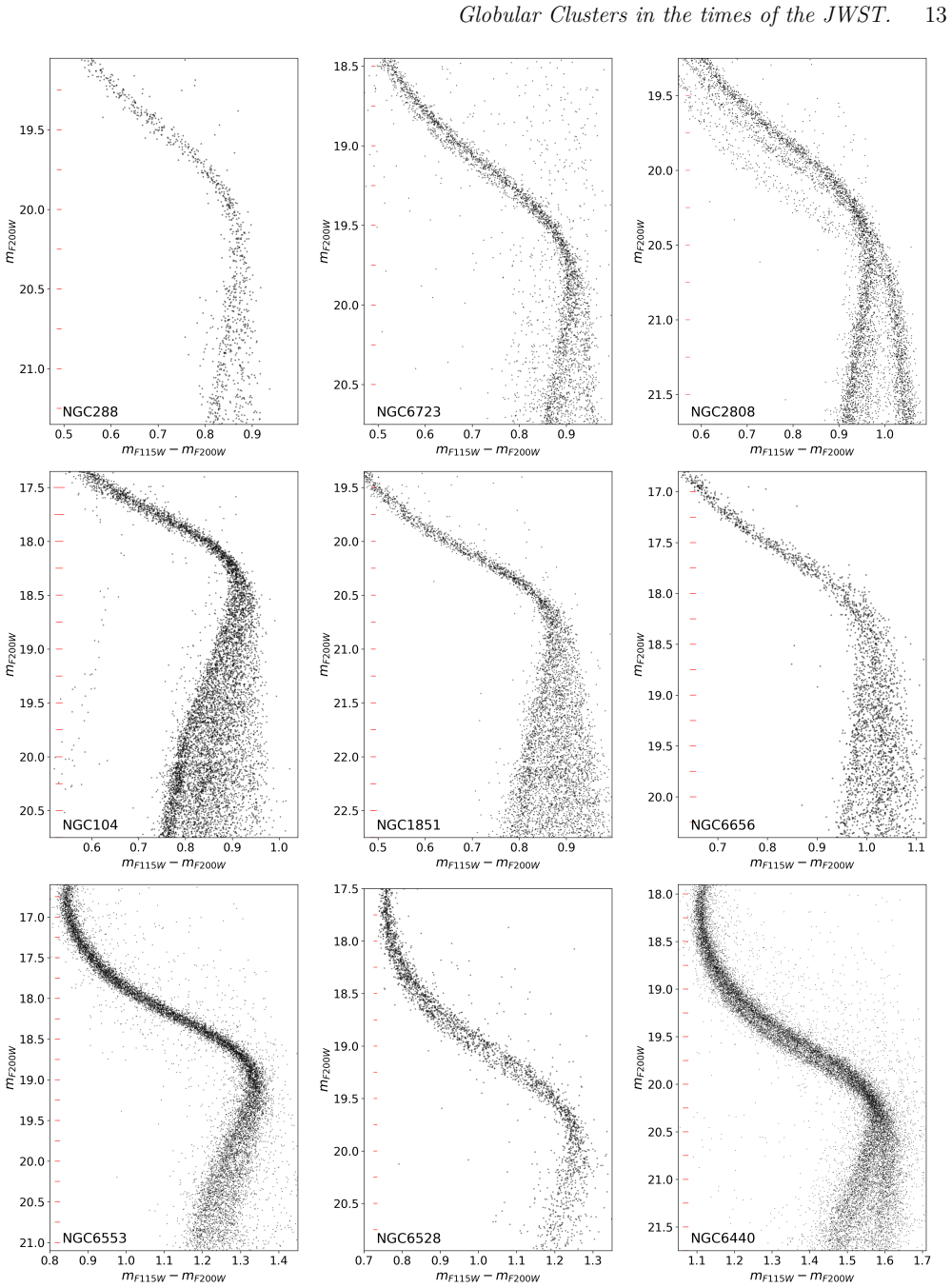
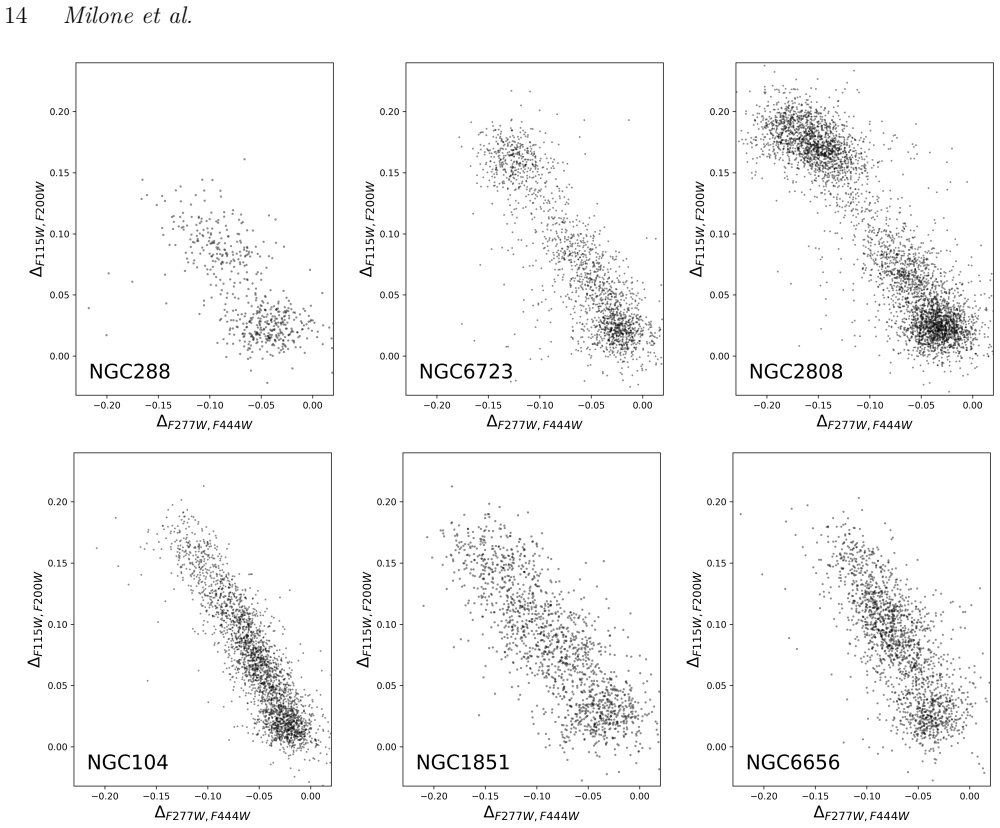
Multiple populations are detected among low-mass stars in all eleven clusters, with discrete main sequences in NGC 288, NGC 6723, and NGC 2808, more continuous distributions in NGC 104 and the Type II clusters NGC 1851 and NGC 6656, patterns consistent with varying helium and oxygen abundances in the bulge clusters NGC 6528, NGC 6553, and NGC 6440, populations spanning different ages and helium variations within the old population of Terzan 5, and an M-dwarf gap in NGC 104 around 0.35 solar masses.
What carries the argument
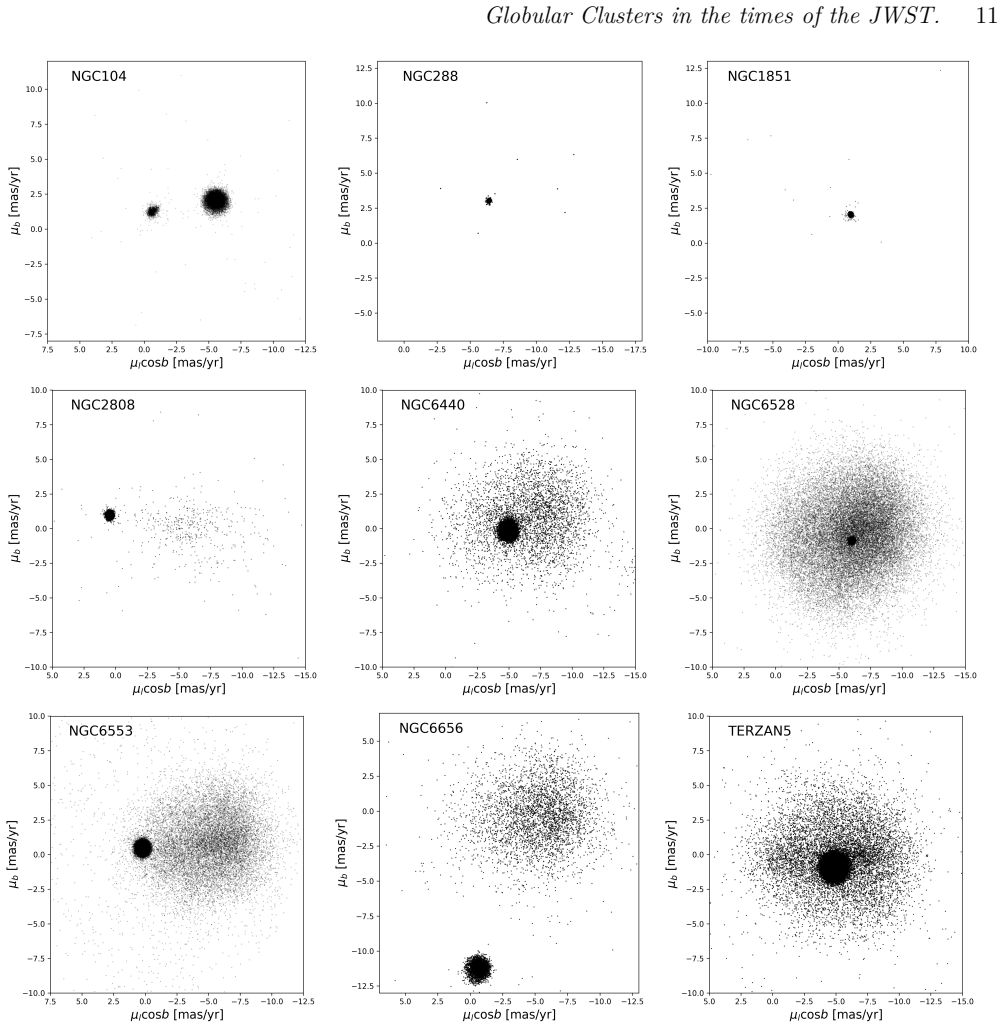
Deep NIRCam infrared photometry combined with proper-motion cleaning that isolates true cluster members and exposes abundance-driven splits in the main sequence of cool, low-mass stars.
If this is right
- Multiple populations extend to the lowest-mass stars across a wide range of cluster masses and environments.
- Bulge clusters exhibit helium-oxygen patterns that do not scale simply with total cluster mass.
- Terzan 5 and Liller 1 contain subpopulations with age and helium differences inside their oldest stars.
- At least one cluster hosts an M-dwarf gap at 0.35 solar masses consistent with the Jao gap.
- The survey supplies a homogeneous dataset for later studies of cluster evolution and Galactic populations.
Where Pith is reading between the lines
- If the observed patterns hold across more clusters, they would imply that the mechanism creating multiple populations operated before the lowest-mass stars formed.
- The bulge-cluster results could link globular-cluster chemistry directly to Milky Way bulge star-formation history.
- Confirmation of the M-dwarf gap in additional clusters would test whether the gap is a universal feature of low-mass stellar interiors.
- The same photometric methods could be applied to extragalactic clusters once JWST reaches comparable depths.
Load-bearing premise
The high-precision photometry and proper-motion selection cleanly separate genuine chemical differences from scatter, crowding, or field stars even at the faintest magnitudes.
What would settle it
Spectroscopic abundance measurements of individual low-mass stars in one of the clusters showing no helium or oxygen differences at the locations of the reported photometric sequences would falsify the multiple-population detection.
Figures


read the original abstract
Globular clusters (GCs) host multiple stellar populations with distinct chemical compositions, but their properties among very low-mass stars remain poorly constrained. The James Webb Space Telescope (JWST) enables precise infrared studies that are highly sensitive to abundance variations in cool stars. We initiate a homogeneous survey of Galactic GCs, based primarily on deep JWST GO-8960 observations and complemented by archival JWST and Hubble Space Telescope data, to characterize multiple populations across a wide range of cluster properties. In this first paper, we present the survey and initial NIRCam results. We analyze eleven GCs, deriving high-precision photometry and astrometry to measure proper motions. Multiple populations are detected among low-mass stars in all clusters, with diverse behaviors. We find discrete main sequences in NGC 288, NGC 6723, and NGC 2808, and more continuous distributions in NGC 104 and the Type II clusters NGC 1851 and NGC 6656. The bulge clusters NGC 6528, NGC 6553, and NGC 6440 show patterns consistent with varying helium and oxygen abundances that do not scale simply with cluster mass. In Terzan 5 and Liller 1, we identify populations spanning different ages and helium variations within the old population of Terzan 5. We also detect an M-dwarf gap in NGC 104 around 0.35 solar masses, consistent with the Jao Gap of field stars and open clusters. This work establishes the foundation for a homogeneous JWST survey of Galactic GCs and provides a valuable dataset for studies of cluster evolution, Galactic stellar populations, and background extragalactic sources.
Editorial analysis
A structured set of objections, weighed in public.
Referee Report
Summary. The paper presents the design of a homogeneous JWST survey of Galactic globular clusters and reports initial NIRCam photometry and proper-motion results for eleven clusters. It claims detections of multiple populations among low-mass stars in all eleven, with discrete main sequences in NGC 288, NGC 6723 and NGC 2808, more continuous distributions in NGC 104 and the Type II clusters NGC 1851 and NGC 6656, helium/oxygen patterns in the bulge clusters NGC 6528, NGC 6553 and NGC 6440, age and helium variations in Terzan 5 and Liller 1, and an M-dwarf gap in NGC 104 around 0.35 solar masses.
Significance. If the photometric and astrometric cleaning procedures prove robust, the work supplies the first homogeneous JWST dataset on multiple populations at low masses, where infrared sensitivity to abundance variations is high. The survey design, use of public GO-8960 and archival data, and the reported M-dwarf gap (linking to the Jao Gap) are concrete strengths that would enable future comparative studies of cluster evolution and Galactic populations.
major comments (2)
- [Abstract and §2 (Survey Design)] The abstract and survey description state clear detections across all eleven clusters but supply no quantitative metrics (e.g., sequence separation in magnitudes, photometric error distributions, or membership probability thresholds). Without these, it is impossible to assess whether the reported discrete versus continuous distributions exceed residual crowding or field contamination in the faint regime.
- [§3 (Data Analysis) and Results paragraphs on NGC 288, NGC 6723, NGC 2808] The central claim that NIRCam photometry plus proper-motion cleaning isolates genuine low-mass multiple-population signals rests on the untested assumption that chosen PM thresholds and crowding corrections suppress systematics below the observed separations. No error budget, artificial-star tests, or residual-contamination simulations are referenced for the low-mass regime.
Simulated Author's Rebuttal
We thank the referee for the constructive and detailed comments. We agree that additional quantitative metrics and validation details will strengthen the manuscript and will incorporate them in the revision.
read point-by-point responses
-
Referee: [Abstract and §2 (Survey Design)] The abstract and survey description state clear detections across all eleven clusters but supply no quantitative metrics (e.g., sequence separation in magnitudes, photometric error distributions, or membership probability thresholds). Without these, it is impossible to assess whether the reported discrete versus continuous distributions exceed residual crowding or field contamination in the faint regime.
Authors: We acknowledge the absence of explicit quantitative metrics in the abstract and §2. In the revised manuscript we will add a summary of photometric error distributions at the faint end, measured sequence separations (in color and magnitude), and the precise proper-motion membership probability thresholds (typically >0.75 after outlier rejection) used for each cluster. These values will be placed in §2 with a brief reference in the abstract, enabling direct evaluation of the separations relative to errors and contamination. revision: yes
-
Referee: [§3 (Data Analysis) and Results paragraphs on NGC 288, NGC 6723, NGC 2808] The central claim that NIRCam photometry plus proper-motion cleaning isolates genuine low-mass multiple-population signals rests on the untested assumption that chosen PM thresholds and crowding corrections suppress systematics below the observed separations. No error budget, artificial-star tests, or residual-contamination simulations are referenced for the low-mass regime.
Authors: Section 3 describes the PM cleaning and crowding corrections, but we agree that an explicit error budget and validation tests for the low-mass regime are not referenced. We will expand §3 to include (i) a tabulated error budget combining photometric uncertainties and crowding, (ii) results from artificial-star tests quantifying recovery rates and bias at the faint end, and (iii) residual-contamination simulations after applying the adopted PM thresholds. These additions will demonstrate that the observed separations in NGC 288, NGC 6723, and NGC 2808 exceed the quantified systematics. revision: yes
Circularity Check
No circularity: observational detections from JWST photometry
full rationale
The paper presents a survey and reports direct detections of multiple populations via NIRCam photometry and proper-motion cleaning in eleven globular clusters. Central claims rest on observed sequences in color-magnitude diagrams without any derivation chain, fitted parameters, equations, or self-citation load-bearing steps. The work is self-contained data analysis against external photometric benchmarks.
Axiom & Free-Parameter Ledger
Reference graph
Works this paper leans on
-
[1]
Toward High-Precision Astrometry with WFPC2. I. Deriving an Accurate Point-Spread Function. , keywords =. doi:10.1086/316632 , archivePrefix =. astro-ph/0006325 , primaryClass =
work page internal anchor Pith review Pith/arXiv arXiv doi:10.1086/316632
-
[2]
The Rotation of the Globular Cluster 47 Tucanae in the Plane of the Sky. , keywords =. doi:10.1086/376480 , adsurl =
-
[3]
The Acs Survey of Globular Clusters. V. Generating a Comprehensive Star Catalog for each Cluster. , keywords =. doi:10.1088/0004-6256/135/6/2055 , archivePrefix =. 0804.2025 , primaryClass =
work page internal anchor Pith review Pith/arXiv arXiv doi:10.1088/0004-6256/135/6/2055 2055
-
[4]
PSFs, Photometry, and Astronomy for the ACS/WFC
-
[5]
An Empirical Pixel-Based Correction for Imperfect CTE. I. HST s Advanced Camera for Surveys. , keywords =. doi:10.1086/656399 , archivePrefix =. 1007.3987 , primaryClass =
work page internal anchor Pith review Pith/arXiv arXiv doi:10.1086/656399
-
[6]
One-Pass HST Photometry with hst1pass
-
[7]
Early Disc Accretion as the Origin of Abundance Anomalies in Globular Clusters
Early disc accretion as the origin of abundance anomalies in globular clusters. , keywords =. doi:10.1093/mnras/stt1745 , archivePrefix =. 1309.3566 , primaryClass =
work page internal anchor Pith review Pith/arXiv arXiv doi:10.1093/mnras/stt1745
-
[8]
Stellar models of evolved secondaries in CVs
Stellar Models of Evolved Secondaries in Cataclysmic Variables. , keywords =. doi:10.1086/423364 , archivePrefix =. astro-ph/0402536 , primaryClass =
work page internal anchor Pith review Pith/arXiv arXiv doi:10.1086/423364
-
[9]
Multiple Stellar Populations in Globular Clusters
Multiple Stellar Populations in Globular Clusters. , keywords =. doi:10.1146/annurev-astro-081817-051839 , archivePrefix =. 1712.01286 , primaryClass =
work page internal anchor Pith review Pith/arXiv arXiv doi:10.1146/annurev-astro-081817-051839
-
[10]
Star cluster ecology: revisiting the origin of iron and age complex clusters. , keywords =. doi:10.1093/mnras/stab3081 , archivePrefix =. 2110.10616 , primaryClass =
-
[11]
A catalogue of masses, structural parameters, and velocity dispersion profiles of 112 Milky Way globular clusters. , keywords =. doi:10.1093/mnras/sty1057 , archivePrefix =. 1804.08359 , primaryClass =
work page internal anchor Pith review Pith/arXiv arXiv doi:10.1093/mnras/sty1057
-
[12]
The bottom of the white dwarf cooling sequence in the old open cluster NGC 2158
The Bottom of the White Dwarf Cooling Sequence in the Old Open Cluster NGC 2158. , keywords =. doi:10.1088/2041-8205/708/1/L32 , archivePrefix =. 0912.0257 , primaryClass =
work page internal anchor Pith review Pith/arXiv arXiv doi:10.1088/2041-8205/708/1/l32 2041
-
[13]
The Puzzling White Dwarf Cooling Sequence in NGC6791: A Simple Solution
The Puzzling White Dwarf Cooling Sequence in NGC 6791: A Simple Solution. , keywords =. doi:10.1086/589151 , archivePrefix =. 0804.1792 , primaryClass =
work page internal anchor Pith review Pith/arXiv arXiv doi:10.1086/589151
-
[14]
Astrometry and Photometry with HST WFC3. I. Geometric Distortion Corrections of F225W, F275W, F336W Bands of the UVIS Channel. , keywords =. doi:10.1086/649061 , archivePrefix =. 0910.3250 , primaryClass =
work page internal anchor Pith review Pith/arXiv arXiv doi:10.1086/649061
-
[15]
Astrometry and Photometry with HST WFC3. II. Improved Geometric-Distortion Corrections for 10 Filters of the UVIS Channel. , keywords =. doi:10.1086/659878 , archivePrefix =. 1102.5218 , primaryClass =
work page internal anchor Pith review Pith/arXiv arXiv doi:10.1086/659878
-
[16]
Hubble Space Telescope Proper Motion (HSTPROMO) Catalogs of Galactic Globular Clusters. I. Sample Selection, Data Reduction, and NGC 7078 Results. , keywords =. doi:10.1088/0004-637X/797/2/115 , archivePrefix =. 1410.5820 , primaryClass =
work page internal anchor Pith review Pith/arXiv arXiv doi:10.1088/0004-637x/797/2/115
-
[17]
The Hubble Space Telescope UV Legacy Survey of Galactic Globular Clusters: The Internal Kinematics of the Multiple Stellar Populations in NGC 2808. , keywords =. doi:10.1088/2041-8205/810/1/L13 , archivePrefix =. 1508.01804 , primaryClass =
work page internal anchor Pith review Pith/arXiv arXiv doi:10.1088/2041-8205/810/1/l13 2041
-
[18]
The State-of-the-art HST Astro-photometric Analysis of the Core of Centauri. I. The Catalog. , keywords =. doi:10.3847/1538-4357/aa7059 , archivePrefix =. 1704.07425 , primaryClass =
work page internal anchor Pith review Pith/arXiv arXiv doi:10.3847/1538-4357/aa7059
-
[19]
On a New Near-Infrared Method to Estimate the Absolute Ages of Star Clusters: NGC 3201 as a First Test Case. , keywords =. doi:10.1088/2041-8205/708/2/L74 , archivePrefix =. 0912.0824 , primaryClass =
work page internal anchor Pith review Pith/arXiv arXiv doi:10.1088/2041-8205/708/2/l74 2041
-
[20]
Exploring the formation environment and dynamics of multiple stellar populations in globular clusters through binary systems. , keywords =. doi:10.1051/0004-6361/202452786 , archivePrefix =. 2503.09708 , primaryClass =
-
[21]
EAZY: A Fast, Public Photometric Redshift Code. , keywords =. doi:10.1086/591786 , archivePrefix =. 0807.1533 , primaryClass =
work page internal anchor Pith review Pith/arXiv arXiv doi:10.1086/591786
-
[22]
JADES NIRSpec Spectroscopy of GN-z11: Lyman- emission and possible enhanced nitrogen abundance in a z = 10.60 luminous galaxy. , keywords =. doi:10.1051/0004-6361/202346159 , archivePrefix =. 2302.07256 , primaryClass =
-
[23]
JWST uncovers helium and water abundance variations in the bulge globular cluster NGC 6440. , keywords =. doi:10.1051/0004-6361/202347961 , archivePrefix =. 2310.13056 , primaryClass =
-
[24]
Nitrogen enhancements 440 Myr after the big bang: supersolar N/O, a tidal disruption event, or a dense stellar cluster in GN-z11?. , keywords =. doi:10.1093/mnras/stad1579 , archivePrefix =. 2302.10142 , primaryClass =
-
[25]
The chemical compositions of multiple stellar populations in the globular cluster NGC 2808. , keywords =. doi:10.1093/mnras/stac3561 , archivePrefix =. 2212.01319 , primaryClass =
-
[26]
Na-O anticorrelation and HB. VII. The chemical composition of first and second-generation stars in 15 globular clusters from GIRAFFE spectra. , keywords =. doi:10.1051/0004-6361/200912096 , archivePrefix =. 0909.2938 , primaryClass =
work page internal anchor Pith review Pith/arXiv arXiv doi:10.1051/0004-6361/200912096
-
[27]
Multiple populations in massive star clusters under the magnifying glass of photometry: theory and tools. , keywords =. doi:10.1007/s00159-020-00127-y , archivePrefix =. 2006.13172 , primaryClass =
-
[28]
N-enhancement in GN-z11: First evidence for supermassive stars nucleosynthesis in proto-globular clusters-like conditions at high redshift?. , keywords =. doi:10.1051/0004-6361/202346410 , archivePrefix =. 2303.07955 , primaryClass =
-
[29]
Little Red Dots as Globular Clusters in Formation. arXiv e-prints , keywords =. doi:10.48550/arXiv.2602.15935 , archivePrefix =. 2602.15935 , primaryClass =
-
[30]
M22: A [Fe/H] Abundance Range Revealed
M22: An [Fe/H] Abundance Range Revealed. , keywords =. doi:10.1088/0004-637X/705/2/1481 , archivePrefix =. 0909.5265 , primaryClass =
work page internal anchor Pith review Pith/arXiv arXiv doi:10.1088/0004-637x/705/2/1481
-
[31]
Three-component Kinematics of Multiple Stellar Populations in Globular Clusters with Gaia and VLT. , keywords =. doi:10.3847/1538-4357/ab5aee , archivePrefix =. 1905.09908 , primaryClass =
-
[32]
Internal dynamics of multiple populations in 28 Galactic globular clusters: a wide-field study with Gaia and the Hubble Space Telescope. , keywords =. doi:10.1093/mnras/staf102 , archivePrefix =. 2409.02330 , primaryClass =
-
[33]
Constraining Globular Cluster Age Uncertainties Using the IR Color-Magnitude Diagram
Constraining Globular Cluster Age Uncertainties using the IR Color-Magnitude Diagram. , keywords =. doi:10.3847/0004-637X/823/1/18 , archivePrefix =. 1603.05254 , primaryClass =
work page internal anchor Pith review Pith/arXiv arXiv doi:10.3847/0004-637x/823/1/18
-
[34]
Faintest Galaxy Morphologies from $HST$ WFPC2 Imaging of the Hawaii Survey Fields
Faintest Galaxy Morphologies From HST WFPC2 Imaging of the Hawaii Survey Fields. , keywords =. doi:10.1086/117631 , archivePrefix =. astro-ph/9507055 , primaryClass =
work page internal anchor Pith review Pith/arXiv arXiv doi:10.1086/117631
-
[35]
Secular evolution of cataclysmic binaries - Evolution of the secondary and the period gap. , keywords =. doi:10.1086/160292 , adsurl =
-
[36]
GN-z11: Witnessing the formation of second-generation stars and an accreting massive black hole in a massive star cluster. , keywords =. doi:10.1051/0004-6361/202348240 , archivePrefix =. 2311.14558 , primaryClass =
-
[37]
A helium spread among the main sequence stars in NGC 2808
A Helium Spread among the Main-Sequence Stars in NGC 2808. , keywords =. doi:10.1086/431968 , archivePrefix =. astro-ph/0505347 , primaryClass =
work page internal anchor Pith review Pith/arXiv arXiv doi:10.1086/431968
-
[38]
Dating N-loud AGNs at high redshift: GS\_3073 as a snapshot of a Centauri-like evolution of a nuclear star cluster. , keywords =. doi:10.1051/0004-6361/202554957 , archivePrefix =. 2507.06311 , primaryClass =
-
[39]
A single model for the variety of multiple-population formation(s) in globular clusters: a temporal sequence. , keywords =. doi:10.1093/mnras/stw387 , archivePrefix =. 1602.05412 , primaryClass =
work page internal anchor Pith review Pith/arXiv arXiv doi:10.1093/mnras/stw387
-
[40]
A view of the H-band light-element chemical patterns in globular clusters under the AGB self-enrichment scenario. , keywords =. doi:10.1093/mnras/stx3249 , archivePrefix =. 1712.04500 , primaryClass =
work page internal anchor Pith review Pith/arXiv arXiv doi:10.1093/mnras/stx3249
-
[41]
Massive binaries as the source of abundance anomalies in globular clusters
Massive binaries as the source of abundance anomalies in globular clusters. , keywords =. doi:10.1051/0004-6361/200913205 , archivePrefix =. 0910.1086 , primaryClass =
work page internal anchor Pith review Pith/arXiv arXiv doi:10.1051/0004-6361/200913205
-
[42]
Supermassive stars as a source of abundance anomalies of proton-capture elements in globular clusters. , keywords =. doi:10.1093/mnrasl/slt133 , archivePrefix =. 1305.5975 , primaryClass =
work page internal anchor Pith review Pith/arXiv arXiv doi:10.1093/mnrasl/slt133
-
[43]
Abundance patterns of multiple populations in globular clusters: a chemical evolution model based on yields from AGB ejecta. , keywords =. doi:10.1111/j.1365-2966.2010.16996.x , archivePrefix =. 1005.1892 , primaryClass =
-
[44]
Survey of Multiple Populations in Globular Clusters among Very-low-mass Stars. , keywords =. doi:10.3847/1538-4357/ac5046 , archivePrefix =. 2201.08631 , primaryClass =
-
[45]
Linking photometry and spectroscopy: profiling multiple populations in globular clusters. , keywords =. doi:10.1051/0004-6361/202453024 , archivePrefix =. 2503.15976 , primaryClass =
-
[46]
The Dartmouth Stellar Evolution Database
The Dartmouth Stellar Evolution Database. , keywords =. doi:10.1086/589654 , archivePrefix =. 0804.4473 , primaryClass =
work page internal anchor Pith review Pith/arXiv arXiv doi:10.1086/589654
-
[47]
FORS2/VLT survey of Milky Way globular clusters. I. Description of the method for derivation of metal abundances in the optical and application to NGC 6528, NGC 6553, M 71, NGC 6558, NGC 6426, and Terzan 8. , keywords =. doi:10.1051/0004-6361/201423996 , archivePrefix =. 1409.4374 , primaryClass =
work page internal anchor Pith review Pith/arXiv arXiv doi:10.1051/0004-6361/201423996
-
[48]
Stellar Models of Multiple Populations in Globular Clusters. I. The Main Sequence of NGC 6752
Stellar models of multiple populations in globular clusters - I. The main sequence of NGC 6752. , keywords =. doi:10.1093/mnras/stu2170 , archivePrefix =. 1410.4570 , primaryClass =
work page internal anchor Pith review Pith/arXiv arXiv doi:10.1093/mnras/stu2170
-
[49]
Discovery of Face-On Counterparts of Chain Galaxies in the Tadpole ACS Field
Discovery of Face-on Counterparts of Chain Galaxies in the Tadpole Advanced Camera for Surveys Field. , keywords =. doi:10.1086/383312 , archivePrefix =. astro-ph/0402477 , primaryClass =
work page internal anchor Pith review Pith/arXiv arXiv doi:10.1086/383312
-
[50]
Stellar Populations in Ten Clump-Cluster Galaxies of the Ultra Deep Field
Stellar Populations in 10 Clump-Cluster Galaxies of the Hubble Ultra Deep Field. , keywords =. doi:10.1086/430514 , archivePrefix =. astro-ph/0504032 , primaryClass =
work page internal anchor Pith review Pith/arXiv arXiv doi:10.1086/430514
-
[51]
The Gaia Catalogue of Nearby Stars
Gaia Early Data Release 3. The Gaia Catalogue of Nearby Stars. , keywords =. doi:10.1051/0004-6361/202039498 , archivePrefix =. 2012.02061 , primaryClass =
-
[52]
The cluster Terzan 5 as a remnant of a primordial building block of the Galactic bulge
The cluster Terzan 5 as a remnant of a primordial building block of the Galactic bulge. , keywords =. doi:10.1038/nature08581 , archivePrefix =. 0912.0192 , primaryClass =
work page internal anchor Pith review Pith/arXiv arXiv doi:10.1038/nature08581
-
[53]
A new class of fossil fragments from the hierarchical assembly of the Galactic bulge. Nature Astronomy , keywords =. doi:10.1038/s41550-020-01267-y , archivePrefix =. 2011.09966 , primaryClass =
-
[54]
Star counts in the Galaxy. Simulating from very deep to very shallow photometric surveys with the TRILEGAL code. , keywords =. doi:10.1051/0004-6361:20042352 , archivePrefix =. astro-ph/0504047 , primaryClass =
work page internal anchor Pith review Pith/arXiv arXiv doi:10.1051/0004-6361:20042352
-
[55]
Exploring the Chemistry and Mass Function of the Globular Cluster 47 Tucanae with New Theoretical Color-Magnitude Diagrams. , keywords =. doi:10.3847/1538-4357/ad08bf , archivePrefix =. 2310.11800 , primaryClass =
-
[56]
Multiple populations in globular clusters. Lessons learned from the Milky Way globular clusters
Multiple populations in globular clusters. Lessons learned from the Milky Way globular clusters. , keywords =. doi:10.1007/s00159-012-0050-3 , archivePrefix =. 1201.6526 , primaryClass =
work page internal anchor Pith review Pith/arXiv arXiv doi:10.1007/s00159-012-0050-3
-
[57]
Concurrent formation of supermassive stars and globular clusters: implications for early self-enrichment. , keywords =. doi:10.1093/mnras/sty1059 , archivePrefix =. 1804.04682 , primaryClass =
work page internal anchor Pith review Pith/arXiv arXiv doi:10.1093/mnras/sty1059
-
[58]
What is a globular cluster? An observational perspective. , keywords =. doi:10.1007/s00159-019-0119-3 , archivePrefix =. 1911.02835 , primaryClass =
-
[59]
Euclid: Early Release Observations -- Internal kinematics and the convective-transition gap of NGC 6397. arXiv e-prints , keywords =. doi:10.48550/arXiv.2606.02703 , archivePrefix =. 2606.02703 , primaryClass =
-
[60]
Sub-Galactic Clumps at High Redshift: A Fragmentation Origin?
Subgalactic Clumps at High Redshift: A Fragmentation Origin?. , keywords =. doi:10.1086/422179 , archivePrefix =. astro-ph/0406135 , primaryClass =
work page internal anchor Pith review Pith/arXiv arXiv doi:10.1086/422179
-
[61]
Hunting for extremely metal-poor emission-line galaxies in the Sloan Digital Sky Survey: MMT and 3.5 m APO observations. , keywords =. doi:10.1051/0004-6361/201219733 , archivePrefix =. 1207.5971 , primaryClass =
work page internal anchor Pith review Pith/arXiv arXiv doi:10.1051/0004-6361/201219733
-
[62]
Abundances of CNO elements in z 0.3-0.4 Lyman continuum leaking galaxies. , keywords =. doi:10.1093/mnras/stad1036 , archivePrefix =. 2304.02452 , primaryClass =
-
[63]
Chromosome maps of globular clusters from wide-field ground-based photometry. , keywords =. doi:10.1093/mnras/stac3086 , archivePrefix =. 2211.00650 , primaryClass =
-
[64]
A Gap in the Lower Main Sequence Revealed by Gaia Data Release 2
A Gap in the Lower Main Sequence Revealed by Gaia Data Release 2. , keywords =. doi:10.3847/2041-8213/aacdf6 , archivePrefix =. 1806.07792 , primaryClass =
work page internal anchor Pith review Pith/arXiv arXiv doi:10.3847/2041-8213/aacdf6 2041
-
[65]
Chemical Abundances for 855 Giants in the Globular Cluster Omega Centauri (NGC 5139)
Chemical Abundances for 855 Giants in the Globular Cluster Omega Centauri (NGC 5139). , keywords =. doi:10.1088/0004-637X/722/2/1373 , archivePrefix =. 1008.2232 , primaryClass =
work page internal anchor Pith review Pith/arXiv arXiv doi:10.1088/0004-637x/722/2/1373
-
[66]
Blanco DECam Bulge Survey (BDBS). VII. Multiple Populations in Globular Clusters of the Galactic Bulge. , keywords =. doi:10.3847/1538-4357/ac94c5 , adsurl =
-
[67]
Abundance Differences among Globular Cluster Giants: Primordial vs. Evolutionary Scenarios. , keywords =. doi:10.1086/133416 , adsurl =
-
[68]
Superbubble dynamics in globular cluster infancy. II. Consequences for secondary star formation in the context of self-enrichment via fast-rotating massive stars. , keywords =. doi:10.1051/0004-6361/201220694 , archivePrefix =. 1302.2494 , primaryClass =
work page internal anchor Pith review Pith/arXiv arXiv doi:10.1051/0004-6361/201220694
-
[69]
A Magnetic White Dwarf Formed through a Binary Merger within 35 Million Yr. , keywords =. doi:10.3847/2041-8213/adfec2 , archivePrefix =. 2509.01069 , primaryClass =
-
[70]
Searching for White Dwarf Candidates Formed Through Binary Evolution in Star Clusters. , keywords =. doi:10.3847/1538-4357/ae3f07 , archivePrefix =. 2602.16550 , primaryClass =
-
[71]
A population of red candidate massive galaxies 600 Myr after the Big Bang. , keywords =. doi:10.1038/s41586-023-05786-2 , archivePrefix =. 2207.12446 , primaryClass =
-
[72]
On the kinematic separation of field and cluster stars across the Bulge globular NGC 6528
On the Kinematic Separation of Field and Cluster Stars across the Bulge Globular NGC 6528. , keywords =. doi:10.1088/0004-637X/782/1/50 , archivePrefix =. 1312.2272 , primaryClass =
work page internal anchor Pith review Pith/arXiv arXiv doi:10.1088/0004-637x/782/1/50
-
[73]
Exploring Simple-population and Multiple-population Globular Clusters in the Outer Galactic Halo Using the Hubble Space Telescope. , keywords =. doi:10.3847/1538-4357/ad98ee , archivePrefix =. 2406.16824 , primaryClass =
-
[74]
Constraining the original composition of the gas forming first-generation stars in globular clusters. , keywords =. doi:10.1093/mnras/stac734 , archivePrefix =. 2203.07571 , primaryClass =
-
[75]
Differential reddening in the direction of 56 Galactic globular clusters. , keywords =. doi:10.1093/mnras/stad1056 , archivePrefix =. 2304.05076 , primaryClass =
-
[76]
The original composition of the gas forming first-generation stars in clusters: Insights from HST and JWST. , keywords =. doi:10.1051/0004-6361/202449533 , archivePrefix =. 2405.02006 , primaryClass =
-
[77]
The Hubble Space Telescope UV Legacy Survey of Galactic Globular Clusters. XXIII. Proper-motion Catalogs and Internal Kinematics. , keywords =. doi:10.3847/1538-4357/ac7727 , archivePrefix =. 2206.09924 , primaryClass =
-
[78]
A deep HST view of the open cluster NGC2158: Binaries, mass functions, and M-dwarf discontinuity. , keywords =. doi:10.1051/0004-6361/202558150 , adsurl =
-
[79]
A double stellar generation in the globular cluster NGC 6656 (M 22). Two stellar groups with different iron and s-process element abundances. , keywords =. doi:10.1051/0004-6361/200911827 , archivePrefix =. 0905.4058 , primaryClass =
work page internal anchor Pith review Pith/arXiv arXiv doi:10.1051/0004-6361/200911827
-
[80]
The two metallicity groups of the globular cluster M22: a chemical perspective
The two metallicity groups of the globular cluster M 22: a chemical perspective. , keywords =. doi:10.1051/0004-6361/201116546 , archivePrefix =. 1105.1523 , primaryClass =
work page internal anchor Pith review Pith/arXiv arXiv doi:10.1051/0004-6361/201116546
discussion (0)
Sign in with ORCID, Apple, or X to comment. Anyone can read and Pith papers without signing in.