Clumpy Disk, Interloper, or Merger? Nature of a Distant Galaxy Pair at 5 kpc Projected Separation
Pith reviewed 2026-06-26 14:09 UTC · model grok-4.3
The pith
Keck spectra show a JWST source is two galaxies merging at 5 kpc projected separation and z ~ 0.92.
A machine-rendered reading of the paper's core claim, the machinery that carries it, and where it could break.
Core claim
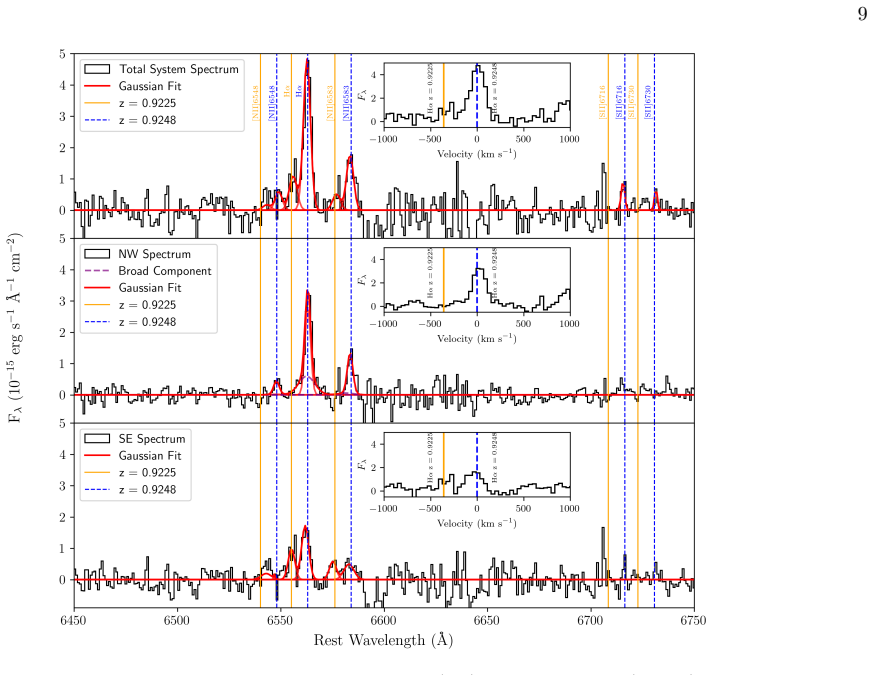
The source consists of two galaxies whose spatially resolved peaks in the MIRI F1500W image produce separate sets of emission lines in Keck NIRES spectra; the northwest peak yields z = 0.9248 while the central peak yields z = 0.9225, placing the pair at a projected separation of approximately 5 kpc and classifying the system as a merger hosting merger-induced star formation on the basis of emission-line ratios from both NIRES and KCWI data.
What carries the argument
Two distinct sets of [N II] and H-alpha emission lines in the Keck NIRES spectra that assign separate redshifts to the two spatially resolved MIRI sources.
If this is right
- Emission-line ratios indicate regions of active star formation driven by the ongoing merger.
- Photometric appearance in JWST images alone cannot distinguish mergers from clumpy disks at z ~ 1.
- Resolved spectroscopic follow-up is required to interpret the population of galaxies detected in deep JWST fields.
- The measured redshift difference of 0.0023 corresponds to a line-of-sight velocity offset consistent with a bound pair.
Where Pith is reading between the lines
- Without spectra, a non-negligible fraction of compact sources in JWST MIRI fields may be misclassified as single clumpy galaxies.
- The same method could be applied to other serendipitous high-redshift pairs to build a statistical sample of close mergers.
- If such pairs are common, merger rates inferred from imaging catalogs at z ~ 1 would need upward revision.
Load-bearing premise
The two emission-line systems arise from the two different spatial sources rather than from line-of-sight projection or instrumental artifacts.
What would settle it
A spectrum or deeper image showing only a single redshift system or no spatial match between the line-emitting gas and the two MIRI peaks would falsify the merger interpretation.
Figures




read the original abstract
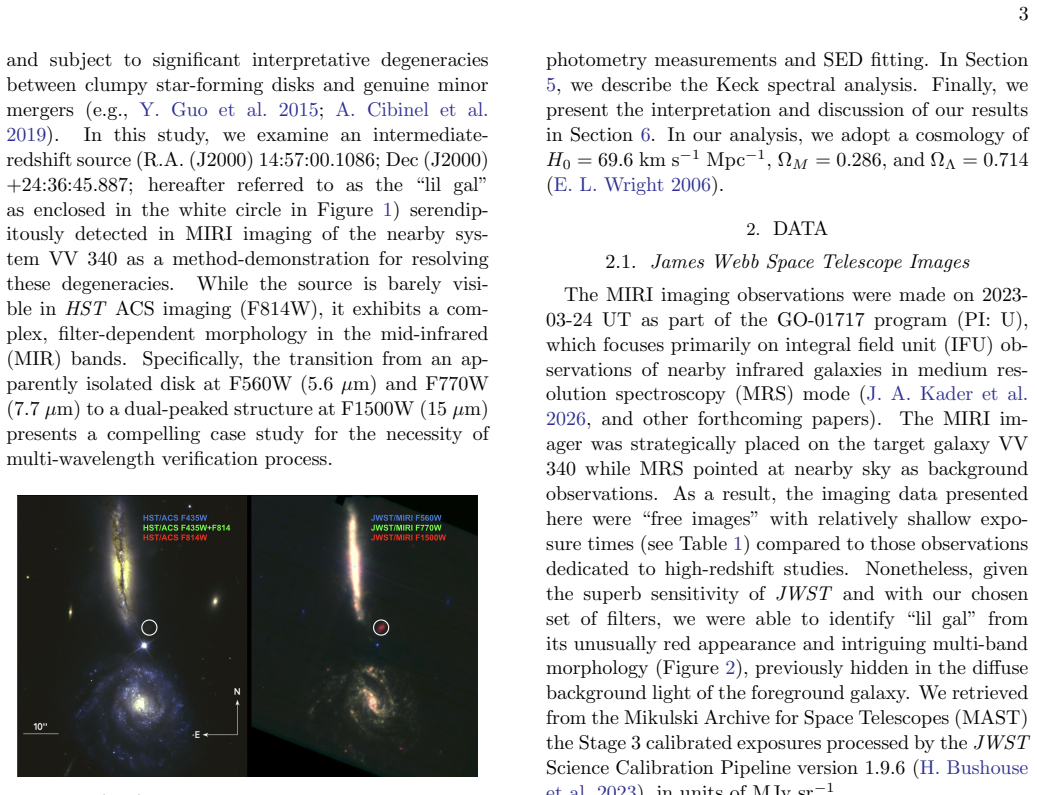
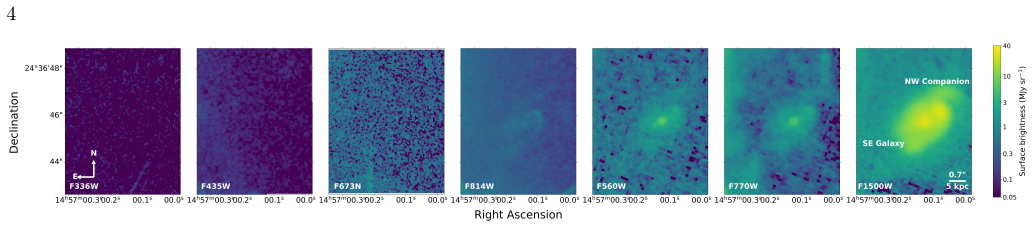
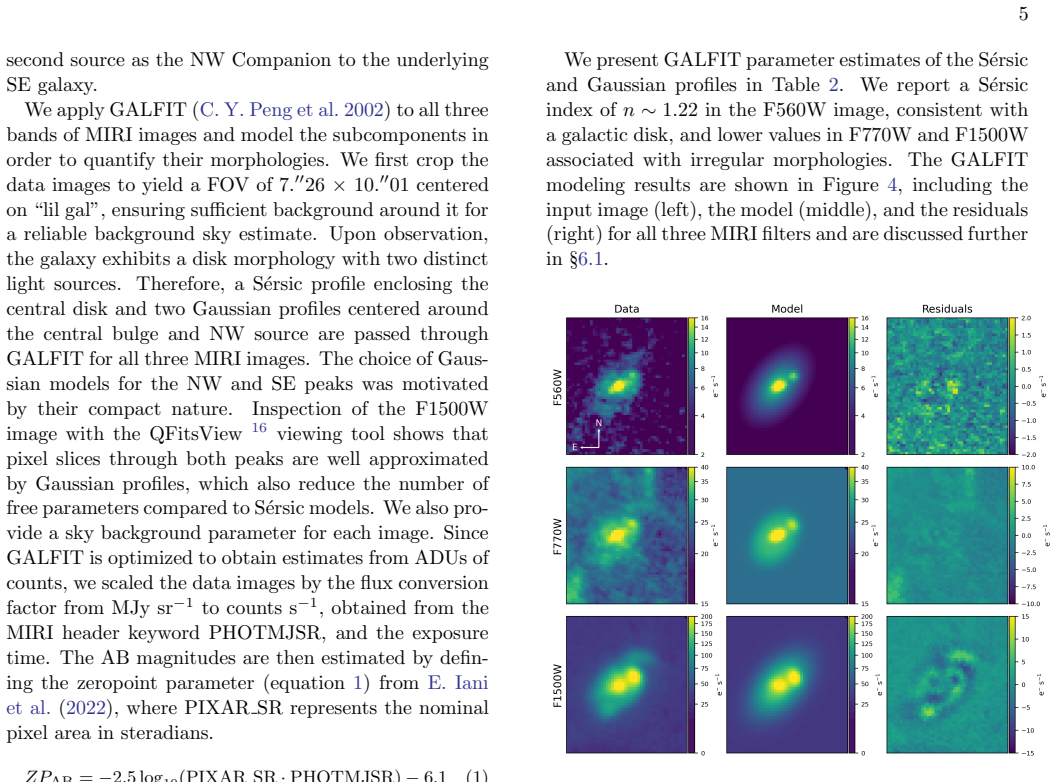
We present the morphological, photometric, and spectroscopic properties of a z ~ 1 galaxy, "lil gal", serendipitously detected in JWST Mid Infrared Instrument (MIRI) images of nearby galaxy VV 340. In the MIRI F560W and F770W images, we identify what appears to be a spiral galaxy with a central bulge. However, in the F1500W image, a second peak appears ~0.7" northwest (NW) from the central bulge, calling into question the nature of this source as a clumpy disk, a high-redshift interloper, or a galaxy merger. Multi-band analyses of the three MIRI and four Hubble Space Telescope (HST) images suggest a photometric redshift of ~0.92. Spectroscopic analyses of data from the Keck Near-Infrared Echellette Spectrometer (NIRES) reveal two sets of [N II] and H-alpha emission lines corresponding to the two observed sources. A redshift of z = 0.9248 is identified for the NW companion. Fainter emission lines are identified from the underlying galaxy at z = 0.9225, suggesting a merging galaxy pair at a projected separation of ~5 kpc. From the emission line ratios from Keck NIRES and Keck Cosmic Web Imager (KCWI) spectra, we classify the system as hosting regions of active star formation, likely attributed to merger-induced starburst activity. The results demonstrate the necessity of resolved, spectroscopic follow-up analyses of galaxies found in deep JWST images to disentangle the role of galaxy mergers from clumpy disk galaxies at z ~ 1 to cosmic noon and beyond.
Editorial analysis
A structured set of objections, weighed in public.
Referee Report
Summary. The paper presents multi-wavelength (MIRI, HST, NIRES, KCWI) observations of a serendipitous z~1 source ('lil gal') detected in JWST imaging of VV 340. Photometric analysis yields z_phot~0.92; NIRES spectroscopy detects two distinct [N II]/Hα systems at z=0.9248 (brighter, assigned to NW peak) and z=0.9225 (fainter, assigned to central source), interpreted as a physical merger pair at ~5 kpc projected separation rather than a clumpy disk or interloper, with line ratios indicating merger-induced star formation.
Significance. If the spatial-spectral association is robust, the result supplies a concrete, spectroscopically confirmed example of a close-pair merger at cosmic noon and illustrates the value of resolved follow-up for interpreting complex JWST morphologies; the multi-instrument redshift consistency is a strength.
major comments (1)
- [Spectroscopic analyses] Spectroscopic analyses section (and abstract): the central merger claim rests on mapping the brighter z=0.9248 lines to the NW MIRI peak and the fainter z=0.9225 lines to the central source. No 2D spectral spatial profiles, slit-position overlay on the MIRI image, or extraction-aperture verification is described, leaving open the possibility that the velocity components arise from line-of-sight projection, internal kinematics, or blending within the 0.7″ separation; this directly affects the weakest assumption flagged in the stress test.
minor comments (2)
- [Abstract] Abstract: omits any quantitative details on line deblending, flux calibration, or contaminant assessment for the NIRES and KCWI spectra.
- [Abstract] Abstract and results: the statement that line ratios classify the system as hosting merger-induced star formation is not supported by tabulated ratios or diagnostic diagrams in the provided text.
Simulated Author's Rebuttal
We thank the referee for their thorough review and constructive feedback on our manuscript. We address the major comment point by point below and agree that additional documentation of the spectroscopic analysis will strengthen the paper.
read point-by-point responses
-
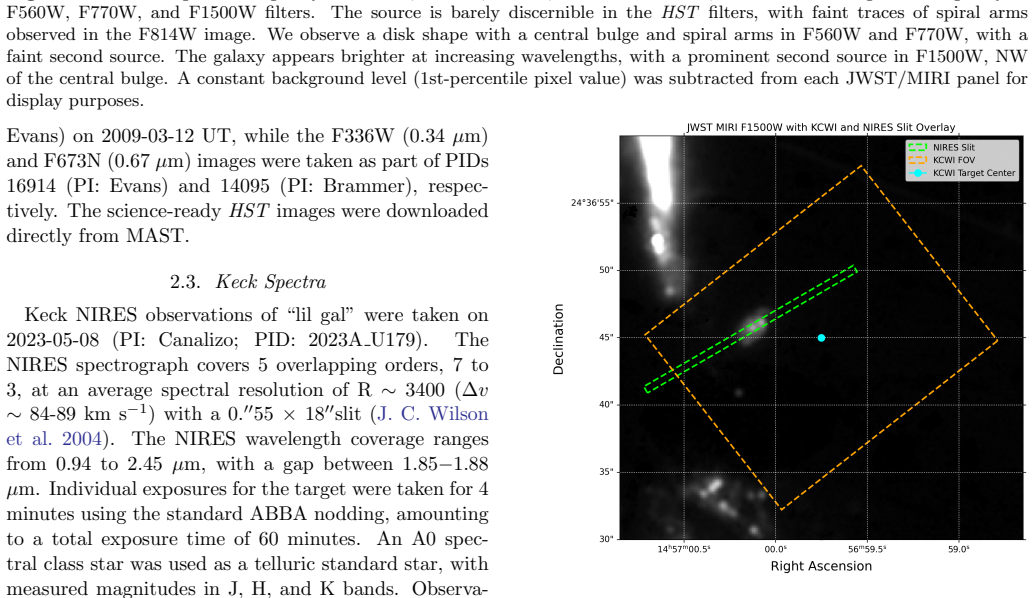
Referee: [Spectroscopic analyses] Spectroscopic analyses section (and abstract): the central merger claim rests on mapping the brighter z=0.9248 lines to the NW MIRI peak and the fainter z=0.9225 lines to the central source. No 2D spectral spatial profiles, slit-position overlay on the MIRI image, or extraction-aperture verification is described, leaving open the possibility that the velocity components arise from line-of-sight projection, internal kinematics, or blending within the 0.7″ separation; this directly affects the weakest assumption flagged in the stress test.
Authors: We agree that the current manuscript does not provide explicit 2D spectral spatial profiles, a slit-position overlay on the MIRI image, or detailed extraction-aperture verification. The assignment of the brighter z=0.9248 system to the NW peak and the fainter z=0.9225 system to the central source is based on the relative line fluxes matching the observed MIRI morphology and the 0.7 arcsec spatial offset. To address this concern directly, we will add a new figure to the revised manuscript showing the NIRES slit position overlaid on the MIRI F1500W image, along with a description of the extraction apertures and any 2D profile information available from the data. We will also expand the text in the spectroscopic analyses section to clarify why blending or internal kinematics are less likely given the distinct spatial peaks and small velocity offset. These additions will be incorporated in the revision. revision: yes
Circularity Check
No circularity in direct spectroscopic redshift measurements
full rationale
The paper's central claims rest on direct measurements: MIRI imaging identifies two spatial peaks separated by ~0.7", and Keck NIRES spectra detect two distinct sets of [N II] and H-alpha emission lines yielding redshifts z=0.9248 (NW) and z=0.9225 (central), with the ~5 kpc projected separation following from standard angular-diameter distance at the measured redshift. These are laboratory wavelength comparisons with no equations, fitted parameters, or self-citations that reduce the result to its inputs by construction. The mapping of lines to sources is an interpretive step, but the paper presents it as an observational association rather than a derived prediction. No patterns of self-definitional loops, fitted-input predictions, or load-bearing self-citations appear. The analysis is self-contained against external spectroscopic benchmarks.
Axiom & Free-Parameter Ledger
axioms (2)
- domain assumption Emission lines detected in NIRES spectra are correctly identified as [N II] and H-alpha at the stated redshifts
- domain assumption Photometric redshift from combined MIRI and HST bands is reliable enough to guide spectroscopic targeting
Reference graph
Works this paper leans on
-
[1]
2013, The Astrophysical Journal, 766, 105, doi: 10.1088/0004-637X/766/2/105
Adamo, A., ¨Ostlin, G., Bastian, N., et al. 2013, The Astrophysical Journal, 766, 105, doi: 10.1088/0004-637X/766/2/105
-
[2]
Bohn, T. 2024, The Astrophysical Journal, 975, 60, doi: 10.3847/1538-4357/ad702b Astropy Collaboration, Robitaille, T. P., Tollerud, E. J., et al. 2013, Astronomy and Astrophysics, 558, A33, doi: 10.1051/0004-6361/201322068 Astropy Collaboration, Price-Whelan, A. M., Sip˝ ocz, B. M., et al. 2018, The Astronomical Journal, 156, 123, doi: 10.3847/1538-3881/...
-
[3]
Baldwin, J. A., Phillips, M. M., & Terlevich, R. 1981, Publications of the Astronomical Society of the Pacific, 93, 5, doi: 10.1086/130766
-
[4]
2023, astropy/photutils: 1.8.0, Zenodo, doi: 10.5281/zenodo.7946442
Bradley, L. 2023, astropy/photutils: 1.8.0, Zenodo, doi: 10.5281/zenodo.7946442
-
[5]
Brown, M. J. I., Moustakas, J., Smith, J. D. T., et al. 2014, The Astrophysical Journal Supplement Series, 212, 18, doi: 10.1088/0067-0049/212/2/18
-
[6]
Bushouse, H., Eisenhamer, J., Dencheva, N., et al. 2023, JWST Calibration Pipeline, Zenodo, doi: 10.5281/zenodo.7714020 Calder´ on-Castillo, P., & Smith, R. 2024, A&A, 691, A82, doi: 10.1051/0004-6361/202450473
-
[7]
Star Formation Rate Determinations
Calzetti, D. 2007, Star Formation Rate Determinations, arXiv, doi: 10.48550/arXiv.0707.0467
work page internal anchor Pith review Pith/arXiv arXiv doi:10.48550/arxiv.0707.0467 2007
-
[8]
Observing and data analysis systems, discovery and timing of 100 pulsars
Charlot, S., & Longhetti, M. 2001, Monthly Notices of the Royal Astronomical Society, 323, 887, doi: 10.1046/j.1365-8711.2001.04260.x
-
[9]
Cibinel, A., Daddi, E., Sargent, M. T., et al. 2019, Monthly Notices of the Royal Astronomical Society, 485, 5631, doi: 10.1093/mnras/stz690
-
[10]
2023, Monthly Notices of the Royal Astronomical Society, 520, 2180, doi: 10.1093/mnras/stac3791
Claeyssens, A., Adamo, A., Richard, J., et al. 2023, Monthly Notices of the Royal Astronomical Society, 520, 2180, doi: 10.1093/mnras/stac3791
-
[11]
Conselice, C. J., & Arnold, J. 2009, Monthly Notices of the Royal Astronomical Society, 397, 208, doi: 10.1111/j.1365-2966.2009.14959.x
-
[12]
2003, The Astronomical Journal, 126, 1183, doi: 10.1086/377318 De Propris, R., Conselice, C
Papovich, C. 2003, The Astronomical Journal, 126, 1183, doi: 10.1086/377318 De Propris, R., Conselice, C. J., Liske, J., et al. 2007, The Astrophysical Journal, 666, 212, doi: 10.1086/520488 Denicol´ o, G., Terlevich, R., & Terlevich, E. 2002, Monthly Notices of the Royal Astronomical Society, 330, 69, doi: 10.1046/j.1365-8711.2002.05041.x Dom´ ınguez, A....
-
[13]
Driver, S. P., Windhorst, R. A., & Griffiths, R. E. 1995, The Astrophysical Journal, 453, 48, doi: 10.1086/176369
-
[14]
Duncan, K., Conselice, C. J., Mundy, C., et al. 2019, The Astrophysical Journal, 876, 110, doi: 10.3847/1538-4357/ab148a D´ ıaz-Santos, T., Armus, L., Charmandaris, V., et al. 2017, The Astrophysical Journal, 846, 32, doi: 10.3847/1538-4357/aa81d7
-
[15]
2024, astropy/specutils: v1.19.0, Zenodo, doi: 10.5281/zenodo.14042033
Earl, N., Tollerud, E., O’Steen, R., et al. 2024, astropy/specutils: v1.19.0, Zenodo, doi: 10.5281/zenodo.14042033
-
[16]
2007, A&A, 468, 33, doi: 10.1051/0004-6361:20077525
Elbaz, D., Daddi, E., Le Borgne, D., et al. 2007, A&A, 468, 33, doi: 10.1051/0004-6361:20077525
-
[17]
Elbaz, D., Dickinson, M., Hwang, H. S., et al. 2011, A&A, 533, A119, doi: 10.1051/0004-6361/201117239
-
[18]
Ellison, S. L., Mendel, J. T., Patton, D. R., & Scudder, J. M. 2013, Monthly Notices of the Royal Astronomical Society, 435, 3627, doi: 10.1093/mnras/stt1562
-
[19]
Ellison, S. L., Patton, D. R., Simard, L., & McConnachie, A. W. 2008, AJ, 135, 1877, doi: 10.1088/0004-6256/135/5/1877
work page internal anchor Pith review doi:10.1088/0004-6256/135/5/1877 2008
-
[20]
Ferreira, L., Adams, N., Conselice, C. J., et al. 2022, The Astrophysical Journal Letters, 938, L2, doi: 10.3847/2041-8213/ac947c
-
[21]
Ferreira, L., Conselice, C. J., Sazonova, E., et al. 2023, The Astrophysical Journal, 955, 94, doi: 10.3847/1538-4357/acec76 Floc’h, E. L., Papovich, C., Dole, H., et al. 2005, The Astrophysical Journal, 632, 169, doi: 10.1086/432789
-
[22]
Geach, J. E., Smail, I., Chapman, S. C., et al. 2007, The Astrophysical Journal, 655, L9, doi: 10.1086/511676 17
-
[23]
1998, The Astrophysical Journal, 498, 579, doi: 10.1086/305576
Genzel, R., Lutz, D., Sturm, E., et al. 1998, The Astrophysical Journal, 498, 579, doi: 10.1086/305576
-
[24]
Koekemoer, A. M. 2012, The Astrophysical Journal, 757, 120, doi: 10.1088/0004-637X/757/2/120
-
[25]
Guo, Y., Ferguson, H. C., Bell, E. F., et al. 2015, The Astrophysical Journal, 800, 39, doi: 10.1088/0004-637X/800/1/39
-
[26]
K., Domingue, D., Cao, C., & Huang, J.-s
He, C., Xu, C. K., Domingue, D., Cao, C., & Huang, J.-s. 2022, The Astrophysical Journal Supplement Series, 261, 34, doi: 10.3847/1538-4365/ac73ec
-
[27]
Hung, C.-L., Sanders, D. B., Casey, C. M., et al. 2014, The Astrophysical Journal, 791, 63, doi: 10.1088/0004-637X/791/1/63
-
[28]
Hunter, J. D. 2007, Computing in Science & Engineering, 9, 90, doi: 10.1109/MCSE.2007.55
-
[29]
Iani, E., Caputi, K. I., Rinaldi, P., & Kokorev, V. I. 2022, The Astrophysical Journal Letters, 940, L24, doi: 10.3847/2041-8213/aca014
-
[30]
A., U, V., Barcos-Mu˜ noz, L., et al
Kader, J. A., U, V., Barcos-Mu˜ noz, L., et al. 2026, Science, 391, 911, doi: 10.1126/science.adp8989
-
[31]
Kartaltepe, J. S., Sanders, D. B., Le Floc’h, E., et al. 2010, The Astrophysical Journal, 709, 572, doi: 10.1088/0004-637X/709/2/572
-
[32]
Kauffmann, G., Heckman, T. M., Tremonti, C., et al. 2003, Monthly Notices of the Royal Astronomical Society, 346, 1055, doi: 10.1111/j.1365-2966.2003.07154.x
-
[33]
2015, Monthly Notices of the Royal Astronomical Society, 452, 2845, doi: 10.1093/mnras/stv1500
Kaviraj, S., Devriendt, J., Dubois, Y., et al. 2015, Monthly Notices of the Royal Astronomical Society, 452, 2845, doi: 10.1093/mnras/stv1500
-
[34]
Kennicutt, Jr., R. C., Keel, W. C., & Blaha, C. A. 1989, The Astronomical Journal, 97, 1022, doi: 10.1086/115046
-
[35]
Kewley, L. J., Dopita, M. A., Sutherland, R. S., Heisler, C. A., & Trevena, J. 2001, The Astrophysical Journal, 556, 121, doi: 10.1086/321545
work page internal anchor Pith review doi:10.1086/321545 2001
-
[36]
Kewley, L. J., Geller, M. J., & Barton, E. J. 2006a, The Astronomical Journal, 131, 2004, doi: 10.1086/500295
-
[37]
Monthly Notices of the Royal Astronomical Society , volume =
Kewley, L. J., Groves, B., Kauffmann, G., & Heckman, T. 2006b, Monthly Notices of the Royal Astronomical Society, 372, 961, doi: 10.1111/j.1365-2966.2006.10859.x
-
[38]
Kormendy, J., & Kennicutt, Jr., R. C. 2004, Annual Review of Astronomy and Astrophysics, 42, 603, doi: 10.1146/annurev.astro.42.053102.134024
-
[39]
Krabbe, A. C., Rosa, D. A., Dors, Jr, O. L., et al. 2014, Monthly Notices of the Royal Astronomical Society, 437, 1155, doi: 10.1093/mnras/stt1913
-
[40]
Lackner, C. N., Silverman, J. D., Salvato, M., et al. 2014, The Astronomical Journal, 148, 137, doi: 10.1088/0004-6256/148/6/137
-
[41]
2006, Astronomy & Astrophysics, 448, 907, doi: 10.1051/0004-6361:20053602
Lamareille, F., Contini, T., Brinchmann, J., et al. 2006, Astronomy & Astrophysics, 448, 907, doi: 10.1051/0004-6361:20053602
-
[42]
G., Alonso, S., Mesa, V., & O’Mill, A
Lambas, D. G., Alonso, S., Mesa, V., & O’Mill, A. L. 2012, Astronomy & Astrophysics, 539, A45, doi: 10.1051/0004-6361/201117900
-
[43]
Lotz, J. M., Jonsson, P., Cox, T. J., et al. 2011, The Astrophysical Journal, 742, 103, doi: 10.1088/0004-637X/742/2/103
-
[44]
Lotz, J. M., Davis, M., Faber, S. M., et al. 2008, The Astrophysical Journal, 672, 177, doi: 10.1086/523659
-
[45]
Lutz, D., Spoon, H. W. W., Rigopoulou, D., Moorwood, A. F. M., & Genzel, R. 1998, The Astrophysical Journal, 505, L103, doi: 10.1086/311614 L´ opez-Hern´ andez, J., Terlevich, E., Terlevich, R., et al. 2013, Monthly Notices of the Royal Astronomical Society, 430, 472, doi: 10.1093/mnras/sts658
-
[46]
Margalef-Bentabol, B., Conselice, C. J., Mortlock, A., et al. 2016, Monthly Notices of the Royal Astronomical Society, 461, 2728, doi: 10.1093/mnras/stw1451
-
[47]
D., Bournaud, F., Martig, M., et al
Matteo, P. D., Bournaud, F., Martig, M., et al. 2008, Astronomy & Astrophysics, 492, 31, doi: 10.1051/0004-6361:200809480
-
[48]
D., Combes, F., Melchior, A.-L., & Semelin, B
Matteo, P. D., Combes, F., Melchior, A.-L., & Semelin, B. 2007, Astronomy & Astrophysics, 468, 61, doi: 10.1051/0004-6361:20066959
-
[49]
Mattila, S., Meikle, W. P. S., & Greimel, R. 2004, New Astronomy Reviews, 48, 595, doi: 10.1016/j.newar.2003.12.033
-
[50]
Mattila, S., V¨ ais¨ anen, P., Farrah, D., et al. 2007, The Astrophysical Journal, 659, L9, doi: 10.1086/516821 M´ arquez, I., Masegosa, J., Moles, M., et al. 2002, Astronomy & Astrophysics, 393, 389, doi: 10.1051/0004-6361:20021036
-
[51]
F., Buschkamp, P., Genzel, R., et al
Newman, S. F., Buschkamp, P., Genzel, R., et al. 2013, The Astrophysical Journal, 781, 21, doi: 10.1088/0004-637X/781/1/21
-
[52]
Noeske, K. G., Weiner, B. J., Faber, S. M., et al. 2007, The Astrophysical Journal, 660, L43, doi: 10.1086/517926
work page internal anchor Pith review doi:10.1086/517926 2007
-
[53]
M., Sebastian, B., Aravindan, A., et al
Ogle, P. M., Sebastian, B., Aravindan, A., et al. 2025, ApJ, 983, 98, doi: 10.3847/1538-4357/adb71a
-
[54]
E., & Ferland, G
Osterbrock, D. E., & Ferland, G. J. 2006, Astrophysics of gaseous nebulae and active galactic nuclei. https://ui.adsabs.harvard.edu/abs/2006agna.book.....O
2006
-
[55]
Patton, D. R., Carlberg, R. G., Marzke, R. O., et al. 2000, The Astrophysical Journal, 536, 153, doi: 10.1086/308907
-
[56]
Peng, C. Y., Ho, L. C., Impey, C. D., & Rix, H.-W. 2002, The Astronomical Journal, 124, 266, doi: 10.1086/340952 18
work page internal anchor Pith review doi:10.1086/340952 2002
-
[57]
Peng, C. Y., Ho, L. C., Impey, C. D., & Rix, H.-W. 2010, The Astronomical Journal, 139, 2097, doi: 10.1088/0004-6256/139/6/2097
work page internal anchor Pith review doi:10.1088/0004-6256/139/6/2097 2010
-
[58]
Pettini, M., & Pagel, B. E. J. 2004, Monthly Notices of the Royal Astronomical Society, 348, L59, doi: 10.1111/j.1365-2966.2004.07591.x
-
[59]
2022, Monthly Notices of the Royal Astronomical Society, 516, 4922, doi: 10.1093/mnras/stac2557
Renaud, F., Segovia Otero, ´A., & Agertz, O. 2022, Monthly Notices of the Royal Astronomical Society, 516, 4922, doi: 10.1093/mnras/stac2557
-
[60]
Rich, J. A., Kewley, L. J., & Dopita, M. A. 2015, The Astrophysical Journal Supplement Series, 221, 28, doi: 10.1088/0067-0049/221/2/28
-
[61]
Rupke, D. S. N., Veilleux, S., & Baker, A. J. 2008, The Astrophysical Journal, 674, 172, doi: 10.1086/522363
-
[62]
2012, The Astrophysical Journal, 757, 13, doi: 10.1088/0004-637X/757/1/13
Sajina, A., Yan, L., Fadda, D., Dasyra, K., & Huynh, M. 2012, The Astrophysical Journal, 757, 13, doi: 10.1088/0004-637X/757/1/13
-
[63]
Sanders, D. B., Soifer, B. T., Elias, J. H., et al. 1988, The Astrophysical Journal, 325, 74, doi: 10.1086/165983
-
[64]
2015, A&A, 575, A74, doi: 10.1051/0004-6361/201425017
Schreiber, C., Pannella, M., Elbaz, D., et al. 2015, A&A, 575, A74, doi: 10.1051/0004-6361/201425017
-
[65]
Scoville, N., Abraham, R. G., Aussel, H., et al. 2007, ApJS, 172, 38, doi: 10.1086/516580
-
[66]
H., Papovich, C., P´ erez-Gonz´ alez, P
Shi, Y., Rieke, G. H., Papovich, C., P´ erez-Gonz´ alez, P. G., & Floc’h, E. L. 2006, The Astrophysical Journal, 645, 199, doi: 10.1086/504027
-
[67]
Storey, P. J., & Zeippen, C. J. 2000, Monthly Notices of the Royal Astronomical Society, 312, 813, doi: 10.1046/j.1365-8711.2000.03184.x
-
[68]
Stott, J. P., Sobral, D., Swinbank, A. M., et al. 2014, Monthly Notices of the Royal Astronomical Society, 443, 2695, doi: 10.1093/mnras/stu1343
-
[69]
Tan, V. Y. Y., Muzzin, A., Sarrouh, G. T. E., et al. 2025, ApJ, 994, 94, doi: 10.3847/1538-4357/ae0ffe U, V., Sanders, D. B., Mazzarella, J. M., et al. 2012, The Astrophysical Journal Supplement Series, 203, 9, doi: 10.1088/0067-0049/203/1/9 U, V., Medling, A. M., Inami, H., et al. 2019, The Astrophysical Journal, 871, 166, doi: 10.3847/1538-4357/aaf1c2
-
[70]
Veilleux, S., & Osterbrock, D. E. 1987, The Astrophysical Journal Supplement Series, 63, 295, doi: 10.1086/191166
-
[71]
Virtanen, P., Gommers, R., Oliphant, T. E., et al. 2020, Nature Methods, 17, 261, doi: 10.1038/s41592-019-0686-2 V¨ ais¨ anen, P., Reunanen, J., Kotilainen, J., et al. 2017, Monthly Notices of the Royal Astronomical Society, 471, 2059, doi: 10.1093/mnras/stx1685
-
[72]
Weedman, D., Polletta, M., Lonsdale, C. J., et al. 2006, The Astrophysical Journal, 653, 101, doi: 10.1086/508647
-
[73]
E., Franx, M., Leja, J., et al
Whitaker, K. E., Franx, M., Leja, J., et al. 2014, The Astrophysical Journal, 795, 104, doi: 10.1088/0004-637X/795/2/104
-
[74]
Wilson, J. C., Henderson, C. P., Herter, T. L., et al. 2004, in Ground-based Instrumentation for Astronomy, Vol. 5492 (SPIE), 1295–1305, doi: 10.1117/12.550925
-
[75]
Wright, E. L. 2006, Publications of the Astronomical Society of the Pacific, 118, 1711, doi: 10.1086/510102
work page internal anchor Pith review doi:10.1086/510102 2006
-
[76]
Yuan, T.-T., Kewley, L. J., & Sanders, D. B. 2010, The Astrophysical Journal, 709, 884, doi: 10.1088/0004-637X/709/2/884
-
[77]
Zanella, A., Le Floc’h, E., Harrison, C. M., et al. 2019, Monthly Notices of the Royal Astronomical Society, 489, 2792, doi: 10.1093/mnras/stz2099
discussion (0)
Sign in with ORCID, Apple, or X to comment. Anyone can read and Pith papers without signing in.