XRISM Time-resolved Fe Kα Spectroscopy of NGC 4395: Time-variable Inner-disk Emission
Pith reviewed 2026-06-26 13:54 UTC · model grok-4.3
The pith
Time-resolved XRISM spectra show the inner accretion disk radius and inclination changing in NGC 4395 over hundreds of kiloseconds.
A machine-rendered reading of the paper's core claim, the machinery that carries it, and where it could break.
Core claim
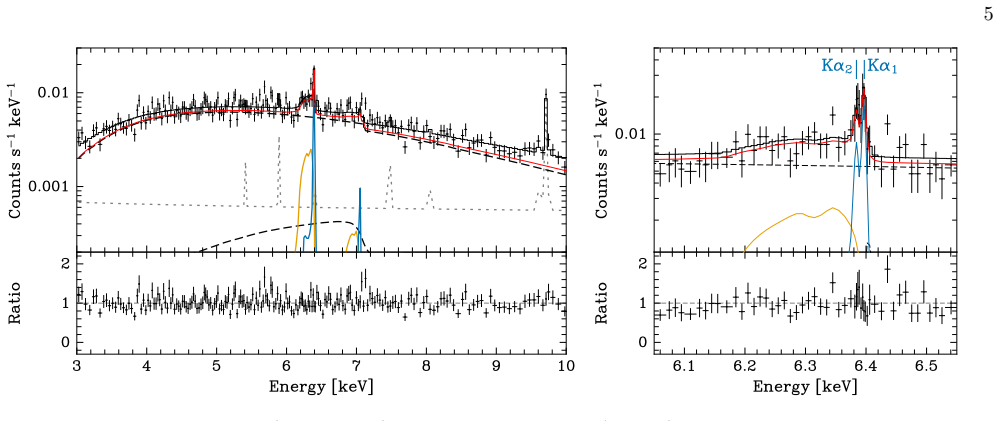
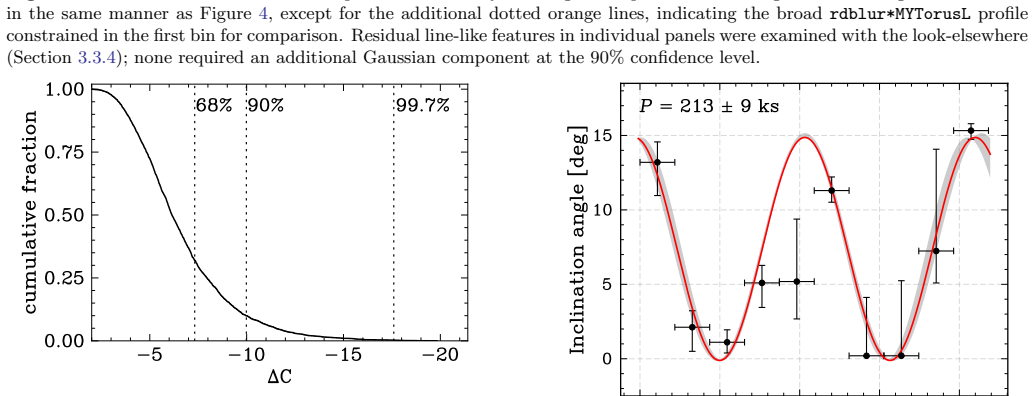
The central claim is that the diskline component of the Fe Kα line varied significantly across the observation. This evolution is consistent with a changing inner radius of the line-emitting region and an inclination modulation on a timescale of approximately 210 ks. Interpreting the modulation as Lense-Thirring precession of a tilted inner flow yields a black-hole mass of roughly 9×10^3 solar masses and a spin parameter a ≳ 0.6.
What carries the argument
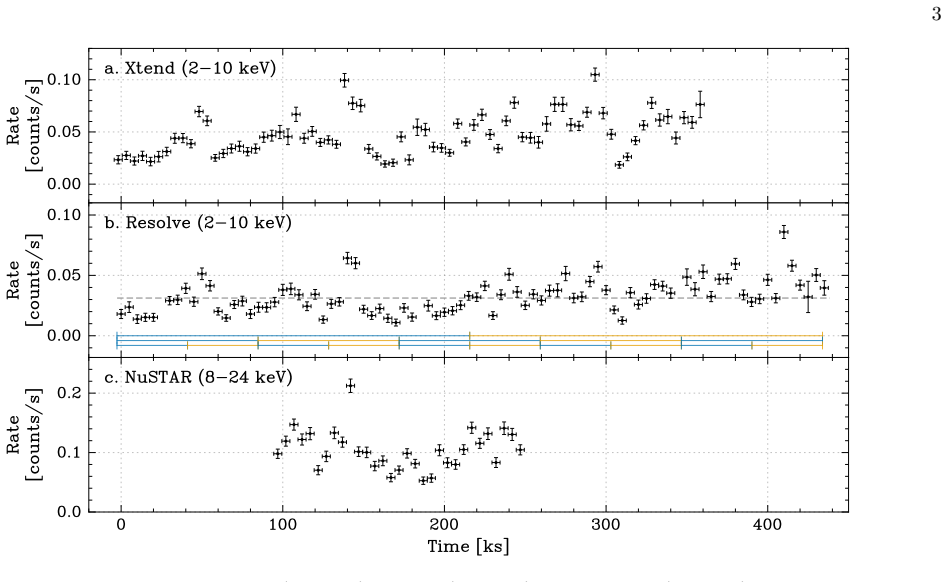
The relativistically broadened Fe K component (diskline model) whose inner radius and inclination are allowed to vary between successive 87 ks time bins.
If this is right
- The inner radius of the Fe K-emitting region in low-mass AGNs can change on timescales of order 100 ks.
- Disk inclination can exhibit periodic modulation consistent with nodal precession.
- Precession periods measured this way can select among published black-hole mass estimates for NGC 4395.
- XRISM Resolve spectra are sufficient to track such relativistic disk dynamics in AGNs.
Where Pith is reading between the lines
- The same time-binning approach could be applied to other nearby low-mass AGNs to search for precession signals and thereby constrain spins.
- Confirmation of the precession interpretation would support the presence of tilted inner flows in at least some AGNs.
- Future monitoring campaigns lasting multiple 210 ks cycles could test whether the modulation repeats coherently.
Load-bearing premise
The 210 ks modulation period is produced by Lense-Thirring precession of a tilted inner accretion flow whose line emission follows the standard precession formula.
What would settle it
A longer observation that either shows no periodic signal near 210 ks in the diskline inclination or yields a period inconsistent with the precession formula evaluated at the reported mass and spin.
Figures
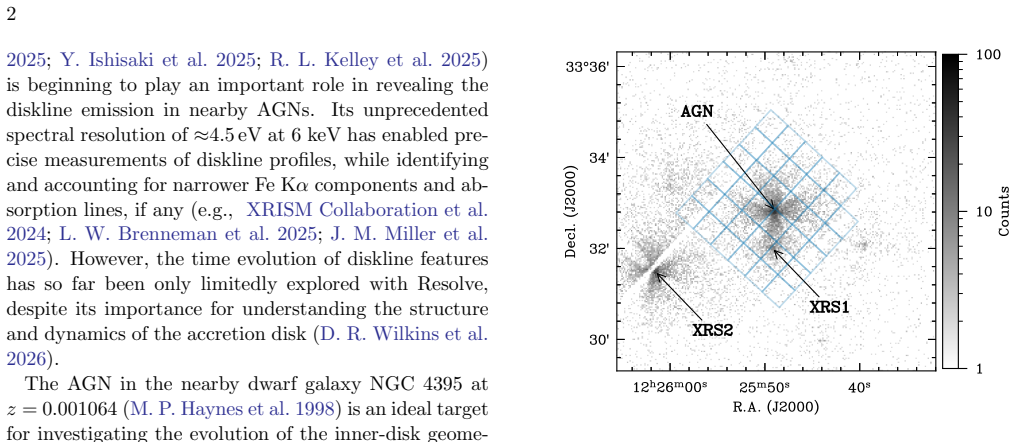

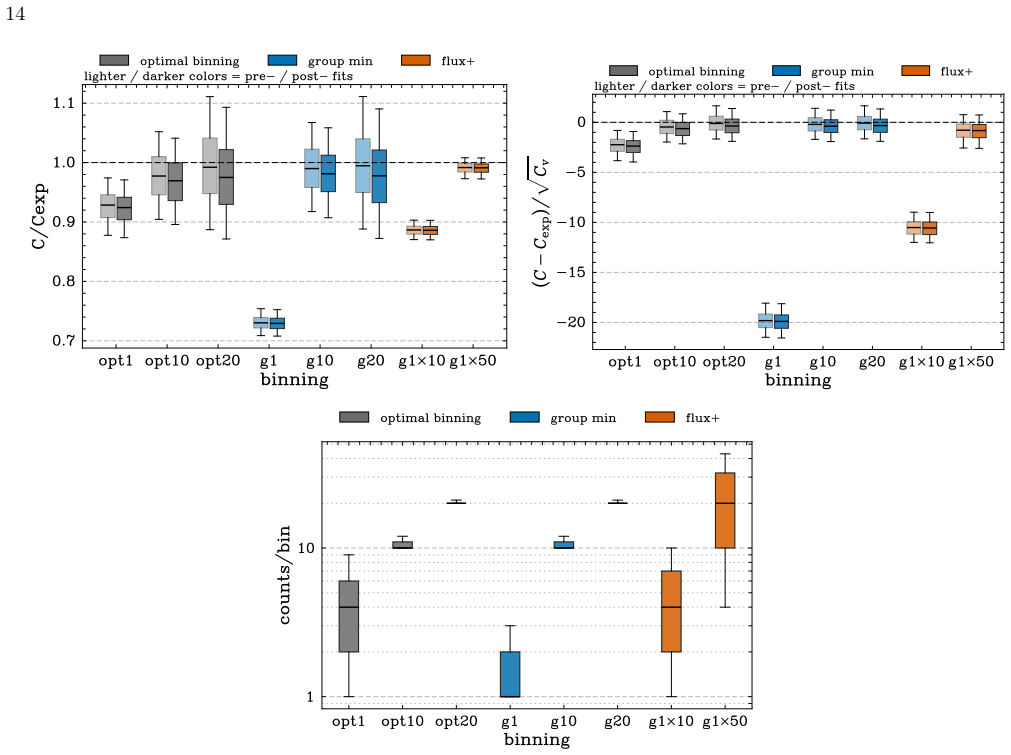
read the original abstract
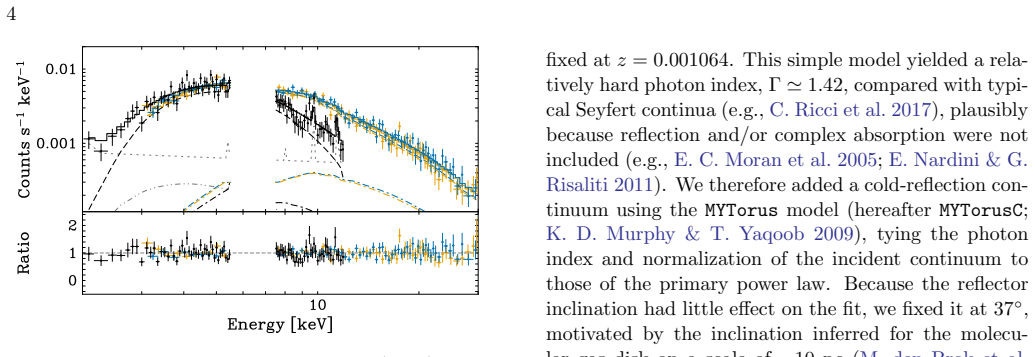
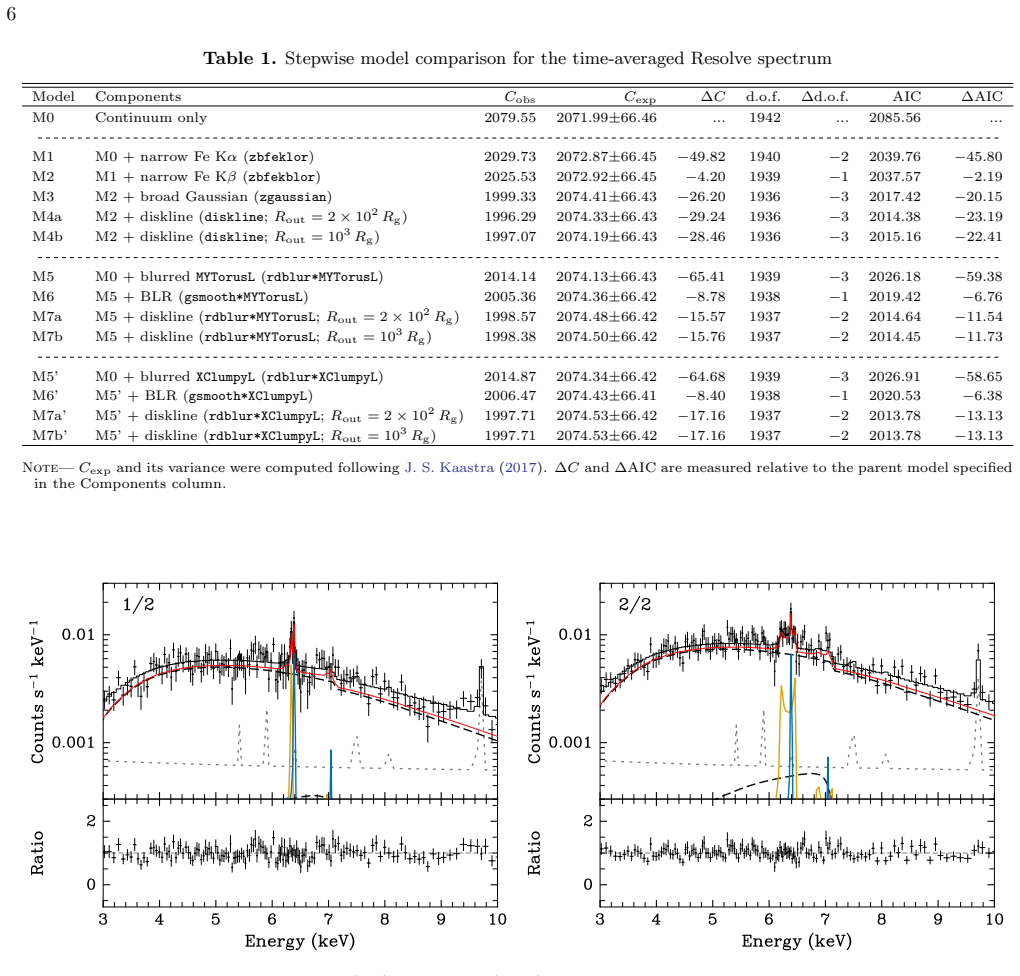
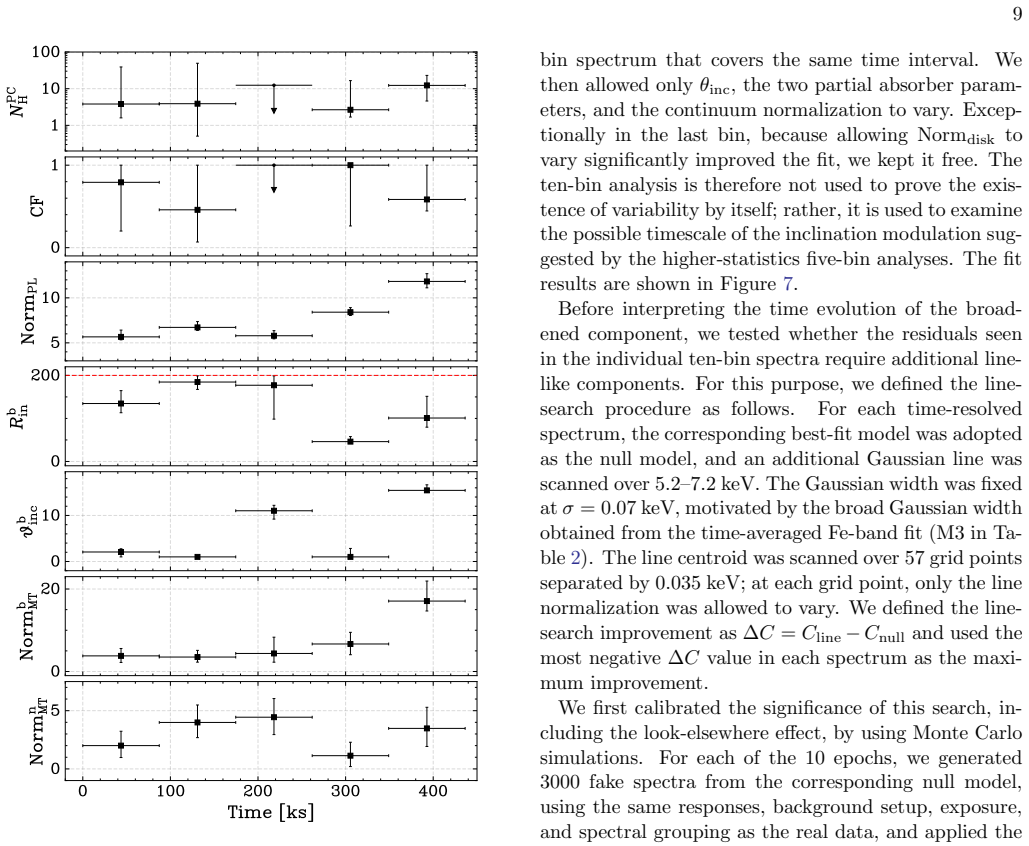
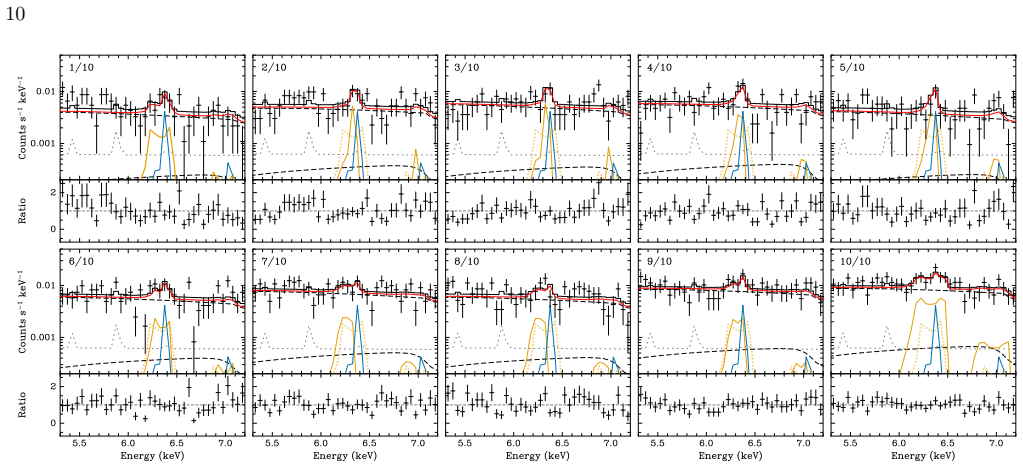
We report the first XRISM observation of the low-mass AGN in the nearby dwarf galaxy NGC 4395 ($M_{\rm BH}\sim10^{4-5}\,M_\odot$), complemented by a simultaneous NuSTAR observation. We constrained the continuum by jointly fitting the XRISM/Resolve (2-12 keV) and NuSTAR (3-30 keV) spectra while excluding the Fe K band (5.5-7.5 keV). Relative to this baseline continuum, the time-averaged Resolve spectrum revealed an unresolved neutral Fe K$\alpha$ core with a velocity width of $\lesssim$110 km s$^{-1}$ and an adjacent redward wing. The red wing was well reproduced by an additional relativistically broadened Fe K component. Furthermore, time-resolved spectroscopy with $\approx$87 ks bins showed that the diskline profile varied significantly over the $\sim$400 ks observation. This evolution can be interpreted in terms of changes in the inner radius of the line-emitting region, together with a possible inclination modulation with a period of $\approx$210 ks. If interpreted as Lense-Thirring precession of a tilted inner flow, the observed period would favor the low end of the black hole mass estimates ($M_{\rm BH}\approx9\times10^3\,M_\odot$) and imply a moderate spin ($a\gtrsim0.6$). These results highlight the capability of XRISM to track relativistic disk dynamics in AGNs.
Editorial analysis
A structured set of objections, weighed in public.
Referee Report
Summary. The paper reports the first XRISM observation of the low-mass AGN NGC 4395, jointly with NuSTAR. After fitting the continuum outside the Fe K band, the time-averaged Resolve spectrum shows an unresolved neutral Fe Kα core (velocity width ≲110 km s⁻¹) plus a red wing modeled as a relativistically broadened diskline. Time-resolved spectroscopy in ≈87 ks bins over the ∼400 ks exposure reveals significant evolution in the diskline profile, interpreted as changes in inner radius together with a possible inclination modulation of period ≈210 ks. If this modulation is Lense-Thirring precession of a tilted inner flow, the period favors the low end of existing M_BH estimates (≈9×10³ M_⊙) and implies moderate spin (a≳0.6).
Significance. If the time-resolved spectral evolution and its precession interpretation hold, the result provides a direct dynamical probe of the inner accretion flow in a low-mass AGN and demonstrates XRISM’s ability to resolve relativistic line variability on ∼100 ks timescales. The mass and spin constraints are derived from the standard Lense-Thirring formula applied to an observed period rather than from a new fitted parameter, which is a strength if the geometric assumptions are validated.
major comments (2)
- [time-resolved spectroscopy] Time-resolved spectroscopy section: the claim of a statistically significant ≈210 ks inclination modulation must be supported by explicit tests showing that the periodic signal is not an artifact of parameter degeneracies between r_in and i or of stochastic variability; without such tests the mapping from observed line-profile changes to a unique precession period (and thence to M_BH and a) is not demonstrated.
- [discussion] Discussion of Lense-Thirring interpretation: the application of the standard precession-period formula assumes that the fitted inner radius traces the precessing region, that warp propagation and external torques can be neglected, and that the 87 ks binning captures a coherent signal; these assumptions are load-bearing for the quoted M_BH≈9×10³ M_⊙ and a≳0.6 values and require quantitative justification or sensitivity checks.
minor comments (1)
- [abstract] Abstract and text: the velocity width of the unresolved core is stated as ≲110 km s⁻¹; confirm whether this is the 1σ or 90% upper limit and whether it is consistent with the instrumental resolution after accounting for any residual broadening.
Simulated Author's Rebuttal
We thank the referee for their careful reading and constructive comments on our XRISM observation of NGC 4395. We agree that the time-resolved analysis and Lense-Thirring interpretation require additional supporting tests and quantitative checks to be fully robust. Below we address each major comment and outline the revisions we will make.
read point-by-point responses
-
Referee: [time-resolved spectroscopy] Time-resolved spectroscopy section: the claim of a statistically significant ≈210 ks inclination modulation must be supported by explicit tests showing that the periodic signal is not an artifact of parameter degeneracies between r_in and i or of stochastic variability; without such tests the mapping from observed line-profile changes to a unique precession period (and thence to M_BH and a) is not demonstrated.
Authors: We agree that explicit validation is required. In the revised manuscript we will add Monte Carlo simulations of the time-resolved spectra that (i) inject stochastic variability consistent with the observed count rates and (ii) explore the r_in–i degeneracy by refitting with one parameter fixed while allowing the other to vary. These tests will quantify the significance of the ≈210 ks modulation and demonstrate that it is not an artifact, thereby supporting the subsequent mapping to precession period, M_BH and spin. revision: yes
-
Referee: [discussion] Discussion of Lense-Thirring interpretation: the application of the standard precession-period formula assumes that the fitted inner radius traces the precessing region, that warp propagation and external torques can be neglected, and that the 87 ks binning captures a coherent signal; these assumptions are load-bearing for the quoted M_BH≈9×10³ M_⊙ and a≳0.6 values and require quantitative justification or sensitivity checks.
Authors: We acknowledge that these assumptions are central. The revised discussion will include a new subsection that (i) justifies why the fitted r_in can be taken as representative of the precessing region given the observed line profile, (ii) cites supporting simulations from the literature on warp propagation timescales in low-mass AGN, and (iii) presents sensitivity checks in which the precession period is recomputed after varying the inner radius by ±20 % and the binning by one time step. The impact on the derived M_BH and a will be shown explicitly. revision: yes
Circularity Check
No significant circularity; derivation applies external formula to independently measured period.
full rationale
The paper extracts a ~210 ks modulation period directly from time-binned spectral fits to the diskline parameters (inner radius and inclination) across the ~400 ks observation. It then applies the standard Lense-Thirring precession formula to that measured period to obtain mass and spin bounds. No step reduces the claimed result to a fitted parameter or self-citation by construction; the precession formula is an external relation, the period is data-driven, and the interpretation is presented conditionally ('if interpreted as'). The central claim therefore remains independent of its inputs.
Axiom & Free-Parameter Ledger
free parameters (2)
- inner disk radius
- disk inclination
axioms (2)
- domain assumption The Fe Kα emission originates from the inner accretion disk and experiences relativistic broadening
- domain assumption The ~210 ks period represents Lense-Thirring precession of a tilted inner flow
Reference graph
Works this paper leans on
-
[1]
IEEE Transactions on Automatic Control , volume =
Akaike, H. 1974, IEEE Transactions on Automatic Control, 19, 716, doi: 10.1109/TAC.1974.1100705
-
[2]
Arnaud, K. A. 1996, Astronomical Society of the Pacific Conference Series, Vol. 101, XSPEC: The First Ten Years, ed. G. H. Jacoby & J. Barnes, 17 Astropy Collaboration, Robitaille, T. P., Tollerud, E. J., et al. 2013, A&A, 558, A33, doi: 10.1051/0004-6361/201322068 Astropy Collaboration, Price-Whelan, A. M., Sip˝ ocz, B. M., et al. 2018, AJ, 156, 123, doi...
-
[3]
The Lense-Thirring Effect and Accretion Disks around Kerr Black Holes[J/OL]
Bardeen, J. M., & Petterson, J. A. 1975, ApJL, 195, L65, doi: 10.1086/181711
-
[4]
Brenneman, L. W., & Reynolds, C. S. 2006, ApJ, 652, 1028, doi: 10.1086/508146
-
[5]
Brenneman, L. W., Wilkins, D. R., Ogorza lek, A., et al. 2025, ApJ, 995, 200, doi: 10.3847/1538-4357/ae1225
-
[6]
Burnham, K. P., & Anderson, D. R. 2002, Information and Likelihood Theory: A Basis for Model Selection and Inference (New York, NY: Springer), 49–97, doi: 10.1007/978-0-387-22456-5 2
-
[7]
Cash, W. 1979, ApJ, 228, 939, doi: 10.1086/156922 den Brok, M., Seth, A. C., Barth, A. J., et al. 2015, ApJ, 809, 101, doi: 10.1088/0004-637X/809/1/101
-
[8]
Eckart, M. E., Brown, G. V., Chiao, M. P., et al. 2024, in Society of Photo-Optical Instrumentation Engineers (SPIE) Conference Series, Vol. 13093, Space Telescopes and Instrumentation 2024: Ultraviolet to Gamma Ray, ed. J.-W. A. den Herder, S. Nikzad, & K. Nakazawa, 130931P, doi: 10.1117/12.3019276
-
[9]
Fabian, A. C., Rees, M. J., Stella, L., & White, N. E. 1989, MNRAS, 238, 729, doi: 10.1093/mnras/238.3.729
-
[10]
Hydrodynamic Simulations of Tilted Thick-Disk Accretion onto a Kerr Black Hole[J/OL]
Fragile, P. C., & Anninos, P. 2005, ApJ, 623, 347, doi: 10.1086/428433
-
[11]
Fragile, P. C., & Liska, M. 2024, arXiv e-prints, arXiv:2404.10052, doi: 10.48550/arXiv.2404.10052
-
[12]
Lense-Thirring precession around supermassive black holes during tidal disruption events[J/OL]
Franchini, A., Lodato, G., & Facchini, S. 2016, MNRAS, 455, 1946, doi: 10.1093/mnras/stv2417
-
[13]
Complex Nuclear Structure in Seyfert 2 Galaxy NGC 4388 Revealed by XRISM Observation
Fujiwara, K., Ueda, Y., Ogawa, S., et al. 2026, arXiv e-prints, arXiv:2604.06719, doi: 10.48550/arXiv.2604.06719
work page internal anchor Pith review Pith/arXiv arXiv doi:10.48550/arxiv.2604.06719 2026
-
[14]
George, I. M., & Fabian, A. C. 1991, MNRAS, 249, 352, doi: 10.1093/mnras/249.2.352
-
[15]
Harrison, F. A., Craig, W. W., Christensen, F. E., et al. 2013, ApJ, 770, 103, doi: 10.1088/0004-637X/770/2/103
-
[16]
Haynes, M. P., Hogg, D. E., Maddalena, R. J., Roberts, M. S., & van Zee, L. 1998, AJ, 115, 62, doi: 10.1086/300166 HI4PI Collaboration, Ben Bekhti, N., Fl¨ oer, L., et al. 2016, A&A, 594, A116, doi: 10.1051/0004-6361/201629178 H¨ olzer, G., Fritsch, M., Deutsch, M., H¨ artwig, J., & F¨ orster, E. 1997, PhRvA, 56, 4554, doi: 10.1103/PhysRevA.56.4554
-
[17]
Ishisaki, Y., Kelley, R. L., Awaki, H., et al. 2025, Journal of Astronomical Telescopes, Instruments, and Systems, 11, 042023, doi: 10.1117/1.JATIS.11.4.042023
-
[18]
Iwasawa, K., Tanaka, Y., & Gallo, L. C. 2010, A&A, 514, A58, doi: 10.1051/0004-6361/200912431
-
[19]
Kaastra, J. S. 2017, A&A, 605, A51, doi: 10.1051/0004-6361/201629319
-
[20]
Kaastra, J. S., & Bleeker, J. A. M. 2016, A&A, 587, A151, doi: 10.1051/0004-6361/201527395
-
[21]
S., Nardini, E., Zoghbi, A., et al
Kammoun, E. S., Nardini, E., Zoghbi, A., et al. 2019, ApJ, 886, 145, doi: 10.3847/1538-4357/ab5110
-
[22]
L., Ishisaki, Y., Costantini, E., et al
Kelley, R. L., Ishisaki, Y., Costantini, E., et al. 2025, Journal of Astronomical Telescopes, Instruments, and Systems, 11, 042026, doi: 10.1117/1.JATIS.11.4.042026
-
[23]
1918, Physikalische Zeitschrift, 19, 156
Lense, J., & Thirring, H. 1918, Physikalische Zeitschrift, 19, 156
1918
-
[24]
M., Beard, M., Breedt, E., et al
McHardy, I. M., Beard, M., Breedt, E., et al. 2023, MNRAS, 519, 3366, doi: 10.1093/mnras/stac3651
-
[25]
M., Xiang, X., Byun, D., et al
Miller, J. M., Xiang, X., Byun, D., et al. 2025, ApJL, 994, L10, doi: 10.3847/2041-8213/ae1606 16
-
[26]
Moran, E. C., Eracleous, M., Leighly, K. M., et al. 2005, AJ, 129, 2108, doi: 10.1086/429522
-
[27]
Murphy, K. D., & Yaqoob, T. 2009, MNRAS, 397, 1549, doi: 10.1111/j.1365-2966.2009.15025.x
-
[28]
Nardini, E., & Risaliti, G. 2011, MNRAS, 417, 2571, doi: 10.1111/j.1365-2966.2011.19423.x
-
[29]
2025, PASJ, 77, S10, doi: 10.1093/pasj/psaf011
Noda, H., Mori, K., Tomida, H., et al. 2025, PASJ, 77, S10, doi: 10.1093/pasj/psaf011
-
[30]
Papaloizou, J. C. B., & Terquem, C. 1995, MNRAS, 274, 987, doi: 10.1093/mnras/274.4.987
-
[31]
Peterson, B. M., Bentz, M. C., Desroches, L.-B., et al. 2005, ApJ, 632, 799, doi: 10.1086/444494
-
[32]
BAT AGN Spectroscopic Survey - V. X-ray properties of the Swift/BAT 70-month AGN catalog
Ricci, C., Trakhtenbrot, B., Koss, M. J., et al. 2017, ApJS, 233, 17, doi: 10.3847/1538-4365/aa96ad
work page internal anchor Pith review doi:10.3847/1538-4365/aa96ad 2017
-
[33]
Tanaka, Y., Nandra, K., Fabian, A. C., et al. 1995, Nature, 375, 659, doi: 10.1038/375659a0
-
[34]
Tanimoto, A., Ueda, Y., Odaka, H., et al. 2019, ApJ, 877, 95, doi: 10.3847/1538-4357/ab1b20
-
[35]
2025, PASJ, 77, S1, doi: 10.1093/pasj/psaf023
Tashiro, M., Kelley, R., Watanabe, S., et al. 2025, PASJ, 77, S1, doi: 10.1093/pasj/psaf023
-
[36]
Vaughan, S., Iwasawa, K., Fabian, A. C., & Hayashida, K. 2005, MNRAS, 356, 524, doi: 10.1111/j.1365-2966.2004.08463.x
-
[37]
Time-resolved XRISM spectroscopy reveals the evolution and structure of the corona in MCG-6-30-15
Wilkins, D. R., Brenneman, L. W., Ogorzalek, A., et al. 2026, arXiv e-prints, arXiv:2604.09761, doi: 10.48550/arXiv.2604.09761
work page internal anchor Pith review Pith/arXiv arXiv doi:10.48550/arxiv.2604.09761 2026
-
[38]
Woo, J.-H., Cho, H., Gallo, E., et al. 2019, Nature Astronomy, 3, 755, doi: 10.1038/s41550-019-0790-3 XRISM Collaboration, Audard, M., Awaki, H., et al. 2024, ApJL, 973, L25, doi: 10.3847/2041-8213/ad7397 XRISM Collaboration, Audard, M., Awaki, H., et al. 2026, Nature Astronomy, doi: 10.1038/s41550-026-02817-6
discussion (0)
Sign in with ORCID, Apple, or X to comment. Anyone can read and Pith papers without signing in.