Elastic Non-Uniform FFT (ENUFFT) spectral reconstruction of irregularly sampled orography on unstructured grids
Pith reviewed 2026-06-26 12:51 UTC · model grok-4.3
The pith
ENUFFT computes local Fourier coefficients directly from irregular orography samples on unstructured grids without interpolation or fitting.
A machine-rendered reading of the paper's core claim, the machinery that carries it, and where it could break.
Core claim
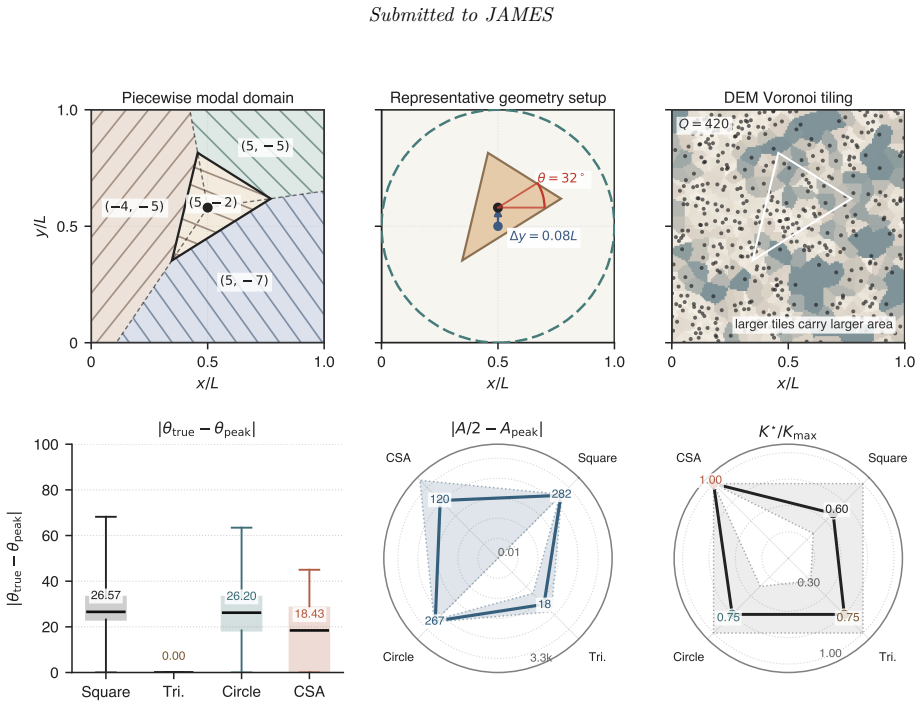
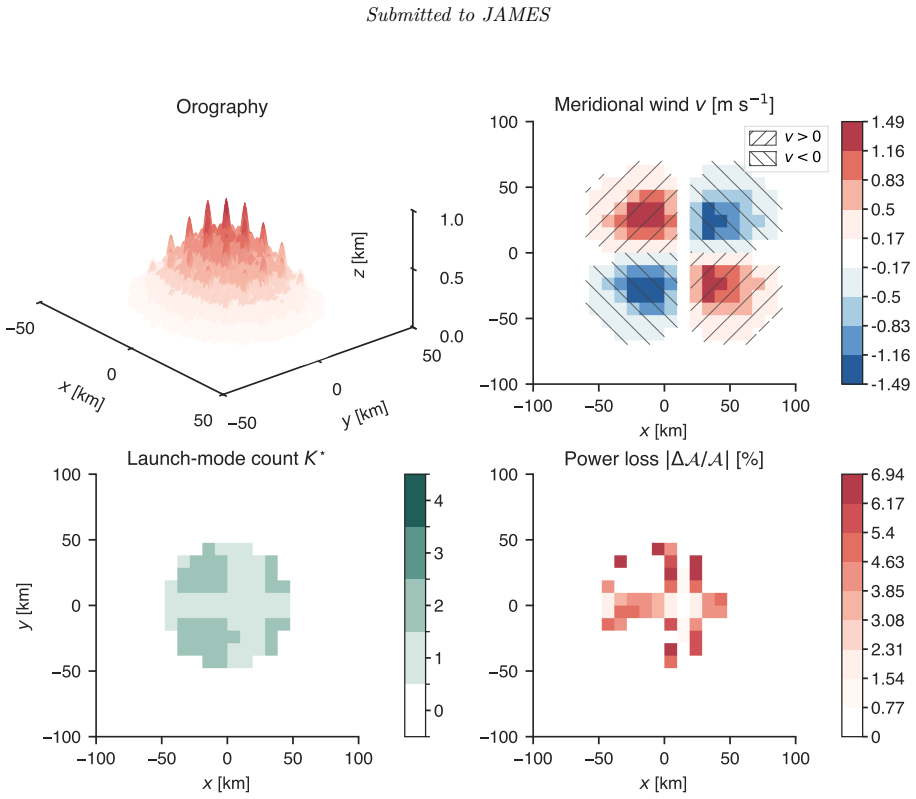
ENUFFT recovers peak amplitude and direction comparably to the strongest existing method while compacting spectra by roughly 25 percent in the monochromatic case and 60 percent in the Alpine case; its spectral variance deviates from the reference by only 14-24 percent versus 500-122000 percent for the prior approach, and the Elastic Mode Selection step reduces the launch spectrum by at least 75 percent with launch-power loss at most 7 percent.
What carries the argument
The Elastic Non-Uniform Fast Fourier Transform (ENUFFT) that pairs a type-1 NUFFT with local windowing, quadrature weights, and the Elastic Mode Selection (EMS) algorithm to produce local Fourier coefficients and retain a flow-dependent subset of modes directly from unstructured-grid samples.
If this is right
- Orographic spectra can be obtained without forcing data onto regular grids or embedding truncation effects inside the coefficients.
- Flow-dependent truncation becomes possible inside parameterizations that need a launch spectrum budget.
- Spectral variance satisfies Parseval's relation closely enough for energy-conserving source descriptions.
- Compute cost scales better with data size than fitting-based alternatives.
- Fourier-based orographic source terms become practical for spectral-budget-aware gravity-wave schemes.
Where Pith is reading between the lines
- Global models could ingest higher-resolution terrain datasets without first resampling them onto structured grids.
- The same direct-coefficient approach might apply to other irregularly observed fields such as sea-surface height or atmospheric temperature.
- Full-model tests could check whether the reduced launch spectrum improves simulated mountain-wave drag without retuning.
- The method opens a route to adaptive, location-specific mode counts that change with local wind.
Load-bearing premise
Type-1 NUFFT combined with local windowing and quadrature weights can compute accurate local Fourier coefficients from irregularly sampled data without introducing sampling-pattern bias.
What would settle it
Compute the spectral energy deviation for a known monochromatic wave sampled on the same irregular Alpine grid points; if ENUFFT stays within 25 percent while the existing method exceeds several hundred percent, the claim holds.
Figures




read the original abstract
Subgrid-scale orography remains a leading source of uncertainty in numerical modeling because terrain spectra must be recovered from irregularly sampled elevation data and then reduced to a flow-dependent launch budget for parameterizations. Existing approaches are limited either by assuming regular samples on rectangular grids or by fitting coefficients whose truncation and regularization effects become embedded in the spectrum. None achieves dynamic, flow-dependent truncation. This study introduces an Elastic Non-Uniform Fast Fourier Transform (ENUFFT) framework that computes local Fourier coefficients directly from irregularly sampled orography on unstructured grids, without interpolation or fitting. It combines a type-1 NUFFT with local windowing, quadrature weights, and a new Elastic Mode Selection (EMS) algorithm for retaining a local flow-dependent subset of modes. ENUFFT is compared with the strongest relevant existing method in a monochromatic and a real Alpine terrain test. In both cases, it recovers peak amplitude and direction comparably while significantly compacting the spectra (monochromatic ~25%, Alpine ~60%). It also satisfies the Parseval condition more closely with its spectral variance (energy) deviating from reference by ~14-24% versus ~500-122,000% for the existing method. Its EMS is additionally tested in a mountain-wave test where it reduces the launch spectrum by >=75% while keeping launch-power loss <=7%. Along with better compute scaling, ENUFFT is thus a computationally efficient, physically interpretable framework that can make Fourier-based orographic source descriptions practical for spectral-budget-aware parameterizations.
Editorial analysis
A structured set of objections, weighed in public.
Referee Report
Summary. The paper introduces the ENUFFT framework to compute local Fourier coefficients directly from irregularly sampled orography on unstructured grids via type-1 NUFFT combined with local windowing and quadrature weights, without interpolation or fitting. It adds the Elastic Mode Selection (EMS) algorithm for flow-dependent mode retention. In monochromatic and Alpine terrain tests, ENUFFT recovers peak amplitude and direction comparably to the strongest existing method while compacting spectra by ~25% and ~60%, respectively, and satisfies Parseval's relation more closely (spectral variance deviation 14-24% vs. 500-122000%). In a mountain-wave test, EMS reduces the launch spectrum by >=75% with <=7% launch-power loss. The method is positioned as enabling practical Fourier-based orographic source descriptions for spectral-budget-aware parameterizations.
Significance. If the local coefficients prove unbiased on unstructured grids, ENUFFT would address a key limitation in subgrid-scale orography modeling by delivering compact, flow-dependent spectra with improved energy conservation from real terrain data. The provision of concrete quantitative test cases (monochromatic, Alpine, mountain-wave) with explicit metrics is a strength that allows direct assessment of the compaction and Parseval claims.
major comments (3)
- [Framework description] Framework description: The claim that type-1 NUFFT plus local windowing and quadrature weights produces unbiased local Fourier coefficients on unstructured grids (no residual sampling-pattern bias) is load-bearing for all reported performance numbers, yet the manuscript provides no explicit verification test recovering known analytical coefficients from irregularly distributed samples. Without such a demonstration that the quadrature weights restore exact integration for the windowed basis functions given the local point geometry, the quantitative improvements in compaction and Parseval deviation cannot be secured.
- [EMS algorithm and mountain-wave test] EMS algorithm and mountain-wave test: The EMS selection thresholds are free parameters, but no justification, sensitivity analysis, or description of how they were chosen is given. The reported >=75% launch-spectrum reduction with <=7% power loss therefore risks being post-hoc; a parameter sweep or cross-validation on the mountain-wave case is required to establish that the truncation performance is robust rather than tuned to the specific test.
- [Quantitative comparisons] Quantitative comparisons (monochromatic and Alpine tests): The reported compaction percentages (~25%, ~60%) and Parseval deviations (14-24% vs. 500-122000%) are presented without error bars, multiple realizations, or details on how the reference spectra were constructed. Because the central claims rest on these specific numbers, the results section must include uncertainty estimates or repeated samplings to demonstrate that the improvements are not sensitive to the particular irregular point distributions used.
minor comments (2)
- [Abstract] Abstract: The compaction and deviation figures should explicitly state the underlying metrics (e.g., number of retained modes for compaction, L2 norm or integrated variance for Parseval deviation) so readers can interpret the percentages without ambiguity.
- [Notation] Notation: The definition of local window parameters and quadrature weights should be given a consistent symbol table or equation reference to avoid ambiguity when the method is implemented by others.
Simulated Author's Rebuttal
We thank the referee for the constructive and detailed report. We address each major comment below and will revise the manuscript accordingly to strengthen the claims.
read point-by-point responses
-
Referee: [Framework description] Framework description: The claim that type-1 NUFFT plus local windowing and quadrature weights produces unbiased local Fourier coefficients on unstructured grids (no residual sampling-pattern bias) is load-bearing for all reported performance numbers, yet the manuscript provides no explicit verification test recovering known analytical coefficients from irregularly distributed samples. Without such a demonstration that the quadrature weights restore exact integration for the windowed basis functions given the local point geometry, the quantitative improvements in compaction and Parseval deviation cannot be secured.
Authors: We agree that an explicit verification test recovering known analytical coefficients would strengthen the foundation for the unbiased-coefficient claim. In the revised manuscript we will add a dedicated verification subsection that applies the type-1 NUFFT plus local windowing and quadrature weights to irregularly distributed samples of known analytical functions and demonstrates exact recovery of the coefficients, thereby confirming that the quadrature weights restore the required integration. revision: yes
-
Referee: [EMS algorithm and mountain-wave test] EMS algorithm and mountain-wave test: The EMS selection thresholds are free parameters, but no justification, sensitivity analysis, or description of how they were chosen is given. The reported >=75% launch-spectrum reduction with <=7% power loss therefore risks being post-hoc; a parameter sweep or cross-validation on the mountain-wave case is required to establish that the truncation performance is robust rather than tuned to the specific test.
Authors: We accept that the EMS thresholds require explicit justification and a sensitivity study. The revised manuscript will include a parameter-sweep and cross-validation analysis on the mountain-wave test case, documenting how the thresholds were selected and confirming that the reported spectrum reduction and power-loss figures remain stable across a range of threshold values. revision: yes
-
Referee: [Quantitative comparisons] Quantitative comparisons (monochromatic and Alpine tests): The reported compaction percentages (~25%, ~60%) and Parseval deviations (14-24% vs. 500-122000%) are presented without error bars, multiple realizations, or details on how the reference spectra were constructed. Because the central claims rest on these specific numbers, the results section must include uncertainty estimates or repeated samplings to demonstrate that the improvements are not sensitive to the particular irregular point distributions used.
Authors: We agree that uncertainty quantification is needed to support the reported compaction and Parseval figures. The revised results section will report error bars obtained from repeated samplings with varied irregular point distributions, together with a clear description of how the reference spectra were constructed, to show that the improvements are robust to the choice of sampling pattern. revision: yes
Circularity Check
No circularity: new computational procedure validated on independent test cases
full rationale
The paper introduces ENUFFT as a direct computational method (type-1 NUFFT + local windowing + quadrature weights + EMS) for obtaining local Fourier coefficients from irregular unstructured-grid samples without interpolation or fitting. All reported metrics (peak recovery, spectral compaction ~25-60%, Parseval deviation 14-24% vs. 500-122000%, EMS reduction >=75% with <=7% power loss) are obtained from explicit numerical comparisons on separate monochromatic, Alpine, and mountain-wave test cases. No step reduces by the paper's own equations to a fitted parameter renamed as prediction, no self-definitional loop, and no load-bearing self-citation chain is present. The derivation chain is therefore self-contained against external benchmarks.
Axiom & Free-Parameter Ledger
free parameters (2)
- local window parameters
- EMS selection thresholds
axioms (1)
- domain assumption Type-1 NUFFT combined with quadrature weights computes unbiased local Fourier coefficients from irregular point samples on unstructured grids.
invented entities (1)
-
Elastic Mode Selection (EMS) algorithm
no independent evidence
Reference graph
Works this paper leans on
-
[1]
and Shea-Brown, Eric , journal =
Recanatesi, Stefano and Bradde, Serena and Balasubramanian, Vijay and Steinmetz, Nicholas A. and Shea-Brown, Eric , journal =. A scale-dependent measure of system dimensionality , year =
-
[2]
Source Enumeration Approaches Using Eigenvalue Gaps and Machine Learning Based Threshold for Direction-of-Arrival Estimation , year =
Lee, Yunseong and Park, Chanhong and Kim, Taeyoung and Choi, Yeongyoon and Kim, Kiseon and Kim, Dongho and Lee, Myung-Sik and Lee, Dongkeun , journal =. Source Enumeration Approaches Using Eigenvalue Gaps and Machine Learning Based Threshold for Direction-of-Arrival Estimation , year =
-
[3]
A tutorial on spectral clustering , year =
Luxburg, Ulrike von , journal =. A tutorial on spectral clustering , year =
-
[4]
and Tukey, John W
Cooley, J.W. and Tukey, John W. , title =. Mathematics of Computation , year =
-
[5]
and Rokhlin, Vladimir , journal =
Dutt, A. and Rokhlin, Vladimir , journal =. Fast Fourier Transforms for Nonequispaced Data , year =
-
[6]
IEEE Transactions on Antennas and Propagation , volume =
Houshmand, Behnam and Chew, Weng Cho and Lee, Shung-Wu , title =. IEEE Transactions on Antennas and Propagation , volume =. 1991 , doi =
1991
-
[7]
Accelerating the Nonuniform Fast Fourier Transform , year =
Greengard, Leslie and Lee, June‐Yub , journal =. Accelerating the Nonuniform Fast Fourier Transform , year =
-
[8]
and Sutton, Bradley P
Fessler, Jeffrey A. and Sutton, Bradley P. , journal =. Nonuniform fast fourier transforms using min-max interpolation , year =
-
[9]
, title =
Fessler, Jeffrey A. , title =
-
[10]
and Magland, Jeremy and Klinteberg, Ludvig af , title =
Barnett, Alexander H. and Magland, Jeremy and Klinteberg, Ludvig af , title =. SIAM Journal on Scientific Computing , year =
-
[11]
Journal of Computational Physics , volume =
Sammis, Ian and Strain, John , title =. Journal of Computational Physics , volume =. 2009 , doi =
2009
-
[12]
, journal =
Barnett, Alex H. , journal =. Aliasing error of the exp(beta1-z2) kernel in the nonuniform fast Fourier transform , year =
-
[13]
Continuous window functions for NFFT , year =
Potts, Daniel and Tasche, Manfred , journal =. Continuous window functions for NFFT , year =
-
[14]
Kaiser, J. F. and Schafer, Ronald W. , journal =. On the use of the I0-sinh window for spectrum analysis , year =
-
[15]
A Constrained Spectral Approximation of Subgrid‐Scale Orography on Unstructured Grids , year =
Chew, Ray and Dolaptchiev, Stamen and Wedel, Maja‐Sophie and Achatz, Ulrich , journal =. A Constrained Spectral Approximation of Subgrid‐Scale Orography on Unstructured Grids , year =
-
[16]
and Reichel, L
Park, Y. and Reichel, L. and Rodriguez, G. and Yu, X. , journal =. Parameter determination for Tikhonov regularization problems in general form , year =
-
[17]
, journal =
Golub, Gene H. , journal =. Matrix Computations , year =
-
[18]
Acta numerica , volume=
Monte Carlo and quasi-Monte Carlo methods , author=. Acta numerica , volume=. 1998 , publisher=
1998
-
[19]
doi:10.5067/MEaSUREs/SRTM/SRTMGL1.003 , note =
2013 , publisher =. doi:10.5067/MEaSUREs/SRTM/SRTMGL1.003 , note =
-
[20]
Reviews of Geophysics , volume=
The shuttle radar topography mission , author=. Reviews of Geophysics , volume=. 2007 , publisher=
2007
-
[21]
Coles, W. A. and Hobbs, G. B. and Champion, D. J. and Manchester, R. N. and Verbiest, J. P. W. , title =. Monthly Notices of the Royal Astronomical Society , year =
-
[22]
and Qui, Harry Z
Maciejewski, Mark W. and Qui, Harry Z. and Rujan, Iulian and Mobli, Mehdi and Hoch, Jeffrey C. , title =. Journal of Magnetic Resonance , year =
-
[23]
and Menon, Padmanabhan , title =
Pipe, James G. and Menon, Padmanabhan , title =. Magnetic Resonance in Medicine , year =
-
[24]
and Meyer, Craig H
Jackson, John I. and Meyer, Craig H. and Nishimura, Dwight G. and Macovski, Albert , title =. IEEE Transactions on Medical Imaging , year =
-
[25]
Mathematics , VOLUME =
Oliveira, Carlos and Pais, Ana and Belinha, Jorge , TITLE =. Mathematics , VOLUME =. 2025 , NUMBER =
2025
-
[26]
Tom Axel Bobach , title =
-
[27]
and Linsen, L
Park, S.W. and Linsen, L. and Kreylos, O. and Owens, J.D. and Hamann, B. , journal=. Discrete Sibson interpolation , year=
-
[28]
Quarterly Journal of the Royal Meteorological Society , author =
Zängl, Günther and Reinert, Daniel and Rípodas, Pilar and Baldauf, Michael , journal =. The ICON (ICOsahedral Non-hydrostatic) modelling framework of DWD and MPI-M: Description of the non-hydrostatic dynamical core , year =. doi:10.1002/qj.2378 , keywords =
-
[29]
SIAM Review , volume =
Du, Qiang and Faber, Vance and Gunzburger, Max , title =. SIAM Review , volume =. 1999 , doi =
1999
-
[30]
Applied Sciences , VOLUME =
Chen, Xinwen and Tan, Zheng and Wang, Jianwei and Zhao, Na and Tang, Yinhui and Liu, Yangyang and Si, Jia and Zhang, Yu and Sun, Jianying and Li, Weiyan and Lv, Qunbo , TITLE =. Applied Sciences , VOLUME =. 2024 , NUMBER =
2024
-
[31]
On the Gibbs Phenomenon and its Resolution , urldate =
David Gottlieb and Chi-Wang Shu , journal =. On the Gibbs Phenomenon and its Resolution , urldate =. 1997 , doi =
1997
-
[32]
and Hogan, Robin J
Williams, Peter D. and Hogan, Robin J. and Sherwood, Steven C. and Warner, Christopher D. and van Niekerk, Annelize , title =. Quarterly Journal of the Royal Meteorological Society , volume =. 2020 , doi =
2020
-
[33]
and Vosper, S
van Niekerk, A. and Vosper, S. B. , title =. Quarterly Journal of the Royal Meteorological Society , volume =. 2021 , doi =
2021
-
[34]
and Vosper, S
van Niekerk, A. and Vosper, S. B. and Teixeira, M. A. C. , title =. Quarterly Journal of the Royal Meteorological Society , volume =. 2023 , doi =
2023
-
[35]
Atmosphere , volume =
Liu, Kun and Yu, Fei and Su, Yong and Zhang, Hongliang and Chen, Qiying and Sun, Jian , title =. Atmosphere , volume =. 2023 , doi =
2023
-
[36]
Hewitt , journal =
Edwin Hewitt and Robert E. Hewitt , journal =. The Gibbs-Wilbraham Phenomenon: An Episode in Fourier Analysis , urldate =. 1979 , doi =
1979
-
[37]
Palmer, T. N. and Shutts, G. J. and Swinbank, R. , title =. Quarterly Journal of the Royal Meteorological Society , volume =. 1986 , doi =
1986
-
[38]
McFarlane, N. A. , title =. Journal of the Atmospheric Sciences , volume =. 1987 , doi =
1987
-
[39]
and Chun, Hye-Yeong , title =
Kim, Young-Joon and Eckermann, Stephen D. and Chun, Hye-Yeong , title =. Atmosphere-Ocean , volume =. 2003 , doi =
2003
-
[40]
Teixeira, Miguel A. C. , title =. Frontiers in Physics , volume =. 2014 , doi =
2014
-
[41]
How does knowledge of atmospheric gravity waves guide their parameterizations? , journal =
Plougonven, Riwal and de la C. How does knowledge of atmospheric gravity waves guide their parameterizations? , journal =. 2020 , doi =
2020
-
[42]
A new subgrid-scale orographic drag parametrization: Its formulation and testing , journal =
Lott, Fran. A new subgrid-scale orographic drag parametrization: Its formulation and testing , journal =. 1997 , doi =
1997
-
[43]
and Shutts, G
Gregory, D. and Shutts, G. J. and Mitchell, J. R. , title =. Quarterly Journal of the Royal Meteorological Society , volume =. 1998 , doi =
1998
-
[44]
Scinocca, J. F. and McFarlane, N. A. , title =. Quarterly Journal of the Royal Meteorological Society , volume =. 2000 , doi =
2000
-
[45]
and Brown, A
Webster, S. and Brown, A. R. and Cameron, D. R. and Jones, C. P. , title =. Quarterly Journal of the Royal Meteorological Society , volume =. 2003 , doi =
2003
-
[46]
Beljaars, A. C. M. and Brown, A. R. and Wood, N. , title =. Quarterly Journal of the Royal Meteorological Society , volume =. 2004 , doi =
2004
-
[47]
, title =
Garner, Stephen T. , title =. Journal of the Atmospheric Sciences , volume =. 2005 , doi =
2005
-
[48]
and Eckermann, Stephen D
Marks, Crispin J. and Eckermann, Stephen D. , title =. Journal of the Atmospheric Sciences , volume =. 1995 , doi =
1995
-
[49]
Journal of Geophysical Research: Atmospheres , volume =
Choi, Hyun-Joo and Hong, Song-You , title =. Journal of Geophysical Research: Atmospheres , volume =. 2015 , doi =
2015
-
[50]
and Zadra, Ayrton , title =
Sandu, Irina and Bechtold, Peter and Beljaars, Anton and Bozzo, Alessio and Pithan, Felix and Shepherd, Theodore G. and Zadra, Ayrton , title =. Journal of Advances in Modeling Earth Systems , volume =. 2016 , doi =
2016
-
[51]
and Sandu, Irina and Wedi, Nils and Vosper, Simon B
Elvidge, Andrew D. and Sandu, Irina and Wedi, Nils and Vosper, Simon B. and Zadra, Ayrton and Boussetta, Souhail and Bouyssel, Fran. Uncertainty in the representation of orography in weather and climate models and implications for parameterized drag , journal =. 2019 , doi =
2019
-
[52]
Journal of Advances in Modeling Earth Systems , volume =
Xie, Jinbo and Zhang, Minghua and Zeng, Qingcun and Xie, Zhenghui and Liu, Hailong and Chai, Zhaoyang and He, JuanXiong and Zhang, He , title =. Journal of Advances in Modeling Earth Systems , volume =. 2021 , doi =
2021
-
[53]
Parameterized orographic gravity wave drag and dynamical effects in
H. Parameterized orographic gravity wave drag and dynamical effects in. Climate Dynamics , volume =. 2024 , doi =
2024
-
[54]
and Bellinghausen, K
Juricke, S. and Bellinghausen, K. and Danilov, S. and Kutsenko, A. and Oliver, M. , title =. Journal of Advances in Modeling Earth Systems , volume =. 2023 , doi =
2023
-
[55]
, title =
Shi, Yilei and Zhu, Xiao Xiang and Ellero, Marco and Adams, Nikolaus A. , title =. Computers & Fluids , volume =. 2013 , doi =
2013
-
[56]
doi:10.5281/ZENODO.17391579 , note =
Jochum, Felix and Knop, Irmgard and Rothermel, Jonas and Artiano, Marco and Babbar, Arpit and Ranocha, Hendrik and Dolaptchiev, Stamen and Klewinghaus, Sandra and Achatz, Ulrich , year =. doi:10.5281/ZENODO.17391579 , note =
-
[57]
npj Climate and Atmospheric Science , volume =
Wang, Yingjie and Xu, Xin and Yang, Xiangrong and Wei, Peng and Li, Congyuan and Wu, Jianping and Ren, Kaijun , title =. npj Climate and Atmospheric Science , volume =. 2025 , doi =
2025
-
[58]
2026 , note =
Banerjee, Tridib , title =. 2026 , note =
2026
-
[59]
Banerjee, Tridib , title =. 2026 , publisher =. doi:10.5281/ZENODO.20544458 , url =
-
[60]
Banerjee, Tridib , title =. 2026 , publisher =. doi:10.5281/ZENODO.20545261 , url =
-
[61]
2026 , publisher =
Banerjee, Tridib , title =. 2026 , publisher =
2026
-
[62]
Achatz, U. and Kim, Y.-H. and Voelker, G. S. , journal =. Multi-scale dynamics of the interaction between waves and mean flows: From nonlinear. 2023 , issn =. doi:10.1063/5.0165180 , publisher =
-
[63]
Achatz, U. and Ribstein, B. and Senf, F. and Klein, R. , journal =. The interaction between synoptic-scale balanced flow and a finite-amplitude mesoscale wave field throughout all atmospheric layers: weak and moderately strong stratification , year =. doi:10.1002/qj.2926 , publisher =
-
[64]
Journal of the Atmospheric Sciences , title =
B. Journal of the Atmospheric Sciences , title =. 2021 , issn =. doi:10.1175/jas-d-20-0065.1 , publisher =
-
[65]
Journal of the Atmospheric Sciences , title =
B. Journal of the Atmospheric Sciences , title =. 2016 , issn =. doi:10.1175/jas-d-16-0069.1 , publisher =
-
[66]
Journal of the Atmospheric Sciences , title =
Jochum, Felix and Chew, Ray and Lott, Fran. Journal of the Atmospheric Sciences , title =. 2025 , issn =. doi:10.1175/jas-d-24-0158.1 , publisher =
-
[67]
Journal of the Atmospheric Sciences , title =
Kim, Young-Ha and B. Journal of the Atmospheric Sciences , title =. 2021 , issn =. doi:10.1175/jas-d-20-0066.1 , publisher =
-
[68]
Atmospheric Chemistry and Physics , title =
Kim, Young-Ha and Voelker, Georg Sebastian and B. Atmospheric Chemistry and Physics , title =. 2024 , issn =. doi:10.5194/acp-24-3297-2024 , publisher =
-
[69]
Muraschko, J. and Fruman, M. D. and Achatz, U. and Hickel, S. and Toledo, Y. , journal =. On the application of. 2015 , issn =. doi:10.1002/qj.2381 , publisher =
-
[70]
Voelker, Georg S. and B. Journal of the Atmospheric Sciences , title =. 2024 , issn =. doi:10.1175/jas-d-23-0153.1 , publisher =
-
[71]
2000 , edition =
Okabe, Atsuyuki and Boots, Barry and Sugihara, Kokichi and Chiu, Sung Nok , title =. 2000 , edition =
2000
-
[72]
ACM Computing Surveys , volume =
Aurenhammer, Franz , title =. ACM Computing Surveys , volume =. 1991 , doi =
1991
-
[73]
and Hodgman, Gary W
Sutherland, Ivan E. and Hodgman, Gary W. , title =. Communications of the ACM , volume =. 1974 , doi =
1974
-
[74]
Nature , volume =
Braun, Jean and Sambridge, Malcolm , title =. Nature , volume =. 1995 , doi =
1995
-
[75]
doi:10.5067/MEaSUREs/NASADEM/NASADEM_HGT.001 , note =
2020 , publisher =. doi:10.5067/MEaSUREs/NASADEM/NASADEM_HGT.001 , note =
-
[76]
2019 , publisher =. doi:10.5067/ASTER/ASTGTM.003 , note =
-
[77]
doi:10.57746/eo.01kkfx0ejw8r5ndc9bg5nt13ws , note =
2024 , publisher =. doi:10.57746/eo.01kkfx0ejw8r5ndc9bg5nt13ws , note =
-
[78]
and Sampson, Christopher C
Yamazaki, Dai and Ikeshima, Daiki and Tawatari, Ryunosuke and Yamaguchi, Taichi and O'Loughlin, Fiachra and Neal, Jeffrey C. and Sampson, Christopher C. and Kanae, Shinjiro and Bates, Paul D. , title =. Geophysical Research Letters , volume =. 2017 , doi =
2017
-
[79]
Hawker, Laurence and Neal, Jeffrey , title =. 2021 , publisher =. doi:10.5523/bris.25wfy0f9ukoge2gs7a5mqpq2j7 , note =
-
[80]
Environmental Research Letters , volume =
Hawker, Laurence and Uhe, Peter and Paulo, Lina and Sosa, Josue and Savage, James and Sampson, Christopher and Neal, Jeffrey , title =. Environmental Research Letters , volume =. 2022 , doi =
2022
discussion (0)
Sign in with ORCID, Apple, or X to comment. Anyone can read and Pith papers without signing in.