Relativistic effects in extreme-mass-ratio inspirals within scalar clouds: Eccentric and inclined orbits
Pith reviewed 2026-06-26 13:30 UTC · model grok-4.3
The pith
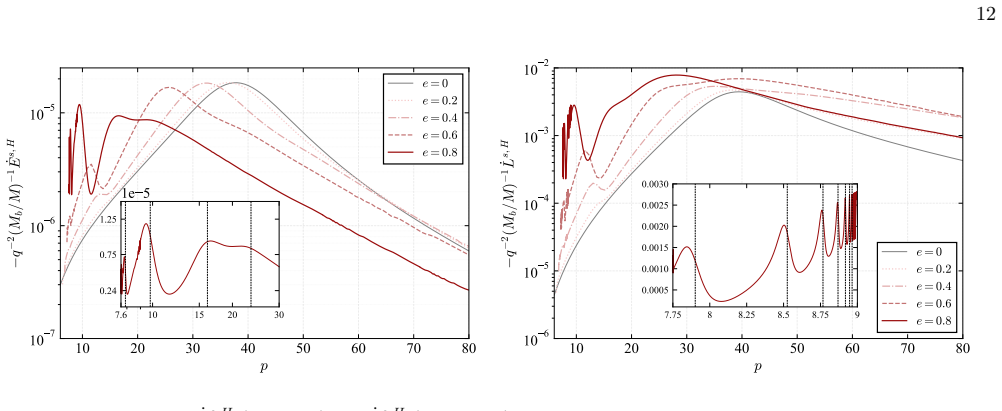
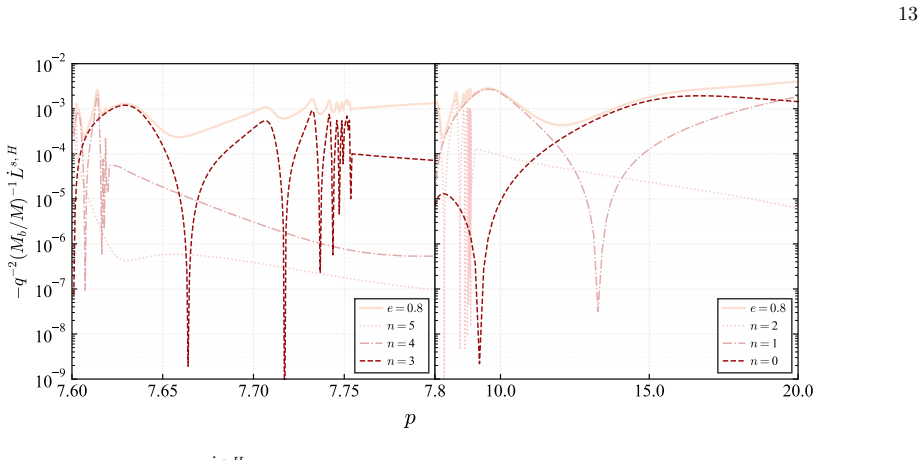
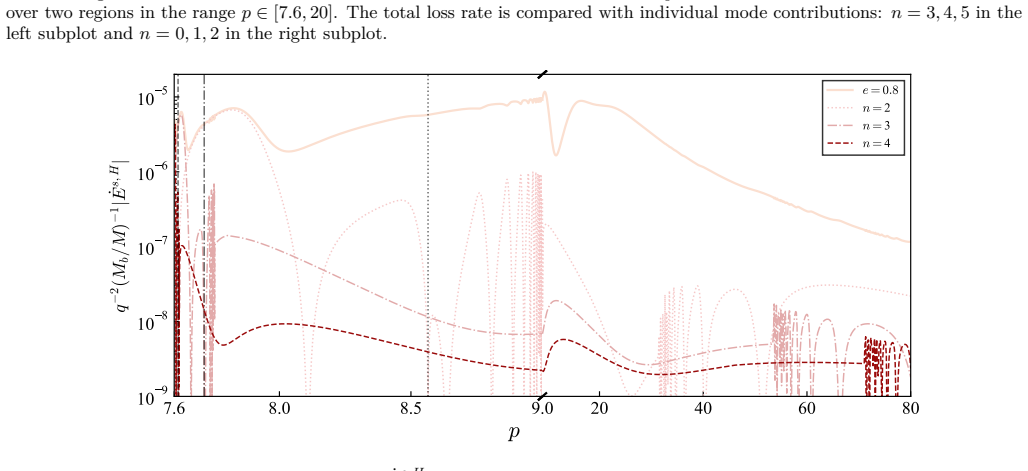
Orbital eccentricity in scalar clouds around black holes creates a dense spectrum of resonances near the last stable orbit through relativistic apsidal precession, while inclination enables net energy transfer from the cloud to the orbit be
A machine-rendered reading of the paper's core claim, the machinery that carries it, and where it could break.
Core claim
Orbital eccentricity induces a dense spectrum of resonances near the last stable orbit associated with strong relativistic apsidal precession. Orbital inclination significantly modifies the orbital energy and angular momentum losses. In particular, a critical inclination angle exists below which, at sufficiently small orbital radii, there is a net transfer of energy from the scalar cloud to the orbit. For sufficiently large eccentricities these resonances persist across the full range of inclinations, although their structure changes between prograde and retrograde orbits.
What carries the argument
The fully relativistic perturbative framework that computes the scalar energy and angular momentum scattered to spatial infinity and absorbed at the event horizon for eccentric and inclined orbits on a fixed Schwarzschild background.
If this is right
- Resonances from eccentricity alter the rate of orbital decay near the last stable orbit.
- Inclination can reverse the direction of energy flow between cloud and orbit at small separations.
- Resonance patterns survive at high eccentricity for both prograde and retrograde motion but differ in structure.
- The framework supplies initial conditions for later calculations on spinning black holes with generic orbits.
Where Pith is reading between the lines
- LISA waveforms from EMRIs could carry imprints of these resonances if scalar clouds are present.
- The critical inclination might set a selection effect on which EMRIs experience cloud-driven orbital pumping.
- Extending the same flux calculation to Kerr backgrounds would test whether spin modifies the resonance density or the critical angle.
Load-bearing premise
The scalar cloud acts as a fixed non-backreacting background and the perturbative calculation of fluxes remains accurate for eccentric and inclined orbits.
What would settle it
A numerical-relativity simulation that includes cloud backreaction and tracks whether energy flows from the cloud to the orbit below the reported critical inclination at small radii would confirm or refute the net-transfer claim.
Figures
read the original abstract
We study extreme-mass-ratio inspirals (EMRIs) evolving in a scalar cloud environment that may form through superradiant instabilities, using a fully relativistic perturbative framework that allows for eccentric and inclined orbits. EMRIs, consisting of a stellar-mass compact object inspiraling into a supermassive black hole, are key sources for space-based gravitational-wave detectors such as LISA. Previous relativistic studies of EMRIs in scalar clouds have been restricted to circular, equatorial motion. Here, instead, we focus on a Schwarzschild black hole background to incorporate eccentricity and orbital inclination. By computing the scalar energy and angular momentum scattered off to spatial infinity and absorbed at the event horizon, we show that orbital eccentricity can induce a dense spectrum of resonances near the last stable orbit, associated with strong relativistic apsidal precession. We further find that orbital inclination can significantly modify the orbital energy and angular momentum losses. In particular, we identify a critical inclination angle below which, at sufficiently small orbital radii, there is a net transfer of energy from the scalar cloud to the orbit. Moreover, for sufficiently large eccentricities, resonances associated with relativistic apsidal precession persist across the full range of inclinations, although their structure changes significantly between prograde and retrograde orbits. These results provide a foundation for future studies of EMRIs in scalar cloud environments on fully generic orbits around spinning black holes.
Editorial analysis
A structured set of objections, weighed in public.
Referee Report
Summary. The manuscript studies relativistic effects in EMRIs within scalar clouds for eccentric and inclined orbits around a Schwarzschild black hole using a perturbative framework. It computes scalar fluxes to infinity and the horizon, finding that eccentricity induces a dense spectrum of resonances near the last stable orbit due to apsidal precession, and that inclination modifies energy and angular momentum losses, with a critical inclination below which net energy is transferred from the cloud to the orbit at small radii. Resonances persist for large eccentricities across inclinations.
Significance. If the results are accurate, this provides an important extension of prior circular-equatorial calculations to generic orbits, highlighting new relativistic phenomena relevant for LISA-detectable EMRIs in scalar environments. The use of a fully relativistic perturbative approach for flux calculations on eccentric and inclined geodesics is a notable technical contribution.
major comments (2)
- [§4] The net energy transfer claim for low inclinations at small radii assumes a fixed scalar cloud background. Since energy is transferred, the cloud would be depleted, and without a backreaction calculation or validity estimate, this central result's applicability is unclear.
- [§2] The perturbative flux computation for eccentric and inclined orbits is presented without convergence tests or comparisons to known limits, raising questions about the reliability of the reported resonances and modifications due to inclination.
minor comments (1)
- [Introduction] A brief comparison table or statement quantifying the differences from circular equatorial cases would strengthen the presentation.
Simulated Author's Rebuttal
We thank the referee for their detailed review and constructive feedback. We address each major comment below and outline the revisions we will make.
read point-by-point responses
-
Referee: [§4] The net energy transfer claim for low inclinations at small radii assumes a fixed scalar cloud background. Since energy is transferred, the cloud would be depleted, and without a backreaction calculation or validity estimate, this central result's applicability is unclear.
Authors: We agree that the fixed-background approximation requires qualification when net energy transfer occurs. In the revised manuscript we will add a dedicated subsection estimating the cloud depletion timescale (using the computed energy flux) relative to the orbital inspiral timescale, thereby providing a validity criterion for the reported net-transfer regime. A full backreaction calculation lies beyond the scope of the present perturbative study. revision: yes
-
Referee: [§2] The perturbative flux computation for eccentric and inclined orbits is presented without convergence tests or comparisons to known limits, raising questions about the reliability of the reported resonances and modifications due to inclination.
Authors: We will incorporate explicit convergence tests (varying the number of azimuthal and radial modes) and direct comparisons to the circular-equatorial fluxes of prior work as well as to the vacuum Schwarzschild geodesic limits. These additions will be placed in a new appendix and referenced in the main text. revision: yes
Circularity Check
No significant circularity; results are direct outputs of perturbative flux calculations
full rationale
The paper computes scalar energy and angular momentum fluxes via a fully relativistic perturbative framework on a fixed Schwarzschild background, extending prior circular-equatorial results to eccentric and inclined geodesics. Resonances near the LSO and the critical inclination for net energy transfer are presented as numerical outputs of these flux integrals, with no reduction to fitted parameters, self-definitional relations, or load-bearing self-citations within the provided text. The derivation chain remains self-contained against external benchmarks and does not exhibit any of the enumerated circularity patterns.
Axiom & Free-Parameter Ledger
axioms (1)
- domain assumption Scalar cloud forms via superradiant instability and can be treated as a fixed background on Schwarzschild spacetime.
Reference graph
Works this paper leans on
-
[1]
The results are summarized in Fig
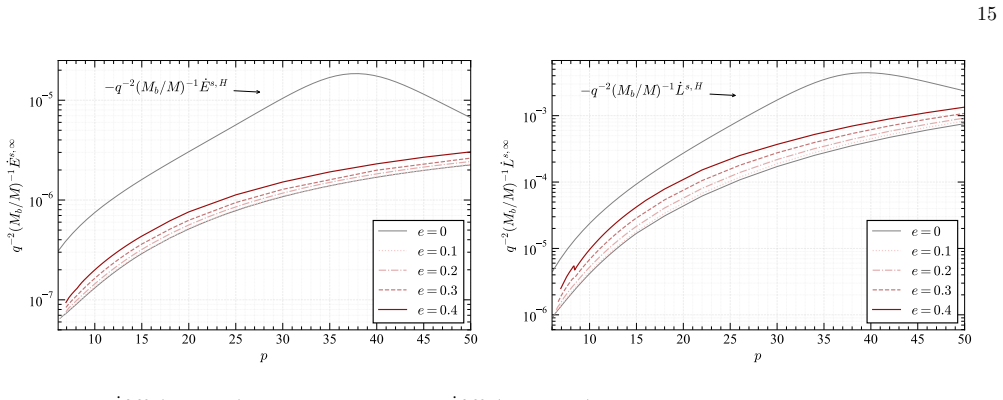
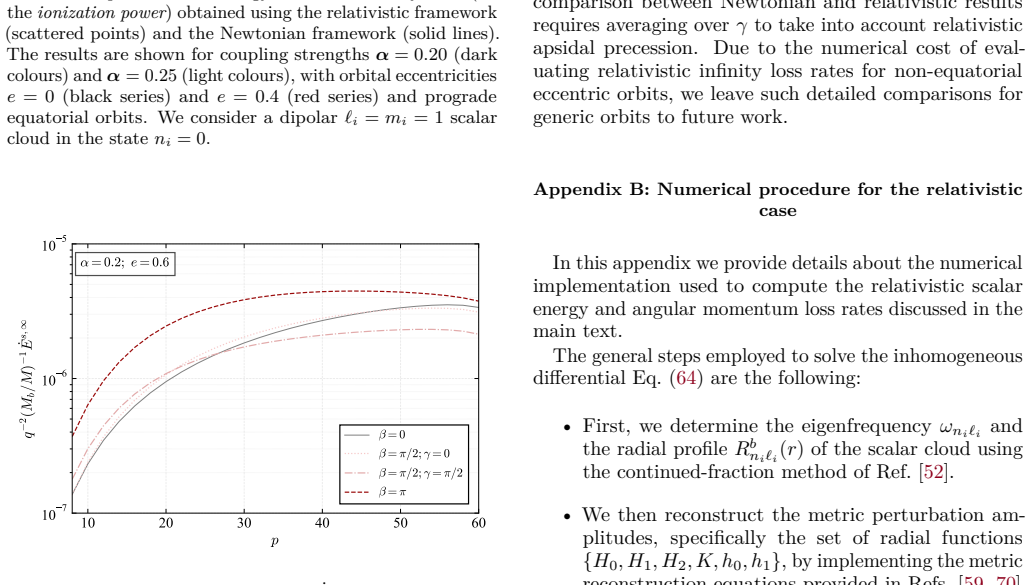
Infinity loss rates We now turn to the loss rates associated with the scalar waves propagating to spatial infinity, ˙Es,∞and ˙Ls,∞. The results are summarized in Fig. 4. We note that, as the eccentricity increases, achieving convergence in then- mode summation requires a substantially larger number of terms, which makes the numerical evaluation increasing...
-
[2]
For this case, the radial overtone index is fixed ton = 0and σm0 =mΩφ=m √ M/r3p, withrp =pM
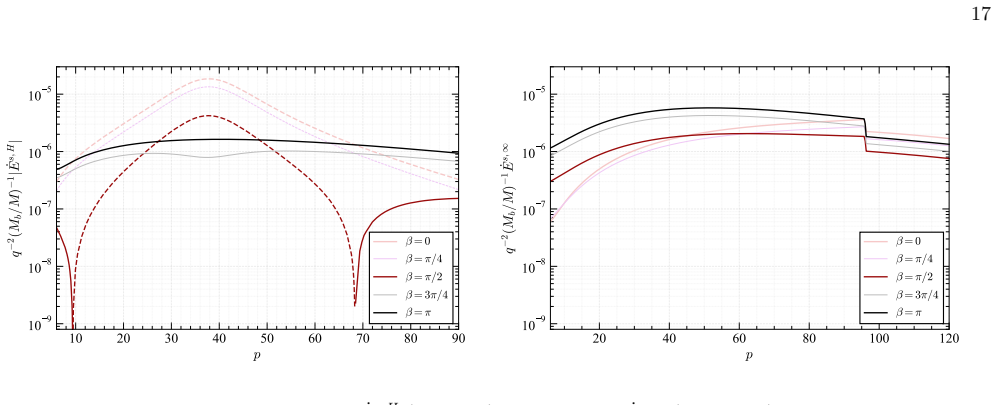
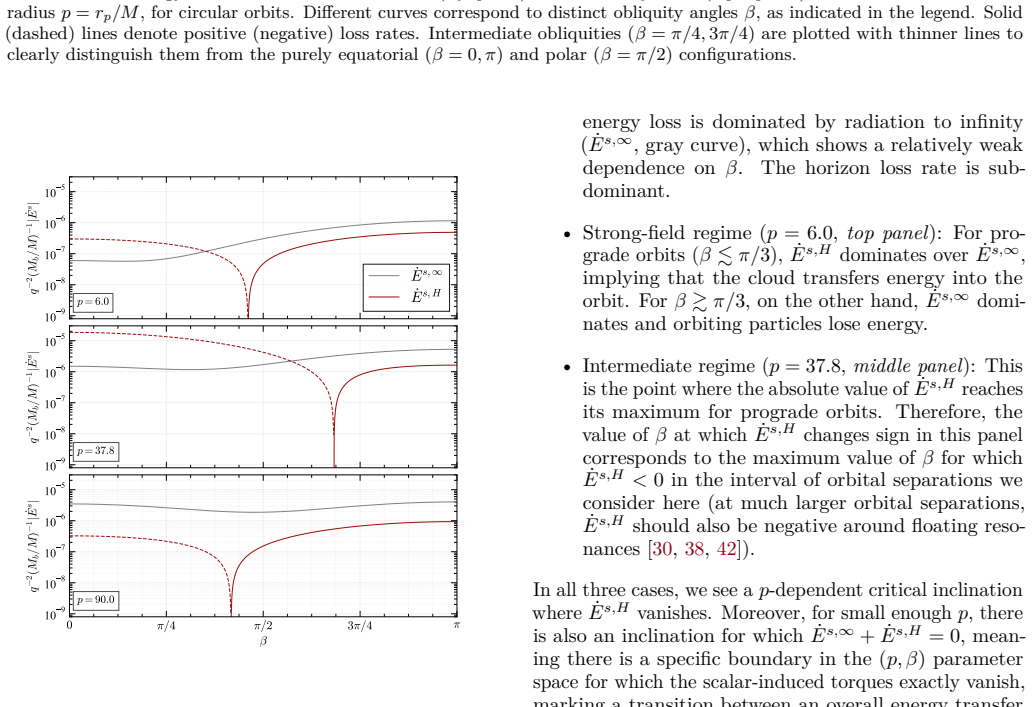
Non-equatorial, circular orbits Let us start by considering inclined circular orbits. For this case, the radial overtone index is fixed ton = 0and σm0 =mΩφ=m √ M/r3p, withrp =pM. Furthermore, for circular orbits, the angular momentum and energy loss rates satisfy the relation˙Es,∞/H= Ωφ˙Ls,∞/Hand therefore we focus the discussion on˙Es,∞/H. Our results ar...
-
[3]
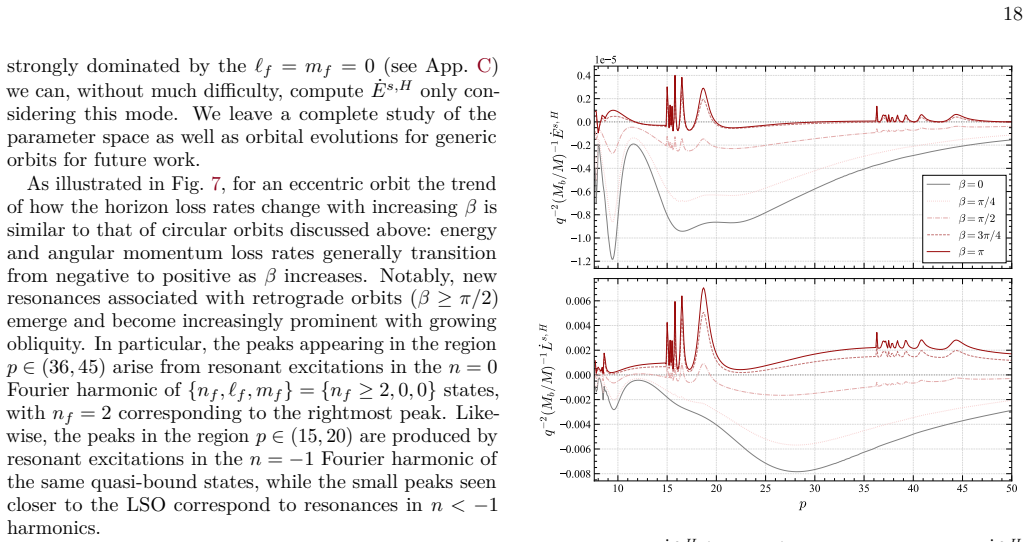
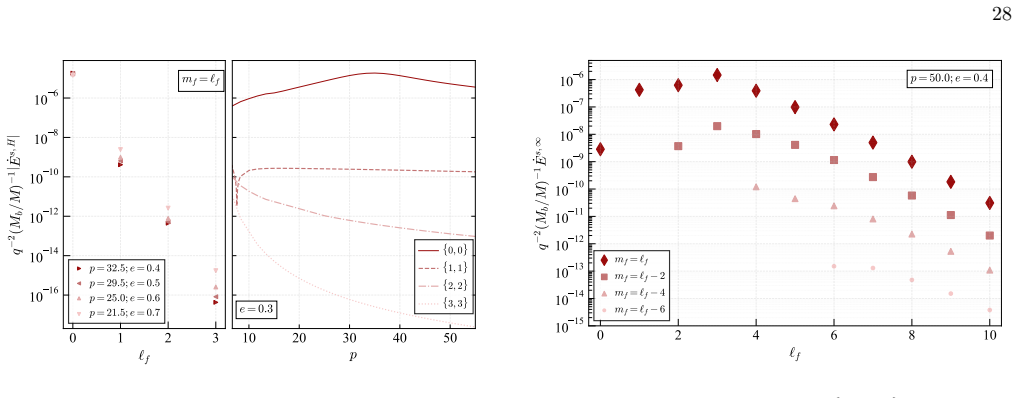
Generic orbits For generically inclined and eccentric orbits, we focus primarily on the horizon loss rates, mainly due to the high computational cost of evaluating infinity loss rates, but also because, as we discussed so far, the horizon loss rates show overall the most interesting features, such as the resonances discussed in Sec. III. Given that˙Es,H i...
arXiv 2025
-
[4]
Using this ansatz, it can be shown that in the non-relativistic limit, the Einstein-Klein-Gordon system (2) reduces itself to the Schrödinger-Poisson sys- tem (see e.g
Gravitational atom To obtain the non-relativistic limit of the Einstein- Klein-Gordon system, it is convenient to factor out high- frequency oscillations, employing the following ansatz: Φ(t,r,θA) =e−iµtˆΦ(t,r,θA),(A1) where ˆΦ (t,r,θA)is assumed to vary on timescales much longer thanµ−1. Using this ansatz, it can be shown that in the non-relativistic lim...
-
[5]
In the Newtonian regime, this object follows a Keplerian trajectory, generically characterized by closed elliptical orbits
Binary system As we did in the main text, we now consider a secondary orbiting object. In the Newtonian regime, this object follows a Keplerian trajectory, generically characterized by closed elliptical orbits. This is in contrast to the relativistic framework in which eccentric orbits experience apsidal precession. It is therefore useful to outline the b...
-
[6]
Perturbations due to the secondary object The presence of the secondary introduced in the previ- ous subsection acts as a perturbing source on the gravita- tional atom system. We can thus expand the gravitational potential and the scalar field perturbatively as U=U 0(r) +δU(t,r,θA), ˆΦ =ϕ0(t,r,θA) +δϕ(t,r,θA), (A14) where δUis the tidal gravitational pert...
-
[7]
The (outgoing) flux of (averaged) energy through a 2-sphere at infinity is [71] ˙EΦ,∞=−lim r→∞ r2 ∫ dθdφsinθδTS rt = 2 ∑ ℓf,mf,g |ω+σg|ℜ [√ (ω+σg)2−µ2 ] |Z∞|2
Orbital loss rates for equatorial orbits The scalar field fluctuations, induced by the secondary, cause a perturbation to its stress-energy tensor, which, at 22 leading order and asymptotically, is given by δTS µν(r→∞) ∼2∂(µδΦ∗∂ν)δΦ−ηµν [ ∂αδΦ∗∂αδΦ+µ2|δΦ|2] , (A31) with δΦ ≡e−iµtδϕ. The (outgoing) flux of (averaged) energy through a 2-sphere at infinity i...
-
[8]
IVA of the main text
Generically inclined orbits For generically inclined orbital configurations (with respect to the cloud’s equatorial plane), we adopt the same approach as in Sec. IVA of the main text. Namely, we rotate the initial spherical harmonicYℓimi from the cloud’s frame to the orbital frame. Following the same steps as in App. A3, we obtain an equation similar to E...
-
[9]
This sec- tion details the numerical strategies employed to ensure accuracy and convergence
Numerical procedure To compute the Newtonian energy loss rates, we have implemented the procedure discussed above in a code written in the Julia programming language. This sec- tion details the numerical strategies employed to ensure accuracy and convergence. Evaluation of special functions. The computation of the solution(A26) relies on the precise evalu...
-
[10]
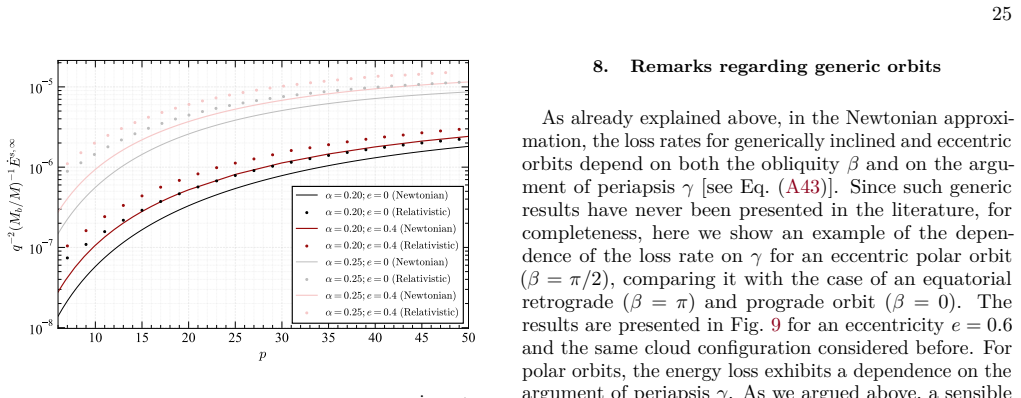
Comparison with previous work and with relativistic results To validate the numerical and analytical framework presented above, we compute the total energy loss for binaries across a range of separations and orbital geome- tries, benchmarking our results against those reported in Ref. [33]. We find that our results are in excellent agreement with their fi...
-
[11]
Remarks regarding generic orbits As already explained above, in the Newtonian approxi- mation, the loss rates for generically inclined and eccentric orbits depend on both the obliquityβand on the argu- ment of periapsisγ[see Eq.(A43)]. Since such generic results have never been presented in the literature, for completeness, here we show an example of the ...
2000
-
[12]
Additional steps for non-equatorial orbits The numerical integration of the radial perturbation equations for non-equatorial orbits follows the general pipeline used for equatorial orbits. As shown in Eq.(84), due to the fact that we are considering a Schwarzschild BH background, the inclination enters solely through the mixing of different azimuthal proj...
-
[13]
(D3) 29 Here, Y, Yφ, andYφφare shorthand for the even-parity scalar, vector, and tensor spherical harmonics, respec- tively, evaluated along the worldline atθ= π/2and φ=φp(χ)
Even parity In the even-parity case, we have: Glm(χ) mp =G rr l qrr lm +G tt l qtt lm +G r lqr lm +G ♭ lq♭ lm +G ♯ lq♯ lm, Flm(χ) mp =F rr l qrr lm +F tt l qtt lm, (D1) where Grr l (χ) := 1 (λ+ 1)rpΛ 2p [ (λ+ 1) (λrp + 6M)rp + 3M2] , Gtt l (χ) :=− f2 p (λ+ 1)rpΛ 2p [ λ(λ+ 1)r2 p + 6λMrp + 15M2] , Gr l (χ) :=2fp Λp ,G ♭ l (χ) := rpf2 p (λ+ 1)Λp ,G ♯ l (χ) ...
-
[14]
(D7) Here, X, Xφ, andXφφare shorthand for the odd-parity scalar, vector, and tensor spherical harmonics, respec- tively, evaluated along the worldline atθ= π/2and φ=φp(χ)
Odd parity In the odd-parity case, we have: Glm(χ) mp =G r1 l pr lm +G r2 l dpr lm dχ dχ dtp +G t lpt lm, Flm(χ) mp =F r lpr lm +F t lpt lm, (D5) where Gr1 l (χ) :=˙rp λ,G r2 l (χ) :=rp λ,G t l (χ) :=−fp λ, Fr l (χ) :=−rp ˙rp λ,F t l (χ) :=rpf2 p λ, (D6) whereas pt lm(χ) = 16π l(l+ 1) L r2p X∗ φ, pr lm(χ) = 16π l(l+ 1) L E fp r2p urX∗ φ. (D7) Here, X, Xφ,...
-
[15]
Even parity The even parityl≥2metric perturbation amplitudes are related to Zerilli-Moncrief master function and the even-parity source terms by K(t,r) =f∂rΨ e +AΨ e−r2f2 (λ+ 1)ΛQtt, H2(t,r) = Λ f2 [λ+ 1 r Ψ e−K ] + r f∂rK, H1(t,r) =r∂t∂rΨ e +rB∂tΨ e−r2 λ+ 1 [ Qtr + rf Λ ∂tQtt ] , H0(t,r) =f 2H2 +fQ ♯, (E3) where A(r) := 1 rΛ [ λ(λ+ 1) +3M r ( λ+2M r )] ,...
-
[16]
(53) with h± 0 = f 2∂r ( rΨ±) , h S 0 = 0,(E13) h± 1 = r 2f∂tΨ±, h S 1 = 0.(E14)
Odd parity The odd-parityl≥2metric perturbation amplitudes can be reconstructed via h0(t,r) = f 2∂r (rΨ o)−r2f 2λpt lm(t)δ[r−rp(t)],(E11) h1(t,r) = r 2f∂tΨ o + r2 2λfpr lm(t).(E12) Using the functional form ofΨo given in Eq.(50), and plugging the relevant expressions into the above equations, the odd-parity metric perturbation amplitudes again take the fo...
-
[17]
Monopolar and dipolar gravitational perturbations For the monopole case,l =m = 0, we adopt the gauge choiceH00 2 =K00 = 0, following Refs. [62,70]. By solving the linearized Einstein equations, one then obtains that the remaining non-zero metric perturbation amplitudes are given by [70] H00 0 = 4√πmp [E r−f Efprp ( 2E2−U2 p )] Θ[r−rp(t)], (E15) H00 1 = 4√...
-
[18]
N. Abac et al. (LIGO Scientific, VIRGO, KAGRA), (2026), arXiv:2605.27223 [gr-qc]
Pith/arXiv arXiv 2026
-
[19]
A. G. Abac et al. (LIGO Scientific, Virgo, KAGRA), Astrophys. J. Lett.993, L21 (2025), arXiv:2510.26931 [astro-ph.HE]
arXiv 2025
-
[20]
A. G. Abacet al. (LIGO Scientific, Virgo, KAGRA), Phys. Rev. Lett.136, 041403 (2026), arXiv:2509.08099 [gr-qc]
Pith/arXiv arXiv 2026
- [21]
-
[22]
Evanset al., (2021), arXiv:2109.09882 [astro-ph.IM]
M. Evanset al., (2021), arXiv:2109.09882 [astro-ph.IM]
Pith/arXiv arXiv 2021
- [23]
-
[24]
J. Luoet al. (TianQin), Class. Quant. Grav.33, 035010 (2016), arXiv:1512.02076 [astro-ph.IM]
Pith/arXiv arXiv 2016
-
[25]
Z. Luo, Y. Wang, Y. Wu, W. Hu, and G. Jin, PTEP 2021, 05A108 (2021)
2021
-
[26]
N. Afshordiet al. (LISA Consortium Waveform Working Group), Living Rev. Rel.28, 9 (2025), arXiv:2311.01300 [gr-qc]
Pith/arXiv arXiv 2025
-
[27]
F. D. Ryan, Phys. Rev. D52, 5707 (1995)
1995
-
[28]
C. J. Moore, A. J. K. Chua, and J. R. Gair, Class. Quant. Grav.34, 195009 (2017), arXiv:1707.00712 [gr-qc]
Pith/arXiv arXiv 2017
-
[29]
K. Destounis, A. G. Suvorov, and K. D. Kokkotas, Phys. Rev. Lett.126, 141102 (2021), arXiv:2103.05643 [gr-qc]
arXiv 2021
-
[30]
A. Maselli, N. Franchini, L. Gualtieri, T. P. Sotiriou, S. Barsanti, and P. Pani, Nature Astron.6, 464 (2022), arXiv:2106.11325 [gr-qc]
arXiv 2022
-
[31]
S. Barsanti, A. Maselli, T. P. Sotiriou, and L. Gualtieri, Phys. Rev. Lett.131, 051401 (2023), arXiv:2212.03888 [gr-qc]
arXiv 2023
- [32]
-
[33]
E. Barausse, V. Cardoso, and P. Pani, Phys. Rev. D89, 104059 (2014), arXiv:1404.7149 [gr-qc]
Pith/arXiv arXiv 2014
-
[34]
V. Cardoso and A. Maselli, Astron. Astrophys.644, A147 (2020), arXiv:1909.05870 [astro-ph.HE]
arXiv 2020
-
[35]
V. Cardoso, K. Destounis, F. Duque, R. Panosso Macedo, and A. Maselli, Phys. Rev. Lett.129, 241103 (2022), arXiv:2210.01133 [gr-qc]
arXiv 2022
-
[36]
R. Vicente, T. K. Karydas, and G. Bertone, Phys. Rev. Lett.135, 211401 (2025), arXiv:2505.09715 [gr-qc]
arXiv 2025
- [37]
- [38]
-
[39]
C. F. B. Macedo, H. C. D. Lima, R. F. P. Mendes, R. Vi- cente, and V. Cardoso, (2026), arXiv:2603.08795 [gr-qc]
arXiv 2026
-
[40]
A. Arvanitaki, S. Dimopoulos, S. Dubovsky, N. Kaloper, and J. March-Russell, Phys. Rev. D81, 123530 (2010), arXiv:0905.4720 [hep-th]
Pith/arXiv arXiv 2010
-
[41]
R. Brito, V. Cardoso, and P. Pani, Class. Quant. Grav. 32, 134001 (2015), arXiv:1411.0686 [gr-qc]
Pith/arXiv arXiv 2015
-
[42]
W. E. East and F. Pretorius, Phys. Rev. Lett.119, 041101 (2017), arXiv:1704.04791 [gr-qc]
Pith/arXiv arXiv 2017
-
[43]
R. Brito, V. Cardoso, and P. Pani, Lect. Notes Phys. 906, pp.1 (2015), arXiv:1501.06570 [gr-qc]
Pith/arXiv arXiv 2015
-
[44]
D. Baumann, H. S. Chia, and R. A. Porto, Phys. Rev. D 99, 044001 (2019), arXiv:1804.03208 [gr-qc]
Pith/arXiv arXiv 2019
-
[45]
O. A. Hannuksela, K. W. K. Wong, R. Brito, E. Berti, and T. G. F. Li, Nature Astron.3, 447 (2019), arXiv:1804.09659 [astro-ph.HE]
arXiv 2019
-
[46]
E. Berti, R. Brito, C. F. B. Macedo, G. Raposo, and J. L. Rosa, Phys. Rev. D99, 104039 (2019), arXiv:1904.03131 [gr-qc]
Pith/arXiv arXiv 2019
-
[47]
D. Baumann, H. S. Chia, R. A. Porto, and J. Stout, Phys. Rev. D101, 083019 (2020), arXiv:1912.04932 [gr-qc]
arXiv 2020
-
[48]
D. Baumann, G. Bertone, J. Stout, and G. M. Tomaselli, Phys. Rev. D105, 115036 (2022), arXiv:2112.14777 [gr- qc]
arXiv 2022
-
[49]
D. Baumann, G. Bertone, J. Stout, and G. M. Tomaselli, Phys. Rev. Lett.128, 221102 (2022), arXiv:2206.01212 [gr-qc]
arXiv 2022
-
[50]
G. M. Tomaselli, T. F. M. Spieksma, and G. Bertone, JCAP07, 070 (2023), arXiv:2305.15460 [gr-qc]
arXiv 2023
- [51]
-
[52]
R. Brito and S. Shah, Phys. Rev. D108, 084019 (2023), [Erratum: Phys.Rev.D 110, 109902 (2024)], arXiv:2307.16093 [gr-qc]
arXiv 2023
-
[53]
M. Bošković, M. Koschnitzke, and R. A. Porto, Phys. Rev. Lett.133, 121401 (2024), arXiv:2403.02415 [gr-qc]
arXiv 2024
-
[54]
G. M. Tomaselli, T. F. M. Spieksma, and G. Bertone, Phys. Rev. Lett.133, 121402 (2024), arXiv:2407.12908 [gr-qc]
arXiv 2024
-
[55]
G. M. Tomaselli, T. F. M. Spieksma, and G. Bertone, Phys. Rev. D110, 064048 (2024), arXiv:2403.03147 [gr- qc]
arXiv 2024
-
[56]
G. M. Tomaselli, Phys. Rev. D112, 063033 (2025), arXiv:2507.15110 [gr-qc]
arXiv 2025
- [57]
-
[58]
D. Li, C. Weller, P. Bourg, M. LaHaye, N. Yunes, and H. Yang, Phys. Rev. D112, 084057 (2025), arXiv:2507.02045 [gr-qc]
arXiv 2025
-
[59]
M. Bošković, R. A. Porto, and M. Koschnitzke, (2025), arXiv:2512.17887 [gr-qc]
arXiv 2025
-
[60]
S. Roy, R. Vicente, J. C. Aurrekoetxea, K. Clough, and P. G. Ferreira, (2025), arXiv:2510.17967 [gr-qc]
Pith/arXiv arXiv 2025
-
[61]
R. Keijzer, S. Maenaut, H. Inchauspé, and T. Hertog, (2026), arXiv:2604.11893 [gr-qc]
Pith/arXiv arXiv 2026
-
[62]
R. Della Monica and R. Brito, Phys. Rev. D112, 024074 (2025), arXiv:2503.23419 [gr-qc]
arXiv 2025
-
[63]
D. Mancieri, L. Broggi, M. Vinciguerra, A. Sesana, and M. Bonetti, Phys. Rev. D113, 043062 (2026), arXiv:2509.02394 [astro-ph.HE]
arXiv 2026
- [64]
-
[65]
S. A. Hughes, N. Warburton, G. Khanna, A. J. K. Chua, and M. L. Katz, Phys. Rev. D103, 104014 (2021), [Erra- tum: Phys.Rev.D 107, 089901 (2023)], arXiv:2102.02713 [gr-qc]
arXiv 2021
-
[66]
S. Isoyama, R. Fujita, A. J. K. Chua, H. Nakano, A. Pound, and N. Sago, Phys. Rev. Lett.128, 231101 (2022), arXiv:2111.05288 [gr-qc]
arXiv 2022
-
[67]
Q.-X. Xu, R. Brito, R. Della Monica, R. Vicente, and C. Yuan, (2026), arXiv:2605.03756 [gr-qc]
Pith/arXiv arXiv 2026
-
[68]
S. L. Detweiler, Phys. Rev. D22, 2323 (1980)
1980
-
[69]
S. R. Dolan, Phys. Rev. D76, 084001 (2007), arXiv:0705.2880 [gr-qc]
Pith/arXiv arXiv 2007
-
[70]
D. Baumann, H. S. Chia, J. Stout, and L. ter Haar, JCAP12, 006 (2019), arXiv:1908.10370 [gr-qc]
arXiv 2019
-
[71]
V. Cardoso and S. Yoshida, JHEP07, 009 (2005), arXiv:hep-th/0502206
Pith/arXiv arXiv 2005
-
[72]
E. Cannizzaro, L. Sberna, S. R. Green, and S. Hollands, Phys. Rev. Lett.132, 051401 (2024), arXiv:2309.10021 [gr-qc]
arXiv 2024
-
[73]
Cutler, D
C. Cutler, D. Kennefick, and E. Poisson, Phys. Rev. D 50, 3816 (1994)
1994
-
[74]
L. Barack and N. Sago, Phys. Rev. D81, 084021 (2010), arXiv:1002.2386 [gr-qc]
Pith/arXiv arXiv 2010
-
[75]
Darwin, Proceedings of the Royal Society of London Series A249, 180 (1959)
C. Darwin, Proceedings of the Royal Society of London Series A249, 180 (1959)
1959
-
[76]
S. Hopper and C. R. Evans, Phys. Rev. D82, 084010 (2010), arXiv:1006.4907 [gr-qc]
Pith/arXiv arXiv 2010
-
[77]
Regge and J
T. Regge and J. A. Wheeler, Phys. Rev.108, 1063 (1957)
1957
-
[78]
F. J. Zerilli, Phys. Rev. Lett.24, 737 (1970). 32
1970
-
[79]
F. J. Zerilli, Phys. Rev. D2, 2141 (1970)
1970
-
[80]
C. V. Vishveshwara, Phys. Rev. D1, 2870 (1970)
1970
discussion (0)
Sign in with ORCID, Apple, or X to comment. Anyone can read and Pith papers without signing in.