Hyperonic equation of state for neutron stars: A systematic Bayesian comparison of density-dependent and non-linear relativistic mean-field models
Pith reviewed 2026-06-26 12:32 UTC · model grok-4.3
The pith
Hyperons reduce neutron star maximum mass by 0.05-0.10 solar masses and increase radius at 1.4 solar masses by 0.5-0.8 km across models.
A machine-rendered reading of the paper's core claim, the machinery that carries it, and where it could break.
Core claim
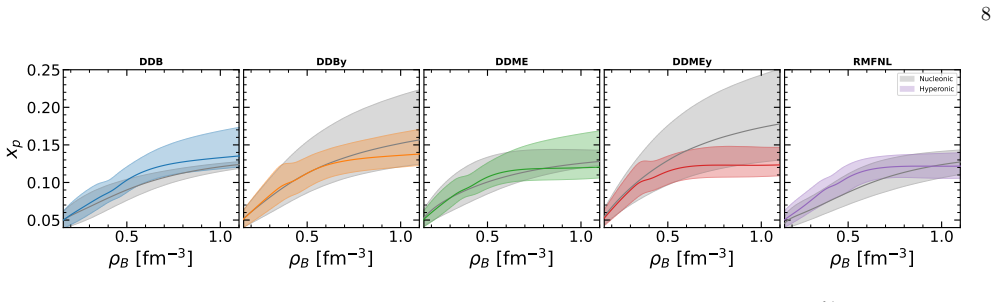
Extending five RMF models to the baryon octet with scalar hyperon-nucleon couplings varied inside hypernuclear ranges and vector isoscalar couplings fixed by SU(6) symmetry yields a consistent reduction in maximum mass of 0.05-0.10 M_⊙ and an increase in radius at 1.4 M_⊙ of 0.5-0.8 km under simultaneous NICER, GW170817, χEFT, pQCD and nuclear saturation constraints. The speed of sound softens at 2-3 ρ_sat coinciding with hyperon onset. Inclusion of hyperons suppresses the extra flexibility of the isovector channel so that average proton fractions become independent of model choice. Only a residual number of the resulting equations of state produce a negative slope in the mass-radius relatio
What carries the argument
Bayesian sampling of density-dependent and nonlinear RMF models extended to the full baryon octet, with scalar hyperon couplings drawn from hypernuclear data ranges and vector couplings fixed by SU(6) symmetry, under joint constraints from NICER, GW170817, χEFT, pQCD and nuclear saturation properties.
If this is right
- Hyperons cause a softening of the speed of sound at densities 2-3 times nuclear saturation density that coincides with their onset.
- The proton fraction distribution becomes independent of isovector-channel flexibility once hyperons are included.
- Less flexible nucleonic models show comparable or slightly higher proton fractions after hyperons are added because of overall EOS stiffening.
- All hyperonic equations of state remain consistent with the two-solar-mass maximum mass constraint.
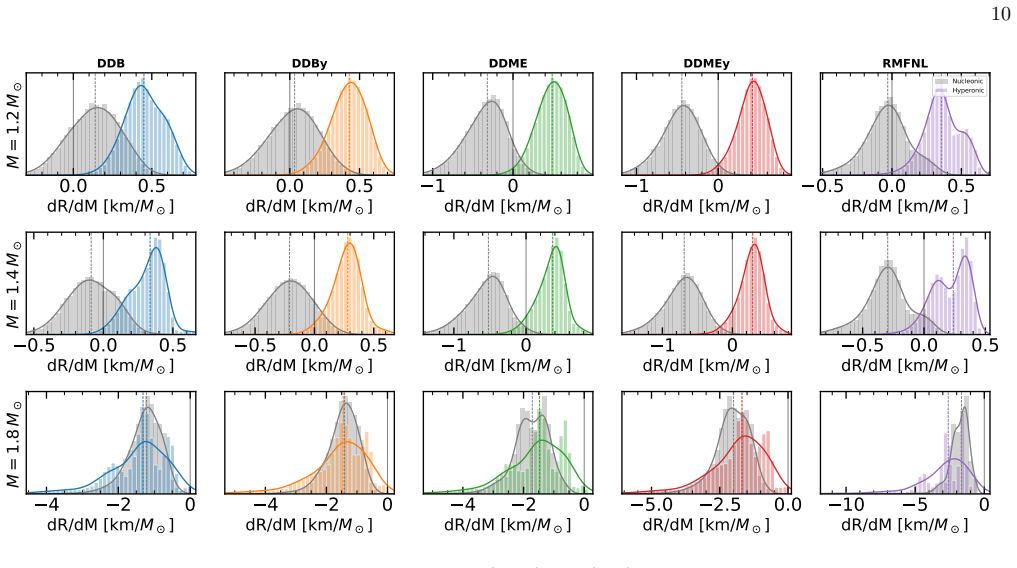
- Only a residual fraction of hyperonic models produce mass-radius curves with negative slope at low masses.
Where Pith is reading between the lines
- Simultaneous radius measurements at 1.2 and 1.8 solar masses could distinguish hyperonic from purely nucleonic compositions without requiring knowledge of the absolute maximum mass.
- The sound-speed softening at 2-3 ρ_sat offers a potential target for gravitational-wave signals from neutron-star mergers that could be checked against the reported models.
- Adding delta resonances or other exotic degrees of freedom on top of hyperons would likely shift the predicted radius difference between low- and high-mass stars and could be tested with the same Bayesian setup.
Load-bearing premise
The ranges allowed for hyperon-nucleon scalar couplings by hypernuclear data, together with SU(6) vector couplings and the listed external constraints, are sufficient to control all relevant uncertainties in the hyperonic equation of state.
What would settle it
Detection of a 1.8 solar mass neutron star whose radius is smaller than the radius of a 1.2 solar mass neutron star would contradict the claim that such a configuration signals hyperonic degrees of freedom.
Figures



read the original abstract
A systematic Bayesian inference study of the equation of state (EOS) of dense matter with strangeness is presented, extending five relativistic mean-field (RMF) models with both constant and density-dependent couplings to include the full baryon octet. The hyperon-nucleon couplings in the scalar channel are varied within ranges informed by hypernuclear data, while vector isoscalar couplings are fixed by the SU(6) symmetry quark model. Observational constraints from NICER (PSR J0030, J0437, J0740) and GW170817, theoretical constraints from chiral effective field theory ($\chi$EFT) and perturbative QCD (pQCD), and experimental constraints from nuclear saturation properties are imposed simultaneously. We find that the inclusion of hyperons systematically reduces the maximum neutron star mass by $0.05$-$0.10,M_\odot$ across all models while increasing the radius at $1.4,M_\odot$ by $0.5$-$0.8$ km. The speed of sound exhibits a characteristic softening at densities $2$-$3,\rho_{\rm sat}$ coinciding with hyperon onset. All hyperonic models remain consistent with the $2,M_\odot$ constraint. Models with a more flexible isovector channel span a larger proton fraction when only nucleons are included. However, the extra flexibility is visibly suppressed by hyperons, meaning that the average proton distribution is independent of model flexibility when hyperons are included. Less flexible models show comparable or slightly increased proton fractions due to EOS stiffening when hyperons are included. Only a residual number of hyperonic equations of state give rise to a mass-radius curve with a negative slope at low masses. A $1.8,M_\odot$ neutron star with a radius larger than or similar to the radius of a $1.2,M_\odot$ star would provide strong evidence that the star contains baryonic degrees of freedom beyond nucleons.
Editorial analysis
A structured set of objections, weighed in public.
Referee Report
Summary. The paper performs a systematic Bayesian inference study of hyperonic extensions to five RMF models (both density-dependent and non-linear), varying scalar hyperon-nucleon couplings within hypernuclear bounds while fixing vector isoscalar couplings via SU(6). Simultaneous constraints from NICER (J0030, J0437, J0740), GW170817, χEFT, pQCD, and nuclear saturation properties are applied. Key findings include a systematic 0.05–0.10 M⊙ reduction in maximum mass, 0.5–0.8 km increase in R(1.4), softening of the speed of sound at 2–3 ρ_sat, suppression of isovector flexibility by hyperons, and the observation that only a residual fraction of hyperonic EOS exhibit negative low-mass M-R slopes. The central claim is that an observed R(1.8) ≳ R(1.2) would constitute strong evidence for baryonic degrees of freedom beyond nucleons.
Significance. If the uniqueness of the proposed M-R diagnostic to hyperons holds under the stated constraints, the work supplies a concrete, falsifiable observational test for strangeness in neutron-star cores and demonstrates the value of multi-model Bayesian pipelines for EOS inference. The consistent numerical shifts across model classes and the explicit incorporation of χEFT/pQCD bounds are strengths that enhance the robustness of the reported trends.
major comments (3)
- [coupling strategy paragraph] Coupling-strategy paragraph (abstract and methods): vector isoscalar couplings are fixed to SU(6) values while only scalar couplings are varied inside hypernuclear ranges. No sensitivity analysis to reasonable deviations from SU(6) (or alternative symmetry assumptions) is reported; such variations could permit nucleonic models to reproduce comparable or inverted low-mass radius slopes after the same NICER/GW170817/χEFT/pQCD constraints, rendering the R(1.8) ≳ R(1.2) diagnostic non-unique to hyperons.
- [results on proton fractions] Results section on proton fractions: the statement that hyperons suppress isovector flexibility so that the average proton distribution becomes independent of model flexibility requires quantitative support (e.g., reported variances, Kolmogorov-Smirnov distances, or explicit comparison of posterior widths between nucleonic and hyperonic ensembles).
- [abstract and concluding paragraph] Abstract and final paragraph: the claim that R(1.8) ≳ R(1.2) provides strong evidence for degrees of freedom beyond nucleons rests on the assertion that only a residual number of hyperonic EOS exhibit negative low-mass slopes. The manuscript must explicitly quantify the corresponding fraction (or posterior probability) for the nucleonic counterparts under identical constraints to establish the claimed specificity.
minor comments (2)
- [abstract] The abstract states that all models satisfy the 2 M⊙ limit but does not report the posterior probability mass above 2 M⊙ or the precise form of the likelihood function used for the NICER and GW170817 data.
- [results] Notation for the speed-of-sound softening (2–3 ρ_sat) should be cross-referenced to the specific density range shown in the relevant figure or table.
Simulated Author's Rebuttal
We thank the referee for the constructive and detailed report. The comments highlight important points for strengthening the presentation and claims. We address each major comment below and indicate planned revisions.
read point-by-point responses
-
Referee: [coupling strategy paragraph] Coupling-strategy paragraph (abstract and methods): vector isoscalar couplings are fixed to SU(6) values while only scalar couplings are varied inside hypernuclear ranges. No sensitivity analysis to reasonable deviations from SU(6) (or alternative symmetry assumptions) is reported; such variations could permit nucleonic models to reproduce comparable or inverted low-mass radius slopes after the same NICER/GW170817/χEFT/pQCD constraints, rendering the R(1.8) ≳ R(1.2) diagnostic non-unique to hyperons.
Authors: The choice to fix vector isoscalar couplings via SU(6) follows the standard approach in the hyperonic RMF literature to constrain the parameter space while remaining consistent with hypernuclear phenomenology. We acknowledge that a dedicated sensitivity study to deviations from SU(6) is not included and would require an expanded analysis. In the revision we will explicitly qualify the uniqueness claim as holding under the SU(6) assumption commonly adopted in the field, add a brief discussion of this modeling choice in the methods section, and note that large deviations are disfavored by existing hypernuclear constraints. We maintain that the reported trends remain representative within this framework. revision: partial
-
Referee: [results on proton fractions] Results section on proton fractions: the statement that hyperons suppress isovector flexibility so that the average proton distribution becomes independent of model flexibility requires quantitative support (e.g., reported variances, Kolmogorov-Smirnov distances, or explicit comparison of posterior widths between nucleonic and hyperonic ensembles).
Authors: We agree that quantitative measures will strengthen this statement. In the revised manuscript we will report the standard deviations of the proton-fraction posteriors for the nucleonic and hyperonic ensembles across all five models and include a direct comparison of posterior widths to demonstrate the suppression of isovector flexibility by hyperons. revision: yes
-
Referee: [abstract and concluding paragraph] Abstract and final paragraph: the claim that R(1.8) ≳ R(1.2) provides strong evidence for degrees of freedom beyond nucleons rests on the assertion that only a residual number of hyperonic EOS exhibit negative low-mass slopes. The manuscript must explicitly quantify the corresponding fraction (or posterior probability) for the nucleonic counterparts under identical constraints to establish the claimed specificity.
Authors: We accept that the specificity of the diagnostic requires explicit comparison with the nucleonic case. In the revision we will add the fraction (and, where appropriate, posterior probability) of nucleonic EOS that exhibit negative low-mass M-R slopes under the identical set of NICER, GW170817, χEFT, pQCD and saturation constraints. This quantification will be included in both the results section and the concluding discussion to support the claim. revision: yes
Circularity Check
No significant circularity; results from external-constraint sampling
full rationale
The paper extends five RMF models to hyperons by varying scalar couplings inside hypernuclear ranges and fixing vector isoscalar couplings via SU(6), then performs Bayesian inference against independent external datasets (NICER pulsars, GW170817, χEFT, pQCD, nuclear saturation properties). Reported outcomes (mass reduction of 0.05-0.10 M_⊙, radius increase of 0.5-0.8 km at 1.4 M_⊙, suppression of isovector flexibility, and rarity of negative low-mass M-R slopes) are direct consequences of this sampling process. The diagnostic claim about R(1.8) ≳ R(1.2) follows from the sampled ensemble rather than any redefinition or refitting of the target observables themselves. No self-citation is invoked as load-bearing justification, and no step reduces a reported prediction to a fitted input by construction.
Axiom & Free-Parameter Ledger
free parameters (1)
- hyperon-nucleon scalar couplings
axioms (1)
- domain assumption Vector isoscalar hyperon-nucleon couplings fixed by SU(6) symmetry quark model
Reference graph
Works this paper leans on
-
[1]
III A for RGOPT were used to generate the corresponding plots
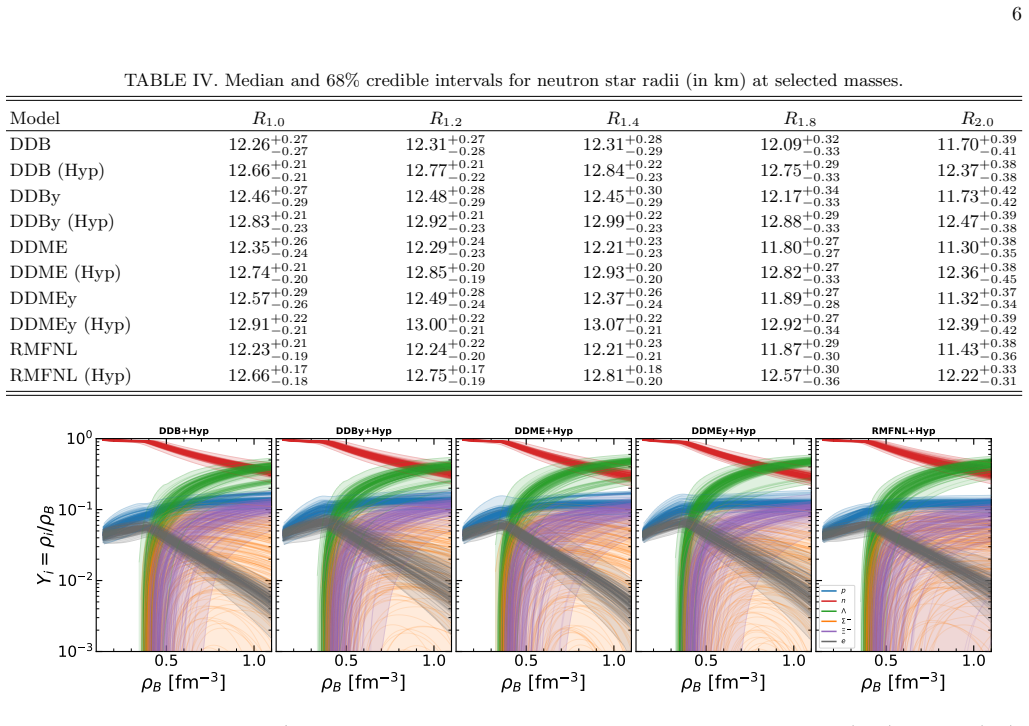
inside NS that describe two solar mass stars will present with a very large probability a positive slope of the mass-radius curves for masses below∼1.5M ⊙. Moreover, a positive slope at 1.8 solar masses would be a very strong indication of the presence of non-nucleonic degrees of freedom inside NS. The radii of different mass NS given in Table IV, and dis...
- [2]
-
[3]
Typel and H
S. Typel and H. H. Wolter, Relativistic mean field calcu- lations with density dependent meson nucleon coupling, Nucl. Phys. A656, 331 (1999)
1999
-
[4]
P. Char, C. Mondal, F. Gulminelli, and M. Oertel, Gener- alized description of neutron star matter with a nucleonic relativistic density functional, Phys. Rev. D108, 103045 (2023), arXiv:2307.12364 [nucl-th]
arXiv 2023
-
[5]
N. K. Glendenning, Neutron Stars Are Giant Hypernu- clei?, Astrophys. J.293, 470 (1985)
1985
-
[6]
J. Schaffner and I. N. Mishustin, Hyperon rich matter in neutron stars, Phys. Rev. C53, 1416 (1996), arXiv:nucl- th/9506011
arXiv 1996
-
[7]
S. Weissenborn, D. Chatterjee, and J. Schaffner-Bielich, Hyperons and massive neutron stars: the role of hyperon potentials, Nucl. Phys. A881, 62 (2012), arXiv:1111.6049 [astro-ph.HE]
Pith/arXiv arXiv 2012
-
[8]
I. Bednarek, P. Haensel, J. L. Zdunik, M. Bejger, and R. Manka, Hyperons in neutron-star cores and two- solar-mass pulsar, Astron. Astrophys.543, A157 (2012), arXiv:1111.6942 [astro-ph.SR]
Pith/arXiv arXiv 2012
-
[9]
C. Providencia and A. Rabhi, Interplay between the sym- metry energy and the strangeness content of neutron stars, Phys. Rev. C87, 055801 (2013), arXiv:1212.5911 [nucl-th]
Pith/arXiv arXiv 2013
-
[10]
L. L. Lopes and D. P. Menezes, Hypernuclear matter in a complete SU(3) symmetry group, Phys. Rev. C89, 025805 (2014), arXiv:1309.4173 [nucl-th]
Pith/arXiv arXiv 2014
-
[11]
M. Fortin, C. Providencia, A. R. Raduta, F. Gulminelli, J. L. Zdunik, P. Haensel, and M. Bejger, Neutron star radii and crusts: uncertainties and unified equations of state, Phys. Rev. C94, 035804 (2016), arXiv:1604.01944 [astro-ph.SR]
Pith/arXiv arXiv 2016
-
[12]
I. Vidana, D. Logoteta, C. Providencia, A. Polls, and I. Bombaci, Estimation of the effect of hyperonic three- body forces on the maximum mass of neutron stars, EPL 94, 11002 (2011), arXiv:1006.5660 [nucl-th]
Pith/arXiv arXiv 2011
-
[13]
H. J. Schulze, A. Polls, A. Ramos, and I. Vidana, Max- imum mass of neutron stars, Phys. Rev. C73, 058801 (2006)
2006
-
[14]
D. Chatterjee and I. Vida˜ na, Do hyperons exist in the interior of neutron stars?, Eur. Phys. J. A52, 29 (2016), arXiv:1510.06306 [nucl-th]
Pith/arXiv arXiv 2016
-
[15]
D. Lonardoni, A. Lovato, S. Gandolfi, and F. Ped- eriva, Hyperon Puzzle: Hints from Quantum Monte Carlo Calculations, Phys. Rev. Lett.114, 092301 (2015), arXiv:1407.4448 [nucl-th]
Pith/arXiv arXiv 2015
-
[16]
D. Logoteta, I. Vidana, and I. Bombaci, Impact of chiral hyperonic three-body forces on neutron stars, Eur. Phys. J. A55, 207 (2019), arXiv:1906.11722 [nucl-th]
arXiv 2019
-
[17]
D. Gerstung, N. Kaiser, and W. Weise, Hyperon–nucleon three-body forces and strangeness in neutron stars, Eur. Phys. J. A56, 175 (2020), arXiv:2001.10563 [nucl-th]
arXiv 2020
- [18]
-
[19]
Fonsecaet al., Refined Mass and Geometric Measure- ments of the High-mass PSR J0740+6620, Astrophys
E. Fonsecaet al., Refined Mass and Geometric Measure- ments of the High-mass PSR J0740+6620, Astrophys. J. Lett.915, L12 (2021), arXiv:2104.00880 [astro-ph.HE]
arXiv 2021
-
[20]
J. Antoniadiset al., A Massive Pulsar in a Com- pact Relativistic Binary, Science340, 6131 (2013), arXiv:1304.6875 [astro-ph.HE]
Pith/arXiv arXiv 2013
-
[21]
S. Weissenborn, D. Chatterjee, and J. Schaffner-Bielich, Hyperons and massive neutron stars: vector repul- sion and SU(3) symmetry, Phys. Rev. C85, 065802 (2012), [Erratum: Phys.Rev.C 90, 019904 (2014)], arXiv:1112.0234 [astro-ph.HE]
Pith/arXiv arXiv 2012
-
[22]
A. Gal, E. V. Hungerford, and D. J. Millener, Strangeness in nuclear physics, Rev. Mod. Phys.88, 035004 (2016), arXiv:1605.00557 [nucl-th]
Pith/arXiv arXiv 2016
-
[23]
M. Fortin, S. S. Avancini, C. Providˆ encia, and I. Vida˜ na, Hypernuclei and massive neutron stars, Phys. Rev. C95, 065803 (2017), arXiv:1701.06373 [nucl-th]
Pith/arXiv arXiv 2017
-
[24]
Descouvemont, Nuclear reactions of astrophysi- cal interest, Front
C. Providˆ encia, M. Fortin, H. Pais, and A. Rabhi, Hy- peronic stars and the nuclear symmetry energy, Fron- tiers in Astronomy and Space Sciences6, 10.3389/fs- pas.2019.00013 (2019)
work page doi:10.3389/fs- 2019
- [25]
-
[26]
X. Sun, Z. Miao, B. Sun, and A. Li, Astrophysical Impli- cations on Hyperon Couplings and Hyperon Star Prop- erties with Relativistic Equations of States, Astrophys. J.942, 55 (2023), arXiv:2205.10631 [astro-ph.HE]
arXiv 2023
- [27]
-
[28]
T. Malik and C. Providˆ encia, Bayesian inference of sig- natures of hyperons inside neutron stars, Phys. Rev. D 106, 063024 (2022), arXiv:2205.15843 [nucl-th]
arXiv 2022
-
[29]
M. Fortin, J. L. Zdunik, P. Haensel, and M. Bejger, Neu- tron stars with hyperon cores: stellar radii and equation of state near nuclear density, Astron. Astrophys.576, A68 (2015), arXiv:1408.3052 [astro-ph.SR]
Pith/arXiv arXiv 2015
-
[30]
Schaffner, C
J. Schaffner, C. B. Dover, A. Gal, C. Greiner, D. J. Mil- lener, and H. Stoecker, Multiply strange nuclear systems, Annals Phys.235, 35 (1994)
1994
-
[31]
J. Buchner, A. Georgakakis, K. Nandra, L. Hsu, C. Rangel, M. Brightman, A. Merloni, M. Salvato, J. Donley, and D. Kocevski, X-ray spectral modelling of the AGN obscuring region in the CDFS: Bayesian model selection and catalogue, Astron. Astrophys.564, A125 12 (2014), arXiv:1402.0004 [astro-ph.HE]
Pith/arXiv arXiv 2014
-
[32]
S. Huthet al., Constraining Neutron-Star Matter with Microscopic and Macroscopic Collisions, Nature606, 276 (2022), arXiv:2107.06229 [nucl-th]
arXiv 2022
-
[33]
T. E. Rileyet al., AN ICERView of PSR J0030+0451: Millisecond Pulsar Parameter Estimation, Astrophys. J. Lett.887, L21 (2019), arXiv:1912.05702 [astro-ph.HE]
arXiv 2019
-
[34]
D. Choudhuryet al., A NICER View of the Nearest and Brightest Millisecond Pulsar: PSR J0437–4715, Astro- phys. J. Lett.971, L20 (2024), arXiv:2407.06789 [astro- ph.HE]
arXiv 2024
-
[35]
T. E. Rileyet al., A NICER View of the Massive Pul- sar PSR J0740+6620 Informed by Radio Timing and XMM-Newton Spectroscopy, Astrophys. J. Lett.918, L27 (2021), arXiv:2105.06980 [astro-ph.HE]
arXiv 2021
-
[36]
B. P. Abbottet al.(LIGO Scientific, Virgo), GW170817: Observation of Gravitational Waves from a Binary Neu- tron Star Inspiral, Phys. Rev. Lett.119, 161101 (2017), arXiv:1710.05832 [gr-qc]
Pith/arXiv arXiv 2017
-
[37]
B. P. Abbottet al.(LIGO Scientific, Virgo), GW170817: Measurements of neutron star radii and equation of state, Phys. Rev. Lett.121, 161101 (2018), arXiv:1805.11581 [gr-qc]
Pith/arXiv arXiv 2018
-
[38]
O. Komoltsev and A. Kurkela, How Perturbative QCD Constrains the Equation of State at Neutron- Star Densities, Phys. Rev. Lett.128, 202701 (2022), arXiv:2111.05350 [nucl-th]
arXiv 2022
-
[39]
M. Ferreira and C. Providˆ encia, Constraining neutron star matter from the slope of the mass-radius curves, Phys. Rev. D110, 063018 (2024), arXiv:2406.12582 [nucl-th]
arXiv 2024
- [40]
-
[41]
M. Oertel, F. Gulminelli, C. Providˆ encia, and A. R. Raduta, Hyperons in neutron stars and supernova cores, Eur. Phys. J. A52, 50 (2016), arXiv:1601.00435 [nucl-th]
Pith/arXiv arXiv 2016
-
[42]
E. Friedman and A. Gal, In-medium nuclear interac- tions of low-energy hadrons, Phys. Rept.452, 89 (2007), arXiv:0705.3965 [nucl-th]
Pith/arXiv arXiv 2007
- [43]
-
[44]
M. Ferreira and C. Providˆ encia, Learning about neu- tron star composition from the slope of the mass- radius diagram, Phys. Rev. D112, 083058 (2025), arXiv:2506.00550 [nucl-th]
arXiv 2025
discussion (0)
Sign in with ORCID, Apple, or X to comment. Anyone can read and Pith papers without signing in.