Getting Tilted: Random Walk of Binary Black Hole Spin-Orbit Alignment in Dense Star Clusters
Pith reviewed 2026-06-26 13:12 UTC · model grok-4.3
The pith
Binary black hole spin-orbit alignment survives several encounters before turning isotropic.
A machine-rendered reading of the paper's core claim, the machinery that carries it, and where it could break.
Core claim
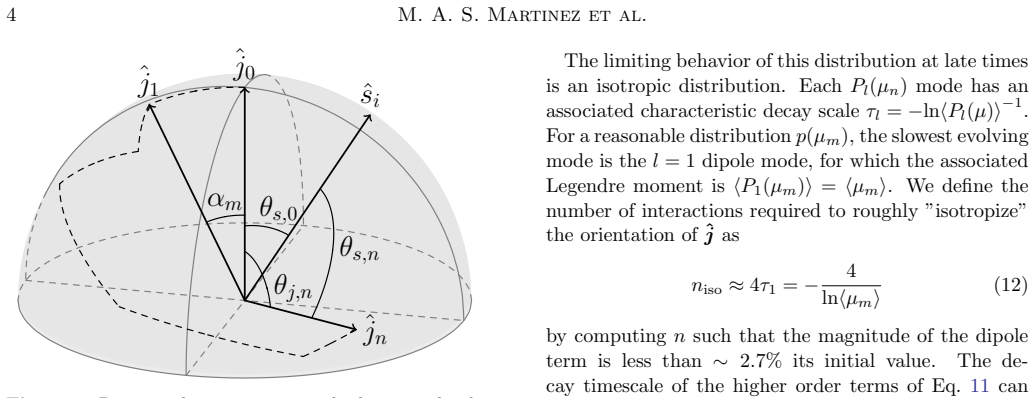
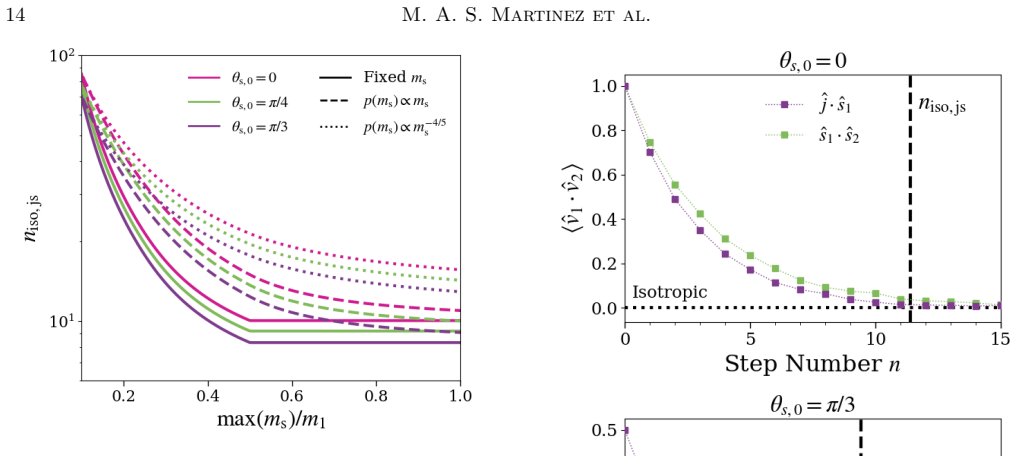
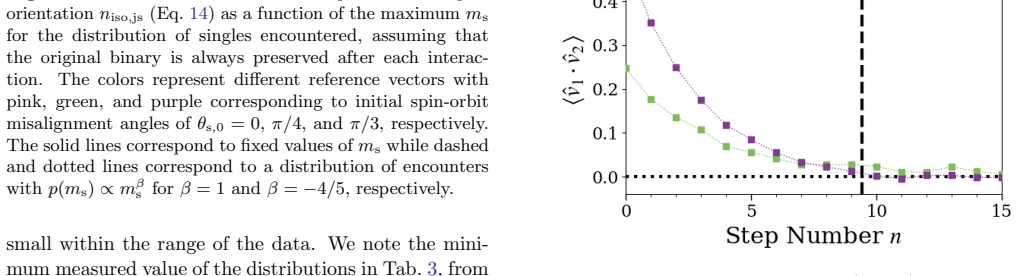
The evolution of the BBH orbital angular momentum orientation through successive binary-single encounters is modeled as a random walk on the unit sphere, yielding an exact solution for the orientation distribution after n encounters and a closed-form expression for the number of encounters required to reach isotropy. Scattering experiments supply the step distribution. For initially aligned systems, spin-orbit alignment survives several strong encounters before erasure.
What carries the argument
Random walk of the orbital angular momentum vector on the unit sphere, with step sizes taken from Newtonian scattering experiments of equal-mass binaries.
If this is right
- Spin-orbit alignment inherited from isolated binary evolution can persist after several encounters in a cluster.
- The mild alignment trend reported in GWTC-5.0 remains compatible with dynamical formation channels.
- Hierarchical merger products such as the components of GW231123 are more likely to be retained in the cluster.
- The exact number of encounters needed to reach isotropy is given by a closed-form expression.
Where Pith is reading between the lines
- The same random-walk treatment could be applied to other vector quantities such as individual spin vectors under repeated encounters.
- Varying the mass ratio in the scattering experiments would show how step sizes and survival times change for unequal-mass systems.
- Future catalogs with thousands of events could compare observed misalignment distributions against the predicted function of cluster encounter rate.
Load-bearing premise
The orientation changes from each encounter act as independent random steps drawn from the distribution measured in equal-mass binary scattering experiments.
What would settle it
A direct N-body integration of one binary black hole through a counted sequence of single encounters whose final misalignment distribution differs from the exact random-walk formula at that step count.
Figures



read the original abstract
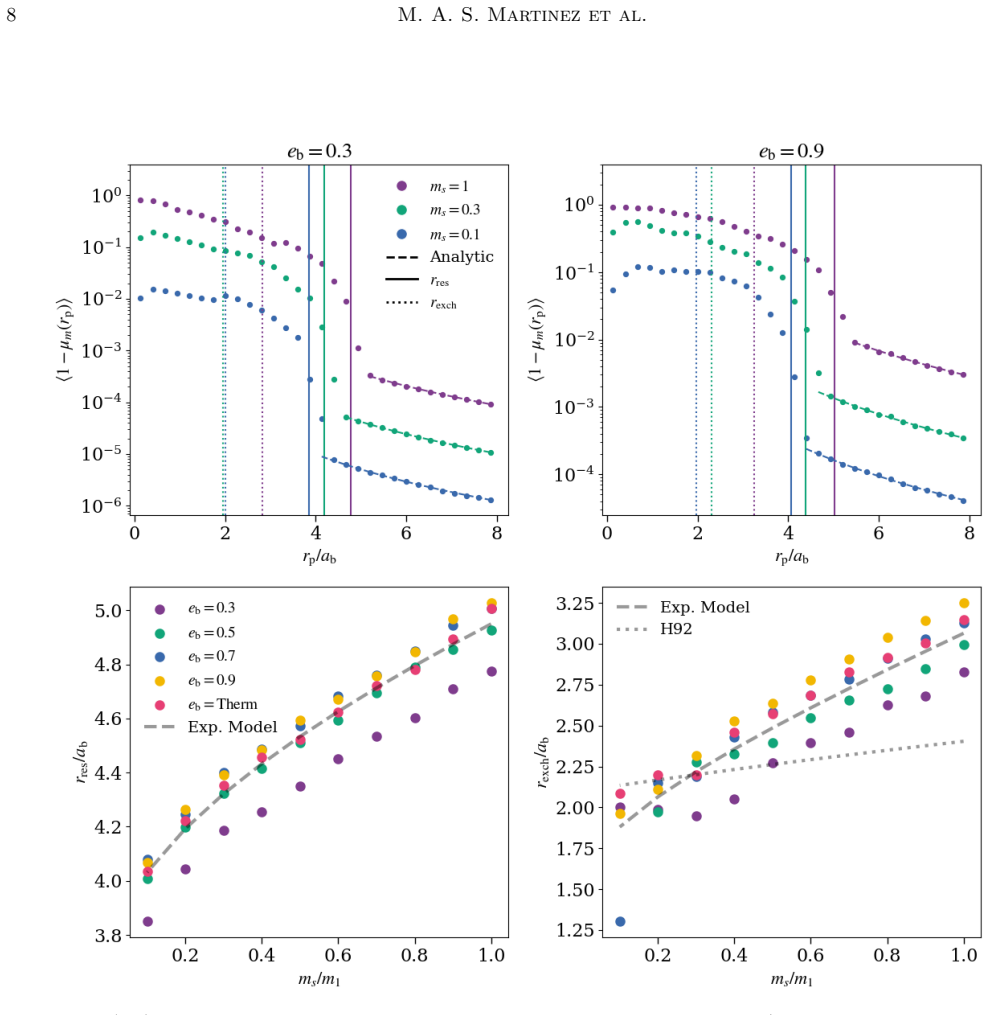
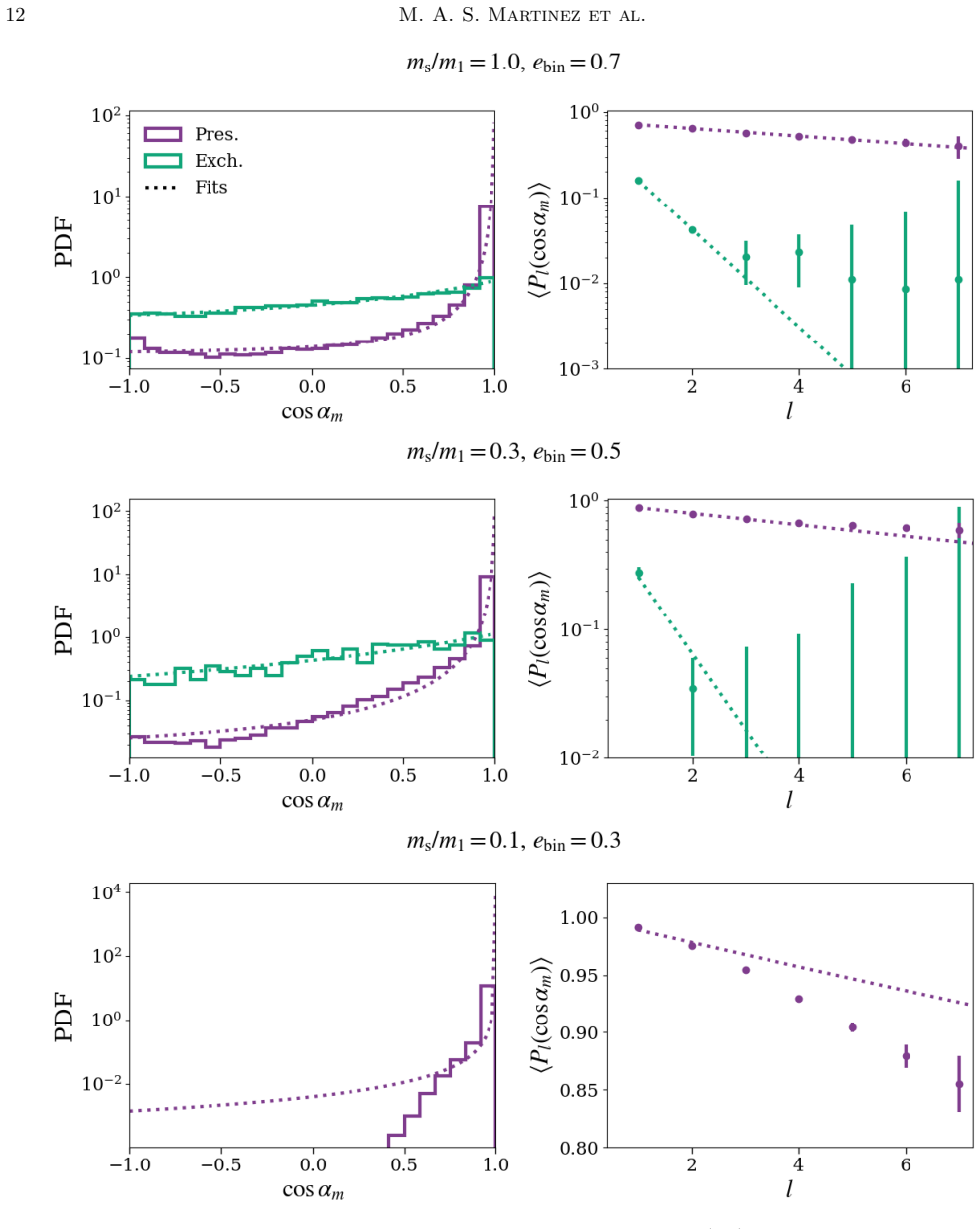
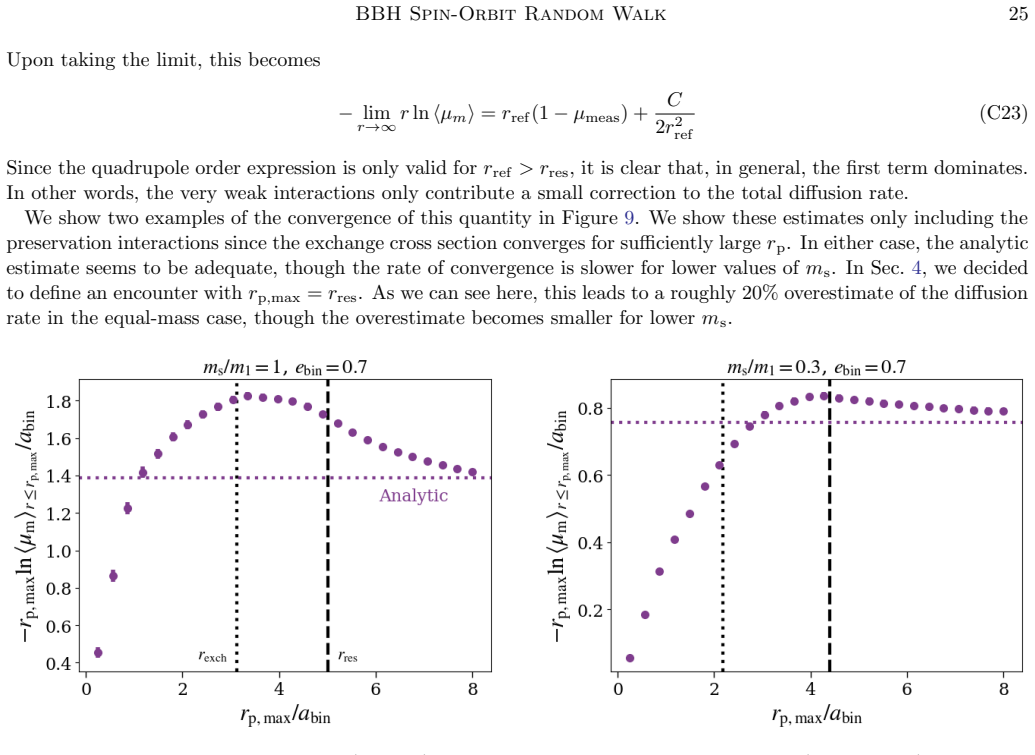
It is commonly assumed that the spin-orbit angles of binary black holes (BBHs) originating from dense stellar environments rapidly converge to an isotropic distribution following a number of strong gravitational encounters. We challenge this assumption by modeling the evolution of the BBH orbital angular momentum orientation through successive binary--single encounters as a random walk on the unit sphere, yielding an exact solution for the orientation distribution after $n$ encounters and a closed-form expression for the number of encounters required to reach isotropy. To characterize the step distribution, we conduct a large suite of Newtonian point-particle scattering experiments with an equal-mass binary, varying the mass of the single, and obtain semi-analytic expressions for both the mean step size and the full distribution of steps. Applying these results to BBHs with initially aligned spins, as may arise from the evolution of primordial massive binaries, we find that spin-orbit alignment can survive several strong encounters before being erased. This has direct implications for the slight trend toward spin-orbit alignment reported in GWTC-5.0 as well as for the retention of hierarchical merger products, such as the components of GW231123.
Editorial analysis
A structured set of objections, weighed in public.
Referee Report
Summary. The paper claims that BBH spin-orbit alignment in dense clusters evolves via a random walk on the unit sphere through successive binary-single encounters. It derives an exact solution for the orientation distribution after n encounters and a closed-form expression for the number of encounters needed to reach isotropy. Scattering experiments with equal-mass binaries yield semi-analytic step-size expressions; applying these to initially aligned systems shows that alignment survives several strong encounters, with implications for GWTC-5.0 trends and hierarchical merger retention.
Significance. If the central modeling holds, the work supplies a quantitative, analytically tractable framework that challenges the rapid-isotropization assumption and directly connects to observable GW spin-orbit trends. The exact solution for the distribution after n steps and the closed-form isotropy threshold are genuine strengths that enable falsifiable predictions without free parameters.
major comments (1)
- [modeling approach and scattering experiments] The random-walk construction (described in the abstract and modeling sections) adopts a fixed step-size distribution obtained from scattering experiments performed at fixed binary parameters. Each encounter, however, exchanges energy and angular momentum, changing the semi-major axis and thereby the range of impact parameters that produce large orientation changes. This fixed-distribution assumption therefore decouples the diffusion constant from the binary's evolving dynamical state, which is load-bearing for the claim that alignment survives several encounters.
minor comments (1)
- [abstract] The abstract refers to 'Newtonian point-particle scattering experiments' but does not specify the range of mass ratios explored or the number of encounters simulated; a brief table or sentence in §3 would clarify the domain of validity.
Simulated Author's Rebuttal
We thank the referee for the constructive report and for identifying a central modeling assumption. We address the concern point-by-point below and will revise the manuscript to make the limitations explicit while preserving the analytic framework.
read point-by-point responses
-
Referee: The random-walk construction (described in the abstract and modeling sections) adopts a fixed step-size distribution obtained from scattering experiments performed at fixed binary parameters. Each encounter, however, exchanges energy and angular momentum, changing the semi-major axis and thereby the range of impact parameters that produce large orientation changes. This fixed-distribution assumption therefore decouples the diffusion constant from the binary's evolving dynamical state, which is load-bearing for the claim that alignment survives several encounters.
Authors: We agree that the fixed step-size distribution is an approximation whose validity must be examined. The distribution is obtained from Newtonian scattering experiments performed at fixed binary semi-major axis and eccentricity; this choice permits the exact solution for the orientation distribution after n encounters and the closed-form isotropy threshold. We recognize that real encounters alter the binary's binding energy and therefore the subsequent cross-section for large orientation changes, so the diffusion constant is not strictly constant. Nevertheless, the approximation remains useful for the regime we target: initially aligned systems that experience only a modest number of strong encounters before the alignment signal is erased. Over this limited number of steps the fractional change in semi-major axis is typically modest for the impact parameters that dominate orientation diffusion, and the fixed distribution therefore provides a conservative (upper-bound) estimate of the number of encounters required for isotropization. In the revised manuscript we will (i) add an explicit paragraph in the discussion section stating the fixed-parameter assumption and its consequences, (ii) justify its adoption by reference to the analytic tractability it enables, and (iii) note that a fully self-consistent treatment would require coupling the orientation random walk to an evolving binary population, which we leave for future work. These additions will not alter the central analytic results but will clarify the domain of applicability. revision: partial
Circularity Check
No significant circularity; derivation uses independent scattering experiments to parameterize an explicit random-walk model
full rationale
The paper models BBH spin-orbit evolution as a random walk whose step-size distribution is obtained from a separate suite of Newtonian scattering experiments (equal-mass binary, varying single mass). It then derives an exact solution for the orientation distribution after n steps and a closed-form expression for the number of encounters needed to reach isotropy. Neither the random-walk construction nor the semi-analytic step expressions reduce to the target result by definition; the scattering runs are external numerical input, and the subsequent analytic steps are standard diffusion mathematics applied to that input. No self-citation chain, fitted-parameter renaming, or ansatz smuggling is visible in the provided description. The model is therefore self-contained against external benchmarks.
Axiom & Free-Parameter Ledger
axioms (2)
- domain assumption Successive binary-single encounters can be modeled as a random walk on the unit sphere for orbital angular momentum orientation.
- domain assumption Newtonian point-particle scattering experiments with equal-mass binary accurately characterize the step size distribution for the random walk.
Reference graph
Works this paper leans on
-
[1]
SciPy 1.0: Fundamental Algo- rithms for Scientific Computing In Python
Virtanen, Pauli and Gommers, Ralf and Oliphant, Travis E. and Haberland, Matt and Reddy, Tyler and Cournapeau, David and Burovski, Evgeni and Peterson, Pearu and Weckesser, Warren and Bright, Jonathan and. Nature Medicine , volume =. doi:10.1038/s41592-019-0686-2 , url =
-
[2]
Random Walk on a Sphere and on a Riemannian Manifold. Philosophical Transactions of the Royal Society of London Series A , year = 1960, month = mar, volume =. doi:10.1098/rsta.1960.0008 , adsurl =
-
[3]
A numerical study of vector resonant relaxation
A numerical study of vector resonant relaxation. , keywords =. doi:10.1093/mnras/stv057 , archivePrefix =. 1406.1178 , primaryClass =
work page internal anchor Pith review Pith/arXiv arXiv doi:10.1093/mnras/stv057
-
[4]
, year = 1941, month = jan, volume =
Diffuse radiation in the Galaxy. , year = 1941, month = jan, volume =. doi:10.1086/144246 , adsurl =
-
[5]
The spherical harmonics solution for the radiation field in plane-parallel clouds with embedded sources. , keywords =. doi:10.1086/161533 , adsurl =
-
[6]
A three-parameter analytic phase function for multiple scattering calculations. , keywords =. doi:10.1016/0022-4073(75)90095-3 , adsurl =
-
[7]
The Three-Body Problem
-
[8]
, year = 2014, month = aug, journal =
Tremaine, Scott and Yavetz, Tomer D. , year = 2014, month = aug, journal =. Why Do. doi:10.1119/1.4874853 , url =
-
[9]
Dynamical formation and scattering of hierarchical triples: cross-sections, Kozai-Lidov oscillations, and collisions. , keywords =. doi:10.1093/mnras/stv2938 , archivePrefix =. 1507.03593 , primaryClass =
work page internal anchor Pith review Pith/arXiv arXiv doi:10.1093/mnras/stv2938
-
[10]
Interactions among binary black holes in star clusters: Eccentric gravitational wave captures and triple formation. , keywords =. doi:10.1051/0004-6361/202453531 , archivePrefix =. 2501.02907 , primaryClass =
-
[11]
Survival Analysis of Intermediate-Mass Black Holes in Dense Star Clusters. arXiv e-prints , keywords =. doi:10.48550/arXiv.2602.23431 , archivePrefix =. 2602.23431 , primaryClass =
-
[12]
Hills, J. Computer. aj , volume =. doi:10.1086/115905 , keywords =
-
[13]
Samsing, J. and Bartos, I. and D'Orazio, D. J. and Haiman, Z. and Kocsis, B. and Leigh, N. W. C. and Liu, B. and Pessah, M. E. and Tagawa, H. , year = 2022, month = mar, journal =. doi:10.1038/s41586-021-04333-1 , url =
-
[14]
A statistical solution to the chaotic, non-hierarchical three-body problem. , keywords =. doi:10.1038/s41586-019-1833-8 , archivePrefix =. 1909.05272 , primaryClass =
-
[15]
, year = 2021, month = jul, journal =
Ginat, Yonadav Barry and Perets, Hagai B. , year = 2021, month = jul, journal =. Analytical,. doi:10.1103/PhysRevX.11.031020 , url =
-
[16]
Spin misalignment of black hole binaries from young star clusters: implications for the origin of gravitational waves events. , keywords =. doi:10.1093/mnras/stab967 , archivePrefix =. 2102.01689 , primaryClass =
-
[17]
Tomaselli, Giovanni Maria and Spieksma, Thomas F. M. , year = 2026, month = may, journal =. Self-Acceleration of. doi:10.48550/arXiv.2605.00976 , url =
work page internal anchor Pith review Pith/arXiv arXiv doi:10.48550/arxiv.2605.00976 2026
-
[18]
Symmetry Breaking in Merging Binary Black Holes from Young Massive Clusters and Isolated Binaries. , keywords =. doi:10.3847/1538-4357/acdd59 , archivePrefix =. 2302.10851 , primaryClass =
-
[19]
Nash, P. E. and Monaghan, J. J. , year = 1978, month = jul, journal =. A Statistical Theory of the Disruption of Three-Body Systems -. doi:10.1093/mnras/184.1.119 , url =
-
[20]
Valtonen, M. J. , year = 1974, month = jan, volume =. Statistics of. Stability of the
1974
-
[21]
Saslaw, William C. and Valtonen, Mauri J. and Aarseth, Sverre J. , year = 1974, month = jun, journal =. The. doi:10.1086/152870 , url =
-
[22]
Anosova, Z. P. and Orlov, V. V. , year = 1986, month = aug, journal =. Dynamical
1986
-
[23]
, year = 1974, month = apr, journal =
Saari, Donald G. , year = 1974, month = apr, journal =. The Angle of. doi:10.1007/BF01260511 , url =
-
[24]
Binary-Single Interactions with Different Mass Ratios:
Rando Forastier, Bruno and Mar. Binary-Single Interactions with Different Mass Ratios:. Astronomy and Astrophysics , volume =. doi:10.1051/0004-6361/202450890 , url =. arXiv , keywords =:2405.16999 , primaryclass =
-
[25]
Binary Evolution in Stellar Dynamics. , author =. mnras , volume =. doi:10.1093/MNRAS/173.3.729 , url =
-
[26]
Heggie, Douglas C. and Rasio, Frederic A. , year = 1996, month = oct, journal =. The. doi:10.1093/mnras/282.3.1064 , url =
-
[27]
Samsing, Johan and MacLeod, Morgan and. The. The Astrophysical Journal , volume =. doi:10.1088/0004-637X/784/1/71 , url =
-
[28]
Eccentric Black Hole Mergers Forming in Globular Clusters
Eccentric Black Hole Mergers Forming in Globular Clusters , author =. prd , volume =. doi:10.1103/PhysRevD.97.103014 , archiveprefix =. 1711.07452 , pages =
work page internal anchor Pith review Pith/arXiv arXiv doi:10.1103/physrevd.97.103014
-
[29]
Precessional dynamics of black hole triples: binary mergers with near-zero effective spin
Antonini, Fabio and Rodriguez, Carl L. and Petrovich, Cristobal and Fischer, Caitlin L. , year = 2018, month = oct, journal =. Precessional Dynamics of Black Hole Triples:. doi:10.1093/mnrasl/sly126 , abstract =. arXiv , keywords =:1711.07142 , pages =
work page internal anchor Pith review Pith/arXiv arXiv doi:10.1093/mnrasl/sly126 2018
-
[30]
and Samsing, Johan , year = 2019, month = oct, journal =
Hamers, Adrian S. and Samsing, Johan , year = 2019, month = oct, journal =. Analytic Computation of the Secular Effects of Encounters on a Binary: Third-Order Perturbation, Octupole, and Post-. doi:10.1093/mnras/stz2029 , url =
-
[31]
Binary-Binary Scattering in the Secular Limit , author =. mnras , volume =. doi:10.1093/mnras/staa691 , archiveprefix =. 2002.04950 , pages =
-
[32]
and Samsing, Johan , year = 2019, month = aug, journal =
Hamers, Adrian S. and Samsing, Johan , year = 2019, month = aug, journal =. Analytic Computation of the Secular Effects of Encounters on a Binary: Features Arising from Second-Order Perturbation Theory , shorttitle =. doi:10.1093/mnras/stz1646 , url =
-
[33]
Leigh, Nathan W. C. and Stone, Nicholas C. and Geller, Aaron M. and Shara, Michael M. and Muddu, Harsha and. The Chaotic Four-Body Problem in. Monthly Notices of the Royal Astronomical Society , volume =. doi:10.1093/mnras/stw2178 , url =
-
[34]
Barrera Retamal, Carlos M. and Leigh, Nathan W. C. and Stone, Nicholas C. , year = 2024, month = feb, journal =. The Chaotic Four-Body Problem in. doi:10.1093/mnras/stad3988 , url =
-
[35]
Astronomy and Astrophysics , volume =
Isles of Regularity in a Sea of Chaos amid the Gravitational Three-Body Problem , author =. Astronomy and Astrophysics , volume =. doi:10.1051/0004-6361/202449862 , url =
-
[36]
Mar. Demographics of Three-Body Binary Black Holes in Star Clusters: Implications for Gravitational Waves , shorttitle =. Monthly Notices of the Royal Astronomical Society , volume =. doi:10.1093/mnras/stad3777 , url =
-
[37]
Monthly Notices of the Royal Astronomical Society , volume =
On Black Hole Subsystems in Idealized Nuclear Star Clusters , author =. Monthly Notices of the Royal Astronomical Society , volume =. doi:10.1093/mnras/stt1599 , url =
-
[38]
2004, MNRAS, 351, 169, doi: 10.1111/j.1365-2966.2004.07765.x
Stellar Collisions during Binary-Binary and Binary-Single Star Interactions , author =. Monthly Notices of the Royal Astronomical Society , volume =. doi:10.1111/j.1365-2966.2004.07914.x , url =
-
[39]
McMillan, Stephen L. W. and Hut, Piet , year = 1996, month = aug, journal =. Binary--. doi:10.1086/177610 , url =
-
[40]
Mai, Aidan and Kremer, Kyle and K. Shadows of the. The Astrophysical Journal , volume =. doi:10.3847/1538-4357/ae2de5 , url =. arXiv , keywords =:2510.21916 , primaryclass =
-
[41]
Rodriguez, Carl L. and Zevin, Michael and. Black Holes:. prd , volume =. doi:10.1103/PhysRevD.100.043027 , abstract =. arXiv , keywords =:1906.10260 , pages =
-
[42]
Monthly Notices of the Royal Astronomical Society , volume =
The. Monthly Notices of the Royal Astronomical Society , volume =. doi:10.1093/mnras/stad3951 , url =
-
[43]
Kremer, Kyle and Ye, Claire S and Rui, Nicholas Z and Weatherford, Newlin C and Chatterjee, Sourav and Fragione, Giacomo and Rodriguez, Carl L and Spera, Mario and Rasio, Frederic A , year = 2020, month = apr, journal =. Modeling. doi:10.3847/1538-4365/ab7919 , archiveprefix =. 1911.00018 , pages =
-
[44]
and Fishbach, Maya and Kremer, Kyle and
Ye, Claire S. and Fishbach, Maya and Kremer, Kyle and. Mass. The Astrophysical Journal , volume =. doi:10.3847/1538-4357/ae317f , url =
-
[45]
Dynamical Evolution of Quasi-Hierarchical Triples
Ginat, Yonadav Barry and Stegmann, Jakob and Samsing, Johan , year = 2026, month = jun, journal =. Dynamical. doi:10.1093/mnras/stag944 , url =. arXiv , keywords =:2509.02685 , primaryclass =
work page internal anchor Pith review Pith/arXiv arXiv doi:10.1093/mnras/stag944 2026
-
[46]
Liu, Bin and Lai, Dong , year = 2018, month = aug, journal =. Black. doi:10.3847/1538-4357/aad09f , abstract =. arXiv , keywords =:1805.03202 , pages =
work page internal anchor Pith review Pith/arXiv arXiv doi:10.3847/1538-4357/aad09f 2018
-
[47]
Mandel, Ilya , year = 2021, month = oct, journal =. An. doi:10.3847/2515-5172/ac2d35 , url =
-
[48]
Gravitational Radiation and the Motion of Two Point Masses , author =. Physical Review , volume =. doi:10.1103/PhysRev.136.B1224 , abstract =
-
[49]
Spin-Induced Orbital Precession and Its Modulation of the Gravitational Waveforms from Merging Binaries , author =. prd , volume =. doi:10.1103/PhysRevD.49.6274 , keywords =
-
[50]
Multi-Timescale Analysis of Phase Transitions in Precessing Black-Hole Binaries , author =. Physical Review D , volume =. doi:10.1103/PhysRevD.92.064016 , url =
-
[51]
Kesden, Michael and Gerosa, Davide and O'Shaughnessy, Richard and Berti, Emanuele and Sperhake, Ulrich , year = 2015, month = feb, journal =. Effective. doi:10.1103/PhysRevLett.114.081103 , url =
-
[52]
doi:10.48550/arXiv.2605.27225 , url =
work page internal anchor Pith review Pith/arXiv arXiv doi:10.48550/arxiv.2605.27225
-
[53]
doi:10.48550/arXiv.2605.27226 , url =
work page internal anchor Pith review Pith/arXiv arXiv doi:10.48550/arxiv.2605.27226
-
[54]
arXiv e-prints , doi =
-
[55]
Abac, A. G. and Abouelfettouh, I. and Acernese, F. and Ackley, K. and Adamcewicz, C. and Adhicary, S. and Adhikari, D. and Adhikari, N. and Adhikari, R. X. and Adkins, V. K. and Afroz, S. and Agapito, A. and Agarwal, D. and Agathos, M. and Aggarwal, N. and Aggarwal, S. and Aguiar, O. D. and Ahrend, I.-L. and Aiello, L. and Ain, A. and Ajith, P. and Akutsu...
-
[56]
Vitale, Salvatore and Mould, Matthew and. Long Road to Alignment:. Physical Review D , volume =. doi:10.1103/drsl-n3wz , url =
-
[57]
Resolving Black Hole Family Issues among the Massive Ancestors of Very High-spin Gravitational-wave Events like GW231123. , keywords =. doi:10.3847/2041-8213/ae0e5f , archivePrefix =. 2507.15967 , primaryClass =
-
[58]
Bartos, Imre and Haiman, Zolt. Accretion Is. The Astrophysical Journal Letters , volume =. doi:10.3847/2041-8213/ae2bff , url =
-
[59]
Astronomy and Astrophysics , volume =
The Impact of Mass-Transfer Physics on the Observable Properties of Field Binary Black Hole Populations , author =. Astronomy and Astrophysics , volume =. doi:10.1051/0004-6361/202039804 , url =
-
[60]
Paiella, Lavinia and Ugolini, Cristiano and Spera, Mario and Branchesi, Marica and Arca Sedda, Manuel , year = 2025, month = dec, journal =. Assembling. doi:10.3847/2041-8213/ae1447 , url =. arXiv , keywords =:2509.10609 , primaryclass =
-
[61]
and Borchers, Angela and Fishbach, Maya and Ye, Claire S
Passenger, Lachlan and Banagiri, Sharan and Thrane, Eric and Lasky, Paul D. and Borchers, Angela and Fishbach, Maya and Ye, Claire S. , year = 2026, month = mar, journal =. Is. doi:10.3847/1538-4357/ae4358 , url =
-
[62]
K. Black. The Astrophysical Journal , volume =. doi:10.3847/1538-4357/ada26b , url =
-
[63]
K. Beyond. The Astrophysical Journal , volume =. doi:10.3847/2041-8213/ae1eeb , url =
-
[64]
The Astrophysical Journal , volume =
K. The Astrophysical Journal , volume =. doi:10.3847/2041-8213/adc263 , url =
-
[65]
Sana, H. and. Binary. Science , volume =. doi:10.1126/science.1223344 , url =
-
[66]
, year = 2019, month = jan, journal =
Moe, M. , year = 2019, month = jan, journal =. Multiplicity Statistics and Properties across the
2019
-
[67]
Offner, S. S. R. and Moe, M. and Kratter, K. M. and Sadavoy, S. I. and Jensen, E. L. N. and Tobin, J. J. , year = 2023, month = jul, volume =. The. doi:10.48550/arXiv.2203.10066 , url =
work page internal anchor Pith review Pith/arXiv arXiv doi:10.48550/arxiv.2203.10066 2023
-
[68]
Hong, Jongsuk and Vesperini, Enrico and Askar, Abbas and Giersz, Mirek and Szkudlarek, Magdalena and Bulik, Tomasz , year = 2018, month = nov, journal =. Binary Black Hole Mergers from Globular Clusters: The Impact of Globular Cluster Properties , shorttitle =. doi:10.1093/mnras/sty2211 , url =
-
[69]
arXiv e-prints , doi =
An Analytical Approach to Binary Populations in Globular Clusters , author =. arXiv e-prints , doi =
-
[70]
Kick Matters:
Islam, Tousif and Wadekar, Digvijay and Kritos, Konstantinos , year = 2026, month = mar, journal =. Kick Matters:
2026
-
[71]
and Fishbach, Maya , year = 2025, month = jul, journal =
Borchers, Angela and Ye, Claire S. and Fishbach, Maya , year = 2025, month = jul, journal =. Gravitational-Wave. doi:10.3847/1538-4357/addec6 , url =
-
[72]
Evidence of the Pair-Instability Gap from Black-Hole Masses , author =. Nature , volume =. doi:10.1038/s41586-026-10359-0 , url =
-
[73]
Ray, Anarya and Kalogera, Vicky , year = 2026, month = feb, journal =. Reexamining. doi:10.3847/2041-8213/ae374d , url =
-
[74]
Signatures of a subpopulation of hierarchical mergers in the GWTC-4 gravitational-wave dataset
Plunkett, Cailin and Callister, Thomas and Zevin, Michael and Vitale, Salvatore , year = 2026, month = jan, journal =. Signatures of a Subpopulation of Hierarchical Mergers in the. doi:10.48550/arXiv.2601.07908 , url =
work page internal anchor Pith review Pith/arXiv arXiv doi:10.48550/arxiv.2601.07908 2026
-
[75]
arXiv e-print , doi =
No Model-Independent Evidence for a Peak in Binary Black Hole Spin (Mis)Alignments , author =. arXiv e-print , doi =
-
[76]
Fuller, Jim and Ma, Linhao , year = 2019, month = aug, journal =. Most. doi:10.3847/2041-8213/ab339b , archiveprefix =. 1907.03714 , pages =
-
[77]
Hierarchical Mergers of Stellar-Mass Black Holes and Their Gravitational-Wave Signatures , author =. Nature Astronomy , volume =. doi:10.1038/s41550-021-01398-w , url =
-
[78]
Monthly Notices of the Royal Astronomical Society , volume =
Merging Binary Black Holes Formed through Chemically Homogeneous Evolution in Short-Period Stellar Binaries , author =. Monthly Notices of the Royal Astronomical Society , volume =. doi:10.1093/mnras/stw379 , url =
-
[79]
Monthly Notices of the Royal Astronomical Society , volume =
The Chemically Homogeneous Evolutionary Channel for Binary Black Hole Mergers: Rates and Properties of Gravitational-Wave Events Detectable by Advanced. Monthly Notices of the Royal Astronomical Society , volume =. doi:10.1093/mnras/stw1219 , url =
-
[80]
Astronomy and Astrophysics , volume =
A New Route towards Merging Massive Black Holes , author =. Astronomy and Astrophysics , volume =. doi:10.1051/0004-6361/201628133 , url =
discussion (0)
Sign in with ORCID, Apple, or X to comment. Anyone can read and Pith papers without signing in.