Configurable Algorithms for Histopathologic Cancer Detection on Quantum Hardware
Pith reviewed 2026-06-26 12:25 UTC · model grok-4.3
The pith
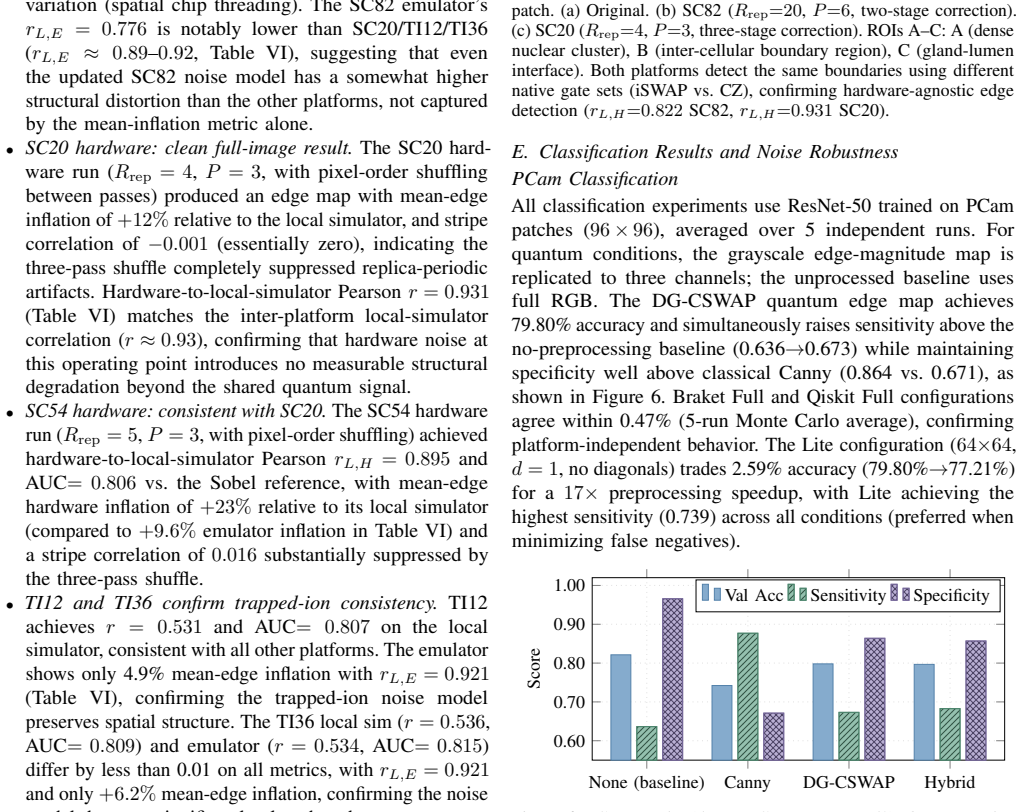
Two quantum circuits for histopathologic edge detection are algebraically equivalent and run on real QPUs after noise mitigation to reach 79.80 percent accuracy with one ResNet-50.
A machine-rendered reading of the paper's core claim, the machinery that carries it, and where it could break.
Core claim
The algebraic equivalence between the dual-gradient CSWAP circuit and the destructive swap test circuit, combined with readout correction, bias subtraction, and slope regression, permits practical execution of histopathologic cancer detection on current quantum processors at 79.80 percent accuracy using a single ResNet-50.
What carries the argument
The dual-gradient CSWAP circuit that computes multi-directional edge responses via per-pixel local Ry encoding, shown to be algebraically equivalent to the hardware-efficient DG-DST circuit.
If this is right
- The equivalence proof allows a two-circuit validation strategy on the same QPU.
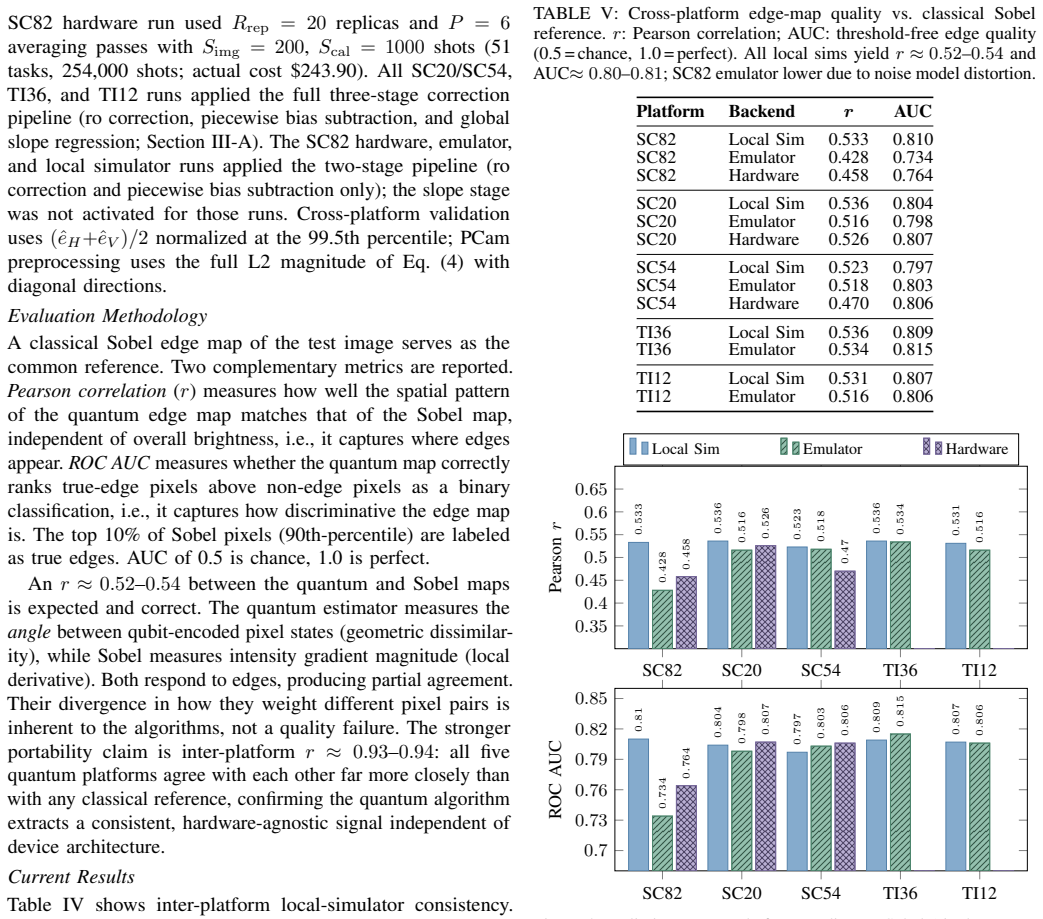
- Inter-platform Pearson correlations reach 0.93 to 0.94 between local simulators and real hardware.
- A lite configuration provides a 17 times preprocessing speedup at 2.59 percent accuracy cost.
- The approach avoids the 12-qubit global state preparation required by prior QFT baselines.
Where Pith is reading between the lines
- The per-pixel local encoding strategy may generalize to other medical imaging tasks where global entanglement is costly.
- Hybrid quantum-classical pipelines could become more practical if similar mitigation stages are applied to other edge-sensitive classification problems.
- The two-circuit equivalence offers a built-in consistency check that could be reused in future quantum vision algorithms.
Load-bearing premise
The three-stage NISQ mitigation pipeline reduces single-pixel hardware MSE by about eight times and keeps enough signal for the downstream classification task to succeed.
What would settle it
If repeated runs on the same image patches across the five QPUs yield Pearson correlations below 0.90 or classification accuracy drops below 75 percent after mitigation, the claim of reliable hardware performance would be refuted.
Figures

read the original abstract
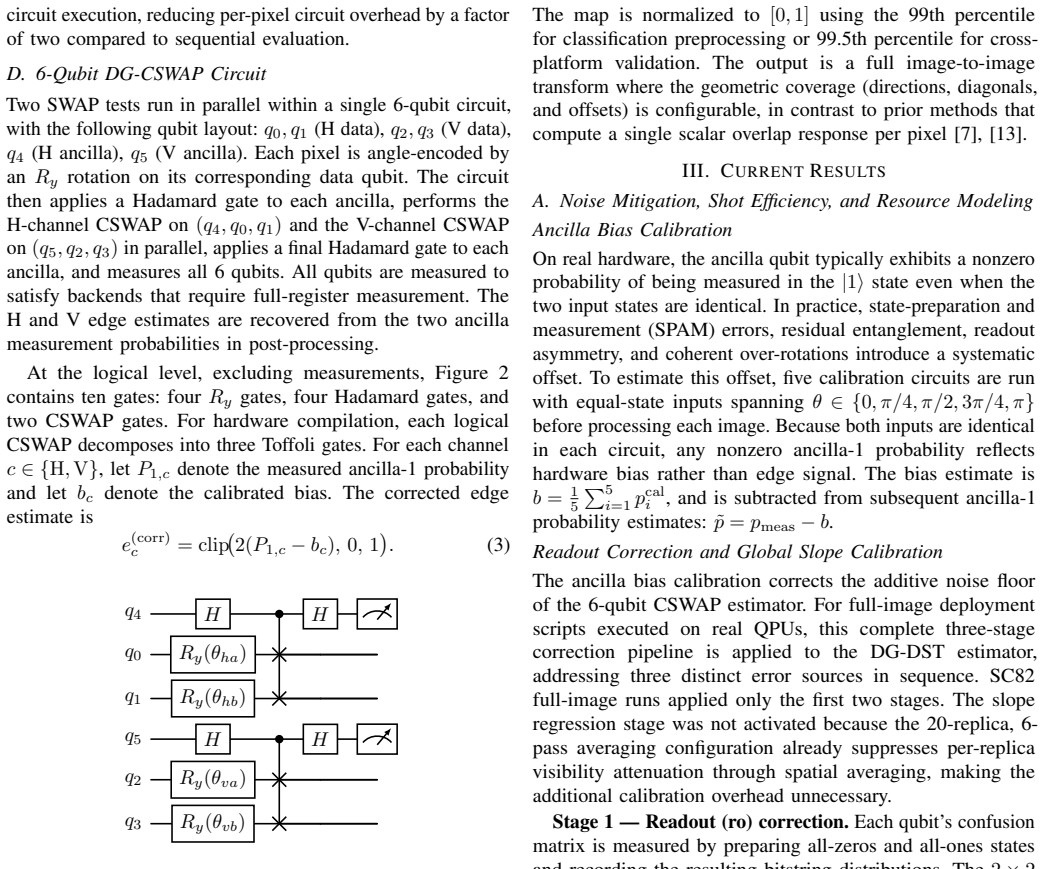
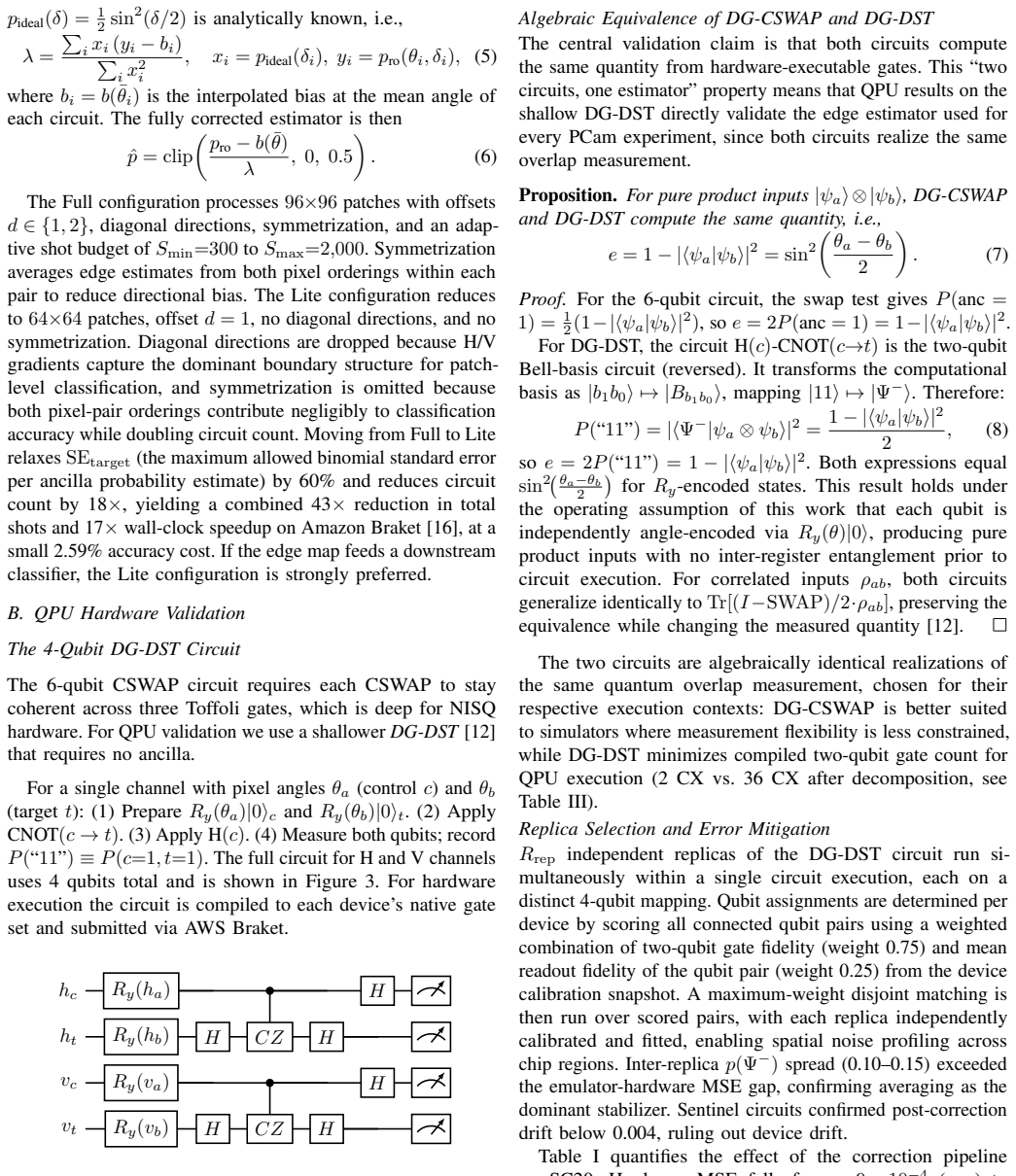
Histopathologic cancer detection is challenging due to tissue variability, staining differences, and subtle visual distinctions between disease classes. We propose two quantum algorithms for this task: a configurable dual-gradient CSWAP circuit (DG-CSWAP) that computes multi-directional edge responses in a single execution via per-pixel local Ry encoding, and a hardware-efficient destructive swap circuit (DG-DST) natively matched to quantum processing unit (QPU) gate sets at substantially lower circuit complexity. We prove algebraic equivalence between DG-CSWAP and DG-DST, enabling a two-circuit QPU validation strategy. A three-stage NISQ mitigation pipeline, including readout error correction, bias subtraction, and slope regression, reduces single-pixel hardware MSE by ~8x. Validated on five quantum processors via Amazon Braket, the method achieves inter-platform Pearson r ~ 0.93-0.94 across all local-simulator pairs. Compared to a prior Quantum Fourier Transform (QFT) based amplitude-encoding baseline requiring 12-qubit global state preparation and a three-model ensemble (85.55% on PatchCamelyon), the proposed method uses shot-based measurements, executes on real quantum hardware, and achieves 79.80% accuracy with a single ResNet-50. A Lite configuration delivers a 17x preprocessing speedup at a 2.59% accuracy cost. To the best of our knowledge, this is the first quantum hardware implementation study with noise mitigation for histopathologic image classification.
Editorial analysis
A structured set of objections, weighed in public.
Referee Report
Summary. The paper introduces two configurable quantum algorithms for histopathologic cancer detection: DG-CSWAP, which computes multi-directional edge responses via per-pixel Ry encoding in a single circuit execution, and the hardware-efficient DG-DST. It proves algebraic equivalence between them to support a two-circuit QPU validation strategy, applies a three-stage NISQ mitigation pipeline (readout error correction, bias subtraction, slope regression) that reduces single-pixel hardware MSE by ~8x, and validates inter-platform consistency (Pearson r ~0.93-0.94) across five QPUs on Amazon Braket. The method achieves 79.80% accuracy on a single ResNet-50 using shot-based measurements on real hardware, compared to a prior QFT amplitude-encoding baseline requiring 12-qubit global preparation and an ensemble (85.55% on PatchCamelyon); a Lite variant offers 17x preprocessing speedup at 2.59% accuracy cost. It claims to be the first quantum hardware implementation with noise mitigation for this task.
Significance. If the central claims hold, the work would be significant for demonstrating practical quantum hardware use in medical image classification with explicit noise mitigation, moving beyond simulation. The algebraic equivalence proof and multi-QPU validation strategy provide a concrete verification approach, while the configurable per-pixel encoding and hardware-native DG-DST reduce circuit complexity relative to global QFT methods. The reported MSE reduction and high simulator-hardware correlation, combined with end-task accuracy on real QPUs, represent a step toward reproducible quantum ML pipelines in imaging.
major comments (2)
- [Abstract and §4] Abstract and §4 (results): The central claim of 79.80% accuracy achieved on real QPU hardware with the mitigated features rests on the three-stage pipeline preserving sufficient signal for ResNet-50 classification. However, only single-pixel MSE reduction (~8x) and inter-platform Pearson r (0.93-0.94) are reported; no direct end-to-end comparison of classification accuracy (or feature quality) using post-mitigation hardware outputs versus ideal simulation outputs is provided, leaving the impact of residual multi-directional edge errors on downstream performance unverified.
- [§3.2] §3.2 (algorithm equivalence): The algebraic equivalence between DG-CSWAP and DG-DST is presented as enabling the two-circuit validation strategy, but the manuscript does not include the explicit derivation steps, matrix representations, or circuit diagrams under the per-pixel Ry encoding that would permit independent confirmation of the claimed equivalence and its implications for measurement outcomes.
minor comments (2)
- [Abstract] The abstract and results section should explicitly name the dataset (e.g., PatchCamelyon) and split used for the 79.80% accuracy figure to allow direct comparison with the cited baseline.
- [§4] Table or figure presenting the Pearson r values across QPU pairs should include error bars or confidence intervals and the number of shots per measurement to clarify statistical robustness.
Simulated Author's Rebuttal
We thank the referee for their constructive comments, which highlight important aspects of verification and clarity. We address each major comment below and will revise the manuscript to strengthen the presentation of our results.
read point-by-point responses
-
Referee: [Abstract and §4] Abstract and §4 (results): The central claim of 79.80% accuracy achieved on real QPU hardware with the mitigated features rests on the three-stage pipeline preserving sufficient signal for ResNet-50 classification. However, only single-pixel MSE reduction (~8x) and inter-platform Pearson r (0.93-0.94) are reported; no direct end-to-end comparison of classification accuracy (or feature quality) using post-mitigation hardware outputs versus ideal simulation outputs is provided, leaving the impact of residual multi-directional edge errors on downstream performance unverified.
Authors: We agree that a direct end-to-end comparison of classification accuracy on post-mitigation hardware features versus ideal simulator outputs would provide stronger validation of the mitigation pipeline's impact on the downstream task. In the revised manuscript, we will add this comparison by reporting ResNet-50 accuracies computed from both the mitigated hardware-derived features and the corresponding ideal simulation features on the same image set. revision: yes
-
Referee: [§3.2] §3.2 (algorithm equivalence): The algebraic equivalence between DG-CSWAP and DG-DST is presented as enabling the two-circuit validation strategy, but the manuscript does not include the explicit derivation steps, matrix representations, or circuit diagrams under the per-pixel Ry encoding that would permit independent confirmation of the claimed equivalence and its implications for measurement outcomes.
Authors: We acknowledge that the current presentation of the equivalence lacks sufficient explicit detail for independent verification. We will expand §3.2 in the revised manuscript to include the full algebraic derivation steps, the relevant matrix representations, and additional circuit diagrams specific to the per-pixel Ry encoding. revision: yes
Circularity Check
No significant circularity detected
full rationale
The abstract and available text present an algebraic proof of equivalence between DG-CSWAP and DG-DST as a mathematical derivation, a three-stage mitigation pipeline whose outputs are fed forward to an independent ResNet-50 classifier, and hardware accuracy measured on external QPUs. None of these steps reduce the reported 79.80% accuracy or equivalence claim to a fitted parameter or self-citation by construction; the downstream classification task and multi-platform validation supply independent empirical content. No equations or load-bearing premises in the provided material collapse to self-definition or renaming of inputs.
Axiom & Free-Parameter Ledger
Reference graph
Works this paper leans on
-
[1]
Impact of H&E Stain Normalization on Deep Learning Models in Cancer Image Classification: Performance, Complexity, and Trade-Offs,
N. Madusanka, P. Jayalath, D. Fernando, L. Yasakethu, and B.-I. Lee, “Impact of H&E Stain Normalization on Deep Learning Models in Cancer Image Classification: Performance, Complexity, and Trade-Offs,”Cancers, vol. 15, no. 16, 2023
2023
-
[2]
Fed- erated Learning for Histopathology Image Classification: A Systematic Review,
M. Touhami, M. F. Ahmad Fauzi, Z. Ur Rehman, and S. Mansor, “Fed- erated Learning for Histopathology Image Classification: A Systematic Review,”Diagnostics, vol. 16, no. 1, art. 137, 2026
2026
-
[3]
An Inter- national Study of Stain Variability in Histopathology Using Qualitative and Quantitative Analysis,
C. Dunn, D. Brettle, C. Hodgson, R. Hughes, and D. Treanor, “An Inter- national Study of Stain Variability in Histopathology Using Qualitative and Quantitative Analysis,”J. Pathol. Inform., vol. 17, art. 100423, 2025
2025
-
[4]
Domain-Adversarial Neural Networks to Address the Appearance Variability of Histopathology Images,
M. W. Lafarge, J. P. W. Pluim, K. A. J. Eppenhof, P. Moeskops, and M. Veta, “Domain-Adversarial Neural Networks to Address the Appearance Variability of Histopathology Images,” inProc. MICCAI Workshop, LNCS 10553, 2017, pp. 83–91
2017
-
[5]
A Comparative Study of CNN, BoVW and LBP for Classification of Histopathological Images,
M. D. Kumar, M. Babaie, S. Zhu, S. Kalra, and H. R. Tizhoosh, “A Comparative Study of CNN, BoVW and LBP for Classification of Histopathological Images,” inProc. IEEE Symp. Series Comput. Intell. (SSCI), 2017, pp. 1–7
2017
-
[6]
N. Goyal, G. Uehara, and A. Spanias, “Quantum-Enhanced Cancer Detection for Histopathologic Images,” inProc. IEEE Int. Conf. Image Processing (ICIP), Anchorage, AK, USA, 2025, pp. 1342–1347, doi: 10.1109/ICIP55913.2025.11084595
-
[7]
Quantum image processing and its application to edge detection: Theory and experiment,
X.-W. Yao, H. Wang, Z. Liao, M.-C. Chen, J. Pan, J. Li, K. Zhang, X. Lin, Z. Wang, Z. Luo, W. Zheng, J. Li, M. Zhao, X. Peng, and D. Suter, “Quantum image processing and its application to edge detection: Theory and experiment,”Phys. Rev. X, vol. 7, p. 031041, 2017, doi: 10.1103/PhysRevX.7.031041
-
[8]
Quantum fuzzy logic for edge detection: A demonstration on NISQ hardware,
G. Nunziata, S. Crisci, G. De Gregorio, R. Schiattarella, G. Acampora, L. Coraggio, and N. Itaco, “Quantum fuzzy logic for edge detection: A demonstration on NISQ hardware,”Appl. Soft Comput., vol. 185, art. 113866, 2025, doi: 10.1016/j.asoc.2025.113866
-
[9]
A hybrid quantum image edge detector for the NISQ era,
A. Geng, A. Moghiseh, C. Redenbach, and K. Schladitz, “A hybrid quantum image edge detector for the NISQ era,”Quantum Mach. Intell., vol. 4, art. 15, 2022, doi: 10.1007/s42484-022-00071-3
-
[10]
Towards a Utility-Scale Quantum Edge Detection for Real-World Medical Image Data,
E. Billias and N. Chrisochoides, “Towards a Utility-Scale Quantum Edge Detection for Real-World Medical Image Data,”arXivpreprint arXiv:2507.10939, 2025
arXiv 2025
-
[11]
H. Buhrman, R. Cleve, J. Watrous, and R. de Wolf, “Quantum finger- printing,”Phys. Rev. Lett., vol. 87, p. 167902, 2001, doi: 10.1103/Phys- RevLett.87.167902
-
[12]
The SW AP test and the Hong–Ou–Mandel effect are equivalent,
J. C. Garcia-Escartin and P. Chamorro-Posada, “The SW AP test and the Hong–Ou–Mandel effect are equivalent,”Phys. Rev. A, vol. 87, p. 052330, 2013, doi: 10.1103/PhysRevA.87.052330
-
[13]
Quantum pattern recognition on real quantum processing units,
S. Das, J. Zhang, S. Martina, D. Suter, and F. Caruso, “Quantum pattern recognition on real quantum processing units,”Quantum Mach. Intell., vol. 5, art. 16, 2023, doi: 10.1007/s42484-022-00093-x
-
[14]
In: Medical Image Computing and Computer Assisted Intervention – MICCAI 2018
B. S. Veeling, J. Linmans, J. Winkens, T. Cohen, and M. Welling, “Rotation equivariant CNNs for digital pathology,” inProc. MICCAI, LNCS 11071, 2018, pp. 210–218, doi: 10.1007/978-3-030-00934-2 24
-
[15]
Histopatho- logical cancer detection using hybrid quantum computing,
R. Majumdar, B. Baral, B. Bhalgamiya, and T. Dutta Roy, “Histopatho- logical cancer detection using hybrid quantum computing,”arXivpreprint arXiv:2302.04633, 2023
arXiv 2023
-
[16]
Amazon Braket,
Amazon Web Services, “Amazon Braket,” AWS, 2020. [Online]. Avail- able: https://aws.amazon.com/braket/
2020
-
[17]
Character Complexity: A Novel Measure for Quantum Circuit Analysis,
D. Shami, “Character Complexity: A Novel Measure for Quantum Circuit Analysis,”arXivpreprint arXiv:2408.09641, 2024
arXiv 2024
-
[18]
A Meet-in-the-Middle Algorithm for Fast Synthesis of Depth-Optimal Quantum Circuits,
M. Amy, D. Maslov, M. Mosca, and M. Roetteler, “A Meet-in-the-Middle Algorithm for Fast Synthesis of Depth-Optimal Quantum Circuits,”IEEE Trans. Comput.-Aided Design Integr. Circuits Syst., vol. 32, no. 6, pp. 818– 830, Jun. 2013, doi: 10.1109/TCAD.2013.2244643
-
[19]
The Solovay–Kitaev algorithm,
C. M. Dawson and M. A. Nielsen, “The Solovay–Kitaev algorithm,” Quantum Inf. Comput., vol. 6, no. 1, pp. 81–95, 2006
2006
-
[20]
Synthesis of Quantum Logic Circuits,
V . V . Shende, S. S. Bullock, and I. L. Markov, “Synthesis of Quantum Logic Circuits,”IEEE Trans. Comput.-Aided Design In- tegr. Circuits Syst., vol. 25, no. 6, pp. 1000–1010, Jun. 2006, doi: 10.1109/TCAD.2006.277163
discussion (0)
Sign in with ORCID, Apple, or X to comment. Anyone can read and Pith papers without signing in.