Do Prompt Gamma-ray Burst Fireball Composition Impact on Afterglow Emission? Cases Study for Long GRBs 080916C/090902B and Short GRBs 090510/130603B
Pith reviewed 2026-06-26 12:05 UTC · model grok-4.3
The pith
Afterglow emission in gamma-ray bursts depends on ambient medium density rather than prompt fireball composition.
A machine-rendered reading of the paper's core claim, the machinery that carries it, and where it could break.
Core claim
By fitting the multi-wavelength afterglow light curves of GRBs 080916C, 090902B, 090510 and 130603B with the forward-shock model that incorporates emission from both primary and cascaded electron populations, the authors find that the characteristic parameters of the light-curve evolution are set by ambient medium density and are unrelated to whether the original fireball was thermally or non-thermally dominated. The prompt-phase conversion of internal energy into jet kinetic energy erases any detectable compositional signature, leaving the density of the ambient medium as the dominant factor shaping the afterglow.
What carries the argument
The standard forward-shock model that includes synchrotron emission from both primary electrons and cascade electron-positron pairs produced by gamma-gamma annihilation.
If this is right
- Ambient medium density is the dominant parameter controlling afterglow light-curve evolution for both long and short GRBs.
- Prompt internal energy is fully converted to kinetic energy before the afterglow phase begins.
- Early UV-optical afterglows of long GRBs can be powered by cascaded pairs without altering the density-driven behavior.
- Afterglow modeling does not require knowledge of the prompt-phase composition.
Where Pith is reading between the lines
- The difference in cascade-pair contribution between the long and short bursts may trace progenitor or environmental differences rather than composition alone.
- Observations of GRBs spanning a wider range of ambient densities would provide a stronger test of the density-only conclusion.
- If microphysical parameters such as electron acceleration efficiency vary systematically with composition, the present modeling could miss that dependence.
Load-bearing premise
The standard forward-shock model with cascade pairs fully captures the afterglow physics of these four bursts without missing composition-dependent effects.
What would settle it
A larger sample of GRBs in which afterglow parameters correlate with prompt spectral type even after ambient density is accounted for.
Figures


read the original abstract
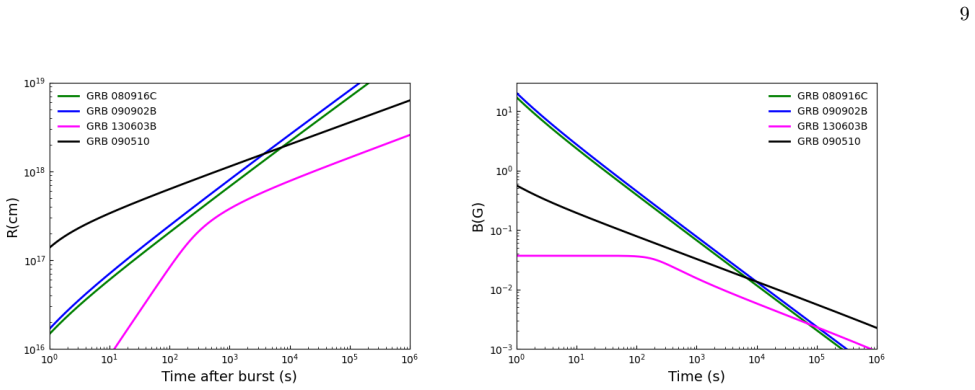
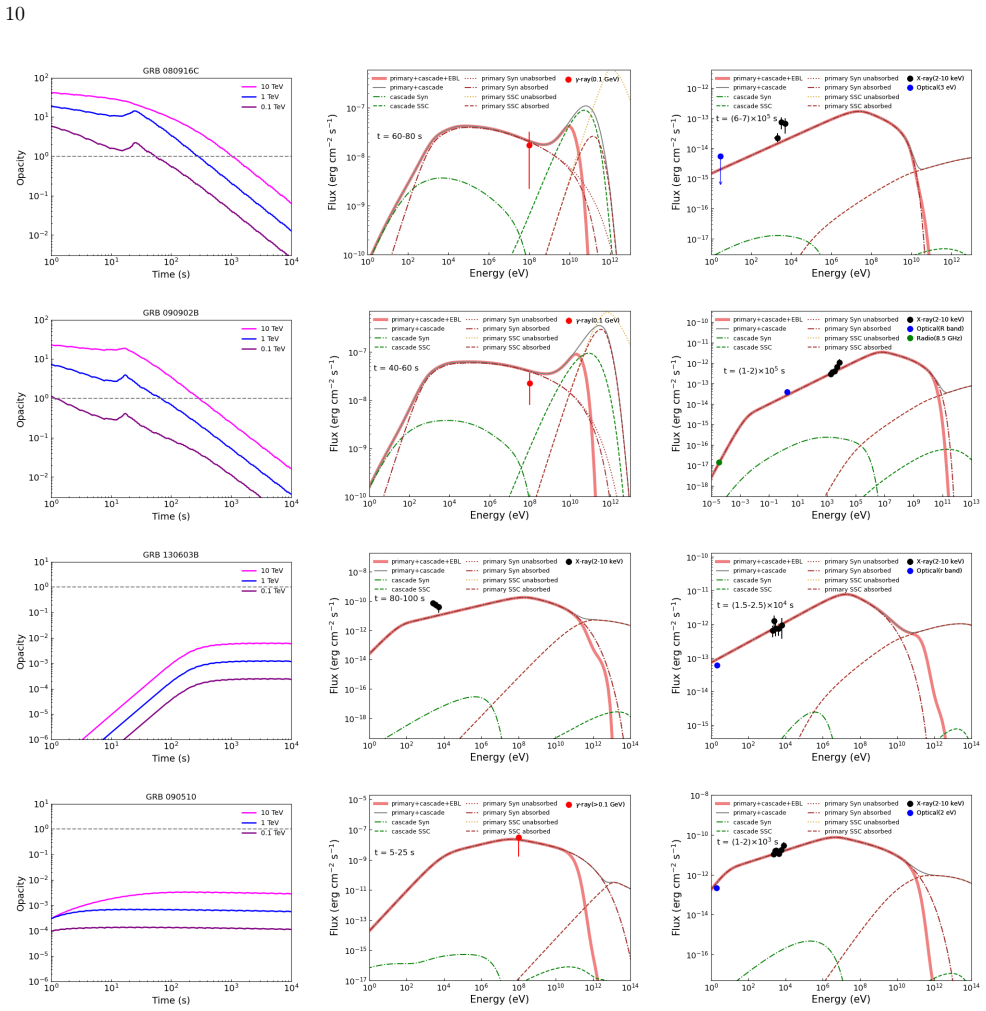
Broadband observations with the {\em Fermi} mission reveal that a large fraction of gamma-ray burst (GRB) spectra are dominated by non-thermal emission, while a small fraction are dominated by thermal/quasi-thermal emission, likely indicating the difference in jet composition among GRB. By selecting two typical long GRBs (080916C and 090902B) and two short GRBs (130603B and 090510), we present a comparative analysis to investigate whether the composition of prompt GRB jets influences the afterglow emission for bursts originating from both massive star collapse and compact binary mergers. Incorporating emission from both primary and cascade electron populations, we fit the multi-wavelength afterglow lightcurves of these GRBs with the standard forward shock model and analyze the particle acceleration and radiation physics of the jets. Our results show that the afterglow lightcurve evolution with the characteristic parameters is not related to the composition of the GRB fireball but rather depends on the ambient medium density. The early UV-optical afterglows of the two long GRBs are dominated by synchrotron emission from cascaded $e^{\pm}$ pairs produced via the $\gamma\gamma$ annihilation process, whereas this is not the case for the two short GRBs. These results suggest that the internal energy of the fireball is converted into jet kinetic energy during the prompt phase, and that the fireball composition leaves no detectable footprint on the afterglow jet. Instead, the density of the ambient medium plays an essential role in shaping the afterglow emission.
Editorial analysis
A structured set of objections, weighed in public.
Referee Report
Summary. The paper selects two long GRBs (080916C, 090902B) and two short GRBs (090510, 130603B) with differing prompt emission (non-thermal vs. thermal/quasi-thermal) to test whether fireball composition affects afterglow. It fits the multi-wavelength afterglow light curves using the standard forward-shock model that includes both primary electrons and cascade e± pairs from γγ annihilation, then reports that the evolution of characteristic afterglow parameters correlates with ambient medium density rather than prompt spectral type. The central conclusion is that fireball composition is converted to kinetic energy during the prompt phase and leaves no detectable footprint on the afterglow jet.
Significance. If the result were independently verified, it would support the view that afterglow physics is insensitive to prompt composition for both collapsar and merger progenitors and would reinforce the dominance of external density in shaping afterglow light curves. The work does not, however, supply machine-checked derivations, reproducible fitting code, or falsifiable predictions that would strengthen its evidential weight.
major comments (3)
- [Abstract / model section] Abstract and § (model description): the claim that 'the fireball composition leaves no detectable footprint' is obtained solely by fitting the standard forward-shock model (primary + cascade electrons). Because that model contains no explicit composition-dependent microphysics or magnetization terms, the absence of a footprint is a direct consequence of the modeling choice rather than an independent test.
- [Results] Results section: no quantitative fit statistics (χ²/dof, residual distributions, parameter uncertainties, or covariance matrices) are reported for the four GRBs, nor is any robustness check against data exclusion or alternative density profiles presented. This leaves the reported correlation between afterglow parameters and ambient density unquantified.
- [Discussion] Discussion: the four bursts are treated as representative, yet no justification is given for why these particular events suffice to generalize the conclusion to the broader long- and short-GRB populations; the weakest-assumption concern in the stress-test note therefore remains unaddressed.
minor comments (2)
- [Abstract] Notation for 'characteristic parameters' is used repeatedly without an explicit list or table linking them to the fitted quantities (e.g., E_k, n, ε_e, ε_B).
- [Results] The statement that early UV-optical afterglows of the long GRBs are 'dominated by synchrotron emission from cascaded e± pairs' would benefit from a quantitative breakdown of the flux contribution from cascade versus primary electrons at each epoch.
Simulated Author's Rebuttal
We thank the referee for the constructive comments. We respond point-by-point to the major comments below, indicating revisions where appropriate.
read point-by-point responses
-
Referee: [Abstract / model section] Abstract and § (model description): the claim that 'the fireball composition leaves no detectable footprint' is obtained solely by fitting the standard forward-shock model (primary + cascade electrons). Because that model contains no explicit composition-dependent microphysics or magnetization terms, the absence of a footprint is a direct consequence of the modeling choice rather than an independent test.
Authors: We acknowledge that the standard forward-shock model employed does not include explicit composition-dependent microphysics. Our analysis tests whether afterglow data from GRBs with differing prompt spectra are adequately described by this model and whether the resulting parameters correlate with prompt type or ambient density. We will revise the abstract and model section to clarify the scope of the test within the standard framework. revision: partial
-
Referee: [Results] Results section: no quantitative fit statistics (χ²/dof, residual distributions, parameter uncertainties, or covariance matrices) are reported for the four GRBs, nor is any robustness check against data exclusion or alternative density profiles presented. This leaves the reported correlation between afterglow parameters and ambient density unquantified.
Authors: We agree that quantitative fit statistics and robustness checks are necessary. In the revised manuscript we will report χ²/dof values, parameter uncertainties, and include a brief robustness discussion using alternative density profiles. revision: yes
-
Referee: [Discussion] Discussion: the four bursts are treated as representative, yet no justification is given for why these particular events suffice to generalize the conclusion to the broader long- and short-GRB populations; the weakest-assumption concern in the stress-test note therefore remains unaddressed.
Authors: These events were selected for their high-quality multi-wavelength coverage and contrasting prompt properties. We will add explicit justification in the discussion, note the case-study nature of the work, and address limitations on generalization to the full populations. revision: yes
Circularity Check
No significant circularity: empirical fits within standard model yield model-dependent conclusion
full rationale
The paper selects GRBs with differing prompt compositions, fits their afterglow light curves using the standard forward-shock model (including primary + cascade electrons), extracts characteristic parameters, and reports that those parameters correlate with ambient density rather than prompt spectral type. This is an empirical comparison inside one fixed model; the text contains no self-definitional equations, no fitted parameter renamed as an independent prediction, no load-bearing self-citation, and no uniqueness theorem imported from prior work. The claim that composition leaves “no detectable footprint” is therefore an interpretation of the fit results rather than a quantity forced by construction to equal the model inputs. The derivation chain is self-contained against the chosen external data sets.
Axiom & Free-Parameter Ledger
free parameters (2)
- ambient medium density
- characteristic afterglow parameters
axioms (2)
- domain assumption The standard forward shock model applies without modification from prompt composition
- domain assumption Cascade e± pairs from γγ annihilation dominate early UV-optical emission in long GRBs
Reference graph
Works this paper leans on
-
[1]
A., Ackermann, M., Ajello, M., et al.\ 2009, , 706, L138
Abdo, A. A., Ackermann, M., Ajello, M., et al.\ 2009, , 706, L138. doi:10.1088/0004-637X/706/1/L138
-
[2]
A., Ackermann, M., Arimoto, M., et al.\ 2009, Science, 323, 1688
Abdo, A. A., Ackermann, M., Arimoto, M., et al.\ 2009, Science, 323, 1688. doi:10.1126/science.1169101
-
[3]
A., Ackermann, M., Ajello, M., et al.\ 2009, , 462, 331
Abdo, A. A., Ackermann, M., Ajello, M., et al.\ 2009, , 462, 331. doi:10.1038/nature08574
-
[4]
B., et al.\ 2010, , 716, 2, 1178
Ackermann, M., Asano, K., Atwood, W. B., et al.\ 2010, , 716, 2, 1178. doi:10.1088/0004-637X/716/2/1178
-
[5]
Band, D., Matteson, J., Ford, L., et al.\ 1993, , 413, 281. doi:10.1086/172995
-
[6]
doi:10.1088/0004-637X/768/1/54
B \"o ttcher, M., Reimer, A., Sweeney, K., et al.\ 2013, , 768, 54. doi:10.1088/0004-637X/768/1/54
-
[7]
Chen, J.-M., Zhu, K.-R., Peng, Z.-Y., et al.\ 2024, , 972, 2, 132. doi:10.3847/1538-4357/ad5f93
-
[8]
& Peng, Z.-Y.\ 2024, , 964, 1, 45
Chen, J.-M. & Peng, Z.-Y.\ 2024, , 964, 1, 45. doi:10.3847/1538-4357/ad26fc
-
[9]
Chevalier, R. A. & Li, Z.-Y.\ 2000, , 536, 195. doi:10.1086/308914
-
[10]
X., Perley, D., et al.\ 2013, , 777, 94
Cucchiara, A., Prochaska, J. X., Perley, D., et al.\ 2013, , 777, 94. doi:10.1088/0004-637X/777/2/94
-
[11]
B., Tanvir, N., et al.\ 2009, GRB Coordinates Network, Circular Service, No
Cucchiara, A., Fox, D. B., Tanvir, N., et al.\ 2009, GRB Coordinates Network, Circular Service, No. 9873, \#1 (2009), 9873
2009
-
[12]
Dai, Z. G. & Lu, T.\ 1998, , 298, 87. doi:10.1046/j.1365-8711.1998.01681.x
-
[13]
De Pasquale, M., Schady, P., Kuin, N. P. M., et al.\ 2010, , 709, L146. doi:10.1088/2041-8205/709/2/L146
-
[14]
Eichler, D., Livio, M., Piran, T., et al.\ 1989, , 340, 6229, 126. doi:10.1038/340126a0
-
[15]
& Dai, Z.-G.\ 2011, Research in Astronomy and Astrophysics, 11, 1046
Feng, S.-Y. & Dai, Z.-G.\ 2011, Research in Astronomy and Astrophysics, 11, 1046. doi:10.1088/1674-4527/11/9/004
-
[16]
Foreman-Mackey, D., Hogg, D. W., Lang, D., et al.\ 2013, , 125, 925, 306. doi:10.1086/670067
-
[17]
Frail, D. A., Kulkarni, S. R., Sari, R., et al.\ 2001, , 562, 1, L55. doi:10.1086/338119
-
[18]
14772, \#1 (2013), 14772, 1
Frederiks, D.\ 2013, GRB Coordinates Network, Circular Service, No. 14772, \#1 (2013), 14772, 1
2013
-
[19]
doi:10.1088/0004-637X/706/1/L33
Gao, W.-H., Mao, J., Xu, D., et al.\ 2009, , 706, L33. doi:10.1088/0004-637X/706/1/L33
-
[20]
Goodman, J.\ 1986, , 308, L47. doi:10.1086/184741
-
[21]
Communications in Applied Mathematics and Computational Science, Vol
Goodman, J. & Weare, J.\ 2010, Communications in Applied Mathematics and Computational Science, 5, 1, 65. doi:10.2140/camcos.2010.5.65
-
[22]
doi:10.1051/0004-6361/200811571
Greiner, J., Clemens, C., Kr \"u hler, T., et al.\ 2009, , 498, 89. doi:10.1051/0004-6361/200811571
-
[23]
doi:10.1088/0004-637X/733/1/22
He, H.-N., Wu, X.-F., Toma, K., et al.\ 2011, , 733, 1, 22. doi:10.1088/0004-637X/733/1/22
-
[24]
Huang, L.-Y., Wang, X.-G., Zheng, W., et al.\ 2018, , 859, 2, 163. doi:10.3847/1538-4357/aaba6e
-
[25]
Huang, X.-L., Wang, Z.-R., Liu, R.-Y., et al.\ 2021, , 908, 225. doi:10.3847/1538-4357/abd6bc
-
[26]
Huang, Y. F., Dai, Z. G., & Lu, T.\ 1999, , 309, 513. doi:10.1046/j.1365-8711.1999.02887.x
-
[27]
Kumar, P. & Barniol Duran, R.\ 2010, , 409, 226. doi:10.1111/j.1365-2966.2010.17274.x
-
[28]
& Panaitescu, A.\ 2000, , 541, 1, L9
Kumar, P. & Panaitescu, A.\ 2000, , 541, 1, L9. doi:10.1086/312888
-
[29]
Kumar, P. & Zhang, B.\ 2015, , 561, 1. doi:10.1016/j.physrep.2014.09.008
work page internal anchor Pith review doi:10.1016/j.physrep.2014.09.008 2015
-
[30]
Gamma Ray Bursts as Electromagnetic Outflows
Lyutikov, M. & Blandford, R.\ 2003, astro-ph/0312347. doi:10.48550/arXiv.astro-ph/0312347
work page internal anchor Pith review Pith/arXiv arXiv doi:10.48550/arxiv.astro-ph/0312347 2003
-
[31]
MacFadyen, A. I. & Woosley, S. E.\ 1999, , 524, 1, 262. doi:10.1086/307790
work page internal anchor Pith review doi:10.1086/307790 1999
-
[32]
Meszaros, P. & Rees, M. J.\ 1993, , 405, 278. doi:10.1086/172360
-
[33]
M \'e sz \'a ros, P. & Rees, M. J.\ 2000, , 530, 1, 292. doi:10.1086/308371
-
[34]
, year = 2005, month = apr, volume =
Moderski, R., Sikora, M., Coppi, P. S., et al.\ 2005, , 363, 954. doi:10.1111/j.1365-2966.2005.09494.x
-
[35]
doi:10.1146/annurev.astro.40.060401.093821
M \'e sz \'a ros, P.\ 2002, , 40, 137. doi:10.1146/annurev.astro.40.060401.093821
-
[36]
M \'e sz \'a ros, P. & Rees, M. J.\ 1997, , 482, L29. doi:10.1086/310692
-
[37]
doi:10.1088/0004-637X/703/1/675
Nakar, E., Ando, S., & Sari, R.\ 2009, , 703, 675. doi:10.1088/0004-637X/703/1/675
-
[38]
Narayan, R., Paczynski, B., & Piran, T.\ 1992, , 395, L83. doi:10.1086/186493
-
[39]
Paczynski, B.\ 1986, , 308, L43. doi:10.1086/184740
-
[40]
Panaitescu, A. & Kumar, P.\ 2000, , 543, 66. doi:10.1086/317090
-
[41]
Pandey, S. B., Swenson, C. A., Perley, D. A., et al.\ 2010, , 714, 799. doi:10.1088/0004-637X/714/1/799
-
[42]
Pe'Er, A., Zhang, B.-B., Ryde, F., et al.\ 2012, , 420, 1, 468. doi:10.1111/j.1365-2966.2011.20052.x
-
[43]
doi:10.1103/RevModPhys.76.1143
Piran, T.\ 2004, Reviews of Modern Physics, 76, 1143. doi:10.1103/RevModPhys.76.1143
-
[44]
B., et al.\ 2010, , 709, 2, L172
Ryde, F., Axelsson, M., Zhang, B. B., et al.\ 2010, , 709, 2, L172. doi:10.1088/2041-8205/709/2/L172
-
[45]
9353, \#1 (2009), 9353
Rau, A., McBreen, S., & Kruehler, T.\ 2009, GRB Coordinates Network, Circular Service, No. 9353, \#1 (2009), 9353
2009
-
[46]
Rees, M. J. & Meszaros, P.\ 1994, , 430, L93. doi:10.1086/187446
-
[47]
Sari, R. & Esin, A. A.\ 2001, , 548, 787. doi:10.1086/319003
-
[48]
1998, ApJL, 497, L17, doi: 10.1086/311269
Sari, R., Piran, T., & Narayan, R.\ 1998, , 497, L17. doi:10.1086/311269
-
[49]
Shemi, A. & Piran, T.\ 1990, , 365, L55. doi:10.1086/185887
-
[50]
Tanvir, N. R., Levan, A. J., Fruchter, A. S., et al.\ 2013, , 500, 547. doi:10.1038/nature12505
-
[51]
Thompson, C.\ 1994, , 270, 480. doi:10.1093/mnras/270.3.480
-
[52]
Toma, K., Wu, X.-F., & M \'e sz \'a ros, P.\ 2011, , 415, 1663. doi:10.1111/j.1365-2966.2011.18807.x
-
[53]
Usov, V. V.\ 1994, , 267, 1035. doi:10.1093/mnras/267.4.1035
-
[54]
Veres, P., Dermer, C. D., & Dhuga, K. S.\ 2017, , 847, 39. doi:10.3847/1538-4357/aa87b1
-
[55]
& K \"o nigl, A.\ 2003, , 596, 1080
Vlahakis, N. & K \"o nigl, A.\ 2003, , 596, 1080. doi:10.1086/378226
-
[56]
Wang, X.-G., Chen, Y.-Z., Huang, X.-L., et al.\ 2022, , 939, 1, 39. doi:10.3847/1538-4357/ac937c
-
[57]
doi:10.1088/0004-637X/712/2/1232
Wang, X.-Y., He, H.-N., Li, Z., et al.\ 2010, , 712, 1232. doi:10.1088/0004-637X/712/2/1232
-
[58]
Wang, Y., Zheng, T.-C., & Jin, Z.-P.\ 2022, , 940, 2, 142. doi:10.3847/1538-4357/aca017
-
[59]
Woosley, S. E. & Bloom, J. S.\ 2006, , 44, 1, 507. doi:10.1146/annurev.astro.43.072103.150558
-
[60]
Xiong, R.-J., Huang, X.-L., & Wang, Z.-R.\ 2024, , 966, 2, L25. doi:10.3847/2041-8213/ad40ab
-
[61]
Zhang, B.\ 2018, . doi:10.1017/9781139226530
-
[62]
Zhang, B. & Yan, H.\ 2011, , 726, 2, 90. doi:10.1088/0004-637X/726/2/90
-
[63]
doi:10.1088/0004-637X/730/2/141
Zhang, B.-B., Zhang, B., Liang, E.-W., et al.\ 2011, , 730, 141. doi:10.1088/0004-637X/730/2/141
-
[64]
doi:10.1088/2041-8205/758/2/L34
Zhang, B., Lu, R.-J., Liang, E.-W., et al.\ 2012, , 758, L34. doi:10.1088/2041-8205/758/2/L34
-
[65]
Zhang, B., Zhang, B.-B., Virgili, F. J., et al.\ 2009, , 703, 1696. doi:10.1088/0004-637X/703/2/1696
-
[66]
doi:10.1016/j.jheap.2024.01.002
Zhang, B., Wang, X.-Y., & Zheng, J.-H.\ 2024, Journal of High Energy Astrophysics, 41, 42. doi:10.1016/j.jheap.2024.01.002
discussion (0)
Sign in with ORCID, Apple, or X to comment. Anyone can read and Pith papers without signing in.