ColumnKeeper: Efficient Solutions to the ColumnDisturb Vulnerability in DRAM-based Systems
Pith reviewed 2026-06-26 09:58 UTC · model grok-4.3
The pith
ColumnKeeper stops ColumnDisturb bitflips in DRAM by counting column activations or refreshing probabilistically at under 0.4 percent average slowdown.
A machine-rendered reading of the paper's core claim, the machinery that carries it, and where it could break.
Core claim
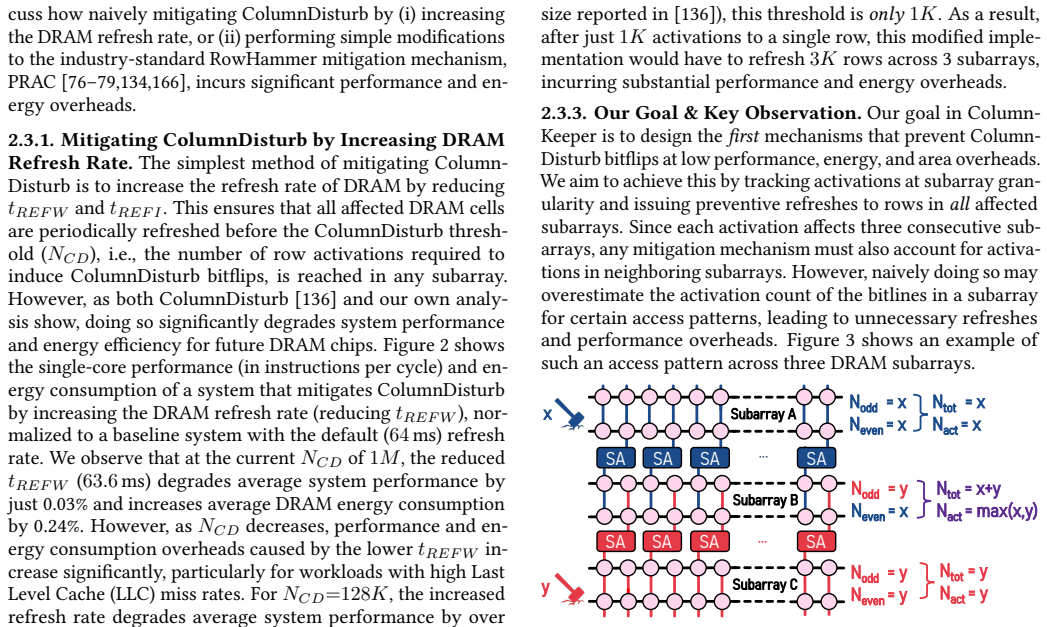
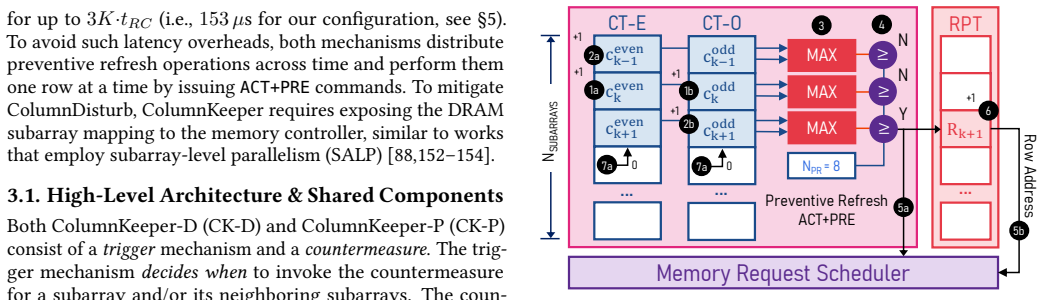
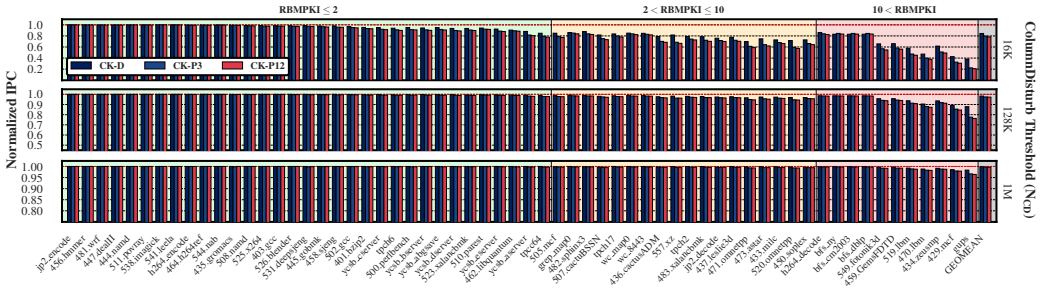
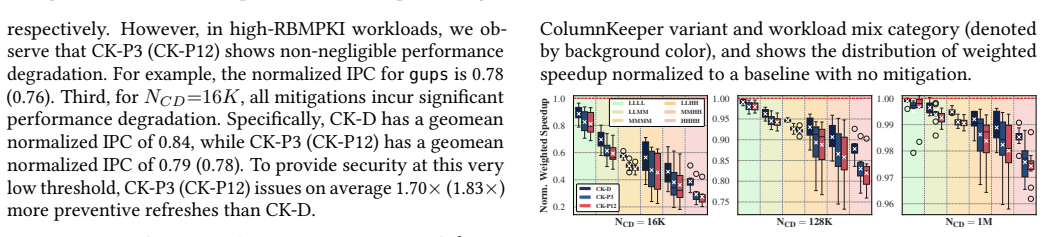
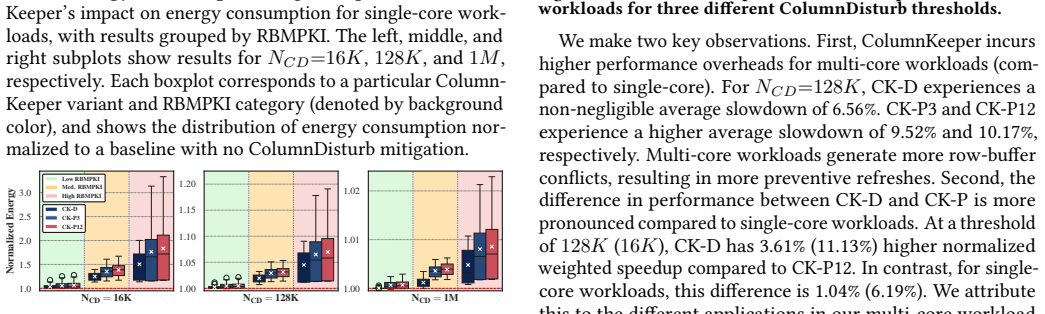
ColumnDisturb disturbs all cells across three consecutive subarrays by targeting columns instead of rows. ColumnKeeper-D exploits the open-bitline architecture with two counters per subarray to track activations to odd and even columns and refreshes one row when a counter reaches the threshold. ColumnKeeper-P refreshes one row in three consecutive subarrays with a chosen probability upon activation in the middle subarray. Both mechanisms prevent ColumnDisturb bitflips at average single-core performance overheads of 0.15 percent and 0.36 percent respectively for the current 1M threshold, rising only to 1.70 percent and 2.73 percent at 128K, with area costs of 0.1 mm² and 0.03 mm².
What carries the argument
Two per-subarray counters that separately track activations affecting odd and even columns and trigger deterministic refresh (CK-D), or probabilistic refresh of one row in three consecutive subarrays upon middle-subarray activation (CK-P).
If this is right
- At the current 1M threshold both mechanisms incur average single-core overhead below 0.4 percent.
- At the projected near-future 128K threshold overhead remains below 3 percent on average.
- Lower thresholds such as 16K become feasible by adopting smaller subarray sizes or enabling subarray-level parallelism.
- Area overhead stays at 0.1 mm² or less for either variant.
Where Pith is reading between the lines
- The two mechanisms could be combined with existing row-disturbance defenses to protect against multiple disturbance types simultaneously.
- Designers might adjust the probability in CK-P or the refresh threshold in CK-D to match different security versus performance targets in specific systems.
- Future DRAM scaling that reduces subarray size would directly improve the effectiveness of these mitigations at lower thresholds.
Load-bearing premise
The ColumnDisturb activation thresholds measured in experiments apply to all DRAM chips and future devices keep the same open-bitline architecture and subarray organization.
What would settle it
Measuring ColumnDisturb thresholds on a broad set of production DRAM chips from multiple vendors and finding values that differ substantially from 1M or 128K would invalidate the reported performance and area overhead numbers.
Figures



read the original abstract
Modern DRAM chips are vulnerable to read disturbance phenomena such as RowHammer and RowPress, which induce bitflips after accessing nearby rows a certain number of times (the read disturbance threshold). ColumnDisturb is a new, fundamentally different DRAM read disturbance phenomenon. Specifically, ColumnDisturb (i) disturbs DRAM columns instead of rows, and (ii) increases the number of affected DRAM cells from those in only a few neighboring rows to all cells across three consecutive DRAM subarrays. We propose ColumnKeeper, the first set of ColumnDisturb mitigations, in two variants: ColumnKeeper-D (CK-D), a deterministic mechanism, and ColumnKeeper-P (CK-P), a probabilistic one. CK-D exploits DRAM's open-bitline architecture to provide deterministic security guarantees at low performance and energy overheads: it uses two counters per subarray to track activations affecting the odd and even columns, and refreshes one row in a subarray when either counter reaches a predetermined threshold. CK-P instead refreshes one row in three consecutive subarrays upon a row activation in the middle subarray, with a predetermined probability, providing configurable security guarantees at low area overhead. Both mechanisms prevent ColumnDisturb bitflips at low performance, energy, and area overheads. At the current experimentally-demonstrated ColumnDisturb threshold (1M), CK-D and CK-P incur very low average single-core performance overheads of 0.15% and 0.36%, respectively. For near-future thresholds (128K), these rise to a still low average of 1.70% and 2.73%. Mitigating ColumnDisturb at low thresholds (e.g., 16K) remains possible by adopting smaller subarray sizes or enabling subarray-level parallelism. CK-D and CK-P require low area overheads of 0.1 mm^2 and 0.03 mm^2, respectively. ColumnKeeper is freely available at https://github.com/CMU-SAFARI/ColumnKeeper .
Editorial analysis
A structured set of objections, weighed in public.
Referee Report
Summary. The paper identifies ColumnDisturb as a new DRAM read-disturbance effect that flips bits across columns in three consecutive subarrays rather than rows, and introduces two mitigations: ColumnKeeper-D (CK-D), which uses two per-subarray activation counters and deterministic refreshes on the open-bitline architecture, and ColumnKeeper-P (CK-P), which applies probabilistic refreshes across three subarrays. Both are claimed to prevent bitflips with average single-core performance overheads of 0.15%/0.36% at the current 1M threshold and 1.70%/2.73% at the projected 128K threshold, plus area costs of 0.1 mm² and 0.03 mm²; the code is released openly.
Significance. If the mechanisms provably bound activation counts below the disturbance threshold under the stated DRAM organization, the work supplies the first concrete defenses against a column-oriented disturbance that affects far more cells than RowHammer/RowPress. The open-source release at the cited GitHub repository is a clear strength that enables independent reproduction of the reported overhead numbers.
major comments (3)
- [Evaluation section] Evaluation section: the headline overhead figures (0.15 % / 0.36 % at 1 M activations; 1.70 % / 2.73 % at 128 K) are produced by simulation that triggers refreshes exactly when counters reach the supplied threshold, yet no description of the simulator, DRAM timing parameters, workload mix, or run-to-run variance is supplied; without these the central “low-overhead” claim cannot be verified.
- [CK-D mechanism description] CK-D mechanism description: the deterministic guarantee rests on the assumption that the open-bitline wiring and three-subarray scope fully capture ColumnDisturb; the manuscript provides no sensitivity analysis showing how the counter-update logic would fail if future devices alter subarray boundaries or bitline sharing.
- [CK-P mechanism description] CK-P mechanism description: the probabilistic refresh probability is listed among the free parameters, yet no derivation or experimental calibration is given for the value chosen to meet the security target at 128 K; the reported overhead therefore depends on an unexamined tuning knob.
minor comments (2)
- [Abstract] The abstract states “experimentally-demonstrated ColumnDisturb threshold (1M)” without citing the source measurement or chip part numbers; a reference or appendix table would clarify the provenance of the 1 M / 128 K numbers.
- [Area overhead paragraph] Area overheads are reported in absolute mm² without stating the process node or the baseline DRAM die area used for the percentage calculation.
Simulated Author's Rebuttal
We thank the referee for the detailed and constructive comments. We address each major point below with clarifications and commitments to strengthen the manuscript. The open-source release already enables reproduction of the reported results.
read point-by-point responses
-
Referee: [Evaluation section] the headline overhead figures (0.15 % / 0.36 % at 1 M activations; 1.70 % / 2.73 % at 128 K) are produced by simulation that triggers refreshes exactly when counters reach the supplied threshold, yet no description of the simulator, DRAM timing parameters, workload mix, or run-to-run variance is supplied; without these the central “low-overhead” claim cannot be verified.
Authors: We will expand the Evaluation section to explicitly describe the cycle-accurate simulator (an extended Ramulator framework), the full set of DDR4 timing parameters drawn from Micron datasheets, the workload suite (SPEC CPU2017, PARSEC, and memory-intensive benchmarks), and the number of runs performed. Average overheads are reported; standard deviations across runs are below 0.1% due to the deterministic nature of CK-D and fixed-probability CK-P. The released GitHub code already contains the exact configuration files used. revision: yes
-
Referee: [CK-D mechanism description] the deterministic guarantee rests on the assumption that the open-bitline wiring and three-subarray scope fully capture ColumnDisturb; the manuscript provides no sensitivity analysis showing how the counter-update logic would fail if future devices alter subarray boundaries or bitline sharing.
Authors: CK-D is derived directly from the experimentally observed ColumnDisturb behavior on current open-bitline DRAMs, where disturbance spans exactly three subarrays. We will add a dedicated paragraph and short sensitivity table in the revised CK-D section discussing how the two-counter logic would be adjusted for hypothetical changes in subarray size or bitline sharing, while noting that the fundamental per-subarray tracking approach remains portable. revision: partial
-
Referee: [CK-P mechanism description] the probabilistic refresh probability is listed among the free parameters, yet no derivation or experimental calibration is given for the value chosen to meet the security target at 128 K; the reported overhead therefore depends on an unexamined tuning knob.
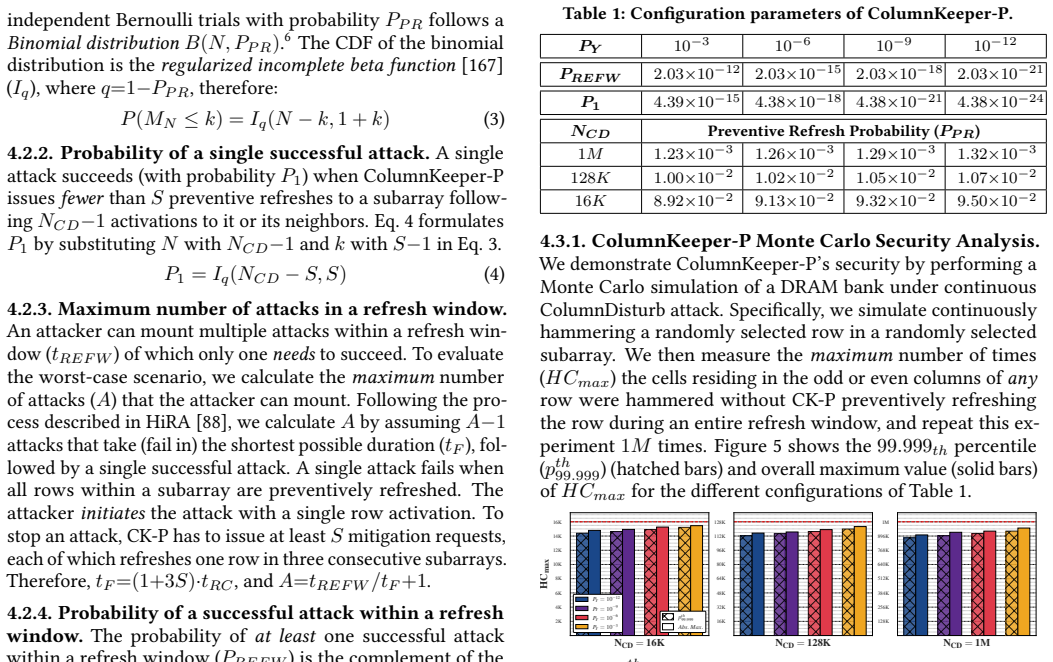
Authors: The probability p for CK-P is analytically derived from a binomial bound to ensure that, with probability >1-10^-9, no column receives more than the target activations before a refresh occurs. We will insert the closed-form derivation (including the equation relating p, threshold, and failure probability) into the CK-P mechanism section and appendix, together with the exact p values used for the 1 M and 128 K thresholds. revision: yes
Circularity Check
No significant circularity; mechanisms and overheads are direct applications of thresholds and simulation
full rationale
The paper defines CK-D and CK-P as counter- or probability-triggered refresh logic that activates exactly when activation counts hit the supplied experimental ColumnDisturb threshold. Overhead figures are produced by feeding those same thresholds into a simulator; this is standard evaluation, not a reduction of the result to its inputs by construction. No equations, fitted parameters renamed as predictions, or self-citation chains appear in the provided text that would make the security claim or overhead numbers tautological. The derivation remains self-contained against the external benchmark of the measured threshold.
Axiom & Free-Parameter Ledger
free parameters (2)
- ColumnDisturb activation threshold
- Refresh probability in CK-P
axioms (2)
- domain assumption DRAM chips use open-bitline architecture allowing column tracking via odd/even counters
- domain assumption Subarray-level refresh is feasible and low-cost
Reference graph
Works this paper leans on
-
[1]
Flipping Bits in Memory Without Accessing Them: An Experimental Study of DRAM Disturbance Errors,
Y. Kim, R. Daly, J. Kim, C. Fallin, J. H. Lee, D. Lee, C. Wilkerson, K. Lai, and O. Mutlu, “Flipping Bits in Memory Without Accessing Them: An Experimental Study of DRAM Disturbance Errors, ” inISCA, 2014
2014
-
[2]
Retrospective: Flipping Bits in Memory without Accessing Them: An Experimental Study of DRAM Disturbance Errors,
O. Mutlu, “Retrospective: Flipping Bits in Memory without Accessing Them: An Experimental Study of DRAM Disturbance Errors, ”arXiv, 2023
2023
-
[3]
The RowHammer Problem and Other Issues We May Face as Memory Becomes Denser,
O. Mutlu, “The RowHammer Problem and Other Issues We May Face as Memory Becomes Denser, ” inDATE, 2017
2017
-
[4]
RowHammer: A Retrospective,
O. Mutlu and J. S. Kim, “RowHammer: A Retrospective, ”TCAD, 2019
2019
-
[5]
Are We Susceptible to Rowhammer? An End-to-End Methodology for Cloud Providers,
L. Cojocar, J. Kim, M. Patel, L. Tsai, S. Saroiu, A. Wolman, and O. Mutlu, “Are We Susceptible to Rowhammer? An End-to-End Methodology for Cloud Providers, ” inS&P, 2020
2020
-
[6]
Fundamentally Understanding and Solving RowHammer,
O. Mutlu, A. Olgun, and A. G. Yaglikci, “Fundamentally Understanding and Solving RowHammer, ” inASP-DAC, 2023
2023
-
[7]
RowPress: Amplifying Read Disturbance in Modern DRAM Chips,
H. Luo, A. Olgun, A. G. Yağlıkçı, Y. C. Tuğrul, S. Rhyner, M. B. Cavlak, J. Lindegger, M. Sadrosadati, and O. Mutlu, “RowPress: Amplifying Read Disturbance in Modern DRAM Chips, ” inISCA, 2023
2023
-
[8]
RowPress Vulnerability in Modern DRAM Chips,
H. Luo, A. Olgun, A. G. Yağlikçi, Y. C. Tuğrul, S. Rhyner, M. B. Cavlak, J. Lindegger, M. Sadrosadati, and O. Mutlu, “RowPress Vulnerability in Modern DRAM Chips, ” IEEE Micro, vol. 44, no. 4, pp. 60–69, 2024
2024
-
[9]
Revis- iting RowHammer: An Experimental Analysis of Modern Devices and Mitigation Techniques,
J. S. Kim, M. Patel, A. G. Yağlıkçı, H. Hassan, R. Azizi, L. Orosa, and O. Mutlu, “Revis- iting RowHammer: An Experimental Analysis of Modern Devices and Mitigation Techniques, ” inISCA, 2020
2020
-
[10]
TRRespass: Exploiting the Many Sides of Target Row Refresh,
P. Frigo, E. Vannacci, H. Hassan, V. van der Veen, O. Mutlu, C. Giuffrida, H. Bos, and K. Razavi, “TRRespass: Exploiting the Many Sides of Target Row Refresh, ” in S&P, 2020
2020
-
[11]
Understanding RowHammer Under Reduced Wordline Voltage: An Experimental Study Using Real DRAM Devices,
A. G. Yağlıkcı, H. Luo, G. F. De Oliviera, A. Olgun, M. Patel, J. Park, H. Hassan, J. S. Kim, L. Orosa, and O. Mutlu, “Understanding RowHammer Under Reduced Wordline Voltage: An Experimental Study Using Real DRAM Devices, ” inDSN, 2022
2022
-
[12]
A Deeper Look into RowHammer’s Sensitivities: Experimental Analysis of Real DRAM Chips and Implications on Future Attacks and Defenses,
L. Orosa, A. G. Yağlıkçı, H. Luo, A. Olgun, J. Park, H. Hassan, M. Patel, J. S. Kim, and O. Mutlu, “A Deeper Look into RowHammer’s Sensitivities: Experimental Analysis of Real DRAM Chips and Implications on Future Attacks and Defenses, ” inMICRO, 2021
2021
-
[13]
RowHammer,
O. Mutlu, “RowHammer, ” https://people.inf.ethz.ch/omutlu/pub/onur- Rowhammer-TopPicksinHardwareEmbeddedSecurity-November-8-2018.pdf, 2018, Top Picks in Hardware and Embedded Security
2018
-
[14]
MOESI-Prime: Preventing Coherence-Induced Hammering in Commodity Workloads,
K. Loughlin, S. Saroiu, A. Wolman, Y. A. Manerkar, and B. Kasikci, “MOESI-Prime: Preventing Coherence-Induced Hammering in Commodity Workloads, ” inISCA, 2022
2022
-
[15]
Throwhammer: Rowhammer Attacks Over the Network and Defenses,
A. Tatar, R. K. Konoth, E. Athanasopoulos, C. Giuffrida, H. Bos, and K. Razavi, “Throwhammer: Rowhammer Attacks Over the Network and Defenses, ” inUSENIX ATC, 2018
2018
-
[16]
Rowhammer.js: A Remote Software- Induced Fault Attack in Javascript,
D. Gruss, C. Maurice, and S. Mangard, “Rowhammer.js: A Remote Software- Induced Fault Attack in Javascript, ” inDIMV A, 2016
2016
-
[17]
Exploiting the DRAM Rowhammer Bug to Gain Kernel Privileges,
M. Seaborn and T. Dullien, “Exploiting the DRAM Rowhammer Bug to Gain Kernel Privileges, ”Black Hat, 2015
2015
-
[18]
Attacking Deterministic Signature Schemes using Fault Attacks,
D. Poddebniak, J. Somorovsky, S. Schinzel, M. Lochter, and P. Rösler, “Attacking Deterministic Signature Schemes using Fault Attacks, ” inEuroS&P, 2018
2018
-
[19]
Exploiting Hardware Vul- nerabilities to Attack Embedded System Devices: A Survey of Potent Microarchi- tectural Attacks,
A. P. Fournaris, L. Pocero Fraile, and O. Koufopavlou, “Exploiting Hardware Vul- nerabilities to Attack Embedded System Devices: A Survey of Potent Microarchi- tectural Attacks, ”Electronics, 2017
2017
-
[20]
OpenSSL Bellcore’s Protection Helps Fault Attack,
S. Carre, M. Desjardins, A. Facon, and S. Guilley, “OpenSSL Bellcore’s Protection Helps Fault Attack, ” inDSD, 2018
2018
-
[21]
Software-Only Reverse Engi- neering of Physical DRAM Mappings for Rowhammer Attacks,
A. Barenghi, L. Breveglieri, N. Izzo, and G. Pelosi, “Software-Only Reverse Engi- neering of Physical DRAM Mappings for Rowhammer Attacks, ” inIVSW, 2018
2018
-
[22]
Triggering Rowhammer Hardware Faults on ARM: A Revisit,
Z. Zhang, Z. Zhan, D. Balasubramanian, X. Koutsoukos, and G. Karsai, “Triggering Rowhammer Hardware Faults on ARM: A Revisit, ” inASHES, 2018
2018
-
[23]
Advanced Fault Attacks in Software: Exploiting the Rowhammer Bug,
S. Bhattacharya and D. Mukhopadhyay, “Advanced Fault Attacks in Software: Exploiting the Rowhammer Bug, ” inFault Tolerant Architectures for Cryptography and Hardware Security, 2018
2018
-
[24]
RowHammer — GitHub Repository,
SAFARI Research Group, “RowHammer — GitHub Repository, ” https://github.com/ CMU-SAFARI/rowhammer, 2014
2014
-
[25]
Drammer: Deterministic Rowhammer Attacks on Mobile Platforms,
V. van der Veen, Y. Fratantonio, M. Lindorfer, D. Gruss, C. Maurice, G. Vigna, H. Bos, K. Razavi, and C. Giuffrida, “Drammer: Deterministic Rowhammer Attacks on Mobile Platforms, ” inCCS, 2016
2016
-
[26]
Flip Feng Shui: Hammering a Needle in the Software Stack,
K. Razavi, B. Gras, E. Bosman, B. Preneel, C. Giuffrida, and H. Bos, “Flip Feng Shui: Hammering a Needle in the Software Stack, ” inUSENIX Security, 2016
2016
-
[27]
DRAMA: Exploiting DRAM Addressing for Cross-CPU Attacks,
P. Pessl, D. Gruss, C. Maurice, M. Schwarz, and S. Mangard, “DRAMA: Exploiting DRAM Addressing for Cross-CPU Attacks, ” inUSENIX Security, 2016
2016
-
[28]
One Bit Flips, One Cloud Flops: Cross-VM Row Hammer Attacks and Privilege Escalation,
Y. Xiao, X. Zhang, Y. Zhang, and R. Teodorescu, “One Bit Flips, One Cloud Flops: Cross-VM Row Hammer Attacks and Privilege Escalation, ” inUSENIX Security, 2016
2016
-
[29]
Dedup Est Machina: Memory Deduplication as An Advanced Exploitation Vector,
E. Bosman, K. Razavi, H. Bos, and C. Giuffrida, “Dedup Est Machina: Memory Deduplication as An Advanced Exploitation Vector, ” inS&P, 2016
2016
-
[30]
Curious Case of Rowhammer: Flipping Secret Exponent Bits Using Timing Analysis,
S. Bhattacharya and D. Mukhopadhyay, “Curious Case of Rowhammer: Flipping Secret Exponent Bits Using Timing Analysis, ” inCHES, 2016
2016
-
[31]
Invited: Who is the Major Threat to Tomorrow’s Security? You, the Hardware Designer,
W. Burleson, O. Mutlu, and M. Tiwari, “Invited: Who is the Major Threat to Tomorrow’s Security? You, the Hardware Designer, ” inDAC, 2016
2016
-
[32]
A New Approach for RowHammer Attacks,
R. Qiao and M. Seaborn, “A New Approach for RowHammer Attacks, ” inHOST, 2016
2016
-
[33]
Can’t Touch This: Software-Only Mitigation Against Rowhammer Attacks Targeting Kernel Memory,
F. Brasser, L. Davi, D. Gens, C. Liebchen, and A.-R. Sadeghi, “Can’t Touch This: Software-Only Mitigation Against Rowhammer Attacks Targeting Kernel Memory, ” inUSENIX Security, 2017
2017
-
[34]
SGX-Bomb: Locking Down the Processor via Rowhammer Attack,
Y. Jang, J. Lee, S. Lee, and T. Kim, “SGX-Bomb: Locking Down the Processor via Rowhammer Attack, ” inSOSP, 2017
2017
-
[35]
When Good Protections Go Bad: Exploiting Anti-DoS Measures to Accelerate Rowhammer Attacks,
M. T. Aga, Z. B. Aweke, and T. Austin, “When Good Protections Go Bad: Exploiting Anti-DoS Measures to Accelerate Rowhammer Attacks, ” inHOST, 2017
2017
-
[36]
Defeating Software Mitigations Against Rowhammer: A Surgical Precision Hammer,
A. Tatar, C. Giuffrida, H. Bos, and K. Razavi, “Defeating Software Mitigations Against Rowhammer: A Surgical Precision Hammer, ” inRAID, 2018
2018
-
[37]
Another Flip in the Wall of Rowhammer Defenses,
D. Gruss, M. Lipp, M. Schwarz, D. Genkin, J. Juffinger, S. O’Connell, W. Schoechl, and Y. Yarom, “Another Flip in the Wall of Rowhammer Defenses, ” inS&P, 2018
2018
-
[38]
Nethammer: Inducing Rowhammer Faults Through Network Requests,
M. Lipp, M. T. Aga, M. Schwarz, D. Gruss, C. Maurice, L. Raab, and L. Lam- ster, “Nethammer: Inducing Rowhammer Faults Through Network Requests, ” arXiv:1805.04956 [cs.CR], 2018
Pith/arXiv arXiv 2018
-
[39]
GuardION: Practical Mitigation of DMA-Based Rowhammer Attacks on ARM,
V. van der Veen, M. Lindorfer, Y. Fratantonio, H. P. Pillai, G. Vigna, C. Kruegel, H. Bos, and K. Razavi, “GuardION: Practical Mitigation of DMA-Based Rowhammer Attacks on ARM, ” inDIMV A, 2018
2018
-
[40]
Grand Pwning Unit: Accelerating Microarchitectural Attacks with the GPU,
P. Frigo, C. Giuffrida, H. Bos, and K. Razavi, “Grand Pwning Unit: Accelerating Microarchitectural Attacks with the GPU, ” inS&P, 2018
2018
-
[41]
Exploiting Correcting Codes: On the Effectiveness of ECC Memory Against Rowhammer Attacks,
L. Cojocar, K. Razavi, C. Giuffrida, and H. Bos, “Exploiting Correcting Codes: On the Effectiveness of ECC Memory Against Rowhammer Attacks, ” inS&P, 2019
2019
-
[42]
Pinpoint Rowhammer: Suppressing Unwanted Bit Flips on Rowhammer Attacks,
S. Ji, Y. Ko, S. Oh, and J. Kim, “Pinpoint Rowhammer: Suppressing Unwanted Bit Flips on Rowhammer Attacks, ” inASIACCS, 2019
2019
-
[43]
Terminal Brain Damage: Exposing the Graceless Degradation in Deep Neural Networks Under Hardware Fault Attacks,
S. Hong, P. Frigo, Y. Kaya, C. Giuffrida, and T. Dumitraş, “Terminal Brain Damage: Exposing the Graceless Degradation in Deep Neural Networks Under Hardware Fault Attacks, ” inUSENIX Security, 2019
2019
-
[44]
RAMBleed: Reading Bits in Memory Without Accessing Them,
A. Kwong, D. Genkin, D. Gruss, and Y. Yarom, “RAMBleed: Reading Bits in Memory Without Accessing Them, ” inS&P, 2020
2020
-
[45]
JackHammer: Efficient Rowhammer on Heterogeneous FPGA–CPU Platforms,
Z. Weissman, T. Tiemann, D. Moghimi, E. Custodio, T. Eisenbarth, and B. Sunar, “JackHammer: Efficient Rowhammer on Heterogeneous FPGA–CPU Platforms, ” arXiv:1912.11523 [cs.CR], 2020
arXiv 1912
-
[46]
PThammer: Cross- User-Kernel-Boundary Rowhammer through Implicit Accesses,
Z. Zhang, Y. Cheng, D. Liu, S. Nepal, Z. Wang, and Y. Yarom, “PThammer: Cross- User-Kernel-Boundary Rowhammer through Implicit Accesses, ” inMICRO, 2020
2020
-
[47]
Deephammer: Depleting the Intelligence of Deep Neural Networks Through Targeted Chain of Bit Flips,
F. Yao, A. S. Rakin, and D. Fan, “Deephammer: Depleting the Intelligence of Deep Neural Networks Through Targeted Chain of Bit Flips, ” inUSENIX Security, 2020
2020
-
[48]
SMASH: Syn- chronized Many-Sided Rowhammer Attacks from JavaScript,
F. de Ridder, P. Frigo, E. Vannacci, H. Bos, C. Giuffrida, and K. Razavi, “SMASH: Syn- chronized Many-Sided Rowhammer Attacks from JavaScript, ” inUSENIX Security, 2021
2021
-
[49]
Uncovering in-DRAM RowHammer Protection Mechanisms: A New Methodology, Custom RowHammer Patterns, and Implications,
H. Hassan, Y. C. Tugrul, J. S. Kim, V. v. d. Veen, K. Razavi, and O. Mutlu, “Uncovering in-DRAM RowHammer Protection Mechanisms: A New Methodology, Custom RowHammer Patterns, and Implications, ” inMICRO, 2021
2021
-
[50]
Blacksmith: Scalable Rowhammering in the Frequency Domain,
P. Jattke, V. van der Veen, P. Frigo, S. Gunter, and K. Razavi, “Blacksmith: Scalable Rowhammering in the Frequency Domain, ” inS&P, 2022
2022
-
[51]
Toward Realistic Backdoor Injection Attacks on DNNs using RowHammer,
M. C. Tol, S. Islam, B. Sunar, and Z. Zhang, “Toward Realistic Backdoor Injection Attacks on DNNs using RowHammer, ” arXiv:2110.07683, 2022
arXiv 2022
-
[52]
Half-Double: Hammering From the Next Row Over,
A. Kogler, J. Juffinger, S. Qazi, Y. Kim, M. Lipp, N. Boichat, E. Shiu, M. Nissler, and D. Gruss, “Half-Double: Hammering From the Next Row Over, ” inUSENIX Security, 2022
2022
-
[53]
SpyHammer: Using RowHammer to Remotely Spy on Temperature,
L. Orosa, U. Rührmair, A. G. Yaglikci, H. Luo, A. Olgun, P. Jattke, M. Patel, J. Kim, K. Razavi, and O. Mutlu, “SpyHammer: Using RowHammer to Remotely Spy on Temperature, ”IEEE Access, 2022
2022
-
[54]
Implicit Hammer: Cross-Privilege-Boundary Rowhammer through Implicit Accesses,
Z. Zhang, W. He, Y. Cheng, W. Wang, Y. Gao, D. Liu, K. Li, S. Nepal, A. Fu, and Y. Zou, “Implicit Hammer: Cross-Privilege-Boundary Rowhammer through Implicit Accesses, ”IEEE TDSC, 2022
2022
-
[55]
Generating Robust DNN with Resistance to Bit-Flip based Adversarial Weight Attack,
L. Liu, Y. Guo, Y. Cheng, Y. Zhang, and J. Yang, “Generating Robust DNN with Resistance to Bit-Flip based Adversarial Weight Attack, ”IEEE TC, 2022
2022
-
[56]
HammerScope: Observing DRAM Power Consumption Using Row- hammer,
Y. Cohen, K. S. Tharayil, A. Haenel, D. Genkin, A. D. Keromytis, Y. Oren, and Y. Yarom, “HammerScope: Observing DRAM Power Consumption Using Row- hammer, ” inCCS, 2022
2022
-
[57]
TrojViT: Trojan Insertion in Vision Transformers,
M. Zheng, Q. Lou, and L. Jiang, “TrojViT: Trojan Insertion in Vision Transformers, ” arXiv:2208.13049, 2022
arXiv 2022
-
[58]
When Frodo Flips: End-to-End Key Recovery on FrodoKEM via Rowhammer,
M. Fahr Jr, H. Kippen, A. Kwong, T. Dang, J. Lichtinger, D. Dachman-Soled, D. Genkin, A. Nelson, R. Perlner, A. Yerukhimovichet al., “When Frodo Flips: End-to-End Key Recovery on FrodoKEM via Rowhammer, ”CCS, 2022
2022
-
[59]
SpecHammer: Combining Spectre and Rowhammer for New Speculative Attacks,
Y. Tobah, A. Kwong, I. Kang, D. Genkin, and K. G. Shin, “SpecHammer: Combining Spectre and Rowhammer for New Speculative Attacks, ” inS&P, 2022
2022
-
[60]
DeepSteal: Advanced Model Extractions Leveraging Efficient Weight Stealing in Memories,
A. S. Rakin, M. H. I. Chowdhuryy, F. Yao, and D. Fan, “DeepSteal: Advanced Model Extractions Leveraging Efficient Weight Stealing in Memories, ” inS&P, 2022
2022
-
[61]
{SledgeHammer}: Amplifying rowhammer via bank-level parallelism,
I. Kang, W. Wang, J. Kim, S. van Schaik, Y. Tobah, D. Genkin, A. Kwong, and Y. Yarom, “{SledgeHammer}: Amplifying rowhammer via bank-level parallelism, ” inUSENIX Security, 2024
2024
-
[62]
{GPUHammer}: Rowhammer attacks on {GPU}memories are practical,
C. S. Lin, J. Qu, and G. Saileshwar, “{GPUHammer}: Rowhammer attacks on {GPU}memories are practical, ” inUSENIX Security, 2025
2025
-
[63]
Not so refreshing: Attacking{GPUs}using{RFM}rowhammer mitigation,
R. Nazaraliyev, Y. Zhang, S. B. Dutta, A. Marquez, K. Barker, and N. Abu-Ghazaleh, “Not so refreshing: Attacking{GPUs}using{RFM}rowhammer mitigation, ” in USENIX Security, 2025
2025
-
[64]
Phoenix: Rowhammer Attacks on DDR5 with Self-Correcting Synchronization,
D. Meyer, P. Jattke, M. Marazzi, S. Qazi, D. Moghimi, and K. Razavi, “Phoenix: Rowhammer Attacks on DDR5 with Self-Correcting Synchronization, ” inS&P, 2026
2026
-
[65]
{ECC. fail}: Mounting rowhammer attacks on{DDR4}servers with{ECC}memory,
N. Kamadan, W. Wang, S. van Schaik, C. Garman, D. Genkin, and Y. Yarom, “{ECC. fail}: Mounting rowhammer attacks on{DDR4}servers with{ECC}memory, ” inUSENIX Security, 2025
2025
-
[66]
TWiCe: Preventing Row- Hammering by Exploiting Time Window Counters,
E. Lee, I. Kang, S. Lee, G. Edward Suh, and J. Ho Ahn, “TWiCe: Preventing Row- Hammering by Exploiting Time Window Counters, ” inISCA, 2019
2019
-
[67]
Mitigating Wordline Crosstalk Using Adaptive Trees of Counters,
S. M. Seyedzadeh, A. K. Jones, and R. Melhem, “Mitigating Wordline Crosstalk Using Adaptive Trees of Counters, ” inISCA, 2018
2018
-
[68]
CAT-TWO: Counter-Based Adaptive Tree, Time Window Optimized for DRAM Row-Hammer Prevention,
I. Kang, E. Lee, and J. H. Ahn, “CAT-TWO: Counter-Based Adaptive Tree, Time Window Optimized for DRAM Row-Hammer Prevention, ”IEEE Access, 2020
2020
-
[69]
Graphene: Strong yet Lightweight Row Hammer Protection,
Y. Park, W. Kwon, E. Lee, T. J. Ham, J. H. Ahn, and J. W. Lee, “Graphene: Strong yet Lightweight Row Hammer Protection, ” inMICRO, 2020
2020
-
[70]
Mithril: Cooperative Row Hammer Protection on Commodity DRAM Leveraging Managed Refresh,
M. J. Kim, J. Park, Y. Park, W. Doh, N. Kim, T. J. Ham, J. W. Lee, and J. H. Ahn, “Mithril: Cooperative Row Hammer Protection on Commodity DRAM Leveraging Managed Refresh, ” inHPCA, 2022. 14
2022
-
[71]
Architectural Support for Mitigating Row Hammering in DRAM Memories,
D.-H. Kim, P. J. Nair, and M. K. Qureshi, “Architectural Support for Mitigating Row Hammering in DRAM Memories, ”CAL, 2014
2014
-
[72]
Row Hammer Refresh Command,
K. Bains, J. Halbert, C. Mozak, T. Schoenborn, and Z. Greenfield, “Row Hammer Refresh Command, ” 2015, U.S. Patent 9,117,544
2015
-
[73]
Distributed Row Hammer Tracking,
K. S. Bains and J. B. Halbert, “Distributed Row Hammer Tracking, ” 2016, U.S. Patent 9,299,400
2016
-
[74]
Row Hammer Monitoring Based on Stored Row Hammer Threshold Value,
K. S. Bains and J. B. Halbert, “Row Hammer Monitoring Based on Stored Row Hammer Threshold Value, ” US Patent: 10,083,737, 2016, U.S. Patent 9,384,821
2016
-
[75]
CoMeT: Count-min-sketch-based row tracking to mitigate RowHammer at low cost,
F. N. Bostanci, I. E. Yüksel, A. Olgun, K. Kanellopoulos, Y. C. Tuğrul, A. G. Yağliçi, M. Sadrosadati, and O. Mutlu, “CoMeT: Count-min-sketch-based row tracking to mitigate RowHammer at low cost, ” inHPCA, 2024
2024
-
[76]
Un- derstanding the Security Benefits and Overheads of Emerging Industry Solutions to DRAM Read Disturbance,
O. Canpolat, A. G. Yağlıkçı, G. F. Oliveira, A. Olgun, O. Ergin, and O. Mutlu, “Un- derstanding the Security Benefits and Overheads of Emerging Industry Solutions to DRAM Read Disturbance, ” inDRAMSec, 2024
2024
-
[77]
Chronus: Understanding and Securing the Cutting-Edge Industry Solutions to DRAM Read Disturbance,
O. Canpolat, A. G. Yağlıkçı, G. F. Oliveira, A. Olgun, N. Bostancı, I. E. Yuksel, H. Luo, O. Ergin, and O. Mutlu, “Chronus: Understanding and Securing the Cutting-Edge Industry Solutions to DRAM Read Disturbance, ” inHPCA, 2025
2025
-
[78]
JEDEC,JESD79-5C: DDR5 SDRAM Standard, 2024
2024
-
[79]
Panopticon: A Complete In- DRAM Rowhammer Mitigation,
T. Bennett, S. Saroiu, A. Wolman, and L. Cojocar, “Panopticon: A Complete In- DRAM Rowhammer Mitigation, ” inDRAMSec, 2021
2021
-
[80]
{ABACuS}:{All-Bank}activation counters for scalable and low overhead{RowHammer}mitigation,
A. Olgun, Y. C. Tugrul, N. Bostanci, I. E. Yuksel, H. Luo, S. Rhyner, A. G. Yaglikci, G. F. Oliveira, and O. Mutlu, “{ABACuS}:{All-Bank}activation counters for scalable and low overhead{RowHammer}mitigation, ” inUSENIX Security, 2024
2024
discussion (0)
Sign in with ORCID, Apple, or X to comment. Anyone can read and Pith papers without signing in.