One-Prompt Censorship Evasion via Generative Diffusion Models
Pith reviewed 2026-06-26 09:43 UTC · model grok-4.3
The pith
Diffusion models can turn censored network traffic into benign patterns with one natural language prompt.
A machine-rendered reading of the paper's core claim, the machinery that carries it, and where it could break.
Core claim
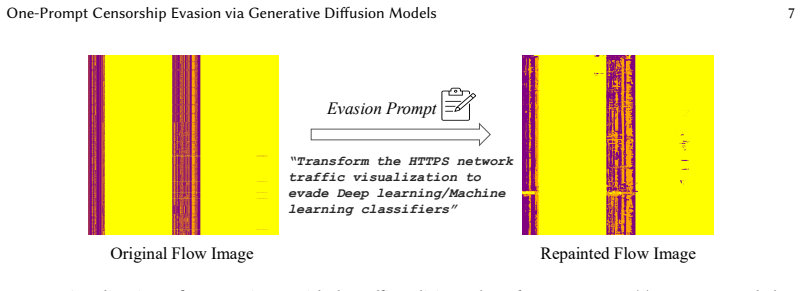
FlowPaint is a generative framework that converts network flows to images and uses instruction-tuned diffusion models to perform semantic edits that convert censored traffic into patterns indistinguishable from benign flows, controlled entirely by natural language prompts.
What carries the argument
FlowPaint, an instruction-tuned diffusion architecture performing semantic editing on network flows cast as images.
If this is right
- Users counter multiple censorship paradigms by changing only the natural language instruction.
- Evasion no longer requires manual fitness functions or domain-specific languages.
- Performance exceeds prior automated baselines on both industrial rule-based and learning-based detectors.
- The same model can be repurposed across different censor types without retraining per modality.
Where Pith is reading between the lines
- Censors may need new detectors tuned to diffusion-generated statistical signatures in traffic.
- The method could extend to other domains where semantic editing of protocol data is useful, such as privacy-preserving data sharing.
- Non-expert users gain practical access to evasion tools that previously demanded technical configuration.
Load-bearing premise
Representing network flows as images lets diffusion models edit them into functional traffic that evades detection without breaking the original communication or adding detectable artifacts.
What would settle it
Measure whether FlowPaint-generated flows preserve the original protocol semantics and payload delivery while passing a target censor's classifier on live traffic.
Figures



read the original abstract
The escalating arms race between Internet censorship and evasion has driven censors to evolve from static rule-based filtering to sophisticated deep learning-based traffic analysis. While recent automated evasion tools have attempted to counter this by leveraging stochastic search and programmable heuristics, they continue to suffer from insufficient evasion robustness across diverse censorship modalities and poor usability due to complex, mechanism-specific configurations that require manual fitness tuning or domain-specific languages. In this paper, we propose a paradigm shift that reframes censorship evasion as a semantic image-to-image editing task, allowing users to execute it with a single prompt. We introduce FlowPaint, a novel generative framework that leverages the "world knowledge" of large diffusion models to automatically reshape censored traffic into benign patterns. FlowPaint utilizes an instruction-tuned diffusion architecture to perform semantic editing on network flows. Evaluations against both industrial-grade rule-based middleboxes and learning-based classifiers demonstrate that FlowPaint outperforms existing censorship evasion baselines, enabling users to counter diverse censorship paradigms solely by varying natural language instructions
Editorial analysis
A structured set of objections, weighed in public.
Referee Report
Summary. The manuscript introduces FlowPaint, a generative framework that reframes censorship evasion as a semantic image-to-image editing task using instruction-tuned diffusion models on network flows. It claims that this approach allows users to evade diverse censorship paradigms by varying natural language instructions and outperforms existing baselines against both rule-based middleboxes and learning-based classifiers.
Significance. If the core technical assumptions hold and the claimed outperformance is demonstrated, the work could offer a notable improvement in usability for evasion tools by removing the need for mechanism-specific configurations. No such validation is present in the manuscript, however, so significance cannot be assessed.
major comments (2)
- [Abstract] Abstract: The claim that 'Evaluations against both industrial-grade rule-based middleboxes and learning-based classifiers demonstrate that FlowPaint outperforms existing censorship evasion baselines' is unsupported by any quantitative results, datasets, experimental setup, or error analysis. This directly undermines the central claim of the paper.
- [Abstract] Abstract (reframing paragraph): The approach assumes that representing network flows as images allows diffusion-based semantic editing to produce functional, undetectable traffic. No justification is given that the encoding preserves protocol invariants such as sequence numbers, timing, and payload integrity, or that an inverse mapping exists that restores a syntactically valid flow; if either fails, edited outputs will break sessions or remain detectable by stateful middleboxes.
Simulated Author's Rebuttal
Thank you for the detailed review of our manuscript. We address each major comment point by point below and indicate the revisions we will make.
read point-by-point responses
-
Referee: [Abstract] Abstract: The claim that 'Evaluations against both industrial-grade rule-based middleboxes and learning-based classifiers demonstrate that FlowPaint outperforms existing censorship evasion baselines' is unsupported by any quantitative results, datasets, experimental setup, or error analysis. This directly undermines the central claim of the paper.
Authors: We agree that the abstract claim lacks supporting quantitative evidence, datasets, setup details, or error analysis in the current manuscript. This is a substantive gap. We will revise the manuscript to include a full experimental section with quantitative results, specific datasets, experimental setup, baselines, and error analysis, and we will update the abstract to accurately reflect these additions rather than making an unsupported claim. revision: yes
-
Referee: [Abstract] Abstract (reframing paragraph): The approach assumes that representing network flows as images allows diffusion-based semantic editing to produce functional, undetectable traffic. No justification is given that the encoding preserves protocol invariants such as sequence numbers, timing, and payload integrity, or that an inverse mapping exists that restores a syntactically valid flow; if either fails, edited outputs will break sessions or remain detectable by stateful middleboxes.
Authors: We agree this is a critical technical point that requires explicit justification. The current manuscript does not provide sufficient detail on how the flow-to-image encoding preserves protocol invariants or on the inverse mapping to valid flows. We will add a dedicated subsection in the methods describing the encoding process, mechanisms for preserving sequence numbers, timing, and payload integrity, the decoding procedure, and discussion of implications for stateful middleboxes, including any limitations. revision: yes
Circularity Check
No circularity: abstract-only text contains no equations, fits, or self-citation chains
full rationale
The provided abstract reframes censorship evasion as an image-to-image editing task and introduces FlowPaint without presenting any derivation, equations, parameter fits, or citations. No load-bearing step reduces to its own inputs by construction, and the central claim remains an empirical proposal whose independence cannot be assessed from the given text alone. This is the expected honest non-finding when no derivation chain is visible.
Axiom & Free-Parameter Ledger
Reference graph
Works this paper leans on
-
[1]
Alice, Bob, Carol, Jan Beznazwy, and Amir Houmansadr. 2020. How China Detects and Blocks Shadowsocks. In Proceedings of the Internet Measurement Conference (IMC ’20)(Virtual Event, USA)(IMC ’20). Association for Computing Machinery, New York, NY, USA, 111–124. doi:10.1145/3419394.3423644
-
[2]
2019.obfs4 (The obfourscator) Protocol Specification
Yawning Angel. 2019.obfs4 (The obfourscator) Protocol Specification. Technical Report. The Tor Project. https: //github.com/Yawning/obfs4/blob/master/doc/obfs4-spec.txt
2019
-
[3]
Kevin Bock, George Hughey, Xiao Qiang, and Dave Levin. 2019. Geneva: Evolving Censorship Evasion Strategies. InProceedings of the ACM SIGSAC Conference on Computer and Communications Security (CCS ’19)(London, United Kingdom)(CCS ’19). Association for Computing Machinery, New York, NY, USA, 2199–2214. doi:10.1145/3319535.3363 189
-
[4]
Leo Breiman. 2001. Random Forests.Machine Learning45, 1 (2001), 5–32
2001
-
[5]
Tim Brooks, Aleksander Holynski, and Alexei A. Efros. 2023. InstructPix2Pix: Learning to Follow Image Editing Instructions. In2023 IEEE/CVF Conference on Computer Vision and Pattern Recognition (CVPR). 18392–18402. doi:10.110 9/CVPR52729.2023.01764
arXiv 2023
-
[6]
Sam Burnett, Nick Feamster, and Santosh Vempala. 2010. Chipping away at censorship firewalls with user-generated content. InProceedings of the 19th USENIX Security Symposium(Washington, DC)(USENIX Security’10). USENIX Association, USA, 29
2010
-
[7]
Adriel Cheng. 2019. PAC-GAN: Packet Generation of Network Traffic using Generative Adversarial Networks. In2019 IEEE 10th Annual Information Technology, Electronics and Mobile Communication Conference (IEMCON). 0728–0734. doi:10.1109/IEMCON.2019.8936224
-
[8]
2008.The Transport Layer Security (TLS) Protocol Version 1.2
Tim Dierks and Eric Rescorla. 2008.The Transport Layer Security (TLS) Protocol Version 1.2. RFC 5246. RFC Editor. https://www.rfc-editor.org/rfc/rfc5246.txt https://www.rfc-editor.org/rfc/rfc5246.txt
2008
-
[9]
Hugging Face Diffusers. 2023. SDXL-InstructPix2Pix-768. https://huggingface.co/diffusers/sdxl-instructpix2pix-768. Accessed: 2026
2023
-
[10]
Lucas Dixon, Thomas Ristenpart, and Thomas Shrimpton. 2016. Network Traffic Obfuscation and Automated Internet Censorship.IEEE Security & Privacy14, 6 (2016), 43–53. doi:10.1109/MSP.2016.121
-
[11]
Kevin P. Dyer, Scott E. Coull, Thomas Ristenpart, and Thomas Shrimpton. 2013. Protocol misidentification made easy with format-transforming encryption. InProceedings of the ACM SIGSAC Conference on Computer and Communications Security (CCS ’13)(Berlin, Germany)(CCS ’13). Association for Computing Machinery, New York, NY, USA, 61–72. doi:10.1145/2508859.25...
-
[12]
Dyer, Scott E
Kevin P. Dyer, Scott E. Coull, and Thomas Shrimpton. 2015. Marionette: A Programmable Network Traffic Obfuscation System. InProceedings of the 24th USENIX Security Symposium. USENIX Association, Washington, D.C., 367–382. https://www.usenix.org/conference/usenixsecurity15/technical-sessions/presentation/dyer
2015
-
[13]
Roya Ensafi, David Fifield, Philipp Winter, Nick Feamster, Nicholas Weaver, and Vern Paxson. 2015. Examining How the Great Firewall Discovers Hidden Circumvention Servers. InProceedings of the Internet Measurement Conference (IMC ’15)(Tokyo, Japan)(IMC ’15). Association for Computing Machinery, New York, NY, USA, 445–458. doi:10.1145/ 2815675.2815690
arXiv 2015
-
[14]
Jiajun Gong and Tao Wang. 2020. Zero-delay Lightweight Defenses against Website Fingerprinting. In29th USENIX Security Symposium (USENIX Security 20). USENIX Association, 717–734. https://www.usenix.org/conference/usenix security20/presentation/gong
2020
-
[15]
Google. 2026. Recommended upload encoding settings. https://support.google.com/youtube/answer/1722171 Accessed: 2026
arXiv 2026
-
[16]
Zhiyuan He, Aashish Gottipati, Lili Qiu, Xufang Luo, Kenuo Xu, Yuqing Yang, and Francis Y. Yan. 2024. Designing Network Algorithms via Large Language Models. InProceedings of the 23rd ACM Workshop on Hot Topics in Networks (Irvine, CA, USA)(HotNets ’24). Association for Computing Machinery, New York, NY, USA, 205–212. doi:10.1145/36 96348.3696868
work page doi:10.1145/36 2024
-
[17]
Pieter Hintjens. 2013. CurveZMQ: ZeroMQ Security Handshake. https://rfc.zeromq.org/spec/26/. ZeroMQ RFC 26
2013
-
[18]
Jonathan Ho, Ajay Jain, and Pieter Abbeel. 2020. Denoising diffusion probabilistic models. InProceedings of the 34th International Conference on Neural Information Processing Systems(Vancouver, BC, Canada)(NIPS ’20). Curran Associates Inc., Red Hook, NY, USA, Article 574, 12 pages
2020
-
[19]
Jonathan Ho and Tim Salimans. 2022. Classifier-Free Diffusion Guidance.arXiv preprint arXiv:2207.12598(2022)
Pith/arXiv arXiv 2022
-
[20]
Jordan Holland, Paul Schmitt, Nick Feamster, and Prateek Mittal. 2021. New Directions in Automated Traffic Analysis. InProceedings of the ACM SIGSAC Conference on Computer and Communications Security (CCS ’21)(Virtual Event, Republic of Korea)(CCS ’21). Association for Computing Machinery, New York, NY, USA, 3366–3383. doi:10.1145/3460 120.3484758
-
[21]
Michio Honda, Yoshifumi Nishida, Costin Raiciu, Adam Greenhalgh, Mark Handley, and Hideyuki Tokuda. 2011. Is it still possible to extend TCP?. InProceedings of the Internet Measurement Conference (IMC ’11)(Berlin, Germany)(IMC ’11). Association for Computing Machinery, New York, NY, USA, 181–194. doi:10.1145/2068816.2068834
-
[22]
Rob Jansen and Nicholas Hopper. 2012. Shadow: Running Tor in a Box for Accurate and Efficient Experimentation. In Proceedings of the Network and Distributed System Security Symposium (NDSS). The Internet Society
2012
-
[23]
Xi Jiang, Shinan Liu, Aaron Gember-Jacobson, Arjun Nitin Bhagoji, Paul Schmitt, Francesco Bronzino, and Nick Feamster. 2024. NetDiffusion: Network Data Augmentation Through Protocol-Constrained Traffic Generation.Proc. ACM Meas. Anal. Comput. Syst.8, 1, Article 11 (Feb. 2024), 32 pages. doi:10.1145/3639037
-
[24]
Ding Li, Yuefei Zhu, Minghao Chen, and Jue Wang. 2022. Minipatch: Undermining DNN-Based Website Fingerprinting With Adversarial Patches.IEEE Transactions on Information Forensics and Security17 (2022), 2437–2451. doi:10.1109/TI FS.2022.3186743
work page doi:10.1109/ti 2022
-
[25]
libp2p Team. 2017. SECIO Security Transport Layer Specification. https://github.com/libp2p/specs/tree/master/secio. Accessed: 2026
2017
-
[26]
Xinjie Lin, Gang Xiong, Gaopeng Gou, Zhen Li, Junzheng Shi, and Jing Yu. 2022. ET-BERT: A Contextualized Datagram Representation with Pre-training Transformers for Encrypted Traffic Classification. InProceedings of the ACM Web Conference 2022(Virtual Event, Lyon, France)(WWW ’22). Association for Computing Machinery, New York, NY, USA, 633–642. doi:10.114...
-
[27]
Ruijie Meng, Martin Mirchev, Marcel Böhme, and Abhik Roychoudhury. 2024. Large language model guided protocol fuzzing. InProceedings of the Network and Distributed System Security Symposium (NDSS), Vol. 2024
2024
-
[28]
Milad Nasr, Alireza Bahramali, and Amir Houmansadr. 2021. Defeating DNN-Based Traffic Analysis Systems in Real-Time With Blind Adversarial Perturbations. In30th USENIX Security Symposium (USENIX Security 21). USENIX Association, 2705–2722. https://www.usenix.org/conference/usenixsecurity21/presentation/nasr
2021
-
[29]
Netflix. 2026. Internet connection speed recommendations. https://help.netflix.com/en/node/306 Accessed: 2026
2026
-
[30]
Niklas Niere, Felix Lange, Robert Merget, and Juraj Somorovsky. 2025. Transport Layer Obscurity: Circumventing SNI Censorship on the TLS-Layer. In2025 IEEE Symposium on Security and Privacy (SP). 1344–1362. doi:10.1109/SP61157.20 25.00151
-
[31]
Sadia Nourin, Van Tran, Xi Jiang, Kevin Bock, Nick Feamster, Nguyen Phong Hoang, and Dave Levin. 2023. Measuring and Evading Turkmenistan’s Internet Censorship: A Case Study in Large-Scale Measurements of a Low-Penetration Country. InProceedings of the ACM Web Conference 2023(Austin, TX, USA)(WWW ’23). Association for Computing Machinery, New York, NY, US...
-
[32]
2018.The Transport Layer Security (TLS) Protocol Version 1.3
Eric Rescorla. 2018.The Transport Layer Security (TLS) Protocol Version 1.3. RFC 8446. RFC Editor. https://www.rfc- editor.org/rfc/rfc8446.txt https://www.rfc-editor.org/rfc/rfc8446.txt. , Vol. 1, No. 1, Article . Publication date: June 2026. 20 Shiyi Ling, Yuhang Gan, and Chen Qian
2018
-
[33]
Robin Rombach, Andreas Blattmann, Dominik Lorenz, Patrick Esser, and Bjorn Ommer. 2022. High-Resolution Image Synthesis with Latent Diffusion Models. In2022 IEEE/CVF Conference on Computer Vision and Pattern Recognition (CVPR). IEEE Computer Society, Los Alamitos, CA, USA, 10674–10685. doi:10.1109/CVPR52688.2022.01042
-
[34]
Shadowsocks Team. 2012. Shadowsocks: A Secure Socks5 Proxy. https://shadowsocks.org/. Accessed: 2026
2012
-
[35]
Tal Shapira and Yuval Shavitt. 2021. FlowPic: A Generic Representation for Encrypted Traffic Classification and Applications Identification.IEEE Transactions on Network and Service Management18, 2 (2021), 1218–1232. doi:10.110 9/TNSM.2021.3071441
arXiv 2021
-
[36]
Payap Sirinam, Mohsen Imani, Marc Juarez, and Matthew Wright. 2018. Deep Fingerprinting: Undermining Website Fingerprinting Defenses with Deep Learning. InProceedings of the ACM SIGSAC Conference on Computer and Commu- nications Security (CCS ’18)(Toronto, Canada)(CCS ’18). Association for Computing Machinery, New York, NY, USA, 1928–1943. doi:10.1145/324...
-
[37]
Stratosphere Laboratory. 2014. Stratosphere IPS Dataset. https://www.stratosphereips.org/datasets-normal. Accessed: 2025
2014
-
[38]
Ryan Wails, Rob Jansen, Aaron Johnson, and Micah Sherr. 2025. Censorship evasion with unidentified protocol generation. InProceedings of the 34th USENIX Security Symposium(Seattle, WA, USA)(SEC ’25). USENIX Association, USA, Article 40, 20 pages
2025
-
[39]
Dyer, Aditya Akella, Thomas Ristenpart, and Thomas Shrimpton
Liang Wang, Kevin P. Dyer, Aditya Akella, Thomas Ristenpart, and Thomas Shrimpton. 2015. Seeing through Network- Protocol Obfuscation. InProceedings of the ACM SIGSAC Conference on Computer and Communications Security (CCS ’15)(Denver, Colorado, USA)(CCS ’15). Association for Computing Machinery, New York, NY, USA, 57–69. doi:10.1145/2810103.2813715
-
[40]
Yahui Wang, Zhiyong Zhang, Kejing Zhao, Peng Wang, and Ruirui Wu. 2024. A few-shot learning based method for industrial internet intrusion detection.International Journal of Information Security23, 5 (2024), 3241–3252
2024
-
[41]
Zhongjie Wang and Shitong Zhu. 2020. SymTCP: Eluding stateful deep packet inspection with automated discrepancy discovery. InProceedings of the Network and Distributed System Security Symposium (NDSS)
2020
-
[42]
Philipp Winter, Tobias Pulls, and Juergen Fuss. 2013. ScrambleSuit: a polymorphic network protocol to circumvent censorship. InProceedings of the 12th ACM Workshop on Workshop on Privacy in the Electronic Society(Berlin, Germany) (WPES ’13). Association for Computing Machinery, New York, NY, USA, 213–224. doi:10.1145/2517840.2517856
-
[43]
Wright, Scott E
Charles V. Wright, Scott E. Coull, and Fabian Monrose. 2009. Traffic Morphing: An Efficient Defense Against Statistical Traffic Analysis. InProceedings of the Network and Distributed System Security Symposium (NDSS). https://api.semant icscholar.org/CorpusID:2562331
2009
-
[44]
Alex Halderman
Eric Wustrow, Scott Wolchok, Ian Goldberg, and J. Alex Halderman. 2011. Telex: Anticensorship in the Network Infrastructure. InProceedings of the 20th USENIX Security Symposium. USENIX Association, San Francisco, CA. https: //www.usenix.org/conference/usenix-security-11/telex-anticensorship-network-infrastructure
2011
-
[45]
Guorui Xie, Qing Li, Zhenning Shi, Gianni Antichi, Yijia Zhu, Kejun Li, Changxing Weng, Sebastiano Miano, Yong Jiang, and Mingwei Xu. 2026. Defending against Traffic Analysis Attacks with Flexible In-Network Obfuscation. In Proceedings of the 23rd USENIX Symposium on Networked Systems Design and Implementation (NSDI ’26, to appear). USENIX Association
2026
-
[46]
Ylonen and C
T. Ylonen and C. Lonvick. 2006.The Secure Shell (SSH) Transport Layer Protocol. RFC 4253. RFC Editor. https://www.rfc- editor.org/rfc/rfc4253.txt https://www.rfc-editor.org/rfc/rfc4253.txt. , Vol. 1, No. 1, Article . Publication date: June 2026
2006
discussion (0)
Sign in with ORCID, Apple, or X to comment. Anyone can read and Pith papers without signing in.