Estimating common synaptic inputs to spinal motor neurons from motor unit spike trains using openhdemg
Pith reviewed 2026-06-26 06:15 UTC · model grok-4.3
The pith
Common synaptic input to spinal motor neurons is estimated from motor unit spike trains using time-domain, frequency-domain, and network methods after decomposition.
A machine-rendered reading of the paper's core claim, the machinery that carries it, and where it could break.
Core claim
Common synaptic input, considered the dominant component of the neural drive transmitted from motor neurons to muscle, can be estimated from populations of motor unit spike trains by applying time-domain approaches to smoothed discharge rates, frequency-domain coherence analysis between cumulative spike trains, and a network-information approach based on nonlinear pairwise dependencies and graph theory; the paper supplies physiological interpretations, parameter recommendations, and a complete workflow showing that decomposition quality directly affects these estimates.
What carries the argument
Three complementary method categories (time-domain on smoothed rates, frequency-domain coherence on cumulative trains, and network graph analysis of nonlinear dependencies) applied after motor-unit decomposition.
If this is right
- Time-domain methods applied to smoothed discharge rates produce estimates whose time course reflects the shared input.
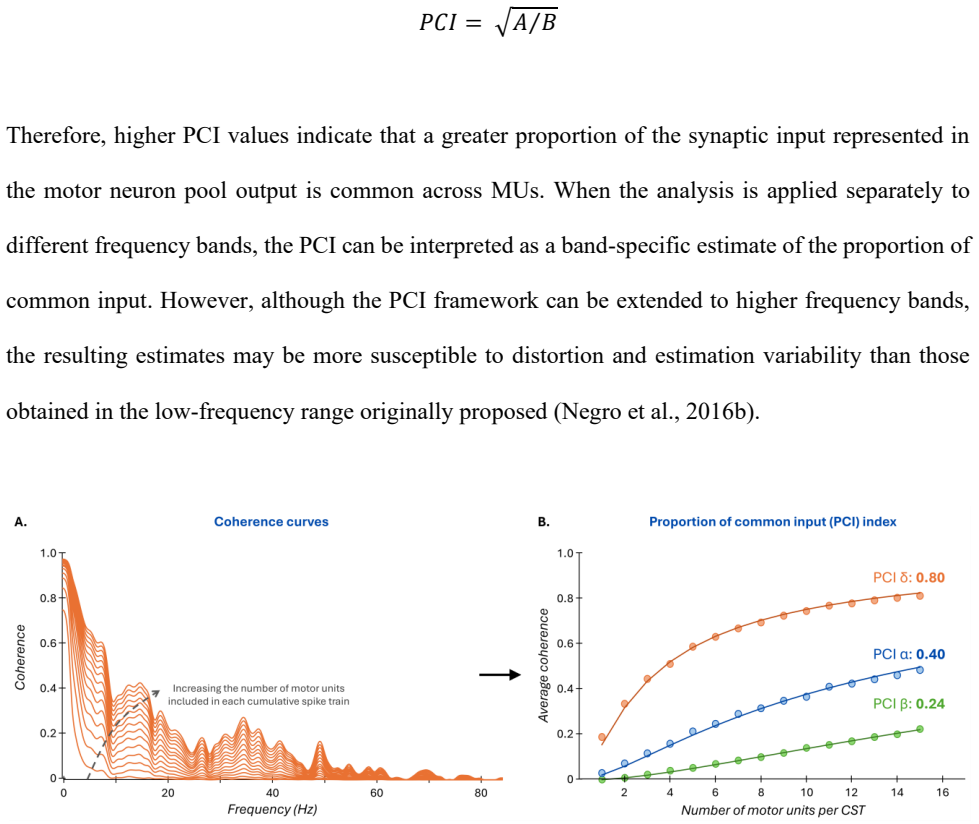
- Frequency-domain coherence between cumulative spike trains isolates the frequency bands in which common input is strongest.
- The network approach extracts nonlinear pairwise dependencies and organizes them into graph metrics that capture the structure of shared input.
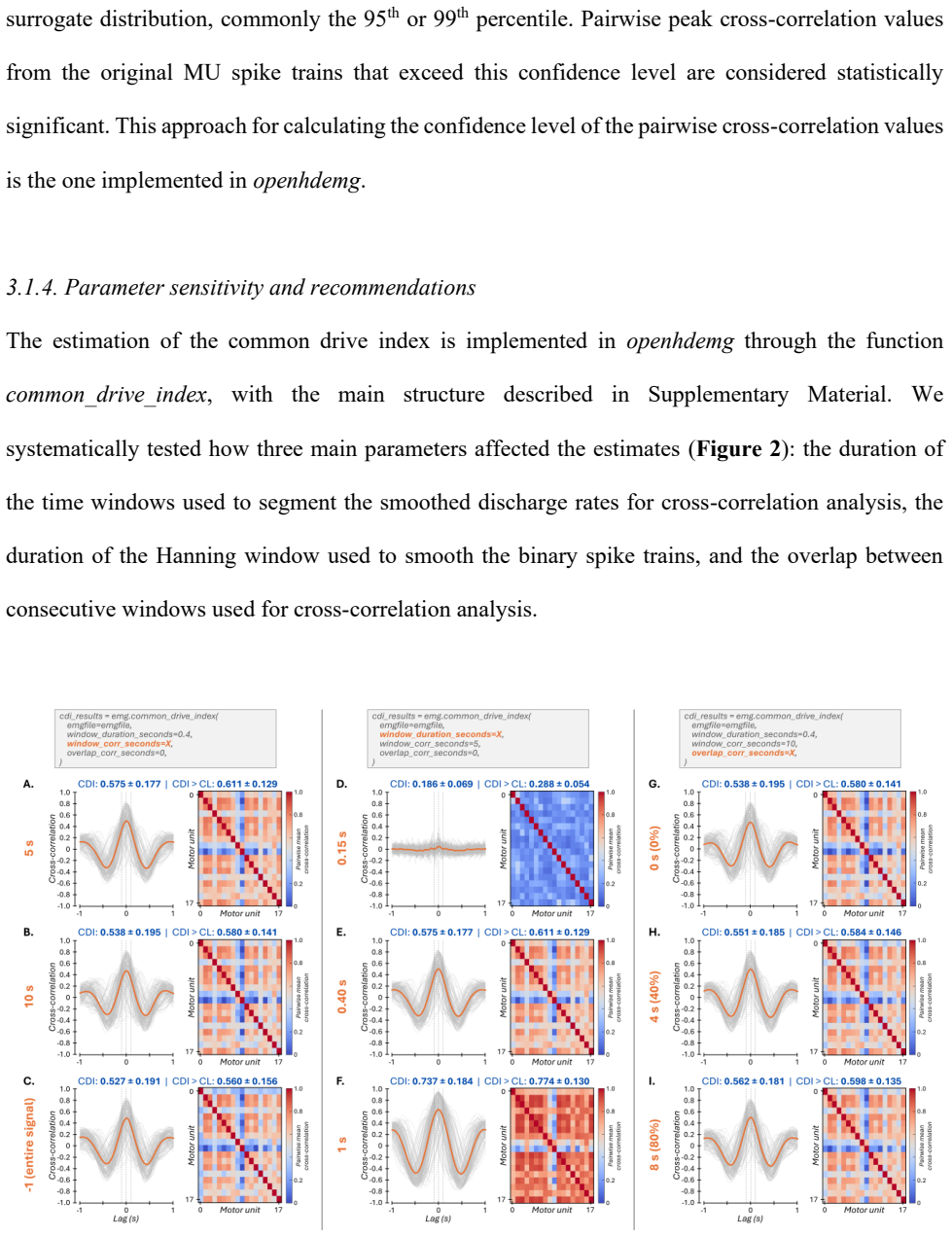
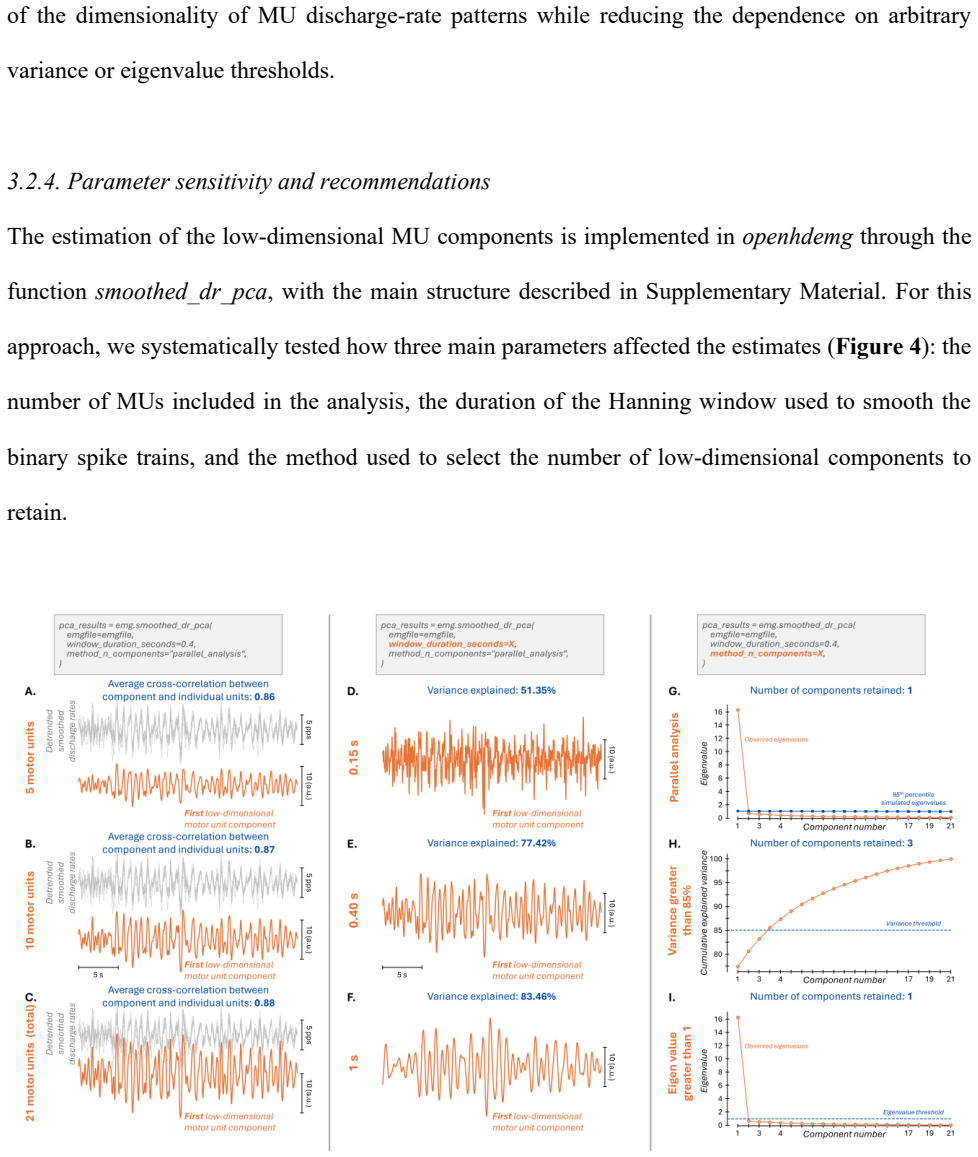
- Parameter choices such as smoothing window length or coherence frequency resolution must be selected according to the physiological assumptions of each category.
- Poor motor-unit decomposition propagates directly into biased or noisy estimates of common synaptic input.
Where Pith is reading between the lines
- The same workflow could be tested on data from patients with motor disorders to check whether the three categories remain consistent when motor-unit populations are smaller.
- If the estimates prove stable across the three categories, they could serve as a non-invasive proxy for monitoring changes in common input during learning or fatigue.
- The emphasis on decomposition quality suggests that future improvements in spike-train extraction algorithms would automatically raise the ceiling on common-input estimation accuracy.
Load-bearing premise
The three method categories and their parameter-sensitivity checks are enough to yield reliable, physiologically interpretable estimates once motor-unit decomposition is finished.
What would settle it
Finding that the estimates from all three method categories diverge sharply from independent physiological measures of shared input whenever the motor-unit decomposition step is performed with low accuracy.
Figures




read the original abstract
Common synaptic input is considered a fundamental principle of motor neuron control and represents the dominant component of the neural drive transmitted from the motor neurons to muscle. Recent advances in High-Density surface Electromyography (HDsEMG) and motor unit (MU) decomposition algorithms have enabled the concurrent identification of increasingly large populations of MUs and substantially expanded the possibility of estimating common synaptic input from MU spike trains, making this approach widely used to investigate the neural control of movement in humans. However, multiple analytical approaches are currently available, each relying on different physiological assumptions, mathematical formulations, and parameter choices. The lack of practical guidelines and open-source implementations has also limited the accessibility and reproducibility of these analyses. In this tutorial, we provide a practical, physiologically grounded guide to estimating common synaptic input from populations of MU spike trains using openhdemg, an open-source Python framework. We organize the available methods into three complementary categories: time-domain approaches applied to smoothed discharge rates, frequency-domain approaches based on coherence between cumulative spike trains, and a network-information approach based on nonlinear pairwise dependencies and graph theory. For each method, we describe its physiological interpretation, step-by-step estimation, and systematically examine how key parameter choices influence the resulting estimates, providing practical recommendations for their selection. Finally, we present a complete workflow from HDsEMG decomposition and MU cleaning to common synaptic input estimation, demonstrating that decomposition quality directly affects these estimates.
Editorial analysis
A structured set of objections, weighed in public.
Referee Report
Summary. The manuscript is a tutorial describing how to estimate common synaptic input to spinal motor neurons from motor-unit spike trains obtained via high-density surface EMG decomposition. It organizes existing methods into three categories (time-domain approaches on smoothed discharge rates, frequency-domain coherence on cumulative spike trains, and network-information methods using nonlinear pairwise dependencies and graph theory), supplies step-by-step procedures inside the openhdemg Python package, reports systematic parameter-sensitivity checks for each category, and presents a workflow from decomposition through MU cleaning to common-input estimation that illustrates the propagation of decomposition quality into the final estimates.
Significance. If the guidance is accurate and the open-source implementation is reliable, the paper supplies a missing practical resource that can improve accessibility, reproducibility, and standardization of common-input analyses in human motor-control studies. The explicit linkage between decomposition quality and downstream estimates, together with the parameter-sensitivity results, addresses a recognized practical barrier in the field.
major comments (1)
- [Workflow section] Workflow section: the demonstration that 'decomposition quality directly affects these estimates' is presented qualitatively; no quantitative metrics (e.g., error propagation, sensitivity coefficients, or comparison against simulated ground-truth inputs) are reported, which limits the strength of the practical recommendation that users must prioritize high-quality decomposition.
minor comments (3)
- [Abstract and §3] Abstract and §3: the physiological assumptions underlying each of the three method categories are stated but not cross-referenced to the specific equations or parameter ranges examined in the sensitivity analyses; adding explicit links would improve traceability.
- [Parameter-sensitivity subsections] Parameter-sensitivity subsections: the criteria used to select the 'practical recommendations' for each parameter are not stated (e.g., stability threshold, physiological plausibility range); this makes it difficult for readers to judge how the recommendations were derived.
- [Figure captions and code listings] Figure captions and code listings: several captions refer to 'default' parameter values without listing the numerical defaults or the openhdemg function calls that produce them; this reduces immediate reproducibility.
Simulated Author's Rebuttal
We thank the referee for the positive assessment of the manuscript and the constructive comment. We address the point below.
read point-by-point responses
-
Referee: [Workflow section] Workflow section: the demonstration that 'decomposition quality directly affects these estimates' is presented qualitatively; no quantitative metrics (e.g., error propagation, sensitivity coefficients, or comparison against simulated ground-truth inputs) are reported, which limits the strength of the practical recommendation that users must prioritize high-quality decomposition.
Authors: We acknowledge that the demonstration in the workflow section is primarily qualitative and serves as an illustrative example to show propagation of decomposition quality into the estimates. This aligns with the tutorial focus of the paper, which emphasizes practical guidance, step-by-step procedures, and parameter recommendations rather than a dedicated quantitative validation study. The manuscript already reports systematic parameter-sensitivity checks for each of the three method categories, supplying quantitative support for the recommendations. A rigorous quantitative treatment involving error propagation, sensitivity coefficients, or simulated ground-truth inputs would require a separate simulation-based investigation outside the scope of this work. We will revise the workflow section to explicitly clarify the illustrative purpose of the demonstration and to strengthen its linkage to the preceding quantitative sensitivity results. revision: partial
Circularity Check
No significant circularity
full rationale
The manuscript is a tutorial that organizes previously published methods for common synaptic input estimation into three categories (time-domain, frequency-domain, network-information), supplies step-by-step procedures inside the open-source openhdemg package, and reports parameter-sensitivity checks plus a workflow showing decomposition quality effects. No novel derivation, prediction, or uniqueness theorem is advanced; all analytical approaches are described as coming from prior literature. No equation or claim reduces by construction to a quantity defined or fitted within the paper itself, and self-citations (if present) are not load-bearing for any central result. The work is therefore self-contained against external benchmarks.
Axiom & Free-Parameter Ledger
Reference graph
Works this paper leans on
-
[1]
DUCHATEAU, J
Flexible control of motor units: is the multidimensionality of motor unit manifolds a sufficient condition? The Journal of Physiology, 603, 2349-2368. DUCHATEAU, J. & ENOKA, R. M. 2011. Human motor unit recordings: origins and insight into the integrated motor system. Brain Res, 1409, 42-61. ENOKA, R. M. & FARINA, D. 2021. Force Steadiness: From Motor Uni...
2011
-
[2]
J Physiol, 470, 127-55
The frequency content of common synaptic inputs to motoneurones studied during voluntary isometric contraction in man. J Physiol, 470, 127-55. GALLET, C. & JULIEN, C. 2011. The significance threshold for coherence when using the Welch's periodogram method: Effect of overlapping segments. Biomedical Signal Processing and Control, 6, 405-409. GALLOS, L. K.,...
2011
-
[3]
Prog Biophys Mol Biol, 53, 1-31
The Fourier approach to the identification of functional coupling between neuronal spike trains. Prog Biophys Mol Biol, 53, 1-31. ROSENBERG, J. R., HALLIDAY, D. M., BREEZE, P. & CONWAY, B. A. 1998. Identification of patterns of neuronal connectivity--partial spectra, partial coherence, and neuronal interactions. J Neurosci Methods, 83, 57-72. ROSSATO, J.,...
1998
-
[4]
J Neurophysiol, 127, 421-433
Less common synaptic input between muscles from the same group allows for more flexible coordination strategies during a fatiguing task. J Neurophysiol, 127, 421-433. SEARS, T. A. & STAGG, D. 1976. Short-term synchronization of intercostal motoneurone activity. J Physiol, 263, 357-81. SHERRINGTON, C. S. 1925. Remarks on some aspects of reflex inhibition. ...
1976
discussion (0)
Sign in with ORCID, Apple, or X to comment. Anyone can read and Pith papers without signing in.