REVIEW 2 major objections 1 minor
War in the Abstract: The Rise and Consequences of Militarized Language in Scientific Communication
T0 review · 2 major / 1 minor · reviewed 2026-06-26 · grok-4.3
Pith's one-line read Militarized terms in scientific abstracts rose 48% from 2010 to 2025 and reduce credibility when used.
desk verdict Large-scale count of militaristic terms in 21M abstracts plus a framing experiment, but the term list lacks validation so the trends rest on shaky ground. read the letter →
The pith
A machine-rendered reading of the paper's core claim, the machinery that carries it, and where it could break.
The reading
What carries the argument
Corpus analysis of a predefined list of militaristic terms applied to 21.4 million abstracts, paired with a within-subject experiment measuring framing effects on credibility and support measures.
What would settle it
Re-analysis of the same 21.4 million papers with a different term list or different conflict dataset that finds no rise or no correlation with conflicts would undermine the prevalence and alignment results.
Extended reading notes
Core claim
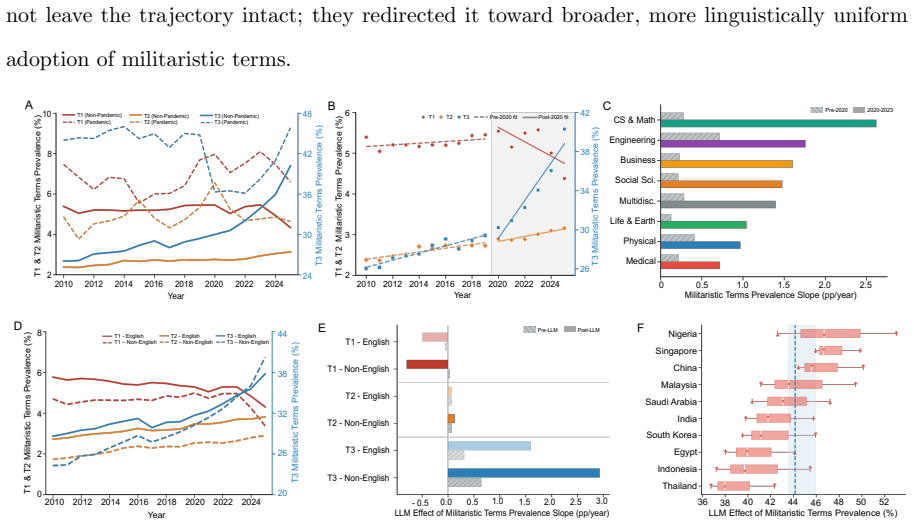
Between 2010 and 2025 the presence of militaristic terms in scientific abstracts rose 48% in OpenAlex and 32% in PubMed, with the rise accelerating sharply after 2019 and aligning with conflict data at country and annual scales; war framing reduced credibility by a mean shift of -0.18 Likert units, funding willingness, and policy support.
Load-bearing premise
The predefined list of militaristic terms used to label abstracts accurately captures the intended construct without substantial false positives or context-dependent misclassification.
Editorial extensions
If this is right
- Social sciences show the highest levels of militaristic language while engineering and computer science show the fastest growth.
- Abstracts from the Global South display the fastest rise.
- The COVID and post-2022 large-language-model periods saw both a rise in use and a narrowing of the gap between native-English and non-English authors.
- War framing produces a small trend-level increase in sense of urgency alongside the negative effects on credibility and support.
Reading between the lines
- Continued growth in such language could gradually lower public willingness to act on scientific findings.
- Disciplines might develop style guidelines that discourage militaristic metaphors in abstracts to protect perceived trustworthiness.
- Similar experiments could test whether other loaded metaphors produce comparable drops in support.
Editorial analysis
A structured set of objections, weighed in public.
Referee Report
Summary. The paper analyzes 21.4 million scientific abstracts (2010-2025) from OpenAlex and PubMed, reporting a 48% and 32% rise in militaristic terms respectively, with post-2019 acceleration (cross-database r=0.96) and correlations to real-world conflict data (r=0.77-0.84). It additionally reports results from a within-subject experiment (N=801, 32,040 trials) in which war framing reduced credibility (d_z=-0.28), funding willingness (d_z=-0.12), and policy support (d_z=-0.08).
Significance. Large sample sizes, cross-database consistency, conflict-aligned correlations, and effect sizes reported with confidence intervals provide directional support for the claims if the measurement is valid. The experimental component supplies causal evidence on potential downstream effects. If the term-list measurement holds, the work identifies a measurable shift in scientific communication with possible implications for credibility and persuasion.
major comments (2)
- [Methods (corpus analysis)] Corpus analysis / term-list construction (described in the methods for the 21.4M-abstract study): no validation, human coding, precision/recall, or false-positive audit is reported for the fixed militaristic term list. Polysemous terms (e.g., 'campaign', 'target', 'attack', 'defense', 'strategy') occur frequently in non-militaristic technical contexts; without evidence that such usages were excluded or quantified, the 48%/32% prevalence rises, post-2019 acceleration, Global-South patterns, and conflict correlations (r=0.77-0.84) cannot be unambiguously attributed to militarized language rather than topic or database shifts.
- [Methods (experiment)] Experimental methods (N=801 study): the exact framing stimuli, control sentences, and any pre-registration or attention-check details are not supplied. These omissions are load-bearing for interpreting the reported effect sizes (credibility d_z=-0.28, funding d_z=-0.12) as specifically due to militaristic language rather than other lexical or affective differences between conditions.
minor comments (1)
- [Abstract] Abstract: the size of the militaristic term list and one or two concrete examples would help readers assess face validity without needing the full methods.
Simulated Author's Rebuttal
We thank the referee for these constructive comments on methodological transparency. We agree that both the corpus term-list validation and the experimental stimuli details require fuller reporting. We will revise the manuscript to address these points directly.
read point-by-point responses
-
Referee: [Methods (corpus analysis)] Corpus analysis / term-list construction (described in the methods for the 21.4M-abstract study): no validation, human coding, precision/recall, or false-positive audit is reported for the fixed militaristic term list. Polysemous terms (e.g., 'campaign', 'target', 'attack', 'defense', 'strategy') occur frequently in non-militaristic technical contexts; without evidence that such usages were excluded or quantified, the 48%/32% prevalence rises, post-2019 acceleration, Global-South patterns, and conflict correlations (r=0.77-0.84) cannot be unambiguously attributed to militarized language rather than topic or database shifts.
Authors: We agree this is a substantive limitation in the current reporting. The methods section does not include a validation study, precision/recall metrics, or false-positive audit for the fixed term list, and polysemy in terms such as 'campaign' or 'target' is a genuine concern that could inflate counts. In the revised manuscript we will add a dedicated subsection on term-list construction that reports any pilot human coding performed, quantifies false-positive rates on a sampled subset of abstracts, and discusses mitigation steps for polysemy. We will also note that while cross-database consistency (r=0.96) and alignment with external conflict data provide convergent support, these do not substitute for direct validation; the added audit will allow readers to assess the degree of contamination. revision: yes
-
Referee: [Methods (experiment)] Experimental methods (N=801 study): the exact framing stimuli, control sentences, and any pre-registration or attention-check details are not supplied. These omissions are load-bearing for interpreting the reported effect sizes (credibility d_z=-0.28, funding d_z=-0.12) as specifically due to militaristic language rather than other lexical or affective differences between conditions.
Authors: We concur that the stimuli, controls, pre-registration status, and attention-check procedures must be supplied for the effects to be interpretable. The revised manuscript will include the full set of war-framed and control sentences in an appendix, along with all attention-check wording, exclusion criteria, and data-quality metrics. The study was not pre-registered; we will state this explicitly as a limitation. These additions will enable direct evaluation of whether the observed shifts (e.g., d_z = -0.28 on credibility) are attributable to militaristic framing rather than other lexical differences. revision: yes
Circularity Check
No circularity: direct corpus counts, external correlations, and independent experiment
full rationale
The paper reports prevalence trends from applying a fixed term list to 21.4 million external abstracts (OpenAlex/PubMed), correlations against the independent Uppsala Conflict Data Program, and effect sizes from a separate N=801 within-subject experiment. No equations, fitted parameters, self-definitional constructs, or load-bearing self-citations are present that would make any reported quantity reduce to the authors' own inputs by construction. The measurement pipeline and causal test remain independent of the target statistics.
Assumptions & free parameters
assumptions (1)
- domain assumption A fixed list of militaristic terms validly and exhaustively measures the construct of militarized language in abstracts
Cite this review
Pith. "Pith review of War in the Abstract: The Rise and Consequences of Militarized Language in Scientific Communication." pith.science (2026). https://pith.science/paper/UK2JTUWM
@misc{pith2026260623462,
  author       = {Pith},
  title        = {Pith review of: War in the Abstract: The Rise and Consequences of Militarized Language in Scientific Communication},
  year         = {2026},
  howpublished = {\url{https://pith.science/paper/UK2JTUWM}},
  note         = {Machine review of arXiv:2606.23462}
}
abstract
Scientists do not, by profession, wage war. Yet warfare's vocabulary consistently appears in their abstracts. To quantify the extent to which warfare's vocabulary pervades scientific abstracts, we analyze 21.4 million papers (2010-2025; OpenAlex, PubMed). We additionally run a within-subject war-framing experiment ($N = 801$; 32{,}040 trials) designed to provide causal insight into the effects of militaristic language on persuasion. Between 2010 and 2025, the presence of militaristic terms in scientific abstracts rose 48\% in OpenAlex and 32\% in PubMed, with the rise accelerating sharply after 2019 (cross-database $r = 0.96$, $p < 10^{-8}$). The prevalence of militaristic language is conflict-aligned at both country and annual scales (Uppsala Conflict Data Program; $r = 0.77$-$0.84$), with the abstracts from the Global South displaying the fastest rise in militaristic language. Among disciplines, social sciences leads in level of such language while engineering and computer science lead in growth. The COVID and post-2022 large-language-model eras also accelerated the rise and narrowed the language gap between native-English-speaking and non-English-speaking countries. In our follow-up experiment, we found that war framing reduced credibility (mean shift $-0.176$ Likert units, 95\% CI $[-0.21, -0.14]$; $d_z = -0.28$, $p < 10^{-20}$), funding willingness ($d_z = -0.12$) and policy support ($d_z = -0.08$), with a trend-level increase in sense of urgency ($d_z = +0.07$). Collectively, findings reveal that while scientific abstracts drift toward warfare, the use of militaristic language may erode credibility, funding willingness, and policy support.
Figures


Figures from the paper (4 more)



Reviewed June 26, 2026 · model on record in the stance chip above.
Discussion (0). Continue with ORCID to comment.