A Collapsar-Disk Origin for GW190814
Pith reviewed 2026-06-26 07:05 UTC · model grok-4.3
The pith
GW190814 originated when a fragment from a neutrino-cooled collapsar disk merged with the central black hole, linked to supernova SN2019npv as precursor.
A machine-rendered reading of the paper's core claim, the machinery that carries it, and where it could break.
Core claim
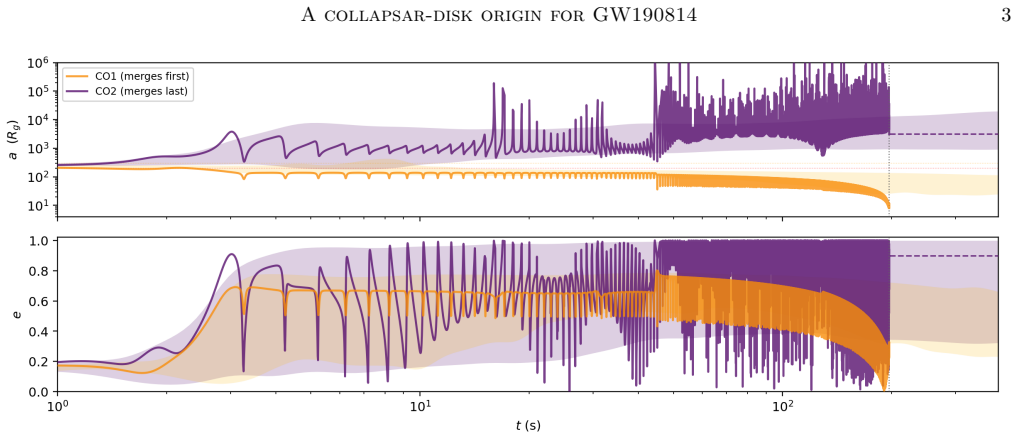
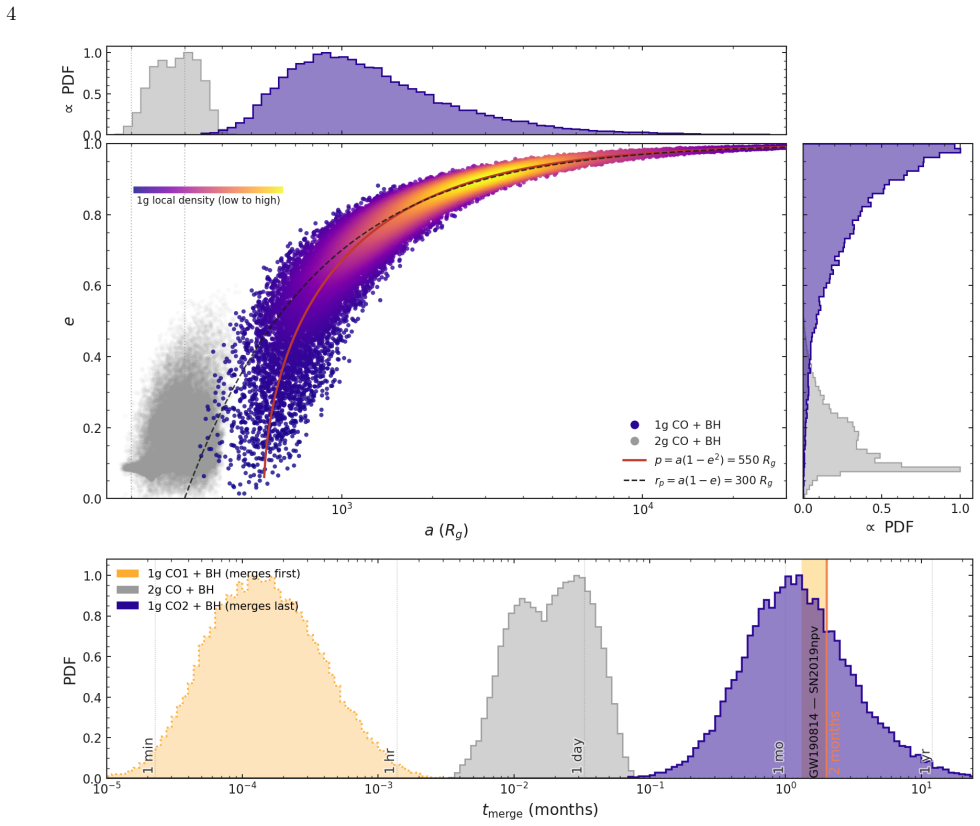
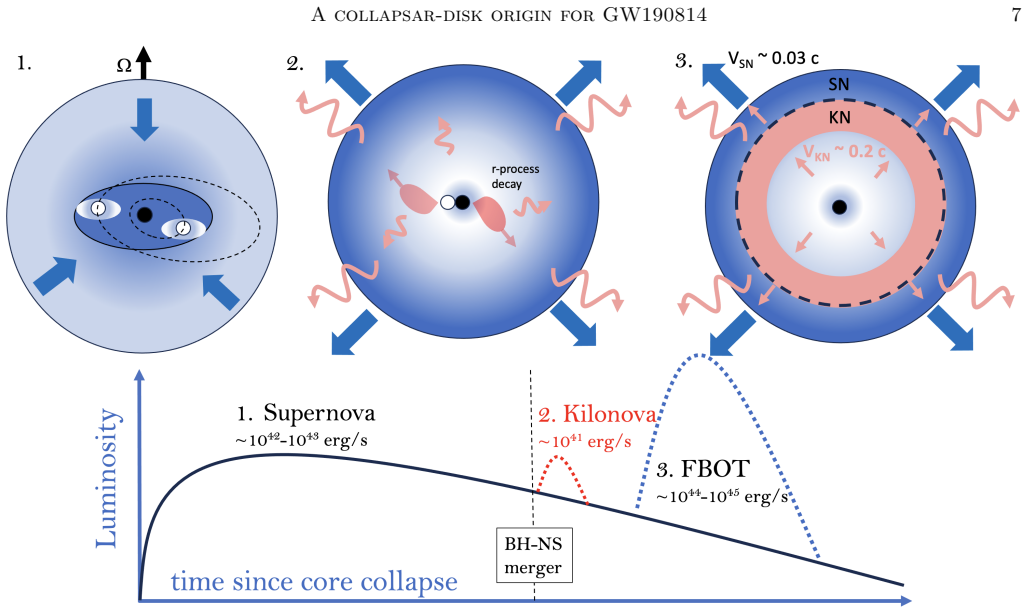
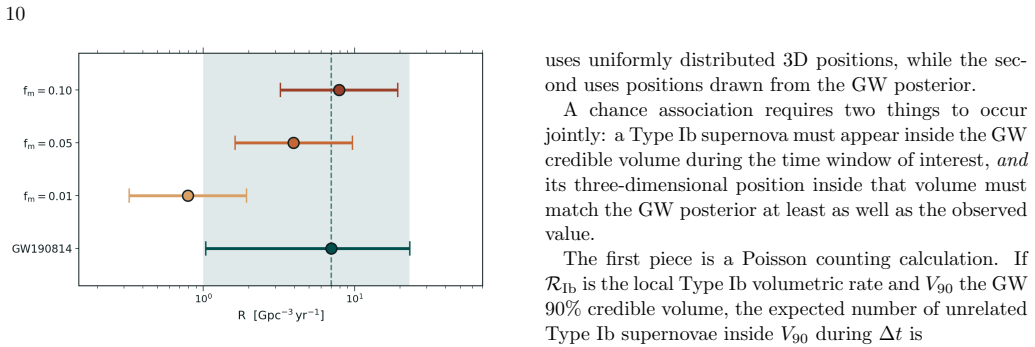
We propose that GW190814 originated from such a collapsar-disk fragment merging with the central BH. A key prediction of this scenario is a temporal association with a stripped-envelope supernova preceding the GW event, and we identify the Type Ib supernova candidate SN2019npv, which occurred inside the GW190814 credible volume approximately 60 days before coalescence, as a possible electromagnetic precursor. Although this delay is too long for a conventional kilonova counterpart, we show that three-body interactions among disk fragments can excite some compact objects to wide orbits and naturally produce merger delays of weeks to months. Finally, treating SN2019npv as the host makes GW19081
What carries the argument
Neutrino-cooled collapsar disks that become gravitationally unstable and fragment into compact objects capable of merging with the central black hole after three-body scattering delays.
If this is right
- Three-body interactions among disk fragments naturally produce merger delays ranging from weeks to months.
- Future delayed mergers in this channel could produce luminous transients through shocks between merger ejecta and preceding supernova ejecta.
- The model supplies an origin for other extreme mass-ratio black-hole mergers that standard channels struggle to explain.
- Association with an identifiable supernova host converts the event into a standard siren for cosmology.
Where Pith is reading between the lines
- Other asymmetric gravitational-wave events could be tested for similar supernova precursors in archival data.
- The contribution of collapsar-disk fragments to the overall merger rate could be bounded by the observed frequency of stripped-envelope supernovae overlapping gravitational-wave sky maps.
- If the channel operates, some future events might show electromagnetic emission on month-long timescales even without a kilonova.
- The scenario predicts that the secondary object in such mergers should often be a low-mass black hole rather than a neutron star.
Load-bearing premise
SN2019npv is the associated stripped-envelope supernova occurring inside the GW190814 credible volume approximately 60 days prior to coalescence.
What would settle it
A redshift for SN2019npv that places its distance outside the GW190814 localization volume or inconsistent with the inferred luminosity distance would rule out the proposed link.
Figures

read the original abstract
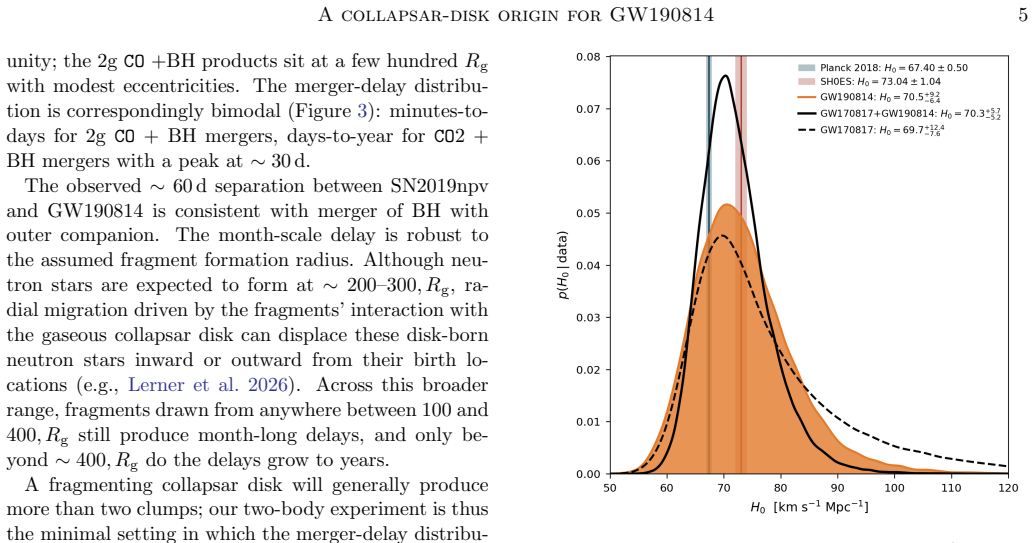
GW190814 was a remarkable gravitational-wave (GW) event: a merger between a 23 solar-mass black hole (BH) and a 2.6 solar-mass compact object, with an extreme mass ratio that is difficult to reproduce through standard isolated-binary or dynamical formation channels. Recent work has shown that neutrino-cooled collapsar disks can become gravitationally unstable and fragment, producing neutron stars (NSs) or low-mass BHs in orbit around the newly formed central BH. These fragments may subsequently interact, scatter, merge with one another, or inspiral into the central remnant. We propose that GW190814 originated from such a collapsar-disk fragment merging with the central BH. A key prediction of this scenario is a temporal association with a stripped-envelope supernova preceding the GW event, and we identify the Type Ib supernova candidate SN2019npv, which occurred inside the GW190814 credible volume approximately 60 days before coalescence, as a possible electromagnetic precursor. Although this delay is too long for a conventional kilonova counterpart, we show that three-body interactions among disk fragments can excite some compact objects to wide orbits and naturally produce merger delays of weeks to months. While GW190814 itself was not expected to produce detectable tidal-disruption-powered emission, future delayed mergers in this channel could generate luminous transients through either reprocessed kilonova heating or shocks driven as merger ejecta collide with the preceding supernova ejecta. Finally, treating SN2019npv as the host makes GW190814 a bright standard siren and yields H_0 = 70.5 (+9.2, -6.4) km/s/Mpc.
Editorial analysis
A structured set of objections, weighed in public.
Referee Report
Summary. The manuscript proposes that GW190814 originated from the merger of a central black hole with a low-mass compact-object fragment formed via gravitational instability in a neutrino-cooled collapsar accretion disk. It identifies the Type Ib supernova SN2019npv, located inside the GW190814 credible volume and occurring ~60 days prior to coalescence, as a possible electromagnetic precursor. Three-body interactions among disk fragments are invoked to explain the delay, and treating SN2019npv as the host yields a standard-siren Hubble constant of H_0 = 70.5 (+9.2, -6.4) km/s/Mpc.
Significance. If the SN2019npv association and the collapsar-disk fragment channel are validated, the work would introduce a new formation pathway for extreme mass-ratio mergers and supply an independent H_0 constraint. The significance is currently limited by the lack of quantitative support for fragment survival, merger-delay statistics, and the false-association probability, which are required to elevate the scenario beyond a post-hoc identification.
major comments (3)
- [abstract] Abstract, final paragraph: The central claim that GW190814 originated in a collapsar-disk fragment and the derived H_0 value both rest on identifying SN2019npv as the associated supernova. The manuscript provides no calculation of the chance-coincidence probability (using the supernova rate, localization area, and 60-day time window), no posterior odds, and no false-association rate. This is load-bearing because the spatial-temporal link must be shown to be improbable under the null hypothesis before the scenario or the standard-siren result can be considered robust.
- [three-body interactions discussion] Discussion of three-body delays (section describing fragment interactions): The manuscript states that three-body interactions can excite fragments to wide orbits and produce merger delays of weeks to months, yet supplies no quantitative modeling of fragment survival probabilities, scattering cross-sections, or resulting delay-time distributions. Without these, the mechanism remains qualitative and does not rescue the prior probability of the SN2019npv association.
- [final paragraph] H_0 derivation (final paragraph): The quoted H_0 = 70.5 (+9.2, -6.4) km/s/Mpc is obtained by treating SN2019npv as the host. The reported uncertainties do not include the systematic uncertainty arising from the unquantified probability that the supernova is a random interloper rather than the true host; this omission directly affects the reliability of the standard-siren result.
minor comments (2)
- [abstract] The abstract claims 'we show that three-body interactions... can naturally produce merger delays,' but the full text should clarify whether this is a new calculation or a reference to existing literature on three-body dynamics in disks.
- Notation for the fragment masses (2.6 M_⊙ compact object) and the central BH (23 M_⊙) should be introduced with explicit symbols early in the text for consistency with later equations.
Simulated Author's Rebuttal
We thank the referee for the constructive report. The comments correctly identify that quantitative support for the SN2019npv association and the three-body delay mechanism would strengthen the manuscript. We address each point below and will revise accordingly.
read point-by-point responses
-
Referee: [abstract] Abstract, final paragraph: The central claim that GW190814 originated in a collapsar-disk fragment and the derived H_0 value both rest on identifying SN2019npv as the associated supernova. The manuscript provides no calculation of the chance-coincidence probability (using the supernova rate, localization area, and 60-day time window), no posterior odds, and no false-association rate. This is load-bearing because the spatial-temporal link must be shown to be improbable under the null hypothesis before the scenario or the standard-siren result can be considered robust.
Authors: We agree that a quantitative estimate of the chance-coincidence probability is required. In the revised manuscript we will compute this probability using the local Type Ib/c supernova rate, the GW190814 localization area, and the 60-day temporal window. The calculation will also yield an estimate of the false-association rate and the posterior odds ratio under the null hypothesis, allowing the robustness of the association to be assessed directly. revision: yes
-
Referee: [three-body interactions discussion] Discussion of three-body delays (section describing fragment interactions): The manuscript states that three-body interactions can excite fragments to wide orbits and produce merger delays of weeks to months, yet supplies no quantitative modeling of fragment survival probabilities, scattering cross-sections, or resulting delay-time distributions. Without these, the mechanism remains qualitative and does not rescue the prior probability of the SN2019npv association.
Authors: The three-body discussion is presented as a plausibility argument rather than a full statistical model. We acknowledge the referee's point and will add order-of-magnitude estimates for scattering cross-sections, fragment survival fractions, and the resulting delay-time distribution using standard three-body scattering theory and typical collapsar-disk parameters. Full N-body or hydrodynamical simulations lie beyond the scope of this work and will be flagged as future work. revision: partial
-
Referee: [final paragraph] H_0 derivation (final paragraph): The quoted H_0 = 70.5 (+9.2, -6.4) km/s/Mpc is obtained by treating SN2019npv as the host. The reported uncertainties do not include the systematic uncertainty arising from the unquantified probability that the supernova is a random interloper rather than the true host; this omission directly affects the reliability of the standard-siren result.
Authors: We agree that the quoted H_0 uncertainties should incorporate the possibility of a false association. In the revision we will either report the H_0 value conditional on the association or augment the error budget with a systematic term derived from the false-association probability calculated in response to the first comment. revision: yes
Circularity Check
No significant circularity; derivation self-contained
full rationale
The paper proposes a collapsar-disk fragment origin for GW190814 and conditionally identifies SN2019npv to enable a standard-siren H0 calculation. The H0 result follows from applying established luminosity-distance methods to the assumed host redshift and does not reduce to any fitted parameter or self-definition within the paper's own equations. The three-body interaction argument explains a possible delay after the association is posited but is not used to derive the association probability or force the result. No self-citation chains, ansatzes smuggled via citation, or renamings of known results appear as load-bearing steps in the provided text. The central claim remains a physical scenario whose validity hinges on external association probability (not analyzed here) rather than internal circular reduction.
Axiom & Free-Parameter Ledger
free parameters (1)
- merger delay timescale
axioms (1)
- domain assumption Neutrino-cooled collapsar disks can become gravitationally unstable and fragment into NSs or low-mass BHs
invented entities (1)
-
collapsar-disk fragments as surviving compact objects capable of delayed merger
no independent evidence
Reference graph
Works this paper leans on
-
[1]
Abbott, B. P., et al. 2017, Nature, 551, 85, doi: 10.1038/nature24471
-
[2]
Abbott, R., et al. 2020, ApJL, 896, L44, doi: 10.3847/2041-8213/ab960f
-
[3]
Abbott, R., et al. 2023, Phys. Rev. X, 13, 041039, doi: 10.1103/PhysRevX.13.041039
-
[4]
2020, A&A, 643, A113, doi: 10.1051/0004-6361/202037669
Ackley, K., et al. 2020, A&A, 643, A113, doi: 10.1051/0004-6361/202037669
-
[5]
2020, Astronomy and Astrophysics, 641, A6, doi: 10.1051/0004-6361/201833910
Aghanim, N., et al. 2020, A&A, 641, A6, doi: 10.1051/0004-6361/201833910
-
[6]
Amsellem, A. J., et al. 2026, Astrophys. J., 1001, 157, doi: 10.3847/1538-4357/ae4b37
-
[7]
2020, ApJ, 890, 131, doi: 10.3847/1538-4357/ab6a1b
Andreoni, I., et al. 2020, ApJ, 890, 131, doi: 10.3847/1538-4357/ab6a1b
-
[8]
Antoniadis, J., Aguilera-Dena, D. R., Vigna-G´ omez, A., et al. 2022, A&A, 657, L6, doi: 10.1051/0004-6361/202142322
-
[9]
Arnett, W. D. 1982, ApJ, 253, 785, doi: 10.1086/159681
-
[10]
Barnes, J., & Metzger, B. D. 2022, ApJL, 939, L29, doi: 10.3847/2041-8213/ac9b41
-
[11]
B., Modjaz, M., Hicken, M., et al
Bianco, F. B., Modjaz, M., Hicken, M., et al. 2014, ApJS, 213, 19, doi: 10.1088/0067-0049/213/2/19
-
[12]
Electromagnetic extraction of energy from Kerr black holes[J/OL]
Blandford, R. D., & Znajek, R. L. 1977, Mon. Not. Roy. Astron. Soc., 179, 433, doi: 10.1093/mnras/179.3.433
-
[13]
and Stevenson, Simon and Thrane, Eric
Broekgaarden, F. S., Stevenson, S., & Thrane, E. 2022, ApJ, 938, 45, doi: 10.3847/1538-4357/ac8879
-
[14]
2012, ApJ, 749, 110, doi: 10.1088/0004-637X/749/2/110
Bromberg, O., Nakar, E., Piran, T., & Sari, R. 2012, ApJ, 749, 110, doi: 10.1088/0004-637X/749/2/110
-
[15]
, year = 1996, month = feb, volume =
Chambers, J. E., Wetherill, G. W., & Boss, A. P. 1996, Icarus, 119, 261, doi: 10.1006/icar.1996.0019
-
[16]
Chatterjee, S., Ford, E. B., Matsumura, S., & Rasio, F. A. 2008, ApJ, 686, 580, doi: 10.1086/590227
-
[17]
Chen, H.-Y., Fishbach, M., & Holz, D. E. 2018, Nature, 562, 545, doi: 10.1038/s41586-018-0606-0
-
[18]
Chen, W.-X., & Beloborodov, A. M. 2007, Astrophys. J., 657, 383, doi: 10.1086/508923
-
[19]
Chen, Y.-X., & Metzger, B. D. 2025, ApJL, 991, L22, doi: 10.3847/2041-8213/ae045d
-
[20]
Drout, M. R., Soderberg, A. M., Gal-Yam, A., et al. 2011, ApJ, 741, 97, doi: 10.1088/0004-637X/741/2/97
-
[21]
R., Chornock, R., Soderberg, A
Drout, M. R., Chornock, R., Soderberg, A. M., et al. 2014, ApJ, 794, 23, doi: 10.1088/0004-637X/794/1/23
-
[22]
2022, ApJ, 926, 34, doi: 10.3847/1538-4357/ac3978
Essick, R., Farah, A., Galaudage, S., et al. 2022, ApJ, 926, 34, doi: 10.3847/1538-4357/ac3978
-
[23]
Essick, R., & Landry, P. 2020, Astrophys. J., 904, 80, doi: 10.3847/1538-4357/abbd3b
-
[24]
Fishbach, M., Essick, R., & Holz, D. E. 2020, Astrophys. J. Lett., 899, L8, doi: 10.3847/2041-8213/aba7b6
-
[25]
Ford, E. B., & Rasio, F. A. 2008, ApJ, 686, 621, doi: 10.1086/590926
-
[26]
2012, PhRvD, 86, 124007, doi: 10.1103/PhysRevD.86.124007
Foucart, F. 2012, PhRvD, 86, 124007, doi: 10.1103/PhysRevD.86.124007
-
[27]
L., Belczynski, K., Wiktorowicz, G., et al
Fryer, C. L., Belczynski, K., Wiktorowicz, G., et al. 2012, ApJ, 749, 91, doi: 10.1088/0004-637X/749/1/91
-
[28]
2022, ApJ, 932, 10, doi: 10.3847/1538-4357/ac6e43
Ghirlanda, G., & Salvaterra, R. 2022, ApJ, 932, 10, doi: 10.3847/1538-4357/ac6e43
-
[29]
Gottlieb, O., Jacquemin-Ide, J., Lowell, B., Tchekhovskoy, A., & Ramirez-Ruiz, E. 2023, Astrophys. J. Lett., 952, L32, doi: 10.3847/2041-8213/ace779 12
-
[30]
Gottlieb, O., Metzger, B. D., Issa, D., et al. 2025, Astrophys. J. Lett., 993, L54, doi: 10.3847/2041-8213/ae0d81
-
[31]
T., Flynn, C., et al
Gourdji, K., Deller, A. T., Flynn, C., et al. 2026
2026
-
[32]
2007, ApJL, 657, L73, doi: 10.1086/511417
Guetta, D., & Della Valle, M. 2007, ApJL, 657, L73, doi: 10.1086/511417
-
[33]
Hall, X. J., Ahumada, T., Gassert, J., et al. 2026, arXiv e-prints, arXiv:2605.10940, doi: 10.48550/arXiv.2605.10940
work page internal anchor Pith review Pith/arXiv arXiv doi:10.48550/arxiv.2605.10940 2026
-
[34]
Ho, A. Y. Q., Phinney, E. S., Kulkarni, S. R., et al. 2019, ApJ, 871, 73, doi: 10.3847/1538-4357/aaf473
-
[35]
Ho, A. Y. Q., Perley, D. A., Gal-Yam, A., et al. 2021, ApJ, 920, 35, doi: 10.3847/1538-4357/ac0fcb
-
[36]
Holz, D. E., & Hughes, S. A. 2005, ApJ, 629, 15, doi: 10.1086/431341
-
[37]
2019, Nature Astron., 3, 940, doi: 10.1038/s41550-019-0820-1
Hotokezaka, K., Nakar, E., Gottlieb, O., et al. 2019, Nature Astron., 3, 940, doi: 10.1038/s41550-019-0820-1
-
[38]
Tchekhovskoy, A. 2026, Phys. Rev. D, 113, 083020, doi: 10.1103/fzhd-hcpp
-
[39]
Tchekhovskoy, A. 2024, Astrophys. J., 961, 212, doi: 10.3847/1538-4357/ad02f0 Juri´ c, M., & Tremaine, S. 2008, ApJ, 686, 603, doi: 10.1086/590047
-
[40]
M., Ahumada, T., Stein, R., et al
Kasliwal, M. M., Ahumada, T., Stein, R., et al. 2025, ApJL, 995, L59, doi: 10.3847/2041-8213/ae2000
-
[41]
Kilpatrick, C. D., et al. 2021, ApJ, 923, 258, doi: 10.3847/1538-4357/ac23c6
-
[42]
Laskar, J., & Petit, A. C. 2017, A&A, 605, A72, doi: 10.1051/0004-6361/201630022
-
[43]
Lerner, Y., Stone, N. C., & Ofengeim, D. D. 2026, MNRAS, 545, staf1835, doi: 10.1093/mnras/staf1835
-
[44]
Liang, E., Zhang, B., Virgili, F., & Dai, Z. G. 2007, ApJ, 662, 1111, doi: 10.1086/517959
-
[45]
MacFadyen, A., & Woosley, S. E. 1999, ApJ, 524, 262, doi: 10.1086/307790
work page internal anchor Pith review doi:10.1086/307790 1999
-
[46]
MacLeod, C. L., & Hogan, C. J. 2008, PRD, 77, 043512, doi: 10.1103/PhysRevD.77.043512 Maga˜ na Hernandez, I., & Breivik, K. 2025, arXiv e-prints
-
[47]
Mandel, I., & Broekgaarden, F. S. 2022, Living Rev. Rel., 25, 1, doi: 10.1007/s41114-021-00034-3
-
[48]
Mandel, I., & de Mink, S. E. 2016, MNRAS, 458, 2634, doi: 10.1093/mnras/stw379
-
[49]
Rapid Stellar and Binary Population Synthesis with COMPAS: Methods Paper II
Mandel, I., et al. 2025, Astrophys. J. Suppl., 280, 43, doi: 10.3847/1538-4365/adf8d0
-
[50]
Astronomy and Astrophysics , volume =
Marchant, P., Langer, N., Podsiadlowski, P., Tauris, T. M., & Moriya, T. J. 2016, A&A, 588, A50, doi: 10.1051/0004-6361/201628133
-
[51]
Marchant, P., Pappas, K. M. W., Gallegos-Garcia, M., et al. 2021, A&A, 650, A107, doi: 10.1051/0004-6361/202039992
-
[52]
Margutti, R., Metzger, B. D., Chornock, R., et al. 2019, ApJ, 872, 18, doi: 10.3847/1538-4357/aafa01
-
[53]
McKernan, B., Ford, K. E. S., & O’Shaughnessy, R. 2020, MNRAS, 498, 4088, doi: 10.1093/mnras/staa2681
-
[54]
Metzger, B. D., Hui, L., & Cantiello, M. 2024, ApJL, 971, L34, doi: 10.3847/2041-8213/ad6990
-
[55]
Metzger, B. D., Martinez-Pinedo, G., Darbha, S., et al. 2010, MNRAS, 406, 2650, doi: 10.1111/j.1365-2966.2010.16864.x
-
[56]
2008, AJ, 135, 2398, doi: 10.1088/0004-6256/135/6/2398
Mikkola, S., & Merritt, D. 2008, AJ, 135, 2398, doi: 10.1088/0004-6256/135/6/2398
-
[57]
Mooley, K. P., Anderson, J., & Lu, W. 2022, Nature, 610, 273, doi: 10.1038/s41586-022-05145-7
-
[58]
, year = 2016, month = sep, volume =
Naoz, S. 2016, ARA&A, 54, 441, doi: 10.1146/annurev-astro-081915-023315
-
[59]
2024, Physical Review D, 109, 063508, doi: 10.1103/PhysRevD.109.063508
Palmese, A., Kaur, R., Hajela, A., et al. 2024, Phys. Rev. D, 109, 063508, doi: 10.1103/PhysRevD.109.063508
-
[60]
Perley, D. A., Mazzali, P. A., Yan, L., et al. 2019, MNRAS, 484, 1031, doi: 10.1093/mnras/sty3420
-
[61]
Pessi, T., Desai, D. D., Prieto, J. L., et al. 2025, Astron. Astrophys., 703, A34, doi: 10.1051/0004-6361/202556799
-
[62]
Peters, P. C. 1964, Phys. Rev., 136, B1224, doi: 10.1103/PhysRev.136.B1224
-
[63]
Piro, A. L., & Pfahl, E. 2007, ApJ, 658, 1173, doi: 10.1086/511672
-
[64]
Rasio, F. A., & Ford, E. B. 1996, Science, 274, 954, doi: 10.1126/science.274.5289.954
-
[65]
Riess, A. G., et al. 2022, ApJL, 934, L7, doi: 10.3847/2041-8213/ac5c5b
-
[66]
Schutz, B. F. 1986, Nature, 323, 310, doi: 10.1038/323310a0
-
[67]
Sekiguchi, Y. 2024, Phys. Rev. D, 109, 043051, doi: 10.1103/PhysRevD.109.043051
-
[68]
Smith, A. W., & Lissauer, J. J. 2009, Icarus, 201, 381, doi: 10.1016/j.icarus.2008.12.027
-
[69]
2018, A&A, 609, A136, doi: 10.1051/0004-6361/201730844
Taddia, F., et al. 2018, A&A, 609, A136, doi: 10.1051/0004-6361/201730844
-
[70]
2021, ApJ, 908, 194, doi: 10.3847/1538-4357/abd555
Tagawa, H., Kocsis, B., Haiman, Z., et al. 2021, ApJ, 908, 194, doi: 10.3847/1538-4357/abd555
-
[71]
2015, ApJ, 807, 157, doi: 10.1088/0004-637X/807/2/157
Tremaine, S. 2015, ApJ, 807, 157, doi: 10.1088/0004-637X/807/2/157
-
[72]
Vasylyev, S., & Filippenko, A. 2020, Astrophys. J., 902, 149, doi: 10.3847/1538-4357/abb5f9
-
[73]
2020, ApJ, 895, 96, doi: 10.3847/1538-4357/ab917d
Vieira, N., et al. 2020, ApJ, 895, 96, doi: 10.3847/1538-4357/ab917d
-
[74]
A., Guillochon, J., Berger, E., et al
Villar, V. A., Guillochon, J., Berger, E., et al. 2017, ApJL, 851, L21, doi: 10.3847/2041-8213/aa9c84 A collapsar-disk origin for GW19081413
-
[75]
Watson, A. M., et al. 2020, MNRAS, 492, 5916, doi: 10.1093/mnras/staa161
-
[76]
Woosley, S. E. 1993, ApJ, 405, 273, doi: 10.1086/172359
-
[77]
Woosley, S. E., & Bloom, J. S. 2006, ARA&A, 44, 507, doi: 10.1146/annurev.astro.43.072103.150558
-
[78]
R., Vu, N
Wu, J., Most, E. R., Vu, N. L., et al. 2026
2026
-
[79]
Yang, Y., Bartos, I., Haiman, Z., et al. 2019, Astrophys. J., 876, 122, doi: 10.3847/1538-4357/ab16e3
-
[80]
S., Fong, W.-f., Kremer, K., et al
Ye, C. S., Fong, W.-f., Kremer, K., et al. 2020, ApJL, 888, L10, doi: 10.3847/2041-8213/ab5dc5
discussion (0)
Sign in with ORCID, Apple, or X to comment. Anyone can read and Pith papers without signing in.