The PICO-Cluster Project: presenting the galaxy cluster sample and studying magnetic field growth, Faraday rotation and Braginskii heating
Pith reviewed 2026-06-26 07:47 UTC · model grok-4.3
The pith
High-resolution simulations of massive galaxy clusters find magnetic energy saturates after small-scale dynamo action to a uniform plasma beta of about 100 inside R200 after redshift 1.2.
A machine-rendered reading of the paper's core claim, the machinery that carries it, and where it could break.
Core claim
In a suite of 24 high-resolution zoom-in simulations of galaxy clusters with masses above 10^15 solar masses, the magnetic energy within the cluster is numerically converged once the small-scale dynamo has saturated, yielding a remarkably tight volume-averaged plasma-beta of β≈100 inside R200 across our sample after redshift z∼1.2. Faraday rotation measure profiles decline with cylindrical radius, with the mean falling faster than the root-mean-square. Viscous heating rates in Braginskii theory are highly intermittent and, on average, approach radiative cooling rates in the cluster outskirts.
What carries the argument
Saturation of the small-scale dynamo in moving-mesh cosmological zoom-in simulations that amplifies seed magnetic fields until the volume-averaged plasma beta reaches a converged value of approximately 100.
If this is right
- Faraday rotation measure profiles decline with cylindrical radius, and the mean decreases more rapidly than the root-mean-square because galaxies contribute relatively more at larger radii.
- Viscous heating rates according to Braginskii theory are highly intermittent yet on average approach radiative cooling rates in the cluster outskirts.
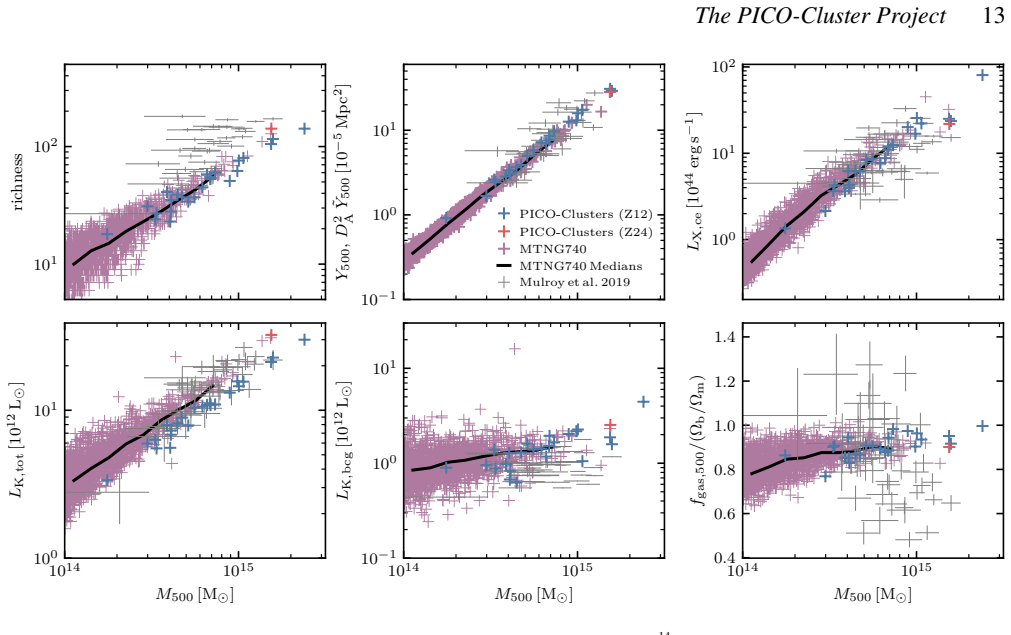
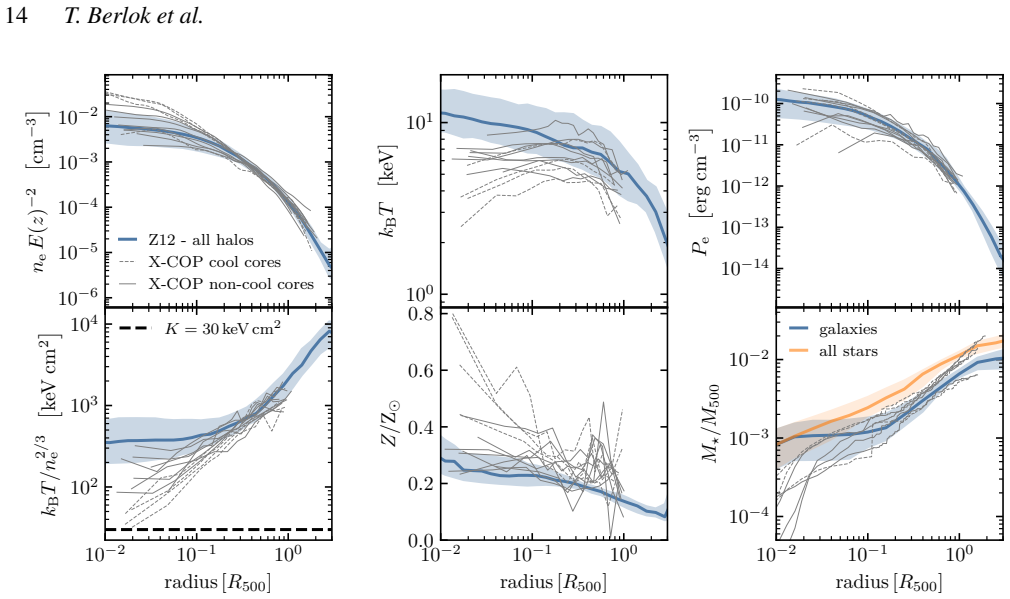
- Galaxy and cluster properties agree with recent simulations and many observational constraints on scaling relations and thermodynamic profiles.
- Magnetic energy is numerically converged once the small-scale dynamo saturates.
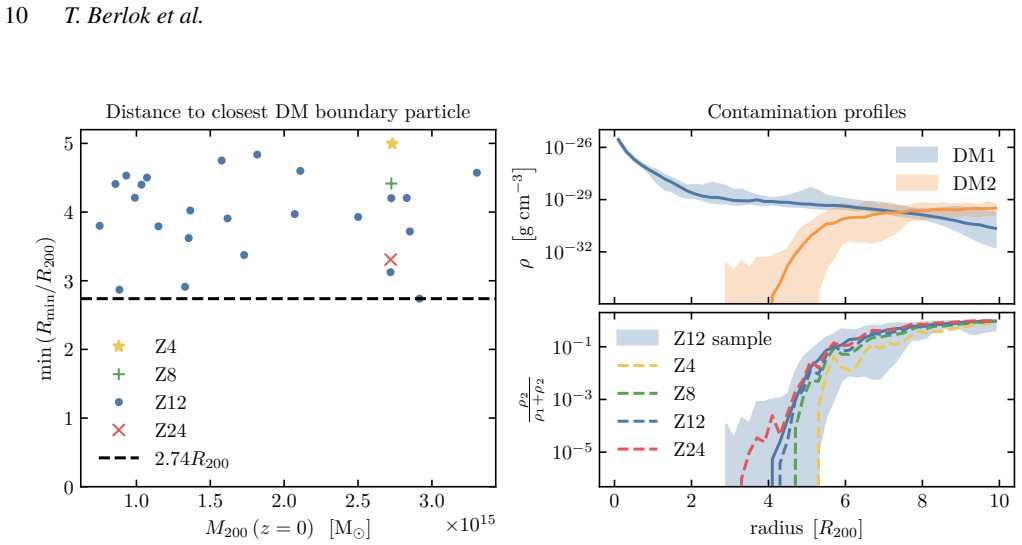
- All clusters remain free of low-resolution particle contamination out to at least 2.7 R200 at all times.
Where Pith is reading between the lines
- Targeted Faraday rotation observations in cluster outskirts could directly test the predicted radial decline and the growing contribution from galaxies.
- The intermittency of Braginskii heating may create localized thermal imbalances that averaged cooling-flow models do not capture.
- The same saturation level of beta approximately 100 may appear in lower-mass groups if the resolution is sufficient for the dynamo to operate.
- The tight beta value offers a concrete prior for including non-thermal magnetic pressure support when modeling cluster hydrostatic equilibrium.
Load-bearing premise
The baryonic mass resolution of 1.4 million solar masses is high enough for the small-scale dynamo to reach saturation without low-resolution particle contamination inside the high-resolution region.
What would settle it
A simulation run at substantially higher baryonic resolution that produces a volume-averaged plasma beta inside R200 deviating by more than a factor of two from 100 after redshift 1.2 would falsify the claimed numerical convergence.
Figures


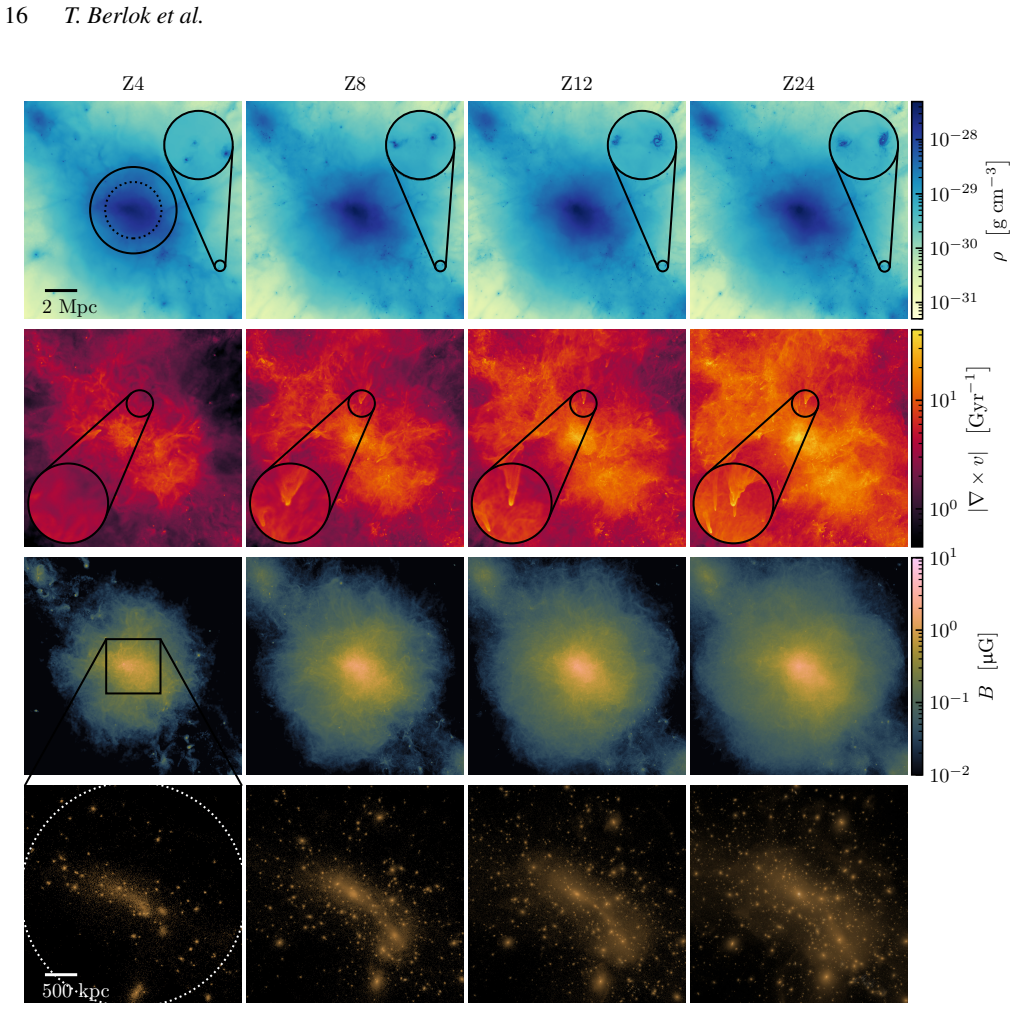


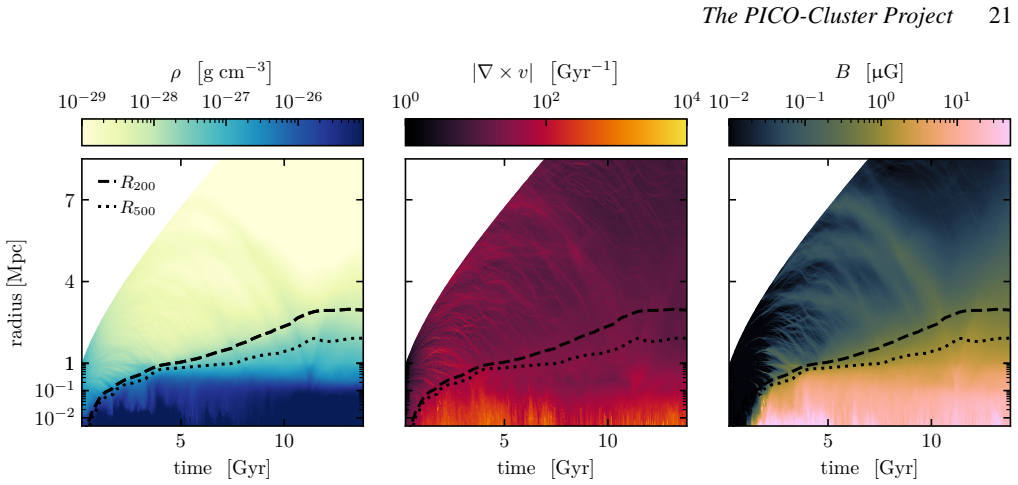


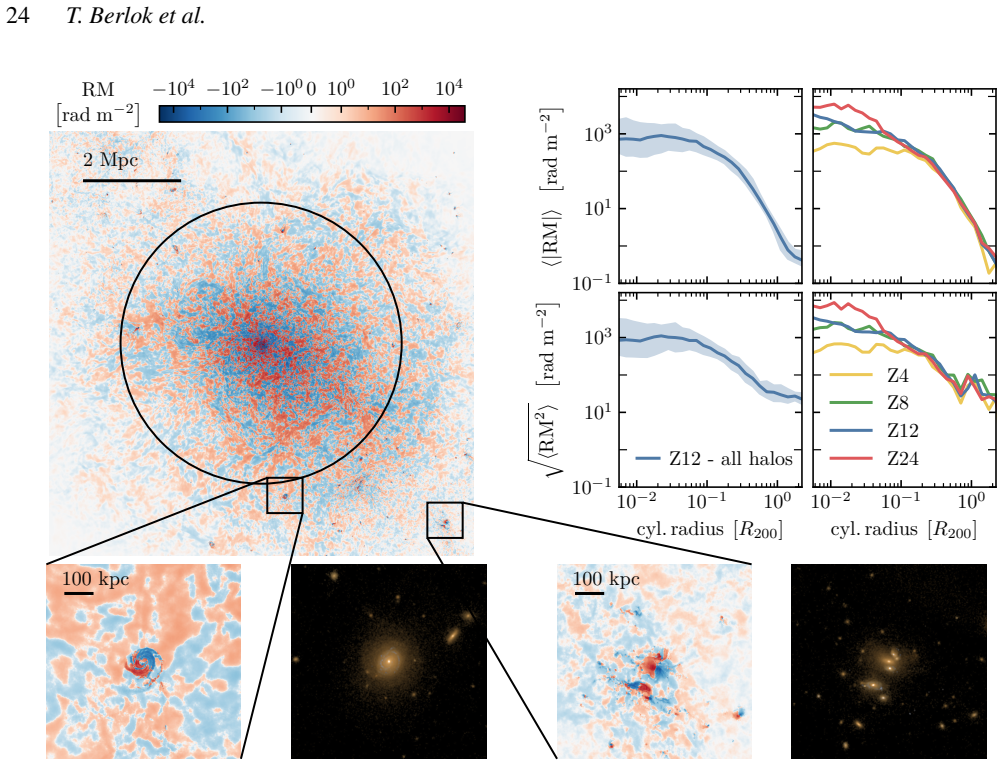


read the original abstract
Galaxy clusters constitute a microcosm of the Universe and offer a unique laboratory for studying plasma astrophysics, encompassing processes such as cosmic-ray acceleration and non-thermal radio emission, turbulence, weakly collisional plasma physics, and transformative mechanisms in galaxy evolution. To investigate these phenomena, we introduce the PICO-Cluster project, studying 'Plasmas In COsmological Clusters' using a suite of high-resolution cosmological zoom-in simulations of massive galaxy clusters with masses $\gtrsim10^{15}$M$_\odot$ selected from a parent simulation box with a comoving side length of 1 $h^{-1}$Gpc. In this work, we present 24 baseline simulations performed with the moving-mesh AREPO code and the IllustrisTNG galaxy formation model, achieving a baryonic mass resolution of up to $1.4\times10^{6}\mathrm{M}_\odot$. The initial conditions are carefully designed to exclude low-resolution particle contamination within the high-resolution region; as a result, all clusters remain free of such contamination out to at least 2.7 $R_{200}$ at all times. Our galaxy and cluster properties agree with recent simulations and many observational constraints, including scaling relations and thermodynamic profiles. The magnetic energy within the cluster is numerically converged once the small-scale dynamo has saturated, yielding a remarkably tight volume-averaged plasma-beta of $\beta\approx100$ inside $R_{200}$ across our sample after redshift $z\sim1.2$. Faraday rotation measure profiles, which trace the line-of-sight magnetic field and electron density, decline with cylindrical radius; notably, the mean decreases more rapidly than the root-mean-square due to the increasing relative contribution of galaxies at larger radii. Finally, viscous heating rates in Braginskii theory are highly intermittent and, on average, approach radiative cooling rates in the cluster outskirts.
Editorial analysis
A structured set of objections, weighed in public.
Referee Report
Summary. The manuscript introduces the PICO-Cluster project, a suite of 24 cosmological zoom-in simulations of massive galaxy clusters (M ≳ 10^15 M⊙) selected from a 1 h^{-1} Gpc parent box and evolved with AREPO plus the IllustrisTNG model at baryonic mass resolution 1.4×10^6 M⊙. Initial conditions are constructed to eliminate low-resolution particle contamination inside the high-resolution region. The paper reports that cluster and galaxy properties match observational scaling relations and thermodynamic profiles, that magnetic energy saturates with numerical convergence to a tight volume-averaged plasma β ≈ 100 inside R200 after z ∼ 1.2, that Faraday rotation-measure profiles decline with cylindrical radius (mean falling faster than rms), and that Braginskii viscous heating is spatially intermittent yet averages to levels comparable to radiative cooling in the outskirts.
Significance. If the numerical convergence of the small-scale dynamo at the stated resolution is demonstrated, the reported tight β value across a statistically useful sample would supply a reproducible benchmark for magnetic-field amplification and its observational tracers in clusters, directly informing models of Faraday rotation and weakly collisional plasma heating.
major comments (2)
- [Abstract] Abstract: the statement that magnetic energy 'is numerically converged once the small-scale dynamo has saturated' and that the chosen baryonic mass resolution 'is sufficient' is presented without any supporting resolution-comparison runs, magnetic Reynolds-number estimates, or cell-size convergence diagnostics. Because the reported β ≈ 100 and its sample-to-sample tightness rest on this claim, the absence of such tests is load-bearing.
- [Abstract] Abstract and methods description of initial conditions: the assertion that 'all clusters remain free of such contamination out to at least 2.7 R200 at all times' is stated without quantitative verification (e.g., time evolution of the contamination radius or a table of minimum contamination distances for the 24 objects). This underpins the reliability of the high-resolution region used for all reported magnetic and heating diagnostics.
minor comments (2)
- [Abstract] Clarify whether the quoted baryonic mass resolution of 1.4×10^6 M⊙ applies uniformly to all 24 runs or whether some achieve 'up to' this value.
- [Abstract] The abstract refers to 'the mean' and 'root-mean-square' of the RM profiles without specifying whether these are volume-weighted, mass-weighted, or line-of-sight averaged quantities; add a brief definition when first introduced.
Simulated Author's Rebuttal
We thank the referee for their careful reading of the manuscript and for highlighting these two points in the abstract. We address each comment below and will revise the manuscript accordingly to provide the requested supporting material.
read point-by-point responses
-
Referee: [Abstract] Abstract: the statement that magnetic energy 'is numerically converged once the small-scale dynamo has saturated' and that the chosen baryonic mass resolution 'is sufficient' is presented without any supporting resolution-comparison runs, magnetic Reynolds-number estimates, or cell-size convergence diagnostics. Because the reported β ≈ 100 and its sample-to-sample tightness rest on this claim, the absence of such tests is load-bearing.
Authors: We agree that the abstract claim would be strengthened by explicit supporting diagnostics. The manuscript demonstrates saturation of magnetic energy and a tight β distribution across the 24 clusters, but does not include dedicated resolution-comparison runs or Reynolds-number estimates. We will add a new subsection (likely in Section 3 or 4) presenting resolution tests at multiple baryonic mass resolutions, magnetic Reynolds-number estimates based on the adopted viscosity and cell sizes, and cell-size convergence diagnostics for the saturated magnetic field. These additions will directly support the abstract statement. revision: yes
-
Referee: [Abstract] Abstract and methods description of initial conditions: the assertion that 'all clusters remain free of such contamination out to at least 2.7 R200 at all times' is stated without quantitative verification (e.g., time evolution of the contamination radius or a table of minimum contamination distances for the 24 objects). This underpins the reliability of the high-resolution region used for all reported magnetic and heating diagnostics.
Authors: We agree that quantitative verification is needed to substantiate the claim. The initial-condition construction is described in the methods, but the manuscript does not provide a table or time-series plot of contamination radii. We will add a supplementary table listing, for each of the 24 clusters, the minimum distance to low-resolution particles as a function of redshift (or at key epochs), together with a brief description confirming that the high-resolution region remains uncontaminated out to at least 2.7 R200 at all times. revision: yes
Circularity Check
No circularity: simulation outputs are direct numerical results compared to external constraints
full rationale
The paper reports direct outputs from AREPO+IllustrisTNG zoom-in simulations (magnetic energy saturation, β≈100 inside R200, RM profiles, Braginskii heating rates). These quantities are not obtained by fitting parameters to subsets of the same data and relabeling them as predictions, nor by self-definitional equations, nor by load-bearing self-citations whose content reduces to the present claims. Galaxy/cluster properties are stated to agree with external observations and other simulations; the resolution choice is asserted as sufficient but the reported β value itself is an independent simulation product, not a tautology.
Axiom & Free-Parameter Ledger
free parameters (2)
- baryonic mass resolution =
1.4e6 solar masses
- parent simulation box size =
1 h^{-1} Gpc
axioms (2)
- domain assumption The IllustrisTNG galaxy formation model supplies the correct subgrid physics for magnetic field amplification and gas thermodynamics in clusters.
- domain assumption The moving-mesh AREPO code accurately evolves ideal MHD plus Braginskii viscosity at the stated resolution.
Reference graph
Works this paper leans on
-
[1]
Ackermann M., et al., 2010, @doi [ ] 10.1088/2041-8205/717/1/L71 , https://ui.adsabs.harvard.edu/abs/2010ApJ...717L..71A 717, L71
-
[2]
Ackermann M., et al., 2014, @doi [ ] 10.1088/0004-637X/787/1/18 , https://ui.adsabs.harvard.edu/abs/2014ApJ...787...18A 787, 18
-
[3]
Ahnen M. L., et al., 2016, @doi [ ] 10.1051/0004-6361/201527846 , https://ui.adsabs.harvard.edu/abs/2016A&A...589A..33A 589, A33
-
[4]
Aleksi \'c J., et al., 2012, @doi [ ] 10.1051/0004-6361/201118502 , https://ui.adsabs.harvard.edu/abs/2012A&A...541A..99A 541, A99
-
[5]
Alonso-L \'o pez D., et al., 2026, @doi [ ] 10.1051/0004-6361/202556287 , https://ui.adsabs.harvard.edu/abs/2026A&A...705A.143A 705, A143
-
[6]
Arlen T., et al., 2012, @doi [ ] 10.1088/0004-637X/757/2/123 , https://ui.adsabs.harvard.edu/abs/2012ApJ...757..123A 757, 123
-
[7]
Ayromlou M., Nelson D., Pillepich A., 2023, @doi [ ] 10.1093/mnras/stad2046 , https://ui.adsabs.harvard.edu/abs/2023MNRAS.524.5391A 524, 5391
-
[8]
Bale S. D., Kasper J. C., Howes G. G., Quataert E., Salem C., Sundkvist D., 2009, @doi [ ] 10.1103/PhysRevLett.103.211101 , https://ui.adsabs.harvard.edu/abs/2009PhRvL.103u1101B 103, 211101
-
[9]
Barnes J., Hut P., 1986, @doi [ ] 10.1038/324446a0 , https://ui.adsabs.harvard.edu/abs/1986Natur.324..446B 324, 446
-
[10]
Barnes D. J., et al., 2017, @doi [ ] 10.1093/mnras/stx1647 , https://ui.adsabs.harvard.edu/abs/2017MNRAS.471.1088B 471, 1088
-
[11]
Bassini L., et al., 2020, @doi [ ] 10.1051/0004-6361/202038396 , https://ui.adsabs.harvard.edu/abs/2020A&A...642A..37B 642, A37
-
[12]
Basu K., 2012, @doi [ ] 10.1111/j.1745-3933.2012.01217.x , https://ui.adsabs.harvard.edu/abs/2012MNRAS.421L.112B 421, L112
-
[13]
Battaglia N., Bond J. R., Pfrommer C., Sievers J. L., 2012, @doi [ ] 10.1088/0004-637X/758/2/74 , https://ui.adsabs.harvard.edu/abs/2012ApJ...758...74B 758, 74
-
[14]
Beattie J. R., Federrath C., Kriel N., Mocz P., Seta A., 2023, @doi [ ] 10.1093/mnras/stad1863 , https://ui.adsabs.harvard.edu/abs/2023MNRAS.524.3201B 524, 3201
-
[15]
Becker M. R., Kravtsov A. V., 2011, @doi [ ] 10.1088/0004-637X/740/1/25 , https://ui.adsabs.harvard.edu/abs/2011ApJ...740...25B 740, 25
-
[16]
Berkhuijsen E., Fletcher A., 2012, @doi [EAS Publications Series] 10.1051/eas/1256039 , 56, 243–246
-
[17]
Berkhuijsen E. M., Fletcher A., 2015, @doi [ ] 10.1093/mnras/stv132 , https://ui.adsabs.harvard.edu/abs/2015MNRAS.448.2469B 448, 2469
-
[18]
Berlok T., 2022, @doi [ ] 10.1093/mnras/stac1882 , https://ui.adsabs.harvard.edu/abs/2022MNRAS.515.3492B 515, 3492
-
[19]
Berlok T., Pessah M. E., 2015, @doi [ ] 10.1088/0004-637X/813/1/22 , https://ui.adsabs.harvard.edu/abs/2015ApJ...813...22B 813, 22
-
[20]
Berlok T., Pessah M. E., 2016, @doi [ ] 10.3847/1538-4357/833/2/164 , https://ui.adsabs.harvard.edu/abs/2016ApJ...833..164B 833, 164
-
[21]
Berlok T., Pfrommer C., 2019, @doi [ ] 10.1093/mnras/stz379 , https://ui.adsabs.harvard.edu/abs/2019MNRAS.485..908B 485, 908
-
[22]
Berlok T., Pakmor R., Pfrommer C., 2020, @doi [ ] 10.1093/mnras/stz3115 , https://ui.adsabs.harvard.edu/abs/2020MNRAS.491.2919B 491, 2919
-
[23]
Berlok T., Jlassi L., Puchwein E., Haugb lle T., 2024, @doi [The Journal of Open Source Software] 10.21105/joss.06296 , https://ui.adsabs.harvard.edu/abs/2024JOSS....9.6296B 9, 6296
-
[24]
Bigwood L., et al., 2024, @doi [ ] 10.1093/mnras/stae2100 , https://ui.adsabs.harvard.edu/abs/2024MNRAS.534..655B 534, 655
-
[25]
Bondi H., 1952, @doi [ ] 10.1093/mnras/112.2.195 , https://ui.adsabs.harvard.edu/abs/1952MNRAS.112..195B 112, 195
-
[26]
Bondi H., Hoyle F., 1944, @doi [ ] 10.1093/mnras/104.5.273 , https://ui.adsabs.harvard.edu/abs/1944MNRAS.104..273B 104, 273
-
[27]
Borrow J., Vogelsberger M., O'Neil S., McDonald M. A., Smith A., 2023, @doi [ ] 10.1093/mnras/stad045 , https://ui.adsabs.harvard.edu/abs/2023MNRAS.520..649B 520, 649
-
[28]
B \"o ss L. M., Steinwandel U. P., Dolag K., 2023, @doi [ ] 10.3847/2041-8213/ad03f7 , https://ui.adsabs.harvard.edu/abs/2023ApJ...957L..16B 957, L16
-
[29]
I., 1965, Reviews of Plasma Physics, https://ui.adsabs.harvard.edu/abs/1965RvPP....1..205B 1, 205
Braginskii S. I., 1965, Reviews of Plasma Physics, https://ui.adsabs.harvard.edu/abs/1965RvPP....1..205B 1, 205
1965
-
[30]
Brough S., et al., 2024, @doi [ ] 10.1093/mnras/stad3810 , https://ui.adsabs.harvard.edu/abs/2024MNRAS.528..771B 528, 771
-
[31]
Br \"u ggen M., Kaiser C. R., 2002, @doi [ ] 10.1038/nature00857 , https://ui.adsabs.harvard.edu/abs/2002Natur.418..301B 418, 301
-
[32]
Brunetti G., Jones T. W., 2014, @doi [International Journal of Modern Physics D] 10.1142/S0218271814300079 , https://ui.adsabs.harvard.edu/abs/2014IJMPD..2330007B 23, 1430007
-
[33]
Brunetti G., Cassano R., Dolag K., Setti G., 2009, @doi [ ] 10.1051/0004-6361/200912751 , https://ui.adsabs.harvard.edu/abs/2009A&A...507..661B 507, 661
-
[34]
K., 2019, @doi [New Journal of Physics] 10.1088/1367-2630/ab0756 , 21, 043004
Buaria D., Pumir A., Bodenschatz E., Yeung P. K., 2019, @doi [New Journal of Physics] 10.1088/1367-2630/ab0756 , 21, 043004
-
[35]
Buck T., Pfrommer C., Girichidis P., Corobean B., 2022, @doi [ ] 10.1093/mnras/stac952 , https://ui.adsabs.harvard.edu/abs/2022MNRAS.513.1414B 513, 1414
-
[36]
Cavagnolo K. W., Donahue M., Voit G. M., Sun M., 2009, @doi [ ] 10.1088/0067-0049/182/1/12 , https://ui.adsabs.harvard.edu/abs/2009ApJS..182...12C 182, 12
-
[37]
Cen R., 1992, @doi [ ] 10.1086/191630 , https://ui.adsabs.harvard.edu/abs/1992ApJS...78..341C 78, 341
-
[38]
Chabrier G., 2003, @doi [ ] 10.1086/376392 , https://ui.adsabs.harvard.edu/abs/2003PASP..115..763C 115, 763
work page internal anchor Pith review doi:10.1086/376392 2003
-
[39]
Chen C. H. K., Matteini L., Schekochihin A. A., Stevens M. L., Salem C. S., Maruca B. A., Kunz M. W., Bale S. D., 2016, @doi [ ] 10.3847/2041-8205/825/2/L26 , https://ui.adsabs.harvard.edu/abs/2016ApJ...825L..26C 825, L26
-
[40]
Chiu I., et al., 2018, @doi [ ] 10.1093/mnras/sty1284 , https://ui.adsabs.harvard.edu/abs/2018MNRAS.478.3072C 478, 3072
-
[41]
Chiu H.-H. S., Ruszkowski M., Thomas T., Werhahn M., Pfrommer C., 2024, @doi [ ] 10.3847/1538-4357/ad84e9 , https://ui.adsabs.harvard.edu/abs/2024ApJ...976..136C 976, 136
-
[42]
Chiu H. H. S., Ruszkowski M., Werhahn M., Pfrommer C., Thomas T., 2025, @doi [arXiv e-prints] 10.48550/arXiv.2510.03229 , https://ui.adsabs.harvard.edu/abs/2025arXiv251003229C p. arXiv:2510.03229
-
[43]
Churazov E., Br \"u ggen M., Kaiser C. R., B \"o hringer H., Forman W., 2001, @doi [ ] 10.1086/321357 , https://ui.adsabs.harvard.edu/abs/2001ApJ...554..261C 554, 261
-
[44]
Colafrancesco S., Blasi P., 1998, @doi [Astroparticle Physics] 10.1016/S0927-6505(98)00018-8 , https://ui.adsabs.harvard.edu/abs/1998APh.....9..227C 9, 227
-
[45]
Crain R. A., et al., 2015, @doi [ ] 10.1093/mnras/stv725 , https://ui.adsabs.harvard.edu/abs/2015MNRAS.450.1937C 450, 1937
-
[46]
Cuciti V., et al., 2021, @doi [ ] 10.1051/0004-6361/202039208 , https://ui.adsabs.harvard.edu/abs/2021A&A...647A..51C 647, A51
-
[47]
Cuciti V., et al., 2022, @doi [ ] 10.1038/s41586-022-05149-3 , https://ui.adsabs.harvard.edu/abs/2022Natur.609..911C 609, 911
-
[48]
Cuciti V., et al., 2023, @doi [ ] 10.1051/0004-6361/202346755 , https://ui.adsabs.harvard.edu/abs/2023A&A...680A..30C 680, A30
-
[49]
Cui W., et al., 2018, @doi [ ] 10.1093/mnras/sty2111 , https://ui.adsabs.harvard.edu/abs/2018MNRAS.480.2898C 480, 2898
-
[50]
Dav \'e R., Angl \'e s-Alc \'a zar D., Narayanan D., Li Q., Rafieferantsoa M. H., Appleby S., 2019, @doi [ ] 10.1093/mnras/stz937 , https://ui.adsabs.harvard.edu/abs/2019MNRAS.486.2827D 486, 2827
work page internal anchor Pith review doi:10.1093/mnras/stz937 2019
-
[51]
Diesing R., B \"o ss L. M., Caprioli D., 2026, @doi [ ] 10.3847/1538-4357/ae40be , https://ui.adsabs.harvard.edu/abs/2026ApJ...999...54D 999, 54
-
[52]
Drake J. F., et al., 2021, @doi [ ] 10.3847/1538-4357/ac1ff1 , https://ui.adsabs.harvard.edu/abs/2021ApJ...923..245D 923, 245
-
[53]
Dursi L. J., Pfrommer C., 2008, @doi [ ] 10.1086/529371 , https://ui.adsabs.harvard.edu/abs/2008ApJ...677..993D 677, 993
-
[54]
Eckert D., et al., 2016, @doi [ ] 10.1051/0004-6361/201527293 , https://ui.adsabs.harvard.edu/abs/2016A&A...592A..12E 592, A12
-
[55]
Eckert D., et al., 2019, @doi [ ] 10.1051/0004-6361/201833324 , https://ui.adsabs.harvard.edu/abs/2019A&A...621A..40E 621, A40
-
[56]
Eckert D., Gaspari M., Gastaldello F., Le Brun A. M. C., O'Sullivan E., 2021, @doi [Universe] 10.3390/universe7050142 , https://ui.adsabs.harvard.edu/abs/2021Univ....7..142E 7, 142
-
[57]
Edler H. W., et al., 2026, @doi [ ] 10.1051/0004-6361/202558007 , https://ui.adsabs.harvard.edu/abs/2026A&A...706A.240E 706, A240
-
[58]
Ehlert K., Weinberger R., Pfrommer C., Pakmor R., Springel V., 2023, @doi [ ] 10.1093/mnras/stac2860 , https://ui.adsabs.harvard.edu/abs/2023MNRAS.518.4622E 518, 4622
-
[59]
Cluster Radio Relics as a Tracer of Shock Waves of the Large-Scale Structure Formation
En lin T. A., Biermann P. L., Klein U., Kohle S., 1998, @doi [ ] 10.48550/arXiv.astro-ph/9712293 , https://ui.adsabs.harvard.edu/abs/1998A&A...332..395E 332, 395
work page internal anchor Pith review Pith/arXiv arXiv doi:10.48550/arxiv.astro-ph/9712293 1998
-
[60]
En lin T., Pfrommer C., Miniati F., Subramanian K., 2011, @doi [ ] 10.1051/0004-6361/201015652 , https://ui.adsabs.harvard.edu/abs/2011A&A...527A..99E 527, A99
-
[61]
Ettori S., et al., 2019, @doi [ ] 10.1051/0004-6361/201833323 , https://ui.adsabs.harvard.edu/abs/2019A&A...621A..39E 621, A39
-
[62]
Faucher-Gigu \`e re C.-A., Lidz A., Zaldarriaga M., Hernquist L., 2009, @doi [ ] 10.1088/0004-637X/703/2/1416 , https://ui.adsabs.harvard.edu/abs/2009ApJ...703.1416F 703, 1416
-
[63]
Federrath C., Chabrier G., Schober J., Banerjee R., Klessen R. S., Schleicher D. R. G., 2011, @doi [ ] 10.1103/PhysRevLett.107.114504 , https://ui.adsabs.harvard.edu/abs/2011PhRvL.107k4504F 107, 114504
-
[64]
Ghirardini V., et al., 2019, @doi [ ] 10.1051/0004-6361/201833325 , https://ui.adsabs.harvard.edu/abs/2019A&A...621A..41G 621, A41
-
[65]
Ghizzardi S., et al., 2021, @doi [ ] 10.1051/0004-6361/202038501 , https://ui.adsabs.harvard.edu/abs/2021A&A...646A..92G 646, A92
-
[66]
Giocoli C., et al., 2025, @doi [ ] 10.1051/0004-6361/202553871 , https://ui.adsabs.harvard.edu/abs/2025A&A...697A.184G 697, A184
-
[67]
Girelli G., Pozzetti L., Bolzonella M., Giocoli C., Marulli F., Baldi M., 2020, @doi [ ] 10.1051/0004-6361/201936329 , https://ui.adsabs.harvard.edu/abs/2020A&A...634A.135G 634, A135
-
[68]
J., Fo \"e x G., Nilo Castell \'o n J
Gonzalez E. J., Fo \"e x G., Nilo Castell \'o n J. L., Dom \' nguez Romero M. J., Alonso M. V., Garc \' a Lambas D., Moreschi O., Gallo E., 2015, @doi [ ] 10.1093/mnras/stv787 , https://ui.adsabs.harvard.edu/abs/2015MNRAS.452.2225G 452, 2225
-
[69]
Groth F., Valentini M., Steinwandel U. P., Vall \'e s-P \'e rez D., Dolag K., 2025, @doi [ ] 10.1051/0004-6361/202451803 , https://ui.adsabs.harvard.edu/abs/2025A&A...693A.263G 693, A263
-
[70]
Gunn J. E., Gott III J. R., 1972, @doi [ ] 10.1086/151605 , https://ui.adsabs.harvard.edu/abs/1972ApJ...176....1G 176, 1
-
[71]
Guo F., Oh S. P., 2008, @doi [ ] 10.1111/j.1365-2966.2007.12692.x , http://adsabs.harvard.edu/abs/2008MNRAS.384..251G 384, 251
-
[72]
Hadzhiyska B., Ferraro S., Farren G. S., Sailer N., Zhou R., 2025, @doi [ ] 10.1103/mdhz-fgj8 , https://ui.adsabs.harvard.edu/abs/2025PhRvD.112l3507H 112, 123507
-
[73]
Hadzhiyska B., et al., 2026, @doi [arXiv e-prints] 10.48550/arXiv.2604.19745 , https://ui.adsabs.harvard.edu/abs/2026arXiv260419745H p. arXiv:2604.19745
work page internal anchor Pith review Pith/arXiv arXiv doi:10.48550/arxiv.2604.19745 2026
-
[74]
Hahn O., Martizzi D., Wu H.-Y., Evrard A. E., Teyssier R., Wechsler R. H., 2017, @doi [ ] 10.1093/mnras/stx001 , https://ui.adsabs.harvard.edu/abs/2017MNRAS.470..166H 470, 166
-
[75]
Han S., et al., 2026, @doi [ ] 10.1051/0004-6361/202556291 , https://ui.adsabs.harvard.edu/abs/2026A&A...705A.169H 705, A169
-
[76]
Harvey D., Revaz Y., Schaller M., Schneider A., Tregidga E., Vecchi F., 2025, @doi [ ] 10.1051/0004-6361/202555180 , https://ui.adsabs.harvard.edu/abs/2025A&A...703A.112H 703, A112
-
[77]
Heinrich A., Zhuravleva I., Zhang C., Churazov E., Forman W., van Weeren R. J., 2024, @doi [ ] 10.1093/mnras/stae208 , https://ui.adsabs.harvard.edu/abs/2024MNRAS.528.7274H 528, 7274
-
[78]
Henden N. A., Puchwein E., Shen S., Sijacki D., 2018, @doi [ ] 10.1093/mnras/sty1780 , https://ui.adsabs.harvard.edu/abs/2018MNRAS.479.5385H 479, 5385
work page internal anchor Pith review doi:10.1093/mnras/sty1780 2018
-
[79]
Hopkins P. F., Quataert E., Silich E. M., Sayers J., Ponnada S. B., Sands I. S., 2025, @doi [The Open Journal of Astrophysics] 10.33232/001c.154053 , https://ui.adsabs.harvard.edu/abs/2025OJAp....854053H 8, 54053
-
[80]
D., 2013, NRL Plasma Formulary
Huba J. D., 2013, NRL Plasma Formulary. Naval Research Laboratory, Washington, DC, https://library.psfc.mit.edu/catalog/online_pubs/NRL_FORMULARY_13.pdf
2013
discussion (0)
Sign in with ORCID, Apple, or X to comment. Anyone can read and Pith papers without signing in.