Faithful by Construction: Claim-Anchored Attribution for Multi-Document Summarization
Pith reviewed 2026-06-26 07:52 UTC · model grok-4.3
The pith
Multi-document summaries can be built by first extracting atomic claims with source provenance to embed attribution and encourage faithfulness by construction.
A machine-rendered reading of the paper's core claim, the machinery that carries it, and where it could break.
Core claim
CAMS extracts atomic claims with token-level provenance from every source document, clusters equivalent claims across documents while flagging inter-source conflicts, selects a support-aware and salient subset, and rewrites the selection into a summary in which every sentence is anchored to a support-checked claim that links back to one or more source spans; because content is localized before it is realized, the pipeline is attribution-oriented by construction and faithfulness-oriented by construction.
What carries the argument
The atomic claim with token-level provenance, which serves as the intermediate unit carrying attribution information through clustering, selection, and constrained rewriting.
If this is right
- Every summary sentence traces back to one or more source spans via its supporting claim.
- Conflicts between sources are flagged explicitly during the clustering stage.
- Support-aware selection and verification encourage factual faithfulness rather than guaranteeing it.
- Summary quality matches strong end-to-end and span-attribution baselines on MultiNews while citation precision improves substantially.
- Multi-source attribution accuracy rises by roughly two-thirds, with zero-shot transfer observed on WCEP.
Where Pith is reading between the lines
- The explicit separation of claim extraction from rewriting could make it simpler to audit which sources contributed to each part of a summary.
- Users might adjust selection thresholds to control the faithfulness-coverage trade-off that end-to-end models leave implicit.
- The same claim-localization step could be inserted into other generation pipelines that currently produce post-hoc attributions.
- An evaluator-decoupled audit using a separate support model already demonstrates that citation quality can be measured independently of the pipeline itself.
Load-bearing premise
Atomic claims can be extracted reliably with token-level provenance from every source document and that clustering equivalent claims across documents accurately identifies conflicts without introducing extraction or grouping errors.
What would settle it
An evaluation showing that the claim extractor routinely misses key facts from the sources or that clustering merges conflicting claims, producing summaries that omit important information or contain incorrect attributions.
Figures

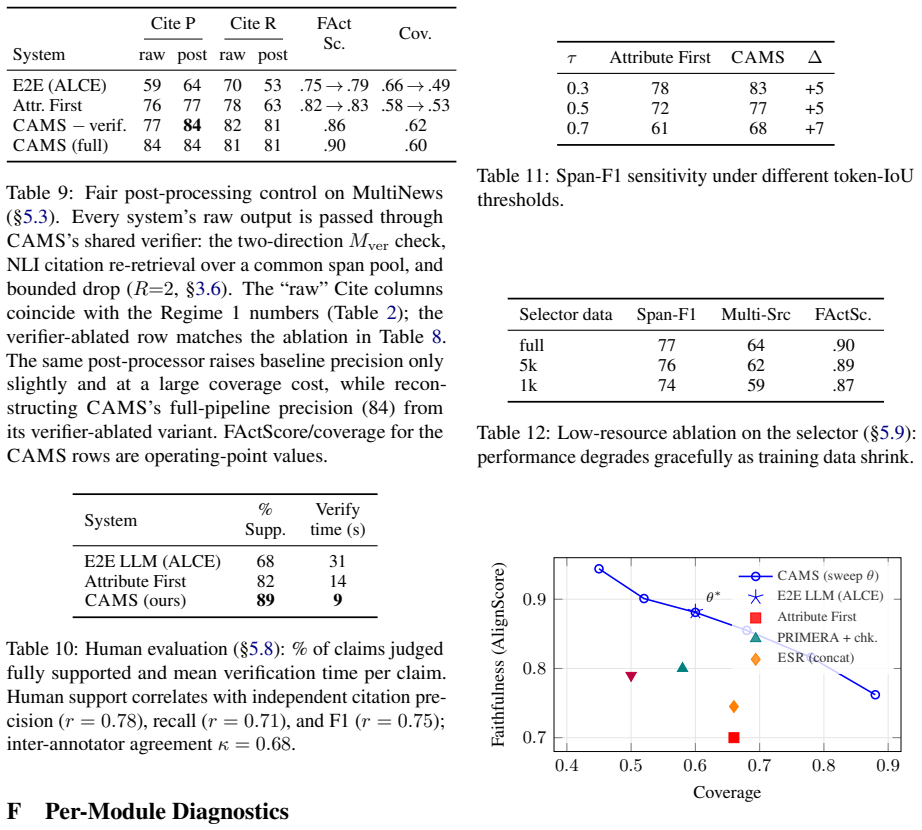
read the original abstract
End-to-end large language models (LLMs) produce fluent multi-document summaries but remain prone to hallucination, and the attributions they offer are typically coarse (whole documents or passages) and generated post hoc, leaving each summary statement hard to verify. We revisit the modular Extract--Select--Rewrite paradigm and recast its intermediate representation as the unit of attribution. We present CAMS, a Claim-Anchored Multi-document Summarization framework that (i) extracts atomic claims with token-level provenance from every source document, (ii) clusters equivalent claims across documents while flagging inter-source conflicts, (iii) selects a support-aware and salient subset, and (iv) rewrites the selection into a summary in which every sentence is anchored to a support-checked claim that links back to one or more source spans. Because content is localized before it is realized, the pipeline is attribution-oriented by construction and faithfulness-oriented by construction: it structurally preserves fine-grained, multi-source traceability while using support-aware selection, constrained rewriting, and verification to encourage, rather than guarantee, factual faithfulness. We evaluate quality, faithfulness, and localization on MultiNews, analyze conflict handling on DiverseSumm, and test zero-shot transfer on WCEP, using a two-regime protocol that separates reference-free citation quality from gold-aligned localization accuracy, and we add an evaluator-decoupled audit that tests citation precision with a support model never used for selection or verification. CAMS matches strong end-to-end and span-attribution baselines on summary quality while substantially improving faithfulness and citation precision, lifting multi-source attribution accuracy by roughly two-thirds, and exposing a controllable faithfulness--coverage trade-off that end-to-end models leave implicit.
Editorial analysis
A structured set of objections, weighed in public.
Referee Report
Summary. The manuscript presents CAMS, a Claim-Anchored Multi-document Summarization framework that recasts the Extract-Select-Rewrite paradigm around atomic claims as the attribution unit. It extracts claims with token-level provenance from all sources, clusters equivalent claims while flagging conflicts, selects a support-aware salient subset, and rewrites the output so every sentence is anchored to a support-checked claim linking back to source spans. The central claim is that localizing content to claims before rewriting renders the pipeline attribution-oriented and faithfulness-oriented by construction (encouraging rather than guaranteeing faithfulness via support-aware selection, constrained rewriting, and verification). Evaluations on MultiNews (quality, faithfulness, localization), DiverseSumm (conflict handling), and WCEP (zero-shot transfer) use a two-regime protocol separating reference-free citation quality from gold-aligned localization accuracy, plus an evaluator-decoupled audit with a held-out support model.
Significance. If the results hold, the work supplies a modular, claim-localized alternative to end-to-end LLM summarization that structurally preserves fine-grained multi-source traceability and improves citation precision and faithfulness metrics while matching baselines on summary quality. The evaluator-decoupled audit and explicit faithfulness-coverage trade-off analysis are notable strengths that address common post-hoc attribution weaknesses.
major comments (1)
- [Abstract (four-stage pipeline description)] Abstract (paragraph describing the four-stage pipeline): the assertion that the pipeline is 'faithfulness-oriented by construction' depends on extraction with token-level provenance and clustering of equivalent claims accurately preserving meaning and detecting conflicts without introducing errors; no quantitative validation, ablation, or error analysis of these steps is referenced, which is load-bearing for the structural argument even when framed as encouragement rather than guarantee.
minor comments (2)
- The two-regime evaluation protocol is mentioned but its separation of reference-free citation quality from gold-aligned localization accuracy would benefit from an explicit definition or pseudocode in the methods section.
- Table or figure captions for the MultiNews and DiverseSumm results should explicitly state whether the reported gains in multi-source attribution accuracy (roughly two-thirds lift) are measured against the same evaluator model used in the decoupled audit.
Simulated Author's Rebuttal
We thank the referee for the positive evaluation and recommendation for minor revision. The single major comment highlights a valid point about the abstract's framing of the pipeline as faithfulness-oriented by construction. We address it directly below.
read point-by-point responses
-
Referee: [Abstract (four-stage pipeline description)] Abstract (paragraph describing the four-stage pipeline): the assertion that the pipeline is 'faithfulness-oriented by construction' depends on extraction with token-level provenance and clustering of equivalent claims accurately preserving meaning and detecting conflicts without introducing errors; no quantitative validation, ablation, or error analysis of these steps is referenced, which is load-bearing for the structural argument even when framed as encouragement rather than guarantee.
Authors: We agree that the abstract's claim would be strengthened by explicit references to supporting analyses of the extraction and clustering stages. The full manuscript provides quantitative validation, ablations, and error analysis for claim extraction (Section 4.1 and Appendix B), clustering accuracy and conflict detection (Section 4.2 and Appendix C), and their downstream impact on faithfulness (Section 5.3). These sections include human-annotated error rates on provenance preservation and inter-annotator agreement on conflict flagging. To address the comment, we will revise the abstract to add a parenthetical reference to these sections, making the load-bearing assumptions traceable without altering the 'encouragement rather than guarantee' framing. revision: yes
Circularity Check
No significant circularity in pipeline description
full rationale
The paper describes a four-stage modular pipeline (claim extraction with provenance, conflict-aware clustering, support-aware selection, constrained rewriting) presented as a new framework rather than a mathematical derivation. No equations, fitted parameters, predictions, or self-citation chains appear in the provided text. The claim that the pipeline is 'attribution-oriented by construction' is a direct consequence of its explicit design choices (localizing content to claims before rewriting), not a reduction of outputs to inputs. This matches the default case of a self-contained methodological contribution with independent content, warranting score 0.
Axiom & Free-Parameter Ledger
axioms (2)
- domain assumption Atomic claims with token-level provenance can be extracted from source documents without substantial information loss or error.
- domain assumption Equivalent claims across documents can be clustered accurately enough to flag genuine inter-source conflicts.
Reference graph
Works this paper leans on
-
[1]
Proceedings of ACL , year=
Multi-News: A Large-Scale Multi-Document Summarization Dataset and Abstractive Hierarchical Model , author=. Proceedings of ACL , year=
-
[2]
Proceedings of ACL , year=
On Faithfulness and Factuality in Abstractive Summarization , author=. Proceedings of ACL , year=
-
[3]
arXiv preprint arXiv:2209.12356 , year=
News Summarization and Evaluation in the Era of GPT-3 , author=. arXiv preprint arXiv:2209.12356 , year=
-
[4]
Proceedings of EMNLP , year=
Enabling Large Language Models to Generate Text with Citations , author=. Proceedings of EMNLP , year=
-
[5]
Attribute First, then Generate: Locally-attributable Grounded Text Generation , author=. Proceedings of the 62nd Annual Meeting of the Association for Computational Linguistics (Volume 1: Long Papers) , pages=. 2024 , address=. doi:10.18653/v1/2024.acl-long.182 , url=
-
[6]
Embrace Divergence for Richer Insights: A Multi-document Summarization Benchmark and a Case Study on Summarizing Diverse Information from News Articles , author=. Proceedings of the 2024 Conference of the North American Chapter of the Association for Computational Linguistics: Human Language Technologies (Volume 1: Long Papers) , pages=. 2024 , address=. ...
-
[7]
Proceedings of the 4th New Frontiers in Summarization Workshop , pages=
Extract, Select and Rewrite: A Modular Sentence Summarization Method , author=. Proceedings of the 4th New Frontiers in Summarization Workshop , pages=. 2023 , address=. doi:10.18653/v1/2023.newsum-1.4 , url=
-
[8]
Measuring Attribution in Natural Language Generation Models , author=
-
[9]
Proceedings of EMNLP , year=
FActScore: Fine-Grained Atomic Evaluation of Factual Precision in Long Form Text Generation , author=. Proceedings of EMNLP , year=
-
[10]
Proceedings of EMNLP , year=
Evaluating the Factual Consistency of Abstractive Text Summarization , author=. Proceedings of EMNLP , year=
-
[11]
Text Summarization Branches Out , year=
ROUGE: A Package for Automatic Evaluation of Summaries , author=. Text Summarization Branches Out , year=
-
[12]
Transactions of the Association for Computational Linguistics , year=
SummaC: Re-Visiting NLI-Based Models for Inconsistency Detection in Summarization , author=. Transactions of the Association for Computational Linguistics , year=
-
[13]
Proceedings of NAACL , year=
QAFactEval: Improved QA-Based Factual Consistency Evaluation for Summarization , author=. Proceedings of NAACL , year=
-
[14]
Proceedings of ACL , year=
AlignScore: Evaluating Factual Consistency with a Unified Alignment Function , author=. Proceedings of ACL , year=
-
[15]
Proceedings of NAACL , year=
TRUE: Re-Evaluating Factual Consistency Evaluation , author=. Proceedings of NAACL , year=
-
[16]
Proceedings of EMNLP , year=
Attributed Question Answering: Evaluation and Modeling for Attributed Large Language Models , author=. Proceedings of EMNLP , year=
-
[17]
Proceedings of ACL , year=
PRIMERA: Pyramid-Based Masked Sentence Pre-Training for Multi-Document Summarization , author=. Proceedings of ACL , year=
-
[18]
Proceedings of SIGIR , year=
The Use of MMR, Diversity-Based Reranking for Reordering Documents and Producing Summaries , author=. Proceedings of SIGIR , year=
-
[19]
Proceedings of ACL-IJCNLP , year=
Leveraging Linguistic Structure For Open Domain Information Extraction , author=. Proceedings of ACL-IJCNLP , year=
-
[20]
Proceedings of ACL-IJCNLP , year=
A Human-Aligned Span-Level Evaluation Framework for Text Summarization , author=. Proceedings of ACL-IJCNLP , year=
-
[21]
arXiv preprint arXiv:2004.05150 , year=
Longformer: The Long-Document Transformer , author=. arXiv preprint arXiv:2004.05150 , year=
Pith/arXiv arXiv 2004
-
[22]
Proceedings of ICLR , year=
BERTScore: Evaluating Text Generation with BERT , author=. Proceedings of ICLR , year=
-
[23]
Proceedings of EMNLP , year=
G-Eval: NLG Evaluation using GPT-4 with Better Human Alignment , author=. Proceedings of EMNLP , year=
-
[24]
2023 , note=
Judging LLM-as-a-Judge with MT-Bench and Chatbot Arena , author=. 2023 , note=
2023
-
[25]
Proceedings of the 58th Annual Meeting of the Association for Computational Linguistics , pages=
A Large-Scale Multi-Document Summarization Dataset from the Wikipedia Current Events Portal , author=. Proceedings of the 58th Annual Meeting of the Association for Computational Linguistics , pages=. 2020 , address=. doi:10.18653/v1/2020.acl-main.120 , url=
-
[26]
Transactions of the Association for Computational Linguistics , volume=
Decontextualization: Making Sentences Stand-Alone , author=. Transactions of the Association for Computational Linguistics , volume=
-
[27]
arXiv preprint arXiv:2308.03281 , year=
Towards General Text Embeddings with Multi-stage Contrastive Learning , author=. arXiv preprint arXiv:2308.03281 , year=
-
[28]
Proceedings of ICLR , year=
DeBERTaV3: Improving DeBERTa using ELECTRA-Style Pre-Training with Gradient-Disentangled Embedding Sharing , author=. Proceedings of ICLR , year=
-
[29]
Proceedings of NAACL , year=
A Broad-Coverage Challenge Corpus for Sentence Understanding through Inference , author=. Proceedings of NAACL , year=
-
[30]
Advances in Neural Information Processing Systems (NeurIPS) , year=
LightGBM: A Highly Efficient Gradient Boosting Decision Tree , author=. Advances in Neural Information Processing Systems (NeurIPS) , year=
-
[31]
Annals of Statistics , volume=
Greedy Function Approximation: A Gradient Boosting Machine , author=. Annals of Statistics , volume=
-
[32]
Proceedings of ACL-IJCNLP , year=
Distant Supervision for Relation Extraction without Labeled Data , author=. Proceedings of ACL-IJCNLP , year=
discussion (0)
Sign in with ORCID, Apple, or X to comment. Anyone can read and Pith papers without signing in.