Aquifer: Hierarchical Memory Pooling with CXL and RDMA for MicroVM Snapshots
Pith reviewed 2026-06-25 23:11 UTC · model grok-4.3
The pith
Aquifer serves MicroVM snapshots from a hierarchical CXL+RDMA pool by splitting hot and cold pages to cut invocation time.
A machine-rendered reading of the paper's core claim, the machinery that carries it, and where it could break.
Core claim
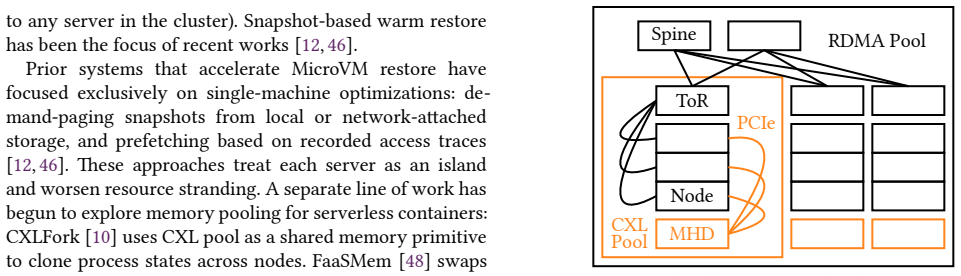
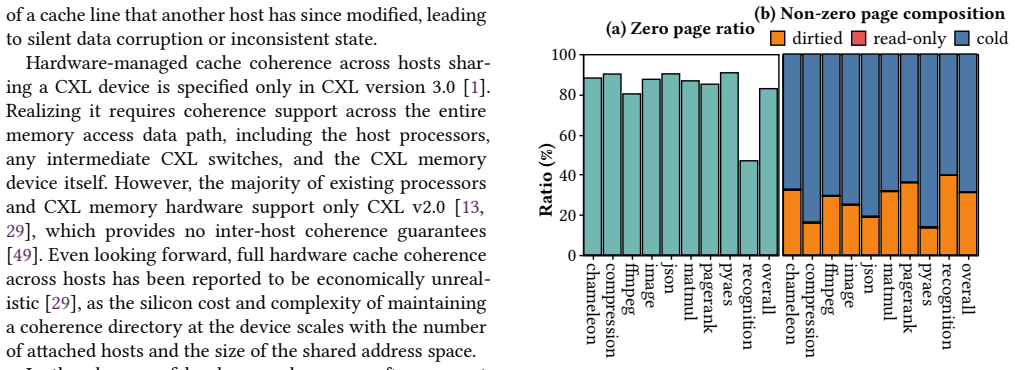
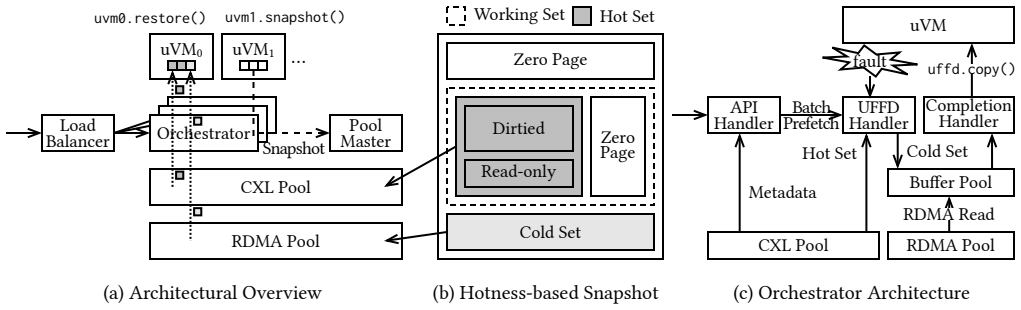
Aquifer is the first system to serve MicroVM snapshots from a hierarchical CXL+RDMA memory pool. A characterization of snapshot images reveals that the vast majority of pages are either zero or cold, enabling a hotness-based snapshot format that eliminates zero pages and places only the hot working set in the CXL pool while storing cold pages in the RDMA pool. Sharing these snapshots across hosts on CXL 2.0 multi-headed devices, which lack hardware cache coherence, requires Aquifer's ownership-based coherence protocol to ensure correctness. Finally, Aquifer uses a copy-based page serving mechanism that pre-installs hot pages from CXL memory before MicroVM resume and demand-pages cold pages a
What carries the argument
Hotness-based snapshot format that drops zero pages and splits remaining pages into a hot working set stored in CXL and cold pages stored in RDMA, paired with an ownership-based coherence protocol for non-coherent multi-headed CXL devices.
If this is right
- Zero pages are removed from the snapshot format, reducing both storage and transfer costs.
- Only the hot working set needs to reside in the low-latency CXL pool while the remainder stays in the higher-capacity RDMA pool.
- An ownership-based protocol maintains correctness when multiple hosts access the same snapshot on CXL 2.0 multi-headed devices without hardware coherence.
- Hot pages are copied into the MicroVM address space before resume while cold pages are fetched asynchronously, overlapping restore with execution.
Where Pith is reading between the lines
- The same hotness split could be applied to other snapshot-based virtualization systems such as containers or full VMs if their page-access patterns show similar skew.
- Cloud operators could reduce total DRAM installed by reclaiming the stranded memory that the paper quantifies at 25-35 percent.
- Future CXL hardware might add lightweight software-visible ownership bits to reduce the protocol overhead that Aquifer currently implements in software.
Load-bearing premise
The vast majority of pages in MicroVM snapshot images are either zero or cold.
What would settle it
A trace of real production MicroVM snapshot images in which more than a small fraction of non-zero pages are accessed frequently enough to defeat the hot/cold split, causing the measured invocation-time improvement to disappear.
Figures

read the original abstract
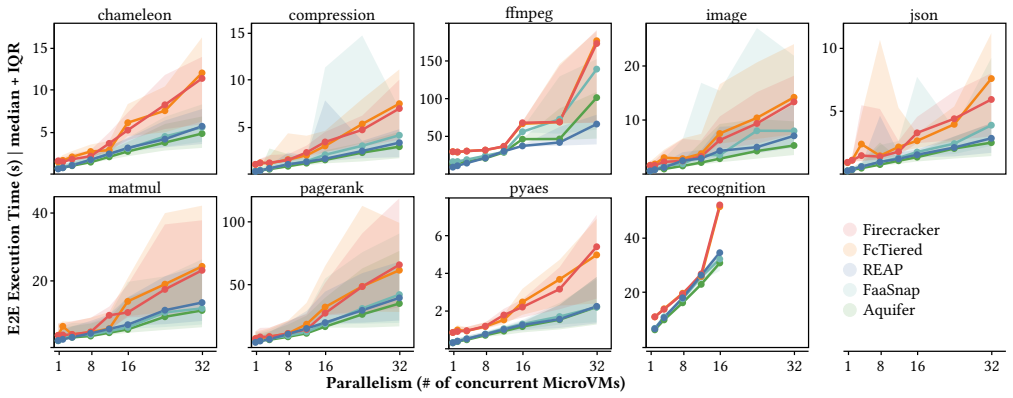
Memory stranding wastes 25-35% of installed DRAM in production cloud clusters. Memory pooling over CXL and RDMA offers a remedy, but neither technology alone suffices: CXL provides low-latency, load/store-transparent access limited to a pod, while RDMA provides cluster-wide reach at higher latency with software overhead. A hierarchical architecture combining both tiers is the practical path forward, yet remains unexplored for MicroVM-based serverless computing, where snapshot restore latency is the dominant cold-start bottleneck. We present Aquifer, the first system to serve MicroVM snapshots from a hierarchical CXL+RDMA memory pool. A characterization of snapshot images reveals that the vast majority of pages are either zero or cold, enabling a hotness-based snapshot format that eliminates zero pages and places only the hot working set in the CXL pool while storing cold pages in the RDMA pool. Sharing these snapshots across hosts on CXL 2.0 multi-headed devices, which lack hardware cache coherence, requires Aquifer's ownership-based coherence protocol to ensure correctness. Finally, Aquifer uses a copy-based page serving mechanism pre-installs hot pages from CXL memory before MicroVM resume and demand-pages cold pages asynchronously from RDMA. On emulated CXL+RDMA hardware, Aquifer achieves a 2.2x geometric-mean speedup in end-to-end invocation time over Firecracker and 1.1x over the next best alternative.
Editorial analysis
A structured set of objections, weighed in public.
Referee Report
Summary. The manuscript introduces Aquifer, the first system to serve MicroVM snapshots from a hierarchical CXL+RDMA memory pool to address memory stranding (25-35%) in cloud clusters. A characterization of snapshot images shows the vast majority of pages are zero or cold, motivating a hotness-based snapshot format that eliminates zero pages, places the hot working set in the CXL pool, and stores cold pages in the RDMA pool. An ownership-based coherence protocol ensures correctness on CXL 2.0 multi-headed devices lacking hardware cache coherence. A copy-based serving mechanism pre-installs hot pages from CXL before MicroVM resume and asynchronously demand-pages cold pages from RDMA. On emulated CXL+RDMA hardware, Aquifer reports a 2.2x geometric-mean speedup in end-to-end invocation time over Firecracker and 1.1x over the next best alternative.
Significance. If the emulation results hold, Aquifer offers a practical path to reduce memory stranding and cold-start latency in serverless MicroVM workloads by combining the low-latency reach of CXL with the cluster-wide scope of RDMA. The work is the first to target this hierarchical architecture for snapshot restore and provides an empirical characterization that directly motivates the design choices. The explicit scoping to emulation results and the concrete speedup numbers are strengths for a systems paper.
minor comments (2)
- [Abstract] Abstract: the phrase 'the next best alternative' is used without naming the system or citing its reference; specify the baseline explicitly for reader clarity.
- The emulation methodology (latency models for CXL and RDMA, hardware configuration details, and how the 2.2x and 1.1x numbers were measured) should be expanded with additional tables or figures to support reproducibility, even if the central claim is scoped to emulation.
Simulated Author's Rebuttal
We thank the referee for their positive assessment of Aquifer, recognition of its novelty as the first system targeting hierarchical CXL+RDMA for MicroVM snapshot serving, and recommendation for minor revision. The review accurately captures the motivation from memory stranding, the hotness-based formatting, ownership coherence, and copy-based serving, along with the reported speedups on emulated hardware.
Circularity Check
No significant circularity
full rationale
The paper is a systems design and evaluation work whose central claims are empirical speedups measured on emulated CXL+RDMA hardware. The snapshot characterization is presented as an independent empirical input that motivates the hotness-based format, not as a fitted parameter or derived quantity. No equations, predictions, self-citation load-bearing steps, uniqueness theorems, or ansatzes appear in the provided text; the ownership protocol and copy-based serving mechanism are described as novel design choices justified by the architecture and measurements rather than by reduction to prior self-citations or definitions. The derivation chain is therefore self-contained against external benchmarks.
Axiom & Free-Parameter Ledger
axioms (1)
- domain assumption Snapshot images have the vast majority of pages that are either zero or cold
invented entities (1)
-
Ownership-based coherence protocol
no independent evidence
Reference graph
Works this paper leans on
-
[1]
Retrieved from https://computeexpressli nk.org/cxl-specification/
CXL Specification. Retrieved from https://computeexpressli nk.org/cxl-specification/
-
[2]
Retrieved from https:// news.skhynix.com/sk-hynix-presents-ai-memory-solutions- at-cxl-devcon-2024/
SK hynix Presents CXL Memory Solutions Set to Power the AI Era at CXL DevCon 2024. Retrieved from https:// news.skhynix.com/sk-hynix-presents-ai-memory-solutions- at-cxl-devcon-2024/
2024
-
[3]
Retrieved from https://www.marvell.com/blogs/ structera-s-scaling-the-ai-memory-wall-with-cxl-switching
Structera S: Scaling the AI Memory Wall with CXL Switching. Retrieved from https://www.marvell.com/blogs/ structera-s-scaling-the-ai-memory-wall-with-cxl-switching. html
-
[4]
Re - trieved from https://learn.microsoft.com/en-us/azure/azure- functions/functions-scale#service-limits
Azure Functions hosting options - Service limits. Re - trieved from https://learn.microsoft.com/en-us/azure/azure- functions/functions-scale#service-limits
-
[5]
Retrieved from https://docs.oasis-open.org/virtio/virtio/v1.4/csprd01/virtio- v1.4-csprd01.pdf
Virtual I/O Device (VIRTIO) Version 1.4. Retrieved from https://docs.oasis-open.org/virtio/virtio/v1.4/csprd01/virtio- v1.4-csprd01.pdf
-
[6]
Mania Abdi, Samuel Ginzburg, Xiayue Charles Lin, Jose Faleiro, Gohar Irfan Chaudhry, Inigo Goiri, Ricardo Bian - chini, Daniel S Berger, and Rodrigo Fonseca. 2023. Palette Load Balancing: Locality Hints for Serverless Functions. In Proceedings of the Eighteenth European Conference on Com - puter Systems (EuroSys '23), 2023. Association for Computing Machi...
arXiv 2023
-
[7]
Alexandru Agache, Marc Brooker, Alexandra Iordache, Anthony Liguori, Rolf Neugebauer, Phil Piwonka, and Diana-Maria Popa. 2020. Firecracker: Lightweight Virtual - ization for Serverless Applications. In 17th USENIX Sympo - sium on Networked Systems Design and Implementation (NSDI 20) , February 2020. USENIX Association, 419–434. Retrieved from https://www...
2020
-
[8]
Marcos K. Aguilera, Nadav Amit, Irina Calciu, Xavier Deguil- lard, Jayneel Gandhi, Stanko Novaković, Arun Ramanathan, Pratap Subrahmanyam, Lalith Suresh, Kiran Tati, Rajesh Venkatasubramanian, and Michael Wei. 2018. Remote re - gions: a simple abstraction for remote memory. In 2018 USENIX Annual Technical Conference (USENIX ATC 18), July
2018
-
[9]
Retrieved from https:// www.usenix.org/conference/atc18/presentation/aguilera
USENIX Association, 775–787. Retrieved from https:// www.usenix.org/conference/atc18/presentation/aguilera
-
[10]
Istemi Ekin Akkus, Ruichuan Chen, Ivica Rimac, Manuel Stein, Klaus Satzke, Andre Beck, Paarijaat Aditya, and Volker Hilt. 2018. SAND: Towards High-Performance Serverless Computing. In 2018 USENIX Annual Technical Conference (USENIX ATC 18) , July 2018. USENIX Association, 923–
2018
-
[11]
Retrieved from https://www.usenix.org/conference/atc 18/presentation/akkus
-
[13]
Aguilera, Aurojit Panda, Sylvia Ratnasamy, and Scott Shenker
Emmanuel Amaro, Christopher Branner-Augmon, Zhihong Luo, Amy Ousterhout, Marcos K. Aguilera, Aurojit Panda, Sylvia Ratnasamy, and Scott Shenker. 2020. Can far memory improve job throughput?. In Proceedings of the Fifteenth Eu - ropean Conference on Computer Systems (EuroSys '20), 2020. Association for Computing Machinery, New York, NY, USA. https://doi.or...
-
[14]
Lixiang Ao, George Porter, and Geoffrey M. Voelker. 2022. FaaSnap: FaaS made fast using snapshot-based VMs. In Proceedings of the Seventeenth European Conference on Com - puter Systems (EuroSys '22), 2022. Association for Computing Machinery, New York, NY, USA, 730–746. https://doi.org/10. 1145/3492321.3524270
arXiv 2022
-
[15]
Berger, Yuhong Zhong, Fiodar Kazhamiaka, Pantea Zardoshti, Shuwei Teng, Mark D
Daniel S. Berger, Yuhong Zhong, Fiodar Kazhamiaka, Pantea Zardoshti, Shuwei Teng, Mark D. Hill, and Rodrigo Fonseca
-
[16]
Retrieved from https://arxiv.org/abs/2501.09020
Octopus: Scalable Low-Cost CXL Memory Pooling. Retrieved from https://arxiv.org/abs/2501.09020
-
[17]
Marc Brooker, Mike Danilov, Chris Greenwood, and Phil Piwonka. 2023. On-demand Container Loading in AWS Lambda. In 2023 USENIX Annual Technical Conference (USENIX ATC 23) , July 2023. USENIX Association, 315–
2023
-
[18]
Retrieved from https://www.usenix.org/conference/atc 23/presentation/brooker
-
[19]
Xiaohu Chai, Tianyu Zhou, Keyang Hu, Jianfeng Tan, Tiwei Bie, Anqi Shen, Dawei Shen, Qi Xing, Shun Song, Tongkai Yang, and others. 2025. Fork in the road: Reflections and optimizations for cold start latency in production serverless systems. In 19th USENIX Symposium on Operating Systems Design and Implementation (OSDI 25), July 2025. USENIX As- sociation,...
2025
-
[20]
Lei Chen, Shi Liu, Chenxi Wang, Haoran Ma, Yifan Qiao, Zhe Wang, Chenggang Wu, Youyou Lu, Xiaobing Feng, Huimin Cui, Shan Lu, and Harry Xu. 2024. A Tale of Two Paths: Toward a Hybrid Data Plane for Efficient Far-Memory Ap - plications. In 18th USENIX Symposium on Operating Systems Design and Implementation (OSDI 24) , July 2024. USENIX Association, 77–95....
2024
-
[21]
Yue Cheng, Ali Anwar, and Xuejing Duan. 2018. Analyzing Alibaba’s Co-located Datacenter Workloads. In 2018 IEEE International Conference on Big Data (Big Data) , 2018. 292–
2018
-
[22]
https://doi.org/10.1109/BigData.2018.8622518
-
[23]
Marcin Copik, Grzegorz Kwasniewski, Maciej Besta, Michal Podstawski, and Torsten Hoefler. 2021. SeBS: a serverless benchmark suite for function-as-a-service computing. In Proceedings of the 22nd International Middleware Conference (Middleware '21), 2021. Association for Computing Machin - ery, New York, NY, USA, 64–78. https://doi.org/ 10.1145/ 3464298.3476133
arXiv 2021
-
[24]
Yaozu Dong, Xiaowei Yang, Xiaoyong Li, Jianhui Li, Kun Tian, and Haibing Guan. 2010. High performance network virtualization with SR-IOV. In 2010 The Sixteenth Interna - tional Symposium on High-Performance Computer Architec - ture (HPCA 16) , 2010. 1–10. https://doi.org/ 10.1109/HPCA. 2010.5416637
-
[25]
Dmitry Duplyakin, Robert Ricci, Aleksander Maricq, Gary Wong, Jonathon Duerig, Eric Eide, Leigh Stoller, Mike Hi - bler, David Johnson, Kirk Webb, Aditya Akella, Kuangching Wang, Glenn Ricart, Larry Landweber, Chip Elliott, Michael Zink, Emmanuel Cecchet, Snigdhaswin Kar, and Prabodh Mishra. 2019. The Design and Operation of CloudLab. In 2019 USENIX Annua...
2019
-
[26]
Padmapriya Duraisamy, Wei Xu, Scott Hare, Ravi Rajwar, David Culler, Zhiyi Xu, Jianing Fan, Christopher Kennelly, Bill McCloskey, Danijela Mijailovic, Brian Morris, Chiranjit Mukherjee, Jingliang Ren, Greg Thelen, Paul Turner, Carlos Villavieja, Parthasarathy Ranganathan, and Amin Vahdat
-
[27]
Towards an Adaptable Systems Architecture for Mem- ory Tiering at Warehouse-Scale. In Proceedings of the 28th ACM International Conference on Architectural Support for Programming Languages and Operating Systems, Volume 3 (ASPLOS '23) , 2023. Association for Computing Machin - ery, New York, NY, USA, 727–741. https://doi.org/ 10.1145/ 3582016.3582031
arXiv 2023
-
[29]
Juncheng Gu, Youngmoon Lee, Yiwen Zhang, Mosharaf Chowdhury, and Kang G. Shin. 2017. Efficient Memory Dis - aggregation with Infiniswap. In 14th USENIX Symposium on Networked Systems Design and Implementation (NSDI 17), March 2017. USENIX Association, 649–667. Retrieved from https://www.usenix.org/conference/nsdi17/technical- sessions/presentation/gu
2017
-
[30]
Chuanxiong Guo, Haitao Wu, Zhong Deng, Gaurav Soni, Jianxi Ye, Jitu Padhye, and Marina Lipshteyn. 2016. RDMA over Commodity Ethernet at Scale. In Proceedings of the 2016 ACM SIGCOMM Conference (SIGCOMM '16), 2016. Associa - tion for Computing Machinery, New York, NY, USA, 202–215. https://doi.org/10.1145/2934872.2934908
-
[31]
Minho Ha, Junhee Ryu, Jungmin Choi, Kwangjin Ko, Sun - woong Kim, Sungwoo Hyun, Donguk Moon, Byungil Koh, Hokyoon Lee, Myoungseo Kim, Hoshik Kim, and Kyoung Park. 2023. Dynamic Capacity Service for Improving CXL Pooled Memory Efficiency. IEEE Micro 43, 2 (March 2023), 39–47. https://doi.org/10.1109/MM.2023.3237756
-
[32]
Junliang Hu, Zhisheng Hu, Chun-Feng Wu, and Ming-Chang Yang. 2025. Demeter: A Scalable and Elastic Tiered Memory Solution for Virtualized Cloud via Guest Delegation. In Pro- ceedings of the ACM SIGOPS 31st Symposium on Operating Systems Principles (SOSP '25), 2025. Association for Comput - ing Machinery, New York, NY, USA, 169–185. https://doi.org/ 10.114...
-
[33]
Zhisheng Hu, Pengfei Zuo, Yizou Chen, Chao Wang, Junliang Hu, and Ming-Chang Yang. 2024. Aceso: Achieving Efficient Fault Tolerance in Memory-Disaggregated Key-Value Stores. In Proceedings of the ACM SIGOPS 30th Symposium on Oper - ating Systems Principles (SOSP '24) , 2024. Association for Computing Machinery, New York, NY, USA, 127–143. https:// doi.org...
-
[34]
Jialiang Huang, MingXing Zhang, Teng Ma, Zheng Liu, Six - ing Lin, Kang Chen, Jinlei Jiang, Xia Liao, Yingdi Shan, Ning Zhang, Mengting Lu, Tao Ma, Haifeng Gong, and YongWei Wu. 2024. TrEnv: Transparently Share Serverless Execution Environments Across Different Functions and Nodes. In Pro- ceedings of the ACM SIGOPS 30th Symposium on Operating Systems Pri...
-
[35]
Yibo Huang, Haowei Chen, Newton Ni, Yan Sun, Vijay Chi - dambaram, Dixin Tang, and Emmett Witchel. 2025. Tigon: A Distributed Database for a CXL Pod. In 19th USENIX Symposium on Operating Systems Design and Implementa - tion (OSDI 25) , July 2025. USENIX Association, 109–128. Retrieved from https://www.usenix.org/conference/osdi25/ presentation/huang-yibo
2025
-
[36]
Jeongchul Kim and Kyungyong Lee. 2019. Practical Cloud Workloads for Serverless FaaS. In Proceedings of the ACM Symposium on Cloud Computing (SoCC '19), 2019. Association for Computing Machinery, New York, NY, USA, 477. https:// doi.org/10.1145/3357223.3365439
-
[37]
Andres Lagar-Cavilla, Junwhan Ahn, Suleiman Souhlal, Neha Agarwal, Radoslaw Burny, Shakeel Butt, Jichuan Chang, Ashwin Chaugule, Nan Deng, Junaid Shahid, Greg Thelen, Kamil Adam Yurtsever, Yu Zhao, and Parthasarathy Ranganathan. 2019. Software-Defined Far Memory in Ware- house-Scale Computers. In Proceedings of the Twenty-Fourth International Conference o...
2019
-
[38]
https://doi.org/10.1145/3297858.3304053
Association for Computing Machinery, New York, NY, USA, 317–330. https://doi.org/10.1145/3297858.3304053
-
[39]
Yuqiao Lan, Xiaohui Peng, and Yifan Wang. 2024. Snapipeline: Accelerating Snapshot Startup for FaaS Con - tainers. In Proceedings of the 2024 ACM Symposium on Cloud Computing (SoCC '24) , 2024. Association for Computing Machinery, New York, NY, USA, 144–159. https://doi.org/10. 1145/3698038.3698513
arXiv 2024
-
[40]
Nikita Lazarev, Varun Gohil, James Tsai, Andy Anderson, Bhushan Chitlur, Zhiru Zhang, and Christina Delimitrou
-
[41]
In 18th USENIX Symposium on Operating Systems Design and Implementation (OSDI 24), July
Sabre: Hardware-Accelerated Snapshot Compression for Serverless MicroVMs. In 18th USENIX Symposium on Operating Systems Design and Implementation (OSDI 24), July
-
[42]
Retrieved from https:// www.usenix.org/conference/osdi24/presentation/lazarev
USENIX Association, 1–18. Retrieved from https:// www.usenix.org/conference/osdi24/presentation/lazarev
-
[43]
Philip Levis, Kun Lin, and Amy Tai. 2023. A Case Against CXL Memory Pooling. In Proceedings of the 22nd ACM Workshop on Hot Topics in Networks (HotNets '23) , 2023. Association for Computing Machinery, New York, NY, USA, 18–24. https://doi.org/10.1145/3626111.3628195
-
[44]
Huaicheng Li, Daniel S. Berger, Lisa Hsu, Daniel Ernst, Pantea Zardoshti, Stanko Novakovic, Monish Shah, Samir Rajadnya, Scott Lee, Ishwar Agarwal, Mark D. Hill, Marcus Fontoura, and Ricardo Bianchini. 2023. Pond: CXL-Based Memory Pooling Systems for Cloud Platforms. In Proceedings of the 28th ACM International Conference on Architectural Support for Prog...
arXiv 2023
-
[45]
Berger, Marie Nguyen, Xun Jian, Sam H
Jinshu Liu, Hamid Hadian, Yuyue Wang, Daniel S. Berger, Marie Nguyen, Xun Jian, Sam H. Noh, and Huaicheng Li
-
[46]
Systematic CXL Memory Characterization and Perfor - mance Analysis at Scale. In Proceedings of the 30th ACM Inter- national Conference on Architectural Support for Programming Languages and Operating Systems, Volume 2 . Association for Computing Machinery, New York, NY, USA, 1203–1217. Retrieved from https://doi.org/10.1145/3676641.3715987
-
[47]
Haoran Ma, Yifan Qiao, Shi Liu, Shan Yu, Yuanjiang Ni, Qingda Lu, Jiesheng Wu, Yiying Zhang, Miryung Kim, and Harry Xu. 2024. DRust: Language-Guided Distributed Shared Memory with Fine Granularity, Full Transparency, and Ultra Efficiency. In 18th USENIX Symposium on Operating Systems Design and Implementation (OSDI 24), July 2024. USENIX As- sociation, 97...
2024
-
[48]
Ashraf Mahgoub, Edgardo Barsallo Yi, Karthick Shankar, Sameh Elnikety, Somali Chaterji, and Saurabh Bagchi. 2022. ORION and the Three Rights: Sizing, Bundling, and Pre - warming for Serverless DAGs. In 16th USENIX Symposium on Operating Systems Design and Implementation (OSDI 22), July
2022
-
[49]
Retrieved from https:// www.usenix.org/conference/osdi22/presentation/mahgoub
USENIX Association, 303–320. Retrieved from https:// www.usenix.org/conference/osdi22/presentation/mahgoub
-
[50]
Antoine Murat, Clément Burgelin, Athanasios Xygkis, Igor Zablotchi, Marcos Kawazoe Aguilera, and Rachid Guerraoui
-
[51]
In Proceedings of the ACM SIGOPS 30th Symposium on Operating Systems Principles (SOSP '24), 2024
SWARM: Replicating Shared Disaggregated-Memory Data in No Time. In Proceedings of the ACM SIGOPS 30th Symposium on Operating Systems Principles (SOSP '24), 2024. Association for Computing Machinery, New York, NY, USA, 24–45. https://doi.org/10.1145/3694715.3695945
-
[52]
Diego Ongaro and John Ousterhout. 2014. In Search of an Understandable Consensus Algorithm. In 2014 USENIX Annual Technical Conference (USENIX ATC 14) , June 2014. USENIX Association, Philadelphia, PA, 305–
2014
-
[53]
Retrieved from https://www.usenix.org/conference/atc 14/technical-sessions/presentation/ongaro
-
[54]
Amanda Raybuck, Tim Stamler, Wei Zhang, Mattan Erez, and Simon Peter. 2021. HeMem: Scalable Tiered Memory Management for Big Data Applications and Real NVM. In Proceedings of the ACM SIGOPS 28th Symposium on Operating Systems Principles (SOSP '21), 2021. Association for Comput - ing Machinery, New York, NY, USA, 392–407. https://doi.org/ 10.1145/3477132.3483550
-
[55]
Aguil - era, and Adam Belay
Zhenyuan Ruan, Malte Schwarzkopf, Marcos K. Aguil - era, and Adam Belay. 2020. AIFM: High-Performance, Application-Integrated Far Memory. In 14th USENIX Sym - posium on Operating Systems Design and Implementation (OSDI 20) , November 2020. USENIX Association, 315–332. Retrieved from https://www.usenix.org/conference/osdi20/ presentation/ruan
2020
-
[56]
Mohammad Shahrad, Rodrigo Fonseca, Inigo Goiri, Gohar Chaudhry, Paul Batum, Jason Cooke, Eduardo Laureano, Colby Tresness, Mark Russinovich, and Ricardo Bianchini
-
[57]
In 2020 USENIX Annual Technical Conference (USENIX ATC 20), July
Serverless in the Wild: Characterizing and Optimizing the Serverless Workload at a Large Cloud Provider. In 2020 USENIX Annual Technical Conference (USENIX ATC 20), July
2020
-
[58]
Retrieved from https:// www.usenix.org/conference/atc20/presentation/shahrad
USENIX Association, 205–218. Retrieved from https:// www.usenix.org/conference/atc20/presentation/shahrad
-
[59]
Jiacheng Shen, Pengfei Zuo, Xuchuan Luo, Yuxin Su, Ji - azhen Gu, Hao Feng, Yangfan Zhou, and Michael R. Lyu
-
[60]
In Proceedings of the 29th Symposium on Operating Systems Principles (SOSP '23), 2023
Ditto: An Elastic and Adaptive Memory-Disaggregated Caching System. In Proceedings of the 29th Symposium on Operating Systems Principles (SOSP '23), 2023. Association for Computing Machinery, New York, NY, USA, 675–691. https:// doi.org/10.1145/3600006.3613144
-
[61]
Donaldson, and John Wickerson
Chengsong Tan, Alastair F. Donaldson, and John Wickerson
-
[62]
Formalising CXL Cache Coherence. In Proceedings of the 30th ACM International Conference on Architectural Support for Programming Languages and Operating Systems, Volume 2. Association for Computing Machinery, New York, NY, USA, 437–450. Retrieved from https://doi.org/10.1145/ 3676641.3715999
-
[63]
Dmitrii Ustiugov, Plamen Petrov, Marios Kogias, Edouard Bugnion, and Boris Grot. 2021. Benchmarking, analysis, and optimization of serverless function snapshots. In Proceedings of the 26th ACM International Conference on Architectural Support for Programming Languages and Operating Systems (ASPLOS '21) , 2021. Association for Computing Machin - ery, New Y...
arXiv 2021
-
[64]
Johannes Weiner, Niket Agarwal, Dan Schatzberg, Leon Yang, Hao Wang, Blaise Sanouillet, Bikash Sharma, Tejun Heo, Mayank Jain, Chunqiang Tang, and Dimitrios Skarlatos
-
[65]
TMO: transparent memory offloading in datacenters. In Proceedings of the 27th ACM International Conference on Architectural Support for Programming Languages and Oper - ating Systems (ASPLOS '22), 2022. Association for Computing Machinery, New York, NY, USA, 609–621. https://doi.org/10. 1145/3503222.3507731
arXiv 2022
-
[66]
Chuhao Xu, Yiyu Liu, Zijun Li, Quan Chen, Han Zhao, Deze Zeng, Qian Peng, Xueqi Wu, Haifeng Zhao, Senbo Fu, and Minyi Guo. 2024. FaaSMem: Improving Memory Efficiency of Serverless Computing with Memory Pool Architecture. In Proceedings of the 29th ACM International Conference on Architectural Support for Programming Languages and Oper - ating Systems, Vol...
-
[67]
Mingxing Zhang, Teng Ma, Jinqi Hua, Zheng Liu, Kang Chen, Ning Ding, Fan Du, Jinlei Jiang, Tao Ma, and Yongwei Wu
-
[68]
In Proceedings of the 29th Symposium on Operating Systems Principles (SOSP '23), 2023
Partial Failure Resilient Memory Management System for (CXL-based) Distributed Shared Memory. In Proceedings of the 29th Symposium on Operating Systems Principles (SOSP '23), 2023. Association for Computing Machinery, New York, NY, USA, 658–674. https://doi.org/10.1145/3600006.3613135
-
[69]
Yanqi Zhang, Íñigo Goiri, Gohar Irfan Chaudhry, Rodrigo Fonseca, Sameh Elnikety, Christina Delimitrou, and Ricardo Bianchini. 2021. Faster and Cheaper Serverless Computing on Harvested Resources. In Proceedings of the ACM SIGOPS 28th Symposium on Operating Systems Principles (SOSP '21),
2021
-
[70]
https://doi.org/10.1145/3477132.3483580
Association for Computing Machinery, New York, NY, USA, 724–739. https://doi.org/10.1145/3477132.3483580
-
[71]
Berger, Carl Waldspurger, Ryan Wee, Ishwar Agarwal, Rajat Agarwal, Frank Hady, Karthik Kumar, Mark D
Yuhong Zhong, Daniel S. Berger, Carl Waldspurger, Ryan Wee, Ishwar Agarwal, Rajat Agarwal, Frank Hady, Karthik Kumar, Mark D. Hill, Mosharaf Chowdhury, and Asaf Cidon
-
[72]
In 18th USENIX Symposium on Operating Systems Design and Implementation (OSDI 24) , July 2024
Managing Memory Tiers with CXL in Virtualized Envi- ronments. In 18th USENIX Symposium on Operating Systems Design and Implementation (OSDI 24) , July 2024. USENIX Association, 37–56. Retrieved from https://www.usenix.org/ conference/osdi24/presentation/zhong-yuhong
2024
discussion (0)
Sign in with ORCID, Apple, or X to comment. Anyone can read and Pith papers without signing in.