Flexible and Stable Dynamics Discovery with Onsager's Variational Principle
Pith reviewed 2026-06-25 22:28 UTC · model grok-4.3
The pith
A variational discretization of Onsager's principle learns uncertain terms in free energy and dissipation from data while guaranteeing unconditional energy stability.
A machine-rendered reading of the paper's core claim, the machinery that carries it, and where it could break.
Core claim
Onsager's variational principle characterizes dissipation-dominated phenomena such as phase separation via extremization of an associated functional. When one or more parts of this functional are empirically approximated or uncertain, a novel variational discretization is introduced that recovers previous work as a special case. A learning problem is then formulated to identify the uncertain terms in the free energy and dissipation potential from observable data. The resulting OVP-based models connect directly to prior work in proximal methods, Sobolev and Wasserstein gradient flows, while remaining provably energy-stable under arbitrarily long rollouts. The approach is illustrated on Allen-
What carries the argument
Minimization of a Rayleighan functional inside a variational discretization of Onsager's variational principle, extended to incorporate data-learned free energy and dissipation terms.
If this is right
- The learned models recover proximal methods and Sobolev and Wasserstein gradient flows as special cases.
- Provable energy stability holds for arbitrarily long rollouts regardless of the learned terms.
- Uncertain elements including bulk free-energy densities, nonlocal potentials, and boundary conditions can be identified using polynomials, shallow neural networks, or spectral kernels.
- The method applies to Allen-Cahn, Fokker-Planck, and Cahn-Hilliard systems while maintaining the variational structure.
Where Pith is reading between the lines
- The same embedding of learning inside the variational step could be tried on time-series data from laboratory experiments rather than synthetic observations.
- Because stability is unconditional, the models might be directly usable inside optimization loops for long-horizon control of dissipative processes.
- Similar variational discretizations might be constructed for other dissipation principles to handle uncertain terms outside the Onsager setting.
Load-bearing premise
Uncertain terms in the free energy and dissipation potential can be identified from observable data in a manner that preserves the unconditional energy stability of the proposed variational discretization.
What would settle it
A long-rollout simulation of a model learned on one of the example systems, such as Cahn-Hilliard, in which the discrete energy increases over time steps would show that the stability guarantee fails to hold after learning.
Figures






read the original abstract
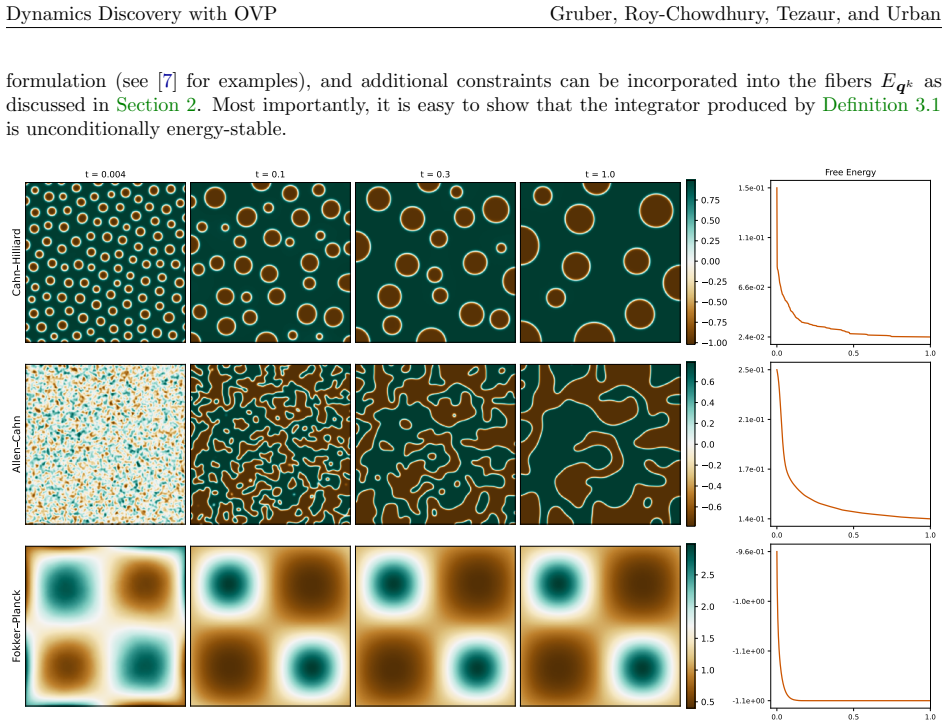
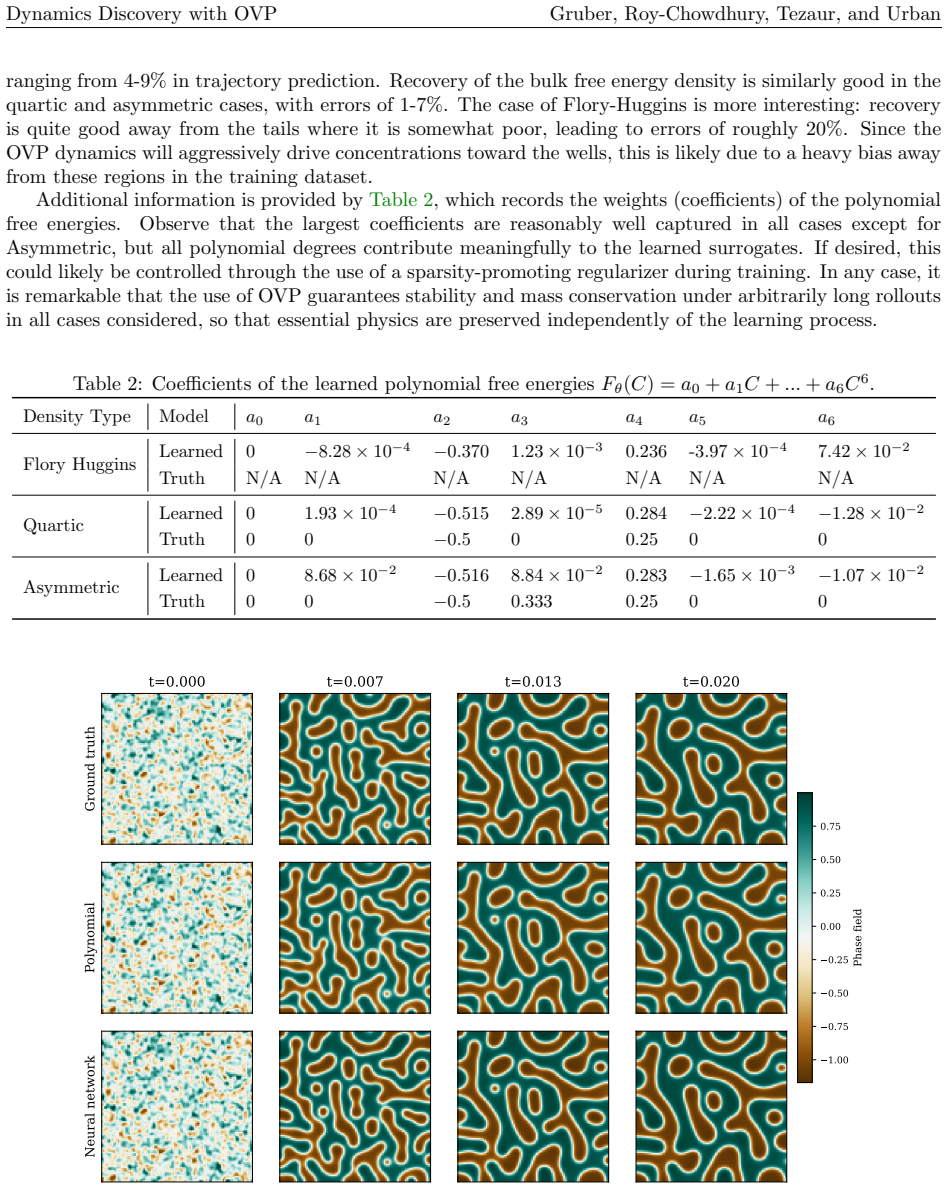
Variational principles specify the dynamics of a physical system via the extremization of associated functional data. Onsager's variational principle (OVP), which characterizes dissipation-dominated phenomena such as phase separation, admits an unconditionally energy-stable time discretization through the minimization of a Rayleighan functional combining free energy and dissipative effects. The present work considers the case where one or more parts of this functional are empirically approximated or otherwise uncertain. To address this, a novel variational discretization of OVP is introduced which recovers previous work as a special case, and a learning problem is formulated which identifies uncertain terms in the free energy and dissipation potential from observable data. It is shown that the resulting OVP-based models connect directly to previous work in terms of proximal methods, Sobolev and Wasserstein gradient flows, while remaining provably energy-stable under arbitrarily long rollouts. The approach is illustrated on examples including Allen-Cahn, Fokker-Planck, and Cahn-Hilliard system models, where the effects of bulk free-energy densities, nonlocal potentials, and nonstandard boundary conditions are effectively learned with model classes consisting of polynomials, shallow neural networks, and spectral convolution kernels.
Editorial analysis
A structured set of objections, weighed in public.
Referee Report
Summary. The paper introduces a variational time discretization of Onsager's variational principle (OVP) for dissipative systems that recovers prior proximal and gradient-flow schemes as special cases. When free-energy and dissipation terms are uncertain, a learning problem is posed to identify them from observable data; the central claim is that the resulting models remain unconditionally energy-stable for arbitrarily long rollouts by construction. Connections to Sobolev/Wasserstein gradient flows are drawn, and the method is illustrated on Allen-Cahn, Fokker-Planck, and Cahn-Hilliard systems with polynomial, neural-network, and spectral-kernel parametrizations of the potentials.
Significance. If the stability preservation under data-driven identification holds rigorously, the work would provide a principled route to stable learned models for phase-separation and transport phenomena, directly linking variational discretizations with modern function approximation. The recovery of existing methods as special cases and the explicit handling of nonlocal potentials and nonstandard boundary conditions are positive features that could facilitate adoption in materials modeling.
major comments (2)
- [§3] §3 (variational discretization): the proof that the learned free-energy and dissipation functionals preserve the unconditional energy stability of the discrete scheme must be stated explicitly; it is not clear from the abstract whether the learning objective is constrained to maintain the variational structure or whether stability follows automatically from the discretization alone.
- [§4] §4 (learning problem): the precise statement of the data-fitting objective (e.g., whether it is a direct regression on observed trajectories or a variational residual) is needed to confirm that it does not introduce terms that could violate the Rayleighian minimization at each step.
minor comments (2)
- [Introduction] The abstract claims recovery of 'previous work as a special case' but does not name the specific discretizations recovered; a brief enumeration in the introduction would improve clarity.
- Notation for the Rayleighian functional and the learned potentials should be introduced once and used consistently; several symbols appear to be overloaded between the continuous and discrete settings.
Simulated Author's Rebuttal
We thank the referee for the positive assessment and recommendation of minor revision. We address each major comment below and will revise the manuscript accordingly to improve clarity.
read point-by-point responses
-
Referee: [§3] §3 (variational discretization): the proof that the learned free-energy and dissipation functionals preserve the unconditional energy stability of the discrete scheme must be stated explicitly; it is not clear from the abstract whether the learning objective is constrained to maintain the variational structure or whether stability follows automatically from the discretization alone.
Authors: The unconditional energy stability is a direct consequence of the variational discretization itself: at each time step the scheme minimizes a Rayleighian that is constructed from the (possibly learned) free-energy and dissipation functionals, and the proof that this minimization yields a discrete energy dissipation law holds for any admissible functionals. The learning problem is posed over parametrizations that enter the Rayleighian linearly or through convex combinations, thereby preserving the variational structure by construction. We agree that an explicit statement and short proof sketch should appear in §3 rather than being left implicit; this will be added in the revision. revision: yes
-
Referee: [§4] §4 (learning problem): the precise statement of the data-fitting objective (e.g., whether it is a direct regression on observed trajectories or a variational residual) is needed to confirm that it does not introduce terms that could violate the Rayleighian minimization at each step.
Authors: The data-fitting objective is formulated as a variational residual that penalizes the mismatch between the observed increments and the minimizer of the discrete Rayleighian; it is not a direct trajectory regression. Because the learned functionals appear only inside the Rayleighian that is subsequently minimized, the resulting scheme remains a valid variational discretization and cannot introduce extraneous terms that would violate the minimization. We will insert the precise mathematical expression of this residual (including the admissible function classes) at the beginning of §4 to make the structure transparent. revision: yes
Circularity Check
No significant circularity detected
full rationale
The provided abstract and reader's summary describe a variational discretization of Onsager's principle that recovers prior work as a special case, followed by a learning problem that identifies uncertain free-energy and dissipation terms directly from observable data while preserving unconditional energy stability by construction of the discretization. No equations, self-citations, or claims are quoted that reduce the stability result or learned models to fitted inputs by definition, nor is there evidence of self-definitional loops, fitted parameters renamed as predictions, or load-bearing uniqueness theorems imported from the same authors. The derivation is presented as self-contained via the variational structure and external data, consistent with a normal non-circular outcome.
Axiom & Free-Parameter Ledger
Reference graph
Works this paper leans on
-
[1]
Efficiently pa- rameterized neural metriplectic systems
Anthony Gruber, Kookjin Lee, Haksoo Lim, Noseong Park, and Nathaniel Trask. Efficiently pa- rameterized neural metriplectic systems. In The Thirteenth International Conference on Learning Representations, 2025
2025
-
[2]
Structure-preserving deep learning
Elena Celledoni, Matthias J Ehrhardt, Christian Etmann, Robert I McLachlan, Brynjulf Owren, C- B Schonlieb, and Ferdia Sherry. Structure-preserving deep learning. European journal of applied mathematics, 32(5):888–936, 2021
2021
-
[3]
Structure-preserving neural ordinary differential equations for stiff systems
Allen Alvarez Loya, Daniel A Serino, JW Burby, and Qi Tang. Structure-preserving neural ordinary differential equations for stiff systems. arXiv preprint arXiv:2503.01775, 2025
-
[4]
Hamiltonian neural networks
Samuel Greydanus, Misko Dzamba, and Jason Yosinski. Hamiltonian neural networks. Advances in neural information processing systems, 32, 2019
2019
-
[5]
Energetic variational neural network discretizations of gradient flows
Ziqing Hu, Chun Liu, Yiwei Wang, and Zhiliang Xu. Energetic variational neural network discretizations of gradient flows. SIAM Journal on Scientific Computing, 46(4):A2528–A2556, 2024
2024
-
[6]
Onsager’s variational principle in soft matter
Masao Doi. Onsager’s variational principle in soft matter. Journal of Physics: Condensed Matter, 23(28):284118, jun 2011
2011
-
[7]
Onsager’s variational principle in soft matter: introduction and application to the dynamics of adsorption of proteins onto fluid membranes
Marino Arroyo, Nikhil Walani, Alejandro Torres-S´ anchez, and Dimitri Kaurin. Onsager’s variational principle in soft matter: introduction and application to the dynamics of adsorption of proteins onto fluid membranes. In The role of mechanics in the study of lipid bilayers, pages 287–332. Springer, 2017
2017
-
[8]
Onsager’s variational principle in active soft matter
Haiqin Wang, Tiezheng Qian, and Xinpeng Xu. Onsager’s variational principle in active soft matter. Soft Matter, 17(13):3634–3653, 2021
2021
-
[9]
Thermodynamic variational principle, its connections to the phenomenological laws and its applications to the derivation of microstructural models
Qiang Du. Thermodynamic variational principle, its connections to the phenomenological laws and its applications to the derivation of microstructural models. Materials Genome Engineering Advances, 2(2):e51, 2024
2024
-
[10]
Onsager’s varia- tional principle for nonreciprocal systems with odd elasticity
Li-Shing Lin, Kento Yasuda, Kenta Ishimoto, Yuto Hosaka, and Shigeyuki Komura. Onsager’s varia- tional principle for nonreciprocal systems with odd elasticity. Journal of the Physical Society of Japan, 92(3):033001, 2023
2023
-
[11]
Dynamics of viscoelastic filaments based on Onsager principle
Jiajia Zhou and Masao Doi. Dynamics of viscoelastic filaments based on Onsager principle. Physical Review Fluids, 3(8):084004, 2018
2018
-
[12]
Hydrodynamic boundary conditions derived from Onsager’s variational principle
Xinpeng Xu and Tiezheng Qian. Hydrodynamic boundary conditions derived from Onsager’s variational principle. Procedia IUTAM, 20:144–151, 2017
2017
-
[13]
The Onsager principle and structure preserving nu- merical schemes
Huangxin Chen, Hailiang Liu, and Xianmin Xu. The Onsager principle and structure preserving nu- merical schemes. Journal of Computational Physics, 523:113679, 2025
2025
-
[14]
Stokes flow of an evolving fluid film with arbitrary shape and topology
Cuncheng Zhu, David Saintillan, and Albert Chern. Stokes flow of an evolving fluid film with arbitrary shape and topology. Journal of Fluid Mechanics, 1003:R1, 2025. 34 Dynamics Discovery with OVP Gruber, Roy-Chowdhury, Tezaur, and Urban
2025
-
[15]
A variational discretization method for mean curvature flows by the Onsager principle
Yihe Liu and Xianmin Xu. A variational discretization method for mean curvature flows by the Onsager principle. arXiv preprint arXiv:2404.11935, 2024
-
[16]
Energy stable and mass conservative numerical method for a generalized hydrodynamic phase-field model with different densities
Jisheng Kou, Xiuhua Wang, Meilan Zeng, and Jianchao Cai. Energy stable and mass conservative numerical method for a generalized hydrodynamic phase-field model with different densities. Physics of Fluids, 32(11), 2020
2020
-
[17]
A moving mesh method for porous medium equation by the Onsager variational principle
Si Xiao and Xianmin Xu. A moving mesh method for porous medium equation by the Onsager variational principle. Journal of Computational Physics, 536:114061, 2025
2025
-
[18]
A thermodynamically consistent phase-field lattice Boltzmann method for two-phase electrohydrodynamic flows
Fang Xiong, Lei Wang, Jiangxu Huang, and Kang Luo. A thermodynamically consistent phase-field lattice Boltzmann method for two-phase electrohydrodynamic flows. Journal of Scientific Computing, 103(1):1–32, 2025
2025
-
[19]
Nonlinear instability in dissipative finite difference schemes
Andrew Stuart. Nonlinear instability in dissipative finite difference schemes. SIAM review, 31(2):191– 220, 1989
1989
-
[20]
A stable and conservative finite difference scheme for the Cahn-Hilliard equation
Daisuke Furihata. A stable and conservative finite difference scheme for the Cahn-Hilliard equation. Numerische Mathematik, 87(4):675–699, 2001
2001
-
[21]
On energy dissipation theory and numerical stability for time- fractional phase-field equations
Tao Tang, Haijun Yu, and Tao Zhou. On energy dissipation theory and numerical stability for time- fractional phase-field equations. SIAM Journal on Scientific Computing, 41(6):A3757–A3778, 2019
2019
-
[22]
Reciprocal relations in irreversible processes
Lars Onsager. Reciprocal relations in irreversible processes. i. Physical review, 37(4):405, 1931
1931
-
[23]
Reciprocal relations in irreversible processes
Lars Onsager. Reciprocal relations in irreversible processes. ii. Physical review, 38(12):2265, 1931
1931
-
[24]
J. W. Strutt. Some general theorems relating to vibrations. Proceedings of the London Mathematical Society, s1-4(1):357–368, 1871
-
[25]
Mathematical foundations of elasticity
Jerrold E Marsden and Thomas JR Hughes. Mathematical foundations of elasticity. Courier Corpora- tion, 1994
1994
-
[26]
The geometry of dissipative evolution equations: the porous medium equation
Felix Otto. The geometry of dissipative evolution equations: the porous medium equation. 2001
2001
-
[27]
Statistical mechanics of lattice systems: a concrete mathematical introduction
Sacha Friedli and Yvan Velenik. Statistical mechanics of lattice systems: a concrete mathematical introduction. Cambridge University Press, 2018
2018
-
[28]
Thermodynamics and an introduction to thermostatistics, 1998
Herbert B Callen and HL Scott. Thermodynamics and an introduction to thermostatistics, 1998
1998
-
[29]
Alexander Mielke, Dora R. ˜M. Renger, and Mark A. Peletier. A generalization of Onsager’s reciprocity relations to gradient flows with nonlinear mobility. Journal of Non-Equilibrium Thermodynamics, 41(2):141–149, 2016
2016
-
[30]
American Mathematical Soc., 2021
C´ edric Villani.Topics in optimal transportation, volume 58. American Mathematical Soc., 2021
2021
-
[31]
Phase-field models for microstructure evolution
Long-Qing Chen. Phase-field models for microstructure evolution. Annual review of materials research, 32(1):113–140, 2002
2002
-
[32]
Phase-field modeling of fracture
Jian-Ying Wu, Vinh Phu Nguyen, Chi Thanh Nguyen, Danas Sutula, Sina Sinaie, and St´ ephane PA Bordas. Phase-field modeling of fracture. Advances in applied mechanics, 53:1–183, 2020
2020
-
[33]
Optimal design of chemoepitaxial guideposts for the directed self-assembly of block copolymer systems using an inexact Newton algorithm
Dingcheng Luo, Lianghao Cao, Peng Chen, Omar Ghattas, and J Tinsley Oden. Optimal design of chemoepitaxial guideposts for the directed self-assembly of block copolymer systems using an inexact Newton algorithm. Journal of Computational Physics, 485:112101, 2023
2023
-
[34]
Self-assembly of diblock copolymers under confinement
An-Chang Shi and Baohui Li. Self-assembly of diblock copolymers under confinement. Soft Matter, 9(5):1398–1413, 2013
2013
-
[35]
Block copolymers: overview and critical survey
Allen Noshay and James E McGrath. Block copolymers: overview and critical survey. 2013. 35 Dynamics Discovery with OVP Gruber, Roy-Chowdhury, Tezaur, and Urban
2013
-
[36]
Weak and strong solutions to the nonhomogeneous incompressible Navier-Stokes-Cahn-Hilliard system
Andrea Giorgini and Roger Temam. Weak and strong solutions to the nonhomogeneous incompressible Navier-Stokes-Cahn-Hilliard system. Journal de Math´ ematiquesPures et Appliqu´ ees, 144:194–249, 2020
2020
-
[37]
The Cahn–Hilliard–Navier–Stokes framework for multiphase fluid flows: laminar, turbulent and active
Nadia Bihari Padhan and Rahul Pandit. The Cahn–Hilliard–Navier–Stokes framework for multiphase fluid flows: laminar, turbulent and active. Journal of Fluid Mechanics, 1010:P1, 2025
2025
-
[38]
Hao Wu. A review on the Cahn-Hilliard equation: classical results and recent advances in dynamic boundary conditions. arXiv preprint arXiv:2112.13812, 2021
-
[39]
Discrete mechanics and variational integrators
Jerrold E Marsden and Matthew West. Discrete mechanics and variational integrators. Acta numerica, 10:357–514, 2001
2001
-
[40]
E. D. Giorgi. Movimenti minimizzanti. In Proceedings of the Conference on Aspetti e problemi della Matematica oggi, Lecce, Italy, 1992
1992
-
[41]
New problems on minimizing movements
Ennio De Giorgi. New problems on minimizing movements. Ennio de Giorgi: selected papers, pages 699–713, 1993
1993
-
[42]
The thresholding scheme for mean curvature flow and de giorgi’s ideas for minimizing movements
Tim Laux and Felix Otto. The thresholding scheme for mean curvature flow and de giorgi’s ideas for minimizing movements. The role of metrics in the theory of partial differential equations, 85:63–94, 2020
2020
-
[43]
Structure-aware variational learning of a class of generalized diffusions, 2026
Yubin Lu, Xiaofan Li, Chun Liu, Qi Tang, and Yiwei Wang. Structure-aware variational learning of a class of generalized diffusions, 2026
2026
-
[44]
Monotone operators and the proximal point algorithm
R Tyrrell Rockafellar. Monotone operators and the proximal point algorithm. SIAM journal on control and optimization, 14(5):877–898, 1976
1976
-
[45]
The developments of proximal point algorithms
Xing-Ju Cai, Ke Guo, Fan Jiang, Kai Wang, Zhong-Ming Wu, and De-Ren Han. The developments of proximal point algorithms. Journal of the Operations Research Society of China, 10(2):197–239, 2022
2022
-
[46]
Tran, Ben S
Brian K. Tran, Ben S. Southworth, David B. Cavender, Sam Olivier, Syed A. Shah, and Tommaso Buvoli. Nonlinear splitting for gradient-based unconstrained and adjoint optimization, 2025
2025
-
[47]
The variational formulation of the Fokker–Planck equation
Richard Jordan, David Kinderlehrer, and Felix Otto. The variational formulation of the Fokker–Planck equation. SIAM journal on mathematical analysis, 29(1):1–17, 1998
1998
-
[48]
OnsagerNet: Learning stable and interpretable dynamics using a generalized Onsager principle
Haijun Yu, Xinyuan Tian, Weinan E, and Qianxiao Li. OnsagerNet: Learning stable and interpretable dynamics using a generalized Onsager principle. Phys. Rev. Fluids, 6:114402, Nov 2021
2021
-
[49]
Variational Onsager neural networks (VONNs): A thermodynamics-based variational learning strategy for non-equilibrium pdes
Shenglin Huang, Zequn He, and Celia Reina. Variational Onsager neural networks (VONNs): A thermodynamics-based variational learning strategy for non-equilibrium pdes. Journal of the Mechanics and Physics of Solids, 163:104856, 2022
2022
-
[50]
Deep learning-based computational method for soft matter dynamics: Deep onsager-machlup method
Zhihao Li, Boyi Zou, Haiqin Wang, Jian Su, Dong Wang, and Xinpeng Xu. Deep learning-based computational method for soft matter dynamics: Deep onsager-machlup method. arXiv preprint arXiv:2308.14513, 2023
-
[51]
The deep Ritz method: A deep learning-based numerical algorithm for solving variational problems
Weinan E and Bing Yu. The deep Ritz method: A deep learning-based numerical algorithm for solving variational problems. Communications in Mathematics and Statistics, 6(1):1–12, 2018
2018
-
[52]
Unsupervised operator learning approach for dissipative equations via Onsager principle, 2025
Zhipeng Chang, Zhenye Wen, and Xiaofei Zhao. Unsupervised operator learning approach for dissipative equations via Onsager principle, 2025
2025
-
[53]
Module-wise training of neural networks via the minimizing movement scheme
Skander Karkar, Ibrahim Ayed, Emmanuel de B´ ezenac, and Patrick Gallinari. Module-wise training of neural networks via the minimizing movement scheme. Advances in Neural Information Processing Systems, 36:53126–53145, 2023
2023
-
[54]
A hybrid minimizing movement and neural network approach to Willmore flow
Martin Rumpf, Josua Sassen, and Christoph Smoch. A hybrid minimizing movement and neural network approach to Willmore flow. arXiv preprint arXiv:2502.14656, 2025. 36 Dynamics Discovery with OVP Gruber, Roy-Chowdhury, Tezaur, and Urban
-
[55]
Large-scale Wasserstein gradient flows
Petr Mokrov, Alexander Korotin, Lingxiao Li, Aude Genevay, Justin M Solomon, and Evgeny Burnaev. Large-scale Wasserstein gradient flows. Advances in Neural Information Processing Systems, 34:15243– 15256, 2021
2021
-
[56]
Optimizing functionals on the space of proba- bilities with input convex neural networks
David Alvarez-Melis, Yair Schiff, and Youssef Mroueh. Optimizing functionals on the space of proba- bilities with input convex neural networks. arXiv preprint arXiv:2106.00774, 2021
-
[57]
Proximal optimal trans- port modeling of population dynamics
Charlotte Bunne, Laetitia Papaxanthos, Andreas Krause, and Marco Cuturi. Proximal optimal trans- port modeling of population dynamics. In International Conference on Artificial Intelligence and Statistics, pages 6511–6528. PMLR, 2022
2022
-
[58]
Input convex neural networks
Brandon Amos, Lei Xu, and J Zico Kolter. Input convex neural networks. In International conference on machine learning, pages 146–155. PMLR, 2017
2017
-
[59]
Normalizing flow neural networks by JKO scheme
Chen Xu, Xiuyuan Cheng, and Yao Xie. Normalizing flow neural networks by JKO scheme. Advances in Neural Information Processing Systems, 36:47379–47405, 2023
2023
-
[60]
Variational inference with normalizing flows
Danilo Rezende and Shakir Mohamed. Variational inference with normalizing flows. In International conference on machine learning, pages 1530–1538. PMLR, 2015
2015
-
[61]
Importance corrected neural JKO sampling
Johannes Hertrich and Robert Gruhlke. Importance corrected neural JKO sampling. arXiv preprint arXiv:2407.20444, 2024
-
[62]
Efficient and modular implicit differentiation
Mathieu Blondel, Quentin Berthet, Marco Cuturi, Roy Frostig, Stephan Hoyer, Felipe Llinares-L´ opez, Fabian Pedregosa, and Jean-Philippe Vert. Efficient and modular implicit differentiation. Advances in neural information processing systems, 35:5230–5242, 2022
2022
-
[63]
Torchopt: An efficient library for differentiable optimization
Jie Ren, Xidong Feng, Bo Liu, Xuehai Pan, Yao Fu, Luo Mai, and Yaodong Yang. Torchopt: An efficient library for differentiable optimization. Journal of Machine Learning Research, 24(367):1–14, 2023
2023
-
[64]
Numerical calculation of time-dependent viscous incompressible flow of fluid with free surface
Francis H Harlow, J Eddie Welch, et al. Numerical calculation of time-dependent viscous incompressible flow of fluid with free surface. Physics of fluids, 8(12):2182, 1965
1965
-
[65]
Computational design of the basic dynamical processes of the UCLA general circulation model
Akio Arakawa and Vivian R Lamb. Computational design of the basic dynamical processes of the UCLA general circulation model. 1977
1977
-
[66]
Physics of active emulsions
Christoph A Weber, David Zwicker, Frank J¨ ulicher, and Chiu Fan Lee. Physics of active emulsions. Reports on Progress in Physics, 82(6):064601, apr 2019
2019
-
[67]
Tsori and D
Y. Tsori and D. Andelman. Diblock copolymer ordering induced by patterned surfaces. Europhysics Letters, 53(6):722, mar 2001
2001
-
[68]
Xiang-Fa Wu and Yuris A. Dzenis. Guided self-assembly of diblock copolymer thin films on chemically patterned substrates. The Journal of Chemical Physics, 125(17):174707, 11 2006
2006
-
[69]
Equilibrium morphology of block copolymer melts
Takao Ohta and Kyozi Kawasaki. Equilibrium morphology of block copolymer melts. Macromolecules, 19(10):2621–2632, 1986
1986
-
[70]
A globally convergent modified Newton method for the direct minimization of the Ohta–Kawasaki energy with application to the directed self-assembly of diblock copolymers
Lianghao Cao, Omar Ghattas, and J Tinsley Oden. A globally convergent modified Newton method for the direct minimization of the Ohta–Kawasaki energy with application to the directed self-assembly of diblock copolymers. SIAM Journal on Scientific Computing, 44(1):B51–B79, 2022
2022
-
[71]
The discrete cosine transform
Gilbert Strang. The discrete cosine transform. SIAM Review, 41(1):135–147, 1999
1999
-
[72]
Fourier Neural Operator for Parametric Partial Differential Equations
Zongyi Li, Nikola Kovachki, Kamyar Azizzadenesheli, Burigede Liu, Kaushik Bhattacharya, Andrew Stuart, and Anima Anandkumar. Fourier neural operator for parametric partial differential equations. arXiv preprint arXiv:2010.08895, 2020. 37
work page internal anchor Pith review Pith/arXiv arXiv 2010
discussion (0)
Sign in with ORCID, Apple, or X to comment. Anyone can read and Pith papers without signing in.