Dust destruction signals shock-accelerated outflows in the nearby active galaxy NGC 1068
Pith reviewed 2026-06-26 05:22 UTC · model grok-4.3
The pith
Outflows in NGC 1068 are accelerated by fast shocks that destroy dust and compress the gas.
A machine-rendered reading of the paper's core claim, the machinery that carries it, and where it could break.
Core claim
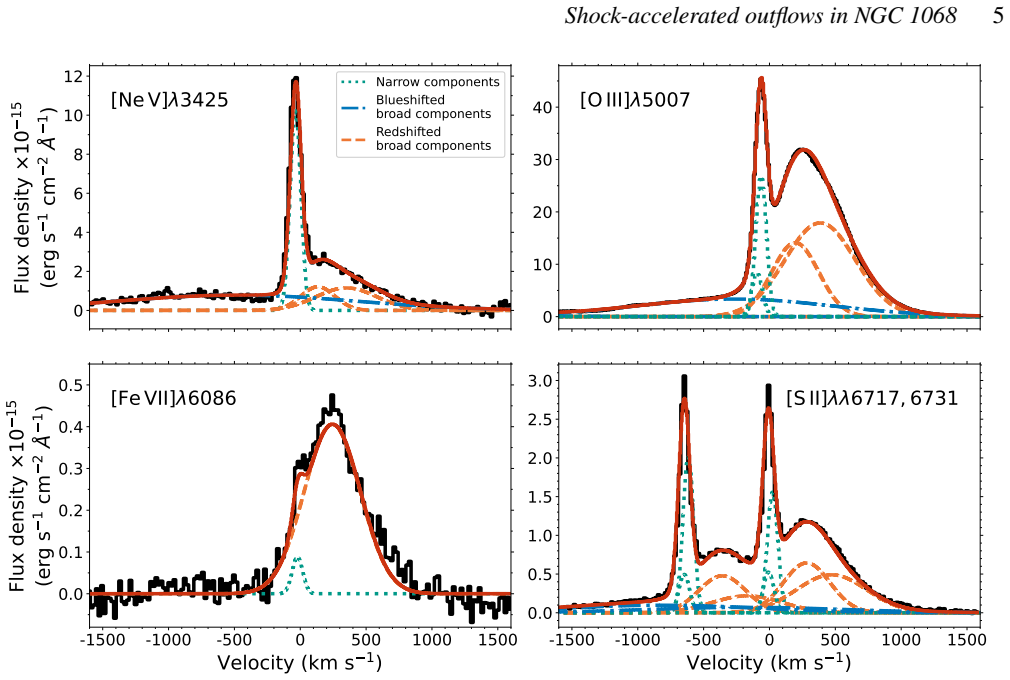
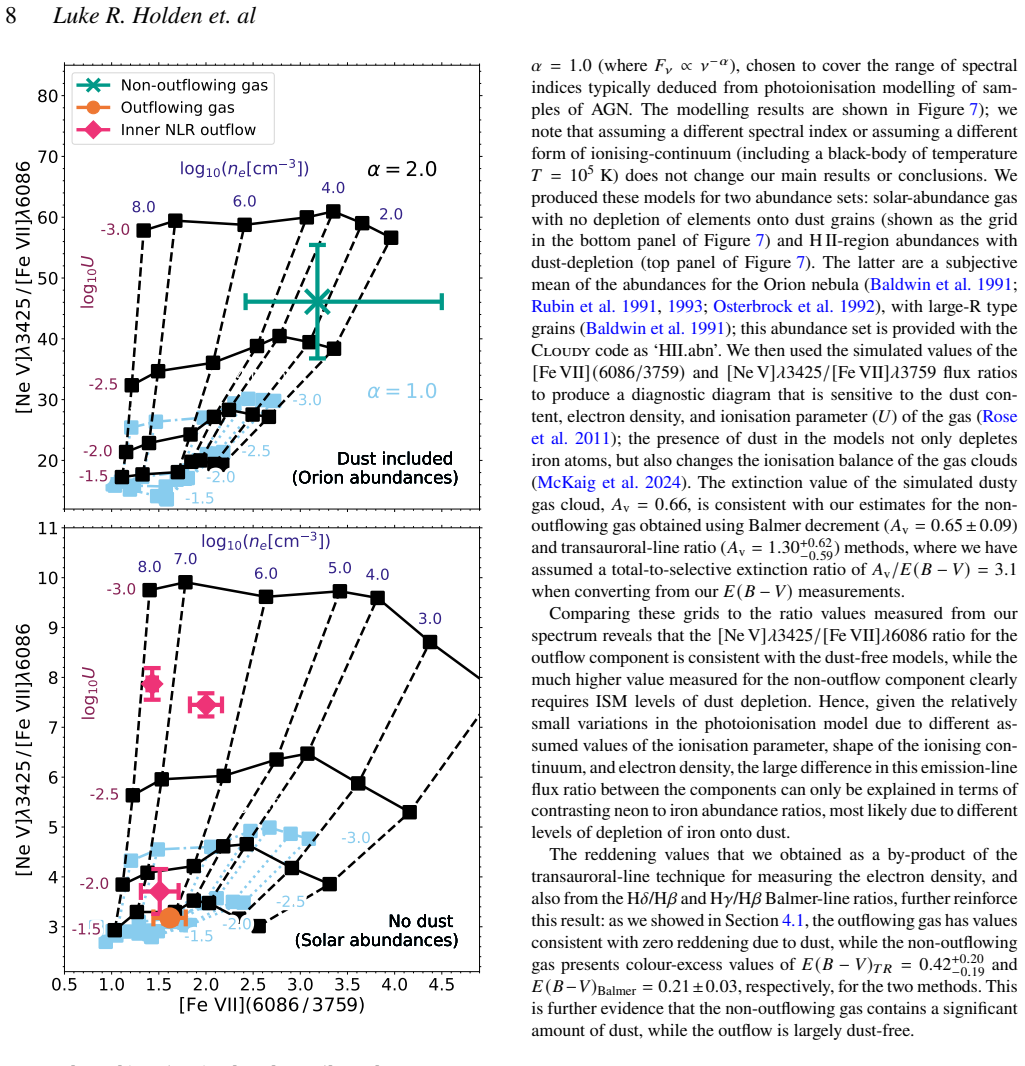
Flux ratios of high-ionisation [NeV]λ3425 and [FeVII]λ6087 lines demonstrate high depletion of refractory elements in the non-outflowing disk gas but little depletion in the outflowing gas; lower-ionisation refractory-to-non-refractory ratios give consistent results, while multiple diagnostics show the outflow density is 19–110 times higher than the disk gas. These observations imply that the outflows are accelerated by fast shocks that both compress the gas and destroy much of the dust.
What carries the argument
Ratios of coronal and lower-ionisation forbidden lines between refractory and non-refractory elements, together with density-sensitive line ratios, that reveal dust destruction and compression in the outflow component.
If this is right
- AGN-driven shocks both heat and accelerate near-nuclear gas in galaxies
- Coronal emission lines provide a direct diagnostic of the destructive effect of AGN activity on dust
- Shock acceleration supplies a physical mechanism that allows outflows to regulate star formation
- The same line-ratio approach can be applied to other nearby active galaxies to test shock dominance
Where Pith is reading between the lines
- If shock-driven dust destruction is common, feedback models must include reduced cooling rates in outflowing gas
- Dust-poor outflows may appear in more distant AGN once similar high-ionization diagnostics become available
- The density jump measured here could be used to estimate shock velocities in other systems without direct kinematics
Load-bearing premise
The differences in refractory-to-non-refractory line ratios between disk and outflow gas are caused mainly by dust depletion rather than by differences in ionization, excitation, or abundance patterns.
What would settle it
A set of line-ratio measurements in which the outflow component shows the same refractory depletion level as the disk component after ionization and excitation corrections are applied would falsify the shock-acceleration interpretation.
Figures






read the original abstract
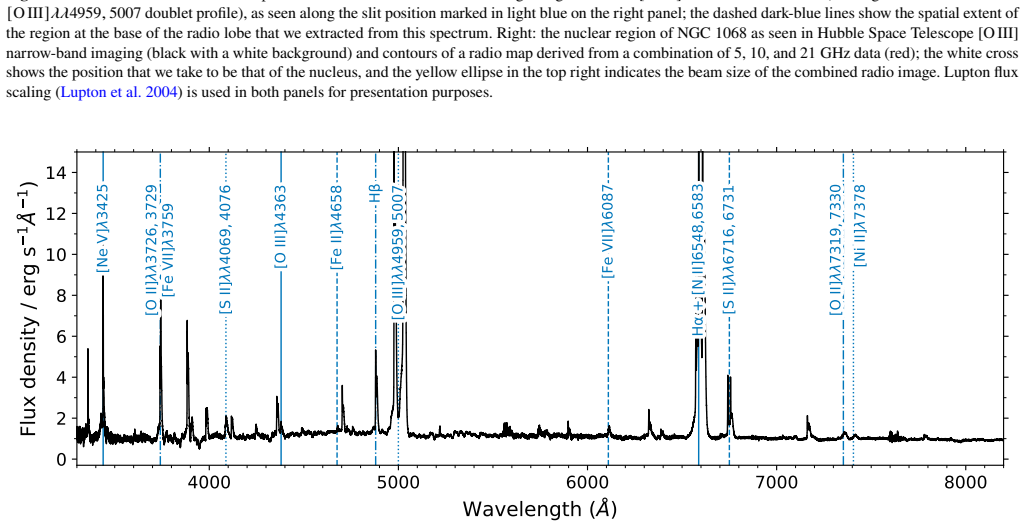
Massive gas outflows driven by active galactic nuclei (AGN) are a key ingredient in models of galaxy evolution, in which they are required to regulate star formation and thus explain the observed properties of the galaxy population. However, it remains uncertain how such outflows are accelerated. Here, we use deep spectroscopic observations of the nearby active galaxy NGC 1068 to directly address this issue. Based on the flux ratios of high-ionisation [NeV]$\lambda$3425 and [FeVII]$\lambda$6087 coronal forbidden lines, we show that the non-outflowing gas in the disk of the galaxy is characterised by high levels of depletion of refractory elements onto dust grains, but the outflowing gas just above the disk is largely dust-free. Consistent results are also found for the ratios of lower-ionisation forbidden lines of refractory and non-refractory elements. Moreover, a range of diagnostic ratios demonstrate that the density of outflowing gas is a factor 19-110 times higher than that of the non-outflowing gas. Together, these results imply that the outflows in NGC 1068 are accelerated by fast shocks that both compress the gas and destroy much of the dust. Consistent with the idea that AGN-driven shocks play an important role in heating and accelerating the near-nuclear gas in galaxies, this study demonstrates that coronal emission lines are a key diagnostic of the destructive impact of AGN activity.
Editorial analysis
A structured set of objections, weighed in public.
Referee Report
Summary. The manuscript presents deep spectroscopic observations of NGC 1068, arguing from flux ratios of high-ionization coronal lines ([NeV] λ3425 / [FeVII] λ6087 and lower-ionization refractory/non-refractory analogs) that disk gas shows high refractory-element depletion onto dust while outflowing gas is largely dust-free. Density diagnostics indicate the outflow is 19–110 times denser; the authors conclude that fast shocks both compress the gas and destroy dust, thereby accelerating the outflows.
Significance. If the dust-depletion interpretation holds after alternatives are quantitatively excluded, the work supplies direct observational evidence that AGN-driven shocks play a key role in heating and accelerating near-nuclear gas, with coronal lines serving as a practical diagnostic of dust destruction. The study is purely observational, reports consistent results across multiple line ratios, and makes falsifiable predictions about shock signatures in other AGN.
major comments (2)
- [Abstract / Results] Abstract and Results sections: the claim that elevated refractory-to-non-refractory ratios indicate reduced dust depletion (rather than ionization-parameter, temperature, or abundance differences between disk and outflow) is load-bearing for the shock-acceleration conclusion, yet the manuscript provides no quantitative photoionization or shock-model grids to demonstrate that these alternatives cannot dominate the observed ratios.
- [Density diagnostics] Density-diagnostics paragraph: the reported factor of 19–110 in density contrast is central to the compression part of the shock-acceleration argument, but the text gives neither the specific diagnostic ratios employed nor error bars or sensitivity tests on the derived densities.
minor comments (2)
- [Abstract] The abstract states 'consistent results' across line ratios but does not list the exact lower-ionization pairs used; adding an explicit table or enumerated list would improve clarity.
- [Observations] Notation for the coronal lines is clear, but the manuscript should define the precise wavelength windows or extraction apertures used for the disk versus outflow components.
Simulated Author's Rebuttal
We thank the referee for their careful reading of the manuscript and for highlighting its potential significance. We address the two major comments below. Where the comments identify areas needing greater clarity or support, we indicate the revisions that will be made.
read point-by-point responses
-
Referee: [Abstract / Results] Abstract and Results sections: the claim that elevated refractory-to-non-refractory ratios indicate reduced dust depletion (rather than ionization-parameter, temperature, or abundance differences between disk and outflow) is load-bearing for the shock-acceleration conclusion, yet the manuscript provides no quantitative photoionization or shock-model grids to demonstrate that these alternatives cannot dominate the observed ratios.
Authors: We agree that the manuscript does not contain new quantitative photoionization or shock-model grids. The current interpretation rests on the observational result that the same refractory/non-refractory enhancement pattern appears consistently in both high-ionization coronal lines and lower-ionization lines, which have different dependencies on ionization parameter and temperature. In the revised manuscript we will add a paragraph in the Discussion that (i) references existing photoionization grids from the literature on AGN coronal lines showing that the observed ratios are difficult to reproduce by ionization or temperature variations alone, and (ii) notes that disk and outflow gas are expected to share similar abundances given their common origin. This addition will make the exclusion of alternatives more explicit while remaining within the observational scope of the paper. revision: partial
-
Referee: [Density diagnostics] Density-diagnostics paragraph: the reported factor of 19–110 in density contrast is central to the compression part of the shock-acceleration argument, but the text gives neither the specific diagnostic ratios employed nor error bars or sensitivity tests on the derived densities.
Authors: We accept that the manuscript text is insufficiently explicit on this point. The density contrast is obtained from standard optical forbidden-line ratios (primarily the [S II] λ6716/λ6731 doublet, with supporting checks from [O II] and [Ar IV] where detected). In the revised version we will (i) list the exact ratios and their measured values, (ii) report the derived densities with 1σ uncertainties, and (iii) include a short sensitivity test showing how the 19–110 factor changes under plausible temperature variations. These details will be inserted into the Results section. revision: yes
Circularity Check
No circularity: purely observational inference from line ratios
full rationale
The paper is an observational study that measures flux ratios of coronal and forbidden lines ([NeV]λ3425/[FeVII]λ6087 and lower-ionization analogs) to infer dust depletion levels and uses diagnostic ratios to infer a density contrast of 19-110× between outflow and disk gas. These inferences are presented as direct consequences of the observed ratios without any equations, fitted parameters, or derivations that reduce the result to the inputs by construction. No self-citations are invoked as load-bearing uniqueness theorems, no ansatzes are smuggled, and no known results are renamed as new derivations. The central claim (shock acceleration via dust destruction) rests on the interpretation of the line ratios rather than on any self-referential mathematical step. This matches the default expectation for a non-circular observational paper.
Axiom & Free-Parameter Ledger
axioms (1)
- domain assumption Flux ratios of refractory versus non-refractory elements trace dust depletion levels
Reference graph
Works this paper leans on
-
[1]
, journal =
Identification of the Radio Sources in Cassiopeia, Cygnus A, and Puppis A. , journal =. 1954 , volume =
1954
-
[2]
High resolution images at 11 and 20 microns of the Active Galactic Nucleus in NGC 1068
0.6 resolution images at 11 and 20 mu m of the active galactic nucleus in NGC 1068. , keywords =. doi:10.48550/arXiv.astro-ph/0008128 , archivePrefix =. astro-ph/0008128 , primaryClass =
work page internal anchor Pith review Pith/arXiv arXiv doi:10.48550/arxiv.astro-ph/0008128
-
[3]
The structure of the narrow-line region in Cygnus A. , keywords =. doi:10.1046/j.1365-8711.2003.06615.x , adsurl =
-
[4]
The ``Alignment Effect'' and the Evolution of Dust in High-Redshift Radio Galaxies. , keywords =. doi:10.1086/306307 , adsurl =
-
[5]
Fast, dust-poor outflows in the local candidate dual AGN MCG-03-34-64 observed with VLT/ERIS
Fast, dust-poor outflows in the local candidate dual AGN MCG-03-34-64 observed with VLT/ERIS. arXiv e-prints , keywords =. doi:10.48550/arXiv.2601.22254 , archivePrefix =. 2601.22254 , primaryClass =
work page internal anchor Pith review Pith/arXiv arXiv doi:10.48550/arxiv.2601.22254
-
[6]
The location and kinematics of the coronal-line emitting regions in active galactic nuclei. , keywords =. doi:10.1111/j.1745-3933.2008.00599.x , archivePrefix =. 0811.3204 , primaryClass =
-
[7]
The size of the coronal line region in active galactic nuclei: a MUSE perspective. , keywords =. doi:10.1093/mnras/staf430 , archivePrefix =. 2503.09999 , primaryClass =
-
[8]
arXiv , doi =:astro-ph/9708072 , keywords =
ApJ , year =. arXiv , doi =:astro-ph/9708072 , keywords =
-
[9]
arXiv , doi =:astro-ph/9908064 , keywords =
MNRAS , year =. arXiv , doi =:astro-ph/9908064 , keywords =
-
[10]
arXiv , doi =:astro-ph/0006289 , keywords =
ApJ , year =. arXiv , doi =:astro-ph/0006289 , keywords =
-
[11]
arXiv , doi =:astro-ph/0006053 , keywords =
ApJ , year =. arXiv , doi =:astro-ph/0006053 , keywords =
-
[12]
arXiv , doi =:astro-ph/0308342 , keywords =
ApJ , year =. arXiv , doi =:astro-ph/0308342 , keywords =
-
[13]
arXiv , doi =:astro-ph/0502199 , keywords =
Nat , year =. arXiv , doi =:astro-ph/0502199 , keywords =
-
[14]
arXiv , doi =:astro-ph/0411108 , keywords =
MNRAS , year =. arXiv , doi =:astro-ph/0411108 , keywords =
-
[15]
arXiv , doi =:0904.0649 , keywords =
MNRAS , year =. arXiv , doi =:0904.0649 , keywords =
-
[16]
arXiv , doi =:astro-ph/0302311 , keywords =
MNRAS , year =. arXiv , doi =:astro-ph/0302311 , keywords =
-
[17]
arXiv , doi =:astro-ph/0510263 , keywords =
A&A , year =. arXiv , doi =:astro-ph/0510263 , keywords =
-
[18]
arXiv , doi =:astro-ph/0606530 , keywords =
ApJ , year =. arXiv , doi =:astro-ph/0606530 , keywords =
-
[19]
arXiv , doi =:1204.5881 , keywords =
A&A , year =. arXiv , doi =:1204.5881 , keywords =
-
[20]
arXiv , doi =:1305.0263 , keywords =
MNRAS , year =. arXiv , doi =:1305.0263 , keywords =
-
[21]
arXiv , doi =:1403.3086 , keywords =
MNRAS , year =. arXiv , doi =:1403.3086 , keywords =
- [22]
-
[23]
arXiv , doi =:1702.04507 , keywords =
A&A , year =. arXiv , doi =:1702.04507 , keywords =
-
[24]
arXiv , doi =:1703.05766 , keywords =
MNRAS , year =. arXiv , doi =:1703.05766 , keywords =
- [25]
-
[26]
arXiv , doi =:1112.3071 , keywords =
A&A , year =. arXiv , doi =:1112.3071 , keywords =
-
[27]
arXiv , doi =:1505.07190 , keywords =
A&A , year =. arXiv , doi =:1505.07190 , keywords =
-
[28]
arXiv , doi =:1303.1400 , keywords =
MNRAS , year =. arXiv , doi =:1303.1400 , keywords =
-
[29]
arXiv , doi =:astro-ph/9902376 , keywords =
MNRAS , year =. arXiv , doi =:astro-ph/9902376 , keywords =
-
[30]
Planetary Nebulae , year = 1993, editor =
Advances in Numerical Simulations of Gaseous Nebulae. Planetary Nebulae , year = 1993, editor =
1993
-
[31]
CA depletion and the presence of dust in large scale nebulosities in radio galaxies. I. , keywords =. doi:10.48550/arXiv.astro-ph/9511113 , archivePrefix =. astro-ph/9511113 , primaryClass =
work page internal anchor Pith review Pith/arXiv arXiv doi:10.48550/arxiv.astro-ph/9511113
-
[32]
CA depletion and the presence of dust in large scale nebulosities in radiogalaxies. II. , keywords =. doi:10.48550/arXiv.astro-ph/9605195 , archivePrefix =. astro-ph/9605195 , primaryClass =
work page internal anchor Pith review Pith/arXiv arXiv doi:10.48550/arxiv.astro-ph/9605195
-
[33]
Emission-Line Probes of Circumnuclear Dust in AGNs
Emission-Line Probes of Circumnuclear Dust in AGNs. Structure and Kinematics of Quasar Broad Line Regions , year = 1999, editor =. doi:10.48550/arXiv.astro-ph/9809247 , archivePrefix =. astro-ph/9809247 , primaryClass =
work page internal anchor Pith review Pith/arXiv arXiv doi:10.48550/arxiv.astro-ph/9809247 1999
-
[34]
arXiv , doi =:astro-ph/9908233 , keywords =
MNRAS , year =. arXiv , doi =:astro-ph/9908233 , keywords =
-
[35]
arXiv , doi =:1710.06600 , keywords =
MNRAS , year =. arXiv , doi =:1710.06600 , keywords =
-
[36]
arXiv , doi =:0710.1189 , keywords =
A&A , year =. arXiv , doi =:0710.1189 , keywords =
-
[37]
arXiv , doi =:astro-ph/0507037 , keywords =
ApJ , year =. arXiv , doi =:astro-ph/0507037 , keywords =
-
[38]
Keck Absorption-Line Spectroscopy of Galactic Winds in Ultraluminous Infrared Galaxies
Keck Absorption-Line Spectroscopy of Galactic Winds in Ultraluminous Infrared Galaxies. , keywords =. doi:10.1086/339789 , archivePrefix =. astro-ph/0201371 , primaryClass =
work page internal anchor Pith review Pith/arXiv arXiv doi:10.1086/339789
-
[39]
arXiv , doi =:1301.5642 , keywords =
ApJ , year =. arXiv , doi =:1301.5642 , keywords =
-
[40]
arXiv , doi =:1311.2595 , keywords =
A&A , year =. arXiv , doi =:1311.2595 , keywords =
-
[41]
arXiv , doi =:1006.1655 , keywords =
A&A , year =. arXiv , doi =:1006.1655 , keywords =
-
[42]
ALMA observations of feeding and feedback in nearby Seyfert galaxies: an AGN-driven outflow in NGC 1433. , keywords =. doi:10.1051/0004-6361/201322288 , archivePrefix =. 1309.7486 , primaryClass =
work page internal anchor Pith review Pith/arXiv arXiv doi:10.1051/0004-6361/201322288
-
[43]
arXiv , doi =:1104.2326 , keywords =
ApJ , year =. arXiv , doi =:1104.2326 , keywords =
-
[44]
Nat. Astron. , year =. arXiv , doi =:1802.10308 , keywords =
-
[45]
arXiv , doi =:1409.1615 , keywords =
MNRAS , year =. arXiv , doi =:1409.1615 , keywords =
- [46]
-
[47]
arXiv , doi =:1806.09461 , keywords =
A&A , year =. arXiv , doi =:1806.09461 , keywords =
-
[48]
arXiv , doi =:1805.02647 , keywords =
MNRAS , year =. arXiv , doi =:1805.02647 , keywords =
-
[49]
Observations of Feedback from Radio-Quiet Quasars - II. Kinematics of Ionized Gas Nebulae
Observations of feedback from radio-quiet quasars - II. Kinematics of ionized gas nebulae. , keywords =. doi:10.1093/mnras/stt1755 , archivePrefix =. 1305.6922 , primaryClass =
work page internal anchor Pith review Pith/arXiv arXiv doi:10.1093/mnras/stt1755
-
[50]
arXiv , doi =:1604.04577 , keywords =
MNRAS , year =. arXiv , doi =:1604.04577 , keywords =
-
[51]
arXiv , doi =:1205.1801 , keywords =
MNRAS , year =. arXiv , doi =:1205.1801 , keywords =
-
[52]
arXiv , doi =:1908.03104 , keywords =
MNRAS , year =. arXiv , doi =:1908.03104 , keywords =
arXiv 1908
-
[53]
arXiv , doi =:1512.05595 , keywords =
A&A , year =. arXiv , doi =:1512.05595 , keywords =
-
[54]
arXiv , doi =:1511.05142 , keywords =
ApJ , year =. arXiv , doi =:1511.05142 , keywords =
-
[55]
arXiv , doi =:1303.6866 , keywords =
ApJ , year =. arXiv , doi =:1303.6866 , keywords =
-
[56]
arXiv , doi =:1211.6250 , keywords =
ApJ , year =. arXiv , doi =:1211.6250 , keywords =
-
[57]
arXiv , doi =:1409.6719 , keywords =
MNRAS , year =. arXiv , doi =:1409.6719 , keywords =
-
[58]
arXiv , doi =:1507.01951 , keywords =
MNRAS , year =. arXiv , doi =:1507.01951 , keywords =
-
[59]
arXiv , doi =:1903.11076 , keywords =
MNRAS , year =. arXiv , doi =:1903.11076 , keywords =
Pith/arXiv arXiv 1903
-
[60]
arXiv , doi =:2003.06153 , keywords =
MNRAS , year =. arXiv , doi =:2003.06153 , keywords =
arXiv 2003
-
[61]
arXiv , doi =:2009.11175 , keywords =
A&A , year =. arXiv , doi =:2009.11175 , keywords =
arXiv 2009
-
[62]
arXiv , doi =:astro-ph/0203468 , keywords =
ApJ , year =. arXiv , doi =:astro-ph/0203468 , keywords =
-
[63]
arXiv , doi =:0903.4897 , keywords =
ApJ , year =. arXiv , doi =:0903.4897 , keywords =
-
[64]
arXiv , doi =:astro-ph/9911459 , keywords =
ApJ , year =. arXiv , doi =:astro-ph/9911459 , keywords =
-
[65]
arXiv , doi =:1611.04469 , keywords =
ApJ , year =. arXiv , doi =:1611.04469 , keywords =
-
[66]
arXiv , doi =:1401.0392 , keywords =
MNRAS , year =. arXiv , doi =:1401.0392 , keywords =
-
[67]
arXiv , doi =:0905.4439 , keywords =
A&A , year =. arXiv , doi =:0905.4439 , keywords =
-
[68]
arXiv , doi =:astro-ph/0406218 , keywords =
ApJ , year =. arXiv , doi =:astro-ph/0406218 , keywords =
-
[69]
Extragalactic Gas at Low Redshift , year = 2002, editor =
Galactic Superwinds Circa 2001. Extragalactic Gas at Low Redshift , year = 2002, editor =
2001
-
[70]
doi:10.1086/159050 , keywords =
ApJ , year =. doi:10.1086/159050 , keywords =
-
[71]
doi:10.1086/166074 , keywords =
ApJ , year =. doi:10.1086/166074 , keywords =
-
[72]
arXiv , doi =:astro-ph/9711285 , keywords =
ApJ , year =. arXiv , doi =:astro-ph/9711285 , keywords =
-
[73]
arXiv , doi =:astro-ph/0002140 , keywords =
ApJ , year =. arXiv , doi =:astro-ph/0002140 , keywords =
-
[74]
doi:10.1086/311104 , keywords =
ApJ , year =. doi:10.1086/311104 , keywords =
-
[75]
arXiv , doi =:1609.03421 , keywords =
A&A , year =. arXiv , doi =:1609.03421 , keywords =
-
[76]
arXiv , doi =:1503.05484 , keywords =
ApJ , year =. arXiv , doi =:1503.05484 , keywords =
-
[77]
arXiv , doi =:1302.2236 , keywords =
A&A , year =. arXiv , doi =:1302.2236 , keywords =
-
[78]
Radio Jets Clearing the Way Through a Galaxy: Watching Feedback in Action
Radio Jets Clearing the Way Through a Galaxy: Watching Feedback in Action. Science , keywords =. doi:10.1126/science.1240436 , archivePrefix =. 1309.1240 , primaryClass =
work page internal anchor Pith review Pith/arXiv arXiv doi:10.1126/science.1240436
-
[79]
arXiv , doi =:1801.06875 , keywords =
MNRAS , year =. arXiv , doi =:1801.06875 , keywords =
-
[80]
arXiv , doi =:1311.5411 , keywords =
A&A , year =. arXiv , doi =:1311.5411 , keywords =
discussion (0)
Sign in with ORCID, Apple, or X to comment. Anyone can read and Pith papers without signing in.