One Model, Many Latencies: Universal Speech Enhancement for Diverse Real-Time Applications
Pith reviewed 2026-06-26 05:48 UTC · model grok-4.3
The pith
A single speech enhancement model adapts to multiple latency budgets without retraining separate versions.
A machine-rendered reading of the paper's core claim, the machinery that carries it, and where it could break.
Core claim
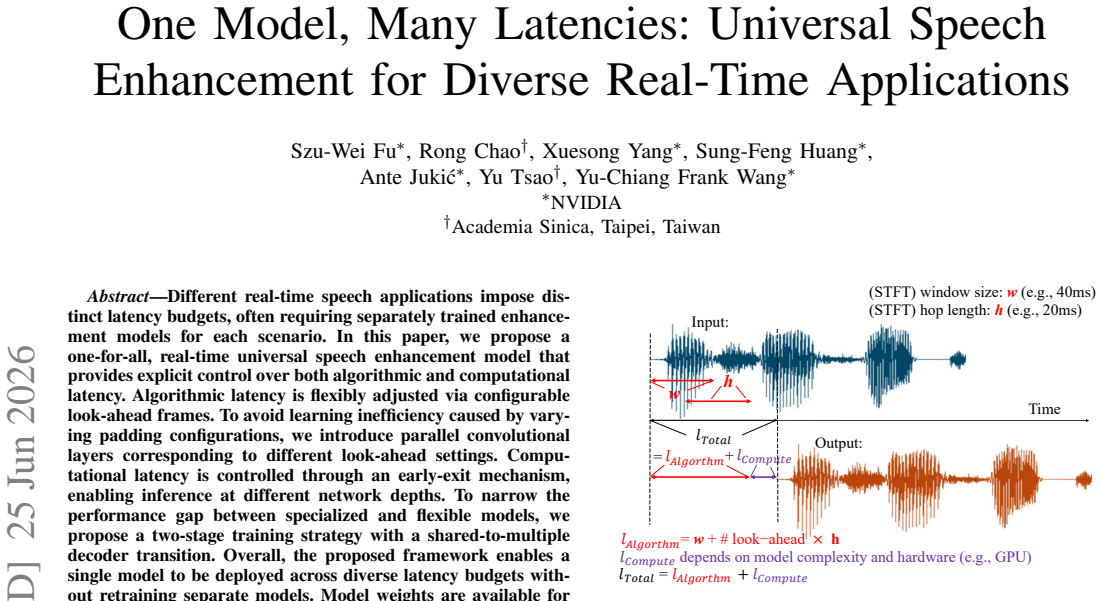
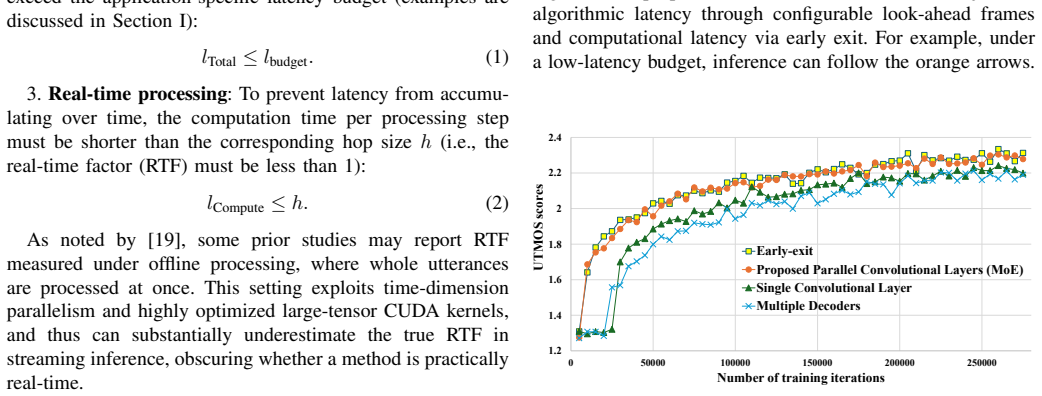
The authors introduce a one-for-all model that supplies explicit control over algorithmic latency via configurable look-ahead frames and computational latency via an early-exit mechanism. Parallel convolutional layers corresponding to different look-ahead settings avoid learning inefficiency from varying padding configurations. A two-stage training strategy with a shared-to-multiple decoder transition narrows the performance gap to specialized models, so that the single model can be deployed across diverse latency budgets without retraining separate models for each scenario.
What carries the argument
Parallel convolutional layers for different look-ahead settings together with an early-exit mechanism and a two-stage shared-to-multiple decoder training strategy.
If this is right
- One set of model weights can serve applications that impose different latency constraints.
- Algorithmic latency is set at inference time by choosing among the parallel convolutional layers.
- Computational latency is set by selecting an early exit point at a chosen network depth.
- No separate training runs or additional stored models are needed for each latency target.
Where Pith is reading between the lines
- Only one model file needs to be stored and updated, which simplifies deployment on varied hardware.
- The same network could switch latency modes at runtime if device load or channel conditions change.
- The parallel-layer and early-exit pattern might transfer to other real-time sequence tasks that face variable timing limits.
Load-bearing premise
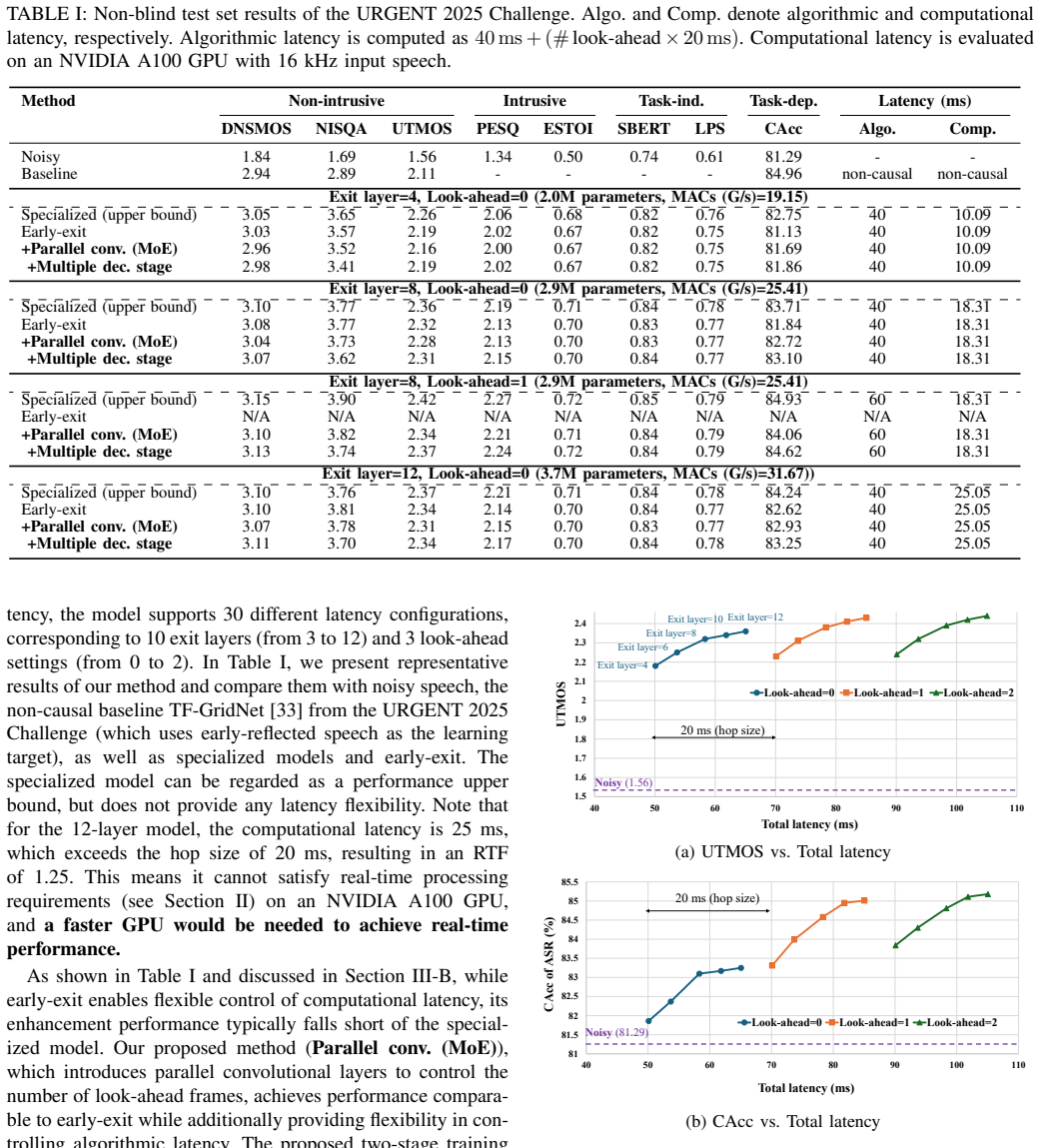
Parallel convolutional layers and early exits plus two-stage training will let the flexible model reach performance close to that of models trained separately for each latency budget.
What would settle it
Measure speech enhancement quality scores of the universal model at several specific latency budgets and compare them directly to the scores of separately trained specialized models on identical test sets.
Figures

read the original abstract
Different real-time speech applications impose distinct latency budgets, often requiring separately trained enhancement models for each scenario. In this paper, we propose a one-for-all, real-time universal speech enhancement model that provides explicit control over both algorithmic and computational latency. Algorithmic latency is flexibly adjusted via configurable look-ahead frames. To avoid learning inefficiency caused by varying padding configurations, we introduce parallel convolutional layers corresponding to different look-ahead settings. Computational latency is controlled through an early-exit mechanism, enabling inference at different network depths. To narrow the performance gap between specialized and flexible models, we propose a two-stage training strategy with a shared-to-multiple decoder transition. Overall, the proposed framework enables a single model to be deployed across diverse latency budgets without retraining separate models. Model weights are available for download at: https://huggingface.co/nvidia/Real-time_RE-USE
Editorial analysis
A structured set of objections, weighed in public.
Referee Report
Summary. The paper proposes a universal real-time speech enhancement model that provides explicit control over algorithmic latency (via configurable look-ahead frames implemented with parallel convolutional layers) and computational latency (via an early-exit mechanism). A two-stage training strategy with a shared-to-multiple decoder transition is introduced to narrow the performance gap relative to specialized per-latency models. The central claim is that a single trained model can be deployed across diverse latency budgets without retraining separate models; public model weights are released.
Significance. If the performance claims hold, the work would be significant for practical real-time speech applications by simplifying model deployment and reducing the overhead of maintaining multiple specialized models. The public release of model weights is a clear strength supporting reproducibility.
major comments (1)
- Abstract: the central claim that the universal model narrows the performance gap to specialized models (and enables deployment across latency budgets) is presented without any quantitative results, ablation studies, baseline comparisons, or gap measurements, leaving the key empirical assertion unverified.
Simulated Author's Rebuttal
We thank the referee for the detailed review and constructive comment. We address the major comment point-by-point below and will incorporate the suggested changes in the revised manuscript.
read point-by-point responses
-
Referee: [—] Abstract: the central claim that the universal model narrows the performance gap to specialized models (and enables deployment across latency budgets) is presented without any quantitative results, ablation studies, baseline comparisons, or gap measurements, leaving the key empirical assertion unverified.
Authors: We agree that the abstract would be strengthened by including quantitative support for the central claim. The full manuscript already contains these elements: Section 4 reports PESQ, STOI, and SI-SDR results across multiple algorithmic and computational latency settings, with direct comparisons to per-latency specialized models and ablations on the two-stage training and parallel-convolution design. The performance gap is quantified in Tables 2 and 3. We will revise the abstract to concisely report the key metrics (e.g., average gap reduction of X dB / Y points) while preserving the word limit. revision: yes
Circularity Check
No circularity detected in derivation chain
full rationale
The paper presents an architectural proposal consisting of parallel convolutional layers for configurable look-ahead, an early-exit mechanism, and a two-stage training strategy with shared-to-multiple decoder transition. No mathematical derivations, fitted parameters renamed as predictions, self-definitional constructs, or load-bearing self-citations appear in the abstract or description. The central claim is an empirical architecture enabling flexible latency control, supported by released model weights for external verification, rendering the work self-contained without any reduction of outputs to inputs by construction.
Axiom & Free-Parameter Ledger
axioms (1)
- standard math Standard deep learning training procedures apply to the proposed architecture
Reference graph
Works this paper leans on
-
[1]
V oiceFixer: Toward general speech restoration with neural vocoder,
H. Liu, Q. Kong, Q. Tian, Y . Zhao, D. Wang, C. Huang, and Y . Wang, “V oiceFixer: Toward general speech restoration with neural vocoder,” arXiv preprint arXiv:2109.13731, 2021
-
[2]
Univer- sal speech enhancement with score-based diffusion,
J. Serr `a, S. Pascual, J. Pons, R. O. Araz, and D. Scaini, “Univer- sal speech enhancement with score-based diffusion,”arXiv preprint arXiv:2206.03065, 2022
-
[3]
MaskSR: Masked language model for full- band speech restoration,
X. Li, Q. Wang, and X. Liu, “MaskSR: Masked language model for full- band speech restoration,” inProc. Interspeech, 2024, pp. 2275–2279
2024
-
[4]
FINALLY: Fast and universal speech enhancement with studio-like quality,
N. Babaev, K. Tamogashev, A. Saginbaev, I. Shchekotov, H. Bae, H. Sung, W. Lee, H.-Y . Cho, and P. Andreev, “FINALLY: Fast and universal speech enhancement with studio-like quality,” inNeural Infor- mation Processing Systems, vol. 37, 2024, pp. 934–965
2024
-
[5]
AnyEnhance: A unified generative model with prompt-guidance and self-critic for voice enhancement,
J. Zhang, J. Yang, Z. Fang, Y . Wang, Z. Zhang, Z. Wang, F. Fan, and Z. Wu, “AnyEnhance: A unified generative model with prompt-guidance and self-critic for voice enhancement,”IEEE/ACM Transactions on Audio, Speech, and Language Processing, 2025
2025
-
[6]
Miipher-2: A universal speech restoration model for million-hour scale data restoration,
S. Karita, Y . Koizumi, H. Zen, H. Ishikawa, R. Scheibler, and M. Bacchi- ani, “Miipher-2: A universal speech restoration model for million-hour scale data restoration,” inIEEE WASPAA, 2025
2025
-
[7]
Sidon: Fast and robust open-source multilingual speech restoration for large-scale dataset cleansing,
W. Nakata, Y . Saito, Y . Ueda, and H. Saruwatari, “Sidon: Fast and robust open-source multilingual speech restoration for large-scale dataset cleansing,” inIEEE International Conference on Acoustics, Speech and Signal Processing (ICASSP), 2026
2026
-
[8]
Rethinking Training Targets, Architectures and Data Quality for Universal Speech Enhancement
S.-W. Fu, R. Chao, X. Yang, S.-F. Huang, R. E. Zezario, R. Nasretdinov, A. Juki ´c, Y . Tsao, and Y .-C. F. Wang, “Rethinking training targets, architectures and data quality for universal speech enhancement,”arXiv preprint arXiv:2603.02641, 2026
work page internal anchor Pith review Pith/arXiv arXiv 2026
-
[9]
Security considerations for voice over IP systems,
D. R. Kuhn, T. J. Walsh, and S. Fries, “Security considerations for voice over IP systems,”NIST special publication, vol. 800, 2005
2005
-
[10]
Trimtail: Low-latency streaming ASR with simple but effective spectrogram-level length penalty,
X. Song, D. Wu, Z. Wu, B. Zhang, Y . Zhang, Z. Peng, W. Li, F. Pan, and C. Zhu, “Trimtail: Low-latency streaming ASR with simple but effective spectrogram-level length penalty,” inIEEE International Conference on Acoustics, Speech and Signal Processing (ICASSP), 2023
2023
-
[11]
Stateful conformer with cache-based inference for streaming automatic speech recognition,
V . Noroozi, S. Majumdar, A. Kumar, J. Balam, and B. Ginsburg, “Stateful conformer with cache-based inference for streaming automatic speech recognition,” inIEEE International Conference on Acoustics, Speech and Signal Processing (ICASSP), 2024
2024
-
[12]
Branchynet: Fast inference via early exiting from deep neural networks,
S. Teerapittayanon, B. McDanel, and H.-T. Kung, “Branchynet: Fast inference via early exiting from deep neural networks,” inIEEE inter- national conference on pattern recognition (ICPR), 2016
2016
-
[13]
Learning to inference with early exit in the progressive speech enhancement,
A. Li, C. Zheng, L. Zhang, and X. Li, “Learning to inference with early exit in the progressive speech enhancement,” inIEEE European Signal Processing Conference (EUSIPCO), 2021
2021
-
[14]
Don’t shoot butterfly with rifles: Multi-channel continuous speech separation with early exit transformer,
S. Chen, Y . Wu, Z. Chen, T. Yoshioka, S. Liu, J. Li, and X. Yu, “Don’t shoot butterfly with rifles: Multi-channel continuous speech separation with early exit transformer,” inIEEE International Conference on Acoustics, Speech and Signal Processing (ICASSP), 2021
2021
-
[15]
Bloom-net: Blockwise optimization for masking networks toward scalable and efficient speech enhancement,
S. Kim and M. Kim, “Bloom-net: Blockwise optimization for masking networks toward scalable and efficient speech enhancement,” inIEEE International Conference on Acoustics, Speech and Signal Processing (ICASSP), 2022
2022
-
[16]
Dynamic nsNet2: Efficient deep noise suppression with early exiting,
R. Miccini, A. Zniber, C. Laroche, T. Piechowiak, M. Schoeberl, L. Pezzarossa, O. Karrakchou, J. Sparsø, and M. Ghogho, “Dynamic nsNet2: Efficient deep noise suppression with early exiting,” inIEEE International Workshop on Machine Learning for Signal Processing (MLSP), 2023
2023
-
[17]
Towards a flexible and unified architecture for speech enhancement,
L. Feng, C. Zhang, and X.-L. Zhang, “Towards a flexible and unified architecture for speech enhancement,”Vicinagearth, vol. 2, no. 1, p. 14, 2025
2025
-
[18]
Knowing when to quit: Probabilistic early exits for speech separation,
K. F. Olsen, M. Østergaard, K. Ulbæk, S. F. Nielsen, R. M. H. Lindrup, B. S. Jensen, and M. Mørup, “Knowing when to quit: Probabilistic early exits for speech separation,”arXiv preprint arXiv:2507.09768, 2025
-
[19]
Real-Time Streamable Generative Speech Restoration with Flow Matching
S. Welker, B. Lay, M. Hillemann, T. Peer, and T. Gerkmann, “Real- time streamable generative speech restoration with flow matching,”arXiv preprint arXiv:2512.19442, 2025
work page internal anchor Pith review Pith/arXiv arXiv 2025
-
[20]
Interspeech 2025 URGENT speech enhancement challenge,
K. Saijo, W. Zhang, S. Cornell, R. Scheibler, C. Li, Z. Ni, A. Kumar, M. Sach, Y . Fu, W. Wanget al., “Interspeech 2025 URGENT speech enhancement challenge,” inProc. Interspeech, 2025, pp. 858–862
2025
-
[21]
UTMOS: Utokyo-sarulab system for V oiceMOS chal- lenge 2022,
T. Saeki, D. Xin, W. Nakata, T. Koriyama, S. Takamichi, and H. Saruwatari, “UTMOS: Utokyo-sarulab system for V oiceMOS chal- lenge 2022,”arXiv preprint arXiv:2204.02152, 2022
-
[22]
Universal speech enhancement with regression and generative Mamba,
R. Chao, R. Nasretdinov, Y .-C. F. Wang, A. Jukic, S.-W. Fu, and Y . Tsao, “Universal speech enhancement with regression and generative Mamba,” inProc. Interspeech, 2025, pp. 888–892
2025
-
[23]
An investigation of incorporating Mamba for speech enhancement,
R. Chao, W.-H. Cheng, M. L. Quatra, S. M. Siniscalchi, C.-H. H. Yang, S.-W. Fu, and Y . Tsao, “An investigation of incorporating Mamba for speech enhancement,” inIEEE Spoken Language Technology Workshop (SLT), 2024, pp. 302–308
2024
-
[24]
Mamba: Linear-time sequence modeling with selective state spaces,
A. Gu and T. Dao, “Mamba: Linear-time sequence modeling with selective state spaces,” inconference on language modeling (COLM), 2024
2024
-
[25]
Toward universal speech enhancement for diverse input conditions,
W. Zhang, K. Saijo, Z.-Q. Wang, S. Watanabe, and Y . Qian, “Toward universal speech enhancement for diverse input conditions,” inIEEE Automatic Speech Recognition and Understanding Workshop (ASRU). IEEE, 2023, pp. 1–6
2023
-
[26]
Perceptual evaluation of speech quality (PESQ)-a new method for speech quality assessment of telephone networks and codecs,
A. W. Rix, J. G. Beerends, M. P. Hollier, and A. P. Hekstra, “Perceptual evaluation of speech quality (PESQ)-a new method for speech quality assessment of telephone networks and codecs,” inIEEE International Conference on Acoustics, Speech and Signal Processing (ICASSP), 2001
2001
-
[27]
An algorithm for predicting the intelligibility of speech masked by modulated noise maskers,
J. Jensen and C. H. Taal, “An algorithm for predicting the intelligibility of speech masked by modulated noise maskers,”IEEE/ACM Transac- tions on Audio, Speech, and Language Process., vol. 24, no. 11, pp. 2009–2022, 2016
2009
-
[28]
SpeechBERTScore: Reference-aware automatic evaluation of speech generation leveraging NLP evaluation metrics,
T. Saeki, S. Maiti, S. Takamichi, S. Watanabe, and H. Saruwatari, “SpeechBERTScore: Reference-aware automatic evaluation of speech generation leveraging NLP evaluation metrics,” inProc. Interspeech, 2024, pp. 4943–4947
2024
-
[29]
Evaluation metrics for generative speech enhancement methods: Issues and perspectives,
J. Pirklbauer, M. Sach, K. Fluyt, W. Tirry, W. Wardah, S. Moeller, and T. Fingscheidt, “Evaluation metrics for generative speech enhancement methods: Issues and perspectives,” inIEEE Speech Communication; 15th ITG Conference, 2023, pp. 265–269
2023
-
[30]
Owsm v3.1: Better and faster open whisper-style speech models based on e-branchformer,
Y . Peng, J. Tian, W. Chen, S. Arora, B. Yan, Y . Sudo, M. Shakeel, K. Choi, J. Shi, X. Changet al., “Owsm v3.1: Better and faster open whisper-style speech models based on e-branchformer,” inProc. Interspeech, 2024
2024
-
[31]
DNSMOS P.835: A non- intrusive perceptual objective speech quality metric to evaluate noise suppressors,
C. K. A. Reddy, V . Gopal, and R. Cutler, “DNSMOS P.835: A non- intrusive perceptual objective speech quality metric to evaluate noise suppressors,” inIEEE International Conference on Acoustics, Speech and Signal Processing (ICASSP), 2022, pp. 886–890
2022
-
[32]
NISQA: A deep cnn- self-attention model for multidimensional speech quality prediction with crowdsourced datasets,
G. Mittag, B. Naderi, A. Chehadi, and S. M ¨oller, “NISQA: A deep cnn- self-attention model for multidimensional speech quality prediction with crowdsourced datasets,” inProc. Interspeech, 2021, pp. 2127–2131
2021
-
[33]
TF-GridNet: Integrating full-and sub-band modeling for speech separation,
Z.-Q. Wang, S. Cornell, S. Choi, Y . Lee, B.-Y . Kim, and S. Watan- abe, “TF-GridNet: Integrating full-and sub-band modeling for speech separation,”IEEE/ACM Transactions on Audio, Speech, and Language Processing, vol. 31, pp. 3221–3236, 2023
2023
-
[34]
Diffusion buffer for online generative speech enhancement,
B. Lay, R. Makarov, S. Welker, M. Hillemann, and T. Gerkmann, “Diffusion buffer for online generative speech enhancement,”arXiv preprint arXiv:2510.18744, 2025
-
[35]
Real time speech enhancement in the waveform domain,
A. Defossez, G. Synnaeve, and Y . Adi, “Real time speech enhancement in the waveform domain,” inProc. Interspeech, 2020
2020
-
[36]
DeepFil- terNet: Perceptually motivated real-time speech enhancement,
H. Schr ¨oter, T. Rosenkranz, A. N. Escalante-B, and A. Maier, “DeepFil- terNet: Perceptually motivated real-time speech enhancement,” inProc. Interspeech, 2023
2023
-
[37]
Investigat- ing RNN-based speech enhancement methods for noise-robust text-to- speech,
C. V . Botinhao, X. Wang, S. Takaki, and J. Yamagishi, “Investigat- ing RNN-based speech enhancement methods for noise-robust text-to- speech,” in9th ISCA speech synthesis workshop, 2016, pp. 159–165
2016
-
[38]
SDR-half- baked or well done?
J. Le Roux, S. Wisdom, H. Erdogan, and J. R. Hershey, “SDR-half- baked or well done?” inIEEE International Conference on Acoustics, Speech and Signal Processing (ICASSP), 2019
2019
discussion (0)
Sign in with ORCID, Apple, or X to comment. Anyone can read and Pith papers without signing in.