New Online Database of Symbiotic Variables: Catalog and Statistical Overview of Symbiotic Binaries
Pith reviewed 2026-06-25 19:19 UTC · model grok-4.3
The pith
A new online database catalogs nearly 1400 symbiotic variables and presents a statistical overview of the confirmed population.
A machine-rendered reading of the paper's core claim, the machinery that carries it, and where it could break.
Core claim
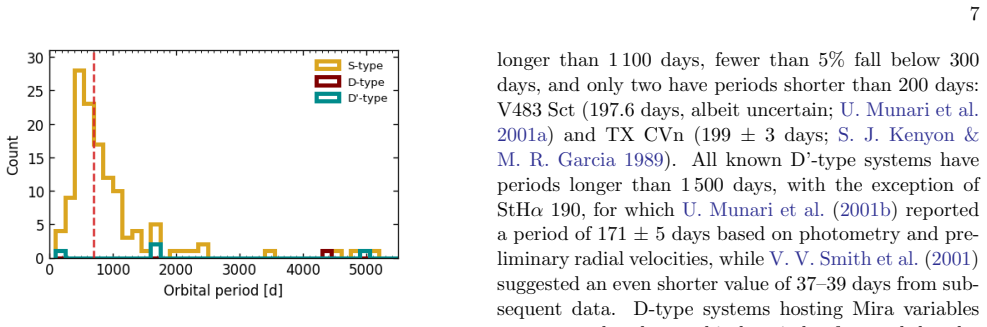
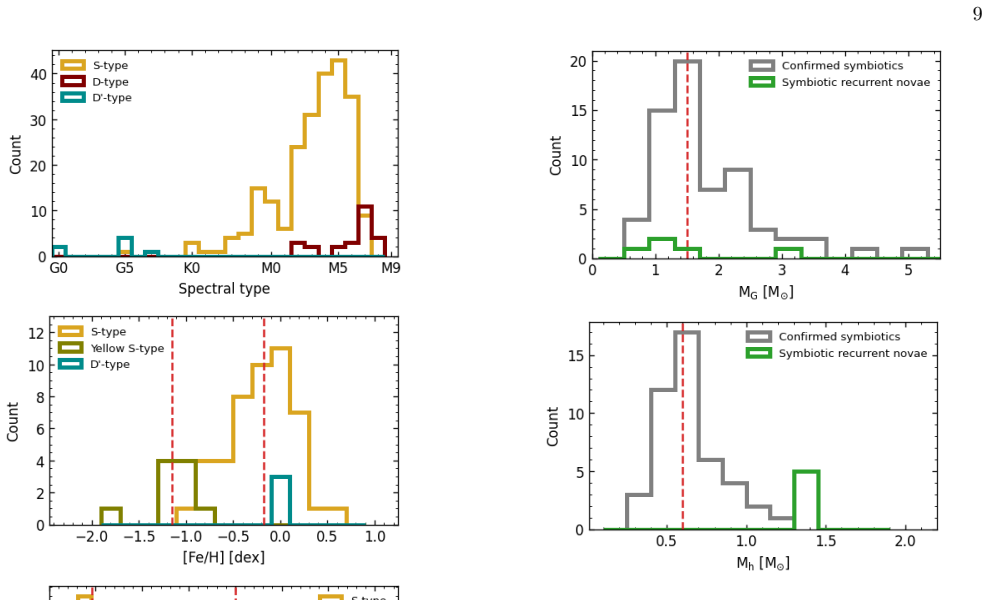
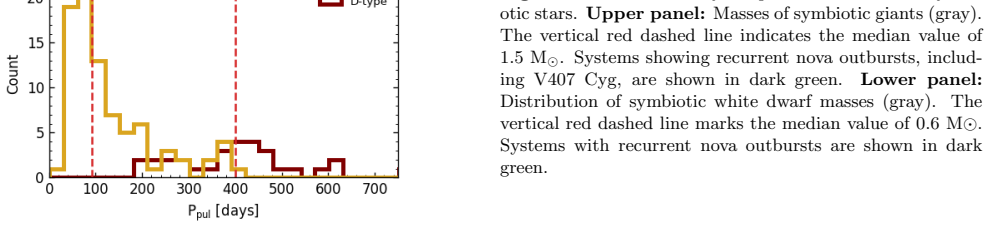
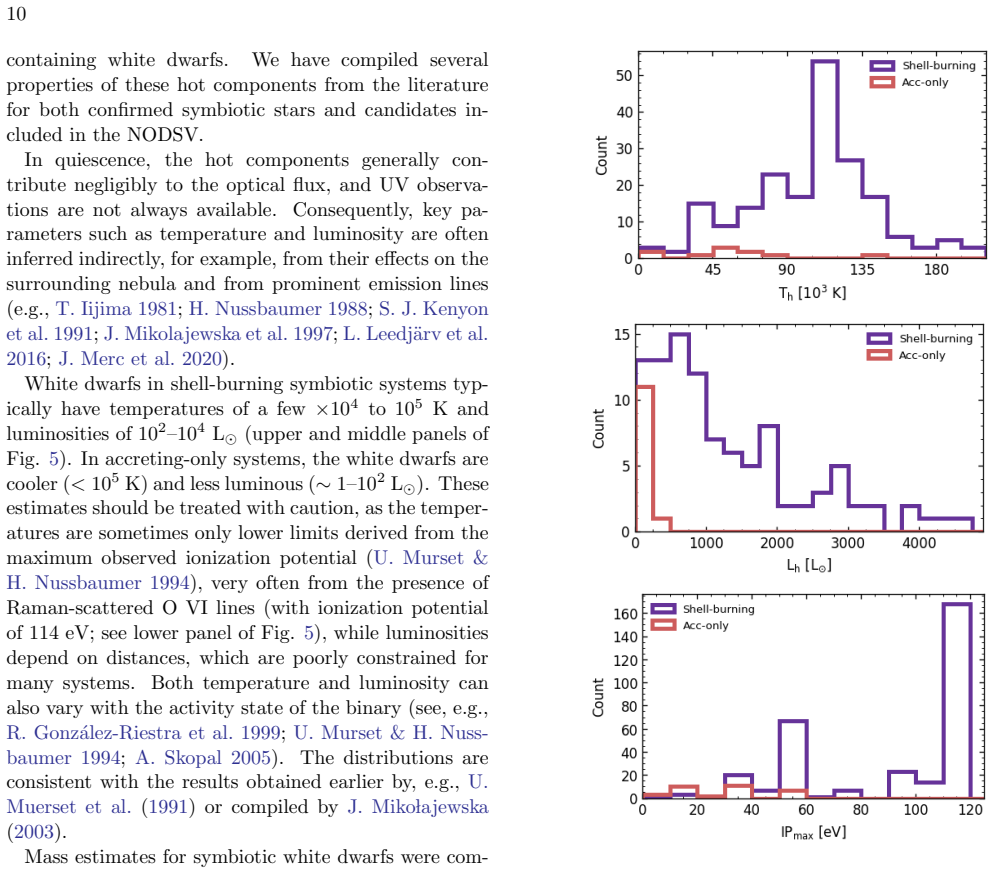
NODSV contains nearly 1400 objects classified into confirmed symbiotic stars, three categories of candidates, and misidentified sources. Based on the collected data, though originating from heterogeneous studies, a statistical overview of the confirmed symbiotic population is presented, highlighting the distributions of orbital parameters and the properties of the cool giants and their hot companions.
What carries the argument
The New Online Database of Symbiotic Variables (NODSV), a publicly accessible catalog that systematically compiles photometric, spectroscopic, orbital, and auxiliary diagnostic information on symbiotic binaries from the literature.
Load-bearing premise
The data compiled from heterogeneous studies is sufficiently consistent, complete, and accurately classified to support a meaningful statistical overview of the symbiotic population.
What would settle it
A targeted re-observation campaign of a statistically significant subset of the confirmed objects that finds a high rate of objects lacking the defining emission-line or binary signatures of symbiotic stars.
Figures

read the original abstract
We present the New Online Database of Symbiotic Variables (NODSV), a comprehensive and publicly accessible catalog of known and candidate symbiotic stars in the Milky Way and nearby galaxies. The database provides an up-to-date census of confirmed symbiotic binaries and systematically compiles information previously scattered across the literature, including photometric and spectroscopic properties, orbital parameters, and characteristics of both their cool and hot stellar components. It further records auxiliary diagnostics such as detected emission lines, flickering, X-ray emission, jets, or information about outburst activity. In its current release, NODSV contains nearly 1 400 objects, classified into confirmed symbiotic stars, three categories of candidates, and misidentified sources. Based on the collected data, though originating from heterogeneous studies, we present a statistical overview of the confirmed symbiotic population, highlighting the distributions of orbital parameters and the properties of the cool giants and their hot companions. Designed as a dynamic and evolving resource, NODSV provides a foundation for future observational campaigns and theoretical investigations of symbiotic binaries.
Editorial analysis
A structured set of objections, weighed in public.
Referee Report
Summary. The paper presents the New Online Database of Symbiotic Variables (NODSV), a publicly accessible catalog compiling nearly 1400 confirmed symbiotic stars, candidates, and misidentified sources from the literature, including photometric, spectroscopic, orbital, and component properties plus auxiliary diagnostics. It additionally provides a statistical overview of the confirmed population's orbital parameters and the properties of cool giants and hot companions, while positioning the database as a dynamic resource for future work.
Significance. A well-curated, public database of this scale would be a useful community resource for symbiotic binary research, particularly if it enables targeted follow-up and reduces duplication of literature searches. The statistical overview, however, adds limited new insight if it simply aggregates heterogeneous literature values without demonstrated controls for classification inconsistencies or selection biases.
major comments (2)
- [abstract and statistical overview section] The description of data compilation and the statistical overview (abstract and the section presenting population statistics) does not specify any standardization protocols, cross-validation steps against primary sources, or quantitative handling of classification inconsistencies across the heterogeneous input studies. This directly affects the reliability of the reported distributions of orbital periods, component properties, and category assignments.
- [statistical overview section] No quantitative assessment of completeness, selection effects, or uncertainty propagation is provided for the confirmed symbiotic sample or the candidate categories, despite the abstract's explicit acknowledgment that the data originate from heterogeneous studies. This omission is load-bearing for any claim that the overview reflects intrinsic population properties rather than literature artifacts.
minor comments (2)
- [catalog description] Clarify the exact criteria used to assign objects to the three candidate categories versus confirmed or misidentified, ideally with a table or flowchart.
- [database documentation] Ensure all database fields are explicitly defined in the text or supplementary material so users can reproduce the statistical plots from the released data.
Simulated Author's Rebuttal
We thank the referee for their constructive comments on the NODSV manuscript. We address the major comments point by point below and have revised the manuscript to improve clarity on data compilation and the scope of the statistical overview.
read point-by-point responses
-
Referee: [abstract and statistical overview section] The description of data compilation and the statistical overview (abstract and the section presenting population statistics) does not specify any standardization protocols, cross-validation steps against primary sources, or quantitative handling of classification inconsistencies across the heterogeneous input studies. This directly affects the reliability of the reported distributions of orbital periods, component properties, and category assignments.
Authors: The NODSV is explicitly a literature compilation, and the values (including classifications and parameters) are reported as given in the source papers without imposing new standardization. In the revised manuscript we have expanded the data compilation section to list the primary literature sources consulted, describe the aggregation workflow, and note instances where multiple references were compared for a given object. We have also added explicit language in the statistical overview clarifying that no quantitative corrections for classification inconsistencies were applied and that the reported distributions reflect the heterogeneous literature sample as compiled. revision: partial
-
Referee: [statistical overview section] No quantitative assessment of completeness, selection effects, or uncertainty propagation is provided for the confirmed symbiotic sample or the candidate categories, despite the abstract's explicit acknowledgment that the data originate from heterogeneous studies. This omission is load-bearing for any claim that the overview reflects intrinsic population properties rather than literature artifacts.
Authors: We agree that the overview is descriptive of the compiled sample and does not constitute a bias-corrected population study. The revised text now states in both the abstract and the statistical overview section that the distributions should be interpreted as reflecting the current heterogeneous literature compilation rather than intrinsic properties, and we explicitly caution readers about selection effects and incompleteness. A full quantitative treatment of completeness, selection biases, and uncertainty propagation lies outside the scope of a catalog paper; the database is instead intended as a resource to enable such analyses in future work. revision: yes
Circularity Check
No circularity: pure data compilation with descriptive statistics
full rationale
The paper compiles literature data into a catalog (NODSV) and presents descriptive statistics on orbital parameters and component properties. No equations, fitted models, predictions, or derivations appear in the abstract or described content. The statistical overview is explicitly noted as originating from heterogeneous studies without any reduction to author-defined quantities or self-citation chains. This matches the default expectation of a non-circular catalog paper.
Axiom & Free-Parameter Ledger
Reference graph
Works this paper leans on
-
[1]
2023, MNRAS, 519, 6044, doi: 10.1093/mnras/stad096
Akras, S. 2023, MNRAS, 519, 6044, doi: 10.1093/mnras/stad096
-
[2]
R., Alvarez-Candal, A., & Pereira, C
Akras, S., Gon¸ calves, D. R., Alvarez-Candal, A., & Pereira, C. B. 2021, MNRAS, 502, 2513, doi: 10.1093/mnras/stab195
-
[3]
2019, The Astrophysical Journal Supplement Series, 240, 21, doi: 10.3847/1538-4365/aaf88c
Ramos-Larios, G. 2019, The Astrophysical Journal Supplement Series, 240, 21, doi: 10.3847/1538-4365/aaf88c
-
[4]
Akras, S., Karagiannis, A., Charalampopoulos, G., Gavras, P., & Guti´ errez-Soto, L. A. 2026, MNRAS, 546, stag105, doi: 10.1093/mnras/stag105
-
[5]
Allen, D. A. 1980, MNRAS, 192, 521, doi: 10.1093/mnras/192.3.521
-
[6]
Allen, D. A. 1984, Proceedings of the Astronomical Society of Australia, 5, 369 Astropy Collaboration, Robitaille, T. P., Tollerud, E. J., et al. 2013, A&A, 558, A33, doi: 10.1051/0004-6361/201322068 Astropy Collaboration, Price-Whelan, A. M., Sip˝ ocz, B. M., et al. 2018, AJ, 156, 123, doi: 10.3847/1538-3881/aabc4f Astropy Collaboration, Price-Whelan, A....
-
[7]
Ball, S. E., Bromley, B. C., & Kenyon, S. J. 2025, The Open Journal of Astrophysics, 8, 122, doi: 10.33232/001c.143522 Belczy´ nski, K., Miko lajewska, J., Munari, U., Ivison, R. J., & Friedjung, M. 2000, Astronomy and Astrophysics Supplement Series, 146, 407, doi: 10.1051/aas:2000280
-
[8]
Bidelman, W. P. 1954, ApJS, 1, 175, doi: 10.1086/190007
-
[9]
Bodaghee, A., Rahoui, F., Tomsick, J. A., & Rodriguez, J. 2012, ApJ, 751, 113, doi: 10.1088/0004-637X/751/2/113
-
[10]
Boffin, H. M. J., & Merc, J. 2025, arXiv e-prints, arXiv:2508.01304, doi: 10.48550/arXiv.2508.01304
-
[11]
Boyarchuk, A. A. 1969, Commmunications of the Konkoly Observatory Hungary, 65, 395
1969
-
[12]
Brocksopp, C., Bode, M. F., Eyres, S. P. S., et al. 2002, ApJ, 571, 947, doi: 10.1086/340018
-
[13]
Cannon, A. J. 1920, Harvard College Observatory Circular, 221, 1 Catal´ an, S., Isern, J., Garc´ ıa-Berro, E., & Ribas, I. 2008, MNRAS, 387, 1693, doi: 10.1111/j.1365-2966.2008.13356.x
-
[14]
2025, ApJ, 987, 147, doi: 10.3847/1538-4357/addec3
Chen, J., Wang, L., Li, Y.-B., et al. 2025, ApJ, 987, 147, doi: 10.3847/1538-4357/addec3
-
[15]
Choi, J., Dotter, A., Conroy, C., et al. 2016, ApJ, 823, 102, doi: 10.3847/0004-637X/823/2/102 Contreras Rojas, V., Jaque Arancibia, M., Ferreira Lopes, C. E., et al. 2026, A&A, 708, A28, doi: 10.1051/0004-6361/202556429
work page internal anchor Pith review doi:10.3847/0004-637x/823/2/102 2016
-
[16]
Corbet, R. H. D., Krimm, H. A., Barthelmy, S. D., et al. 2010, The Astronomer’s Telegram, 2570, 1
2010
-
[17]
Corradi, R. L. M., Rodr´ ıguez-Flores, E. R., Mampaso, A., et al. 2008, A&A, 480, 409, doi: 10.1051/0004-6361:20078989
-
[18]
Corradi, R. L. M., Valentini, M., Munari, U., et al. 2010, A&A, 509, A41, doi: 10.1051/0004-6361/200913231
-
[19]
2018, ApJ, 866, 21, doi: 10.3847/1538-4357/aadfd6
Ramirez-Ruiz, E., & Choi, J. 2018, ApJ, 866, 21, doi: 10.3847/1538-4357/aadfd6
-
[20]
2022, ApJ, 935, 36, doi: 10.3847/1538-4357/ac7c6e
De, K., Mereminskiy, I., Soria, R., et al. 2022, ApJ, 935, 36, doi: 10.3847/1538-4357/ac7c6e
-
[21]
Fekel, F. C., Hinkle, K. H., Joyce, R. R., & Skrutskie, M. F. 2000a, AJ, 120, 3255, doi: 10.1086/316872
-
[22]
Fekel, F. C., Hinkle, K. H., Joyce, R. R., & Skrutskie, M. F. 2001, AJ, 121, 2219, doi: 10.1086/319966
-
[23]
Fekel, F. C., Hinkle, K. H., Joyce, R. R., & Wood, P. R. 2010, AJ, 139, 1315, doi: 10.1088/0004-6256/139/4/1315
-
[24]
Fekel, F. C., Hinkle, K. H., Joyce, R. R., & Wood, P. R. 2015, AJ, 150, 48, doi: 10.1088/0004-6256/150/2/48
-
[25]
Fekel, F. C., Hinkle, K. H., Joyce, R. R., & Wood, P. R. 2017, AJ, 153, 35, doi: 10.3847/1538-3881/153/1/35
-
[26]
Howarth, I. D. 2008, AJ, 136, 146, doi: 10.1088/0004-6256/136/1/146
-
[27]
2007, AJ, 133, 17, doi: 10.1086/509133
Lebzelter, T. 2007, AJ, 133, 17, doi: 10.1086/509133
-
[28]
Fekel, F. C., Joyce, R. R., Hinkle, K. H., & Skrutskie, M. F. 2000b, AJ, 119, 1375, doi: 10.1086/301260
-
[29]
Fleming, W. P. S., & Pickering, E. C. 1912, Annals of Harvard College Observatory, 56, 165
1912
-
[30]
Frew, D. J., Bento, J., Bojiˇ ci´ c, I. S., & Parker, Q. A. 2014, MNRAS, 445, 1605, doi: 10.1093/mnras/stu1185 Gaia Collaboration, Prusti, T., de Bruijne, J. H. J., et al. 2016, A&A, 595, A1, doi: 10.1051/0004-6361/201629272 Gaia Collaboration, Vallenari, A., Brown, A. G. A., et al. 2023, A&A, 674, A1, doi: 10.1051/0004-6361/202243940 Ga lan, C., Miko laj...
-
[31]
Gaposchkin, C. H. P. 1957, The Galactic Novae 13 Gon¸ calves, D. R., Magrini, L., de la Rosa, I. G., & Akras, S. 2015, MNRAS, 447, 993, doi: 10.1093/mnras/stu2437 Gon¸ calves, D. R., Magrini, L., Martins, L. P., Teodorescu, A. M., & Quireza, C. 2012, MNRAS, 419, 854, doi: 10.1111/j.1365-2966.2011.19749.x Gon¸ calves, D. R., Magrini, L., Munari, U., Corrad...
-
[32]
2009, A&A, 495, 931, doi: 10.1051/0004-6361:200810052
Gromadzki, M., & Miko lajewska, J. 2009, A&A, 495, 931, doi: 10.1051/0004-6361:200810052
-
[33]
Light curves of symbiotic stars in massive photomeric surveys II: S and D'-type systems
Gromadzki, M., Miko lajewska, J., & Soszy´ nski, I. 2013, AcA, 63, 405, doi: 10.48550/arXiv.1312.6063
work page internal anchor Pith review Pith/arXiv arXiv doi:10.48550/arxiv.1312.6063 2013
-
[34]
Light-curves of symbiotic stars in massive photometric surveys I: D-type systems
Gromadzki, M., Miko lajewska, J., Whitelock, P., & Marang, F. 2009, AcA, 59, 169, doi: 10.48550/arXiv.0906.4136
work page internal anchor Pith review Pith/arXiv arXiv doi:10.48550/arxiv.0906.4136 2009
-
[35]
Harris, C. R., Millman, K. J., van der Walt, S. J., et al. 2020, Nature, 585, 357, doi: 10.1038/s41586-020-2649-2
-
[36]
Henize, K. G. 1976, ApJS, 30, 491, doi: 10.1086/190369
-
[37]
Hinkle, K. H., Fekel, F. C., & Joyce, R. R. 2009, ApJ, 692, 1360, doi: 10.1088/0004-637X/692/2/1360
-
[38]
Hinkle, K. H., Fekel, F. C., Joyce, R. R., et al. 2019, ApJ, 872, 43, doi: 10.3847/1538-4357/aafba5
-
[39]
Hinkle, K. H., Fekel, F. C., Joyce, R. R., et al. 2006, ApJ, 641, 479, doi: 10.1086/500350
-
[40]
Hunter, J. D. 2007, Computing in Science & Engineering, 9, 90, doi: 10.1109/MCSE.2007.55
-
[41]
1981, in NATO Advanced Study Institute (ASI) Series C, Vol
Iijima, T. 1981, in NATO Advanced Study Institute (ASI) Series C, Vol. 69, Photometric and Spectroscopic Binary Systems, 517, doi: 10.1007/978-94-009-8486-8 27 I lkiewicz, K., Miko lajewska, J., Scaringi, S., et al. 2022, MNRAS, 510, 2707, doi: 10.1093/mnras/stab3637
-
[42]
Ilkiewicz, K., Mikolajewska, J., Shara, M. M., et al. 2018, arXiv e-prints, arXiv:1811.06696. https://arxiv.org/abs/1811.06696
Pith/arXiv arXiv 2018
-
[43]
2012, ApJ, 750, 5, doi: 10.1088/0004-637X/750/1/5
Kato, M., Miko lajewska, J., & Hachisu, I. 2012, ApJ, 750, 5, doi: 10.1088/0004-637X/750/1/5
-
[44]
Kenyon, S. J. 1986, The symbiotic stars
1986
-
[45]
Kenyon, S. J., & Garcia, M. R. 1989, AJ, 97, 194, doi: 10.1086/114969
-
[46]
J., Livio, M., Mikolajewska, J., & Tout, C
Kenyon, S. J., Livio, M., Mikolajewska, J., & Tout, C. A. 1993, ApJL, 407, L81, doi: 10.1086/186811
-
[47]
Kenyon, S. J., Oliversen, N. A., Mikolajewska, J., et al. 1991, AJ, 101, 637, doi: 10.1086/115712
-
[48]
O., Pelisoli, I., Koester, D., et al
Kepler, S. O., Pelisoli, I., Koester, D., et al. 2015, MNRAS, 446, 4078, doi: 10.1093/mnras/stu2388
-
[49]
O., Pelisoli, I., Koester, D., et al
Kepler, S. O., Pelisoli, I., Koester, D., et al. 2016, MNRAS, 455, 3413, doi: 10.1093/mnras/stv2526
-
[50]
2016, AJ, 151, 68, doi: 10.3847/0004-6256/151/3/68
Kirk, B., Conroy, K., Prˇ sa, A., et al. 2016, AJ, 151, 68, doi: 10.3847/0004-6256/151/3/68
-
[51]
Kleinman, S. J., Kepler, S. O., Koester, D., et al. 2013, ApJS, 204, 5, doi: 10.1088/0067-0049/204/1/5
-
[52]
Kniazev, A. Y., V¨ ais¨ anen, P., Whitelock, P. A., et al. 2009, MNRAS, 395, 1121, doi: 10.1111/j.1365-2966.2009.14617.x
-
[53]
Kuranov, A. G., & Postnov, K. A. 2015, Astronomy Letters, 41, 114, doi: 10.1134/S1063773715040064
-
[54]
Merc, J. 2025, A&A, 698, A155, doi: 10.1051/0004-6361/202451548 Leedj¨ arv, L., G´ alis, R., Hric, L., Merc, J., & Burmeister, M. 2016, MNRAS, 456, 2558, doi: 10.1093/mnras/stv2807
-
[55]
Lewis, H. M., Anguiano, B., Stassun, K. G., et al. 2020, ApJL, 900, L43, doi: 10.3847/2041-8213/abb248 L¨ u, G., Yungelson, L., & Han, Z. 2006, MNRAS, 372, 1389, doi: 10.1111/j.1365-2966.2006.10947.x L¨ u, G. L., Zhu, C. H., Postnov, K. A., et al. 2012, MNRAS, 424, 2265, doi: 10.1111/j.1365-2966.2012.21395.x
-
[56]
Lucy, A. B., Sokoloski, J. L., Luna, G. J. M., et al. 2025, MNRAS, 543, 2292, doi: 10.1093/mnras/staf1351
-
[57]
Luna, G. J. M., Sokoloski, J. L., Mukai, K., & Nelson, T. 2013, A&A, 559, A6, doi: 10.1051/0004-6361/201220792
-
[58]
Magrini, L., Corradi, R. L. M., & Munari, U. 2003, in Astronomical Society of the Pacific Conference Series, Vol. 303, Symbiotic Stars Probing Stellar Evolution, ed. R. L. M. Corradi, J. Mikolajewska, & T. J. Mahoney, 539, doi: 10.48550/arXiv.astro-ph/0208085
work page internal anchor Pith review Pith/arXiv arXiv doi:10.48550/arxiv.astro-ph/0208085 2003
-
[59]
Magrini, L., Gon¸ calves, D. R., & Vajgel, B. 2017, MNRAS, 464, 739, doi: 10.1093/mnras/stw2389
-
[60]
2013, in IAU Symposium, Vol
Marigo, P. 2013, in IAU Symposium, Vol. 281, Binary Paths to Type Ia Supernovae Explosions, ed. R. Di
2013
-
[61]
Stefano, M. Orio, & M. Moe, 36–43, doi: 10.1017/S1743921312014664 Medina Tanco, G. A., & Steiner, J. E. 1995, AJ, 109, 1770, doi: 10.1086/117407
-
[62]
2025, Galaxies, 13, 49, doi: 10.3390/galaxies13030049
Merc, J. 2025, Galaxies, 13, 49, doi: 10.3390/galaxies13030049
-
[63]
Merc, J., Beck, P. G., Mathur, S., & Garc´ ıa, R. A. 2024, A&A, 683, A84, doi: 10.1051/0004-6361/202348116
-
[64]
Merc, J., & Boffin, H. M. J. 2025, A&A, 695, A61, doi: 10.1051/0004-6361/202553789
-
[65]
Research Notes of the American Astronomical Society , year = 2019, month = feb, volume =
Merc, J., G´ alis, R., & Wolf, M. 2019a, Research Notes of the American Astronomical Society, 3, 28, doi: 10.3847/2515-5172/ab0429
-
[66]
2019b, Astronomische Nachrichten, 340, 598, doi: 10.1002/asna.201913662
Merc, J., G´ alis, R., & Wolf, M. 2019b, Astronomische Nachrichten, 340, 598, doi: 10.1002/asna.201913662
-
[67]
2022, MNRAS, 510, 1404, doi: 10.1093/mnras/stab3512 14
Merc, J., G´ alis, R., Wolf, M., et al. 2022, MNRAS, 510, 1404, doi: 10.1093/mnras/stab3512 14
-
[68]
2026a, MNRAS, 545, staf2146, doi: 10.1093/mnras/staf2146
Udalski, A. 2026a, MNRAS, 545, staf2146, doi: 10.1093/mnras/staf2146
-
[69]
2020, A&A, 644, A49, doi: 10.1051/0004-6361/202039132
Merc, J., Miko lajewska, J., Gromadzki, M., et al. 2020, A&A, 644, A49, doi: 10.1051/0004-6361/202039132
-
[70]
Merrill, P. W. 1958, in Liege International Astrophysical
1958
-
[71]
Orbital and stellar parameters of symbiotic stars
Colloquia, Vol. 8, Liege International Astrophysical Colloquia, 436–448 Miko lajewska, J. 2003, in Astronomical Society of the Pacific Conference Series, Vol. 303, Symbiotic Stars Probing Stellar Evolution, ed. R. L. M. Corradi, J. Mikolajewska, & T. J. Mahoney, 9, doi: 10.48550/arXiv.astro-ph/0210489 Miko lajewska, J. 2007, Baltic Astronomy, 16, 1
work page internal anchor Pith review Pith/arXiv arXiv doi:10.48550/arxiv.astro-ph/0210489 2003
-
[72]
Mikolajewska, J. 2010, arXiv e-prints, arXiv:1011.5657, doi: 10.48550/arXiv.1011.5657 Miko lajewska, J. 2012, Baltic Astronomy, 21, 5, doi: 10.1515/astro-2017-0352
work page internal anchor Pith review Pith/arXiv arXiv doi:10.48550/arxiv.1011.5657 2010
-
[73]
1997, A&A, 327, 191 Miko lajewska, J., Caldwell, N., & Shara, M
Mikolajewska, J., Acker, A., & Stenholm, B. 1997, A&A, 327, 191 Miko lajewska, J., Caldwell, N., & Shara, M. M. 2014a, MNRAS, 444, 586, doi: 10.1093/mnras/stu1480 Miko lajewska, J., Ga lan, C., Hinkle, K. H., Gromadzki, M., & Schmidt, M. R. 2014b, MNRAS, 440, 3016, doi: 10.1093/mnras/stu492 Miko lajewska, J., & Shara, M. M. 2017, ApJ, 847, 99, doi: 10.384...
-
[74]
2014, MNRAS, 440, 1410, doi: 10.1093/mnras/stu292
Miszalski, B., & Miko lajewska, J. 2014, MNRAS, 440, 1410, doi: 10.1093/mnras/stu292
-
[75]
2013, MNRAS, 432, 3186, doi: 10.1093/mnras/stt673
Miszalski, B., Miko lajewska, J., & Udalski, A. 2013, MNRAS, 432, 3186, doi: 10.1093/mnras/stt673
-
[76]
M., & Vogel, M
Muerset, U., Nussbaumer, H., Schmid, H. M., & Vogel, M. 1991, A&A, 248, 458
1991
-
[77]
Mukai, K., Luna, G. J. M., Cusumano, G., et al. 2016, MNRAS, 461, L1, doi: 10.1093/mnrasl/slw087
-
[78]
Analysis of the Gaia DR3 planetary nebula candidates and the possible symbiotic stars among them
Mulato, L., Merc, J., Charbonnel, S., et al. 2026, arXiv e-prints, arXiv:2604.24730, doi: 10.48550/arXiv.2604.24730
work page internal anchor Pith review Pith/arXiv arXiv doi:10.48550/arxiv.2604.24730 2026
-
[79]
Munari, U. 2019, arXiv e-prints, arXiv:1909.01389, doi: 10.48550/arXiv.1909.01389
-
[80]
2013, A&A, 558, A2, doi: 10.1051/0004-6361/201321883
Maitan, A. 2013, A&A, 558, A2, doi: 10.1051/0004-6361/201321883
discussion (0)
Sign in with ORCID, Apple, or X to comment. Anyone can read and Pith papers without signing in.