Staying In Character: Perspective-Bounded Memory For Book-Based Role-Playing Agents
Pith reviewed 2026-06-25 20:54 UTC · model grok-4.3
The pith
A three-layer memory architecture keeps book characters from using facts outside their own perspective.
A machine-rendered reading of the paper's core claim, the machinery that carries it, and where it could break.
Core claim
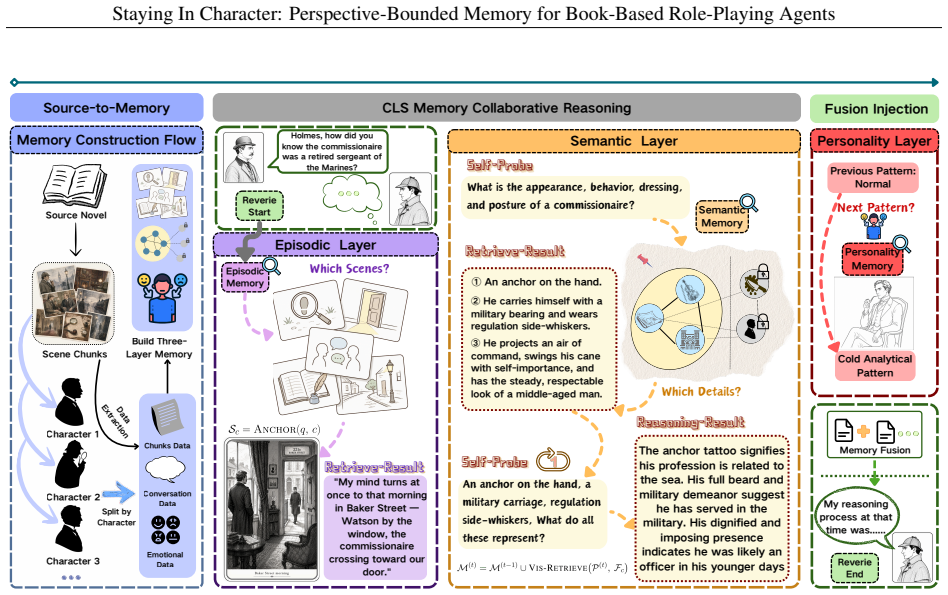
REVERIEMEM stores episodic memories as first-person scene records, semantic facts tagged by visibility to the character, and personality patterns that vary by context, allowing agents to respect the knowledge boundaries of book characters during long narrative interactions.
What carries the argument
Three-layer memory architecture that stores first-person scenes, visibility-tagged facts, and situation-dependent personality patterns to enforce perspective bounds.
Load-bearing premise
The new KBF-QA questions and BOOKWORLD protocol measure only the effect of the memory layers rather than differences in the underlying model or retrieval code.
What would settle it
An experiment that shows an agent using the three-layer memory still answers questions with facts visible only to other characters in the same novel.
Figures

read the original abstract
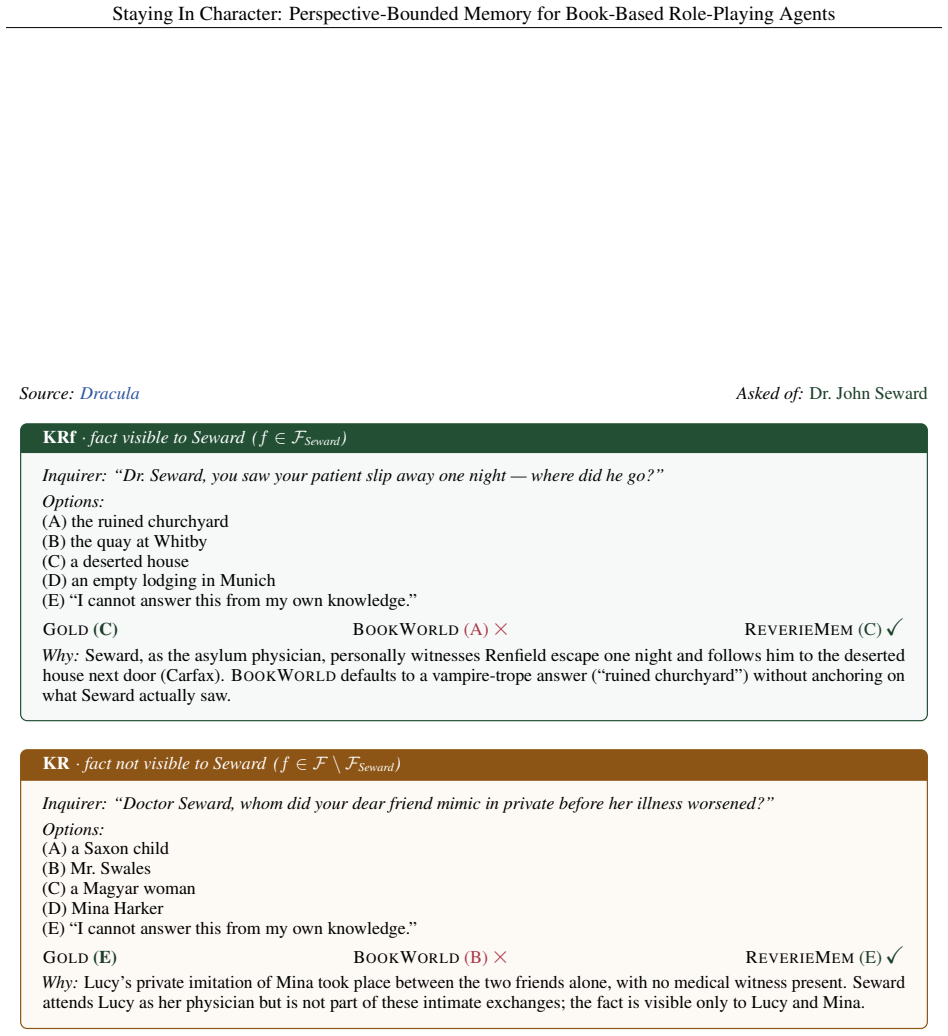
Recent LLM role-playing systems build character agents from novels by extracting characters, scenes, and relations. Yet long-narrative role-playing suffers from two failures: Factual Overreach, where shared retrieval or parametric memory lets a character use facts outside its perspective, and Stylistic Monotony, where profile descriptions flatten a character into a fixed voice. To address these failures, we propose REVERIEMEM, a three-layer memory architecture for book-based character agents. The episodic layer stores first-person scene memories; the semantic layer stores visibility-tagged facts; and the personality layer stores situation-dependent speech and behaviour patterns. For evaluation, we construct KBF-QA, a 4,386-question benchmark over eight novels for testing knowledge boundaries. REVERIEMEM improves Knowledge Boundary Fidelity by 34.6 percentage points over the strongest prior method. On BOOKWORLD's five-dimension pairwise narrative protocol, REVERIEMEM achieves a ~ 79% win rate, suggesting that perspective-bounded memory improves both boundary fidelity and character-grounded narrative generation.
Editorial analysis
A structured set of objections, weighed in public.
Referee Report
Summary. The paper proposes REVERIEMEM, a three-layer perspective-bounded memory architecture (episodic first-person scenes, semantic visibility-tagged facts, personality situation-dependent patterns) for LLM role-playing agents extracted from novels. It introduces the KBF-QA benchmark (4,386 questions over eight novels) to measure knowledge boundary fidelity and evaluates narrative quality via BOOKWORLD's five-dimension pairwise protocol, claiming a 34.6 percentage point KBF gain over the strongest baseline and a ~79% win rate.
Significance. If the quantitative claims are supported by controlled experiments that isolate the memory architecture, the work would offer a concrete mechanism for reducing factual overreach and stylistic flattening in book-derived agents, together with a reusable benchmark for perspective adherence. The layered design and benchmark construction represent potentially useful contributions to character consistency research.
major comments (2)
- [Abstract] Abstract: The headline claims of a 34.6pp KBF improvement and ~79% win rate are load-bearing for the central thesis yet supply no experimental protocol, baseline descriptions, LLM/prompt/retrieval controls, or statistical tests. Without these, it is impossible to determine whether the gains are attributable to the three-layer design rather than confounds.
- [Evaluation] Evaluation section (inferred from abstract claims): The KBF-QA and BOOKWORLD protocols are presented as isolating the effect of perspective-bounded memory, but no evidence is given that baselines share identical base models, system prompts, and retrieval implementations. This control is required to support the causal attribution stated in the abstract.
Simulated Author's Rebuttal
We thank the referee for the constructive feedback. The comments highlight the need for greater transparency in experimental controls to support causal claims about the memory architecture. We address each point below and will revise the manuscript accordingly to strengthen the presentation of results.
read point-by-point responses
-
Referee: [Abstract] Abstract: The headline claims of a 34.6pp KBF improvement and ~79% win rate are load-bearing for the central thesis yet supply no experimental protocol, baseline descriptions, LLM/prompt/retrieval controls, or statistical tests. Without these, it is impossible to determine whether the gains are attributable to the three-layer design rather than confounds.
Authors: We agree that the abstract, due to length constraints, omits key experimental details. The full protocols, baseline descriptions (including RAG, profile-only, and memory-augmented variants), LLM choices (GPT-4o and Llama-3-70B), prompt templates, retrieval implementations, and statistical significance tests (paired t-tests with p<0.01) are documented in Section 4 (Evaluation) and Appendix B. In the revision we will add one sentence to the abstract summarizing the shared experimental controls to make the claims more self-contained while preserving conciseness. revision: yes
-
Referee: [Evaluation] Evaluation section (inferred from abstract claims): The KBF-QA and BOOKWORLD protocols are presented as isolating the effect of perspective-bounded memory, but no evidence is given that baselines share identical base models, system prompts, and retrieval implementations. This control is required to support the causal attribution stated in the abstract.
Authors: All methods were run with identical base models, system prompts, and retrieval pipelines; only the memory component differed. This is stated in Section 4.1 (“Experimental Setup”) and Table 2. To address the concern directly, the revision will include an explicit paragraph confirming these controls and noting that any differences in performance are therefore attributable to the three-layer perspective-bounded design rather than implementation variance. revision: yes
Circularity Check
No circularity: empirical architecture evaluated on external benchmarks
full rationale
The paper proposes REVERIEMEM as a three-layer memory design and reports empirical gains on KBF-QA (4,386 questions) and BOOKWORLD protocol. No equations, fitted parameters, self-definitional loops, or load-bearing self-citations appear in the provided text. Claims rest on benchmark comparisons rather than any derivation that reduces to its own inputs by construction. The evaluation protocol is presented as an independent test of perspective-bounded memory, with no indication that results are forced by the architecture definition itself.
Axiom & Free-Parameter Ledger
Reference graph
Works this paper leans on
-
[1]
2025 , eprint=
BookWorld: From Novels to Interactive Agent Societies for Creative Story Generation , author=. 2025 , eprint=
2025
-
[2]
HippoRAG: Neurobiologically Inspired Long-Term Memory for Large Language Models , url =
Guti\'. HippoRAG: Neurobiologically Inspired Long-Term Memory for Large Language Models , url =. Advances in Neural Information Processing Systems , doi =
-
[4]
, author=
Why there are complementary learning systems in the hippocampus and neocortex: insights from the successes and failures of connectionist models of learning and memory. , author=. Psychological review , volume=. 1995 , publisher=
1995
-
[5]
, author=
The construction of autobiographical memories in the self-memory system. , author=. Psychological review , volume=. 2000 , publisher=
2000
-
[6]
Narrative Identity , volume =
Mcadams, Dan and McLean, Kate , year =. Narrative Identity , volume =. Current Directions in Psychological Science , doi =
-
[7]
Character- LLM : A Trainable Agent for Role-Playing
Shao, Yunfan and Li, Linyang and Dai, Junqi and Qiu, Xipeng. Character- LLM : A Trainable Agent for Role-Playing. Proceedings of the 2023 Conference on Empirical Methods in Natural Language Processing. 2023
2023
-
[9]
2025 , eprint=
OpenCharacter: Training Customizable Role-Playing LLMs with Large-Scale Synthetic Personas , author=. 2025 , eprint=
2025
-
[10]
2025 , editor =
Wang, Xintao and Wang, Heng and Zhang, Yifei and Yuan, Xinfeng and Xu, Rui and Huang, Jen-Tse and Yuan, Siyu and Guo, Haoran and Chen, Jiangjie and Zhou, Shuchang and Wang, Wei and Xiao, Yanghua , booktitle =. 2025 , editor =
2025
-
[15]
AgentVerse: Facilitating Multi-Agent Collaboration and Exploring Emergent Behaviors , url =
Chen, Weize and Su, Yusheng and Zuo, Jingwei and Yang, Cheng and Yuan, Chenfei and Chan, Chi-Min and Yu, Heyang and Lu, Yaxi and Hung, Yi-Hsin and Qian, Chen and Qin, Yujia and Cong, Xin and Xie, Ruobing and Liu, Zhiyuan and Sun, Maosong and Zhou, Jie , booktitle =. AgentVerse: Facilitating Multi-Agent Collaboration and Exploring Emergent Behaviors , url =
-
[18]
2026 , url=
RoleArena: A Multi-Agent Role-Playing Environment for Long Multi-Turn Dialogues with Autonomous Plot Progression , author=. 2026 , url=
2026
-
[19]
Retrieval-Augmented Generation for Knowledge-Intensive NLP Tasks , url =
Lewis, Patrick and Perez, Ethan and Piktus, Aleksandra and Petroni, Fabio and Karpukhin, Vladimir and Goyal, Naman and K\". Retrieval-Augmented Generation for Knowledge-Intensive NLP Tasks , url =. Advances in Neural Information Processing Systems , editor =
-
[20]
International conference on learning representations , volume=
Self-rag: Learning to retrieve, generate, and critique through self-reflection , author=. International conference on learning representations , volume=
-
[21]
RAPTOR: Recursive Abstractive Processing for Tree-Organized Retrieval , url =
Sarthi, Parth and Abdullah, Salman and Tuli, Aditi and Khanna, Shubh and Goldie, Anna and Manning, Christopher , booktitle =. RAPTOR: Recursive Abstractive Processing for Tree-Organized Retrieval , url =
-
[24]
2024 , eprint=
ERABAL: Enhancing Role-Playing Agents through Boundary-Aware Learning , author=. 2024 , eprint=
2024
-
[26]
NarrativePlay: Interactive Narrative Understanding
Runcong Zhao and Wenjia Zhang and Jiazheng Li and Lixing Zhu and Yanran Li and Yulan He and Lin Gui. NarrativePlay: Interactive Narrative Understanding. EACL 2024 - 18th Conference of the European Chapter of the Association for Computational Linguistics, Proceedings of System Demonstrations. 2024
2024
-
[27]
2026 , eprint=
OpenAI GPT-5 System Card , author=. 2026 , eprint=
2026
-
[28]
Qwen3.5: Accelerating Productivity with Native Multimodal Agents , url =
Qwen Team , month =. Qwen3.5: Accelerating Productivity with Native Multimodal Agents , url =
-
[29]
2025 , eprint=
DeepSeek-V3 Technical Report , author=. 2025 , eprint=
2025
-
[30]
Akari Asai, Zeqiu Wu, Yizhong Wang, Avi Sil, and Hannaneh Hajishirzi. 2024. Self-rag: Learning to retrieve, generate, and critique through self-reflection. In International conference on learning representations, volume 2024, pages 9112--9141
2024
-
[31]
Jing Chen, Xinyu Zhu, Cheng Yang, Chufan Shi, Yadong Xi, Yuxiang Zhang, Junjie Wang, Jiashu Pu, Tian Feng, Yujiu Yang, and Rongsheng Zhang. 2024 a . https://doi.org/10.18653/v1/2024.findings-emnlp.474 H o LLM wood: Unleashing the creativity of large language models in screenwriting via role playing . In Findings of the Association for Computational Lingui...
-
[32]
Weize Chen, Yusheng Su, Jingwei Zuo, Cheng Yang, Chenfei Yuan, Chi-Min Chan, Heyang Yu, Yaxi Lu, Yi-Hsin Hung, Chen Qian, Yujia Qin, Xin Cong, Ruobing Xie, Zhiyuan Liu, Maosong Sun, and Jie Zhou. 2024 b . https://proceedings.iclr.cc/paper_files/paper/2024/file/578e65cdee35d00c708d4c64bce32971-Paper-Conference.pdf Agentverse: Facilitating multi-agent colla...
2024
-
[33]
Martin A Conway and Christopher W Pleydell-Pearce. 2000. The construction of autobiographical memories in the self-memory system. Psychological review, 107(2):261
2000
-
[34]
DeepSeek-AI, Aixin Liu, Bei Feng, Bing Xue, Bingxuan Wang, Bochao Wu, Chengda Lu, Chenggang Zhao, Chengqi Deng, Chenyu Zhang, Chong Ruan, Damai Dai, Daya Guo, Dejian Yang, Deli Chen, Dongjie Ji, Erhang Li, Fangyun Lin, Fucong Dai, and 181 others. 2025. https://arxiv.org/abs/2412.19437 Deepseek-v3 technical report . Preprint, arXiv:2412.19437
Pith/arXiv arXiv 2025
-
[35]
Qiming Feng, Qiujie Xie, Xiaolong Wang, Qingqiu Li, Yuejie Zhang, Rui Feng, Tao Zhang, and Shang Gao. 2025. https://doi.org/10.18653/v1/2025.naacl-long.316 E mo C haracter: Evaluating the emotional fidelity of role-playing agents in dialogues . In Proceedings of the 2025 Conference of the Nations of the Americas Chapter of the Association for Computationa...
-
[36]
Bernal Jim\' e nez Guti\' e rrez, Yiheng Shu, Yu Gu, Michihiro Yasunaga, and Yu Su. 2024. https://doi.org/10.52202/079017-1902 Hipporag: Neurobiologically inspired long-term memory for large language models . In Advances in Neural Information Processing Systems, volume 37, pages 59532--59569. Curran Associates, Inc
-
[37]
u ttler, Mike Lewis, Wen-tau Yih, Tim Rockt\
Patrick Lewis, Ethan Perez, Aleksandra Piktus, Fabio Petroni, Vladimir Karpukhin, Naman Goyal, Heinrich K\" u ttler, Mike Lewis, Wen-tau Yih, Tim Rockt\" a schel, Sebastian Riedel, and Douwe Kiela. 2020. https://proceedings.neurips.cc/paper_files/paper/2020/file/6b493230205f780e1bc26945df7481e5-Paper.pdf Retrieval-augmented generation for knowledge-intens...
2020
-
[38]
Moxin Li, Yong Zhao, Wenxuan Zhang, Shuaiyi Li, Wenya Xie, See-Kiong Ng, Tat-Seng Chua, and Yang Deng. 2025. https://doi.org/10.18653/v1/2025.acl-long.256 Knowledge boundary of large language models: A survey . In Proceedings of the 63rd Annual Meeting of the Association for Computational Linguistics (Volume 1: Long Papers), pages 5131--5157, Vienna, Aust...
-
[39]
Wenhao Liu, Siyu An, Junru Lu, Muling Wu, Tianlong Li, Xiaohua Wang, Changze Lv, Xiaoqing Zheng, Di Yin, Xing Sun, and Xuanjing Huang. 2025. https://doi.org/10.18653/v1/2025.findings-acl.311 Tell me what you don ' t know: Enhancing refusal capabilities of role-playing agents via representation space analysis and editing . In Findings of the Association fo...
-
[40]
Dan Mcadams and Kate McLean. 2013. https://doi.org/10.1177/0963721413475622 Narrative identity . Current Directions in Psychological Science, 22:233--238
-
[41]
James L McClelland, Bruce L McNaughton, and Randall C O'Reilly. 1995. Why there are complementary learning systems in the hippocampus and neocortex: insights from the successes and failures of connectionist models of learning and memory. Psychological review, 102(3):419
1995
-
[42]
Generative agents: Interactive simulacra of human behavior,
Joon Sung Park, Joseph O'Brien, Carrie Jun Cai, Meredith Ringel Morris, Percy Liang, and Michael S. Bernstein. 2023. https://doi.org/10.1145/3586183.3606763 Generative agents: Interactive simulacra of human behavior . In Proceedings of the 36th Annual ACM Symposium on User Interface Software and Technology, UIST '23, New York, NY, USA. Association for Com...
-
[43]
Yiting Ran, Xintao Wang, Tian Qiu, Jiaqing Liang, Yanghua Xiao, and Deqing Yang. 2025. https://arxiv.org/abs/2504.14538 Bookworld: From novels to interactive agent societies for creative story generation . Preprint, arXiv:2504.14538
arXiv 2025
-
[44]
Parth Sarthi, Salman Abdullah, Aditi Tuli, Shubh Khanna, Anna Goldie, and Christopher Manning. 2024. https://proceedings.iclr.cc/paper_files/paper/2024/file/8a2acd174940dbca361a6398a4f9df91-Paper-Conference.pdf Raptor: Recursive abstractive processing for tree-organized retrieval . In International Conference on Learning Representations, volume 2024, page...
2024
-
[45]
Yunfan Shao, Linyang Li, Junqi Dai, and Xipeng Qiu. 2023. https://aclanthology.org/2023.emnlp-main.814/ Character- LLM : A trainable agent for role-playing . In Proceedings of the 2023 Conference on Empirical Methods in Natural Language Processing, pages 13153--13187, Singapore. Association for Computational Linguistics
2023
-
[46]
Aaditya Singh, Adam Fry, Adam Perelman, Adam Tart, Adi Ganesh, Ahmed El-Kishky, Aidan McLaughlin, Aiden Low, AJ Ostrow, Akhila Ananthram, Akshay Nathan, Alan Luo, Alec Helyar, Aleksander Madry, Aleksandr Efremov, Aleksandra Spyra, Alex Baker-Whitcomb, Alex Beutel, Alex Karpenko, and 467 others. 2026. https://arxiv.org/abs/2601.03267 Openai gpt-5 system ca...
Pith/arXiv arXiv 2026
-
[47]
Yihong Tang, Jiao Ou, Che Liu, Fuzheng Zhang, Di Zhang, and Kun Gai. 2024. https://arxiv.org/abs/2409.14710 Erabal: Enhancing role-playing agents through boundary-aware learning . Preprint, arXiv:2409.14710
arXiv 2024
-
[48]
Qwen Team. 2026. https://qwen.ai/blog?id=qwen3.5 Qwen3.5: Accelerating productivity with native multimodal agents
2026
-
[49]
Yu-Min Tseng, Yu-Chao Huang, Teng-Yun Hsiao, Wei-Lin Chen, Chao-Wei Huang, Yu Meng, and Yun-Nung Chen. 2024. https://doi.org/10.18653/v1/2024.findings-emnlp.969 Two tales of persona in LLM s: A survey of role-playing and personalization . In Findings of the Association for Computational Linguistics: EMNLP 2024, pages 16612--16631, Miami, Florida, USA. Ass...
-
[50]
Quan Tu, Shilong Fan, Zihang Tian, Tianhao Shen, Shuo Shang, Xin Gao, and Rui Yan. 2024. https://doi.org/10.18653/v1/2024.acl-long.638 C haracter E val: A C hinese benchmark for role-playing conversational agent evaluation . In Proceedings of the 62nd Annual Meeting of the Association for Computational Linguistics (Volume 1: Long Papers), pages 11836--118...
-
[51]
Juyuan Wang, Rongchen Zhao, Wei Wei, Yufeng Wang, Mo Yu, Jie Zhou, Jin Xu, and Liyan Xu. 2026. https://doi.org/10.1609/aaai.v40i39.40644 Comorag: A cognitive-inspired memory-organized rag for stateful long narrative reasoning . Proceedings of the AAAI Conference on Artificial Intelligence, 40(39):33557–33565
-
[52]
Noah Wang, Z.y. Peng, Haoran Que, Jiaheng Liu, Wangchunshu Zhou, Yuhan Wu, Hongcheng Guo, Ruitong Gan, Zehao Ni, Jian Yang, Man Zhang, Zhaoxiang Zhang, Wanli Ouyang, Ke Xu, Wenhao Huang, Jie Fu, and Junran Peng. 2024 a . https://doi.org/10.18653/v1/2024.findings-acl.878 R ole LLM : Benchmarking, eliciting, and enhancing role-playing abilities of large lan...
-
[53]
Xiaoyang Wang, Hongming Zhang, Tao Ge, Wenhao Yu, Dian Yu, and Dong Yu. 2025 a . https://arxiv.org/abs/2501.15427 Opencharacter: Training customizable role-playing llms with large-scale synthetic personas . Preprint, arXiv:2501.15427
arXiv 2025
-
[54]
Xintao Wang, Heng Wang, Yifei Zhang, Xinfeng Yuan, Rui Xu, Jen-Tse Huang, Siyu Yuan, Haoran Guo, Jiangjie Chen, Shuchang Zhou, Wei Wang, and Yanghua Xiao. 2025 b . https://proceedings.mlr.press/v267/wang25dk.html C o SER : Coordinating LLM -based persona simulation of established roles . In Proceedings of the 42nd International Conference on Machine Learn...
2025
-
[55]
Xintao Wang, Yunze Xiao, Jen-tse Huang, Siyu Yuan, Rui Xu, Haoran Guo, Quan Tu, Yaying Fei, Ziang Leng, Wei Wang, Jiangjie Chen, Cheng Li, and Yanghua Xiao. 2024 b . https://doi.org/10.18653/v1/2024.acl-long.102 I n C haracter: Evaluating personality fidelity in role-playing agents through psychological interviews . In Proceedings of the 62nd Annual Meeti...
-
[56]
Haotian Xia, Hao Peng, Yunjia Qi, Bin Xu, Juanzi Li, Hou Lei, and Xiaozhi Wang. 2025. https://doi.org/10.1145/3746252.3761616 Storywriter: A multi-agent framework for long story generation . In Proceedings of the 34th ACM International Conference on Information and Knowledge Management, CIKM '25, page 6559–6563, New York, NY, USA. Association for Computin...
-
[57]
Qi Zhao, Jian Li, Yizhang Jin, Dongqi Liu, Hang Ding, Qi Song, and Xiangyang Li. 2026. https://openreview.net/forum?id=o1idr3SbjG Rolearena: A multi-agent role-playing environment for long multi-turn dialogues with autonomous plot progression
2026
-
[58]
Runcong Zhao, Wenjia Zhang, Jiazheng Li, Lixing Zhu, Yanran Li, Yulan He, and Lin Gui. 2024. NarrativePlay: Interactive Narrative Understanding, pages 82--93. EACL 2024 - 18th Conference of the European Chapter of the Association for Computational Linguistics, Proceedings of System Demonstrations. Association for Computational Linguistics (ACL). Publisher...
2024
discussion (0)
Sign in with ORCID, Apple, or X to comment. Anyone can read and Pith papers without signing in.