Search for long-lived particles decaying into muons in proton-proton collisions at sqrt{s} = 13.6 TeV using data scouting
Pith reviewed 2026-06-25 19:34 UTC · model grok-4.3
The pith
No significant excess of displaced dimuon events is found in 13.6 TeV data, yielding new upper limits on branching fractions for long-lived particles in several beyond-standard-model scenarios.
A machine-rendered reading of the paper's core claim, the machinery that carries it, and where it could break.
Core claim
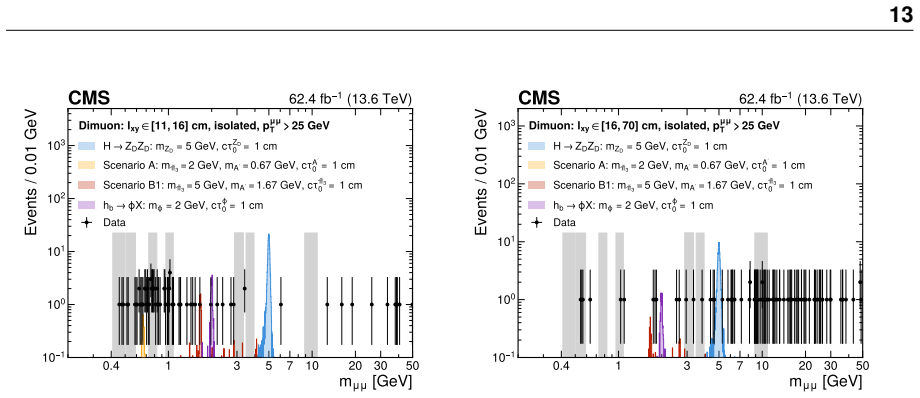
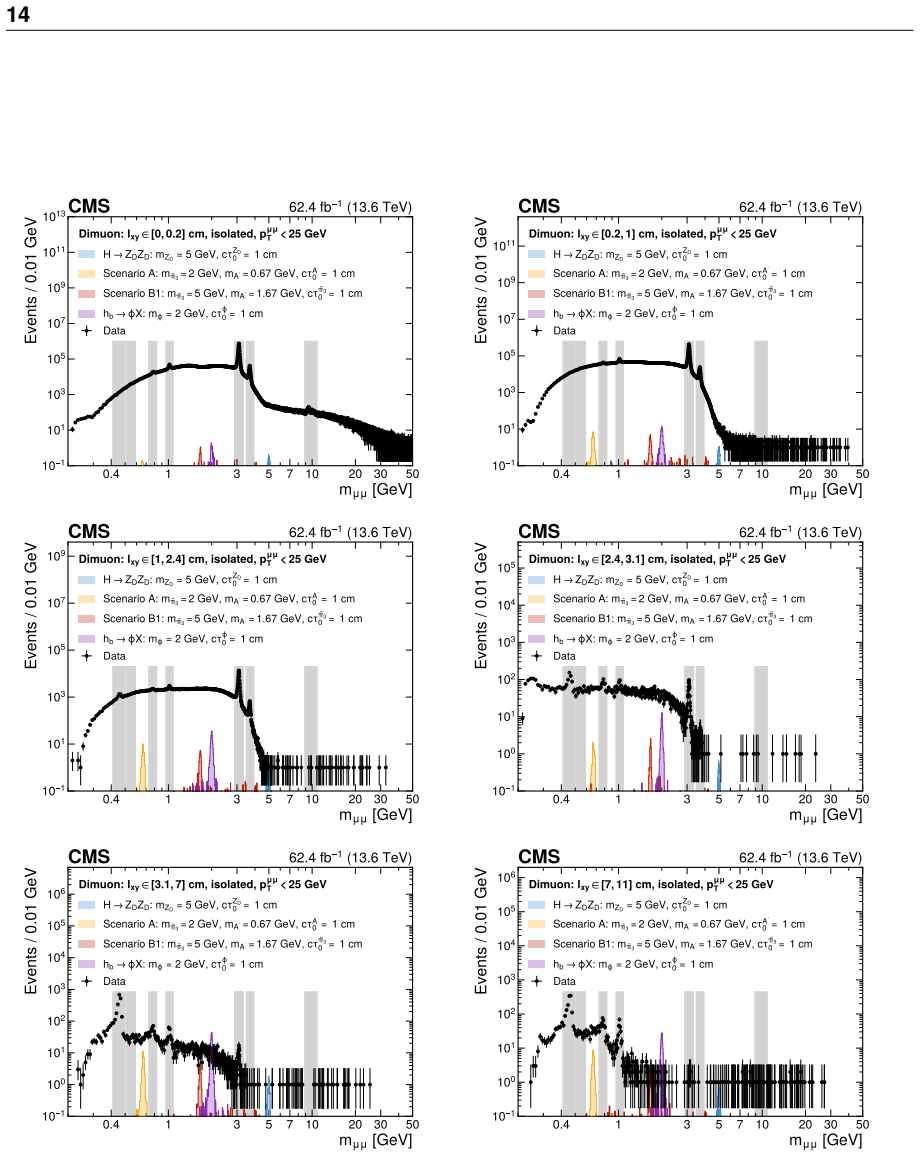
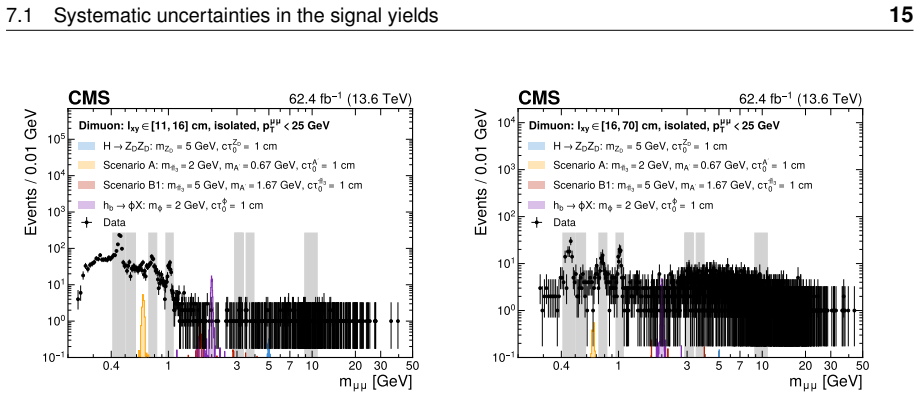
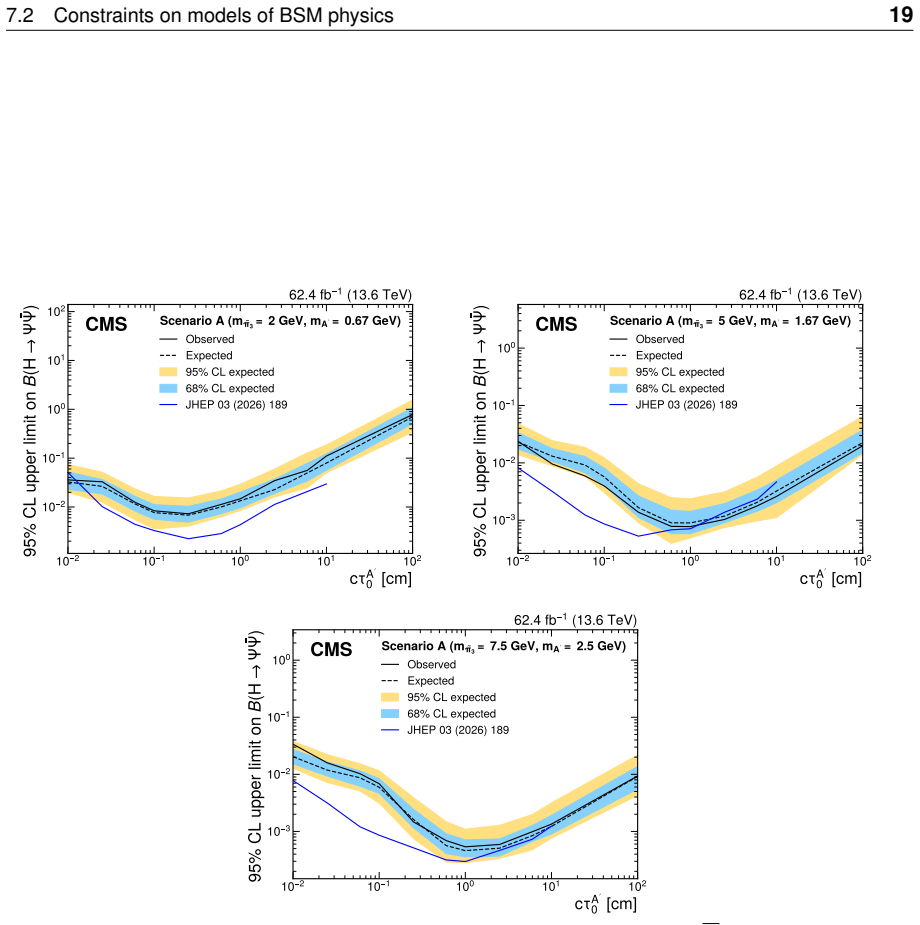
Using proton-proton collisions at 13.6 TeV collected with low-threshold dimuon scouting triggers, corresponding to 62.4 fb inverse, no significant excess of events with displaced dimuons above the standard model prediction is observed. Upper limits at 95 percent confidence level are therefore placed on branching fractions in models where the Higgs boson decays to long-lived dark photons or to dark partons yielding showers of long-lived particles, and where a long-lived scalar resonance arises from b-hadron decay.
What carries the argument
The dimuon data scouting trigger stream, which records reduced event information at the high-level trigger to access low multimuon invariant mass and nonzero displacement from the primary vertex.
If this is right
- Branching fraction limits on Higgs decays to long-lived dark photons are strengthened in multiple mass and lifetime regions.
- Constraints apply to models in which the Higgs decays to dark partons that produce showers containing long-lived particles.
- Upper limits are set on the production rate of long-lived scalar resonances from b-hadron decays.
- The scouting approach extends experimental reach to lower masses and shorter lifetimes than conventional triggers.
Where Pith is reading between the lines
- If these particles exist at all, their couplings or lifetimes must lie below the excluded values in the tested models.
- Additional integrated luminosity in future LHC runs would allow the same method to probe smaller branching fractions.
- The scouting technique could be adapted to search for long-lived particles decaying to other final states at hadron colliders.
Load-bearing premise
The standard model background prediction for displaced dimuons in the scouting stream is accurate and the trigger plus reconstruction efficiencies for low-pT displaced vertices are correctly modeled without large unaccounted systematics.
What would settle it
A statistically significant excess of events above background in the displaced dimuon sample, with mass and lifetime distributions matching one of the tested signal hypotheses, would indicate the presence of long-lived particles.
Figures






read the original abstract
A search for long-lived particles decaying into muons is performed using proton-proton collisions at $\sqrt{s}$ = 13.6 TeV, collected by the CMS experiment at the LHC in 2022 and 2023, corresponding to an integrated luminosity of 62.4 fb$^{-1}$. The data were collected using dedicated dimuon triggers with low transverse momentum thresholds, recorded with a high-rate data scouting trigger stream. This data stream retains a reduced amount of information at the high-level trigger, to explore otherwise inaccessible phase space at low multimuon invariant mass and nonzero displacement from the primary interaction vertex. No significant excess of events above the standard model prediction is found. Upper limits on branching fractions at 95% confidence level are set for a wide range of mass and lifetime hypotheses in several beyond the standard model frameworks, where the Higgs boson decays into long-lived dark photons or into dark partons that produce showers containing long-lived particles, or where a long-lived scalar resonance is produced from the decay of a b hadron. The resulting constraints improve and extend existing ones in large regions of the parameter space.
Editorial analysis
A structured set of objections, weighed in public.
Referee Report
Summary. The manuscript reports a search for long-lived particles decaying to muons in 13.6 TeV pp collisions with the CMS experiment, using 62.4 fb^{-1} of 2022-2023 data collected via dedicated low-pT dimuon triggers in the data scouting stream. This enables access to low multimuon invariant mass and nonzero displacement from the primary vertex. No significant excess above the SM prediction is observed, and 95% CL upper limits on branching fractions are set for BSM scenarios including Higgs decays to long-lived dark photons or dark partons, and long-lived scalars from b-hadron decays, improving existing constraints over wide regions of mass-lifetime parameter space.
Significance. The data scouting approach is a clear strength, allowing exploration of otherwise inaccessible low-pT displaced dimuon phase space. If the background modeling and efficiencies are robust, the resulting limits meaningfully extend constraints on LLP models in the low-mass regime.
major comments (1)
- [Background estimation and efficiency modeling (inferred from abstract and search description)] The null-result claim and derived 95% CL limits rest on the accuracy of the SM background prediction for displaced dimuons in the scouting stream (abstract and search description). The manuscript must provide quantitative validation of the data-driven background method, including closure tests or control-region comparisons specifically in the low-pT, low-mass, nonzero-displacement regime, to demonstrate control over potential systematics from material interactions or fake vertices.
Simulated Author's Rebuttal
We thank the referee for their positive assessment of the data scouting approach and for the constructive comment on background validation. We address the major comment below and will strengthen the manuscript accordingly.
read point-by-point responses
-
Referee: [Background estimation and efficiency modeling (inferred from abstract and search description)] The null-result claim and derived 95% CL limits rest on the accuracy of the SM background prediction for displaced dimuons in the scouting stream (abstract and search description). The manuscript must provide quantitative validation of the data-driven background method, including closure tests or control-region comparisons specifically in the low-pT, low-mass, nonzero-displacement regime, to demonstrate control over potential systematics from material interactions or fake vertices.
Authors: We agree that quantitative validation of the data-driven background method is essential to support the null result and the 95% CL limits. The manuscript describes the background estimation procedure and includes validation in control regions. To directly address the referee's request for explicit tests in the low-pT, low-mass, nonzero-displacement regime and to demonstrate control over material interactions and fake vertices, we will expand the relevant section with additional closure tests, control-region comparisons, and quantitative metrics in the revised manuscript. revision: yes
Circularity Check
No circularity: experimental search is data-driven comparison with no self-referential derivation
full rationale
The paper performs a direct experimental search comparing observed dimuon events in the scouting stream to standard model background predictions, finding no excess and setting limits. No step in the analysis chain (trigger, reconstruction, background estimation, efficiency modeling, or limit setting) reduces by the paper's own equations or self-citation to a fitted input renamed as a prediction. Background estimation and efficiencies are external to the target BSM signals; the null result and limits are falsifiable against independent data. This matches the default expectation for non-circular experimental papers.
Axiom & Free-Parameter Ledger
axioms (2)
- domain assumption Standard model processes accurately predict the background rate of displaced dimuon events in the scouting stream.
- domain assumption Trigger and reconstruction efficiencies for low-pT displaced muons are correctly modeled by simulation and data-driven methods.
Reference graph
Works this paper leans on
-
[1]
Silk et al.,Particle Dark Matter: Observations, Models and Searches, Cambridge Univ
G. Bertone and J. Silk, “Particle dark matter: Observations, models and searches”. Cambridge Univ. Press, Cambridge, 2010.doi:10.1017/CBO9780511770739, ISBN 978-1-107-65392-4. 24
-
[2]
Dark Matter Candidates from Particle Physics and Methods of Detection
J. L. Feng, “Dark matter candidates from particle physics and methods of detection”, Ann. Rev. Astron. Astrophys.48(2010) 495, doi:10.1146/annurev-astro-082708-101659,arXiv:1003.0904
work page internal anchor Pith review Pith/arXiv arXiv doi:10.1146/annurev-astro-082708-101659 2010
-
[3]
Dark Matter Searches with Astroparticle Data
T. A. Porter, R. P . Johnson, and P . W. Graham, “Dark matter searches with astroparticle data”,Ann. Rev. Astron. Astrophys.49(2011) 155, doi:10.1146/annurev-astro-081710-102528,arXiv:1104.2836
work page internal anchor Pith review Pith/arXiv arXiv doi:10.1146/annurev-astro-081710-102528 2011
-
[4]
Planck 2015 results. XIII. Cosmological parameters
Planck Collaboration, “Planck 2015 results. XIII. Cosmological parameters”,Astron. Astrophys.594(2016) A13,doi:10.1051/0004-6361/201525830, arXiv:1502.01589
work page internal anchor Pith review Pith/arXiv arXiv doi:10.1051/0004-6361/201525830 2015
-
[5]
Working group report: New light weakly coupled particles
R. Essig et al., “Working group report: New light weakly coupled particles”, inProc. Community Summer Study 2013: Snowmass on the Mississippi. 2013.arXiv:1311.0029
Pith/arXiv arXiv 2013
-
[6]
Illuminating Dark Photons with High-Energy Colliders
D. Curtin, R. Essig, S. Gori, and J. Shelton, “Illuminating dark photons with high-energy colliders”,JHEP02(2015) 157,doi:10.1007/JHEP02(2015)157, arXiv:1412.0018
work page internal anchor Pith review Pith/arXiv arXiv doi:10.1007/jhep02(2015)157 2015
-
[7]
Dark sector searches with the CMS experiment
CMS Collaboration, “Dark sector searches with the CMS experiment”,Phys. Rept.1115 (2025) 448,doi:10.1016/j.physrep.2024.09.013,arXiv:2405.13778
-
[8]
Scouting for dark showers at CMS and LHCb
S. Born, R. Karur, S. Knapen, and J. Shelton, “Scouting for dark showers at CMS and LHCb”,Phys. Rev. D108(2023) 035034,doi:10.1103/PhysRevD.108.035034, arXiv:2303.04167
-
[9]
Search for neutral particles in electron beam dump experiment
A. Konaka et al., “Search for neutral particles in electron beam dump experiment”,Phys. Rev. Lett.57(1986) 659,doi:10.1103/PhysRevLett.57.659
-
[10]
Search for a new gauge boson in the $A'$ Experiment (APEX)
APEX Collaboration, “Search for a new gauge boson in electron-nucleus fixed-target scattering by the APEX experiment”,Phys. Rev. Lett.107(2011) 191804, doi:10.1103/PhysRevLett.107.191804,arXiv:1108.2750
work page internal anchor Pith review Pith/arXiv arXiv doi:10.1103/physrevlett.107.191804 2011
-
[11]
Search for Dimuon Decays of a Light Scalar Boson in Radiative Transitions Upsilon -> gamma A0
BaBar Collaboration, “Search for dimuon decays of a light scalar boson in radiative transitionsΥ→γA 0”,Phys. Rev. Lett.103(2009) 081803, doi:10.1103/PhysRevLett.103.081803,arXiv:0905.4539
work page internal anchor Pith review Pith/arXiv arXiv doi:10.1103/physrevlett.103.081803 2009
-
[12]
SINDRUM I Collaboration, “Search for weakly interacting neutral bosons produced in π −p interactions at rest and decaying into e +e− pairs”,Phys. Rev. Lett.68(1992) 3845, doi:10.1103/PhysRevLett.68.3845
-
[13]
Inclusive Dark Photon Search at LHCb
LHCb Collaboration, “Proposed inclusive dark photon search at LHCb”,Phys. Rev. Lett. 116(2016) 251803,doi:10.1103/PhysRevLett.116.251803,arXiv:1603.08926
work page internal anchor Pith review Pith/arXiv arXiv doi:10.1103/physrevlett.116.251803 2016
-
[14]
Search for dark photons produced in 13 TeV $pp$ collisions
LHCb Collaboration, “Search for dark photons produced in 13 TeV pp collisions”,Phys. Rev. Lett.120(2018) 061801,doi:10.1103/PhysRevLett.120.061801, arXiv:1710.02867
work page internal anchor Pith review Pith/arXiv arXiv doi:10.1103/physrevlett.120.061801 2018
-
[15]
LHCb Collaboration, “Search for A ′ →µ +µ− decays”,Phys. Rev. Lett.124(2020) 041801, doi:10.1103/PhysRevLett.124.041801,arXiv:1910.06926
-
[16]
ATLAS Collaboration, “Search for light long-lived neutral particles that decay to collimated pairs of leptons or light hadrons in pp collisions at √s=13 TeV with the ATLAS detector”,JHEP06(2023) 153,doi:10.1007/JHEP06(2023)153, arXiv:2206.12181. References 25
-
[17]
CMS Collaboration, “Search for a narrow resonance lighter than 200 GeV decaying to a pair of muons in proton-proton collisions at √s=13 TeV”,Phys. Rev. Lett.124(2020) 131802,doi:10.1103/PhysRevLett.124.131802,arXiv:1912.04776
-
[18]
CMS Collaboration, “Search for long-lived particles decaying into muon pairs in proton-proton collisions at √s=13 TeV collected with a dedicated high-rate data stream”,JHEP04(2022) 062,doi:10.1007/JHEP04(2022)062, arXiv:2112.13769
-
[19]
CMS Collaboration, “Search for direct production of GeV-scale resonances decaying to a pair of muons in proton-proton collisions at √s=13 TeV”,JHEP12(2023) 070, doi:10.1007/JHEP12(2023)070,arXiv:2309.16003
-
[20]
CMS Collaboration, “Search for long-lived particles decaying to final states with a pair of muons in proton-proton collisions at √s=13.6 TeV”,JHEP05(2024) 047, doi:10.1007/JHEP05(2024)047,arXiv:2402.14491
-
[21]
CMS Collaboration, “Search for low-mass hidden-valley dark showers with non-prompt muon pairs in proton-proton collisions at √s=13 TeV”,JHEP03(2026) 189, doi:10.1007/JHEP03(2026)189,arXiv:2511.11888
-
[22]
Light inflaton after LHC8 and WMAP9 results
F. Bezrukov and D. Gorbunov, “Light inflaton after LHC8 and WMAP9 results”,JHEP 07(2013) 140,doi:10.1007/JHEP07(2013)140,arXiv:1303.4395
work page internal anchor Pith review Pith/arXiv arXiv doi:10.1007/jhep07(2013)140 2013
-
[23]
Searching for exotic B meson decays with the CMS L1 track trigger
J. A. Evans, A. Gandrakota, S. Knapen, and H. Routray, “Searching for exotic B meson decays with the CMS L1 track trigger”,Phys. Rev. D103(2021) 015026, doi:10.1103/PhysRevD.103.015026,arXiv:2008.06918
-
[24]
Search for axion like particle production in 400 GeV proton-copper interactions
CHARM Collaboration, “Search for axion like particle production in 400 GeV proton-copper interactions”,Phys. Lett. B157(1985) 458, doi:10.1016/0370-2693(85)90400-9
-
[25]
Search for hidden-sector bosons in $B^0 \!\to K^{*0}\mu^+\mu^-$ decays
LHCb Collaboration, “Search for hidden-sector bosons in B 0 →K ∗0µ+µ− decays”,Phys. Rev. Lett.115(2015) 161802,doi:10.1103/PhysRevLett.115.161802, arXiv:1508.04094
work page internal anchor Pith review Pith/arXiv arXiv doi:10.1103/physrevlett.115.161802 2015
-
[26]
Search for long-lived scalar particles in $B^+ \to K^+ \chi (\mu^+\mu^-)$ decays
LHCb Collaboration, “Search for long-lived scalar particles in B + →K +χ (µ+µ−) decays”,Phys. Rev. D95(2017) 071101,doi:10.1103/PhysRevD.95.071101, arXiv:1612.07818
work page internal anchor Pith review Pith/arXiv arXiv doi:10.1103/physrevd.95.071101 2017
-
[27]
Enriching the physics program of the CMS experiment via data scouting and data parking
CMS Collaboration, “Enriching the physics program of the CMS experiment via data scouting and data parking”,Phys. Rept.1115(2025) 678, doi:10.1016/j.physrep.2024.09.006,arXiv:2403.16134
-
[28]
HEPData record for this analysis, 2026.doi:10.17182/hepdata.169181
-
[29]
Particle-flow reconstruction and global event description with the CMS detector
CMS Collaboration, “Particle-flow reconstruction and global event description with the CMS detector”,JINST12(2017) P10003,doi:10.1088/1748-0221/12/10/P10003, arXiv:1706.04965
work page internal anchor Pith review Pith/arXiv arXiv doi:10.1088/1748-0221/12/10/p10003 2017
-
[30]
The CMS phase-1 pixel detector upgrade
Tracker Group of the CMS Collaboration, “The CMS phase-1 pixel detector upgrade”, JINST16(2021) P02027,doi:10.1088/1748-0221/16/02/P02027, arXiv:2012.14304. 26
-
[31]
The CMS experiment at the CERN LHC
CMS Collaboration, “The CMS experiment at the CERN LHC”,JINST3(2008) S08004, doi:10.1088/1748-0221/3/08/S08004
-
[32]
Development of the CMS detector for the CERN LHC Run 3
CMS Collaboration, “Development of the CMS detector for the CERN LHC Run 3”, JINST19(2024) P05064,doi:10.1088/1748-0221/19/05/P05064, arXiv:2309.05466
-
[33]
Performance of the CMS Level-1 trigger in proton-proton collisions at √s=13 TeV
CMS Collaboration, “Performance of the CMS Level-1 trigger in proton-proton collisions at √s=13 TeV”,JINST15(2020) P10017,doi:10.1088/1748-0221/15/10/P10017, arXiv:2006.10165
-
[34]
CMS Collaboration, “The CMS trigger system”,JINST12(2017) P01020, doi:10.1088/1748-0221/12/01/P01020,arXiv:1609.02366
work page internal anchor Pith review Pith/arXiv arXiv doi:10.1088/1748-0221/12/01/p01020 2017
-
[35]
Performance of the CMS high-level trigger during LHC Run 2
CMS Collaboration, “Performance of the CMS high-level trigger during LHC Run 2”, JINST19(2024) P11021,doi:10.1088/1748-0221/19/11/P11021, arXiv:2410.17038
-
[36]
CMS Collaboration, “Strategy and performance of the CMS long-lived particle trigger program in proton-proton collisions at √s=13.6 TeV”, 2026.arXiv:2601.17544. Submitted toPhys. Rept
arXiv 2026
-
[37]
J. Alwall et al., “The automated computation of tree-level and next-to-leading order differential cross sections, and their matching to parton shower simulations”,JHEP07 (2014) 079,doi:10.1007/JHEP07(2014)079,arXiv:1405.0301
work page internal anchor Pith review Pith/arXiv arXiv doi:10.1007/jhep07(2014)079 2014
-
[38]
Higgs Physics at the HL-LHC and HE-LHC
M. Cepeda et al., “Report from working group 2: Higgs physics at the HL-LHC and HE-LHC”,CERN Y ellow Rep. Monogr.7(2019) 221, doi:10.23731/CYRM-2019-007.221,arXiv:1902.00134
work page internal anchor Pith review Pith/arXiv arXiv doi:10.23731/cyrm-2019-007.221 2019
-
[39]
Ad interim recommendations for the Higgs boson production cross sections at √s=13.6 TeV
A. Karlberg et al., “Ad interim recommendations for the Higgs boson production cross sections at √s=13.6 TeV”, 2024.arXiv:2402.09955
arXiv 2024
-
[40]
A comprehensive guide to the physics and usage of PYTHIA 8.3
C. Bierlich et al., “A comprehensive guide to the physics and usage ofPYTHIA8.3”, SciPost Phys. Codeb.2022(2022) 8,doi:10.21468/SciPostPhysCodeb.8, arXiv:2203.11601
work page internal anchor Pith review Pith/arXiv arXiv doi:10.21468/scipostphyscodeb.8 2022
-
[41]
Extraction and validation of a new set of CMS PYTHIA8 tunes from underlying-event measurements
CMS Collaboration, “Extraction and validation of a new set of CMSPYTHIA8 tunes from underlying-event measurements”,Eur. Phys. J. C80(2020) 4, doi:10.1140/epjc/s10052-019-7499-4,arXiv:1903.12179
-
[42]
Parton distri- butions for the LHC Run II,
NNPDF Collaboration, “Parton distributions from high-precision collider data”,Eur. Phys. J. C77(2017) 663,doi:10.1140/epjc/s10052-017-5199-5, arXiv:1706.00428
work page internal anchor Pith review Pith/arXiv arXiv doi:10.1140/epjc/s10052-017-5199-5 2017
-
[43]
GEANT4 Collaboration, “GEANT4—a simulation toolkit”,Nucl. Instrum. Meth. A506 (2003) 250,doi:10.1016/S0168-9002(03)01368-8
-
[44]
A study of the reactionsψ ′ →γγψ
M. J. Oreglia, “A study of the reactionsψ ′ →γγψ”. PhD thesis, Stanford University,
-
[45]
SLAC Report SLAC-R-236, see Appendix D
-
[46]
Charmonium spectroscopy from radiative decays of the J/ψandψ ′
J. E. Gaiser, “Charmonium spectroscopy from radiative decays of the J/ψandψ ′”. PhD thesis, Stanford University, 1982. SLAC Report SLAC-R-255. References 27
1982
-
[47]
On the interpretation ofχ 2 from contingency tables, and the calculation of P
R. A. Fisher, “On the interpretation ofχ 2 from contingency tables, and the calculation of P”,J. R. Stat. Soc85(1922) 87,doi:10.1098/rsta.1922.0009
-
[48]
Trial factors for the look elsewhere effect in high energy physics
E. Gross and O. Vitells, “Trial factors for the look elsewhere effect in high energy physics”,Eur. Phys. J. C70(2010) 525,doi:10.1140/epjc/s10052-010-1470-8, arXiv:1005.1891
work page internal anchor Pith review Pith/arXiv arXiv doi:10.1140/epjc/s10052-010-1470-8 2010
-
[49]
Handling uncertainties in background shapes: the discrete profiling method
P . D. Dauncey, M. Kenzie, N. Wardle, and G. J. Davies, “Handling uncertainties in background shapes: the discrete profiling method”,JINST10(2015) P04015, doi:10.1088/1748-0221/10/04/P04015,arXiv:1408.6865
work page internal anchor Pith review Pith/arXiv arXiv doi:10.1088/1748-0221/10/04/p04015 2015
-
[50]
Confidence Level Computation for Combining Searches with Small Statistics
T. Junk, “Confidence level computation for combining searches with small statistics”, Nucl. Instrum. Meth. A434(1999) 435,doi:10.1016/S0168-9002(99)00498-2, arXiv:hep-ex/9902006
work page internal anchor Pith review Pith/arXiv arXiv doi:10.1016/s0168-9002(99)00498-2 1999
-
[51]
Presentation of search results: theCL s technique
A. L. Read, “Presentation of search results: The CL s technique”,J. Phys. G28(2002) 2693, doi:10.1088/0954-3899/28/10/313
-
[52]
Procedure for the LHC Higgs boson search combination in summer 2011
ATLAS and CMS Collaborations, “Procedure for the LHC Higgs boson search combination in summer 2011”, ATL-PHYS-PUB-2011-011, CMS NOTE-2011/005, 2011
2011
-
[53]
The CMS statistical analysis and combination tool: COMBINE
CMS Collaboration, “The CMS statistical analysis and combination tool: COMBINE”, Comput. Softw. Big Sci.8(2024) 19,doi:10.1007/s41781-024-00121-4, arXiv:2404.06614
-
[54]
The ROOFITtoolkit for data modeling
W. Verkerke and D. Kirkby, “The ROOFITtoolkit for data modeling”, inProc. 13th International Conference on Computing in High Energy and Nuclear Physics (CHEP 2003): La Jolla CA, United States, March 24–28, 2003. 2003.arXiv:physics/0306116
Pith/arXiv arXiv 2003
-
[55]
L. Moneta et al., “The ROOSTATSproject”, inProc. 13th International Workshop on Advanced Computing and Analysis T echniques in Physics Research (ACAT 2010): Jaipur, India, February 22–27, 2010. 2010.arXiv:1009.1003.doi:10.22323/1.093.0057
work page internal anchor Pith review Pith/arXiv arXiv doi:10.22323/1.093.0057 2010
-
[56]
Precision luminosity measurement in proton-proton collisions at√s=13 TeV in 2015 and 2016 at CMS
CMS Collaboration, “Precision luminosity measurement in proton-proton collisions at√s=13 TeV in 2015 and 2016 at CMS”,Eur. Phys. J. C81(2021) 800, doi:10.1140/epjc/s10052-021-09538-2,arXiv:2104.01927
-
[57]
Luminosity measurement in proton-proton collisions at 13.6 TeV in 2022 at CMS
CMS Collaboration, “Luminosity measurement in proton-proton collisions at 13.6 TeV in 2022 at CMS”, CMS Physics Analysis Summary, CMS-PAS-LUM-22-001, 2024
2022
-
[58]
Measurement of the offline integrated luminosity for the CMS proton-proton collision dataset recorded in 2023
CMS Collaboration, “Measurement of the offline integrated luminosity for the CMS proton-proton collision dataset recorded in 2023”, CMS Detector Performance Note, CMS-DP-2024-068, 2024. 28 29 A The CMS Collaboration Yerevan Physics Institute, Yerevan, Armenia A. Gevorgyan , A. Hayrapetyan, V . Makarenko , A. Tumasyan1 Marietta Blau Institute for Particle ...
2023
discussion (0)
Sign in with ORCID, Apple, or X to comment. Anyone can read and Pith papers without signing in.