A Methodology for Integrating Life Cycle Assessment into a Multidisciplinary Design Analysis and Optimization Framework for Sustainable Launcher Development
Pith reviewed 2026-06-25 19:18 UTC · model grok-4.3
The pith
Parametric life-cycle inventories let LCA run as a discipline inside launch vehicle MDAO optimization.
A machine-rendered reading of the paper's core claim, the machinery that carries it, and where it could break.
Core claim
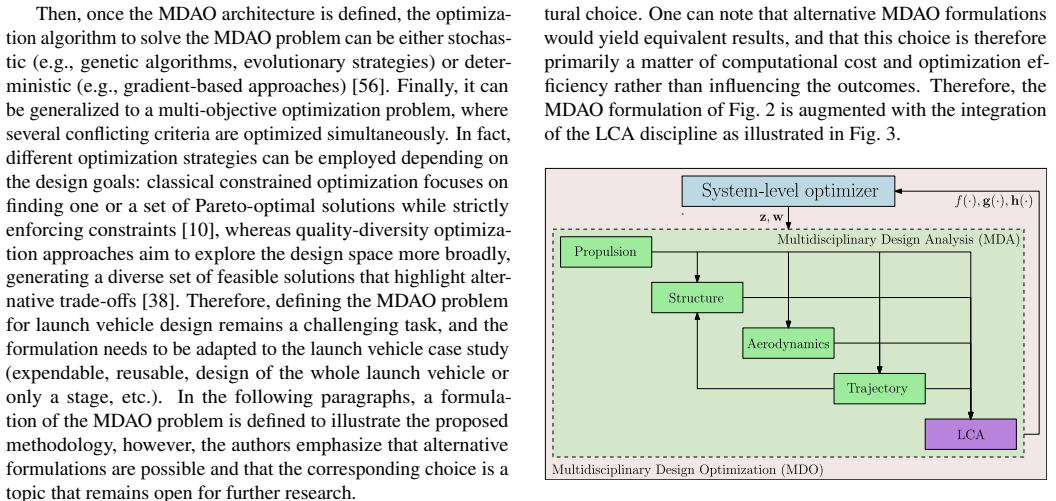
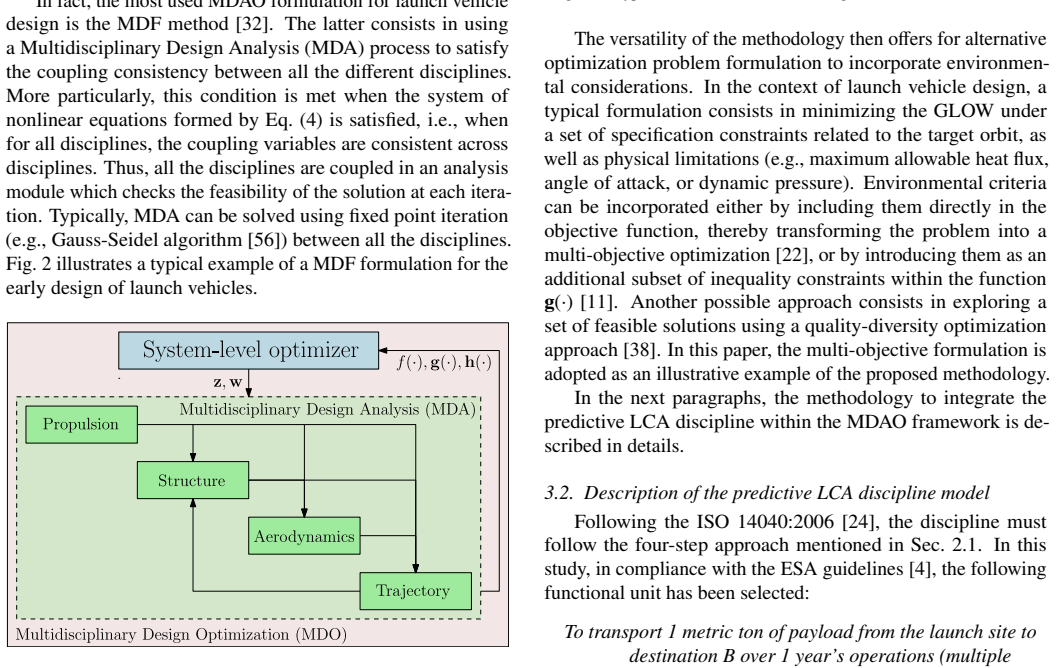
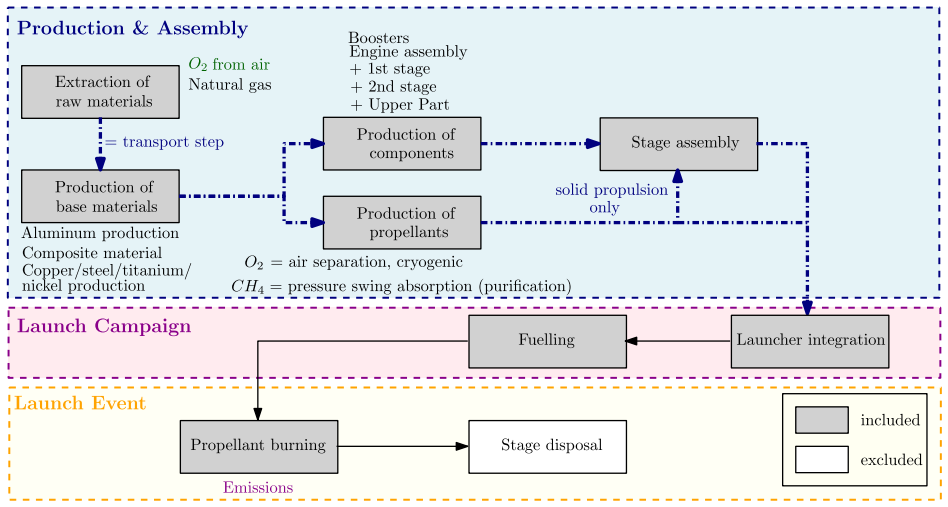
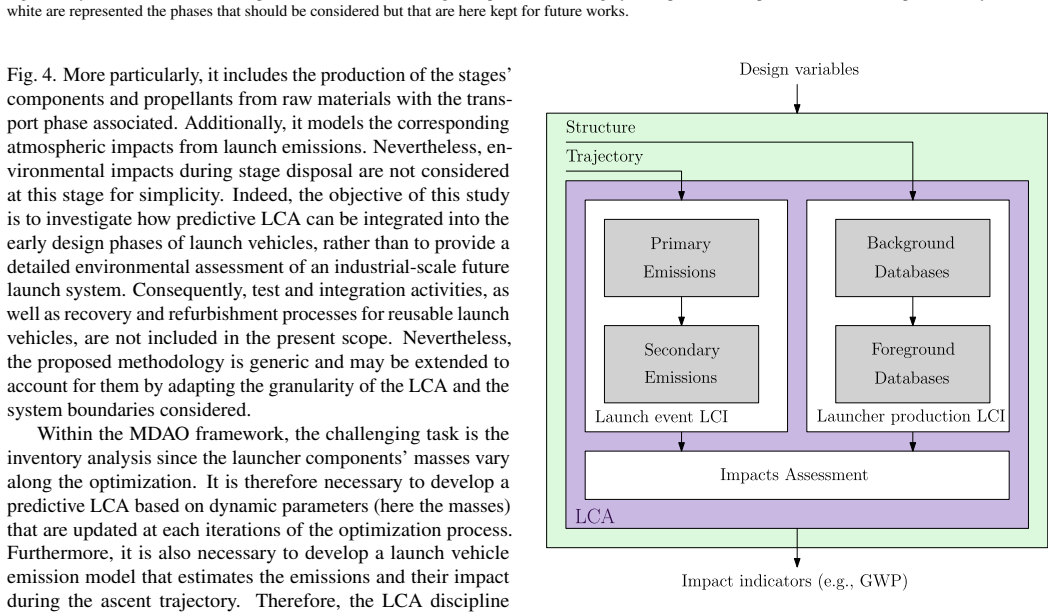
The methodology integrates an LCA discipline within an MDAO framework for launch vehicle design. The approach relies on parametric life-cycle inventories depending on design and coupling variables, covering component and propellant production as well as transport to the launch site. Launch emissions are evaluated from optimized trajectory profiles and characterized in terms of climate change impact. The methodology is illustrated on a representative expendable launch vehicle, where multi-objective optimizations assess trade-offs between performance and environmental indicators and results highlight antagonistic behaviors among environmental impact categories.
What carries the argument
Parametric life-cycle inventories that scale with design and coupling variables, inserted as an additional discipline inside the MDAO framework.
If this is right
- Multi-objective optimizations can now trade performance metrics against environmental indicators from the start of design.
- Antagonistic behaviors among different environmental impact categories become visible inside the design space.
- The generic method supplies a foundation for adding LCA to early-stage launch vehicle architecture studies.
- Trade-offs among performance, cost, and environmental indicators can be explored together in one framework.
Where Pith is reading between the lines
- The same parametric structure could be extended to reusable vehicles by adding new inventory terms for recovery and refurbishment operations.
- Mission-specific trajectory data already inside the optimizer might be used to test how different orbital targets change the environmental ranking of a given launcher.
- Adding standardized space-industry material databases would reduce the uncertainty now carried by the parametric inventories.
- Running the optimization with cost as a third objective would show whether the performance-environment trade-offs remain stable when economic constraints are added.
Load-bearing premise
Parametric life-cycle inventories can be defined accurately from design and coupling variables so that they represent the full life-cycle impacts without introducing large modeling errors.
What would settle it
Run a full detailed LCA after the optimization finishes on the same vehicle configuration and compare the numerical impact scores against the values the parametric model produced during the run; large differences would falsify the claim that the inventories are accurate enough.
Figures



read the original abstract
The increasing number of orbital and sub-orbital launches makes it necessary to investigate the environmental impacts of launch vehicles and incorporate eco-design considerations into their development. In response, the European Space Agency has promoted Life Cycle Assessment (LCA) as a standardization methodology to mitigate environmental impacts of present and future space missions. This need is further amplified in the NewSpace, where numerous configurations and innovative technologies are explored, reinforcing the importance of integrating environmental considerations. At early design stages, launch vehicle architecture can be formalized through a multi-physics optimization problem based on Multidisciplinary Design Analysis and Optimization (MDAO) methods, where disciplines such as propulsion, aerodynamics, structure, and trajectory are coupled to obtain trade-offs among candidate configurations. This paper proposes a methodology to integrate an LCA discipline within an MDAO framework for launch vehicle design. The approach relies on parametric life-cycle inventories depending on design and coupling variables, covering component and propellant production as well as transport to the launch site. Launch emissions are evaluated from optimized trajectory profiles and characterized in terms of climate change impact. The methodology is illustrated on a representative expendable launch vehicle, where multi-objective optimizations assess trade-offs between performance and environmental indicators. Results highlight antagonistic behaviors among environmental impact categories, emphasizing the importance of carefully defining environmental objectives in eco-design studies. The generic nature of the methodology lays the foundation for integrating LCA into early-stage launch vehicle design, enabling exploration of trade-offs between performance, cost, and environmental considerations.
Editorial analysis
A structured set of objections, weighed in public.
Referee Report
Summary. The paper proposes a methodology to integrate Life Cycle Assessment (LCA) as an additional discipline within a Multidisciplinary Design Analysis and Optimization (MDAO) framework for launch vehicle design. Parametric life-cycle inventories are constructed as functions of design and coupling variables to cover component and propellant production plus transport; launch emissions are computed from optimized trajectories and characterized via climate-change metrics. The approach is demonstrated on a representative expendable launch vehicle through multi-objective optimizations that reveal trade-offs among performance and environmental impact categories.
Significance. If the parametric mappings prove robust, the framework would enable systematic exploration of environmental trade-offs at the earliest design stages, directly supporting ESA’s LCA standardization efforts and eco-design in the NewSpace context. The explicit coupling of trajectory-derived emissions and the reported antagonistic behaviors among impact categories constitute a concrete, falsifiable illustration that could serve as a template for subsequent studies.
major comments (2)
- [Methods] Methods section: while the paper states that parametric life-cycle inventories are defined explicitly from design and coupling variables, it does not report any sensitivity analysis or uncertainty quantification on the functional forms chosen for material quantities, propellant production factors, or transport distances; this directly affects the claim that the inventories can be coupled “without introducing significant modeling errors.”
- [Results] Results section: the multi-objective optimizations are said to exhibit antagonistic behaviors among environmental impact categories, yet no quantitative metrics (e.g., Pareto-front distances, correlation coefficients, or normalized trade-off slopes) are supplied to substantiate the strength or consistency of these antagonisms across the design space.
minor comments (2)
- [Abstract] Abstract and introduction: the phrase “antagonistic behaviors among environmental impact categories” is used without naming the specific categories (e.g., climate change vs. resource depletion) or indicating the direction of the observed trade-offs.
- The manuscript would benefit from a short table or appendix listing the exact design variables, coupling variables, and inventory parameters that enter the parametric LCI functions, even if the underlying data sources are referenced rather than reproduced.
Simulated Author's Rebuttal
We thank the referee for the constructive comments and positive evaluation of the manuscript. We address each major comment below and indicate the corresponding revisions.
read point-by-point responses
-
Referee: [Methods] Methods section: while the paper states that parametric life-cycle inventories are defined explicitly from design and coupling variables, it does not report any sensitivity analysis or uncertainty quantification on the functional forms chosen for material quantities, propellant production factors, or transport distances; this directly affects the claim that the inventories can be coupled “without introducing significant modeling errors.”
Authors: We acknowledge that explicit sensitivity or uncertainty quantification on the chosen functional forms would further support the claim of negligible modeling errors. The parametric inventories rely on linear scaling relations and emission factors drawn from established databases (Ecoinvent and engineering handbooks), which are standard in the LCA community. To address the point directly, the revised manuscript will add a short sensitivity subsection in Methods that perturbs the principal parameters (material quantities, production factors, transport distances) by representative ranges and reports the resulting variation in inventory entries. revision: yes
-
Referee: [Results] Results section: the multi-objective optimizations are said to exhibit antagonistic behaviors among environmental impact categories, yet no quantitative metrics (e.g., Pareto-front distances, correlation coefficients, or normalized trade-off slopes) are supplied to substantiate the strength or consistency of these antagonisms across the design space.
Authors: We agree that quantitative descriptors would strengthen the presentation of the observed antagonisms. The revised Results section will report Pearson correlation coefficients between the environmental impact categories across the Pareto set and will include normalized trade-off slopes extracted from the fronts to quantify the strength and consistency of the antagonisms. revision: yes
Circularity Check
No significant circularity detected
full rationale
The paper presents a methodology for coupling parametric life-cycle inventories (defined explicitly from design and coupling variables) into an MDAO framework, with trajectory-based emissions evaluated from optimized profiles. No derivation step reduces by construction to a fitted input, self-definition, or self-citation chain; the parametric mappings and multi-objective trade-off results are constructed independently of the target outputs. The central claim remains a generic framework illustrated on one vehicle, with no load-bearing reliance on prior author work that would collapse the result to its inputs.
Axiom & Free-Parameter Ledger
axioms (2)
- domain assumption Standard assumptions in Life Cycle Assessment for inventory data accuracy and completeness hold when made parametric on design variables.
- domain assumption MDAO frameworks can incorporate an additional LCA discipline while maintaining numerical stability and convergence.
Reference graph
Works this paper leans on
-
[1]
L. Miraux, A. R. Wilson, G. J. Dominguez Calabuig, Environmental sustainability of future proposed space activities, Acta Astronautica 200 (2022) 329–346.doi:10.1016/j.actaastro.2022.07.034
-
[2]
G. J. Dominguez Calabuig, A. Wilson, S. Bi, M. Vasile, M. Sippel, M. Taj- mar, Environmental life cycle assessment of reusable launch vehicle fleets: Large climate impact driven by rocket exhaust emissions, Acta Astronau- tica 221 (2024) 1–11.doi:10.1016/j.actaastro.2024.05.009
-
[3]
D. Keiser, L. H. Schnoor, B. Pupkes, M. Freitag, Life cycle assessment in aviation: A systematic literature review of applications, methodological approaches and challenges, Journal of Air Transport Management 110 (2023) 102418.doi:10.1016/j.jairtraman.2023.102418. URLhttps://doi.org/10.1016/j.jairtraman.2023.102418
-
[4]
0 (December 2025)
ESA LCA Working Group, Space System Life Cycle Assessment (LCA) Guidelines, European Space Agency (ESA), handbook ESSB-HB-U-005, Issue 2 Rev. 0 (December 2025)
2025
-
[5]
T. Maury, S. Morales Serrano, P. Loubet, G. Sonnemann, C. Colombo, Application of environmental life cycle assessment (lca) within the space sector: a state of the art, Acta Astronautica 170 (2020) 122–135. doi: 10.1016/j.actaastro.2020.01.035
-
[6]
M. Damiani, N. Ferrara, F. Ardente, Understanding product environmental footprint and organisation environmental footprint methods., Tech. rep., Publications Office of the European Union, Luxembourg (2022). doi: 10.2760/11564
-
[7]
Gallice, T
A. Gallice, T. Maury, D. E. del Olmo, Environmental impact of the ex- ploitation of the ariane 6 launcher system, in: Cleanspace Industrial Days, ESA – ESTEC, 2018
2018
-
[8]
J. Vila, A. Ott, J. Hassin, C. Bonnal, Maiaspace: Sustainability applied to the development of a semi-reusable solution for space mobility, Acta Astronautica 226 (2025) 31–38. doi:10.1016/j.actaastro.2024.11. 027
-
[9]
F. Castellini, M. R. Lavagna, A. Riccardi, C. Büskens, Quantitative assessment of multidisciplinary design models for expendable launch vehicles, Journal of Spacecraft and Rockets 51 (1) (2014) 343–359. doi:10.2514/1.a32527
-
[10]
M. Balesdent, L. Brevault, J.-L. Valderrama-Zapata, A. Urbano, All-at- once formulation integrating pseudo-spectral optimal control for launch ve- hicle design and uncertainty quantification, Acta Astronautica 200 (2022) 462–477.doi:10.1016/j.actaastro.2022.08.032
-
[11]
Tormena, A
E. Tormena, A. R. S. Teixera, L. Brevault, M. Balesdent, A. Urbano, Multidisciplinary analysis of launch vehicles including environmental impact, in: Proceedings of the 9th European Conference for Aerospace Sciences. Lille, France, 27 June - 1 July, 2022, 2022. doi:10.13009/ EUCASS2022-6164
2022
-
[12]
Musso, I
G. Musso, I. Figueiras, H. Goubel, A. Gonçalves, A. L. Costa, B. Fer- reira, L. Azeitona, S. Barata, A. Souza, F. Afonso, I. Ribeiro, F. Lau, A multidisciplinary optimization framework for ecodesign of reusable microsatellite launchers, Aerospace 11 (2) (2024) 126. doi:10.3390/ aerospace11020126
2024
-
[13]
A. Gregorio, F. Borgna, R. Fusaro, G. Narducci, N. Viola, Eco-design vision for reusable vertical launch vehicles supported by multi-disciplinary design methodology and framework, Aerospace Science and Technology 174 (2026) 111871.doi:10.1016/j.ast.2026.111871
-
[14]
M. N. Ross, P. M. Sheaffer, Radiative forcing caused by rocket en- gine emissions, Earth’s Future 2 (4) (2014) 177–196. doi:10.1002/ 2013ef000160
2014
-
[15]
A. De Oliveira, M. Balesdent, L. Brevault, A. Urbano, Integrating life cycle assessment into an early-stage multidisciplinary design analysis tool for sustainable launcher development, in: Proceedings of the 11th European Conference for Aeronautics and Space Sciences (EUCASS), Rome, Italy, 2025.doi:10.13009/EUCASS2025-310
-
[16]
Fischer, S
J.-S. Fischer, S. Fasoulas, Assessment of environmental impacts of orbital launches and rocket body re-entry emissions 2019-2024, in: Proceedings of the 11th European Conference for Aeronautics and Space Sciences (EUCASS), Rome, Italy, 2025
2019
-
[17]
D. Hartmann, A. Klein Tank, M. Rusticucci, L. Alexander, S. Brönni- mann, Y . Charabi, F. Dentener, E. Dlugokencky, D. Easterling, A. Ka- plan, Climate Change 2013 – The Physical Science Basis: Working Group I Contribution to the Fifth Assessment Report of the Intergov- ernmental Panel on Climate Change, Cambridge University Press, 2014. doi:10.1017/cbo97...
-
[18]
D. Lee, D. Fahey, A. Skowron, M. Allen, U. Burkhardt, Q. Chen, S. Do- herty, S. Freeman, P. Forster, J. Fuglestvedt, A. Gettelman, R. De León, L. Lim, M. Lund, R. Millar, B. Owen, J. Penner, G. Pitari, M. Prather, R. Sausen, L. Wilcox, The contribution of global aviation to anthropogenic climate forcing for 2000 to 2018, Atmospheric Environment 244 (2021)...
-
[19]
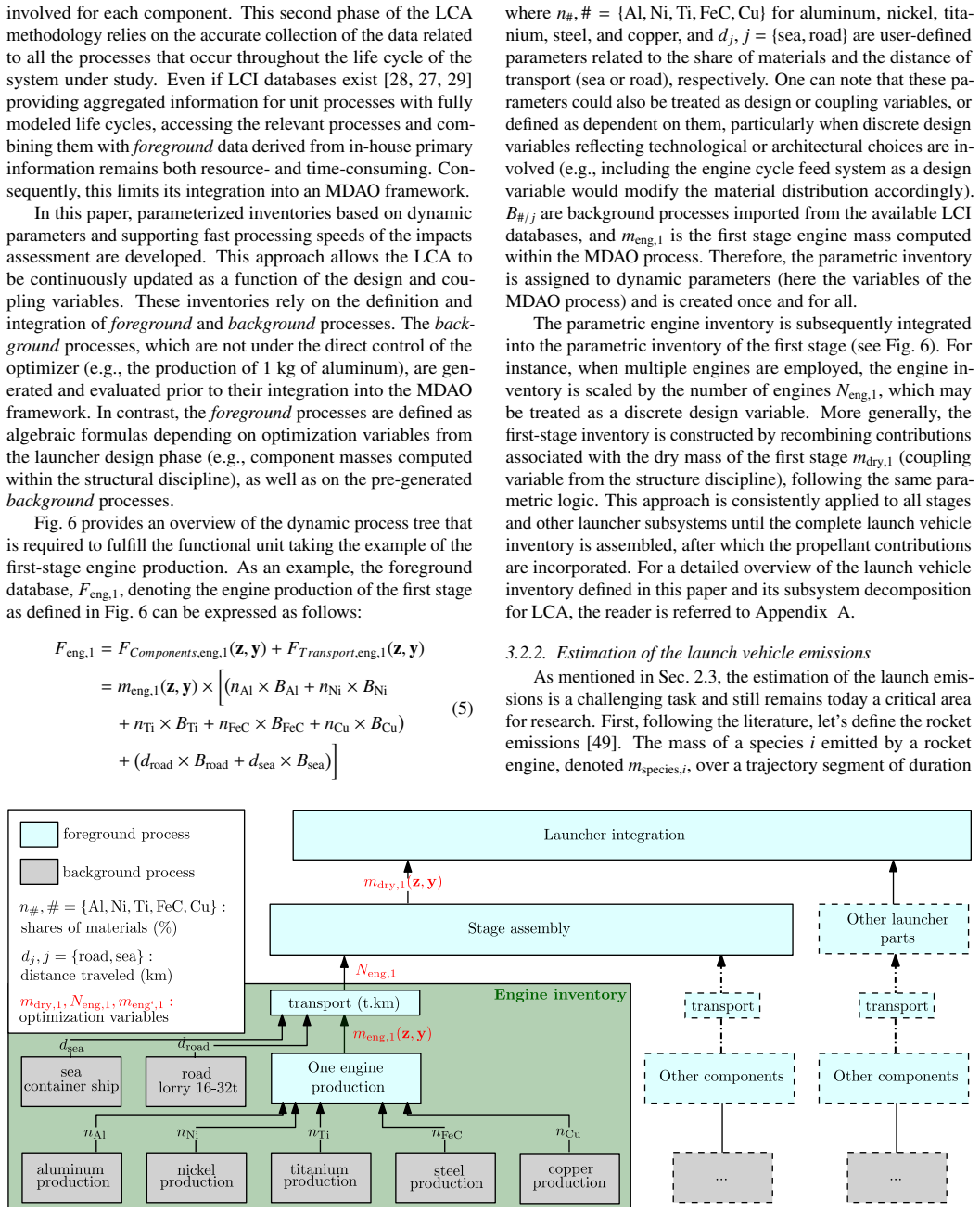
S. C. Sherwood, V . Dixit, C. Salomez, The global warming potential of near-surface emitted water vapour, Environmental Research Letters 13 (10) 22 Table A.1: Description of the parametric inventories as defined for this study. They are constructed from thebackgroundLCI databases: ESA LCA v1.2.0 [ 28] and ecoinvent v3.9.1 (cutoff) [27] Output from MDO dis...
-
[20]
D. Hauglustaine, F. Paulot, W. Collins, R. Derwent, M. Sand, O. Boucher, Climate benefit of a future hydrogen economy, Communications Earth & Environment 3 (1) (Nov. 2022).doi:10.1038/s43247-022-00626-z
-
[21]
G. Lammel, H. Graßl, Greenhouse effect of nox, Environmental Science and Pollution Research 2 (1) (1995) 40–45. doi:10.1007/bf02987512
-
[22]
Balesdent, L
M. Balesdent, L. Brevault, A. Langenais, Multidisciplinary design of launch vehicles considering atmospheric emissions, in: Proceedings of the 11th European Conference for Aeronautics and Space Sciences (EUCASS), Rome, Italy, 2025
2025
-
[23]
Brevault, M
L. Brevault, M. Balesdent, A. Langenais, Impacts of uncertainties on launch vehicle atmospheric emissions, in: Proceedings of the 11th Euro- 23 pean Conference for Aeronautics and Space Sciences (EUCASS), Rome, Italy, 2025
2025
-
[24]
International Organization for Standardization, ISO 14040:2006 Environ- mental Management – Life Cycle Assessment – Principles and Frame- work, https://www.iso.org/standard/37456.html, iSO Standard (2006)
2006
-
[25]
International Organization for Standardization, ISO 14044:2006 Environ- mental Management – Life Cycle Assessment – Requirements and Guide- lines, https://www.iso.org/standard/38498.html, iSO Standard (2006)
2006
-
[26]
int/cleanspace/, accessed: 2025-06-09
European Space Agency (ESA), Clean space blog, https://blogs.esa. int/cleanspace/, accessed: 2025-06-09
2025
-
[27]
Frischknecht, G
R. Frischknecht, G. Rebitzer, The ecoinvent database system: A compre- hensive web-based LCA database, Journal of Cleaner Production 13 (13–
-
[28]
(2005) 1337–1343.doi:10.1016/j.jclepro.2005.05.002
-
[29]
European Space Agency (ESA), Life cycle assessment (lca) database, https://sdup.esoc.esa.int/lca/, space Debris User Portal, ac- cessed 2026-06-09 (2026)
2026
-
[30]
A. R. Wilson, Advanced methods of life cycle assessment for space sys- tems, Ph.d. thesis, University of Strathclyde (2019). URLhttps://doi.org/10.48730/nrjb-r655
-
[31]
M. A. J. Huijbregts, Z. J. N. Steinmann, P. M. F. Elshout, G. Stam, F. Verones, M. Vieira, M. Zijp, A. Hollander, R. van Zelm, Recipe2016: a harmonised life cycle impact assessment method at midpoint and endpoint level, The International Journal of Life Cycle Assessment 22 (2) (2016) 138–147.doi:10.1007/s11367-016-1246-y
-
[32]
C. Bulle, M. Margni, L. Patouillard, A.-M. Boulay, G. Bourgault, V . De Bruille, V . Cao, M. Hauschild, A. Henderson, S. Humbert, S. Kashef- Haghighi, A. Kounina, A. Laurent, A. Levasseur, G. Liard, R. K. Rosen- baum, P.-O. Roy, S. Shaked, P. Fantke, O. Jolliet, Impact world+: a globally regionalized life cycle impact assessment method, The Inter- nationa...
-
[33]
M. Balesdent, N. Bérend, P. Dépincé, A. Chriette, A survey of mul- tidisciplinary design optimization methods in launch vehicle design, Structural and Multidisciplinary Optimization 45 (5) (2011) 619–642. doi:10.1007/s00158-011-0701-4
-
[34]
J. Wilken, S. Stappert, Comparative analysis of european vertical landing reusable first stage concepts, CEAS Space Journal 17 (1) (2024) 113–130. doi:10.1007/s12567-024-00549-9
-
[35]
F. Pollet, M. Budinger, S. Delbecq, J.-M. Moschetta, T. Planès, Environ- mental life cycle assessments for the design exploration of electric uavs, in: Proceedings of the Aerospace Europe Conference 2023 – 10th EU- CASS – 9th CEAS, Lausanne, Switzerland, 2023, international conference proceedings.doi:10.13009/EUCASS2023-548
-
[36]
F. Pollet, F. Lutz, T. Planès, S. Delbecq, M. Budinger, A generic life cycle assessment tool for overall aircraft design, Applied Energy 399 (2025) 126514.doi:10.1016/j.apenergy.2025.126514
-
[37]
G. J. Dominguez Calabuig, A. R. Wilson, L. Miraux, A. Sarritzu, Eco- design of future reusable launchers: insight into their life-cycle and atmospheric impact, in: Proceedings of the 9th European Conference for Aerospace Sciences. Lille, France, 27 June - 1 July, 2022, 2022. doi:10.13009/EUCASS2022-7353
-
[38]
G. J. Dominguez Calabuig, J. Wilken, Pre-conceptual staging trade-offs of reusable launch vehicles, in: Proceedings of the 9th European Conference for Aerospace Sciences. Lille, France, 27 June - 1 July, 2022, 2022. doi: 10.13009/EUCASS2022-7332
-
[39]
L. Baraton, A. Urbano, L. Brevault, M. Balesdent, Bayesian quality- diversity optimization for conditional search-space problems, Optimization and Engineering (Nov. 2025).doi:10.1007/s11081-025-10041-w
-
[40]
S. Sala, A. Cerutti, R. Pant, Development of a weighting approach for the environmental footprint, JRC Technical Report EUR 28562 EN, Publications Office of the European Union, Luxembourg (2017). doi:10.2760/945290
-
[41]
Verkammen, H
M. Verkammen, H. Svedhem, A. Menicucci, M. Udriot, A. Saada, E. David, A. Wilson, Feasibility study of a single-score life-cycle assessment for space missions: preliminary results., in: Proceedings of the Aerospace Europe Conference - EUCASS - CEAS - 2023, 2023. doi:10.13009/ EUCASS2023-571
2023
-
[42]
M. Udriot, K. Treyer, O. Bühler, L. Etesi, E. David, V . Girardin, Rapid life cycle assessment software for future space transportation vehicles design, in: Proceedings of the Aerospace Europe Conference - EUCASS - CEAS - 2023, 2023.doi:10.13009/EUCASS2023-015
-
[43]
M. Udriot, K. Treyer, J.-S. Fischer, E. David, A. Urbano, A. De Oliveira, E. Wolf, V . Girardin, M. Verkammen, Sustainability of end-to-end space transportation missions: Modelling technical and environmental aspects for early-phase ecodesign decision support, in: Proceedings of the 75th International Astronautical Congress (IAC 2024), Milan, Italy, Inter...
-
[44]
J.-S. Fischer, S. Fasoulas, N. Bergmann, A. Ott, V . Pinto, J. Wilken, M. Udriot, L. Schulz, C. Maddock, A pathway for closing the knowledge gaps for a comprehensive life cycle assessment and ecodesign of space transportation systems - results of the 3rd workshop on life cycle assess- ment of space transportation systems, Tech. rep., University of Stuttga...
-
[45]
DeSain, B
J. DeSain, B. Brady, Potential atmospheric impact generated by space launches worldwide—update for emission estimates from 1985 to 2013, Aerospace Report TOR-2014-02140, Space and Missile Systems Center, US Air Force Space Command (2014)
1985
-
[46]
C. V . M. Pradon, S. D. Eastham, G. Chossière, J. Sabnis, R. L. Speth, S. R. H. Barrett, J. André Jooste, Global three-dimensional emission inventory for launch vehicles from 2009 to 2018, Journal of Spacecraft and Rockets 60 (3) (2023) 716–727.doi:10.2514/1.a35385
-
[47]
C. R. Barker, E. A. Marais, J. C. McDowell, Global 3d rocket launch and re-entry air pollutant and co2 emissions at the onset of the mega- constellation era, Scientific Data 11 (1) (Oct. 2024). doi:10.1038/ s41597-024-03910-z
2024
-
[48]
R. G. Ryan, E. A. Marais, C. J. Balhatchet, S. D. Eastham, Impact of rocket launch and space debris air pollutant emissions on stratospheric ozone and global climate, Earth’s Future 10 (6) (Jun. 2022). doi:10. 1029/2021ef002612
2022
-
[49]
T. F. M. Brown, M. T. Bannister, L. E. Revell, T. Sukhodolov, E. Rozanov, Worldwide rocket launch emissions 2019: An inventory for use in global models, Earth and Space Science 11 (10) (Oct. 2024). doi:10.1029/ 2024ea003668
2019
-
[50]
James, S
M. James, S. Lympany, A. Salton, M. Calton, R. Miake-Lye, R. Wayson, Commercial space vehicle emissions modeling, Technical report (2021)
2021
-
[51]
P. Schabedoth, Life cycle assessment of rocket launches and the effects of the propellant choice on their environmental performance, Master’s thesis, Norwegian University of Science and Technology (NTNU) (2020)
2020
-
[52]
F. D. A. Quadros, M. Snellen, J. Sun, I. C. Dedoussi, Global civil aviation emissions estimates for 2017–2020 using ads-b data, Journal of Aircraft 59 (6) (2022) 1394–1405.doi:10.2514/1.c036763
-
[53]
R. Teoh, Z. Engberg, M. Shapiro, L. Dray, M. E. J. Stettler, The high- resolution global aviation emissions inventory based on ads-b (gaia) for 2019–2021, Atmospheric Chemistry and Physics 24 (1) (2024) 725–744. doi:10.5194/acp-24-725-2024
-
[54]
C. M. Maloney, R. W. Portmann, M. N. Ross, K. H. Rosenlof, The climate and ozone impacts of black carbon emissions from global rocket launches, Journal of Geophysical Research: Atmospheres 127 (12) (Jun. 2022). doi:10.1029/2021jd036373
-
[55]
Pelamatti, L
J. Pelamatti, L. Brevault, M. Balesdent, E.-G. Talbi, Y . Guerin, Bayesian optimization of variable-size design space problems, Opti- mization and Engineering 22 (1) (2020) 387–447. doi:10.1007/ s11081-020-09520-z
2020
-
[56]
J. T. Betts, Practical Methods for Optimal Control and Estimation Using Nonlinear Programming, Society for Industrial and Applied Mathematics, 2010.doi:10.1137/1.9780898718577
-
[57]
J. R. R. A. Martins, A. Ning, Engineering Design Optimization, Cambridge University Press, 2021
2021
-
[58]
B. J. McBride, S. Gordon, Computer program for calculation of com- plex chemical equilibrium compositions and applications, Tech. Rep. NASA-RP-1311, National Aeronautics and Space Administration, Lewis Research Center (June 1996)
1996
-
[59]
Malkin, Environmental impact statement for the space shuttle program, Technical report (1978)
M. Malkin, Environmental impact statement for the space shuttle program, Technical report (1978)
1978
-
[60]
J. Sacks, S. B. Schiller, W. J. Welch, Designs for computer experiments, Technometrics 31 (1) (1989) 41–47. doi:10.1080/00401706.1989. 10488474
-
[61]
P. Saves, R. Lafage, N. Bartoli, Y . Diouane, J. Bussemaker, T. Lefeb- vre, J. T. Hwang, J. Morlier, J. R. R. A. Martins, SMT 2.0: A surrogate 24 modeling toolbox with a focus on hierarchical and mixed variables gaus- sian processes, Advances in Engineering Sofware 188 (2024) 103571. doi:https://doi.org/10.1016/j.advengsoft.2023.103571
-
[62]
M. Sippel, J. Wilken, Selection of propulsion characteristics for systematic assessment of future european rlv-options, CEAS Space Journal 17 (1) (2024) 89–111.doi:10.1007/s12567-024-00564-w
-
[63]
J. S. Gray, J. T. Hwang, J. R. R. A. Martins, K. T. Moore, B. A. Nay- lor, Openmdao: An open-source framework for multidisciplinary design, analysis, and optimization, Structural and Multidisciplinary Optimization 59 (4) (2019) 1075–1104.doi:10.1007/s00158-019-02211-z
-
[64]
Castellini, Multidisciplinary design optimization for expendable launch vehicles, Ph.d
F. Castellini, Multidisciplinary design optimization for expendable launch vehicles, Ph.d. thesis, Politecnico di Milano (2013). URLhttps://hdl.handle.net/10589/56841
2013
-
[65]
Air Force, Missile DATCOM (Version 2014), Air Force Materiel Command, Wright-Patterson Air Force Base, OH (2014)
U.S. Air Force, Missile DATCOM (Version 2014), Air Force Materiel Command, Wright-Patterson Air Force Base, OH (2014)
2014
-
[66]
A. J. Krueger, R. A. Minzner, A mid-latitude ozone model for the 1976 u.s. standard atmosphere, Journal of Geophysical Research (1896-1977) 81 (24) (1976) 4477–4481.doi:10.1029/JC081i024p04477
-
[67]
N. Hansen, A. Ostermeier, Completely derandomized self-adaptation in evolution strategies, Evolutionary Computation 9 (2) (2001) 159–195. doi:10.1162/106365601750190398
-
[68]
Mutel, Brightway: An open source framework for life cycle assessment, Journal of Open Source Software 2 (15) (2017) 236
C. Mutel, Brightway: An open source framework for life cycle assessment, Journal of Open Source Software 2 (15) (2017) 236. doi:10.21105/ joss.00236
2017
-
[69]
R. Jolivet, J. Clavreul, R. Brière, R. Besseau, A. Prieur Vernat, M. Sauze, I. Blanc, M. Douziech, P. Pérez-López, lca_algebraic: a library bring- ing symbolic calculus to lca for comprehensive sensitivity analysis, The International Journal of Life Cycle Assessment 26 (2021) 2457–2471. doi:10.1007/s11367-021-01986-z
-
[70]
C. Touré, N. Hansen, A. Auger, D. Brockhoff, Uncrowded hypervolume improvement: Como-cma-es and the sofomore framework, in: Proceedings of the Genetic and Evolutionary Computation Conference, GECCO ’19, Association for Computing Machinery, New York, NY , USA, 2019, p. 638–646.doi:10.1145/3321707.3321852. URLhttps://doi.org/10.1145/3321707.3321852
-
[71]
K. Deb, A. Pratap, S. Agarwal, T. Meyarivan, A fast and elitist multiob- jective genetic algorithm: Nsga-ii, IEEE Transactions on Evolutionary Computation 6 (2) (2002) 182–197.doi:10.1109/4235.996017. 25
discussion (0)
Sign in with ORCID, Apple, or X to comment. Anyone can read and Pith papers without signing in.