The evolution of the galaxy gas-phase mass-metallicity relation from z=15 to z=0 in the COLIBRE cosmological simulations
Pith reviewed 2026-06-25 19:50 UTC · model grok-4.3
The pith
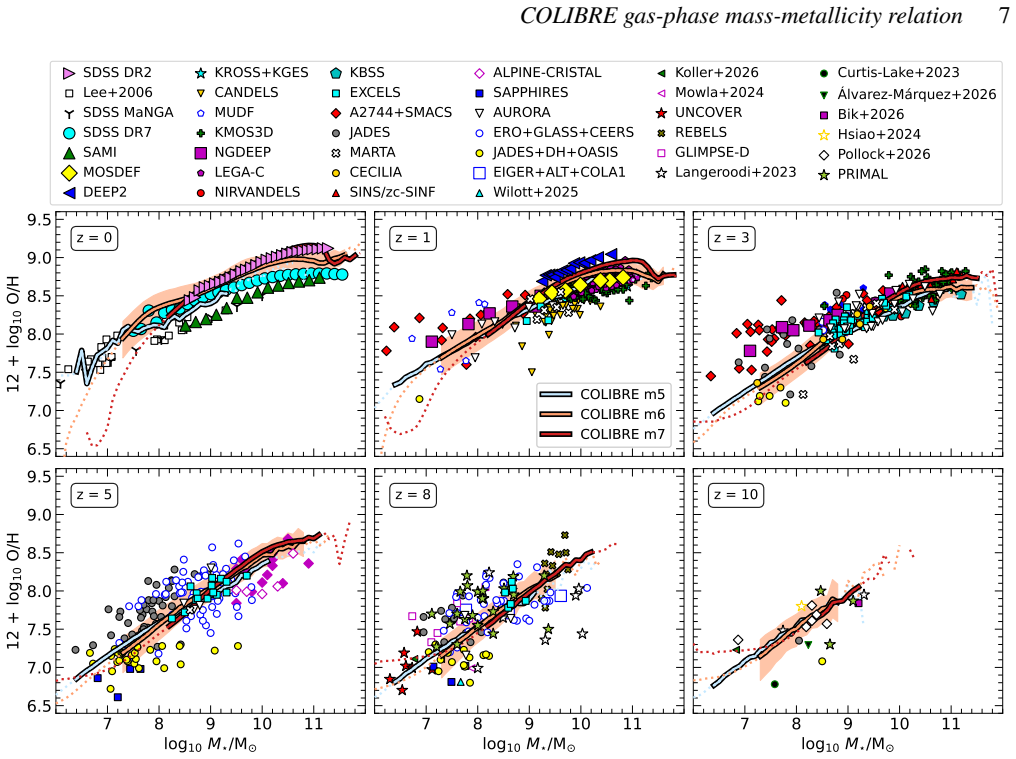
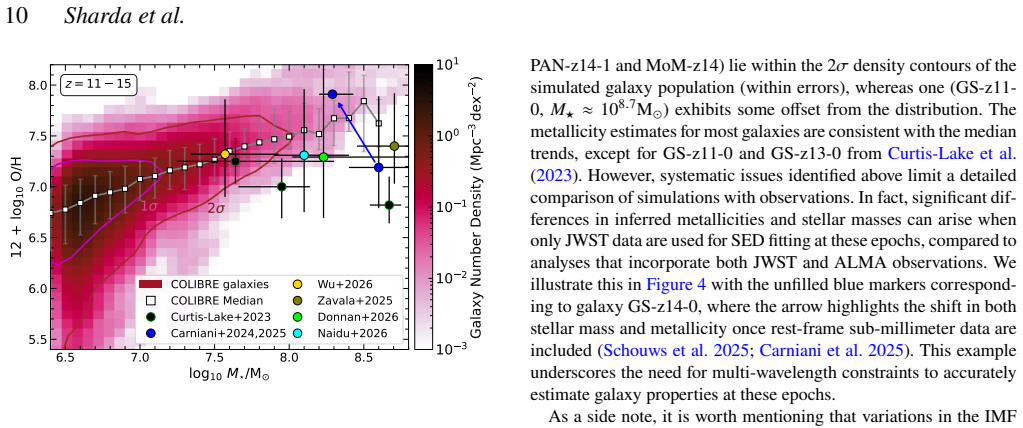
The COLIBRE simulations show the galaxy mass-metallicity relation is already in place at redshift 10 and shows no evolution until redshift 5.
A machine-rendered reading of the paper's core claim, the machinery that carries it, and where it could break.
Core claim
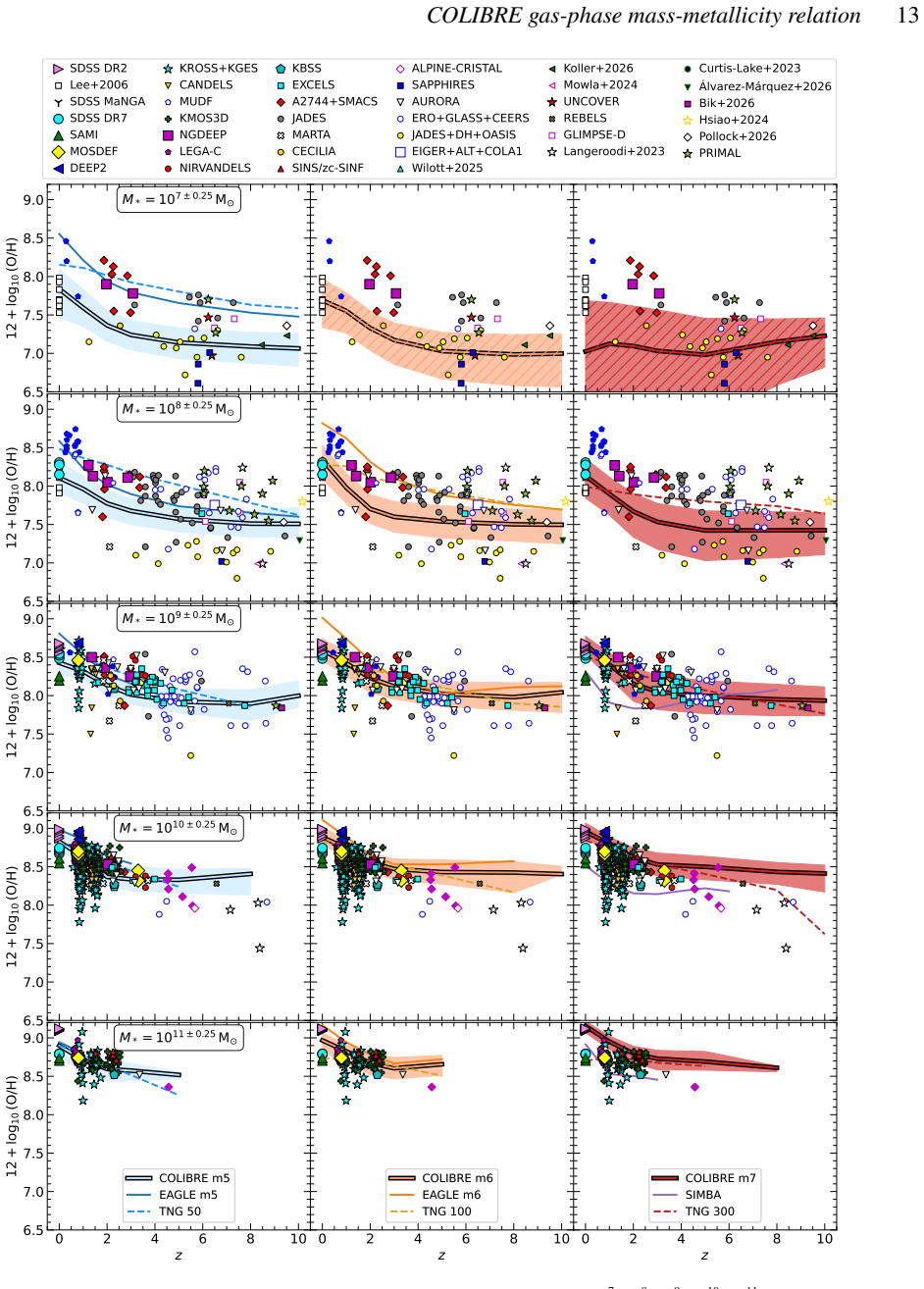
In the COLIBRE simulations the galaxy gas-phase mass-metallicity relation is already in place at cosmic dawn (z approximately 10) and exhibits no evolution until z approximately 5. The relation is reproduced across the full stellar mass range sampled by observations at all redshifts, with the slope becoming shallower at low redshifts. The high-mass end turnover is set primarily by AGN feedback, while the low-mass end depends on core-collapse supernova feedback. Variations in star formation efficiency or oxygen depletion on dust grains have smaller effects.
What carries the argument
The mass-weighted gas-phase mass-metallicity relation for star-forming galaxies, which encodes the competition between metal production in stars and removal or dilution by feedback.
If this is right
- The mass-metallicity relation exhibits no significant evolution between redshifts 10 and 5.
- AGN feedback largely sets the turnover at the high-mass end of the relation.
- Core-collapse supernova feedback controls the slope at the low-mass end.
- The simulated relation shows numerical convergence across particle masses from 10^5 to 10^7 solar masses and box sizes from 25 to 400 comoving megaparsecs.
Where Pith is reading between the lines
- Metal enrichment must proceed rapidly in the first galaxies to produce the observed relation by redshift 10.
- Observations targeting low-mass galaxies at redshifts 5 to 10 could test the strength of supernova feedback assumed in the model.
- The inclusion of live dust opens the possibility of predicting how dust depletion alters inferred metallicities in high-redshift observations.
Load-bearing premise
The fiducial COLIBRE model of the multiphase interstellar medium, non-equilibrium chemistry, metal diffusion, and live dust accurately represents the physical processes that set gas-phase metallicities.
What would settle it
A measurement of strong evolution in the mass-metallicity relation between redshift 10 and redshift 5 at low stellar masses would contradict the reported lack of evolution.
Figures




read the original abstract
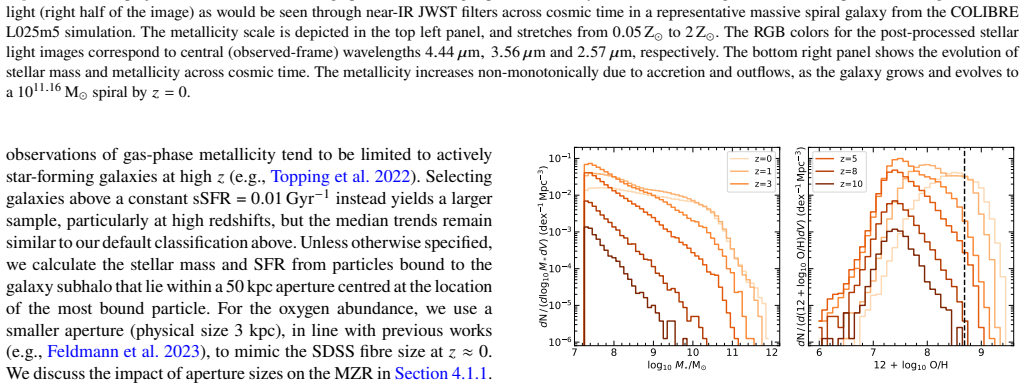
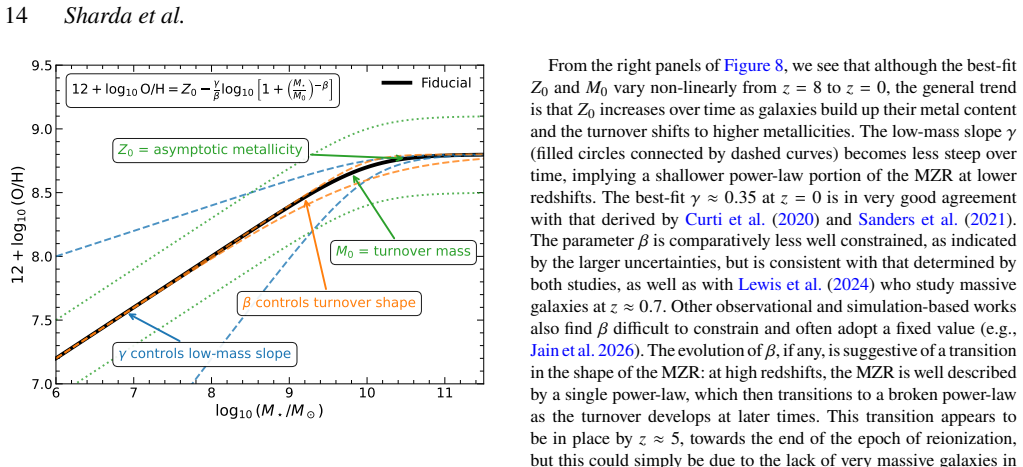
We present the evolution of the galaxy gas-phase mass-metallicity relation (MZR) from $z=15$ to $z=0$ in the COLIBRE cosmological hydrodynamical simulations. Amongst other novel features, COLIBRE follows the multiphase interstellar medium with gas allowed to cool to $\sim 10\,\mathrm{K}$, and includes a new chemistry model in which hydrogen and helium are tracked in non-equilibrium, metals are allowed to mix and diffuse, and the chemical network is coupled to a self-consistent live dust model. Using fiducial COLIBRE runs spanning particle masses from $10^5\,\mathrm{M_{\odot}}$ to $10^7\,\mathrm{M_{\odot}}$ and box sizes $25 - 400\,\mathrm{cMpc}$, we derive the median, mass-weighted MZRs for star-forming galaxies and compare them with a comprehensive compilation of observational data and other simulations. COLIBRE reproduces the observed MZR across cosmic time, notwithstanding the systematic uncertainties in observational measurements of the gas-phase oxygen abundances. The simulations show excellent numerical convergence and uniquely probe the full stellar mass range sampled by current observations across all redshifts. We find that the MZR is already in place at cosmic dawn ($z \approx 10$), and shows no evolution until $z \approx 5$. The slope of the MZR becomes shallower at low redshifts. The turnover at the high-mass end is largely governed by feedback from active galactic nuclei (AGN), whereas the low-mass end of the MZR sensitively depends on the strength of feedback from core collapse supernovae. Variations in the star formation efficiency or depletion of oxygen on dust grains have a more minor impact on the MZR. We identify key physical processes that shape the MZR across cosmic time and highlight where future observations can further constrain galaxy formation models.
Editorial analysis
A structured set of objections, weighed in public.
Referee Report
Summary. The paper presents the evolution of the galaxy gas-phase mass-metallicity relation (MZR) from z=15 to z=0 using the COLIBRE cosmological hydrodynamical simulations. These runs incorporate a multiphase ISM cooling to ~10 K, non-equilibrium H/He chemistry, metal diffusion, and a self-consistent live dust model. Across fiducial runs with particle masses 10^5-10^7 M⊙ and box sizes 25-400 cMpc, the median mass-weighted MZRs for star-forming galaxies are shown to reproduce observational compilations at all redshifts. The MZR is already established at z≈10 with no evolution to z≈5; the slope shallows at low z. High-mass turnover is attributed to AGN feedback and low-mass end to core-collapse SN feedback, with star-formation efficiency and dust depletion having minor effects. Numerical convergence is reported as excellent.
Significance. If the central results hold, the work provides a valuable, high-dynamic-range simulation benchmark for the MZR across cosmic time, enabled by the new ISM and chemistry modules. Explicit convergence across resolution and volume, plus targeted feedback variations, strengthen the attribution of MZR features to specific physical processes. This can inform both observational interpretations and future model development, particularly where the simulations uniquely cover the full observed stellar-mass range at high redshift.
minor comments (3)
- [Abstract, §3] Abstract and §3: the statement that the MZR 'shows no evolution until z≈5' would benefit from an explicit quantitative definition (e.g., change in normalization or slope below a stated threshold) and a figure showing the redshift-dependent parameters.
- [§4] The comparison to observations notes 'systematic uncertainties in observational measurements' but does not specify which abundance calibrations or diagnostics are adopted for the simulated oxygen abundances; a short table or paragraph reconciling the two would improve clarity.
- [Figures 2-5] Figure captions and text should explicitly state whether the plotted MZRs are mass-weighted or luminosity-weighted and how star-forming galaxies are selected (e.g., sSFR threshold).
Simulated Author's Rebuttal
We thank the referee for their positive assessment of the manuscript, including the recognition that it provides a valuable high-dynamic-range benchmark for the MZR across cosmic time, enabled by the new ISM and chemistry modules, with explicit convergence tests and targeted feedback variations strengthening the physical attributions. The recommendation for minor revision is noted. No specific major comments were listed in the report for us to address point by point.
Circularity Check
No significant circularity; results are direct simulation outputs compared to external data
full rationale
The paper derives the MZR by running COLIBRE hydrodynamical simulations with explicit multiphase ISM, non-equilibrium chemistry, metal diffusion, and live dust physics, then measures median mass-weighted relations in star-forming galaxies across redshifts and compares them to independent observational compilations. No parameters are fitted to MZR data (variations in AGN/SN feedback, star-formation efficiency, and dust depletion are sensitivity tests, not fits), no self-citations justify core premises or uniqueness theorems, and no ansatzes or renamings reduce the reported evolution to inputs by construction. The claim that the MZR is in place at z≈10 with limited evolution to z≈5 is an emergent output, not a redefinition of the simulation setup. This is a standard, self-contained simulation-vs-observation comparison.
Axiom & Free-Parameter Ledger
Reference graph
Works this paper leans on
-
[1]
The Astropy Project: Building an inclusive, open-science project and status of the v2.0 core package
The Astropy Project: Building an Open-science Project and Status of the v2.0 Core Package. , keywords =. doi:10.3847/1538-3881/aabc4f , archivePrefix =. 1801.02634 , primaryClass =
work page internal anchor Pith review Pith/arXiv arXiv doi:10.3847/1538-3881/aabc4f
-
[2]
Astropy: A Community Python Package for Astronomy
Astropy: A community Python package for astronomy. , keywords =. 2013. doi:10.1051/0004-6361/201322068 , archivePrefix =. 1307.6212 , primaryClass =
work page internal anchor Pith review Pith/arXiv arXiv doi:10.1051/0004-6361/201322068 2013
-
[3]
2006 , series =
A guide to NumPy , author=. 2006 , series =
2006
-
[4]
Array Programming with NumPy. , keywords =. doi:10.1038/s41586-020-2649-2 , archivePrefix =. 2006.10256 , primaryClass =
-
[5]
SciPy 1.0--Fundamental Algorithms for Scientific Computing in Python
SciPy 1.0: fundamental algorithms for scientific computing in Python. Nature Methods , keywords =. doi:10.1038/s41592-019-0686-2 , archivePrefix =. 1907.10121 , primaryClass =
work page internal anchor Pith review Pith/arXiv arXiv doi:10.1038/s41592-019-0686-2 1907
-
[6]
Hunter, J. D. , Title =. Computing in Science & Engineering , Volume =
-
[7]
The Journal of Open Source Software , keywords =
CMasher: Scientific colormaps for making accessible, informative and 'cmashing' plots. The Journal of Open Source Software , keywords =. doi:10.21105/joss.02004 , archivePrefix =. 2003.01069 , primaryClass =
-
[8]
The Properties of Starburst-driven Warm Ionized Outflows
CLASSY III. The Properties of Starburst-driven Warm Ionized Outflows. , keywords =. doi:10.3847/1538-4357/ac6d56 , archivePrefix =. 2204.09181 , primaryClass =
-
[9]
A unified model for galactic discs: star formation, turbulence driving, and mass transport. , keywords =. doi:10.1093/mnras/sty852 , archivePrefix =. 1706.00106 , primaryClass =
-
[10]
The KMOS ^ 3D Survey: Design, First Results, and the Evolution of Galaxy Kinematics from 0.7 <= z <= 2.7. , keywords =. doi:10.1088/0004-637X/799/2/209 , archivePrefix =. 1409.6791 , primaryClass =
-
[11]
The evolution of turbulent galactic discs: gravitational instability, feedback, and accretion. , keywords =. doi:10.1093/mnras/stac1324 , archivePrefix =. 2202.12331 , primaryClass =
-
[12]
The metallicity's fundamental dependence on both local and global galactic quantities. , keywords =. doi:10.1093/mnras/stac3594 , archivePrefix =. 2210.03755 , primaryClass =
-
[13]
Characterizing mass, momentum, energy, and metal outflow rates of multiphase galactic winds in the FIRE-2 cosmological simulations. , keywords =. doi:10.1093/mnras/stab2714 , archivePrefix =. 2103.06891 , primaryClass =
-
[14]
The cosmic baryon cycle and galaxy mass assembly in the FIRE simulations. , keywords =. doi:10.1093/mnras/stx1517 , archivePrefix =. 1610.08523 , primaryClass =
-
[15]
How supernovae launch galactic winds?. , keywords =. doi:10.1093/mnrasl/slx072 , archivePrefix =. 1704.01579 , primaryClass =
-
[16]
First Results from SMAUG: Characterization of Multiphase Galactic Outflows from a Suite of Local Star-forming Galactic Disk Simulations. , keywords =. doi:10.3847/1538-4357/aba962 , archivePrefix =. 2006.16315 , primaryClass =
-
[17]
Kinetic Energy Decay Rates of Supersonic and Super-Alfvenic Turbulence in Star-Forming Clouds
Kinetic Energy Decay Rates of Supersonic and Super-Alfv \'e nic Turbulence in Star-Forming Clouds. , keywords =. doi:10.1103/PhysRevLett.80.2754 , archivePrefix =. astro-ph/9712013 , primaryClass =
work page internal anchor Pith review Pith/arXiv arXiv doi:10.1103/physrevlett.80.2754
-
[18]
Comparing the statistics of interstellar turbulence in simulations and observations. Solenoidal versus compressive turbulence forcing. , keywords =. doi:10.1051/0004-6361/200912437 , archivePrefix =. 0905.1060 , primaryClass =
work page internal anchor Pith review Pith/arXiv arXiv doi:10.1051/0004-6361/200912437
-
[19]
The sonic scale of interstellar turbulence. Nature Astronomy , keywords =. doi:10.1038/s41550-020-01282-z , archivePrefix =. 2011.06238 , primaryClass =
-
[20]
The chemical make-up of the Sun: A 2020 vision. , keywords =. doi:10.1051/0004-6361/202140445 , archivePrefix =. 2105.01661 , primaryClass =
-
[21]
Planck 2018 results. VI. Cosmological parameters. arXiv e-prints , keywords =
2018
-
[22]
A Universal, Local Star Formation Law in Galactic Clouds, nearby Galaxies, High-redshift Disks, and Starbursts. , keywords =. doi:10.1088/0004-637X/745/1/69 , archivePrefix =. 1109.4150 , primaryClass =
-
[23]
Cloud-scale Molecular Gas Properties in 15 Nearby Galaxies. , keywords =. doi:10.3847/1538-4357/aac326 , archivePrefix =. 1805.00937 , primaryClass =
-
[24]
The Star Formation Efficiency in Nearby Galaxies: Measuring Where Gas Forms Stars Effectively. , keywords =. doi:10.1088/0004-6256/136/6/2782 , archivePrefix =. 0810.2556 , primaryClass =
-
[25]
Galactic Stellar and Substellar Initial Mass Function. , keywords =. doi:10.1086/376392 , archivePrefix =. astro-ph/0304382 , primaryClass =
-
[26]
A General Theory of Turbulence-regulated Star Formation, from Spirals to Ultraluminous Infrared Galaxies. , keywords =. doi:10.1086/431734 , archivePrefix =. astro-ph/0505177 , primaryClass =
-
[27]
arXiv e-prints , keywords =
Delayed Massive-Star Mechanical Feedback at Low Metallicity. arXiv e-prints , keywords =
-
[28]
Evidence for supernova feedback sustaining gas turbulence in nearby star-forming galaxies. , keywords =. doi:10.1051/0004-6361/202038223 , archivePrefix =. 2006.10764 , primaryClass =
-
[29]
Density Studies of MHD Interstellar Turbulence: Statistical Moments, Correlations and Bispectrum. , keywords =. doi:10.1088/0004-637X/693/1/250 , archivePrefix =. 0811.0822 , primaryClass =
-
[30]
Dissipation in Compressible Magnetohydrodynamic Turbulence. , keywords =. doi:10.1086/311718 , archivePrefix =. astro-ph/9809357 , primaryClass =
-
[31]
A Constant Molecular Gas Depletion Time in Nearby Disk Galaxies. , keywords =. doi:10.1088/2041-8205/730/2/L13 , archivePrefix =. 1102.1720 , primaryClass =
-
[32]
How stellar feedback simultaneously regulates star formation and drives outflows. , keywords =. doi:10.1093/mnras/stw2888 , archivePrefix =. 1510.05650 , primaryClass =
-
[33]
Sub-Eddington star-forming regions are super-Eddington: momentum-driven outflows from supersonic turbulence. , keywords =. doi:10.1093/mnras/stv2331 , archivePrefix =. 1411.1769 , primaryClass =
work page internal anchor Pith review Pith/arXiv arXiv doi:10.1093/mnras/stv2331
-
[34]
A Unified Model for the Coevolution of Galaxies and Their Circumgalactic Medium: The Relative Roles of Turbulence and Atomic Cooling Physics. , keywords =. doi:10.3847/1538-4357/acf3ea , archivePrefix =. 2211.09755 , primaryClass =
-
[35]
The Star Formation Rate in the Gravoturbulent Interstellar Medium. , keywords =. doi:10.3847/1538-4357/aad002 , archivePrefix =. 1801.05428 , primaryClass =
-
[36]
The Star Formation Rate of Turbulent Magnetized Clouds: Comparing Theory, Simulations, and Observations. , keywords =. doi:10.1088/0004-637X/761/2/156 , archivePrefix =. 1209.2856 , primaryClass =
-
[37]
A multishock model for the density variance of anisotropic, highly magnetized, supersonic turbulence. , keywords =. doi:10.1093/mnras/stab1037 , archivePrefix =. 2102.00629 , primaryClass =
-
[38]
The Link between Turbulence, Magnetic Fields, Filaments, and Star Formation in the Central Molecular Zone Cloud G0.253+0.016. , keywords =. doi:10.3847/0004-637X/832/2/143 , archivePrefix =. 1609.05911 , primaryClass =
-
[39]
Testing star formation laws in a starburst galaxy at redshift 3 resolved with ALMA. , keywords =. doi:10.1093/mnras/sty886 , archivePrefix =. 1712.03661 , primaryClass =
-
[40]
Testing star formation laws on spatially resolved regions in a z 4.3 starburst galaxy. , keywords =. doi:10.1093/mnras/stz1543 , archivePrefix =. 1906.01173 , primaryClass =
-
[41]
The Global Schmidt Law in Star-forming Galaxies. , keywords =. doi:10.1086/305588 , archivePrefix =. astro-ph/9712213 , primaryClass =
-
[42]
Feedback-regulated star formation in molecular clouds and galactic discs. , keywords =. doi:10.1093/mnras/stt866 , archivePrefix =. 1301.3905 , primaryClass =
-
[43]
The SAMI galaxy survey: gas velocity dispersions in low-z star-forming galaxies and the drivers of turbulence. , keywords =. doi:10.1093/mnras/staa1272 , archivePrefix =. 2005.04874 , primaryClass =
-
[44]
Galactic star formation and accretion histories from matching galaxies to dark matter haloes. , keywords =. doi:10.1093/mnras/sts261 , archivePrefix =. 1205.5807 , primaryClass =
-
[45]
A new method for spatially resolving the turbulence-driving mixture in the ISM with application to the Small Magellanic Cloud. , keywords =. doi:10.1093/mnras/stad2718 , archivePrefix =. 2309.10755 , primaryClass =
-
[46]
Photoelectric heating of interstellar gas. , keywords =. doi:10.1086/190513 , adsurl =
-
[47]
Rosseland and Planck mean opacities for protoplanetary discs. , keywords =. doi:10.1051/0004-6361:20031279 , archivePrefix =. astro-ph/0308344 , primaryClass =
-
[48]
Photodissociation of H _ 2 in protogalaxies: modelling self-shielding in three-dimensional simulations. , keywords =. doi:10.1111/j.1365-2966.2011.19538.x , archivePrefix =. 1106.3523 , primaryClass =
-
[49]
The photodissociation and chemistry of CO isotopologues: applications to interstellar clouds and circumstellar disks. , keywords =. doi:10.1051/0004-6361/200912129 , archivePrefix =. 0906.3699 , primaryClass =
-
[50]
Photochemistry and Heating/Cooling of the Multiphase Interstellar Medium with UV Radiative Transfer for Magnetohydrodynamic Simulations. , keywords =. doi:10.3847/1538-4365/ac9b1d , archivePrefix =. 2210.08024 , primaryClass =
-
[51]
Photodissociation regions. I. Basic model. , keywords =. doi:10.1086/163111 , adsurl =
-
[52]
The UMIST Database for Astrochemistry 2022. , keywords =. doi:10.1051/0004-6361/202346908 , archivePrefix =. 2311.03936 , primaryClass =
-
[53]
Cosmic-Ray--induced Photodissociation and Photoionization Rates of Interstellar Molecules. , keywords =. doi:10.1086/168117 , adsurl =
-
[54]
H I-to-H _ 2 Transitions in Dust-free Interstellar Gas. , keywords =. doi:10.3847/1538-4357/ac167b , archivePrefix =. 2105.01681 , primaryClass =
-
[55]
Production of atomic hydrogen by cosmic rays in dark clouds. , keywords =. doi:10.1051/0004-6361/201834008 , archivePrefix =. 1809.04168 , primaryClass =
-
[56]
The basic model, library of chemical reactions, and chemistry among C, N, and O compounds
A model for gas phase chemistry in interstellar clouds: I. The basic model, library of chemical reactions, and chemistry among C, N, and O compounds. , keywords =. doi:10.1086/190665 , adsurl =
-
[58]
The C/CO Ratio in Dense Interstellar Clouds. , keywords =. doi:10.1086/185073 , adsurl =
-
[59]
Photodissociation and photoionisation of atoms and molecules of astrophysical interest. , keywords =. doi:10.1051/0004-6361/201628742 , archivePrefix =. 1701.04459 , primaryClass =
-
[60]
Sensitivity analyses of dense cloud chemical models. , keywords =. doi:10.1051/0004-6361/200913856 , archivePrefix =. 1004.1902 , primaryClass =
-
[61]
On the effect of the Cosmic Microwave Background in high-redshift (sub-)millimeter observations
On the Effect of the Cosmic Microwave Background in High-redshift (Sub-)millimeter Observations. , keywords =. doi:10.1088/0004-637X/766/1/13 , archivePrefix =. 1302.0844 , primaryClass =
work page internal anchor Pith review Pith/arXiv arXiv doi:10.1088/0004-637x/766/1/13
-
[62]
CO lines in high redshift galaxies: perspective for future mm instruments
CO lines in high redshift galaxies: perspective for future MM instruments. , keywords =. doi:10.48550/arXiv.astro-ph/9902286 , archivePrefix =. astro-ph/9902286 , primaryClass =
work page internal anchor Pith review Pith/arXiv arXiv doi:10.48550/arxiv.astro-ph/9902286
-
[63]
A Heuristic Prediction of the Cosmic Evolution of the Co-luminosity Functions. , keywords =. doi:10.1088/0004-637X/702/2/1321 , archivePrefix =. 0907.3091 , primaryClass =
-
[64]
UCLCHEM: A Gas-Grain Chemical Code
UCLCHEM: A Gas-grain Chemical Code for Clouds, Cores, and C-Shocks. , keywords =. doi:10.3847/1538-3881/aa773f , archivePrefix =. 1705.10677 , primaryClass =
work page internal anchor Pith review Pith/arXiv arXiv doi:10.3847/1538-3881/aa773f
-
[65]
Evaporation of ices near massive stars: models based on laboratory temperature programmed desorption data. , keywords =. doi:10.1111/j.1365-2966.2004.08273.x , archivePrefix =. astro-ph/0406054 , primaryClass =
-
[66]
Astrochem: Abundances of chemical species in the interstellar medium
-
[68]
On the Stability and Evolution of Isolated BOK Globules. , keywords =. doi:10.1086/307823 , adsurl =
-
[69]
doi:10.1111/j.1365-2966.2011.18648.x , archiveprefix =
Approximations for modelling CO chemistry in giant molecular clouds: a comparison of approaches. , keywords =. doi:10.1111/j.1365-2966.2011.20260.x , archivePrefix =. 1102.0670 , primaryClass =
-
[70]
Modelling CO formation in the turbulent interstellar medium. , keywords =. doi:10.1111/j.1365-2966.2009.15718.x , archivePrefix =. 0907.4081 , primaryClass =
-
[71]
Star formation in metal-poor gas clouds. , keywords =. doi:10.1111/j.1365-2966.2012.21737.x , archivePrefix =. 1203.4251 , primaryClass =
-
[72]
Thermal and Fragmentation Properties of Star-forming Clouds in Low-Metallicity Environments. , keywords =. doi:10.1086/429955 , archivePrefix =. astro-ph/0503010 , primaryClass =
-
[73]
Non-equilibrium chemistry and cooling in the diffuse interstellar medium - II. Shielded gas. , keywords =. doi:10.1093/mnras/stu1046 , archivePrefix =. 1403.6155 , primaryClass =
-
[74]
CN and HCN in Dense Interstellar Clouds
CN and HCN in Dense Interstellar Clouds. , keywords =. doi:10.1086/432864 , archivePrefix =. astro-ph/0506535 , primaryClass =
work page internal anchor Pith review Pith/arXiv arXiv doi:10.1086/432864
-
[75]
The interstellar gas-phase chemistry of HCN and HNC. , keywords =. doi:10.1093/mnras/stu1089 , archivePrefix =. 1406.1696 , primaryClass =
-
[76]
KROME - a package to embed chemistry in astrophysical simulations. , keywords =. doi:10.1093/mnras/stu114 , archivePrefix =. 1311.1070 , primaryClass =
-
[77]
Ultraviolet H _ 2 luminescence in molecular clouds induced by cosmic rays. , keywords =. doi:10.1051/0004-6361/202348168 , archivePrefix =. 2312.02062 , primaryClass =
-
[78]
Gong, Munan and Ostriker, Eve C. and Wolfire, Mark G. , number =. 2016 , journal =. doi:10.3847/1538-4357/aa7561 , arxivId =
-
[79]
Modeling primordial gas in numerical cosmology. , keywords =. doi:10.1016/S1384-1076(97)00010-9 , archivePrefix =. astro-ph/9608040 , primaryClass =
- [80]
-
[81]
A Hydrodynamic Approach to Cosmology: Methodology. , keywords =. doi:10.1086/191630 , adsurl =
-
[82]
, year = 1973, month = may, volume =
Radiative and Dielectronic Recombination Coefficients for Complex Ions. , year = 1973, month = may, volume =
1973
discussion (0)
Sign in with ORCID, Apple, or X to comment. Anyone can read and Pith papers without signing in.