Jets and Outflows in Young Stellar Objects with the SKAO
Pith reviewed 2026-06-25 19:07 UTC · model grok-4.3
The pith
SKAO will enable high-resolution centimeter observations to probe jets and outflows near young stellar objects.
A machine-rendered reading of the paper's core claim, the machinery that carries it, and where it could break.
Core claim
The SKA-project will overcome the limitations of current mm/cm-facilities by enabling high-angular resolution and high-sensitivity cm-observations, crucial for probing jets/outflows near YSOs. Radio recombination lines, combined with proper motions, offer a unique opportunity to study the 3D-kinematics of jets. Non-thermal linearly polarised synchrotron emission will allow measuring magnetic field strength and morphology at unprecedented scales of a few au. Observations of dust emission in outflow cavities will allow studying how dust grows and is eventually transported from the disc to the envelope and back. Finally, the SKA-project will allow exploring the dust composition and chemical enr
What carries the argument
SKAO high-angular resolution and high-sensitivity cm-observations that target radio recombination lines, non-thermal polarized synchrotron emission, dust in outflow cavities, and shock-released chemical species.
If this is right
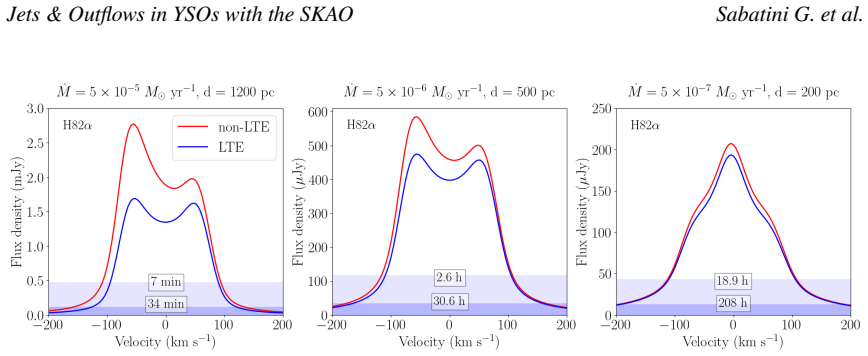
- Radio recombination lines combined with proper motions will reveal the 3D-kinematics of jets.
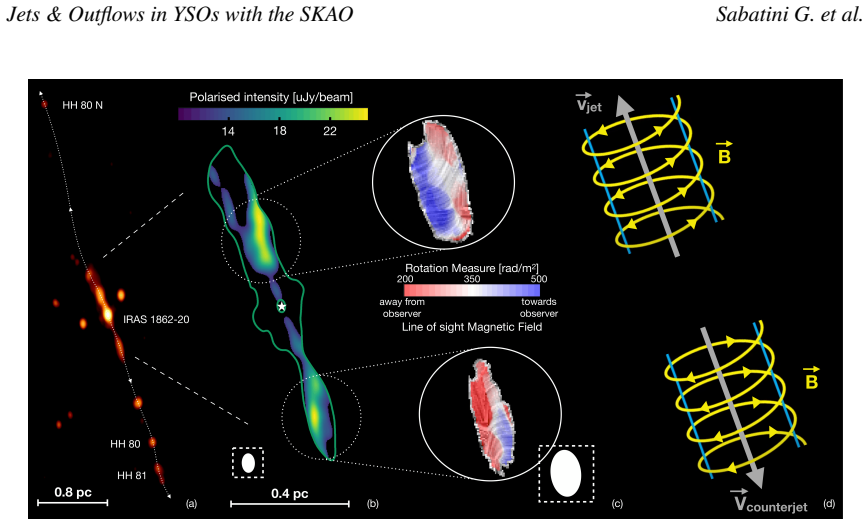
- Non-thermal polarized synchrotron emission will measure magnetic field strength and morphology at scales of a few au.
- Dust emission in outflow cavities will show how dust grows and moves from the disc to the envelope and back.
- Shock observations will detect long carbon chains, rings, and metal-bearing species released from grain mantles.
- These cm-wave data will complement ALMA's sub-mm detections of organic molecules to build fuller chemical inventories.
Where Pith is reading between the lines
- High-resolution magnetic field maps could directly test whether magnetic fields provide the dominant collimation mechanism for jets.
- Combined SKAO-ALMA datasets might reveal how outflow shocks alter the overall molecular inventory from inner disk to outer envelope.
- Detection of dust transport in cavities could quantify the efficiency with which material is recycled between disk and envelope during early star formation.
- If signals prove weaker than expected, the review's case would require targeted simulations of emission strengths for specific YSO targets.
- keywords:[
Load-bearing premise
The described emission processes will produce detectable signals at the scales and sensitivities projected for SKAO.
What would settle it
If SKAO observations of known YSO jets detect neither radio recombination lines with measurable proper motions nor polarized synchrotron emission at few-au scales, despite the claimed sensitivity gains over VLA and ALMA.
Figures





read the original abstract
Jets and outflows are ubiquitous phenomena associated with the formation of young stellar objects (YSOs). They play a crucial role in removing angular momentum from the accreting system and in regulating star-formation efficiency. Theoretical studies and observations with ALMA and VLA have shown that jets and winds may have a crucial role in promoting dust growth in the envelope-disc system and in shaping the physical and chemical properties of the surrounding environment. Despite these significant advances, many fundamental questions remain unanswered regarding the acceleration, collimation, and chemical impact of jets and outflows from YSOs. The SKA-project will overcome the limitations of current mm/cm-facilities by enabling high-angular resolution and high-sensitivity cm-observations, crucial for probing jets/outflows near YSOs. Radio recombination lines, combined with proper motions, offer a unique opportunity to study the 3D-kinematics of jets. Non-thermal linearly polarised synchrotron emission will allow measuring magnetic field strength and morphology at unprecedented scales of a few au. Observations of dust emission in outflow cavities will allow studying how dust grows and is eventually transported from the disc to the envelope and back. Finally, the SKA-project will allow exploring the dust composition and chemical enrichment in shocks, where sputtering/shattering of grains cause the release of their mantles and refractory cores in the gas-phase. Complementary to ALMA's detection of simple and complex organic molecules, the SKAO will probe, for the first time, long carbon chains/rings, several Cl-, Al-, Mg-, and other metal-bearing species (missed by current sub-mm facilities).
Editorial analysis
A structured set of objections, weighed in public.
Referee Report
Summary. The manuscript presents a perspective on the scientific opportunities offered by the Square Kilometre Array Observatory (SKAO) for studying jets and outflows associated with young stellar objects (YSOs). It argues that SKAO's high-resolution and high-sensitivity cm-wave observations will address open questions in jet acceleration, collimation, and chemical impact by enabling observations of radio recombination lines for 3D kinematics, polarized synchrotron emission for magnetic fields, dust emission in cavities for dust growth, and shock-induced chemical enrichment including long carbon chains and metal-bearing species.
Significance. If the detectability assumptions hold, this work could guide future observational strategies with SKAO, complementing ALMA and VLA data on YSOs. However, the absence of quantitative modeling or simulations means the significance is primarily in outlining qualitative prospects rather than providing actionable predictions.
major comments (2)
- [Abstract] Abstract: The central assertion that the SKA-project 'will overcome the limitations of current mm/cm-facilities by enabling high-angular resolution and high-sensitivity cm-observations, crucial for probing jets/outflows near YSOs' is not supported by any quantitative estimates of expected fluxes, brightness temperatures, optical depths, or comparisons to SKA sensitivity and confusion limits for the listed processes (synchrotron emission, dust in cavities, RRLs, shock chemistry).
- Main text (paragraph on non-thermal emission and dust): The claims that linearly polarised synchrotron emission 'will allow measuring magnetic field strength and morphology at unprecedented scales of a few au' and that dust emission observations 'will allow studying how dust grows' rest on unverified extrapolation from ALMA/VLA results without error budgets, simulated visibilities, or predicted signal strengths at SKAO frequencies and resolutions.
minor comments (1)
- The manuscript alternates between 'SKA-project' and 'SKAO'; adopting consistent nomenclature would improve readability.
Simulated Author's Rebuttal
We thank the referee for their review. We address the major comments point by point below, with proposed revisions to strengthen the quantitative grounding of the perspective while preserving its scope as a science case outline.
read point-by-point responses
-
Referee: [Abstract] Abstract: The central assertion that the SKA-project 'will overcome the limitations of current mm/cm-facilities by enabling high-angular resolution and high-sensitivity cm-observations, crucial for probing jets/outflows near YSOs' is not supported by any quantitative estimates of expected fluxes, brightness temperatures, optical depths, or comparisons to SKA sensitivity and confusion limits for the listed processes (synchrotron emission, dust in cavities, RRLs, shock chemistry).
Authors: We agree that the abstract assertion would be strengthened by quantitative context. The manuscript is a perspective paper that extrapolates from published ALMA and VLA results on YSO jets rather than presenting new modeling. We will revise the abstract to moderate the phrasing and insert a concise paragraph (or subsection) providing order-of-magnitude flux and sensitivity estimates drawn from existing literature and SKA technical documentation, including references to sensitivity calculators and prior scaling studies for RRLs, synchrotron, and dust. revision: yes
-
Referee: [—] Main text (paragraph on non-thermal emission and dust): The claims that linearly polarised synchrotron emission 'will allow measuring magnetic field strength and morphology at unprecedented scales of a few au' and that dust emission observations 'will allow studying how dust grows' rest on unverified extrapolation from ALMA/VLA results without error budgets, simulated visibilities, or predicted signal strengths at SKAO frequencies and resolutions.
Authors: The referee correctly identifies that these statements rely on extrapolation. We will expand the relevant paragraphs to cite specific ALMA/VLA detections that demonstrate the relevant angular scales and polarization fractions, and add brief scaling arguments for expected polarized intensities and dust fluxes at SKA frequencies using published spectral indices. We will also explicitly note that detailed error budgets and visibility simulations lie beyond the scope of a perspective paper. This addresses the concern without altering the manuscript's qualitative focus. revision: partial
Circularity Check
No circularity: paper is a science-case review with no derivations or fitted predictions
full rationale
The manuscript contains no equations, no fitted parameters, no 'predictions' derived from models, and no derivation chain. It enumerates observational opportunities (RRLs, synchrotron, dust in cavities, shock chemistry) based on prior ALMA/VLA results but performs no quantitative detectability calculations or reductions that could be circular. All claims are forward-looking statements about SKAO capabilities; none reduce to self-definition, self-citation load-bearing, or renaming of inputs. This is the expected non-finding for a proposal-style paper.
Axiom & Free-Parameter Ledger
Reference graph
Works this paper leans on
-
[1]
doi: 10.1051/0004-6361/201833666. B. Albertazzi et al.Science, 346(6207):325–328, Oct
-
[2]
F.O.Alves,W.H.T.Vlemmings,J.M.Girart,andJ.M.Torrelles.A&A,542:A14,June2012
doi: 10.1126/science.1259694. F.O.Alves,W.H.T.Vlemmings,J.M.Girart,andJ.M.Torrelles.A&A,542:A14,June2012. doi: 10.1051/0004-6361/ 201118710. AMI Consortium et al.MNRAS, 410(4):2662–2678, Feb
-
[3]
doi: 10.1111/j.1365-2966.2010.17644.x. P. Andre, T. Montmerle, and E. D. Feigelson.AJ, 93:1182, May
-
[4]
doi: 10.1086/114400. P. Andre, B. D. Deeney, R. B. Phillips, and J.-F. Lestrade.ApJ, 401:667, Dec
-
[5]
doi: 10.1086/172094. G. Anglada et al.ApJ, 395:494, Aug
-
[6]
doi: 10.1086/171670. G. Anglada et al.AJ, 116(6):2953–2964, Dec
-
[7]
doi: 10.1086/300637. G. Anglada, L. F. Rodríguez, and C. Carrasco-Gonzalez. InAdvancing Astrophysics with the Square Kilometre Array (AASKA14), page 121, Apr
-
[8]
G.Anglada,L.F.Rodríguez,andC.Carrasco-González.A&ARv,26(1):3,June2018
doi: 10.22323/1.215.0121. G.Anglada,L.F.Rodríguez,andC.Carrasco-González.A&ARv,26(1):3,June2018. doi: 10.1007/s00159-018-0107-z. H. G. Arce and A. I. Sargent.ApJ, 646(2):1070–1085, Aug
-
[9]
doi: 10.1086/505104. H. G. Arce et al. In B. Reipurth, D. Jewitt, and K. Keil, editors,Protostars and Planets V, page 245, Jan
-
[10]
doi: 10.48550/arXiv.astro-ph/0603071. H. G. Arce et al.ApJL, 681(1):L21, July
work page internal anchor Pith review Pith/arXiv arXiv doi:10.48550/arxiv.astro-ph/0603071
-
[11]
25 Jets & Outflows in YSOs with the SKAO Sabatini G
doi: 10.1086/590110. 25 Jets & Outflows in YSOs with the SKAO Sabatini G. et al. F. Bacciotti, J. Eislöffel, and T. P. Ray.A&A, 350:917–927, Oct
-
[12]
doi: 10.1086/341725. F. Bacciotti et al.arXiv e-prints, art. arXiv:2501.03920, Jan
-
[13]
doi: 10.48550/arXiv.2501.03920. R. Bachiller and J. Cernicharo.A&A, 239:276, Nov
-
[14]
doi: 10.1086/310877. R. Bachiller, J. Martin-Pintado, and A. Fuente.A&A, 243:L21, Mar
-
[16]
doi: 10.1051/0004-6361/201424389. J. Bally.Astro. & Space Sci., 311(1-3):15–24, Oct
-
[17]
doi: 10.1007/s10509-007-9531-7. J. Bally.ARA&A, 54:491–528,
-
[18]
doi: https://doi.org/10.1146/annurev-astro-081915-023341
ISSN 1545-4282. doi: https://doi.org/10.1146/annurev-astro-081915-023341. M. R. Bate.MNRAS, 514(2):2145–2161, Aug
-
[19]
doi: 10.1093/mnras/stac1391. A. R. Bell.MNRAS, 182:147–156, Jan
-
[20]
doi: 10.1093/mnras/182.2.147. M. Benedettini et al.MNRAS, 381(3):1127–1136, Nov
-
[21]
doi: 10.1111/j.1365-2966.2007.12300.x. M. Benedettini et al.MNRAS, 436(1):179–190, Nov
-
[22]
doi: 10.1093/mnras/stt1559. H. Beuther, R. Kuiper, and M. Tafalla.ARA&A, 63(1):1–44, Aug
-
[23]
doi: 10.1146/annurev-astro-013125-122023. A. Bhandare et al.A&A, 687:A158, July
-
[24]
doi: 10.1051/0004-6361/202449594. E. Bianchi et al.Faraday Discussions, 245:164–180, Sept. 2023a. doi: 10.1039/D3FD00018D. E. Bianchi et al.ApJ, 944(2):208, Feb. 2023b. doi: 10.3847/1538-4357/acb5e8. E. Bianchi et al. InAdvancing Astrophysics with the SKA – II (AASKAII)
-
[25]
doi: 10.1051/0004-6361/202451433. P. Bjerkeli et al.Nature, 540(7633):406–409, Dec
-
[26]
doi: 10.1038/nature20600. G. Blázquez-Calero et al.Nature Astronomy, 10:105–123, Jan
-
[27]
doi: 10.1038/s41550-025-02716-2. M. Bouvier et al.MNRAS, 539(3):2380–2399, May
-
[28]
doi: 10.1093/mnras/staf631. S. Bovino et al.MNRAS, 495(1):L7–L11, June
-
[29]
doi: 10.1093/mnrasl/slaa048. R. D. Boyden et al.ApJ, 983(1):81, Apr
-
[30]
doi: 10.3847/1538-4357/adbbcc. A. Bracco et al.A&A, 604:A52, Aug
-
[31]
doi: 10.1051/0004-6361/201731117. S. Cabrit, A. Raga, and F. Gueth. In B. Reipurth and C. Bertout, editors,Herbig-Haro Flows and the Birth of Stars, volume 182 ofIAU Symposium, pages 163–180, Jan
-
[32]
doi: 10.3847/1538-4357/ad0f17. L. Cacciapuoti et al.A&A, 700:A188, Aug
-
[33]
doi: 10.1051/0004-6361/202554645. A. Caratti o Garatti et al.A&A, 691:A134, Nov. 2024a. doi: 10.1051/0004-6361/202451350. A. Caratti o Garatti et al.A&A, 691:A134, Nov. 2024b. doi: 10.1051/0004-6361/202451350. C. Carrasco-González et al.Science, 330(6008):1209, Nov
-
[34]
doi: 10.1126/science.1195589. C. Carrasco-González et al.ApJL, 752(2):L29, June
-
[35]
doi: 10.1088/2041-8205/752/2/L29. C. Carrasco-González et al.Science, 348(6230):114–117, Apr
-
[36]
doi: 10.1126/science.aaa7216. C. Carrasco-González et al.ApJ, 883(1):71, Sept
-
[37]
doi: 10.3847/1538-4357/ab3d33. C. Carrasco-González et al.ApJL, 914(1):L1, June
-
[38]
doi: 10.3847/2041-8213/abf735. P. Caselli, T. W. Hartquist, and O. Havnes.A&A, 322:296–301, June
-
[39]
doi: 10.3847/1538-4357/aa961d. C. Ceccarelli et al. InProtostars and Planets VII, volume 534 ofAstronomical Society of the Pacific Conference Series, page 379, July
-
[40]
doi: 10.1086/432828. C. Codella, R. Bachiller, and B. Reipurth.A&A, 343:585–598, Mar
-
[41]
doi: 10.1051/0004-6361/200913340. C. Codella et al.A&A, 518:L112, July
-
[42]
26 Jets & Outflows in YSOs with the SKAO Sabatini G
doi: 10.1051/0004-6361/201014582. 26 Jets & Outflows in YSOs with the SKAO Sabatini G. et al. C. Codella et al.ApJL, 757:L9, Sept
-
[43]
doi: 10.1088/2041-8205/757/1/L9. C. Codella et al.MNRAS, 449:L11–L15, Apr
-
[44]
doi: 10.1093/mnrasl/slu204. C. Codella et al.A&A, 605:L3, Sept
-
[45]
doi: 10.1051/0004-6361/201731249. C. Codella et al.A&A, 635:A17, Mar
-
[46]
doi: 10.1051/0004-6361/201936725. C. Codella et al.A&A, 654:A52, Oct
-
[47]
doi: 10.1051/0004-6361/202141485. C. Codella et al.A&A, 696:A219, Apr
-
[48]
doi: 10.1051/0004-6361/202453621. M. Cohen, J. H. Bieging, and P. R. Schwartz.ApJ, 253:707–715, Feb
-
[49]
doi: 10.1086/159671. C. P. Coughlan et al.ApJ, 834(2):206, Jan
-
[50]
doi: 10.3847/1538-4357/834/2/206. A. Coutens et al.A&A, 631:A58, Nov
-
[51]
doi: 10.1051/0004-6361/201935340. S. Curiel, L. F. Rodriguez, J. M. Moran, and J. Canto.ApJ, 415:191, Sept
-
[52]
doi: 10.1086/173155. S. Curiel, J. M. Girart, L. F. Rodríguez, and J. Cantó.ApJL, 582(2):L109–L113, Jan
-
[53]
doi: 10.1086/367631. S. Curiel et al.ApJ, 638(2):878–886, Feb
-
[54]
doi: 10.1086/498931. M. De Simone et al.A&A, 599:A121, Mar
-
[55]
doi: 10.1051/0004-6361/201630049. M. De Simone et al.A&A, 640:A75, Aug
-
[56]
doi: 10.1051/0004-6361/201937004. A. de Valon et al.A&A, 668:A78, Dec
-
[57]
doi: 10.1051/0004-6361/202141316. V. Delabrosse et al.A&A, 688:A173, Aug
-
[58]
doi: 10.1051/0004-6361/202449176. E. Díaz-Márquez et al.A&A, 682:A180, Feb
-
[59]
doi: 10.1051/0004-6361/202348085. A. K. Diaz-Rodriguez et al.ApJ, 930(1):91, May
-
[60]
doi: 10.3847/1538-4357/ac3b50. C. Dickinson et al.New Astron. Rev., 80:1–28, Feb
-
[61]
doi: 10.1016/j.newar.2018.02.001. M. M. Dunham et al.ApJ, 783(1):29, Mar
-
[62]
doi: 10.1088/0004-637X/783/1/29. S. A. Dzib et al.ApJ, 775(1):63, Sept
-
[63]
doi: 10.1088/0004-637X/775/1/63. S. A. Dzib et al.ApJ, 834(2):139, Jan
-
[64]
doi: 10.3847/1538-4357/834/2/139. L. E. Ellerbroek et al.A&A, 551:A5, Mar
-
[65]
doi: 10.1051/0004-6361/201220635. J. Erkal et al.ApJ, 919(1):23, Sept
-
[66]
doi: 10.3847/1538-4357/ac06c5. J. R. Feddersen et al.ApJ, 896(1):11, June
-
[67]
doi: 10.3847/1538-4357/ab86a9. S. A. Federman et al.ApJ, 966(1):41, May
-
[68]
doi: 10.3847/1538-4357/ad2fa0. R. Fedriani et al.Nat. Commun., 10:3630, Aug
-
[69]
doi: 10.1038/s41467-019-11595-x. A. Feeney-Johansson et al.ApJL, 885(1):L7, Nov
-
[70]
doi: 10.3847/2041-8213/ab4b56. M. Fernández-López et al.ApJ, 956(2):82, Oct
-
[71]
doi: 10.3847/1538-4357/ace786. F. Fontani et al.ApJL, 788:L43, June
-
[72]
doi: 10.1088/2041-8205/788/2/L43. F. Fontani et al.A&A, 605:A57, Sept
-
[73]
doi: 10.1051/0004-6361/201730527. A. Frank et al.Protostars and Planets VI, pages 451–474,
-
[74]
doi: 10.2458/azu_uapress_9780816531240-ch020. R. S. Furuya et al.ApJSS, 144(1):71–134, Jan
-
[75]
doi: 10.1086/342749. M. Galametz et al.A&A, 632:A5, Dec
-
[76]
doi: 10.1051/0004-6361/201936342. G. Garay et al.ApJ, 459:193, Mar
-
[77]
doi: 10.1086/176882. A. Garufi et al.A&A, 694:A290, Feb
-
[78]
doi: 10.1051/0004-6361/202452496. A. Garufi et al. InAdvancing Astrophysics with the SKA – II (AASKAII)
-
[79]
doi: 10.1051/0004-6361/201322541. L. Giani et al.MNRAS, 526(3):4535–4556, Dec
-
[80]
doi: 10.1093/mnras/stad2892. L. Giani et al.MNRAS, 544(4):4043–4061, Dec
-
[81]
doi: 10.1093/mnras/staf1941. T. Giannini et al.ApJ, 814(1):52, Nov
discussion (0)
Sign in with ORCID, Apple, or X to comment. Anyone can read and Pith papers without signing in.