A Population of Little Red Dot-like Quasars in SDSS
Pith reviewed 2026-06-25 18:58 UTC · model grok-4.3
The pith
SDSS quasars selected by color matching define a sample of local Little Red Dot analogs.
A machine-rendered reading of the paper's core claim, the machinery that carries it, and where it could break.
Core claim
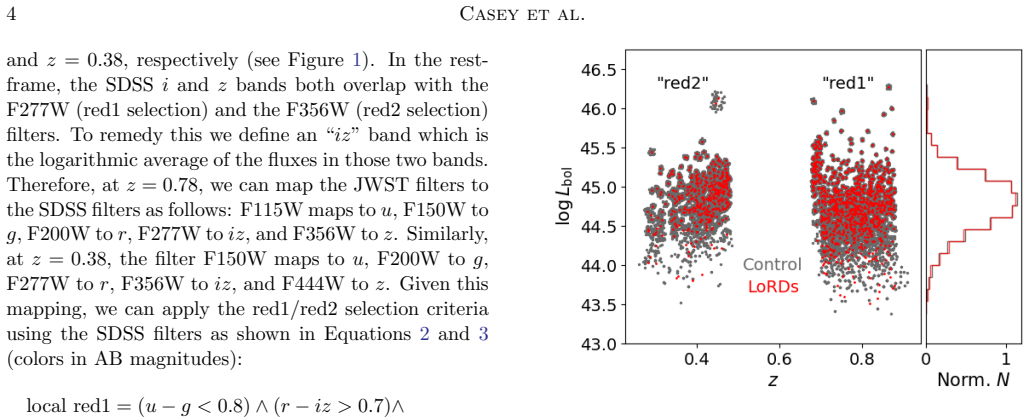
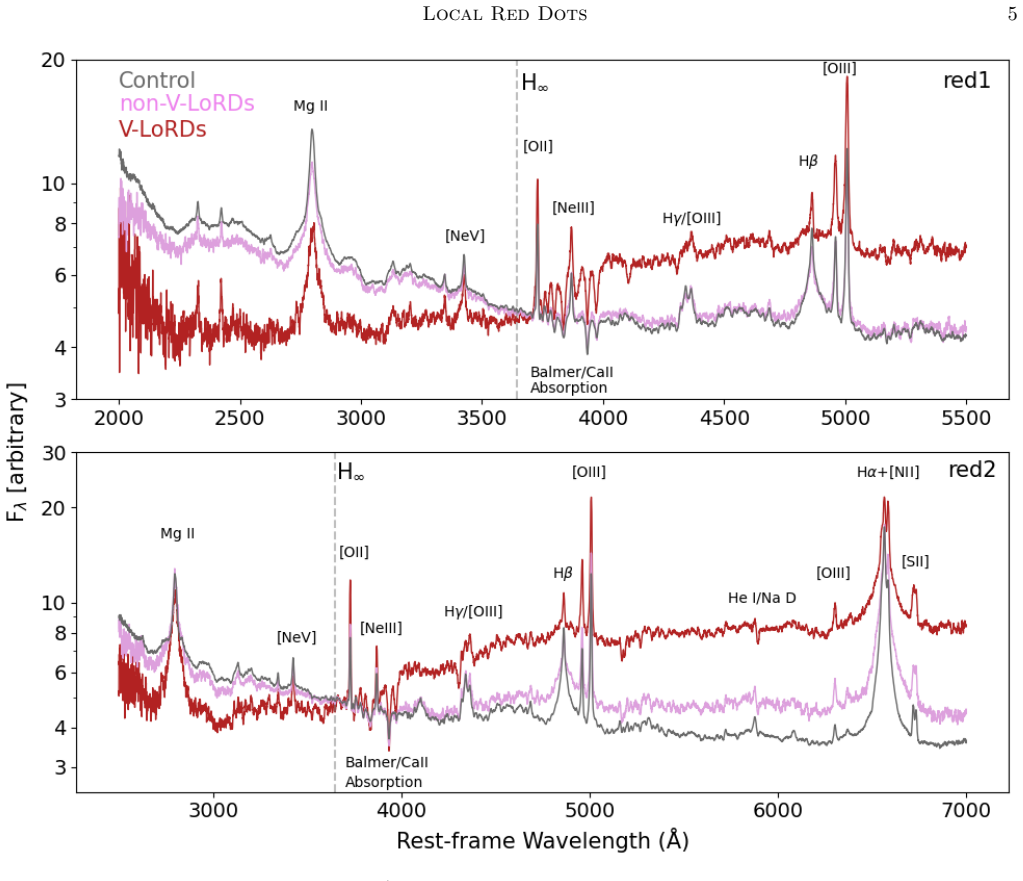
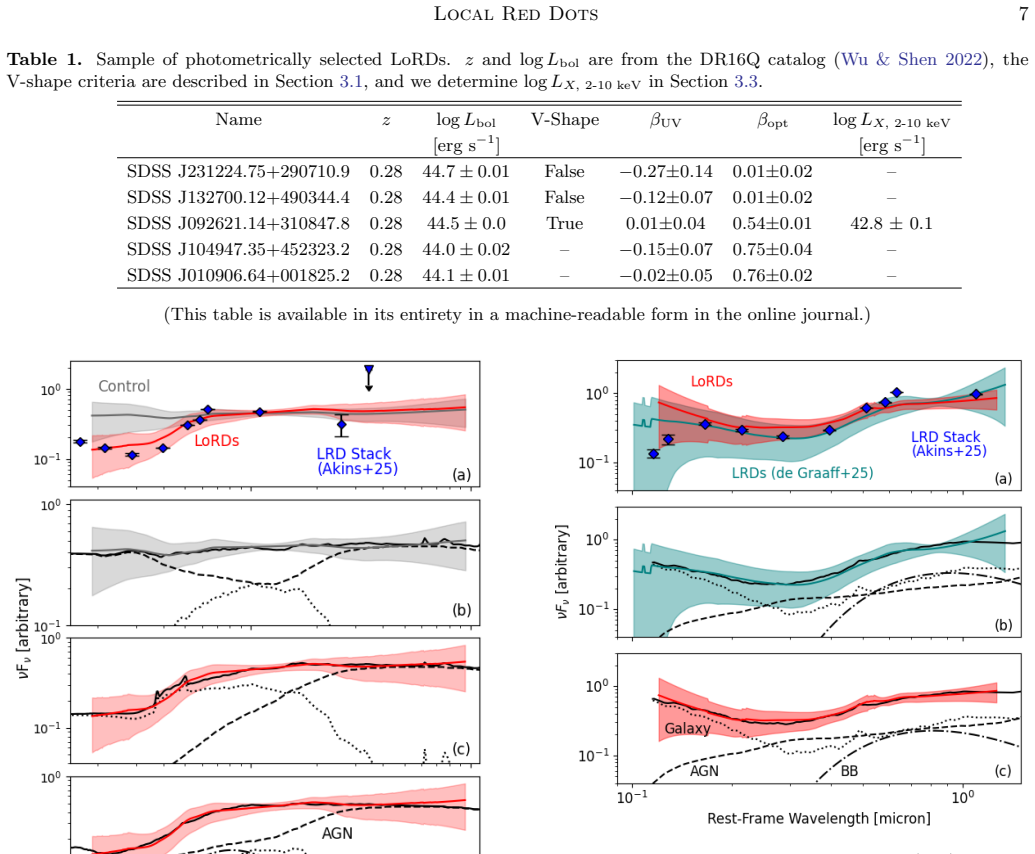
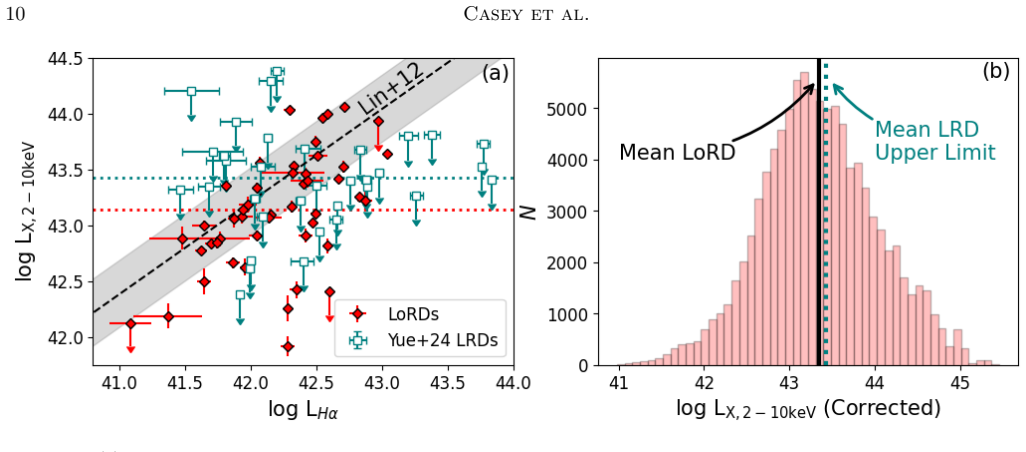
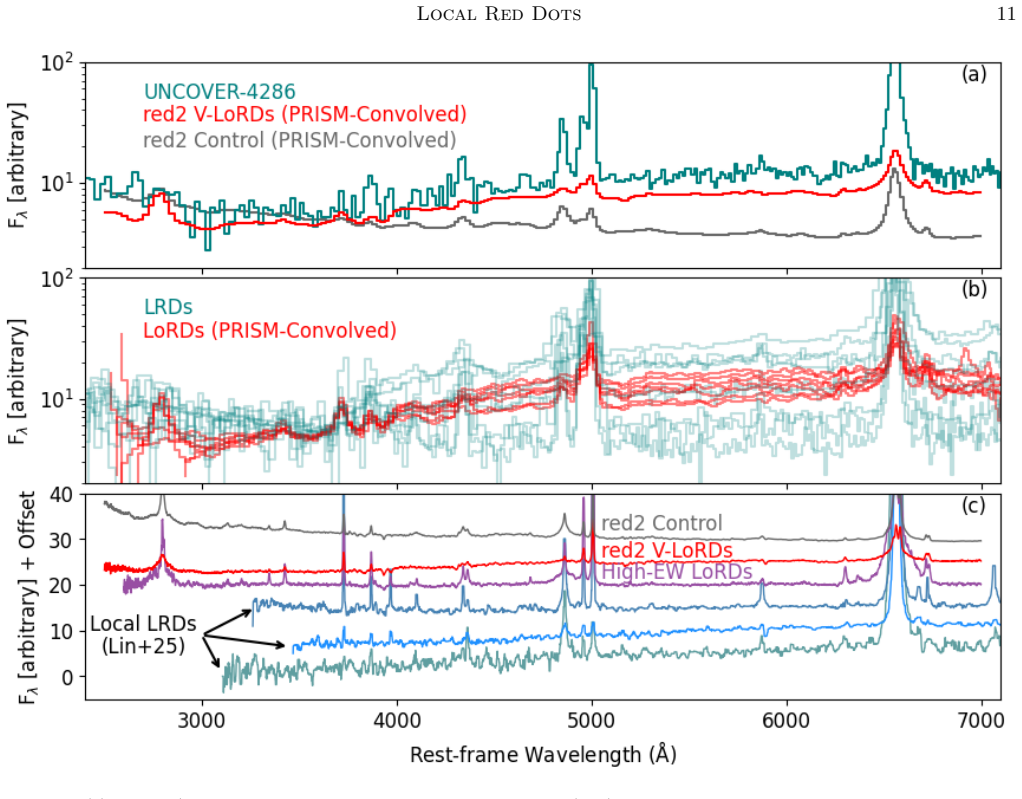
Selecting SDSS quasars whose ugriz photometry at z≈0.4 and 0.8 reproduces the JWST color cuts used for LRDs at z~5 yields a sample of ~1300 Local Red Dots. The V-shaped continuum subset exhibits prominent higher-order Balmer absorption and [NeV]λ3426 emission. The LoRD composite SED matches LRD stacks and is successfully fit either as a reddened AGN plus host galaxy or as a reddened AGN plus host galaxy plus cool blackbody; the X-ray detection rate remains similar to typical quasars.
What carries the argument
Photometric color selection that maps SDSS ugriz bands at moderate redshift onto JWST bands at z~5 to isolate Local Red Dots as color analogs.
If this is right
- LoRDs supply multi-wavelength archival data that can be used to test physical processes inferred for high-redshift LRDs.
- Dust reddening of an AGN plus host galaxy contribution is sufficient to reproduce the observed SED shapes.
- X-ray properties of LoRDs do not require them to be intrinsically weaker than ordinary quasars.
- Low-resolution spectra at high redshift are expected to miss higher-order Balmer absorption and certain emission lines.
Where Pith is reading between the lines
- If the analogy holds, the cool blackbody component may trace a common dust or star-formation feature across both populations.
- The same color cuts could be applied to other low-redshift surveys to enlarge the sample of accessible analogs.
- Detailed X-ray and radio follow-up of LoRDs would test whether the high non-detection probability under LRD limits arises from sensitivity differences.
Load-bearing premise
Objects that agree in the chosen filter colors share the same underlying physical components and spectral shapes rather than matching only by coincidence.
What would settle it
High-resolution optical spectra of the LoRD sample that lack the reported Balmer absorption and [NeV] features, or SED fits that fail when using reddened AGN plus host models, would show the color match does not select comparable objects.
Figures



read the original abstract
Compact and red sources in the high redshift ($z\sim5$) Universe, known as "Little Red Dots" (LRDs), are among JWST's most intriguing discoveries. These sources have broad Balmer emission lines, weak X-ray emission, and unique spectral energy distributions (SEDs) poorly fit by either stellar or AGN templates. Local analogs of LRDs allow for detailed studies of the underlying physical processes with archival multi-wavelength datasets unavailable in the high-$z$ Universe. We show that the SDSS $ugriz$ filters at $z\approx0.4, 0.8$ overlap well with the JWST filters used to select LRDs at $z\sim5$. We use SDSS quasars to define a sample of $\sim1300$ Local Red Dots (LoRDs) which share the same photometric colors of LRDs. A subset of the LoRD sample selected to have V-shaped continua ($N=244$) show prominent higher-order Balmer absorption features and [NeV]$\lambda$3426 emission, both of which would likely be missed in JWST/PRISM observations given the low spectral resolution. A composite SED of the LoRDs differs from a typical quasar SED in the rest-frame UV/optical, but the two agree with each other in the NIR. The LoRD SED matches well with a stack of LRDs and can be modeled either as a reddened AGN combined with a host galaxy, or as a reddened AGN combined with a host galaxy and a cool blackbody. Interestingly, the LoRDs are X-ray detected at a rate comparable to typical quasars. However, the probability that LoRDs and typical quasars would go undetected, if subject to the LRD X-ray upper limits, is $>50\%$.
Editorial analysis
A structured set of objections, weighed in public.
Referee Report
Summary. The manuscript claims to define a sample of ~1300 Local Red Dots (LoRDs) from SDSS quasars at z≈0.4,0.8 via ugriz color cuts chosen to overlap JWST filters used for high-z Little Red Dots (LRDs). A V-shaped subset (N=244) exhibits higher-order Balmer absorption and [NeV]λ3426 emission. The LoRD composite SED matches an LRD stack, is fit by reddened AGN+host (optionally with cool blackbody), and shows X-ray detection rates comparable to typical quasars, although the probability of non-detection under LRD upper limits exceeds 50%.
Significance. If the photometric selection identifies genuine analogs, the work supplies local laboratories for multi-wavelength study of LRD physics using archival data unavailable at high redshift. Credit is due for reliance on public SDSS quasar catalogs and standard filter-overlap calculations, which support reproducibility.
major comments (3)
- [Abstract] Abstract: The exact ugriz color cuts, full sample statistics, and error analysis used to construct the ~1300 LoRDs are not reported. These details are load-bearing for assessing whether the selection robustly isolates objects whose rest-frame properties match LRDs rather than producing coincidental color agreement.
- [Abstract] Abstract: The central premise that limited-band color matching selects objects with comparable underlying SED shapes and physical properties is untested beyond the defining filters; no demonstration is given that the full UV-to-X-ray SEDs remain consistent once the color constraints are relaxed.
- [Abstract] Abstract: The X-ray result states detection rates comparable to typical quasars yet reports >50% probability of non-detection if subject to LRD upper limits. This tension is load-bearing for claims about whether LoRDs support or contradict the weak-X-ray interpretation of LRDs and requires explicit integration into the discussion.
minor comments (1)
- [Abstract] The criterion used to select the N=244 V-shaped continuum subset is not defined, which affects reproducibility of the Balmer-feature analysis.
Simulated Author's Rebuttal
We thank the referee for their constructive comments on our manuscript. We address each major comment point by point below, with plans to revise the manuscript accordingly where the points identify areas for improvement.
read point-by-point responses
-
Referee: [Abstract] Abstract: The exact ugriz color cuts, full sample statistics, and error analysis used to construct the ~1300 LoRDs are not reported. These details are load-bearing for assessing whether the selection robustly isolates objects whose rest-frame properties match LRDs rather than producing coincidental color agreement.
Authors: We agree that these details should be more prominent. The ugriz color cuts, sample construction, and associated statistics (including uncertainties from photometric errors and selection) are fully described in Section 2 of the manuscript. To address the referee's concern, we will add a concise summary of the exact color criteria, final sample size, and error considerations directly into the abstract in the revised version. revision: yes
-
Referee: [Abstract] Abstract: The central premise that limited-band color matching selects objects with comparable underlying SED shapes and physical properties is untested beyond the defining filters; no demonstration is given that the full UV-to-X-ray SEDs remain consistent once the color constraints are relaxed.
Authors: The manuscript provides supporting evidence beyond the photometric selection filters, including the identification of a V-shaped subset (N=244) showing higher-order Balmer absorption and [NeV]λ3426 emission (features not used in the color cuts), as well as a composite SED that matches an LRD stack and is well-fit by reddened AGN plus host galaxy models across UV-to-NIR wavelengths. However, we acknowledge that an explicit test relaxing the color constraints and verifying consistency of the full UV-to-X-ray SEDs would further strengthen the case. We will add such a discussion or supplementary analysis in the revision. revision: partial
-
Referee: [Abstract] Abstract: The X-ray result states detection rates comparable to typical quasars yet reports >50% probability of non-detection if subject to LRD upper limits. This tension is load-bearing for claims about whether LoRDs support or contradict the weak-X-ray interpretation of LRDs and requires explicit integration into the discussion.
Authors: We agree this tension requires more explicit discussion. The abstract already presents both the comparable X-ray detection rate and the >50% non-detection probability under LRD limits. We will expand the relevant discussion section to integrate this point, clarifying the implications for whether LoRDs support or challenge the weak-X-ray interpretation of high-z LRDs, including caveats from sample selection and sensitivity differences. revision: yes
Circularity Check
No significant circularity; sample definition and reported properties are independent measurements
full rationale
The paper selects ~1300 LoRDs by applying photometric color cuts in SDSS ugriz at z≈0.4,0.8 chosen to overlap JWST bands at z~5, then directly measures and reports observed properties of that sample (higher-order Balmer absorption, [NeV] emission in a V-shaped subset, composite SED shape, X-ray detection rate, and modeling as reddened AGN+host). These quantities are extracted from the selected objects rather than being predictions or parameters fitted from the same color criteria by construction. No self-citations, uniqueness theorems, or ansatzes are invoked as load-bearing steps. The central claims rest on external data (SDSS catalogs, X-ray detections) and standard filter-overlap calculations, making the derivation self-contained against external benchmarks.
Axiom & Free-Parameter Ledger
axioms (1)
- domain assumption SDSS ugriz filters at z≈0.4, 0.8 overlap well with the JWST filters used to select LRDs at z∼5
Reference graph
Works this paper leans on
-
[1]
Aihara, H., Arimoto, N., Armstrong, R., et al.\ 2018, , 70, S4. doi:10.1093/pasj/psx066
work page internal anchor Pith review doi:10.1093/pasj/psx066 2018
-
[2]
Akins, H. B., Casey, C. M., Allen, N., et al.\ 2023, , 956, 1, 61. doi:10.3847/1538-4357/acef21
-
[3]
Akins, H. B., Casey, C. M., Lambrides, E., et al.\ 2025, , 991, 1, 37. doi:10.3847/1538-4357/ade984
-
[4]
T., Bogd \'a n, \'A ., Kov \'a cs, O
Ananna, T. T., Bogd \'a n, \'A ., Kov \'a cs, O. E., et al.\ 2024, , 969, 1, L18. doi:10.3847/2041-8213/ad5669
-
[5]
Aoki, K.\ 2010, , 62, 1333. doi:10.1093/pasj/62.5.1333
-
[6]
Assef, R. J., Kochanek, C. S., Brodwin, M., et al.\ 2010, , 713, 2, 970. doi:10.1088/0004-637X/713/2/970
-
[7]
Astropy Collaboration, Price-Whelan, A. M., Lim, P. L., et al.\ 2022, , 935, 167. doi:10.3847/1538-4357/ac7c74
work page internal anchor Pith review doi:10.3847/1538-4357/ac7c74 2022
-
[8]
Baggen, J. F. W., van Dokkum, P., Brammer, G., et al.\ 2024, , 977, 1, L13. doi:10.3847/2041-8213/ad90b8
-
[9]
A., et al.\ 2018, , 854, 1, 42
Balokovi \'c , M., Brightman, M., Harrison, F. A., et al.\ 2018, , 854, 1, 42. doi:10.3847/1538-4357/aaa7eb
-
[10]
Barrows, R. S., Comerford, J. M., Stern, D., et al.\ 2023, , 951, 2, 92. doi:10.3847/1538-4357/acd2d3
-
[11]
Barger, A. J. & Cowie, L. L.\ 2026, arXiv:2605.27903
Pith/arXiv arXiv 2026
-
[12]
Barro, G., P \'e rez-Gonz \'a lez, P. G., Kocevski, D. D., et al.\ 2024, , 963, 2, 128. doi:10.3847/1538-4357/ad167e
-
[13]
Begelman, M. C., Rossi, E. M., & Armitage, P. J.\ 2008, , 387, 4, 1649. doi:10.1111/j.1365-2966.2008.13344.x
-
[14]
E., et al.\ 2024, , 974, 1, 92
Bezanson, R., Labbe, I., Whitaker, K. E., et al.\ 2024, , 974, 1, 92. doi:10.3847/1538-4357/ad66cf
-
[15]
Do little red dots really form a distinct class of astronomical objects?
Billand, J.-B., Elbaz, D., Franco, M., et al.\ 2026, arXiv:2604.11677. doi:10.48550/arXiv.2604.11677
work page internal anchor Pith review Pith/arXiv arXiv doi:10.48550/arxiv.2604.11677 2026
-
[16]
Blanton, M. R., Bershady, M. A., Abolfathi, B., et al.\ 2017, , 154, 1, 28. doi:10.3847/1538-3881/aa7567
-
[17]
Calzetti, D., Armus, L., Bohlin, R. C., et al.\ 2000, , 533, 2, 682. doi:10.1086/308692
work page internal anchor Pith review doi:10.1086/308692 2000
-
[18]
Casey, C. M., Akins, H. B., Kokorev, V., et al.\ 2024, , 975, 1, L4. doi:10.3847/2041-8213/ad7ba7
-
[19]
J., Yang, G., Papovich, C., et al.\ 2023, , 948, 112
Cleri, N. J., Yang, G., Papovich, C., et al.\ 2023, , 948, 112. doi:10.3847/1538-4357/acc1e6
-
[20]
Cleri, N. J., Olivier, G. M., Hutchison, T. A., et al.\ 2023, , 953, 10. doi:10.3847/1538-4357/acde55
-
[21]
Cleri, N. J., Olivier, G. M., Backhaus, B. E., et al.\ 2025, , 994, 146. doi:10.3847/1538-4357/ae0f17
-
[22]
Cleri, N. J., Lewis, Z. J., Leja, J., et al.\ 2026, arXiv:2605.30410
Pith/arXiv arXiv 2026
-
[23]
Cloonan, A. P., Whitaker, K. E., Manning, S. M., et al.\ 2026, arXiv:2603.24700. doi:10.48550/arXiv.2603.24700
-
[24]
Davis, J. D., Tremonti, C. A., Swiggum, C. N., et al.\ 2023, , 951, 2, 105. doi:10.3847/1538-4357/accbbf
-
[25]
Davis, K., Brooks, M., Simons, R. C., et al.\ 2026, arXiv:2606.00258. doi:10.48550/arXiv.2606.00258
work page internal anchor Pith review Pith/arXiv arXiv doi:10.48550/arxiv.2606.00258 2026
-
[26]
doi:10.1051/0004-6361/202557164
Delvecchio, I., Daddi, E., Magnelli, B., et al.\ 2025, , 704, A313. doi:10.1051/0004-6361/202557164
-
[27]
G., et al.\ 2026, , 171, 5, 285
DESI Collaboration, Abdul Karim, M., Adame, A. G., et al.\ 2026, , 171, 5, 285. doi:10.3847/1538-3881/ae4c43
-
[28]
Durodola, E., Pacucci, F., & Hickox, R. C.\ 2025, , 985, 2, 169. doi:10.3847/1538-4357/adced2
-
[29]
Eisenstein, D. J., Weinberg, D. H., Agol, E., et al.\ 2011, , 142, 3, 72. doi:10.1088/0004-6256/142/3/72
-
[30]
J., Willott, C., Alberts, S., et al
Eisenstein, D. J., Willott, C., Alberts, S., et al.\ 2026, , 283, 1, 6. doi:10.3847/1538-4365/ae3163
-
[31]
Evans, I. N., Evans, J. D., Mart \' nez-Galarza, J. R., et al.\ 2024, , 274, 2, 22. doi:10.3847/1538-4365/ad6319
-
[32]
Fitzpatrick, E. L.\ 1999, , 111, 755, 63. doi:10.1086/316293
-
[33]
Foreman-Mackey, D., Hogg, D. W., Lang, D., et al.\ 2013, , 125, 925, 306. doi:10.1086/670067
-
[34]
H., Broussard, A., et al.\ 2018, , 863, 2, 131
Forrest, B., Tran, K.-V. H., Broussard, A., et al.\ 2018, , 863, 2, 131. doi:10.3847/1538-4357/aad232
-
[35]
J., Labb \'e , I., Zitrin, A., et al.\ 2024, , 628, 8006, 57
Furtak, L. J., Labb \'e , I., Zitrin, A., et al.\ 2024, , 628, 8006, 57. doi:10.1038/s41586-024-07184-8
-
[36]
doi:10.1051/0004-6361/202452186
de Graaff, A., Brammer, G., Weibel, A., et al.\ 2025, , 697, A189. doi:10.1051/0004-6361/202452186
-
[37]
de Graaff, A., Rix, H.-W., Naidu, R. P., et al.\ 2025, , 701, A168. doi:10.1051/0004-6361/202554681
-
[38]
de Graaff, A., Hviding, R. E., Naidu, R. P., et al.\ 2025, arXiv:2511.21820. doi:10.48550/arXiv.2511.21820
-
[39]
Ferland, G. J., Chatzikos, M., Guzm \'a n, F., et al.\ 2017, , 53, 385. doi:10.48550/arXiv.1705.10877
-
[40]
Fu, S., Zhang, Z., Jiang, D., et al.\ 2025, arXiv:2512.02096. doi:10.48550/arXiv.2512.02096
-
[41]
doi:10.1038/s41550-026-02885-8
Fu, S., Zhang, Z., Jiang, D., et al.\ 2026, Nature Astronomy. doi:10.1038/s41550-026-02885-8
-
[42]
Gao, F., Wang, L., Pearson, W. J., et al.\ 2020, , 637, A94. doi:10.1051/0004-6361/201937178
-
[43]
doi:10.1051/0004-6361/201014039
Gilli, R., Vignali, C., Mignoli, M., et al.\ 2010, , The X-ray to [Ne V]3426 flux ratio: discovering heavily obscured AGN in the distant Universe, 519, A92. doi:10.1051/0004-6361/201014039
-
[44]
doi:10.1088/0004-637X/806/2/218
Glikman, E., Simmons, B., Mailly, M., et al.\ 2015, , 806, 2, 218. doi:10.1088/0004-637X/806/2/218
-
[45]
Goulding, A. D., Greene, J. E., Bezanson, R., et al.\ 2018, , 70, S37. doi:10.1093/pasj/psx135
-
[46]
Greene, J. E., Labbe, I., Goulding, A. D., et al.\ 2024, , 964, 1, 39. doi:10.3847/1538-4357/ad1e5f
-
[47]
Greene, J. E., Setton, D. J., Furtak, L. J., et al.\ 2026, , 996, 2, 129. doi:10.3847/1538-4357/ae1836
-
[48]
A., Pacucci, F., & Kocevski, D
Guia, C. A., Pacucci, F., & Kocevski, D. D.\ 2024, Research Notes of the American Astronomical Society, 8, 8, 207. doi:10.3847/2515-5172/ad7262
-
[49]
ascl:1809.008
Guo, H., Shen, Y., & Wang, S.\ 2018, Astrophysics Source Code Library. ascl:1809.008
2018
-
[50]
Hall, P. B.\ 2007, , 133, 4, 1271. doi:10.1086/511272
-
[51]
Harris, C.R., Millman, K.J., van der Walt, S.J. et al.\ 2020, , 585, 357. doi:10.1038/s41586-020-2649-2
-
[52]
Hickox, R. C., Myers, A. D., Greene, J. E., et al.\ 2017, , 849, 1, 53. doi:10.3847/1538-4357/aa8c77
-
[53]
Hickox, R. C. & Alexander, D. M.\ 2018, , 56, 625. doi:10.1146/annurev-astro-081817-051803
-
[54]
D.\ 2007, Computing in Science and Engineering, 9, 3, 90
Hunter, J. D.\ 2007, Computing in Science and Engineering, 9, 3, 90. doi:10.1109/MCSE.2007.55
-
[55]
Hviding, R. E., de Graaff, A., Miller, T. B., et al.\ 2025, , 702, A57. doi:10.1051/0004-6361/202555816
-
[56]
E., de Graaff, A., Liu, H., et al.\ 2026, , 1000, 1, L18
Hviding, R. E., de Graaff, A., Liu, H., et al.\ 2026, , 1000, 1, L18. doi:10.3847/2041-8213/ae4c88
-
[57]
& Maiolino, R.\ 2025, , 980, 2, L27
Inayoshi, K. & Maiolino, R.\ 2025, , 980, 2, L27. doi:10.3847/2041-8213/adaebd
-
[58]
Inayoshi, K.\ 2025, , 988, 1, L22. doi:10.3847/2041-8213/adea66
-
[59]
Inayoshi, K. & Ho, L. C.\ 2025, arXiv:2512.03130. doi:10.48550/arXiv.2512.03130
-
[60]
Ji, X., Maiolino, R., \"U bler, H., et al.\ 2025a, , arXiv:2501.13082. doi:10.48550/arXiv.2501.13082
-
[61]
Ji, X., Maiolino, R., \"U bler, H., et al.\ 2025, , 544, 4, 3900. doi:10.1093/mnras/staf1867
-
[62]
Ji, X., D'Eugenio, F., Juod z balis, I., et al.\ 2025b, , arXiv:2507.23774. doi:10.48550/arXiv.2507.23774
-
[63]
Ji, X., D'Eugenio, F., Juod z balis, I., et al.\ 2026, , 545, 3, staf2235. doi:10.1093/mnras/staf2235
-
[64]
Ji, X., Pezzulli, G., D'Eugenio, F., et al.\ 2026, arXiv:2604.03370. doi:10.48550/arXiv.2604.03370
work page internal anchor Pith review Pith/arXiv arXiv doi:10.48550/arxiv.2604.03370 2026
-
[65]
Jin, C., Ward, M., & Done, C.\ 2012, , 422, 4, 3268. doi:10.1111/j.1365-2966.2012.20847.x
-
[66]
, archivePrefix = "arXiv", eprint =
Juneau, S., Bournaud, F., Charlot, S., et al.\ 2014, , 788, 1, 88. doi:10.1088/0004-637X/788/1/88
-
[67]
, archivePrefix = "arXiv", eprint =
Kewley, L. J., Maier, C., Yabe, K., et al.\ 2013, , 774, 1, L10. doi:10.1088/2041-8205/774/1/L10
-
[68]
Kocevski, D. D., Finkelstein, S. L., Barro, G., et al.\ 2025, , 986, 2, 126. doi:10.3847/1538-4357/adbc7d
-
[69]
Kokorev, V., Caputi, K. I., Greene, J. E., et al.\ 2024, , 968, 1, 38. doi:10.3847/1538-4357/ad4265
-
[70]
P., et al.\ 2025, arXiv:2511.07515
Kokorev, V., Chisholm, J., Naidu, R. P., et al.\ 2025, arXiv:2511.07515. doi:10.48550/arXiv.2511.07515
-
[71]
P., et al.\ 2026, , 1004, 2, 153
Kokorev, V., Chisholm, J., Naidu, R. P., et al.\ 2026, , 1004, 2, 153. doi:10.3847/1538-4357/ae4ed7
-
[72]
& Harikane, Y.\ 2024, , arXiv:2407.04777
Kokubo, M. & Harikane, Y.\ 2024, , arXiv:2407.04777. doi:10.48550/arXiv.2407.04777
-
[73]
& Harikane, Y.\ 2025, , 995, 1, 24
Kokubo, M. & Harikane, Y.\ 2025, , 995, 1, 24. doi:10.3847/1538-4357/ae119e
-
[74]
Koss, M., Trakhtenbrot, B., Ricci, C., et al.\ 2017, , 850, 1, 74. doi:10.3847/1538-4357/aa8ec9
-
[75]
doi:10.1038/s41586-023-05786-2
Labb \'e , I., van Dokkum, P., Nelson, E., et al.\ 2023, , 616, 7956, 266. doi:10.1038/s41586-023-05786-2
-
[76]
Labbe, I., Greene, J. E., Matthee, J., et al.\ 2024, arXiv:2412.04557. doi:10.48550/arXiv.2412.04557
-
[77]
E., Bezanson, R., et al.\ 2025, , 978, 1, 92
Labbe, I., Greene, J. E., Bezanson, R., et al.\ 2025, , 978, 1, 92. doi:10.3847/1538-4357/ad3551
-
[78]
The case for super-Eddington accretion in JWST broad-line AGN during the first billion years
Lambrides, E., Garofali, K., Larson, R., et al.\ 2024, , arXiv:2409.13047. doi:10.48550/arXiv.2409.13047
work page internal anchor Pith review Pith/arXiv arXiv doi:10.48550/arxiv.2409.13047 2024
-
[79]
L., Garofali, K., et al.\ 2026, Nature Astronomy
Lambrides, E., Larson, R. L., Garofali, K., et al.\ 2026, Nature Astronomy. doi:10.1038/s41550-026-02813-w
-
[80]
Lambrides, E., Larson, R., Hutchison, T., et al.\ 2025, arXiv:2509.09607. doi:10.48550/arXiv.2509.09607
discussion (0)
Sign in with ORCID, Apple, or X to comment. Anyone can read and Pith papers without signing in.