Multivariable Mendelian randomization with weak instruments: a comparison of Bayesian and frequentist methods
Pith reviewed 2026-06-26 03:34 UTC · model grok-4.3
The pith
Bayesian MVMR-Pony reduces bias and improves coverage compared to frequentist methods in multivariable Mendelian randomization with weak instruments.
A machine-rendered reading of the paper's core claim, the machinery that carries it, and where it could break.
Core claim
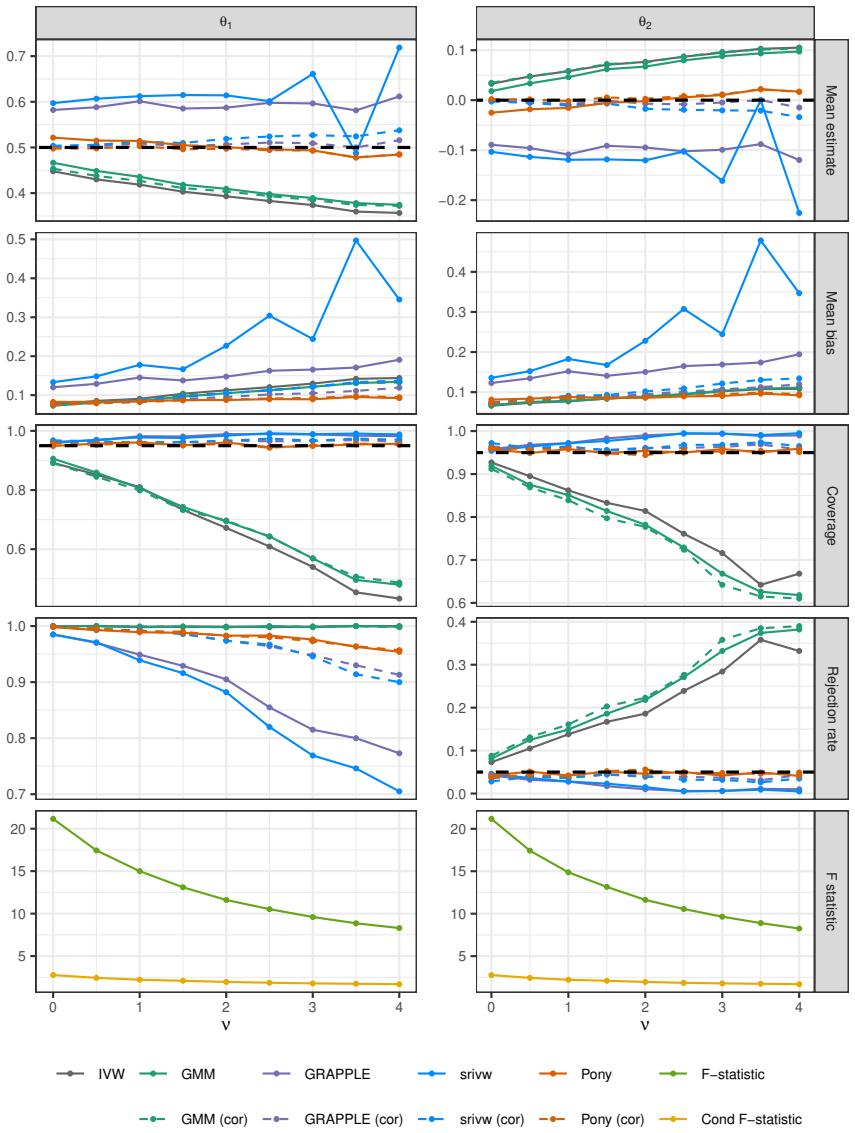
In simulation studies, the MVMR-Pony Bayesian method outperforms frequentist approaches with respect to bias, coverage, type I error rates, and power across settings where weak instrument bias arises due to correlated genetic effects, measurement error, and mediation.
What carries the argument
MVMR-Pony, a Bayesian framework for multivariable Mendelian randomization that mitigates weak instrument bias.
If this is right
- In settings with correlated genetic effects, MVMR-Pony provides more accurate causal effect estimates than frequentist alternatives.
- When measurement error is present in the exposures, the Bayesian method produces less biased results.
- In mediation scenarios, MVMR-Pony maintains better control of type I error while retaining higher power.
- The approach supports valid inference even when instruments are only weakly associated with an exposure conditional on the others.
Where Pith is reading between the lines
- Re-analysis of published multivariable MR studies that used frequentist methods on datasets with multiple correlated exposures could test whether effect estimates change substantially.
- Future work could examine whether the performance advantage persists when the number of exposures grows beyond the two- or three-exposure cases typical in current simulations.
- Software implementations that allow routine use of the Bayesian method alongside standard frequentist tools would let analysts compare results directly on the same data.
Load-bearing premise
The simulation studies accurately represent the conditions under which weak instrument bias occurs in real multivariable Mendelian randomization analyses with multiple exposures.
What would settle it
A simulation or real-data analysis in which frequentist methods achieve lower bias or higher coverage than MVMR-Pony under the same weak-instrument conditions generated by correlated effects, measurement error, or mediation.
Figures



read the original abstract
Weak instruments are a well known limitation for valid causal inference in Mendelian randomization studies. In the single exposure setting, weak instrument bias can be mitigated by selecting genetic instruments which are strongly associated with the exposure according to p-value and/or F-statistic thresholds. However, in the multi-exposure setting, genetic instruments may be strongly associated with an exposure but weakly associated with it conditional on all other exposures in the analysis. It is therefore more difficult to guarantee conditionally strong instruments in multivariable Mendelian randomization. Weak instrument bias can be mitigated using modelling approaches, however there are fewer methods for doing this in the multivariable case compared with the single exposure case. In this paper, we consider a method for mitigating weak instrument bias in multivariable Mendelian randomization using a Bayesian framework: MVMR-Pony. We compare this method with existing frequentist methods. We show using simulation studies that the MVMR-Pony method outperforms the frequentist approaches with respect to bias, coverage, type I error rates, and power, across settings where weak instrument bias arises due to correlated genetic effects, measurement error, and mediation.
Editorial analysis
A structured set of objections, weighed in public.
Referee Report
Summary. The manuscript introduces MVMR-Pony, a Bayesian method for multivariable Mendelian randomization (MVMR) intended to mitigate weak instrument bias arising from correlated genetic effects, measurement error, and mediation. It compares this approach to existing frequentist methods and claims, based on simulation studies, that MVMR-Pony outperforms them with respect to bias, coverage, type I error rates, and power across the simulated settings.
Significance. The topic is relevant given the prevalence of weak instruments in MVMR applications. A simulation-based comparison of Bayesian and frequentist approaches under multiple bias mechanisms is an appropriate evidentiary standard for a methodological paper of this type. If the simulations are representative, the results could inform method choice in practice; the paper appropriately confines its claims to the simulated conditions rather than asserting general superiority.
minor comments (3)
- The simulation studies section would benefit from a table explicitly listing all parameter values (instrument strengths, correlation coefficients, sample sizes, and number of replicates) to facilitate reproducibility and assessment of coverage of realistic scenarios.
- Consider adding a brief real-data illustration, even if secondary, to show how MVMR-Pony behaves on actual genetic data with weak instruments.
- Clarify in the methods whether the Bayesian priors in MVMR-Pony are chosen in a data-dependent way or are fully pre-specified, as this affects the interpretation of the performance metrics.
Simulated Author's Rebuttal
We thank the referee for their positive assessment of the manuscript, recognition of its relevance, and recommendation for minor revision. No specific major comments were raised in the report.
Circularity Check
No significant circularity
full rationale
The paper presents MVMR-Pony as a new Bayesian approach for MVMR with weak instruments and evaluates it exclusively via simulation studies that generate data under three explicit mechanisms (correlated genetic effects, measurement error, mediation). Performance metrics (bias, coverage, type I error, power) are computed against these independently generated datasets rather than being derived from or fitted to the method's own parameters. No equations, uniqueness theorems, or ansatzes are shown to reduce by construction to the paper's inputs or to prior self-citations. The evidentiary basis is external simulation benchmarks, which is the standard and non-circular approach for this class of methodological work.
Axiom & Free-Parameter Ledger
axioms (1)
- domain assumption Standard Mendelian randomization assumptions hold (no pleiotropy, no population stratification, etc.).
Reference graph
Works this paper leans on
-
[1]
Mendelian randomization: Using genes as instruments for making causal infer ences in epidemiology
Lawlor, DA, Harbord, RM, Sterne, JAC, Timpson, N, and Davey S mith, G. Mendelian randomization: Using genes as instruments for making causal infer ences in epidemiology. Stat Med. 2008;27(8):1133–1163
2008
-
[2]
An introduction to instrumental variables for epid emiologists
Greenland, S. An introduction to instrumental variables for epid emiologists. Int J Epidemiol. 2000;29(4):722–729
2000
-
[3]
Instruments for causal inference : an epidemiologists dream? Epidemiology
Hernan, MA and Robins, JM. Instruments for causal inference : an epidemiologists dream? Epidemiology. 2006;17(4):360–372
2006
-
[4]
Mendelian ran domization analysis with multiple genetic variants using summarized data
Burgess, S, Butterworth, A, and Thompson, SG. Mendelian ran domization analysis with multiple genetic variants using summarized data. Genet Epidemiol . 2013;37(7):658–665
2013
-
[5]
Multivariable Mendelian randomizat ion: the use of pleiotropic genetic variants to estimate causal effects
Burgess, S and Thompson, SG. Multivariable Mendelian randomizat ion: the use of pleiotropic genetic variants to estimate causal effects. Am J Epidemiol. 2015;181(4):251–260
2015
-
[6]
High-thro ughput multivariable Mendelian randomization analysis prioritizes apolipoprotein B as key lipid risk factor for coronary artery disease
Zuber, V, Gill, D, Ala-Korpela, M, Langenberg, C, et al. High-thro ughput multivariable Mendelian randomization analysis prioritizes apolipoprotein B as key lipid risk factor for coronary artery disease. Int J Epidemiol . 2021;50(3):893–901
2021
-
[7]
Mendelian randomisa- tion for mediation analysis: current methods and challenges for imple mentation
Carter, AR, Sanderson, E, Hammerton, G, Richmond, RC, et al. Mendelian randomisa- tion for mediation analysis: current methods and challenges for imple mentation. Eur J Epidemiol. 2021;36:465–478
2021
-
[8]
Estimating causal effects on a disease pr ogression trait using bivariate Mendlian randomisation
Cai, S and Dudbridge, F. Estimating causal effects on a disease pr ogression trait using bivariate Mendlian randomisation. Genet Epidemiol . 2025;49:e22600
2025
-
[9]
Instrumental variables regression w ith weak instruments
Staiger, D and Stock, JH. Instrumental variables regression w ith weak instruments. Econo- metrica. 1997;65(3):557–586. 15
1997
-
[10]
Testing and correctin g for weak and pleiotropic instruments in two-sample multivariable Mendelian randomization
Sanderson, E, Spiller, W, and Bowden, J. Testing and correctin g for weak and pleiotropic instruments in two-sample multivariable Mendelian randomization. Stat Med . 2021;40(25): 5434–5452
2021
-
[11]
Mendelianrandomization v0.9 .0: updates to an R package for performing Mendelian randomization analyses using sum marized data [version 1; peer review: 2 approved]
Patel, A, Ye, T, Xue, H, Lin, Z, et al. Mendelianrandomization v0.9 .0: updates to an R package for performing Mendelian randomization analyses using sum marized data [version 1; peer review: 2 approved]. Wellcome Open Res . 2023;8(449)
2023
-
[12]
Efficient Design for Mendelian Random ization Studies: Sub- sample and 2-Sample Instrumental Variable Estimators
Pierce, BL and Burgess, S. Efficient Design for Mendelian Random ization Studies: Sub- sample and 2-Sample Instrumental Variable Estimators. Am J Epidemiol 07 . 2013;178(7): 1177–1184
2013
-
[13]
Mendelia n randomization
Sanderson, E, Glymour, MM, Holmes, MV, Kang, H, et al. Mendelia n randomization. Nat Rev Methods Primers . 2022;2(1):6
2022
-
[14]
Bias in causal estimates from me ndelian randomization studies with weak instruments
Burgess, S and Thompson, SG. Bias in causal estimates from me ndelian randomization studies with weak instruments. Stat Med. 2011;30(11):1312–1323
2011
-
[15]
A n examination of multivari- able Mendelian randomization in the single-sample and two-sample summ ary data settings
Sanderson, E, Davey Smith, G, Windmeijer, F, and Bowden, J. A n examination of multivari- able Mendelian randomization in the single-sample and two-sample summ ary data settings. Int J Epidemiol . 2019;48(3):713–727
2019
-
[16]
Bias in multivariable Mendelian randomization studies due to measurement error on exposures
Zhu, J, Burgess, S, and Grant, AJ. Bias in multivariable Mendelian randomization studies due to measurement error on exposures. arXiv:2203.08668. 2022
-
[17]
Disentangling the effe cts of traits with shared clustered genetic predictors using multivariable Mendelian randomiza tion
Batool, F, Patel, A, Gill, D, and Burgess, S. Disentangling the effe cts of traits with shared clustered genetic predictors using multivariable Mendelian randomiza tion. Genet Epidemiol. 2022;46:415–429
2022
-
[18]
Using gene tic association data to guide drug discovery and development: Review of methods and applic ations
Burgess, S, Mason, AM, Grant, AJ, Slob, EA W, et al. Using gene tic association data to guide drug discovery and development: Review of methods and applic ations. Am J Hum Genet. 2023;110(2):195–214
2023
-
[19]
Use of allele scores as instrumen tal variables for Mendelian randomization
Burgess, S and Thompson, SG. Use of allele scores as instrumen tal variables for Mendelian randomization. Int J Epidemiol . 2013;42(4):1134–1144
2013
-
[20]
The many weak instruments problem and Mendelian randomization
Davies, NM, von Hinke Kessler Scholder, S, Farbmacher, H, Bur gess, S, et al. The many weak instruments problem and Mendelian randomization. Stat Med. 2015;34(3):454–468
2015
-
[21]
Causal inferenc e for heritable phenotypic risk factors using heterogeneous genetic instruments
Wang, J, Zhao, Q, Bowden, J, Hemani, G, et al. Causal inferenc e for heritable phenotypic risk factors using heterogeneous genetic instruments. PLoS Genet . 2021;17(6):1–24
2021
-
[22]
Weak instruments in multivar iable mendelian random- ization: methods and practice
Patel, A, Lane, J, and Burgess, S. Weak instruments in multivar iable mendelian random- ization: methods and practice. arXiv:2408.09868v1. 2024. 16
-
[23]
A Bayesian approach to Mendelian randomization with multiple pleiotropic variants
Berzuini, C, Guo, H, Burgess, S, and Bernardinelli, L. A Bayesian approach to Mendelian randomization with multiple pleiotropic variants. Biostatistics. 2020;21(1):86–101
2020
-
[24]
Inferring the directio n of a causal link and estimating its effect via a Bayesian Mendelian randomization approach
Bucur, IG, Claassen, T, and Heskes, T. Inferring the directio n of a causal link and estimating its effect via a Bayesian Mendelian randomization approach. Stat Methods Med Res . 2020;29 (4):1081–1111
2020
-
[25]
Mendelian randomization accounting for correlated and uncorrelated pleiotropic effects us ing genome-wide summary statistics
Morrison, J, Knoblauch, N, Marcus, JH, Stephens, M, and He, X. Mendelian randomization accounting for correlated and uncorrelated pleiotropic effects us ing genome-wide summary statistics. Nat Genet . 2020;52(7):740–747
2020
-
[26]
Mendelian randomizat ion accounting for complex correlated horizontal pleiotropy while elucidating shared genetic et iology
Cheng, Q, Zhang, X, Chen, LS, and Liu, J. Mendelian randomizat ion accounting for complex correlated horizontal pleiotropy while elucidating shared genetic et iology. Nat Commun . 2022;13:6490
2022
-
[27]
Improving bias and coverage in in strumental variable anal- ysis with weak instruments for continuous and binary outcomes
Burgess, S and Thompson, SG. Improving bias and coverage in in strumental variable anal- ysis with weak instruments for continuous and binary outcomes. Stat Med . 2012;31(15): 1582–1600
2012
-
[28]
A bayesian app roach to Mendelian ran- domisation with dependent instruments
Shapland, CY, Thompson, JR, and Sheehan, NA. A bayesian app roach to Mendelian ran- domisation with dependent instruments. Stat Med. 2019;38(6):985–1001
2019
-
[29]
Selecting likely c ausal risk factors from high-throughput experiments using multivariable Mendelian randomiz ation
Zuber, V, Colijn, JM, Klaver, C, and Burgess, S. Selecting likely c ausal risk factors from high-throughput experiments using multivariable Mendelian randomiz ation. Nat Commun . 2020;11(1):29
2020
-
[30]
GMM is inadmissible under weak ident ification
Andrews, I and Mikusheva, A. GMM is inadmissible under weak ident ification. arXiv:2204.12462. 2023
-
[31]
A Bayesian approach to Mendelian ra ndomization using summary statistics in the univariable and multivariable settings with correlated pleiotropy
Grant, AJ and Burgess, S. A Bayesian approach to Mendelian ra ndomization using summary statistics in the univariable and multivariable settings with correlated pleiotropy. Am J Hum Genet. 2024;111(1):165–180
2024
-
[32]
Multivariab le Mendelian randomiza- tion: the use of pleiotropic genetic variants to estimate causal effe cts
Burgess, S, Dudbridge, F, and Thompson, SG. Re: “Multivariab le Mendelian randomiza- tion: the use of pleiotropic genetic variants to estimate causal effe cts”. Am J Epidemiol . 2015;181(4):290–291
2015
-
[33]
A more robust approach to multivaria ble Mendelian random- ization
Wu, Y, Kang, H, and Ye, T. A more robust approach to multivaria ble Mendelian random- ization. arXiv.2402.00307. 2025
-
[34]
Noise-augmented directional clustering of genetic association data identifies distinct mechanisms underlying obesity
Grant, AJ, Gill, D, Kirk, PDW, and Burgess, S. Noise-augmented directional clustering of genetic association data identifies distinct mechanisms underlying obesity. PLoS Genet . 2022;18:e10009975
2022
-
[35]
An atla s of genetic correlations across human diseases and traits
Bulik-Sullivan, B, Finucane, HK, Anttila, V, Gusev, A, et al. An atla s of genetic correlations across human diseases and traits. Nat Genet . 2015;47(11):1236–1241. 17
2015
-
[36]
Methods for meta-analysis of multiple tr aits using GW AS summary statistics
Ray, D and Boehnke, M. Methods for meta-analysis of multiple tr aits using GW AS summary statistics. Genet Epidemiol . 2018;42(2):134–145
2018
-
[37]
Determ ining the relationship between blood pressure, kidney function, and chronic kidney disea se: Insights from genetic epidemiology
Staplin, N, Herrington, WG, Murgia, F, Ibrahim, M, et al. Determ ining the relationship between blood pressure, kidney function, and chronic kidney disea se: Insights from genetic epidemiology. Hypertension. 2022;79(12):2671–2681
2022
-
[38]
Mild-to-moderate kid ney dysfunction and cardiovascular disease: Observational and Mendelian randomizatio n analyses
Gaziano, L, Sun, L, Arnold, M, Bell, S, et al. Mild-to-moderate kid ney dysfunction and cardiovascular disease: Observational and Mendelian randomizatio n analyses. Circulation. 2022;146(20):1507–1517
2022
-
[39]
Disorders of lipid met abolism in chronic kidney disease
Bulbul, M, Dagel, T, Afsar, B, Ulusu, N, et al. Disorders of lipid met abolism in chronic kidney disease. Blood Purif. 2018;46(2):144–152
2018
-
[40]
Causa l relationship between kidney function and cancer risk: A Mendelian randomization study
Dobrijevic, E, van Zwieten, A, Grant, AJ, Loy, CT, et al. Causa l relationship between kidney function and cancer risk: A Mendelian randomization study. Am J Kidney Dis . 2024;84(6):686–695.e1
2024
-
[41]
A catalog of genetic loci associated with kidney function from analyses of a million individuals
Wuttke, M, Li, Y, Li, M, Sieber, KB, et al. A catalog of genetic loci associated with kidney function from analyses of a million individuals. Nat Genet . 2019;51(6):957–972
2019
-
[42]
Genome-wide asso ciation meta-analyses and fine-mapping elucidate pathways influencing albuminuria
Teumer, A, Li, Y, Ghasemi, S, Prins, BP, et al. Genome-wide asso ciation meta-analyses and fine-mapping elucidate pathways influencing albuminuria. Nat Commun . 2019;10(1):4130
2019
-
[43]
Meta-analysis of 74,046 individuals identifies 11 new susceptibility loci for Alzheimer’s disease
Lambert, JC, Ibrahim-Verbaas, CA, Harold, D, Naj, AC, et al. Meta-analysis of 74,046 individuals identifies 11 new susceptibility loci for Alzheimer’s disease. Nat Genet . 2013;45 (12):1452–1458
2013
-
[44]
Con sistent estimation in Mendelian randomization with some invalid instruments using a weighted median estimator
Bowden, J, Davey Smith, G, Haycock, PC, and Burgess, S. Con sistent estimation in Mendelian randomization with some invalid instruments using a weighted median estimator. Genet Epidemiol . 2016;40(4):304–314
2016
-
[45]
Pleiotropy robust methods for mult ivariable Mendelian random- ization
Grant, AJ and Burgess, S. Pleiotropy robust methods for mult ivariable Mendelian random- ization. Stat Med. 2021;40(26):5813–5830
2021
-
[46]
Robust multivariable Mendelian random ization based on constrained maximum likelihood
Lin, Z, Xue, H, and Pan, W. Robust multivariable Mendelian random ization based on constrained maximum likelihood. Am J Hum Genet . 2023;110(4):592–605
2023
-
[47]
MendelianRandomization: an R pa ckage for performing Mendelian randomization analyses using summarized data
Yavorska, OO and Burgess, S. MendelianRandomization: an R pa ckage for performing Mendelian randomization analyses using summarized data. Int J Epidemiol . 2017;46(6): 1734–1739
2017
-
[48]
Broadbent, JR, Foley, CN, Grant, AJ, Mason, AM, et al. Mende lianRandomization v0.5.0: updates to an R package for performing Mendelian randomization an alyses using summa- rized data [version 2; peer review: 1 approved, 2 approved with res ervations]. Wellcome Open Res. 2020;5(252). 18
2020
-
[49]
GRAPPLE: R Package for MR Framework GRAPPLE
Wang, J and Zhao, Q. GRAPPLE: R Package for MR Framework GRAPPLE . . 2024. R package version 0.2.2
2024
-
[50]
rjags: Bayesian Graphical Models using MCMC
Plummer, M. rjags: Bayesian Graphical Models using MCMC . . 2024. URL https://CRAN. R-project.org/package=rjags . R package version 4-16
2024
-
[51]
R2jags: Using R to Run ’JAGS’
Su, YS and Yajima, M. R2jags: Using R to Run ’JAGS’ . . 2024. URL https://CRAN. R-project.org/package=R2jags . R package version 0.8-9. 19 θ1 0.0 0.2 0.4 0.6 0.8 0.50 0.75 1.00 1.25 0.0 0.4 0.8 1.2 0.80 0.85 0.90 0.95 1.00 0.00 0.25 0.50 0.75 1.00 5 10 15 20 ρ θ2 Mean estimateMean biasCoverageRejection rateF statistic 0.0 0.2 0.4 0.6 0.8 −0.6 −0.4 −0.2 0....
2024
discussion (0)
Sign in with ORCID, Apple, or X to comment. Anyone can read and Pith papers without signing in.