Operator Learning for Cubic Nonlinear Schr\"odinger Equation on Periodic Domains
Pith reviewed 2026-06-29 01:10 UTC · model grok-4.3
The pith
A geometry-conditioned Fourier neural operator learns the one-step map for the cubic nonlinear Schrödinger equation on tori and reproduces the distinct Sobolev norm growth for rational versus irrational aspect ratios.
A machine-rendered reading of the paper's core claim, the machinery that carries it, and where it could break.
Core claim
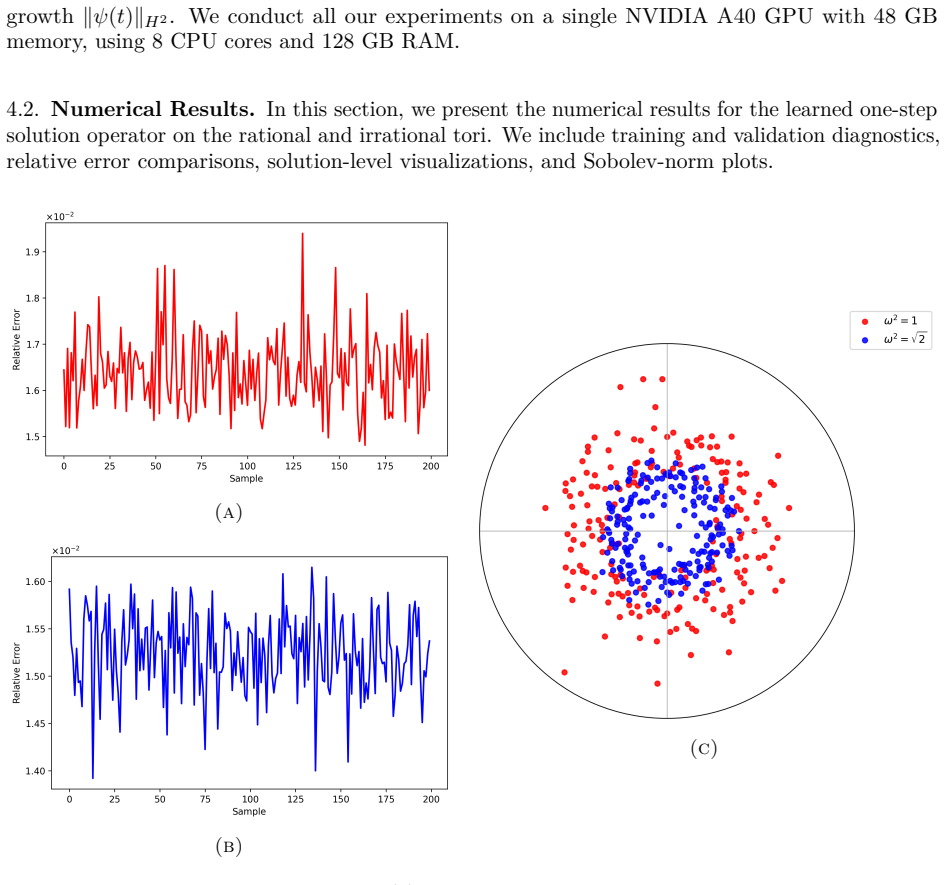
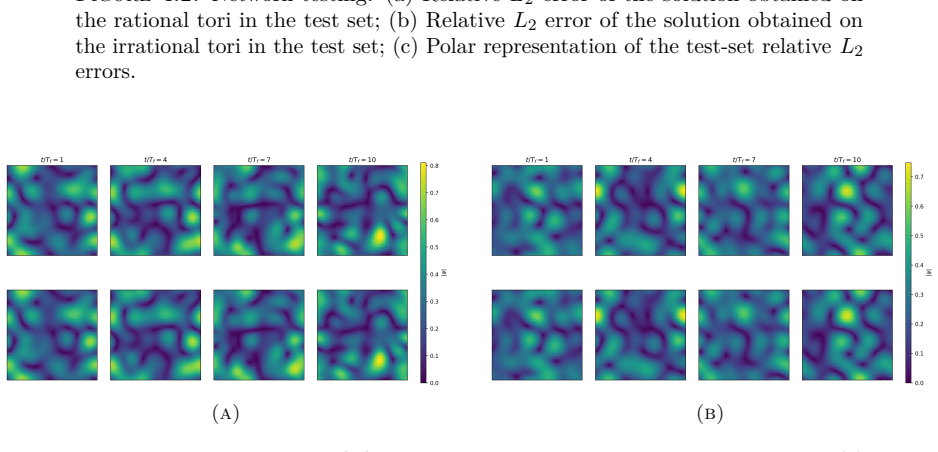
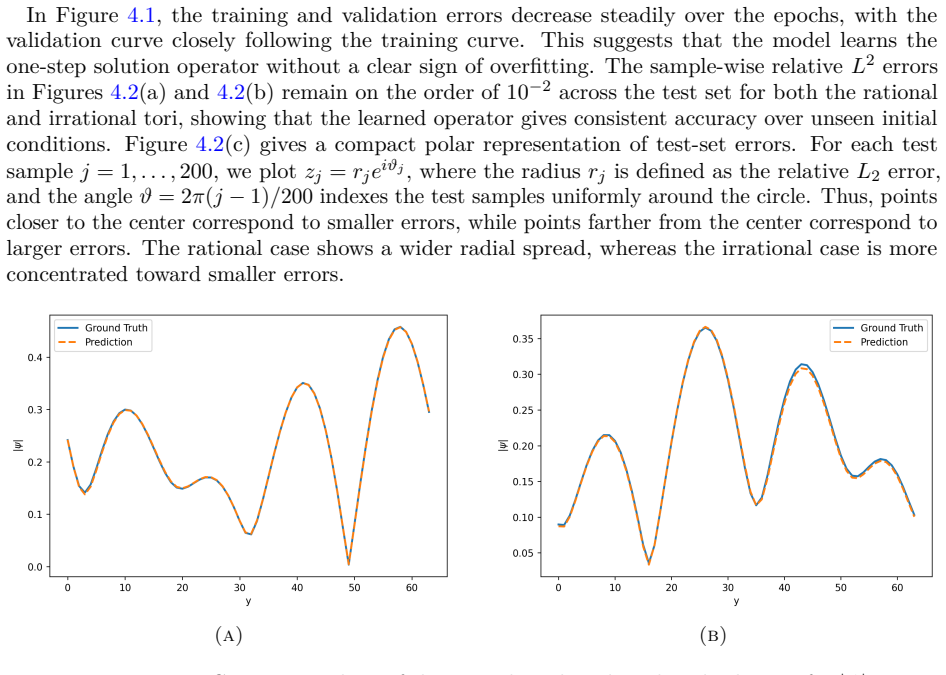
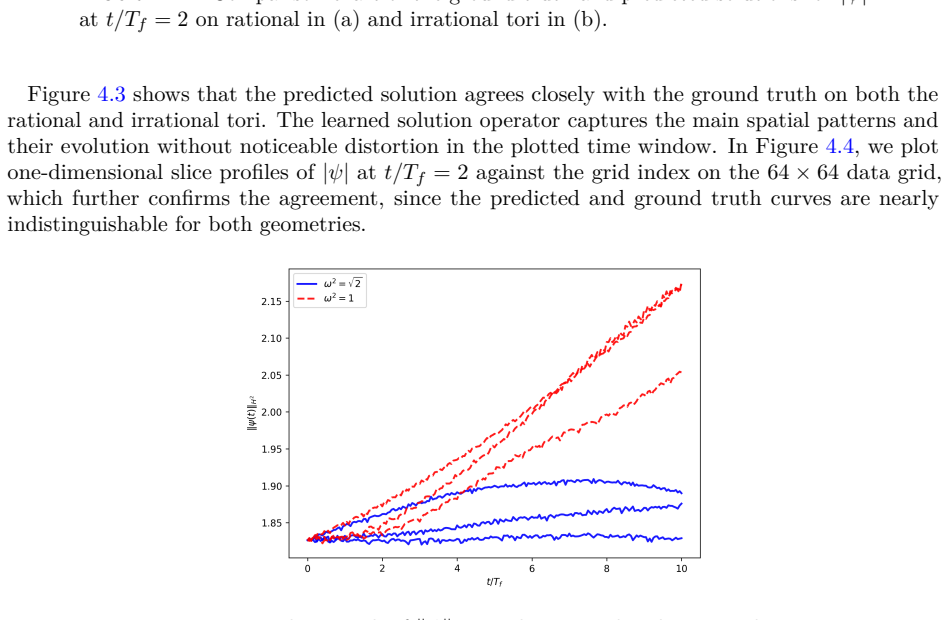
The geometry-conditioned FNO approximates the one-step solution operator for the cubic NLS on two-dimensional flat tori; when evaluated on unseen random-phase trajectories it captures the main solution dynamics and reproduces stronger H² growth on the rational torus together with more constrained behavior on the irrational torus, consistent with known analytic distinctions between the two geometries.
What carries the argument
Geometry-conditioned Fourier neural operator whose input is augmented by the aspect-ratio parameter ω², allowing the network to distinguish the distinct Fourier resonance structures of rational and irrational tori.
If this is right
- Including the aspect-ratio parameter improves long-time predictive accuracy, especially for the rational geometry.
- The learned operator reproduces the geometry-dependent distinction in Sobolev-norm growth reported by prior analytic work.
- Ablation results indicate that retained Fourier modes, activation choice, and Fourier-layer depth all affect the quality of the learned one-step map.
- Geometry-aware neural operators can be used to learn spectral-transfer phenomena in nonlinear dispersive PDEs whose resonance structure depends on domain geometry.
Where Pith is reading between the lines
- The same conditioning strategy could be tested on other dispersive equations where torus aspect ratio controls resonance conditions.
- Successful one-step learning without rapid error growth would allow the operator to generate long statistical ensembles for studying invariant measures.
- The observed difference in H² growth suggests the method could help probe energy-cascade thresholds across families of periodic domains.
Load-bearing premise
The one-step operator learned from random-phase trajectories generated by the Fourier pseudospectral method will generalize to accurate long-time predictions on unseen initial data without rapid error accumulation.
What would settle it
Long-time rollouts on new random-phase initial data where the predicted H² norms diverge markedly from those produced by the Fourier pseudospectral reference solver on the same data.
Figures



read the original abstract
We consider the cubic nonlinear Schr\"odinger (NLS) equation on two-dimensional flat tori with varying aspect ratios. In this formulation, the choice of aspect ratio governs the Fourier resonance structure, so rational and irrational geometries can exhibit different high-frequency cascade behaviors. We present a geometry-conditioned Fourier neural operator (FNO) for the cubic defocusing NLS equation, where the input consists of the real and imaginary parts of the solution together with the aspect-ratio parameter \(\omega^2\). The model is trained to approximate the one-step solution operator and is evaluated on unseen trajectories generated from random-phase initial data using Fourier pseudospectral method. Our numerical experiments show that the learned operator captures the main solution dynamics on both tori and reproduces the distinct Sobolev norm behavior of the two geometries, with stronger \(H^2\)-growth on the rational torus and more constrained behavior on the irrational torus, consistent with the findings of \cite{hrabski2021energy}. We perform ablation studies to examine the roles of retained Fourier modes, activation functions, Fourier-layer depth, and explicit geometry conditioning. The results indicate that including $\omega^2$ improves long-time predictive accuracy, especially for the rational geometry, and supports the use of geometry-aware neural operators for learning spectral-transfer phenomena in nonlinear dispersive partial differential equations.
Editorial analysis
A structured set of objections, weighed in public.
Referee Report
Summary. The manuscript introduces a geometry-conditioned Fourier neural operator (FNO) for the one-step solution map of the cubic defocusing nonlinear Schrödinger equation on 2D tori, with the aspect-ratio parameter ω² supplied as an additional input channel. Data are generated via Fourier pseudospectral discretization from random-phase initial conditions; the model is trained to approximate single-step evolution and is asserted, via numerical experiments and ablations, to capture the main dynamics while reproducing the distinct long-time H²-norm growth signatures of rational versus irrational tori that were previously reported in the literature.
Significance. If the long-time generalization claim is substantiated, the work would provide concrete evidence that explicit geometric conditioning can allow neural operators to learn resonance-driven spectral transfer in dispersive PDEs whose qualitative behavior depends on domain commensurability. The ablation results on retained modes, activation choice, layer depth, and ω² conditioning would also supply practical guidance for designing geometry-aware operators for other parameter-dependent dispersive problems.
major comments (2)
- [§4] §4 (Numerical Experiments): the central claim that the learned operator 'reproduces the distinct Sobolev norm behavior' (stronger H² growth on the rational torus) is not supported by any reported quantitative multi-step error curves, time-averaged L²/H² discrepancies, or direct overlays of norm evolution against the pseudospectral reference at the integration horizons where the cited reference observes divergence; without these data the experimental validation of long-time fidelity remains incomplete.
- [§3 and §4] §3 (Method) and §4: the training protocol is strictly one-step on random-phase trajectories, yet no stability analysis, rollout-error accumulation study, or comparison of learned versus reference trajectories over many steps is provided; because the geometry-dependent H² signatures arise from resonant cascades that develop only over long times, the absence of such verification directly weakens the strongest claim.
minor comments (1)
- [§4] The abstract states that ablations were performed on retained Fourier modes, activation functions, layer depth, and geometry conditioning, but the main text does not tabulate the quantitative accuracy gains (e.g., relative L² error reduction) associated with each choice; adding a compact table would improve readability.
Simulated Author's Rebuttal
We thank the referee for the constructive comments on our manuscript. The points raised emphasize the need for stronger quantitative validation of long-time behavior, which we address below with proposed revisions.
read point-by-point responses
-
Referee: [§4] §4 (Numerical Experiments): the central claim that the learned operator 'reproduces the distinct Sobolev norm behavior' (stronger H² growth on the rational torus) is not supported by any reported quantitative multi-step error curves, time-averaged L²/H² discrepancies, or direct overlays of norm evolution against the pseudospectral reference at the integration horizons where the cited reference observes divergence; without these data the experimental validation of long-time fidelity remains incomplete.
Authors: We agree that additional quantitative metrics are needed to fully support the claim of reproducing distinct H²-norm growth. In the revised manuscript we will add multi-step rollout error curves for L² and H² norms, time-averaged discrepancies, and direct overlays of H²-norm evolution versus the pseudospectral reference over the integration horizons examined in the cited literature. These will be presented for both rational and irrational tori. revision: yes
-
Referee: [§3 and §4] §3 (Method) and §4: the training protocol is strictly one-step on random-phase trajectories, yet no stability analysis, rollout-error accumulation study, or comparison of learned versus reference trajectories over many steps is provided; because the geometry-dependent H² signatures arise from resonant cascades that develop only over long times, the absence of such verification directly weakens the strongest claim.
Authors: We acknowledge that explicit verification of stability under iterated rollout is required to substantiate long-time claims. While one-step training is the standard protocol for learning the solution operator, the revised version will include a dedicated multi-step analysis subsection containing rollout-error accumulation studies, direct trajectory comparisons over many steps, and stability metrics for both geometries. This will confirm that the learned operator sustains the resonant-cascade signatures without rapid divergence. revision: yes
Circularity Check
No circularity; empirical validation uses independent trajectories and external reference
full rationale
The paper trains a geometry-conditioned FNO to approximate the one-step NLS operator on data generated by an external Fourier pseudospectral solver, then evaluates multi-step rollouts on unseen random-phase initial conditions. The reported reproduction of distinct H²-growth signatures on rational versus irrational tori is measured directly against the same independent solver and is stated to be consistent with an external citation (hrabski2021energy). No derivation step reduces by construction to fitted parameters, no self-citation is load-bearing, and the central claim is an empirical generalization test rather than a self-referential identity. The chain is therefore self-contained against external benchmarks.
Axiom & Free-Parameter Ledger
free parameters (3)
- number of retained Fourier modes
- Fourier-layer depth
- activation function
axioms (2)
- domain assumption Fourier pseudospectral method produces sufficiently accurate trajectories for training and evaluation
- domain assumption The solution operator for the cubic defocusing NLS can be approximated by a neural network trained only on one-step maps
Reference graph
Works this paper leans on
-
[1]
W. Bao. The nonlinear Schrödinger equation and applications in Bose-Einstein condensation and plasma physics. InDynamics in models of coarsening, coagulation, condensation and quantization, pages 141–239. World Scientific, 2007
2007
-
[2]
W. Bao, S. Jin, and P. A. Markowich. Numerical Study of Time-Splitting Spectral Discretiza- tions of Nonlinear Schrödinger Equations in the Semiclassical Regimes.SIAM Journal on Scientific Computing, 25(1):27–64, 2003
2003
-
[3]
Bourgain
J. Bourgain. On the growth in time of higher Sobolev norms of smooth solutions of Hamiltonian PDE.International Mathematics Research Notices, (6):277–304, 1996
1996
-
[4]
Colliander, M
J. Colliander, M. Keel, G. Staffilani, H. Takaoka, and T. Tao. Transfer of energy to high frequencies in the cubic defocusing nonlinear Schrödinger equation.Inventiones Mathematicae, 181(1):39–113, 2010
2010
-
[5]
M. Cranmer, S. Greydanus, S. Hoyer, P. Battaglia, D. Spergel, and S. Ho. Lagrangian Neural Networks.arXiv preprint arXiv:2003.04630, 2020
-
[6]
Deng and P
Y. Deng and P. Germain. Growth of Solutions to NLS on Irrational Tori.International Mathematics Research Notices, 2019(9):2919–2950, 2019
2019
-
[7]
Giuliani and M
F. Giuliani and M. Guardia. Sobolev norms explosion for the cubic NLS on irrational tori. Nonlinear Analysis, 220:112865, 2022
2022
-
[8]
Y. Gong, Q. Wang, Y. Wang, and J. Cai. A conservative Fourier pseudo-spectral method for the nonlinear Schrödinger equation.Journal of Computational Physics, 328:354–370, 2017
2017
-
[9]
Greydanus, M
S. Greydanus, M. Dzamba, and J. Yosinski. Hamiltonian Neural Networks. InAdvances in Neural Information Processing Systems, volume 32, 2019
2019
-
[10]
Z. Hani, B. Pausader, N. Tzvetkov, and N. Visciglia. Modified scattering for the cubic Schrödinger equation on product spaces and applications.Forum of Mathematics, Pi, 3:e4, 2015
2015
-
[11]
Hernández, A
Q. Hernández, A. Badias, D. González, F. Chinesta, and E. Cueto. Structure-preserving neural networks.Journal of Computational Physics, 426:109950, 2021
2021
-
[12]
Herr and B
S. Herr and B. Kwak. Global well-posedness of the cubic nonlinear schrödinger equation on $\mathbb{t} ˆ{2}$.Inventiones mathematicae, 2026
2026
-
[13]
A. Hrabski, Y. Pan, G. Staffilani, and B. Wilson. Energy transfer for solutions to the nonlinear Schröodinger equation on irrational tori.arXiv preprint arXiv:2107.01459, 2021
-
[14]
A. D. Jagtap and G. E. Karniadakis. Extended physics-informed neural networks (xpinns): A generalized space-time domain decomposition based deep learning framework for nonlinear partial differential equations.Communications in Computational Physics, 28(5):2002–2041, 2020
2002
-
[15]
A. D. Jagtap, E. Kharazmi, and G. E. Karniadakis. Conservative physics-informed neural networks on discrete domains for conservation laws: Applications to forward and inverse problems.Computer Methods in Applied Mechanics and Engineering, 365:113028, 2020
2020
-
[16]
P. Jin, Z. Zhang, A. Zhu, Y. Tang, and G. E. Karniadakis. Sympnets: Intrinsic structure- preserving symplectic networks for identifying hamiltonian systems.Neural Networks, 132:166– 179, 2020
2020
-
[17]
Kovachki, S
N. Kovachki, S. Lanthaler, and S. Mishra. On universal approximation and error bounds for Fourier neural operators.Journal of Machine Learning Research, 22(290):1–76, 2021
2021
-
[18]
Kovachki, Z
N. Kovachki, Z. Li, B. Liu, K. Azizzadenesheli, K. Bhattacharya, A. M. Stuart, and A. Anand- kumar. Neural Operator: Learning Maps Between Function Spaces with Applications to PDEs. Journal of Machine Learning Research, 24(89):1–97, 2023. 19
2023
-
[19]
Z. Li, N. B. Kovachki, K. Azizzadenesheli, B. Liu, K. Bhattacharya, A. M. Stuart, and A. Anandkumar. Neural Operator: Graph Kernel Network for Partial Differential Equations. arXiv preprint arXiv:2003.03485, 2020
work page internal anchor Pith review Pith/arXiv arXiv 2003
-
[20]
Z. Li, N. B. Kovachki, K. Azizzadenesheli, B. Liu, K. Bhattacharya, A. M. Stuart, and A. Anandkumar. Fourier Neural Operator for Parametric Partial Differential Equations. In International Conference on Learning Representations, 2021
2021
-
[21]
L. Lu, P. Jin, G. Pang, Z. Zhang, and G. E. Karniadakis. Learning nonlinear operators via DeepONet based on the universal approximation theorem of operators.Nature Machine Intelligence, 3(3):218–229, 2021
2021
-
[22]
A. C. Newell and J. V. Moloney.Nonlinear Optics. Addison-Wesley, 1992
1992
-
[23]
V. Obieke and E. Oguadimma. Structure-preserving physics-informed neural network for the Korteweg–de Vries (KdV) equation.arXiv preprint arXiv:2511.00418, 2025
-
[24]
V. C. Obieke, C. Chukwuemeka, and E. E. Oguadimma. Structure-informed neural operators for long-time prediction of parametric hamiltonian pdes.arXiv preprint arXiv:2606.14913, 2026
work page internal anchor Pith review Pith/arXiv arXiv 2026
-
[25]
E. E. Oguadimma, M. A. F. Elbarkawy, D. O. Oranugo, H. E. Salem, M. Bayram, and O. J. Obulezi. A Foundational Review of Ordinary Differential Equation Solution Methods and Their Inherent Symmetries.Boletim da Sociedade Paranaense de Matemática, 44(8):1–27, 2026
2026
-
[26]
S. A. Orszag. On the Elimination of Aliasing in Finite-Difference Schemes by Filtering High-Wavenumber Components.Journal of the Atmospheric Sciences, 28(6):1074–1074, 1971
1971
-
[27]
Planchon, N
F. Planchon, N. Tzvetkov, and N. Visciglia. On the Growth of Sobolev norms for NLS on 2- and 3-Dimensional Manifolds.Analysis & PDE, 10(5):1123–1147, 2017
2017
-
[28]
Raissi, P
M. Raissi, P. Perdikaris, and G. E. Karniadakis. Physics-informed neural networks: A deep learning framework for solving forward and inverse problems involving nonlinear partial differential equations.Journal of Computational Physics, 378:686–707, 2019
2019
-
[29]
Ren and S.-F
H.-M. Ren and S.-F. Tian. The evolution process of the solutions for the coupled nonlinear Schrödinger equations via Fourier neural operator approach.Mathematics and Computers in Simulation, 239:1082–1096, 2026
2026
-
[30]
Sirignano and K
J. Sirignano and K. Spiliopoulos. DGM: A deep learning algorithm for solving partial differential equations.Journal of Computational Physics, 375:1339–1364, 2018
2018
-
[31]
Staffilani and B
G. Staffilani and B. Wilson. Stability of the cubic nonlinear Schrödinger equation on an irrational torus.SIAM Journal on Mathematical Analysis, 52(2):1318–1342, 2020
2020
-
[32]
Sulem and P.-L
C. Sulem and P.-L. Sulem.The Nonlinear Schrödinger Equation: Self-Focusing and Wave Collapse, volume 139 ofApplied Mathematical Sciences. Springer, 1999
1999
-
[33]
J. A. C. Weideman and B. M. Herbst. Split-Step Methods for the Solution of the Nonlinear Schrödinger Equation.SIAM Journal on Numerical Analysis, 23(3):485–507, 1986
1986
-
[34]
G. Wen, Z. Li, K. Azizzadenesheli, A. Anandkumar, and S. M. Benson. U-FNO—An enhanced fourier neural operator-based deep-learning model for multiphase flow.Advances in Water Resources, 163:104180, 2022
2022
-
[35]
B. Wilson and X. Yu. Modified Scattering of Cubic Nonlinear Schrödinger Equation on Rescaled Waveguide Manifolds.arXiv preprint arXiv:2207.07248, 2022
-
[36]
W. Xiao, T. Gao, K. Liu, J. Duan, and M. Zhao. Fourier neural operator based fluid–structure interaction for predicting the vesicle dynamics.Physica D: Nonlinear Phenomena, 463:134145, 2024
2024
-
[37]
H. You, Q. Zhang, C. J. Ross, C.-H. Lee, and Y. Yu. Learning deep implicit Fourier neural operators (IFNOs) with applications to heterogeneous material modeling.Computer Methods in Applied Mechanics and Engineering, 398:115296, 2022
2022
-
[38]
B. Yu. The deep Ritz method: A deep learning-based numerical algorithm for solving variational problems.Communications in Mathematics and Statistics, 6(1):1–12, 2018
2018
-
[39]
V. E. Zakharov. Stability of Periodic Waves of Finite Amplitude on the Surface of a Deep Fluid.Journal of Applied Mechanics and Technical Physics, 9(2):190–194, 1968
1968
-
[40]
Y. Zang, G. Bao, X. Ye, and H. Zhou. Weak adversarial networks for high-dimensional partial differential equations.Journal of Computational Physics, 411:109409, 2020. 20
2020
-
[41]
Zhong, Z
M. Zhong, Z. Yan, and S.-F. Tian. Data-driven parametric soliton-rogon state transitions for nonlinear wave equations using deep learning with Fourier neural operator.Communications in Theoretical Physics, 75:025001, 2023
2023
-
[42]
Y. D. Zhong, B. Dey, and A. Chakraborty. Symplectic ODE-Net: Learning Hamiltonian Dynamics with Control. InInternational Conference on Learning Representations, 2020. Emmanuel E. Oguadimma Department of Mathematics, Oregon State University Kidder Hall 368 Corvallis, OR 97331 Email address:oguadime@oregonstate.edu Victory C. Obieke Department of Mathematic...
2020
discussion (0)
Sign in with ORCID, Apple, or X to comment. Anyone can read and Pith papers without signing in.