The Dust Mineralogy of Interstellar Comet 3I/ATLAS from JWST/MIRI Observations
Pith reviewed 2026-06-29 00:52 UTC · model grok-4.3
The pith
Interstellar comet 3I/ATLAS dust is dominated by amorphous silicates like the interstellar medium.
A machine-rendered reading of the paper's core claim, the machinery that carries it, and where it could break.
Core claim
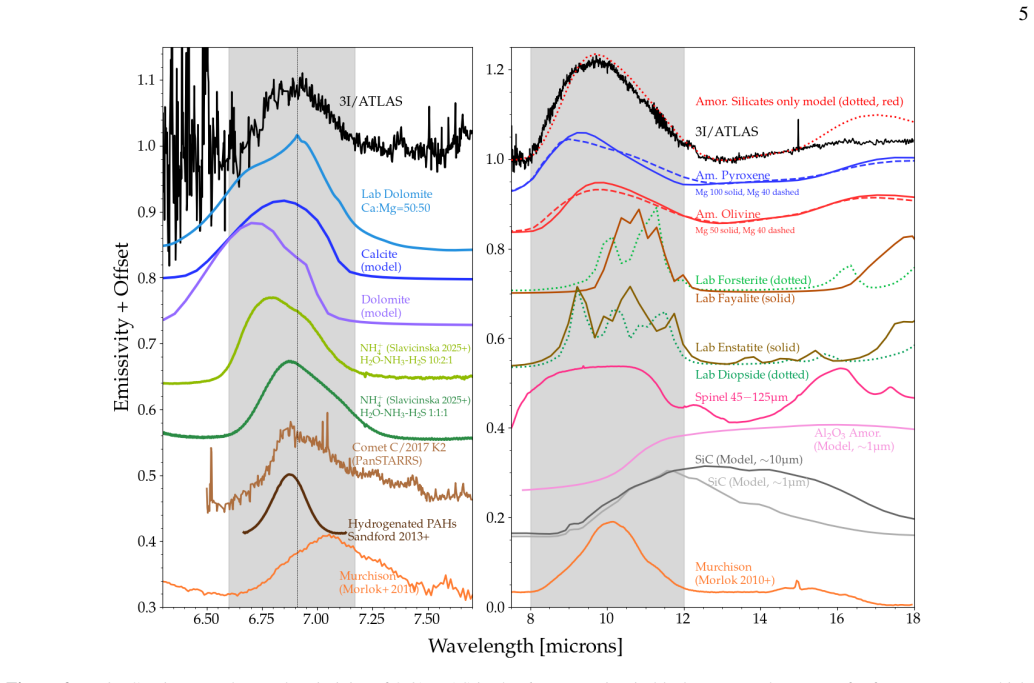
Characterization of this 10-micron emissivity maximum reveals that 3I's dust composition is dominated by amorphous silicates, and that 3I is unlike Solar System comets, which show significant crystalline silicate dust. Instead, 3I's dust composition is more similar to circumstellar transition disks and the interstellar medium. We suggest 3I may have formed in a distant part of its home system out of interstellar medium-like material, without substantial incorporation of silicates condensed near its host star, unlike the mixing scenarios commonly hypothesized for Solar System comets. Alternatively, 3I's original crystalline silicates may have been amorphized during its Gyr-long journey, altho
What carries the argument
The 10-micron emissivity feature in the JWST/MIRI spectrum of the dust coma, interpreted through comparison to laboratory and observational templates of silicate mineralogy.
If this is right
- 3I's dust is more similar to the interstellar medium than to Solar System comets.
- 3I likely formed without the radial mixing of inner and outer system materials that is common for Solar System comets.
- Amorphization of crystalline silicates over its long interstellar journey is considered less likely than primordial formation conditions.
- The composition provides a new constraint on how dust is incorporated into planetesimals in other planetary systems.
Where Pith is reading between the lines
- If the composition is representative, models of comet formation must allow for regions that accrete almost exclusively ISM-like material with little inner-disk processing.
- Spectroscopy of additional interstellar objects could test whether amorphous-silicate dominance is common or varies with dynamical history.
- Laboratory measurements of amorphization timescales under cosmic-ray exposure could quantitatively evaluate the alternative explanation.
Load-bearing premise
The observed 10-micron emissivity feature can be unambiguously attributed to amorphous silicates and compared directly to features in Solar System comets and the ISM without detailed grain size, temperature, or optical depth modeling specific to the 3I coma environment.
What would settle it
A radiative-transfer model of the 3I coma that reproduces the observed 10-micron feature using a substantial fraction of crystalline silicates under the measured grain temperatures and optical depths.
Figures



read the original abstract
We present the first spectroscopic mineralogical analysis of the dust coma of an interstellar object (ISO) from JWST mid-infrared spectroscopy of 3I/ATLAS (3I). 3I exhibits a strong 10-micron emissivity feature commonly seen on asteroids, comets, disks, and the interstellar medium. Characterization of this 10-micron emissivity maximum reveals that 3I's dust composition is dominated by amorphous silicates, and that 3I is unlike Solar System comets, which show significant crystalline silicate dust. Instead, 3I's dust composition is more similar to circumstellar transition disks and the interstellar medium. We suggest 3I may have formed in a distant part of its home system out of interstellar medium-like material, without substantial incorporation of silicates condensed near its host star, unlike the mixing scenarios commonly hypothesized for Solar System comets. Alternatively, 3I's original crystalline silicates may have been amorphized during its Gyr-long journey, although we find this alternative less likely due to 3I's mass loss rate and distinct 10 micron feature as opposed to observed Solar System comets.
Editorial analysis
A structured set of objections, weighed in public.
Referee Report
Summary. The manuscript reports JWST/MIRI mid-infrared spectroscopy of interstellar comet 3I/ATLAS, the first such mineralogical analysis of an ISO dust coma. It identifies a strong 10-micron emissivity feature and interprets it as evidence that the dust is dominated by amorphous silicates, in contrast to Solar System comets that exhibit significant crystalline silicate fractions; instead, 3I is argued to resemble the ISM and circumstellar transition disks. The authors propose formation from ISM-like material in a distant region of the home system or possible amorphization during its interstellar journey, with the latter deemed less likely.
Significance. If the spectral attribution holds after quantitative validation, this would constitute the first direct mineralogical constraint on an interstellar object's dust, offering a key datum for distinguishing ISO formation pathways from those of Solar System comets and testing mixing versus inheritance scenarios. The JWST/MIRI dataset itself is a clear strength, providing the requisite mid-IR sensitivity and resolution for such work.
major comments (2)
- [Abstract and spectral analysis section] Abstract and spectral analysis section: the central claim that the 10-micron emissivity maximum demonstrates dominance by amorphous silicates (and thereby distinguishes 3I from Solar System comets) is load-bearing, yet the manuscript provides no coma-specific radiative transfer modeling of grain-size distribution, temperature structure, or optical depth to demonstrate that the observed feature shape, peak position, and contrast cannot arise from mixed or processed grains under 3I conditions.
- [Discussion section] Discussion section: the assertion that amorphization during the Gyr journey is less likely than ISM-like formation rests on qualitative comparison of the 10-micron feature and mass-loss rate to Solar System comets, but lacks quantitative forward modeling or error budgets showing that the observed profile is incompatible with partial crystalline fractions after processing.
minor comments (1)
- [Abstract] The abstract would benefit from a concise statement of the data-reduction steps, fitting methodology, and uncertainty treatment used to characterize the 10-micron feature.
Simulated Author's Rebuttal
We thank the referee for their careful reading and constructive comments on our manuscript. The points raised highlight areas where additional clarification and analysis can strengthen the presentation. We respond to each major comment below and indicate where revisions will be made.
read point-by-point responses
-
Referee: [Abstract and spectral analysis section] Abstract and spectral analysis section: the central claim that the 10-micron emissivity maximum demonstrates dominance by amorphous silicates (and thereby distinguishes 3I from Solar System comets) is load-bearing, yet the manuscript provides no coma-specific radiative transfer modeling of grain-size distribution, temperature structure, or optical depth to demonstrate that the observed feature shape, peak position, and contrast cannot arise from mixed or processed grains under 3I conditions.
Authors: We acknowledge that the manuscript does not include full coma-specific radiative transfer modeling, which would indeed provide a more rigorous exclusion of alternative grain mixtures. Our interpretation instead rests on the direct match of the observed emissivity peak position (~10 μm), width, and lack of substructure to laboratory spectra of amorphous silicates and to ISM/transition-disk observations, contrasted against the crystalline features seen in Solar System comets. This comparative approach follows standard practice in mid-IR cometary mineralogy studies. We will revise the spectral analysis section to explicitly discuss potential degeneracies with grain size and temperature, add references to existing coma models of similar objects, and include a brief forward-modeling exercise using simple two-component mixtures to quantify how much crystalline material could be hidden within the observed profile. revision: partial
-
Referee: [Discussion section] Discussion section: the assertion that amorphization during the Gyr journey is less likely than ISM-like formation rests on qualitative comparison of the 10-micron feature and mass-loss rate to Solar System comets, but lacks quantitative forward modeling or error budgets showing that the observed profile is incompatible with partial crystalline fractions after processing.
Authors: The discussion currently relies on the observed feature contrast and the comet's high mass-loss rate (implying exposure of relatively unprocessed material) to argue against substantial amorphization. We agree that quantitative forward modeling of amorphization effects and associated error budgets would make this argument more robust. We will expand the discussion section to incorporate laboratory constraints on amorphization timescales, provide a simple error budget on the crystalline fraction upper limit derived from the feature shape, and reference relevant processing models from the literature. This will allow a clearer quantitative statement on why the ISM-like formation scenario is favored. revision: yes
Circularity Check
No significant circularity; analysis rests on new observational spectra
full rationale
The paper reports new JWST/MIRI mid-infrared spectroscopy of interstellar comet 3I/ATLAS and attributes the observed 10-micron emissivity feature to amorphous silicates via direct comparison with template spectra from Solar System comets, transition disks, and the ISM. No equations, parameter fits, or derivations are presented that reduce by construction to prior inputs or self-citations. The central claim follows from the fresh data and external spectral libraries rather than any self-referential loop, self-citation load-bearing premise, or renaming of known results. This is the expected outcome for an observational mineralogy study grounded in new measurements.
Axiom & Free-Parameter Ledger
Reference graph
Works this paper leans on
-
[1]
The Volatile Inventory of 3I/ATLAS as seen with JWST/MIRI
The Volatile Inventory of 3I/ATLAS as Seen with JWST/MIRI. The Astrophysical Journal , keywords =. doi:10.3847/2041-8213/ae5700 , archivePrefix =. 2601.22034 , primaryClass =
work page internal anchor Pith review Pith/arXiv arXiv doi:10.3847/2041-8213/ae5700 2041
-
[2]
The Astropy Project: Building an inclusive, open-science project and status of the v2.0 core package
The Astropy Project: Building an Open-science Project and Status of the v2.0 Core Package. , keywords =. doi:10.3847/1538-3881/aabc4f , archivePrefix =. 1801.02634 , primaryClass =
work page internal anchor Pith review Pith/arXiv arXiv doi:10.3847/1538-3881/aabc4f
-
[3]
Astropy: A Community Python Package for Astronomy
Astropy: A Community Python Package for Astronomy. , keywords =. doi:10.1051/0004-6361/201322068 , archivePrefix =. 1307.6212 , primaryClass =
work page internal anchor Pith review Pith/arXiv arXiv doi:10.1051/0004-6361/201322068
-
[4]
Hunter, J. D. , Title =. CSE , Volume =
-
[5]
The Astropy Project: Sustaining and Growing a Community-oriented Open-source Project and the Latest Major Release (v5.0) of the Core Package. , keywords =. doi:10.3847/1538-4357/ac7c74 , archivePrefix =. 2206.14220 , primaryClass =
work page internal anchor Pith review Pith/arXiv arXiv doi:10.3847/1538-4357/ac7c74
-
[6]
and Haberland, Matt and Reddy, Tyler and Cournapeau, David and Burovski, Evgeni and Peterson, Pearu and Weckesser, Warren and Bright, Jonathan and
Virtanen, Pauli and Gommers, Ralf and Oliphant, Travis E. and Haberland, Matt and Reddy, Tyler and Cournapeau, David and Burovski, Evgeni and Peterson, Pearu and Weckesser, Warren and Bright, Jonathan and. NatMe , year =
-
[7]
Centaurs , year = 2025, editor =
Formation of Planetesimals in the Outer Solar System. Centaurs , year = 2025, editor =. doi:10.1088/2514-3433/ada267ch2 , adsurl =
-
[8]
Comets III , year = 2024, editor =
Comets and Planetesimal Formation. Comets III , year = 2024, editor =. doi:10.2458/azu_uapress_9780816553631-ch003 , adsurl =
-
[9]
Charles R. Harris and K. Jarrod Millman and St. Array Programming with. 2020 , month = sep, journal =. doi:10.1038/s41586-020-2649-2 , publisher =
-
[10]
doi:10.5281/zenodo.17515973 , version =
Zenodo , year = 2025, month = nov, eid =. doi:10.5281/zenodo.17515973 , version =
-
[11]
doi:10.5281/zenodo.17186395 , url =
jwstspec , month = sep, year = 2025, journal =. doi:10.5281/zenodo.17186395 , url =
-
[12]
Disordered Silicates in Space: a Study of Laboratory Spectra of "Amorphous" Silicates
Disordered Silicates in Space: A Study of Laboratory Spectra of ``Amorphous'' Silicates. , keywords =. doi:10.1088/0004-637X/740/2/93 , archivePrefix =. 1108.0429 , primaryClass =
work page internal anchor Pith review Pith/arXiv arXiv doi:10.1088/0004-637x/740/2/93
-
[13]
ArXiv e-prints , archivePrefix = "arXiv", eprint =
The Pan-STARRS1 Surveys. ArXiv e-prints , archivePrefix = "arXiv", eprint =
-
[14]
The Gemini-North Multi-Object Spectrograph: Performance in Imaging, Long-Slit, and Multi-Object Spectroscopic Modes. , keywords =. doi:10.1086/383624 , adsurl =
-
[15]
Comet Bowell 1980b. , keywords =. 1984. doi:10.1086/113552 , adsurl =
-
[16]
, year = 1998, month = apr, volume =
Narrowband Photometry of Comet P/Halley: Variation with Heliocentric Distance, Season, and Solar Phase Angle. , year = 1998, month = apr, volume =. doi:10.1006/icar.1997.5902 , adsurl =
-
[17]
The Sloan Digital Sky Survey Photometric System. , keywords =. doi:10.1086/117915 , adsurl =
-
[19]
The Discovery and Characterization of Earth-crossing Asteroid 2024 YR _ 4. , keywords =. doi:10.3847/2041-8213/adc910 , archivePrefix =. 2503.05694 , primaryClass =
-
[20]
Keck and Gemini Characterization of Hayabusa2\# Rendezvous Target 1998 KY _ 26. , keywords =. doi:10.3847/1538-3881/adccbe , archivePrefix =. 2501.17156 , primaryClass =
-
[21]
The Pan-STARRS1 Photometric System
doi:10.1088/0004-637X/750/2/99 , Eid =. arXiv , Author =:1203.0297 , Journal =
work page internal anchor Pith review Pith/arXiv arXiv doi:10.1088/0004-637x/750/2/99
-
[22]
, year = 1968, month = jan, volume =
Infrared reflectance from mat surfaces. , year = 1968, month = jan, volume =. doi:10.1364/AO.7.000053 , adsurl =
-
[23]
Remote Sensing of Environment , year = 1992, month = jan, volume =
Emissivity of terrestrial materials in the 8-14- m atmospheric window. Remote Sensing of Environment , year = 1992, month = jan, volume =. doi:10.1016/0034-4257(92)90092-X , adsurl =
-
[24]
Mineral formation in stellar winds. I. Condensation sequence of silicate and iron grains in stationary oxygen rich outflows , author=. Astronomy and Astrophysics, v. 347, p. 594-616 (1999) , volume=
1999
-
[25]
Astronomy & Astrophysics , volume=
Turbulent radial mixing in the solar nebula as the source of crystalline silicates in comets , author=. Astronomy & Astrophysics , volume=. 2002 , publisher=
2002
-
[26]
Icarus , volume=
Aqueous alteration on asteroids: Linking the mineralogy and spectroscopy of CM and CI chondrites , author=. Icarus , volume=. 2015 , publisher=
2015
-
[27]
Meteoritics & Planetary Science , volume=
Linking mineralogy and spectroscopy of highly aqueously altered CM and CI carbonaceous chondrites in preparation for primitive asteroid sample return , author=. Meteoritics & Planetary Science , volume=. 2020 , publisher=
2020
-
[28]
Brownlee, D. E. and Tsou, P. and Anderson, J. D. and Hanner, M. S. and Newburn, R. L. and Sekanina, Z. and Clark, B. C. and Hörz, F. and Zolensky, M. E. and Kissel, J. and McDonnell, J. A. M. and Sandford, S. A. and Tuzzolino, A. J. , title =. Journal of Geophysical Research: Planets , volume =
-
[29]
Hanner, M.S. and Zolensky, M.E. The Mineralogy of Cometary Dust. Astromineralogy. 2010. doi:10.1007/978-3-642-13259-9_4
-
[30]
Harker, David E. and Wooden, Diane H. and Kelley, Michael S. P. and Woodward, Charles E. , title =. The Planetary Science Journal , abstract =. 2023 , month =. doi:10.3847/PSJ/ad0382 , url =
-
[31]
The role of volume scattering in reducing spectral contrast of reststrahlen bands in spectra of powdered minerals. Icarus , keywords =. doi:10.1016/0019-1035(92)90009-V , adsurl =
-
[32]
Annual Review of Astronomy and Astrophysics , year = 2010, month = sep, volume =
Cosmic Silicates. Annual Review of Astronomy and Astrophysics , year = 2010, month = sep, volume =. doi:10.1146/annurev-astro-081309-130815 , adsurl =
-
[33]
Infrared sounding of comet Halley from Vega 1. Nature , keywords =. doi:10.1038/321266a0 , adsurl =
-
[34]
Advances in Space Research , keywords =
A preliminary look at the dust in comet Halley. Advances in Space Research , keywords =. doi:10.1016/0273-1177(85)90105-X , adsurl =
-
[35]
Cometary dust: the diversity of primitive refractory grains. Philosophical Transactions of the Royal Society of London Series A , year = 2017, month = may, volume =. doi:10.1098/rsta.2016.0260 , adsurl =
-
[36]
Mid-infrared spectra of comet nuclei
Mid-infrared spectra of comet nuclei. Icarus , keywords =. doi:10.1016/j.icarus.2016.11.029 , archivePrefix =. 1611.09389 , primaryClass =
work page internal anchor Pith review Pith/arXiv arXiv doi:10.1016/j.icarus.2016.11.029 2016
-
[37]
Astronomy and Astrophysics , keywords =
JWST MIRI/MRS in-flight absolute flux calibration and tailored fringe correction for unresolved sources. Astronomy and Astrophysics , keywords =. doi:10.1051/0004-6361/202245633 , archivePrefix =. 2212.03596 , primaryClass =
-
[38]
Steps toward interstellar silicate mineralogy. I. Laboratory results of a silicate glass of mean cosmic composition. Astronomy and Astrophysics , keywords =
-
[39]
Geochimica et Cosmochimica Acta , year = 2014, month = jan, volume =
A transmission electron microscopy study of presolar spinel. Geochimica et Cosmochimica Acta , year = 2014, month = jan, volume =. doi:10.1016/j.gca.2013.09.010 , adsurl =
-
[40]
The Astrophysical Journal , keywords =
Aluminum Oxide and the Opacity of Oxygen-rich Circumstellar Dust in the 12-17 Micron Range. The Astrophysical Journal , keywords =. doi:10.1086/303597 , adsurl =
-
[41]
Evidence for interstellar SiC in the Murray carbonaceous meteorite. Nature , keywords =. doi:10.1038/330728a0 , adsurl =
-
[42]
Monthly Notices of the Royal Astronomical Society , keywords =
The nature of the silicon carbide in carbon star outflows. Monthly Notices of the Royal Astronomical Society , keywords =. doi:10.1093/mnras/288.2.431 , adsurl =
-
[43]
Monthly Notices of the Royal Astronomical Society , keywords =
On the abundance of silicon carbide in the interstellar medium. Monthly Notices of the Royal Astronomical Society , keywords =
-
[44]
The Astronomical Journal , keywords =
The Effects of the Carbon-to-oxygen Ratio on the Condensate Compositions around Solar-like Stars. The Astronomical Journal , keywords =. doi:10.3847/1538-3881/adaead , archivePrefix =. 2408.07761 , primaryClass =
-
[45]
Radial mixing in protoplanetary accretion disks. IV. Metamorphosis of the silicate dust complex. Astronomy and Astrophysics , keywords =. doi:10.1051/0004-6361:20031554 , adsurl =
-
[46]
Spitzer Infrared Spectrograph Spectroscopy of the 10 Myr Old EF Cha Debris Disk: Evidence for Phyllosilicate-rich Dust in the Terrestrial Zone. The Astrophysical Journal , keywords =. doi:10.1088/0004-637X/734/2/115 , archivePrefix =. 1104.1431 , primaryClass =
work page internal anchor Pith review Pith/arXiv arXiv doi:10.1088/0004-637x/734/2/115
-
[47]
Lazzarin, M. and Mura, A. C. and La Forgia, F. and Cremonese, G. and Cambianica, P. and Munaretto, G. and Farina, A. and Mazzotta Epifani, E. and Ieva, S. and Dotto, E. , title =. The Astrophysical Journal Letters , abstract =. 2026 , month =. doi:10.3847/2041-8213/ae3dd7 , url =
-
[48]
Icarus , year = 1998, month = feb, volume =
A Thermal Model for Near-Earth Asteroids. Icarus , year = 1998, month = feb, volume =. doi:10.1006/icar.1997.5865 , adsurl =
-
[49]
The Astronomical Journal , keywords =
The Formation and Extent of the Solar System Comet Cloud. The Astronomical Journal , keywords =. doi:10.1086/114571 , adsurl =
-
[50]
MIRI EC Protoplanetary and Debris Disks Survey
-
[51]
The Chemistry of Planet Formation: A JWST-ALMA Survey of 4 Planet-Forming Disks
-
[52]
57th Lunar and Planetary Science Conference , year = 2026, series =
Dust Composition of Comet 81P/Wild 2 from JWST Spectroscopy Compared to Stardust's Fine-Grained Materials and GEMS-Rich IDPs. 57th Lunar and Planetary Science Conference , year = 2026, series =
2026
-
[53]
A 10 micron spectroscopic survey of Herbig Ae star disks: grain growth and crystallization
A 10 m spectroscopic survey of Herbig Ae star disks: Grain growth and crystallization. Astronomy and Astrophysics , keywords =. doi:10.1051/0004-6361:20042339 , archivePrefix =. astro-ph/0503507 , primaryClass =
work page internal anchor Pith review Pith/arXiv arXiv doi:10.1051/0004-6361:20042339
-
[54]
The Astrophysical Journal , keywords =
Temperature-dependent Infrared Optical Constants of Olivine and Enstatite. The Astrophysical Journal , keywords =. doi:10.1088/0004-637X/798/2/125 , adsurl =
-
[55]
How leaky? A large parameter study of leaky dust traps to quantify the transport of pebbles and ice in protoplanetary discs. Astronomy and Astrophysics , keywords =. doi:10.1051/0004-6361/202659705 , archivePrefix =. 2604.11925 , primaryClass =
work page internal anchor Pith review Pith/arXiv arXiv doi:10.1051/0004-6361/202659705
-
[56]
Astronomy and Astrophysics , keywords =
Leaky dust traps: How fragmentation impacts dust filtering by planets. Astronomy and Astrophysics , keywords =. doi:10.1051/0004-6361/202245512 , archivePrefix =. 2301.05505 , primaryClass =
-
[57]
The Astrophysical Journal , keywords =
Three-dimensional Transport of Solids in a Protoplanetary Disk Containing a Growing Giant Planet. The Astrophysical Journal , keywords =. doi:10.3847/1538-4357/ada8a4 , archivePrefix =. 2501.07520 , primaryClass =
-
[58]
Dust Evolution in Protoplanetary Disks
Dust Evolution in Protoplanetary Disks. Protostars and Planets VI , year = 2014, editor =. doi:10.2458/azu_uapress_9780816531240-ch015 , archivePrefix =. 1402.1354 , primaryClass =
work page internal anchor Pith review Pith/arXiv arXiv doi:10.2458/azu_uapress_9780816531240-ch015 2014
-
[59]
Protoplanetary Disks and Their Evolution
Protoplanetary Disks and Their Evolution. Annual Review of Astronomy and Astrophysics , keywords =. doi:10.1146/annurev-astro-081710-102548 , archivePrefix =. 1103.0556 , primaryClass =
work page internal anchor Pith review Pith/arXiv arXiv doi:10.1146/annurev-astro-081710-102548
-
[60]
Steps toward interstellar silicate mineralogy. VI. Dependence of crystalline olivine IR spectra on iron content and particle shape. Astronomy and Astrophysics , keywords =. doi:10.1051/0004-6361:20011196 , adsurl =
-
[61]
Steps toward interstellar silicate mineralogy. II. Study of Mg-Fe-silicate glasses of variable composition. Astronomy and Astrophysics , keywords =
-
[62]
55th Annual Meeting of the Division for Planetary Sciences , year = 2023, series =
Measuring the Polycyclic Aromatic Hydrocarbon Content of Comets with JWST: Comet 81P/Wild 2 and Links to Stardust. 55th Annual Meeting of the Division for Planetary Sciences , year = 2023, series =
2023
-
[63]
The Astronomical Journal , keywords =
A Multiwavelength Study of Comet C/2022 E3 (ZTF): Complementary ALMA and JWST Investigations of Water and Methanol in Cometary Comae. The Astronomical Journal , keywords =. doi:10.3847/1538-3881/ae3565 , archivePrefix =. 2601.11767 , primaryClass =
-
[64]
IAU Colloquium 61: Comet Discoveries, Statistics, and Observational Selection , year = 1982, editor =
Optical and infrared observations of bright comets in the range 0.5 micrometers to 20 micrometers. IAU Colloquium 61: Comet Discoveries, Statistics, and Observational Selection , year = 1982, editor =
1982
-
[65]
Measuring the Insoluble Organic Matter (IOM) and Polycyclic Aromatic Hydrocarbon (PAH) Content of Comet 9P/Tempel 1
-
[66]
The Coma Dust and Volatiles of C/2017 K2 (Pan-STARRS)
2017
-
[67]
Central Bureau Electronic Telegrams , year = 2007, month = aug, volume =
Comet C/2006 P1 (McNaught). Central Bureau Electronic Telegrams , year = 2007, month = aug, volume =
2006
-
[68]
arXiv , author =:2001.11040 , journal =
A Multifrequency ALMA Characterization of Substructures in the GM Aur Protoplanetary Disk. The Astrophysical Journal , keywords =. doi:10.3847/1538-4357/ab711e , archivePrefix =. 2001.11040 , primaryClass =
-
[69]
arXiv e-prints , keywords =
Assessment of the Mass Loss and Radius Change of 3I/ATLAS Based on Observed Production Rates. arXiv e-prints , keywords =
-
[70]
The Planetary Science Journal , keywords =
Characterization of Thermal-infrared Dust Emission and Refinements to the Nucleus Properties of Centaur 29P/Schwassmann-Wachmann 1. The Planetary Science Journal , keywords =. doi:10.3847/PSJ/abfe6f , adsurl =
-
[71]
Icarus , year = 1997, month = jan, volume =
Effects of Hyperfine Particles on Reflectance Spectra from 0.3 to 25 m. Icarus , year = 1997, month = jan, volume =. doi:10.1006/icar.1996.5583 , adsurl =
-
[72]
Journal of Geophysical Research (Planets) , year = 2025, month = may, volume =
Mid-Infrared Reflectance and Emissivity Spectra of High Porosity Regoliths. Journal of Geophysical Research (Planets) , year = 2025, month = may, volume =. doi:10.1029/2024JE008331 , adsurl =
-
[73]
Astronomy and Astrophysics , keywords =
Airborne and groundbased spectrophotometry of comet P/Halley from 5-13 micrometers. Astronomy and Astrophysics , keywords =
-
[74]
Compositional Trends in Rock-Forming Elements of Comet Halley Dust. Science , keywords =. doi:10.1126/science.11538058 , adsurl =
-
[75]
Compositional dependence of infrared absorption spectra of crystalline silicate. II. Natural and synthetic olivines. Astronomy and Astrophysics , keywords =. doi:10.1051/0004-6361:20021831 , adsurl =
-
[76]
Compositional dependence of infrared absorption spectra of crystalline silicates. I. Mg-Fe pyroxenes. Astronomy and Astrophysics , keywords =. doi:10.1051/0004-6361:20020791 , adsurl =
-
[77]
Chemie der Erde / Geochemistry , year = 2010, month = mar, volume =
Thermal infrared (vibrational) spectroscopy of Mg-Fe olivines: A review and applications to determining the composition of planetary surfaces. Chemie der Erde / Geochemistry , year = 2010, month = mar, volume =. doi:10.1016/j.chemer.2009.12.005 , adsurl =
-
[78]
Journal of Geophysical Research (Planets) , keywords =
Midinfrared spectroscopy of synthetic olivines: Thermal emission, specular and diffuse reflectance, and attenuated total reflectance studies of forsterite to fayalite. Journal of Geophysical Research (Planets) , keywords =. doi:10.1029/2010JE003588 , adsurl =
-
[79]
Earth and Planetary Science Letters , year = 2009, month = oct, volume =
Ultra-primitive interplanetary dust particles from the comet 26P/Grigg-Skjellerup dust stream collection. Earth and Planetary Science Letters , year = 2009, month = oct, volume =. doi:10.1016/j.epsl.2009.09.007 , adsurl =
-
[80]
Cometary Science with the James Webb Space Telescope
Cometary Science with the James Webb Space Telescope. Publications of the Astronomical Society of the Pacific , keywords =. doi:10.1088/1538-3873/128/959/018009 , archivePrefix =. 1510.05878 , primaryClass =
work page internal anchor Pith review Pith/arXiv arXiv doi:10.1088/1538-3873/128/959/018009
-
[81]
The Astrophysical Journal , keywords =
ALMA Observations of the Asymmetric Dust Disk around DM Tau. The Astrophysical Journal , keywords =. doi:10.3847/1538-4357/abe59f , archivePrefix =. 2102.05905 , primaryClass =
discussion (0)
Sign in with ORCID, Apple, or X to comment. Anyone can read and Pith papers without signing in.