Recognition: no theorem link
The Volatile Inventory of 3I/ATLAS as seen with JWST/MIRI
Pith reviewed 2026-05-16 09:28 UTC · model grok-4.3
The pith
JWST spectra of interstellar object 3I/ATLAS detect methane for the first time and show elevated CO2 relative to water, indicating surface depletion and subsurface release.
A machine-rendered reading of the paper's core claim, the machinery that carries it, and where it could break.
Core claim
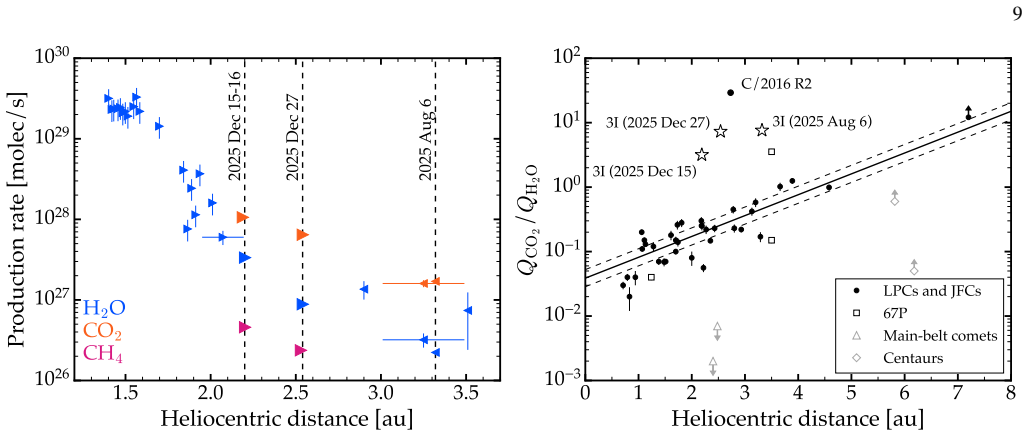
The first direct detection of methane in an interstellar object is reported, with its delayed onset relative to water production suggesting past depletion from the outermost layers and emergence from unprocessed subsurface material. Production rate measurements confirm that 3I exhibits a strongly enhanced CO2:H2O mixing ratio relative to typical solar system comets, along with a somewhat enriched CH4:H2O value, and an extended source of water from entrained icy grains.
What carries the argument
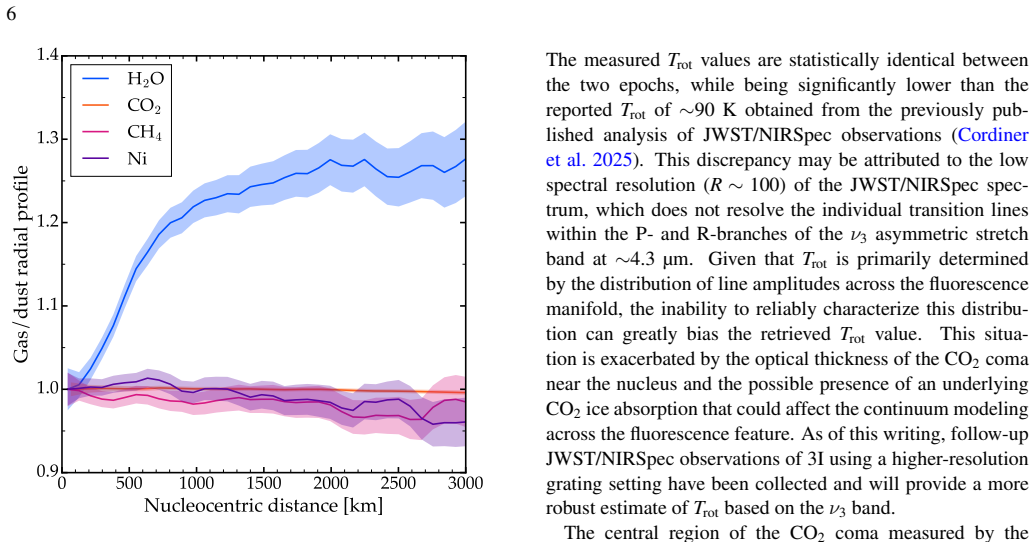
The JWST/MIRI medium-resolution spectrometer spectra that capture fluorescence features from water, CO2, and methane, combined with production rate calculations and coma mapping across two epochs.
Load-bearing premise
The timing difference between methane and water release is caused by prior loss of volatiles from the surface layers rather than by temperature-dependent production rates or other dynamical effects.
What would settle it
Spectra taken at smaller heliocentric distances showing methane production rates that do not exceed those predicted by surface-only models, or simultaneous onset of methane and water release in earlier epochs, would undermine the subsurface emergence interpretation.
Figures


read the original abstract
We present the first spectroscopic characterization of an interstellar object at mid-infrared wavelengths. Post-perihelion observations of 3I/ATLAS using the JWST/MIRI medium-resolution spectrometer were obtained on 2025 December 15--16 and 27 when the object was at heliocentric distances of 2.20 and 2.54 au, respectively. Our 5--28 micron spectra exhibit fluorescence features from several gaseous species, including the $\nu_2$ band of water at 5.8--7.0 microns. the primary $\nu_2$ and associated hot bands of carbon dioxide around 15 microns, and a forbidden transition of atomic nickel at 7.507 microns. We also report the first direct detection of methane in an interstellar object. The delayed onset of methane production relative to water suggests past depletion from the outermost layers, with the observed methane emerging from unprocessed subsurface material. Comparison of the volatile production rates measured during the two epochs indicate a significant reduction in overall outgassing over 12 days, with the measured water activity level dropping more steeply than other species. As shown through near-nucleus coma mapping, 3I continues to display an extended source of water production from icy grains entrained within the coma. Our production rate measurements confirm that 3I exhibits a strongly enhanced CO$_2$:H$_2$O mixing ratio relative to typical solar system comets, as well as a somewhat enriched CH$_4$:H$_2$O value.
Editorial analysis
A structured set of objections, weighed in public.
Referee Report
Summary. The paper reports the first mid-infrared spectroscopic observations of the interstellar object 3I/ATLAS using JWST/MIRI at post-perihelion distances of 2.20 and 2.54 au. It presents detections of H2O (ν2 band), CO2 (ν2 and hot bands), atomic nickel, and the first direct detection of CH4 in an interstellar object. Production rates show overall outgassing decline between epochs, with water dropping more steeply, continued extended water production from icy grains, and a strongly enhanced CO2:H2O mixing ratio (plus somewhat enriched CH4:H2O) relative to solar-system comets. The delayed CH4 onset is interpreted as evidence of prior depletion from outermost layers with emergence from unprocessed subsurface material.
Significance. If the detections and quantitative production rates hold, this constitutes the first mid-IR characterization of any interstellar object and the first direct CH4 detection therein, providing direct constraints on the volatile inventory of material formed outside the solar system. The enhanced CO2:H2O ratio and grain-entrained water source add to the growing evidence that interstellar objects can retain distinct compositional signatures from solar-system comets, with potential implications for formation conditions and thermal processing in the interstellar medium.
major comments (2)
- [Abstract] Abstract: The central interpretive claim that the delayed onset of methane production relative to water 'suggests past depletion from the outermost layers, with the observed methane emerging from unprocessed subsurface material' is load-bearing for the paper's narrative on volatile history, yet no quantitative nucleus thermal model (incorporating layered composition, sublimation curves for CH4 vs. H2O, or grain entrainment) is referenced to distinguish this from alternatives such as temperature-dependent outgassing or coma dynamics. CH4 being more volatile than H2O makes its later appearance at 2.20–2.54 au counter to naive expectations, and the two-epoch data alone (showing steeper water decline) do not rule out other explanations.
- [Abstract] Abstract: The assertion that production-rate measurements 'confirm that 3I exhibits a strongly enhanced CO2:H2O mixing ratio relative to typical solar system comets' is a key comparative claim, but the abstract supplies neither the measured mixing ratios with uncertainties nor the specific solar-system reference values or statistical comparison used to establish the enhancement; this quantitative support must be explicit for the claim to be assessable.
minor comments (2)
- [Abstract] Abstract: The sentence beginning 'the primary ν2 and associated hot bands' uses lowercase 'the' after a period, which should be capitalized for consistency.
- [Abstract] Abstract: The abstract states detections and ratio claims without any mention of error bars, signal-to-noise, or production-rate uncertainties, which should be summarized even at this level for a data-driven paper.
Simulated Author's Rebuttal
We thank the referee for their careful and constructive review of our manuscript. We respond point-by-point to the major comments below and have revised the abstract accordingly where appropriate.
read point-by-point responses
-
Referee: [Abstract] Abstract: The central interpretive claim that the delayed onset of methane production relative to water 'suggests past depletion from the outermost layers, with the observed methane emerging from unprocessed subsurface material' is load-bearing for the paper's narrative on volatile history, yet no quantitative nucleus thermal model (incorporating layered composition, sublimation curves for CH4 vs. H2O, or grain entrainment) is referenced to distinguish this from alternatives such as temperature-dependent outgassing or coma dynamics. CH4 being more volatile than H2O makes its later appearance at 2.20–2.54 au counter to naive expectations, and the two-epoch data alone (showing steeper water decline) do not rule out other explanations.
Authors: We agree that a dedicated quantitative thermal model would provide stronger discrimination between interpretations. Our two-epoch observations show a clear temporal offset in CH4 production relative to H2O (despite CH4's higher volatility), which we interpret as consistent with prior depletion of the outer layers. We will revise the abstract to present this as a plausible interpretation supported by the data rather than a definitive conclusion, and we will add references to existing literature on layered cometary thermal models and volatile sublimation in the revised manuscript. This is a partial revision, as we do not introduce new modeling in this observational paper. revision: partial
-
Referee: [Abstract] Abstract: The assertion that production-rate measurements 'confirm that 3I exhibits a strongly enhanced CO2:H2O mixing ratio relative to typical solar system comets' is a key comparative claim, but the abstract supplies neither the measured mixing ratios with uncertainties nor the specific solar-system reference values or statistical comparison used to establish the enhancement; this quantitative support must be explicit for the claim to be assessable.
Authors: We thank the referee for this observation. The full manuscript reports the specific production rates and derived mixing ratios (with uncertainties) from both epochs, along with direct comparison to literature values for solar-system comets. We will update the abstract to explicitly include the measured CO2:H2O ratios with uncertainties and the reference solar-system values used for the comparison, making the claim quantitatively assessable. revision: yes
Circularity Check
No circularity: direct observations and standard rate calculations
full rationale
The paper reports JWST/MIRI mid-IR spectra of 3I/ATLAS at two post-perihelion epochs, identifying fluorescence bands of H2O, CO2, CH4, and Ni via direct spectral features. Production rates are derived from these measured line fluxes using established cometary fluorescence models and coma mapping; no equations define a target quantity in terms of a fitted parameter that is then re-presented as a prediction. The enhanced CO2:H2O and CH4:H2O ratios are stated as comparisons to literature solar-system comet values, not as outputs forced by internal fits. The delayed-CH4 interpretation is offered as a qualitative suggestion without a quantitative thermal model or self-referential derivation that would close a loop. No self-citation load-bearing steps appear in the derivation chain.
Axiom & Free-Parameter Ledger
axioms (1)
- domain assumption Standard molecular fluorescence excitation models for cometary gases at given heliocentric distances
Forward citations
Cited by 3 Pith papers
-
Coma Physics of an Interstellar Object: JWST Spatial-Spectral Mapping of 3I/ATLAS
JWST spatial-spectral maps of 3I/ATLAS reveal CO as the primary volatile with H2O and CO2 abundances of 40.5% and 41.6% relative to CO, anisotropic distributions for apolar molecules, and a flat H2O OPR of 2.7.
-
Interstellar Object 3I/ATLAS Observed from Mars by China's Tianwen-1 Spacecraft
Tianwen-1 provided the first out-of-plane imaging of 3I/ATLAS, indicating large dust grains (hundreds of micrometers) ejected at 3-10 m/s with steady-state outflow and a mass loss rate of about 1000 kg/s.
-
Origin and evolution of NiI and FeI in the coma of the interstellar comet 3I/ATLAS throughout its trajectory
Post-perihelion UVES spectra of interstellar comet 3I/ATLAS reveal elevated NiI and FeI production explained by direct sublimation of Ni(CO)4 and Fe(CO)5 from subsurface layers, with a transient heat source accounting...
Reference graph
Works this paper leans on
-
[1]
Argyriou, I., Glasse, A., Law, D. R., et al. 2023, A&A, 675, A111, doi: 10.1051/0004-6361/202346489 Astropy Collaboration, Robitaille, T. P., Tollerud, E. J., et al. 2013, A&A, 558, A33, doi: 10.1051/0004-6361/201322068 Astropy Collaboration, Price-Whelan, A. M., Sip˝ocz, B. M., et al. 2018, AJ, 156, 123, doi: 10.3847/1538-3881/aabc4f Astropy Collaboratio...
-
[2]
Banzatti, A., Salyk, C., Pontoppidan, K. M., et al. 2025, AJ, 169, 165, doi: 10.3847/1538-3881/ada962
-
[3]
Belyakov, M., Fremling, C., Graham, M. J., et al. 2025, RNAAS, 9, 194, doi: 10.3847/2515-5172/adf059
-
[4]
Bohlin, R. C., Gordon, K. D., & Tremblay, P.-E. 2014, PASP, 126, 711, doi: 10.1086/677655
-
[5]
Bolin, B. T., & Lisse, C. M. 2020, MNRAS, 497, 4031, doi: 10.1093/mnras/staa2192
-
[6]
Bolin, B. T., Weaver, H. A., Fernandez, Y . R., et al. 2018, ApJL, 852, L2, doi: 10.3847/2041-8213/aaa0c9
-
[7]
Bolin, B. T., Lisse, C. M., Kasliwal, M. M., et al. 2020, AJ, 160, 26, doi: 10.3847/1538-3881/ab9305
-
[8]
T., Belyakov, M., Fremling, C., et al
Bolin, B. T., Belyakov, M., Fremling, C., et al. 2025, MNRAS, 542, L139, doi: 10.1093/mnrasl/slaf078
-
[9]
Bonev, B. P., Villanueva, G. L., DiSanti, M. A., et al. 2017, AJ, 153, 241, doi: 10.3847/1538-3881/aa64dd
-
[10]
Bromley, S. J., Neff, B., Loch, S. D., et al. 2021, PSJ, 2, 228, doi: 10.3847/PSJ/ac2dff
-
[11]
Brown, M. E., & Fraser, W. C. 2023, PSJ, 4, 130, doi: 10.3847/PSJ/ace2ba
-
[12]
Brucato, J. R., Palumbo, M. E., & Strazzulla, G. 1997, Icar, 125, 135, doi: 10.1006/icar.1996.5561
-
[13]
2025, JWST Calibration Pipeline, v1.20.2„ Zenodo, doi: 10.5281/zenodo.17515973
Bushouse, H., Eisenhamer, J., Dencheva, N., et al. 2025, JWST Calibration Pipeline, v1.20.2„ Zenodo, doi: 10.5281/zenodo.17515973
-
[14]
NSF-DOE Vera C. Rubin Observatory Observations of Interstellar Comet 3I/ATLAS (C/2025 N1)
Chandler, C. O., Bernardinelli, P. H., Juri´c, M., et al. 2025, arXiv, arXiv:2507.13409, doi: 10.48550/arXiv.2507.13409
work page internal anchor Pith review Pith/arXiv arXiv doi:10.48550/arxiv.2507.13409 2025
-
[15]
R., Mâkinen, T., Bertaux, J.-L., et al
Combi, M. R., Mâkinen, T., Bertaux, J.-L., et al. 2025, arXiv, arXiv:2512.22354, doi: 10.48550/arXiv.2512.22354
-
[16]
Cordiner, M. A., Roth, N. X., Kelley, M. S. P., et al. 2025, ApJL, 991, L43, doi: 10.3847/2041-8213/ae0647 de la Fuente Marcos, R., Alarcon, M. R., Licandro, J., et al. 2025, A&A, 700, L9, doi: 10.1051/0004-6361/202556439 Dello Russo, N., Kawakita, H., Vervack, R. J., & Weaver, H. A. 2016, Icar, 278, 301, doi: 10.1016/j.icarus.2016.05.039
-
[17]
2025, MPEC, 2025-N12, doi: 10.48377/MPEC/2025-N12
Denneau, L., Siverd, R., Tonry, J., et al. 2025, MPEC, 2025-N12, doi: 10.48377/MPEC/2025-N12
-
[18]
P., Wong, I., Brunetto, R., et al
Emery, J. P., Wong, I., Brunetto, R., et al. 2024, Icar, 414, 116017, doi: 10.1016/j.icarus.2024.116017
-
[19]
Feinstein, A. D., Noonan, J. W., & Seligman, D. Z. 2025, ApJL, 991, L2, doi: 10.3847/2041-8213/adfd4d
-
[20]
Fitzsimmons, A., Meech, K., Matrà, L., & Pfalzner, S. 2024, in Comets III, ed. K. J. Meech, M. R. Combi, D. Bockelée-Morvan, S. N. Raymodn, & M. E. Zolensky, 731–766, doi: 10.2458/azu_uapress_9780816553631-ch022
-
[21]
C., Dones, L., V olk, K., Womack, M., & Nesvorý, D
Fraser, W. C., Dones, L., V olk, K., Womack, M., & Nesvorý, D. 2024, in Comets III, ed. K. J. Meech, M. R. Combi, D. Bockelée-Morvan, S. N. Raymodn, & M. E. Zolensky, 121–152, doi: 10.2458/azu_uapress_9780816553631-ch005
-
[22]
Gibson, A., MacGregor, M. A., Howard, W. S., et al. 2025, ApJL, 993, L29, doi: 10.3847/2041-8213/ae11a1
-
[23]
Grant, S. L., van Dishoeck, E. F., Tabone, B., et al. 2023, ApJL, 947, L6, doi: 10.3847/2041-8213/acc44b 13
-
[24]
2021, Natur, 593, 375, doi: 10.1038/s41586-021-03485-4
Guzik, P., & Drahus, M. 2021, Natur, 593, 375, doi: 10.1038/s41586-021-03485-4
-
[25]
Harris, C. R., Millman, K. J., van der Walt, S. J., et al. 2020, Natur, 585, 357, doi: 10.1038/s41586-020-2649-2
-
[26]
2020, PSJ, 1, 83, doi: 10.3847/PSJ/abc17b Hénault, E., Baklouti, D., Brunetto, R., et al
Haser, L., Oset, S., & Bodewits, D. 2020, PSJ, 1, 83, doi: 10.3847/PSJ/abc17b Hénault, E., Baklouti, D., Brunetto, R., et al. 2025, Icar, 441, 116669, doi: 10.1016/j.icarus.2025.116669
-
[27]
J., Brunetto, R., Cruikshank, D
Holler, B. J., Brunetto, R., Cruikshank, D. P., et al. 2025, RNAAS, 9, 241, doi: 10.3847/2515-5172/ae03a2
-
[28]
Hoogendam, W. B., Shappee, B. J., Wray, J. J., et al. 2025, arXiv, arXiv:2510.11779, doi: 10.48550/arXiv.2510.11779
-
[29]
Hoogendam, W. B., Jones, D. O., Yang, B., et al. 2026, arXiv e-prints, arXiv:2601.16983. https://arxiv.org/abs/2601.16983
-
[30]
Hopkins, M. J., Dorsey, R. C., Forbes, J. C., et al. 2025, ApJL, 990, L30, doi: 10.3847/2041-8213/adfbf4
-
[31]
Hunter, J. D. 2007, CSE, 9, 90, doi: 10.1109/MCSE.2007.55 Hutsemékers, D., Manfroid, J., Jehin, E., Opitom, C., & Moulane, Y . 2021, A&A, 652, L1, doi: 10.1051/0004-6361/202141554 Hutsemékers, D., Manfroid, J., Jehin, E., et al. 2025, arXiv, arXiv:2509.26053, doi: 10.48550/arXiv.2509.26053
-
[32]
2024, arXiv e-prints, arXiv:2407.06475, doi: 10.48550/arXiv.2407.06475
Jewitt, D. 2024, arXiv e-prints, arXiv:2407.06475, doi: 10.48550/arXiv.2407.06475
-
[33]
2025, ApJL, 990, L2, doi: 10.3847/2041-8213/adf8d8
Jewitt, D., Hui, M.-T., Mutchler, M., Kim, Y ., & Agarwal, J. 2025, ApJL, 990, L2, doi: 10.3847/2041-8213/adf8d8
-
[34]
2019, ApJL, 886, L29, doi: 10.3847/2041-8213/ab530b —
Jewitt, D., & Luu, J. 2019, ApJL, 886, L29, doi: 10.3847/2041-8213/ab530b —. 2025, ApJL, 994, L3, doi: 10.3847/2041-8213/ae1832
-
[35]
2025, ApJL, 990, L65, doi: 10.3847/2041-8213/adfbdf
Kareta, T., Champagne, C., McClure, L., et al. 2025, ApJL, 990, L65, doi: 10.3847/2041-8213/adfbdf
-
[36]
2020, ApJL, 895, L34, doi: 10.3847/2041-8213/ab9228
Kim, Y ., Jewitt, D., Mutchler, M., et al. 2020, ApJL, 895, L34, doi: 10.3847/2041-8213/ab9228
-
[37]
Ralchenko, Reader, J., & and NIST ASD Team
Kramida, A., Yu. Ralchenko, Reader, J., & and NIST ASD Team. 2024, NIST Atomic Spectra Database (ver. 5.12), [Online]. Available: https://physics.nist.gov/asd[2016, January 31]. National Institute of Standards and Technology, Gaithersburg, MD
work page 2024
-
[38]
Lamy, P. L., Toth, I., Fernandez, Y . R., & Weaver, H. A. 2004, in Comets II, ed. M. C. Festou, H. U. Keller, & H. A. Weaver, 223 Le Roy, L., Altwegg, K., Balsiger, H., et al. 2015, A&A, 583, A1, doi: 10.1051/0004-6361/201526450
-
[39]
Lisse, C. M., Gladstone, G. R., Young, L. A., et al. 2022, PSJ, 3, 112, doi: 10.3847/PSJ/ac6097
-
[40]
Lisse, C. M., Bach, Y . P., Crill, B. P., et al. 2025, arXiv, arXiv:2512.07318, doi: 10.48550/arXiv.2512.07318
-
[41]
Lisse, C. M., Bach, Y ., Bryan, S. A., et al. 2026, arXiv e-prints, arXiv:2601.06759, doi: 10.48550/arXiv.2601.06759
-
[42]
2003, ApJ, 591, 1220, doi: 10.1086/375492
Lodders, K. 2003, ApJ, 591, 1220, doi: 10.1086/375492
-
[43]
2021, Natur, 593, 372, doi: 10.1038/s41586-021-03435-0
Manfroid, J., Hutsemékers, D., & Jehin, E. 2021, Natur, 593, 372, doi: 10.1038/s41586-021-03435-0
-
[44]
2025, ApJL, 994, L51, doi: 10.3847/2041-8213/ae1f91
Martinez-Palomera, J., Tuson, A., Hedges, C., et al. 2025, ApJL, 994, L51, doi: 10.3847/2041-8213/ae1f91
-
[45]
McKay, A. J., DiSanti, M. A., Kelley, M. S. P., et al. 2019, AJ, 158, 128, doi: 10.3847/1538-3881/ab32e4
-
[46]
J., Weryk, R., Micheli, M., et al
Meech, K. J., Weryk, R., Micheli, M., et al. 2017, Natur, 552, 378, doi: 10.1038/nature25020 Mejía, C., Bender, M., Severin, D., et al. 2015, Nuclear Instruments and Methods in Physics Research B, 365, 477, doi: 10.1016/j.nimb.2015.09.039
-
[47]
2012, ApJ, 752, 15, doi: 10.1088/0004-637X/752/1/15
Ootsubo, T., Kawakita, H., Hamada, S., et al. 2012, ApJ, 752, 15, doi: 10.1088/0004-637X/752/1/15
-
[48]
2025, MNRAS, 544, L31, doi: 10.1093/mnrasl/slaf095
Opitom, C., Snodgrass, C., Jehin, E., et al. 2025, MNRAS, 544, L31, doi: 10.1093/mnrasl/slaf095
-
[49]
Pinilla-Alonso, N., Brunetto, R., De Prá, M. N., et al. 2025, Nature Astronomy, 9, 230, doi: 10.1038/s41550-024-02433-2
-
[50]
M., Salyk, C., Banzatti, A., et al
Pontoppidan, K. M., Salyk, C., Banzatti, A., et al. 2024, ApJ, 963, 158, doi: 10.3847/1538-4357/ad20f0
-
[51]
2023, Icar, 394, 115396, doi: 10.1016/j.icarus.2022.115396
Quirico, E., Bacmann, A., Wolters, C., et al. 2023, Icar, 394, 115396, doi: 10.1016/j.icarus.2022.115396
-
[52]
Rahatgaonkar, R., Carvajal, J. P., Puzia, T. H., et al. 2025, ApJL, 995, L34, doi: 10.3847/2041-8213/ae1cbc
-
[53]
2024, Detection and Flagging of Showers and Snowballs in
Regan, M. 2024, Detection and Flagging of Showers and Snowballs in
work page 2024
-
[54]
Rivkin, A. S., Thomas, C. A., Wong, I., et al. 2023, PSJ, 4, 214, doi: 10.3847/PSJ/ad04d8
-
[55]
Roth, N. X., Cordiner, M. A., Bockelée-Morvan, D., et al. 2025, arXiv, arXiv:2511.20845, doi: 10.48550/arXiv.2511.20845 Salazar Manzano, L. E., Lin, H. W., Taylor, A. G., et al. 2025, ApJL, 993, L23, doi: 10.3847/2041-8213/ae1232
-
[56]
2025, A&A, 702, L3, doi: 10.1051/0004-6361/202556717
Santana-Ros, T., Ivanova, O., Mykhailova, S., et al. 2025, A&A, 702, L3, doi: 10.1051/0004-6361/202556717
-
[57]
Schaller, E. L., & Brown, M. E. 2007, ApJL, 659, L61, doi: 10.1086/516709
-
[58]
Z., Micheli, M., Farnocchia, D., et al
Seligman, D. Z., Micheli, M., Farnocchia, D., et al. 2025, ApJL, 989, L36, doi: 10.3847/2041-8213/adf49a
-
[59]
Perihelion Asymmetry in the Water Production Rate of the Interstellar Object 3I/ATLAS
Tan, H., Yan, X., & Li, J.-Y . 2026, arXiv e-prints, arXiv:2601.15443, doi: 10.48550/arXiv.2601.15443
work page internal anchor Pith review Pith/arXiv arXiv doi:10.48550/arxiv.2601.15443 2026
-
[60]
Taylor, A. G., & Seligman, D. Z. 2025, ApJL, 990, L14, doi: 10.3847/2041-8213/adfa28
-
[61]
L., Liuzzi, G., Faggi, S., et al
Villanueva, G. L., Liuzzi, G., Faggi, S., et al. 2022, Fundamentals of the Planetary Spectrum Generator
work page 2022
-
[62]
Villanueva, G. L., Mumma, M. J., DiSanti, M. A., et al. 2011, Icar, 216, 227, doi: 10.1016/j.icarus.2011.08.024
-
[63]
Villanueva, G. L., Smith, M. D., Protopapa, S., Faggi, S., & Mandell, A. M. 2018, JQSRT, 217, 86, doi: 10.1016/j.jqsrt.2018.05.023
-
[64]
Virtanen, P., Gommers, R., Oliphant, T. E., et al. 2020, NatMe, 17, 261, doi: 10.1038/s41592-019-0686-2
-
[65]
2015, PASP, 127, 646, doi: 10.1086/682281
Wells, M., Pel, J.-W., Glasse, A., et al. 2015, PASP, 127, 646, doi: 10.1086/682281
-
[66]
2025, jwstspec, v0.6„ Zenodo, doi: 10.5281/zenodo.17186395
Wong, I. 2025, jwstspec, v0.6„ Zenodo, doi: 10.5281/zenodo.17186395
-
[67]
Wong, I., Brown, M. E., Emery, J. P., et al. 2024, PSJ, 5, 87, doi: 10.3847/PSJ/ad2fc3
-
[68]
E., Bockélee-Morvan, D., Harker, D
Woodward, C. E., Bockélee-Morvan, D., Harker, D. E., et al. 2025, PSJ, 6, 139, doi: 10.3847/PSJ/add1d5
-
[69]
2025, ApJL, 991, L50, doi: 10.3847/2041-8213/ae08ab
Xing, Z., Oset, S., Noonan, J., & Bodewits, D. 2025, ApJL, 991, L50, doi: 10.3847/2041-8213/ae08ab
-
[70]
J., Connelley, M., Zhao, R., & Keane, J
Yang, B., Meech, K. J., Connelley, M., Zhao, R., & Keane, J. V . 2025, ApJL, 992, L9, doi: 10.3847/2041-8213/ae08a7
-
[71]
Ye, Q., Kelley, M. S. P., Hsieh, H. H., et al. 2025, ApJL, 993, L31, doi: 10.3847/2041-8213/ae147b
-
[72]
2025, arXiv, arXiv:2510.25035, doi: 10.48550/arXiv.2510.25035
Zhang, Q., & Battams, K. 2025, arXiv, arXiv:2510.25035, doi: 10.48550/arXiv.2510.25035
discussion (0)
Sign in with ORCID, Apple, or X to comment. Anyone can read and Pith papers without signing in.