Self-organized robustness in mean-field interacting systems
Pith reviewed 2026-06-29 00:53 UTC · model grok-4.3
The pith
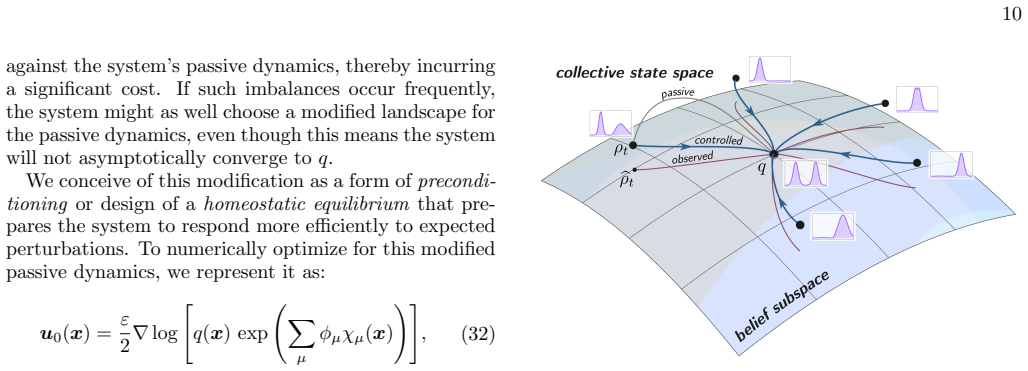
Mean-field systems self-organize interactions into a seascape that accelerates relaxation to equilibrium.
A machine-rendered reading of the paper's core claim, the machinery that carries it, and where it could break.
Core claim
In mean-field interacting systems, self-organized robustness emerges when the interaction structure is determined self-consistently through meta-optimization over responses to perturbations. This produces a seascape whose shape accelerates return to equilibrium, with collective dynamics described by an optimized Wasserstein gradient flow to an attractor. Limited communication causes the interactions to encode slowly relaxing modes and frequently perturbed modes preferentially. Robust states sit on flatter equilibrium landscapes, and the framework predicts a continuum of intermediate reservoir states, framing self-organization as hierarchical associative memory operating across collective uni
What carries the argument
The seascape, a dynamically modulated landscape whose shape is determined self-consistently by meta-optimization to accelerate relaxation back to equilibrium.
If this is right
- When communication is limited, interactions preferentially encode slowly relaxing modes and modes that are frequently perturbed.
- Robust collective states are associated with flatter equilibrium landscapes.
- The model predicts a continuum of intermediate reservoir states.
- Self-organization functions as a hierarchical associative memory operating on the scale of a collective of interacting units.
Where Pith is reading between the lines
- The seascape view implies that external control of perturbation statistics could reshape the effective landscape and steer collective attractors.
- The Wasserstein flow description links the model to gradient-based optimization methods used in other collective systems.
- A direct test would involve imposing controlled perturbation spectra on an experimental collective and checking whether encoded modes match the predicted slow and frequent ones.
Load-bearing premise
That self-organized robustness can be usefully formulated as meta-optimization over the system's response to perturbations, allowing the interaction structure to be determined self-consistently.
What would settle it
Simulations or measurements of interaction strengths in a collective with limited communication would need to show stronger couplings precisely for modes with longer relaxation times and higher perturbation rates.
Figures


read the original abstract
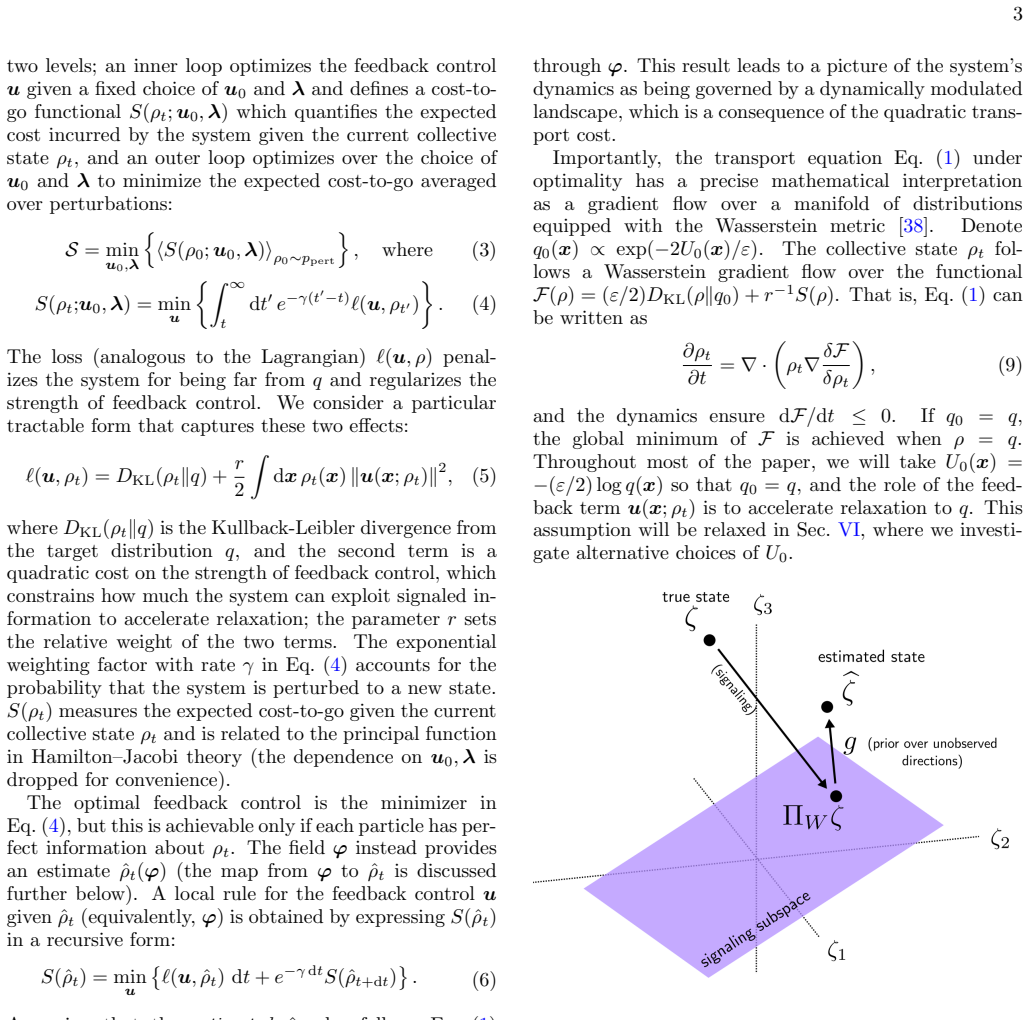
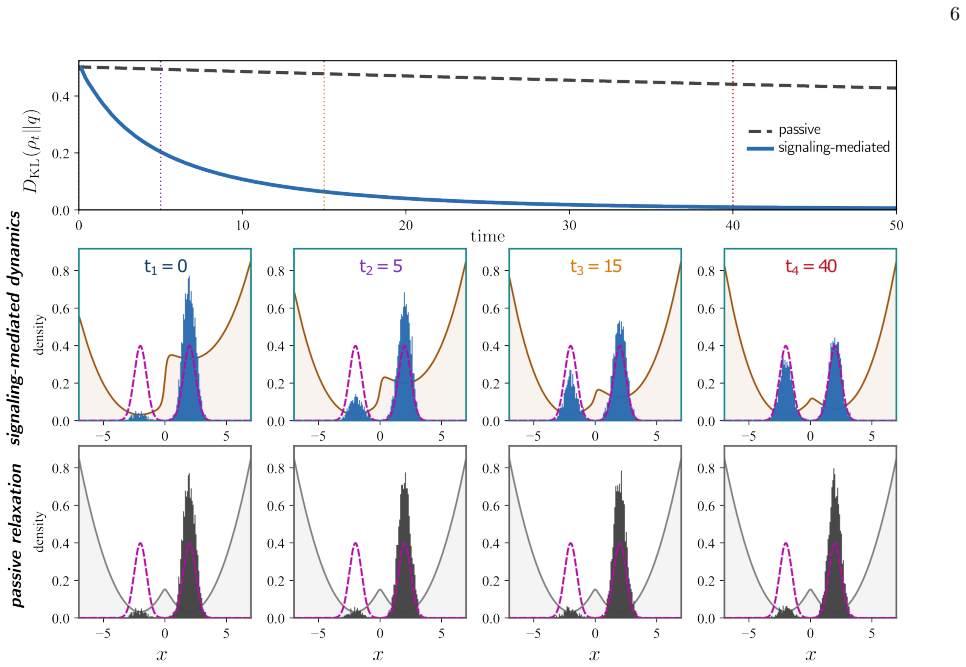
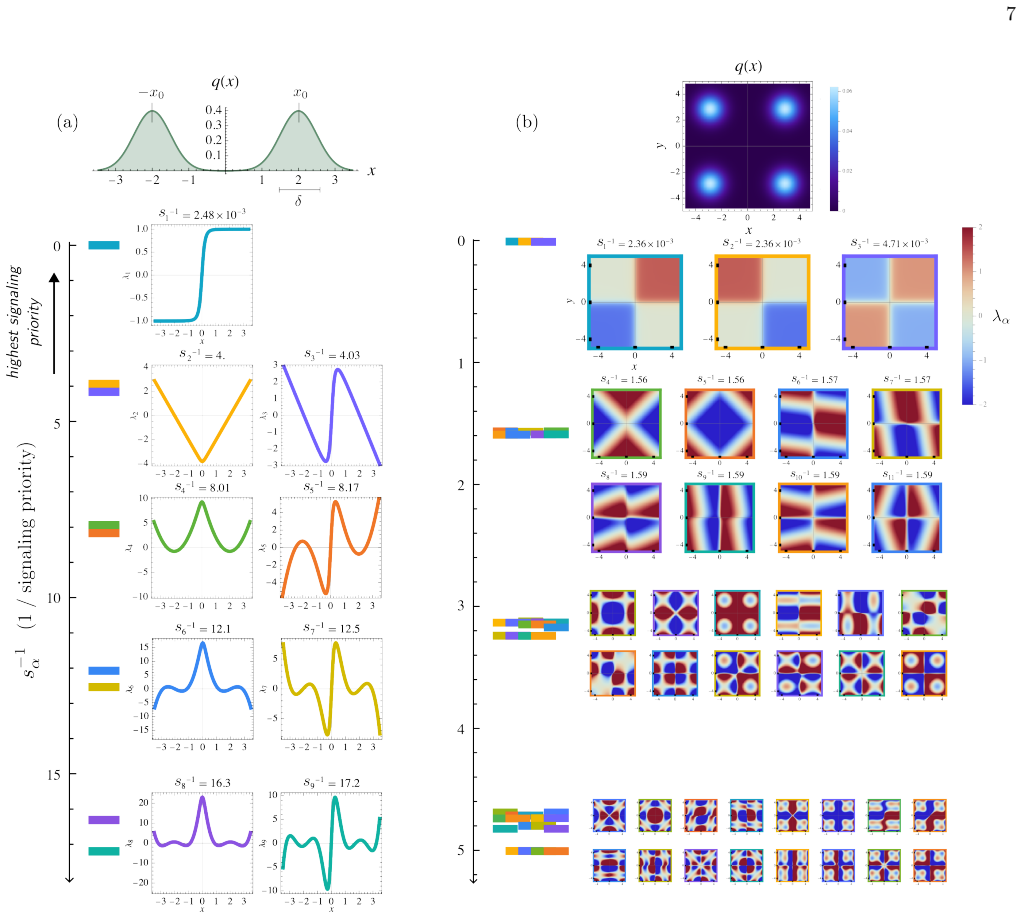
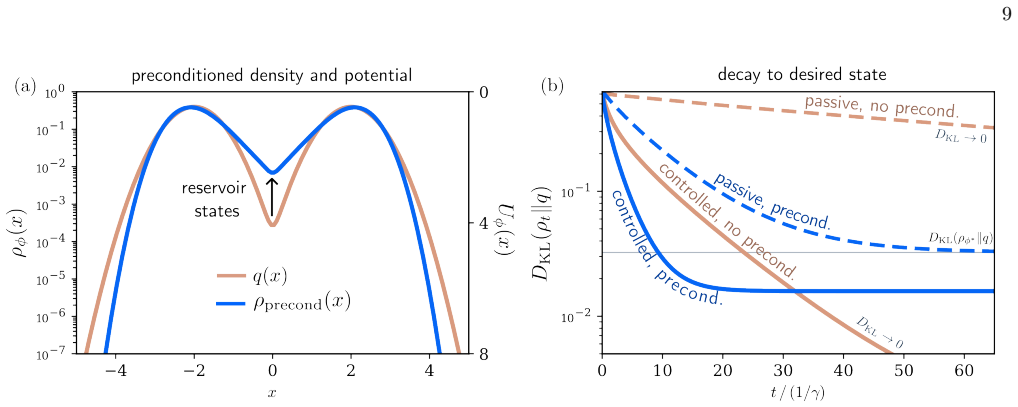
Self-organization is a defining feature of living systems, with order often maintained through interactions between constituent units rather than centralized feedback. We introduce a tractable mean-field model of self-organized robustness, formulated as meta-optimization over the system's response to perturbations. The resulting interaction structure has an intuitive picture as a dynamically modulated landscape (``seascape'') whose shape is determined self-consistently to accelerate relaxation back to equilibrium. The collective dynamics follows an optimized Wasserstein gradient flow toward an attractor in the space of collective states. When communication is limited, interactions preferentially encode slowly relaxing modes and modes that are frequently perturbed. The model further shows that robust collective states are associated with flatter equilibrium landscapes and predicts a continuum of intermediate ``reservoir states'' in such systems. The model offers a perspective of self-organization as a hierarchical associative memory that operates on the scale of a collective of interacting computational units.
Editorial analysis
A structured set of objections, weighed in public.
Referee Report
Summary. The paper introduces a tractable mean-field model of self-organized robustness formulated as meta-optimization over the system's response to perturbations. The resulting interaction structure is pictured as a dynamically modulated 'seascape' determined self-consistently to accelerate relaxation back to equilibrium. Collective dynamics are described as an optimized Wasserstein gradient flow toward an attractor in collective state space. With limited communication, interactions preferentially encode slowly relaxing and frequently perturbed modes. The model associates robust collective states with flatter equilibrium landscapes, predicts a continuum of intermediate 'reservoir states,' and frames self-organization as hierarchical associative memory operating on interacting computational units.
Significance. If the meta-optimization construction and self-consistency can be shown to be internally consistent and free of circularity, the framework could supply a useful modeling lens for robustness in biological collectives, linking mean-field limits, Wasserstein geometry, and associative-memory ideas. The absence of any equations, derivations, or validation in the abstract, however, leaves the technical content and predictive power unassessable from the provided material.
major comments (1)
- [Abstract] Abstract: the central construction is described only at the level of a modeling perspective with no equations, no explicit definition of the meta-optimization functional, and no statement of the mean-field limit or Wasserstein flow. Without these, it is impossible to verify whether the self-consistent seascape avoids the circularity risk noted in the reader's report (i.e., whether the optimization target is independent of the relaxation dynamics it is intended to produce).
minor comments (1)
- [Abstract] The abstract introduces several novel terms ('seascape', 'reservoir states') without immediate definitions or references; a short glossary or forward reference to their first mathematical appearance would improve readability.
Simulated Author's Rebuttal
We thank the referee for their review and for highlighting the need for clarity on the abstract's technical content. We address the single major comment below. The full manuscript contains the requested equations, definitions, and derivations; the abstract is written at a conceptual level for accessibility.
read point-by-point responses
-
Referee: [Abstract] Abstract: the central construction is described only at the level of a modeling perspective with no equations, no explicit definition of the meta-optimization functional, and no statement of the mean-field limit or Wasserstein flow. Without these, it is impossible to verify whether the self-consistent seascape avoids the circularity risk noted in the reader's report (i.e., whether the optimization target is independent of the relaxation dynamics it is intended to produce).
Authors: The abstract is intentionally non-technical to summarize the modeling perspective for a broad readership, which is standard practice. The full manuscript provides the explicit meta-optimization functional (defined over expected relaxation times to perturbations), the mean-field limit derivation, and the formulation of dynamics as an optimized Wasserstein gradient flow, all with equations and proofs. On circularity: the optimization target (minimizing integrated relaxation time under a perturbation measure) is specified independently of the flow; the seascape is obtained as the self-consistent solution to this optimization problem, after which the gradient flow is derived from the resulting landscape. This separation is shown to be non-circular in the derivations, with the fixed-point iteration converging to a consistent equilibrium without feedback from the dynamics into the target. revision: no
Circularity Check
No significant circularity; model is self-contained by definition
full rationale
The paper introduces a tractable mean-field model explicitly formulated as meta-optimization over perturbation response, with the seascape and Wasserstein flow presented as direct consequences of that modeling choice. No derivation chain, equations, or self-citations are exhibited that reduce a claimed prediction or first-principles result back to the inputs by construction. The construction is definitional to the model rather than an independent theorem that loops on itself, satisfying the criterion for a self-contained modeling perspective.
Axiom & Free-Parameter Ledger
invented entities (1)
-
seascape
no independent evidence
Reference graph
Works this paper leans on
-
[1]
Self-Organization in Pattern Formation , journal =
Schweisguth, Fran. Self-Organization in Pattern Formation , journal =. 2019 , doi =
2019
-
[2]
and Guo, Yipei and Brenner, Michael P
Pelc, Guy and McKeithan, Wesley L. and Guo, Yipei and Brenner, Michael P. and Lim, Wendell A. and Nitzan, Mor , title =. 2025 , doi =
2025
-
[3]
Tripathi, Ashutosh and Dunkel, J. Collective Is Different: Information Exchange and Speed-Accuracy Trade-Offs in Self-Organized Patterning , year =. 2510.01397 , archivePrefix =
-
[4]
Information Content and Optimization of Self-Organized Developmental Systems , journal =
Br. Information Content and Optimization of Self-Organized Developmental Systems , journal =. 2024 , doi =
2024
-
[5]
and Scandolo, Mattia and Fruchart, Michel and Munro, Edwin M
Romeo, Nicolas and Martin, David G. and Scandolo, Mattia and Fruchart, Michel and Munro, Edwin M. and Vitelli, Vincenzo , title =. 2026 , eprint =
2026
-
[6]
and Grason, Gregory M
Hagan, Michael F. and Grason, Gregory M. , title =. Reviews of Modern Physics , volume =. 2021 , doi =
2021
-
[7]
Cell Reports Physical Science , volume =
Smart, Matthew and Zilman, Anton , title =. Cell Reports Physical Science , volume =. 2023 , doi =
2023
-
[8]
and Lemaire, Patrick and Mani, Madhav , title =
Skinner, Dominic J. and Lemaire, Patrick and Mani, Madhav , title =. PRX Life , volume =. 2025 , doi =
2025
-
[9]
Physical Review X , volume =
Howe, Addison and Mani, Madhav , title =. Physical Review X , volume =. 2025 , doi =
2025
-
[10]
Cislo, Dillon J. and Del. Reconstructing. Proceedings of the National Academy of Sciences , volume =. 2025 , doi =
2025
-
[11]
and Dal Co, Alma , title =
Deshpande, Ramya and Mottes, Francesco and Vlad, Ariana-Dalia and Brenner, Michael P. and Dal Co, Alma , title =. Nature Computational Science , volume =. 2025 , doi =
2025
-
[12]
2024 , eprint =
Reddy, Gautam , title =. 2024 , eprint =
2024
-
[13]
and Simons, Benjamin D
Klein, Allon M. and Simons, Benjamin D. , title =. Development , volume =. 2011 , doi =
2011
-
[14]
and Swaminathan, Aishwarya and Winward, Ashley and Lalonde, Logan and Hwang, Yung and Littman, Noah and Socolovsky, Merav and Klein, Allon M
Wu, Qiu C. and Swaminathan, Aishwarya and Winward, Ashley and Lalonde, Logan and Hwang, Yung and Littman, Noah and Socolovsky, Merav and Klein, Allon M. , title =. 2024 , doi =
2024
-
[15]
Gradient Flows in Metric Spaces and in the Space of Probability Measures , edition =
Ambrosio, Luigi and Gigli, Nicola and Savar. Gradient Flows in Metric Spaces and in the Space of Probability Measures , edition =. 2008 , doi =
2008
-
[16]
2015 , doi =
Santambrogio, Filippo , title =. 2015 , doi =
2015
-
[17]
Chewi, Sinho and Niles-Weed, Jonathan and Rigollet, Philippe , title =. 2024 , eprint =. doi:10.48550/arXiv.2407.18163 , url =
-
[18]
Chizat, L. Computational Guarantees for Doubly Entropic Wasserstein Barycenters via Damped Sinkhorn Iterations , year =. 2307.13370 , archivePrefix =
-
[19]
On the relation between optimal transport and Schr\"odinger bridges: A stochastic control viewpoint
Chen, Yongxin and Georgiou, Tryphon T. and Pavon, Michele , title =. 2014 , eprint =. doi:10.48550/arXiv.1412.4430 , url =
work page internal anchor Pith review Pith/arXiv arXiv doi:10.48550/arxiv.1412.4430 2014
-
[20]
and Pavon, Michele , title =
Chen, Yongxin and Georgiou, Tryphon T. and Pavon, Michele , title =. SIAM Review , volume =. 2021 , doi =
2021
-
[21]
2016 , doi =
Amari, Shun-ichi , title =. 2016 , doi =
2016
-
[22]
and Mahony, Robert and Sepulchre, Rodolphe , title =
Absil, P.-A. and Mahony, Robert and Sepulchre, Rodolphe , title =
-
[23]
, title =
Bendokat, Thomas and Zimmermann, Ralf and Absil, P.-A. , title =. Advances in Computational Mathematics , volume =. 2024 , doi =
2024
-
[24]
Bensoussan, Alain , title =
-
[25]
, title =
Sinha, Sumit and Krishnan, Vishaal and Mahadevan, L. , title =. 2023 , eprint =
2023
-
[26]
Advances in Neural Information Processing Systems , volume =
Liu, Qiang and Wang, Dilin , title =. Advances in Neural Information Processing Systems , volume =
-
[27]
Lipman, Yaron and Havasi, Marton and Holderrieth, Peter and Shaul, Neta and Le, Matt and Karrer, Brian and Chen, Ricky T. Q. and Lopez-Paz, David and Ben-Hamu, Heli and Gat, Itai , title =. 2024 , eprint =
2024
-
[28]
2024 , eprint =
Haviv, Doron and Pooladian, Aram-Alexandre and Pe'er, Dana and Amos, Brandon , title =. 2024 , eprint =
2024
-
[29]
2025 , eprint =
Ollivier, Yann , title =. 2025 , eprint =
2025
-
[30]
2025 , eprint =
Nimonkar, Chirayu and Shah, Shlok and Ji, Catherine and Eysenbach, Benjamin , title =. 2025 , eprint =
2025
-
[31]
, title =
Krishnan, Vishaal and Sinha, Sumit and Mahadevan, L. , title =. Newton , volume =. 2026 , doi =
2026
-
[32]
, title =
Sethian, James A. , title =. Proceedings of the National Academy of Sciences , volume =. 1996 , doi =
1996
-
[33]
and Vladimirsky, Alexander , title =
Sethian, James A. and Vladimirsky, Alexander , title =. Proceedings of the National Academy of Sciences , volume =. 2001 , doi =
2001
-
[34]
Mathematics of Computation , volume =
Zhao, Hongkai , title =. Mathematics of Computation , volume =. 2005 , doi =
2005
-
[35]
and Haberland, Matt and Reddy, Tyler and Cournapeau, David and Burovski, Evgeni and Peterson, Pearu and Weckesser, Warren and Bright, Jonathan and van der Walt, St
Virtanen, Pauli and Gommers, Ralf and Oliphant, Travis E. and Haberland, Matt and Reddy, Tyler and Cournapeau, David and Burovski, Evgeni and Peterson, Pearu and Weckesser, Warren and Bright, Jonathan and van der Walt, St. Nature Methods , volume =. 2020 , doi =
2020
-
[36]
Chen, Ricky T. Q. and Rubanova, Yulia and Bettencourt, Jesse and Duvenaud, David K. , title =. Advances in Neural Information Processing Systems , volume =. 2018 , url =
2018
-
[37]
SIAM Journal on Scientific Computing , volume =
Wang, Qiqi and Moin, Parviz and Iaccarino, Gianluca , title =. SIAM Journal on Scientific Computing , volume =. 2009 , doi =
2009
-
[38]
SIAM Journal on Scientific Computing , volume =
Stumm, Philipp and Walther, Andrea , title =. SIAM Journal on Scientific Computing , volume =. 2010 , doi =
2010
-
[39]
2018 , url =
Bradbury, James and Frostig, Roy and Hawkins, Peter and Johnson, Matthew James and Leary, Chris and Maclaurin, Dougal and Necula, George and Paszke, Adam and VanderPlas, Jake and Wanderman-Milne, Skye and Zhang, Qiao , title =. 2018 , url =
2018
-
[40]
2021 , url =
Kidger, Patrick , title =. 2021 , url =
2021
-
[41]
iScience , volume=
The inherent fragility of collective proliferative control , author=. iScience , volume=. 2025 , publisher=
2025
-
[42]
Annual Review of Condensed Matter Physics , volume=
Stem cell populations as self-renewing many-particle systems , author=. Annual Review of Condensed Matter Physics , volume=. 2021 , publisher=
2021
-
[43]
Nature , volume=
Intestinal crypt homeostasis revealed at single-stem-cell level by in vivo live imaging , author=. Nature , volume=. 2014 , publisher=
2014
-
[44]
Cell stem cell , volume=
Homeostatic epidermal stem cell self-renewal is driven by local differentiation , author=. Cell stem cell , volume=. 2018 , publisher=
2018
-
[45]
Cell Stem Cell , volume=
Competition for mitogens regulates spermatogenic stem cell homeostasis in an open niche , author=. Cell Stem Cell , volume=. 2019 , publisher=
2019
-
[46]
Cell , volume=
Strategies for homeostatic stem cell self-renewal in adult tissues , author=. Cell , volume=. 2011 , publisher=
2011
-
[47]
Development , volume=
Communication codes in developmental signaling pathways , author=. Development , volume=. 2019 , publisher=
2019
-
[48]
International Conference on Learning Representations , volume=
Meta flow matching: Integrating vector fields on the wasserstein manifold , author=. International Conference on Learning Representations , volume=
-
[49]
arXiv preprint arXiv:2206.05262 , year=
Meta optimal transport , author=. arXiv preprint arXiv:2206.05262 , year=
-
[50]
Physical Review X , volume=
Speed-accuracy relations for diffusion models: Wisdom from nonequilibrium thermodynamics and optimal transport , author=. Physical Review X , volume=. 2025 , publisher=
2025
-
[51]
Physical Review E , volume=
Universal energy-speed-accuracy trade-offs in driven nonequilibrium systems , author=. Physical Review E , volume=. 2025 , publisher=
2025
-
[52]
Orland, Henri , journal=. Schr. 2025 , publisher=
2025
-
[53]
2014 , publisher=
The strategy of the genes , author=. 2014 , publisher=
2014
-
[54]
Proceedings of the National Academy of Sciences , volume=
Geometry of gene regulatory dynamics , author=. Proceedings of the National Academy of Sciences , volume=. 2021 , publisher=
2021
-
[55]
Development, Growth & Differentiation , volume=
A geometrical perspective on development , author=. Development, Growth & Differentiation , volume=. 2023 , publisher=
2023
-
[56]
Cell systems , volume=
Statistically derived geometrical landscapes capture principles of decision-making dynamics during cell fate transitions , author=. Cell systems , volume=. 2022 , publisher=
2022
-
[57]
Interface focus , volume=
Dynamical landscapes of cell fate decisions , author=. Interface focus , volume=. 2022 , publisher=
2022
-
[58]
PLoS computational biology , volume=
Epigenetic landscapes explain partially reprogrammed cells and identify key reprogramming genes , author=. PLoS computational biology , volume=. 2014 , publisher=
2014
-
[59]
Development , volume=
scTOP: physics-inspired order parameters for cellular identification and visualization , author=. Development , volume=. 2023 , publisher=
2023
-
[60]
Physical Review Research , volume=
Waddington landscape for prototype learning in generalized Hopfield networks , author=. Physical Review Research , volume=. 2024 , publisher=
2024
-
[61]
Nature Reviews Methods Primers , volume=
Optimal transport for single-cell and spatial omics , author=. Nature Reviews Methods Primers , volume=. 2024 , publisher=
2024
-
[62]
Nature methods , volume=
Learning single-cell perturbation responses using neural optimal transport , author=. Nature methods , volume=. 2023 , publisher=
2023
-
[63]
Cell , volume=
Optimal-transport analysis of single-cell gene expression identifies developmental trajectories in reprogramming , author=. Cell , volume=. 2019 , publisher=
2019
-
[64]
2009 , publisher=
Optimal transport: old and new , author=. 2009 , publisher=
2009
-
[65]
Numerische Mathematik , volume=
A computational fluid mechanics solution to the Monge-Kantorovich mass transfer problem , author=. Numerische Mathematik , volume=. 2000 , publisher=
2000
-
[66]
Physical review letters , volume=
Optimal protocols and optimal transport in stochastic thermodynamics , author=. Physical review letters , volume=. 2011 , publisher=
2011
-
[67]
Physical Review X , volume=
Thermodynamic unification of optimal transport: Thermodynamic uncertainty relation, minimum dissipation, and thermodynamic speed limits , author=. Physical Review X , volume=. 2023 , publisher=
2023
-
[68]
Journal of statistical physics , volume=
Refined second law of thermodynamics for fast random processes , author=. Journal of statistical physics , volume=. 2012 , publisher=
2012
-
[69]
Journal of Optimization Theory and Applications , volume=
On the relation between optimal transport and Schrödinger bridges: A stochastic control viewpoint , author=. Journal of Optimization Theory and Applications , volume=. 2016 , publisher=
2016
-
[70]
Siam Review , volume=
Stochastic control liaisons: Richard sinkhorn meets gaspard monge on a schrodinger bridge , author=. Siam Review , volume=. 2021 , publisher=
2021
-
[71]
Journal of statistical mechanics: theory and experiment , volume=
Path integrals and symmetry breaking for optimal control theory , author=. Journal of statistical mechanics: theory and experiment , volume=. 2005 , publisher=
2005
-
[72]
Proceedings of the national academy of sciences , volume=
Efficient computation of optimal actions , author=. Proceedings of the national academy of sciences , volume=. 2009 , publisher=
2009
-
[73]
Journal of Functional Analysis , volume=
Unbalanced optimal transport: Dynamic and Kantorovich formulations , author=. Journal of Functional Analysis , volume=. 2018 , publisher=
2018
-
[74]
Handbook of Numerical Analysis , volume=
Unbalanced optimal transport, from theory to numerics , author=. Handbook of Numerical Analysis , volume=. 2023 , publisher=
2023
-
[75]
Foundations and Trends
Computational optimal transport: With applications to data science , author=. Foundations and Trends. 2019 , publisher=
2019
-
[76]
Advances in neural information processing systems , volume=
Sinkhorn distances: Lightspeed computation of optimal transport , author=. Advances in neural information processing systems , volume=
-
[77]
1931 , publisher=
Schr. 1931 , publisher=
1931
-
[78]
Sur la th
Schr. Sur la th. Annales de l'institut Henri Poincar
-
[79]
Pacific Journal of Mathematics , volume=
Concerning nonnegative matrices and doubly stochastic matrices , author=. Pacific Journal of Mathematics , volume=. 1967 , publisher=
1967
-
[80]
The annals of mathematical statistics , volume=
A relationship between arbitrary positive matrices and doubly stochastic matrices , author=. The annals of mathematical statistics , volume=. 1964 , publisher=
1964
discussion (0)
Sign in with ORCID, Apple, or X to comment. Anyone can read and Pith papers without signing in.