Characterisation of reactive Nash equilibria in repeated additive games
Pith reviewed 2026-06-29 02:47 UTC · model grok-4.3
The pith
Symmetric Nash equilibria for reactive strategies in repeated additive games correspond one-to-one with non-empty subsets of actions used against themselves.
A machine-rendered reading of the paper's core claim, the machinery that carries it, and where it could break.
Core claim
For reactive strategies in repeated additive games, the conditions for symmetric Nash equilibria reduce to a system of linear equalities and inequalities in the strategy parameters. There is a one-to-one correspondence between non-empty subsets S of the action set and S-supporting equilibrium classes, which use exactly the actions in S when playing against themselves. Equalizer strategies appear as the equilibria supported on the entire action set.
What carries the argument
S-supporting equilibria, the one-to-one correspondence between each non-empty subset S of the action set and the class of equilibria that employ exactly the actions in S during self-play.
If this is right
- All symmetric reactive Nash equilibria can be identified by solving the linear system separately for each possible non-empty subset S.
- Equalizer strategies are recovered exactly as the equilibria supported on the full action set.
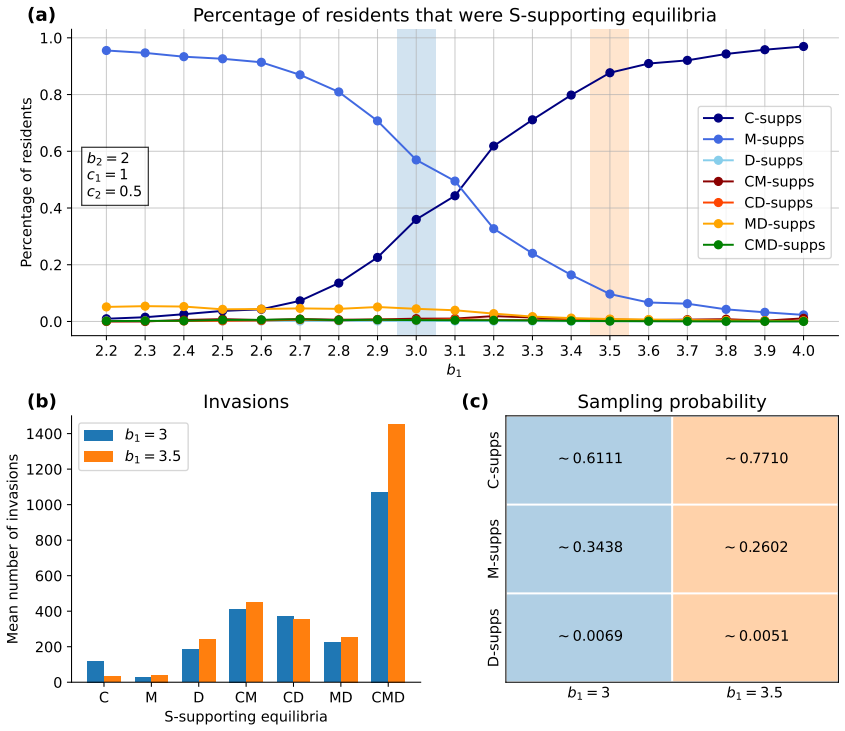
- Evolutionary simulations show that equilibrium class prevalence is set by the combination of generation likelihood and invasion robustness.
Where Pith is reading between the lines
- The linear reduction could permit systematic enumeration of equilibria even when the number of actions grows moderately large.
- Identifying which S classes are favored under social learning may suggest how interaction rules could be adjusted to stabilize particular outcomes.
- The correspondence structure offers a template for checking whether similar linear characterizations exist when strategies incorporate slightly more history.
Load-bearing premise
Players restrict themselves to reactive strategies that respond only to the opponent's immediately preceding action, and the stage games possess an additive payoff structure.
What would settle it
A concrete symmetric Nash equilibrium using reactive strategies in an additive game whose supported actions against itself do not match any single subset S, or that fails to satisfy the corresponding linear equalities and inequalities.
Figures

read the original abstract
In this paper, we study reactive strategies in repeated additive games between two players with finitely many actions. Reactive strategies condition only on the opponent's previous action, making them one of the simplest ways players can respond to past interactions. Additive games include important models of cooperation, such as the donation game and games with a punishment option. We show that, for this class of games and strategies, the conditions for symmetric Nash equilibria reduce to a system of linear equalities and inequalities in the strategy parameters, allowing us to characterise all such equilibria. We establish a one-to-one correspondence between non-empty subsets S of the action set and equilibrium classes, which we call S-supporting equilibria. These are equilibria that use exactly the actions in S when playing against themselves. As a special case, we recover the well-known equalizer strategies as the equilibria supported on the entire action set. To assess which equilibrium classes are most evolutionarily relevant, we complement our analytical characterisation with simulations of social learning dynamics. We find that their prevalence is determined by two factors: how likely they are to be generated and how robust they are against invasion.
Editorial analysis
A structured set of objections, weighed in public.
Referee Report
Summary. The paper claims that for reactive strategies (conditioning only on the opponent's previous action) in repeated additive games (payoffs separable as u(a,b)=x(a)+y(b)), the conditions for symmetric Nash equilibria reduce to a system of linear equalities and inequalities in the strategy parameters. It establishes a one-to-one correspondence between non-empty subsets S of the action set and classes of S-supporting equilibria (those inducing exactly the actions in S against themselves), recovers equalizer strategies as the full-support case, and uses simulations of social learning dynamics to assess which classes are evolutionarily prevalent based on generation probability and invasion robustness.
Significance. If the central algebraic reduction holds, the work supplies a complete, parameter-free characterization of symmetric reactive equilibria in this restricted but practically relevant class, directly leveraging payoff separability and the Markovian structure of reactive strategies. The explicit S-support bijection and recovery of equalizers are clear strengths, as is the link to evolutionary dynamics via simulation. No internal inconsistency or circularity is apparent; the result is a direct consequence of the stated assumptions rather than fitted parameters.
minor comments (3)
- [Abstract / §3] The abstract and introduction assert that equilibrium conditions 'reduce to a system of linear equalities and inequalities' but do not exhibit the explicit system or a worked example for a small action set (e.g., |A|=2 or 3). Adding this in §3 or §4 would make the reduction immediately verifiable without altering the central claim.
- [§5] Simulations are invoked to rank equilibrium classes by evolutionary relevance, yet the text provides no detail on the update rule, population size, mutation rate, or number of runs. This is a presentation gap that affects reproducibility but not the mathematical characterization.
- [§2] Notation for the reactive strategy matrix (rows/columns indexed by actions) and the induced stationary distribution should be stated once with a clear reference to the transition probabilities; minor inconsistencies in indexing appear in the current draft.
Simulated Author's Rebuttal
We thank the referee for their positive assessment of the manuscript, the clear summary of our contributions, and the recommendation for minor revision. No major comments appear in the report.
Circularity Check
No significant circularity; derivation is algebraic reduction from stated assumptions
full rationale
The paper's central claim is a direct algebraic characterization: symmetric Nash conditions for reactive strategies in additive games reduce to linear equalities/inequalities because payoffs separate as u(a,b)=x(a)+y(b) and reactive strategies induce Markov chains whose stationary distributions and deviation payoffs are linear in the strategy matrix entries. The S-support correspondence is a definitional partition by the support of the induced action process. No self-citation is load-bearing for the main theorem, no parameters are fitted then renamed as predictions, and no ansatz or uniqueness result is smuggled in. The derivation is self-contained within the restricted strategy class and payoff structure; simulations are presented only as a complement for evolutionary relevance.
Axiom & Free-Parameter Ledger
axioms (2)
- standard math Symmetric Nash equilibrium is defined by the usual best-response condition in the repeated game.
- domain assumption Stage games have additive payoff structure.
Reference graph
Works this paper leans on
-
[1]
& Hamilton, W
Axelrod, R. & Hamilton, W. D. The evolution of cooperation.Science211, 1390–1396 (1981)
1981
-
[2]
Mailath, G. J. & Samuelson, L.Repeated games and reputations(Oxford Univ. Press, Oxford, UK, 2006)
2006
-
[3]
& van Veelen, M
Garc´ ıa, J. & van Veelen, M. No strategy can win in the repeated prisoner’s dilemma: Linking game theory and computer simulations.Frontiers in Robotics and AI5, 102 (2018)
2018
-
[4]
Press, Princeton, NJ, 2010)
Sigmund, K.The Calculus of Selfishness(Princeton Univ. Press, Princeton, NJ, 2010)
2010
-
[5]
G., Ohtsuki, H
Rand, D. G., Ohtsuki, H. & Nowak, M. A. Direct reciprocity with costly punishment: Gen- erous tit-for-tat prevails.Journal of theoretical biology256, 45–57 (2009)
2009
-
[6]
& Schuster, H
Hauert, C. & Schuster, H. G. Effects of increasing the number of players and memory size in the iterated prisoner’s dilemma: a numerical approach.Proceedings of the Royal Society B 264, 513–519 (1997)
1997
-
[7]
A., Cuesta, J
Martinez-Vaquero, L. A., Cuesta, J. A. & Sanchez, A. Generosity pays in the presence of direct reciprocity: A comprehensive study of 2x2 repeated games.PLoS ONE7, E35135 (2012)
2012
-
[8]
Stewart, A. J. & Plotkin, J. B. Small groups and long memories promote cooperation.Scien- tific Reports6, 26889 (2016)
2016
-
[9]
Press, W. H. & Dyson, F. J. Iterated prisoner’s dilemma contains strategies that dominate any evolutionary opponent.Proceedings of the National Academy of Sciences109, 10409–10413 (2012)
2012
-
[10]
& Zelen` y, M
Lev´ ınsk` y, R., Neyman, A. & Zelen` y, M. Should I remember more than you? On the best response to factor-based strategies. Tech. Rep., Jena Economic Research Papers (2010)
2010
-
[11]
E., Akin, E., Nowak, M
Glynatsi, N. E., Akin, E., Nowak, M. A. & Hilbe, C. Conditional cooperation with longer memory.Proceedings of the National Academy of Sciences(2024)
2024
-
[12]
LaPorte, P., Hilbe, C., Glynatsi, N. E. & Nowak, M. A. Payoff equivalence and complete strategy spaces of direct reciprocity.Proceedings of the National Academy of Sciences123, e2518486123 (2026)
2026
-
[13]
& Hauert, C
McAvoy, A., Rao, A. & Hauert, C. Intriguing effects of selection intensity on the evolution of prosocial behaviors.PLoS Computational Biology17, e1009611 (2021)
2021
-
[14]
& Glynatsi, N
Lesigang, F., Hilbe, C. & Glynatsi, N. E. Can I afford to remember less than you? Best responses in repeated additive games.Economics Letters250, 112300 (2025)
2025
-
[15]
Stewart, A. J. & Plotkin, J. B. Collapse of cooperation in evolving games.Proceedings of the National Academy of Sciences USA111, 17558 – 17563 (2014)
2014
-
[16]
S., Nowak, M
Park, P. S., Nowak, M. A. & Hilbe, C. Cooperation in alternating interactions with memory constraints.Nature Communications13, 737 (2022)
2022
-
[17]
& Sigmund, K
Hilbe, C., Traulsen, A. & Sigmund, K. Partners or rivals? Strategies for the iterated prisoner’s dilemma.Games and Economic Behavior92, 41–52 (2015)
2015
-
[18]
& Wang, L
Zhang, F., Zhou, L., Zhang, G. & Wang, L. Direct reciprocity in multi-action repeated games. Journal of Theoretical Biology618, 112312 (2026)
2026
-
[19]
& Wang, L
Zhang, F., Chen, F., Zhou, L. & Wang, L. Beyond the prisoner’s dilemma: Cooperation in repeated three-action games.Chaos, Solitons & Fractals204, 117747 (2026)
2026
-
[20]
Nowak, M. A. & Sigmund, K. Game-dyamical aspects of the prisoner’s dilemma.Applied Mathematics and Computation30, 191–213 (1989). 15
1989
-
[21]
Nowak, M. A. & Sigmund, K. Tit for tat in heterogeneous populations.Nature355, 250–253 (1992)
1992
-
[22]
Imhof, L. A. & Nowak, M. A. Stochastic evolutionary dynamics of direct reciprocity.Pro- ceedings of the Royal Society B277, 463–468 (2010)
2010
-
[23]
Allen, B., Nowak, M. A. & Dieckmann, U. Adaptive dynamics with interaction structure. American Naturalist181, E139–E163 (2013)
2013
-
[24]
C., Nowak, M
Boerlijst, M. C., Nowak, M. A. & Sigmund, K. Equal pay for all prisoners.American Mathematical Monthly104, 303–307 (1997)
1997
-
[25]
Hilbe, C., Nowak, M. A. & Sigmund, K. Evolution of extortion in iterated prisoner’s dilemma games.Proceedings of the National Academy of Sciences110, 6913–6918 (2013)
2013
-
[26]
Traulsen, A., Nowak, M. A. & Pacheco, J. M. Stochastic dynamics of invasion and fixation. Physical Review E74, 011909 (2006)
2006
-
[27]
& T˝ oke, C
Szab´ o, G. & T˝ oke, C. Evolutionary Prisoner’s Dilemma game on a square lattice.Physical Review E58, 69–73 (1998)
1998
-
[28]
& Imhof, L
Fudenberg, D. & Imhof, L. A. Imitation processes with small mutations.Journal of Economic Theory131, 251–262 (2006)
2006
-
[29]
S., Wang, L
Wu, B., Gokhale, C. S., Wang, L. & Traulsen, A. How small are small mutation rates?Journal of Mathematical Biology64, 803–827 (2012)
2012
-
[30]
Imitation processes with small mutations
McAvoy, A. Comment on “Imitation processes with small mutations”.J. Econ. Theory159, 66–69 (2015)
2015
-
[31]
A., Sasaki, A., Taylor, C
Nowak, M. A., Sasaki, A., Taylor, C. & Fudenberg, D. Emergence of cooperation and evolu- tionary stability in finite populations.Nature428, 646–650 (2004)
2004
-
[32]
& Tirole, J.Game theory(MIT press, 1991)
Fudenberg, D. & Tirole, J.Game theory(MIT press, 1991)
1991
-
[33]
Do Yi, S., Baek, S. K. & Choi, J.-K. Combination with anti-tit-for-tat remedies problems of tit-for-tat.Journal of Theoretical Biology412, 1–7 (2017)
2017
-
[34]
A., Chatterjee, K
Hilbe, C., Martinez-Vaquero, L. A., Chatterjee, K. & Nowak, M. A. Memory-n strategies of direct reciprocity.Proceedings of the National Academy of Sciences114, 4715–4720 (2017)
2017
-
[35]
& Baek, S
Murase, Y. & Baek, S. K. Five rules for friendly rivalry in direct reciprocity.Scientific reports 10, 16904 (2020)
2020
-
[36]
Memory-two zero-determinant strategies in repeated games.Royal Society open science8, 202186 (2021)
Ueda, M. Memory-two zero-determinant strategies in repeated games.Royal Society open science8, 202186 (2021)
2021
-
[37]
Controlling conditional expectations by zero-determinant strategies
Ueda, M. Controlling conditional expectations by zero-determinant strategies. InOperations Research Forum, vol. 3, 48 (Springer, 2022)
2022
-
[38]
Li, J.et al.Evolution of cooperation through cumulative reciprocity.Nature Computational Science2, 677–686 (2022)
2022
-
[39]
P., Perc, M., Xu, H
Fang, Y., Benko, T. P., Perc, M., Xu, H. & Tan, Q. Synergistic third-party rewarding and punishment in the public goods game.Proceedings. Mathematical, Physical, and Engineering Sciences475, 20190349 (2019)
2019
-
[40]
The iterated prisoner’s dilemma: good strategies and their dynamics.Ergodic Theory, Advances in Dynamical Systems77–107 (2016)
Akin, E. The iterated prisoner’s dilemma: good strategies and their dynamics.Ergodic Theory, Advances in Dynamical Systems77–107 (2016). 16 Figures and tables SConditions {C} (a)p C = (1,0,0) (b)b 1pM(C) +b 2pM(M)−c 2 ≤b 1 −c 1 (c)b 1pD(C) +b 2pD(M)≤b 1 −c 1 {M} (a)p M = (0,1,0) (b)b 1pC(C) +b 2pC(M)−c 1 ≤b 2 −c 2 (c)b 1pD(C) +b 2pD(M)≤b 2 −c 2 {D} (a)p D...
2016
discussion (0)
Sign in with ORCID, Apple, or X to comment. Anyone can read and Pith papers without signing in.