hp-Optimal DG Approximation and Robust Schwarz Decompositions on One-Irregular Cubical Meshes
Pith reviewed 2026-06-29 03:42 UTC · model grok-4.3
The pith
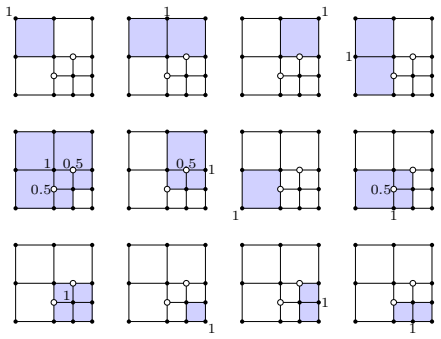
Interior penalty DG attains hp-optimal energy-norm estimates on one-irregular hexahedral meshes via a conforming hp interpolant from fitted vertex-patch closures.
A machine-rendered reading of the paper's core claim, the machinery that carries it, and where it could break.
Core claim
For fitted homogeneous diffusion interface problems on one-irregular hexahedral meshes, the interior penalty DG method attains an hp-optimal energy-norm estimate. The interpolation input is a conforming hp interpolant obtained from fitted conforming closures of one-irregular vertex patches. Stable decompositions are derived for both conforming and DG spaces; on quadrilateral meshes the bounds are independent of mesh size, local degrees, and coefficient contrast under local quasi-monotonicity, while on hexahedral meshes the conforming decomposition carries a polylogarithmic loss and the DG case uses a DG-to-conforming reduction for uniform degrees.
What carries the argument
The conforming hp interpolant obtained from fitted conforming closures of one-irregular vertex patches, which supplies the approximation theory and enables the stable Schwarz decompositions.
If this is right
- The DG energy error is optimal simultaneously in mesh size h and polynomial degree p.
- Additive Schwarz preconditioners for DG remain robust to coefficient contrast when quasi-monotonicity holds.
- On quadrilateral meshes the bounds permit locally comparable but variable polynomial degrees.
- On hexahedral meshes the conforming decomposition incurs a polylogarithmic factor while DG uses reduction to conforming spaces for uniform degrees.
Where Pith is reading between the lines
- The vertex-patch closure technique may extend the hp-optimal result to other interface or transmission problems if the fitting procedure generalizes.
- Robustness to hanging nodes indicates these preconditioners could be combined with existing adaptive refinement strategies for three-dimensional problems.
- The distinction between quadrilateral and hexahedral behavior suggests dimension-specific analysis is needed to remove the polylog factor in three dimensions.
Load-bearing premise
The local coefficient quasi-monotonicity condition must hold for the decomposition bounds to stay independent of the coefficient contrast.
What would settle it
A sequence of numerical experiments on one-irregular hexahedral meshes with coefficient jumps that violate quasi-monotonicity, checking whether the Schwarz preconditioner condition number grows with the contrast ratio.
Figures
read the original abstract
We study hp approximation and additive Schwarz decompositions for variable-order cubical finite element spaces on one-irregular meshes. For fitted homogeneous diffusion interface problems on one-irregular hexahedral meshes, we prove an hp-optimal energy-norm estimate for the interior penalty DG method. The interpolation input is a conforming hp interpolant obtained from fitted conforming closures of one-irregular vertex patches. We also derive stable decompositions for conforming and DG spaces. On one-irregular quadrilateral meshes the bounds allow locally comparable variable polynomial degrees and are independent of the mesh size, the local degrees, and, under a local coefficient quasi-monotonicity condition, the coefficient contrast. On one-irregular hexahedral meshes the conforming decomposition has the corresponding polylogarithmic loss; the DG-to-conforming reduction is used there for uniform-degree DG spaces. Numerical experiments illustrate the p-optimal DG error estimate and the robustness of the DG Schwarz preconditioner.
Editorial analysis
A structured set of objections, weighed in public.
Referee Report
Summary. The paper studies hp approximation and additive Schwarz decompositions for variable-order cubical finite element spaces on one-irregular meshes. For fitted homogeneous diffusion interface problems on one-irregular hexahedral meshes, it proves an hp-optimal energy-norm estimate for the interior penalty DG method. The interpolation input is a conforming hp interpolant obtained from fitted conforming closures of one-irregular vertex patches. It also derives stable decompositions for conforming and DG spaces. On one-irregular quadrilateral meshes the bounds allow locally comparable variable polynomial degrees and are independent of the mesh size, the local degrees, and, under a local coefficient quasi-monotonicity condition, the coefficient contrast. On one-irregular hexahedral meshes the conforming decomposition has the corresponding polylogarithmic loss; the DG-to-conforming reduction is used there for uniform-degree DG spaces. Numerical experiments illustrate the p-optimal DG error estimate and the robustness of the DG Schwarz preconditioner.
Significance. If the proofs hold, this advances the theory of hp-version DG methods and robust additive Schwarz preconditioners on meshes with hanging nodes, which arise naturally in adaptive refinement. The explicit use of a conforming hp interpolant constructed via fitted closures of one-irregular vertex patches, together with the clear statement of the local coefficient quasi-monotonicity assumption, provides a solid foundation for contrast-independent bounds. The numerical experiments directly support the hp-optimality and robustness claims.
minor comments (1)
- [Abstract] Abstract: the phrase 'the DG-to-conforming reduction is used there for uniform-degree DG spaces' on hexahedral meshes is concise but leaves the precise reason for the reduction and the nature of the polylog loss implicit; a single additional sentence would improve readability for readers focused on the 3D case.
Simulated Author's Rebuttal
We thank the referee for the careful reading and positive evaluation of the manuscript, including the accurate summary of our contributions on hp-optimal DG estimates and robust Schwarz decompositions for variable-order spaces on one-irregular cubical meshes. The recommendation for minor revision is noted. No specific major comments were provided in the report.
Circularity Check
No significant circularity; derivation is self-contained
full rationale
The paper proves hp-optimal DG energy-norm estimates and Schwarz decomposition bounds on one-irregular meshes using a conforming hp interpolant constructed from fitted closures of vertex patches, under explicitly stated assumptions including local coefficient quasi-monotonicity. No step reduces by construction to a fitted input, self-definition, or self-citation chain; the argument relies on standard interpolation theory and numerical analysis techniques that are independent of the target results. The provided abstract and reader's assessment confirm the absence of any load-bearing reduction to inputs, consistent with a normal non-circular mathematical derivation.
Axiom & Free-Parameter Ledger
axioms (1)
- domain assumption Local coefficient quasi-monotonicity condition
Reference graph
Works this paper leans on
-
[1]
Eibner and J
T. Eibner and J. M. Melenk , A local error analysis of the boundary-concentrated hp -FEM , IMA J. Numer. Anal., 26 (2006), pp. 752--778
2006
-
[2]
J. M. Melenk , hp -Interpolation of Nonsmooth Functions and an Application to hp -A Posteriori Error Estimation , SIAM J. Numer. Anal., 43 (2005), pp. 127--155
2005
-
[3]
Guo and J
B. Guo and J. Zhang , Stable and compatible polynomial extensions in three dimensions and applications to the p and h - p finite element method , SIAM J. Numer. Anal., 47 (2009), pp. 1195--1225
2009
-
[4]
Schwab , p - and hp -Finite Element Methods: Theory and Applications in Solid and Fluid Mechanics , Numerical Mathematics and Scientific Computation, Clarendon Press, Oxford, 1998
C. Schwab , p - and hp -Finite Element Methods: Theory and Applications in Solid and Fluid Mechanics , Numerical Mathematics and Scientific Computation, Clarendon Press, Oxford, 1998
1998
-
[5]
Stamm and T
B. Stamm and T. P. Wihler , hp -Optimal Discontinuous Galerkin Methods for Linear Elliptic Problems , Math. Comp., 79 (2010), pp. 2117--2133
2010
-
[6]
O. A. Karakashian and F. Pascal , A Posteriori Error Estimates for a Discontinuous Galerkin Approximation of Second-Order Elliptic Problems , SIAM J. Numer. Anal., 41 (2003), pp. 2374--2399
2003
-
[7]
Pazner and T
W. Pazner and T. Kolev , Uniform subspace correction preconditioners for discontinuous Galerkin methods with hp -refinement , Commun. Appl. Math. Comput., 4 (2022), pp. 697--727
2022
-
[8]
Houston, D
P. Houston, D. Sch\"otzau, and T. P. Wihler , Energy Norm A Posteriori Error Estimation of hp -Adaptive Discontinuous Galerkin Methods for Elliptic Problems , Math. Models Methods Appl. Sci., 17 (2007), pp. 33--62
2007
-
[9]
S. Li and W. Zheng , Trace-Preserving hp Interpolation and Polynomial Liftings on Conforming Hexahedral Meshes , arXiv:2606.02125, 2026
Pith/arXiv arXiv 2026
-
[10]
S. Li and W. Zheng , Weighted hp -Uniform Decompositions for H^k -Type Tensor-Product Spaces in Arbitrary Dimension , arXiv:2606.05615, 2026
Pith/arXiv arXiv 2026
-
[11]
S. Li and W. Zheng , Owner-selected bubble transforms and coefficient-robust Schwarz preconditioners for variable-degree hp finite elements , arXiv:2606.03141, 2026
Pith/arXiv arXiv 2026
discussion (0)
Sign in with ORCID, Apple, or X to comment. Anyone can read and Pith papers without signing in.