Trace-Preserving hp Interpolation and Polynomial Liftings on Conforming Hexahedral Meshes
Pith reviewed 2026-06-28 13:38 UTC · model grok-4.3
The pith
Polynomial liftings on hexahedral boundary patches preserve traces with p-uniform control of both the H1 norm and seminorm.
A machine-rendered reading of the paper's core claim, the machinery that carries it, and where it could break.
Core claim
On nonsingular conforming hexahedral boundary patches, polynomial liftings of prescribed edge and face traces exist that remain stable in both the H1 norm and the H1 seminorm with constants independent of p under the uniform boundary-degree condition; these liftings yield H1-seminorm stable discrete harmonic extensions and serve as boundary corrections that make the conforming hp Clement interpolant trace-preserving for H1 functions, with only polylogarithmic loss when degrees are non-uniform or patches are singular.
What carries the argument
p-robust polynomial liftings on nonsingular conforming hexahedral boundary patches, built from reference-cell constructions and vertex-supported decompositions
If this is right
- The liftings produce H1-seminorm stable discrete harmonic extensions of any polynomial Dirichlet trace.
- They supply the boundary corrections that turn the hp Clement interpolant into a trace-preserving operator for H1-regular functions.
- Constants remain p-uniform whenever the uniform boundary-degree condition holds.
- Only polylogarithmic growth in the maximal local degree occurs for non-uniform degrees or for meshes containing singular patches.
Where Pith is reading between the lines
- The same reference-cell and vertex-decomposition tools could be reused to obtain analogous liftings on other polyhedral element shapes.
- The constructions suggest that trace-preserving hp interpolants can be assembled on hybrid meshes that mix hexahedra with tetrahedra or prisms.
- Numerical computation of the lifting constants on successively refined patches with increasing p would give direct evidence for the polylog bound.
Load-bearing premise
The boundary patches must be nonsingular and conforming, and the uniform boundary-degree condition is required to keep the constants free of p.
What would settle it
A concrete sequence of nonsingular conforming patches on which the smallest lifting constant grows faster than any polylogarithm of the maximal degree p would show the claimed p-robustness fails.
Figures
read the original abstract
Trace-compatible polynomial extensions are a recurring local ingredient in high-order finite element analysis on conforming hexahedral meshes. They are needed whenever prescribed edge and face traces must be preserved while a polynomial is extended into a neighboring cell or boundary patch. The main contribution of this paper is the construction of p-robust polynomial liftings on nonsingular conforming hexahedral boundary patches, with stable control of both the H^1 norm and the H^1-seminorm estimates needed for energy arguments. These liftings imply H^1-seminorm stable discrete harmonic extensions of polynomial Dirichlet traces. They also serve as boundary corrections for the conforming hp Clement interpolant, yielding trace-preserving interpolation operators for functions with only H^1 regularity. Under the uniform boundary-degree condition the constants are p-uniform; in the non-uniform case the stated logarithmic loss appears. We also treat meshes that may contain conforming singular boundary patches, where the loss remains polylogarithmic in the maximal local degree. Trace-preserving interpolation on reference cells and vertex-supported decompositions are developed as local tools for these patch and mesh-level constructions.
Editorial analysis
A structured set of objections, weighed in public.
Referee Report
Summary. The manuscript constructs trace-preserving polynomial liftings on nonsingular conforming hexahedral boundary patches that are stable in both the full H^1 norm and the H^1 seminorm with p-uniform constants under the uniform boundary-degree hypothesis (polylog loss otherwise). These liftings yield H^1-seminorm stable discrete harmonic extensions of polynomial Dirichlet traces and serve as boundary corrections in a conforming hp Clément interpolant that preserves traces for H^1 functions. All constructions are performed via reference-cell operators and vertex-supported decompositions on conforming meshes, including the treatment of singular boundary patches with polylogarithmic loss in the maximal local degree.
Significance. If the stated stability estimates hold, the constructions supply standard but previously unavailable local tools for the analysis of hp finite-element methods on hexahedral meshes. They directly enable trace-preserving interpolation operators and energy-stable extensions that are essential for proving optimal a priori estimates in high-order discretizations. The explicit reference-cell and vertex-supported approach is a strength, as it supports implementation and extension to global mesh-level arguments.
minor comments (2)
- The abstract refers to 'the stated logarithmic loss' without giving its explicit form; a one-sentence statement of the dependence (e.g., O(log p)^k) already in the abstract would improve readability.
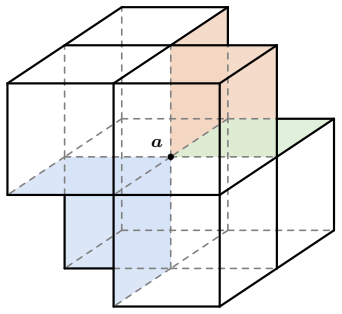
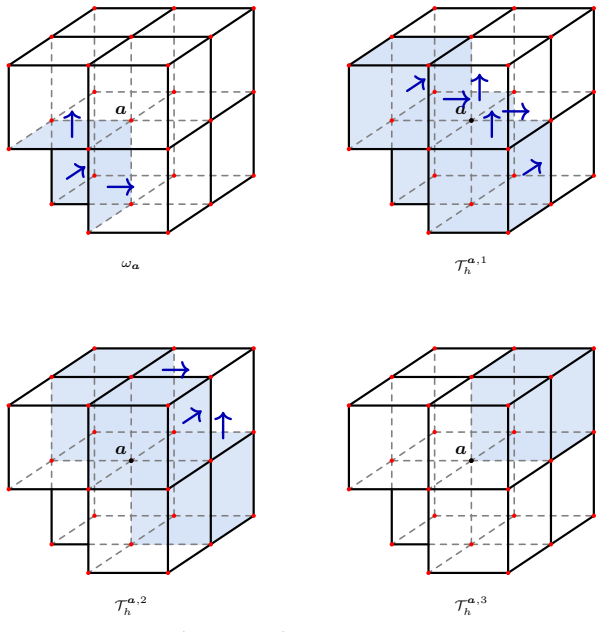
- [§2] Notation for the reference patch and the precise definition of 'nonsingular conforming hexahedral boundary patch' should be introduced with a figure or diagram in §2 to make the local constructions easier to follow.
Simulated Author's Rebuttal
We thank the referee for the positive evaluation of our manuscript and for recommending minor revision. The provided summary correctly captures the scope and contributions of the work on trace-preserving polynomial liftings and the associated hp-interpolation operators.
Circularity Check
No significant circularity identified
full rationale
The paper consists of explicit constructions of polynomial liftings and trace-preserving interpolants on reference cells and boundary patches using standard polynomial spaces, Sobolev norms, and vertex-supported decompositions. These are local tools developed from first principles with explicitly stated assumptions (nonsingular patches, uniform boundary degree). No self-definitional reductions, fitted inputs renamed as predictions, load-bearing self-citations, or ansatzes smuggled via prior work appear in the derivation chain. The central claims are independent mathematical results on hp-FEM operators.
Axiom & Free-Parameter Ledger
axioms (1)
- standard math Standard properties of polynomial spaces on hexahedral reference elements and H^1 Sobolev norms hold for the patch constructions.
Forward citations
Cited by 1 Pith paper
-
hp-Optimal DG Approximation and Robust Schwarz Decompositions on One-Irregular Cubical Meshes
Proves hp-optimal DG error estimates and derives robust additive Schwarz decompositions for conforming and DG spaces on one-irregular cubical meshes with variable orders.
Reference graph
Works this paper leans on
-
[1]
J. M. Melenk , hp -Interpolation of Nonsmooth Functions and an Application to hp -A Posteriori Error Estimation , SIAM J. Numer. Anal., 43 (2005), pp. 127--155
2005
-
[2]
B. Q. Guo and J. M. Zhang , Stable and Compatible Polynomial Extensions in Three Dimensions and Applications to the p and h - p Finite Element Method , SIAM J. Numer. Anal., 47 (2009), pp. 1195--1225
2009
-
[3]
Eibner and J
T. Eibner and J. M. Melenk , A Local Error Analysis of the Boundary-Concentrated hp -FEM , IMA J. Numer. Anal., 26 (2006), pp. 752--778
2006
-
[4]
Schwab , p - and hp -Finite Element Methods: Theory and Applications in Solid and Fluid Mechanics , Clarendon Press, Oxford, 1998
C. Schwab , p - and hp -Finite Element Methods: Theory and Applications in Solid and Fluid Mechanics , Clarendon Press, Oxford, 1998
1998
-
[5]
Babu s ka, A
I. Babu s ka, A. Craig, J. Mandel, and J. Pitk\" a ranta , Efficient Preconditioning for the p -Version Finite Element Method in Two Dimensions , SIAM J. Numer. Anal., 28 (1991), pp. 624--661
1991
-
[6]
Ainsworth and B
M. Ainsworth and B. Q. Guo , An Additive Schwarz Preconditioner for p -Version Boundary Element Approximation of the Hypersingular Operator in Three Dimensions , Numer. Math., 85 (2000), pp. 343--366
2000
-
[7]
Toselli and O
A. Toselli and O. Widlund , Domain Decomposition Methods: Algorithms and Theory , Springer Series in Computational Mathematics, vol. 34, Springer, 2005
2005
discussion (0)
Sign in with ORCID, Apple, or X to comment. Anyone can read and Pith papers without signing in.