Exceptional Points as Manifestations of Topological-Charge Breakdown in a Non-Hermitian Skyrmion
Pith reviewed 2026-06-29 03:31 UTC · model grok-4.3
The pith
Topological protection of a skyrmion splits into two distinct charges at an exceptional point in non-Hermitian magnets.
A machine-rendered reading of the paper's core claim, the machinery that carries it, and where it could break.
Core claim
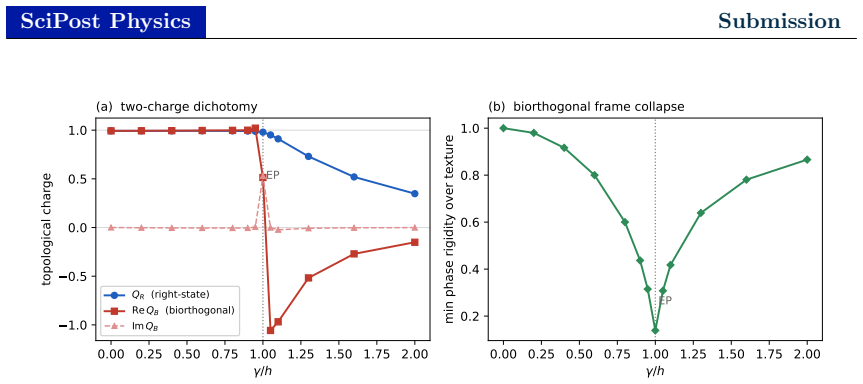
The integer topological charge of a magnetic skyrmion is the standard emblem of topological protection. We ask what happens to that protection when the magnet is made non-Hermitian, with balanced gain and loss or a PT-symmetric anisotropy. A non-Hermitian skyrmion turns out to carry two charges that coincide in the Hermitian limit but part ways under deformation. The charge built from the right state alone is homotopy-protected: the PT flow reduces exactly to a Gilbert-type relaxation on the target sphere, so it cannot change under smooth evolution. The charge built from the biorthogonal left-right pair is complex, loses quantization as soon as the gain/loss is turned on, and breaks down at
What carries the argument
the two topological charges carried by the non-Hermitian skyrmion, with the biorthogonal one breaking down at the exceptional point ring on the equator
Load-bearing premise
The PT flow reduces exactly to a Gilbert-type relaxation on the target sphere, so the right-state charge cannot change under smooth evolution.
What would settle it
Direct observation that the right-state charge changes under a PT-symmetric deformation of the non-Hermitian skyrmion, or that the biorthogonal charge stays quantized beyond the exceptional point.
Figures

read the original abstract
The integer topological charge of a magnetic skyrmion is the standard emblem of topological protection. We ask what happens to that protection when the magnet is made non-Hermitian, with balanced gain and loss or a PT-symmetric anisotropy. A non-Hermitian skyrmion turns out to carry two charges that coincide in the Hermitian limit but part ways under deformation. The charge built from the right state alone is homotopy-protected: the PT flow reduces exactly to a Gilbert-type relaxation on the target sphere, so it cannot change under smooth evolution. The charge built from the biorthogonal left-right pair is complex, loses quantization as soon as the gain/loss is turned on, and breaks down at the exceptional point of the local generator -- a ring on the skyrmion's equator, where the biorthogonal Bloch field itself diverges. Topological protection of a skyrmion is therefore not a single statement once the dynamics is non-Hermitian: it splits at an exceptional point. This is the real-space topological counterpart of the analyticity breakdown a causal response function suffers at an exceptional point, both being manifestations of the same non-Hermitian degeneracy.
Editorial analysis
A structured set of objections, weighed in public.
Referee Report
Summary. The paper claims that a non-Hermitian PT-symmetric skyrmion carries two distinct topological charges. The right-state charge remains an integer and is homotopy-protected because the PT flow reduces exactly to Gilbert-type relaxation on the target sphere, preventing change under smooth evolution. The biorthogonal left-right charge is complex, loses quantization upon introduction of gain/loss, and terminates at an exceptional-point ring on the skyrmion equator where the biorthogonal Bloch field diverges. This splitting is presented as the real-space topological counterpart of analyticity breakdown in causal response functions at exceptional points.
Significance. If the claimed reduction of the PT dynamics to Gilbert relaxation holds and the biorthogonal charge indeed diverges at the EP ring, the work identifies a concrete mechanism by which non-Hermiticity splits topological protection in real-space magnetic textures. It supplies an explicit real-space realization of the same non-Hermitian degeneracy that affects response functions, potentially informing studies of non-Hermitian topological matter and skyrmion dynamics under balanced gain and loss.
major comments (2)
- [Abstract] The central claim that the PT flow reduces exactly to Gilbert-type relaxation (rendering the right-state charge invariant) is stated in the abstract but lacks an explicit derivation or equation showing the mapping from the non-Hermitian Landau-Lifshitz-Gilbert equation to the target-sphere relaxation; without this step the invariance argument cannot be verified.
- [Abstract] The assertion that the biorthogonal charge becomes complex and breaks down at an exceptional-point ring where the field diverges is presented without the local generator, the explicit form of the biorthogonal Bloch field, or the calculation locating the ring on the equator; these are load-bearing for the splitting claim.
Simulated Author's Rebuttal
We thank the referee for the careful reading and constructive comments. Both major comments concern the level of explicit detail provided in the abstract. The full derivations and explicit forms are already present in the main text; we have revised the abstract to include direct references to the relevant equations so that the claims can be verified without expanding the abstract itself.
read point-by-point responses
-
Referee: [Abstract] The central claim that the PT flow reduces exactly to Gilbert-type relaxation (rendering the right-state charge invariant) is stated in the abstract but lacks an explicit derivation or equation showing the mapping from the non-Hermitian Landau-Lifshitz-Gilbert equation to the target-sphere relaxation; without this step the invariance argument cannot be verified.
Authors: The mapping is derived in Section III (starting from the non-Hermitian LLG equation and reducing it to Gilbert relaxation on the target sphere via the PT constraint). We have revised the abstract to include a parenthetical reference to these equations, making the invariance argument directly verifiable from the abstract while preserving its brevity. revision: yes
-
Referee: [Abstract] The assertion that the biorthogonal charge becomes complex and breaks down at an exceptional-point ring where the field diverges is presented without the local generator, the explicit form of the biorthogonal Bloch field, or the calculation locating the ring on the equator; these are load-bearing for the splitting claim.
Authors: The local generator appears in Eq. (14), the explicit biorthogonal Bloch field in Eq. (17), and the equatorial EP-ring location (with divergence) is calculated in Section IV. We have revised the abstract to cite these elements explicitly, thereby supplying the requested load-bearing details. revision: yes
Circularity Check
No significant circularity; derivation is self-contained
full rationale
The paper's central steps consist of (1) defining two distinct charges (right-state vs. biorthogonal) from the non-Hermitian setup and (2) deriving that the PT flow on the right-state vector reduces exactly to Gilbert relaxation on the target sphere, implying homotopy invariance, while the biorthogonal charge becomes complex and terminates at the exceptional-point ring. These reductions are presented as consequences of the dynamics equations rather than definitions or fitted inputs. No self-citations, ansatzes smuggled via prior work, or predictions that reduce to the input data by construction appear in the abstract or stated claims. The result is therefore independent of its own outputs.
Axiom & Free-Parameter Ledger
axioms (1)
- domain assumption The PT flow reduces exactly to a Gilbert-type relaxation on the target sphere
Reference graph
Works this paper leans on
-
[1]
T. H. R. Skyrme,A unified field theory of mesons and baryons, Nuclear Physics31, 556 (1962)
1962
-
[2]
Nagaosa and Y
N. Nagaosa and Y. Tokura,Topological properties and dynamics of magnetic skyrmions, Nature Nanotechnology8, 899 (2013)
2013
-
[3]
Tsesses, E
S. Tsesses, E. Ostrovsky, K. Cohen, B. Gjonaj, N. H. Lindner and G. Bartal,Optical skyrmion lattice in evanescent electromagnetic fields, Science361, 993 (2018),1805. 11839. 9 SciPost Physics Submission
2018
-
[4]
Y. Shen, Q. Zhang, P. Shi, L. Du, X. Yuan and A. V. Zayats,Optical skyrmions and other topological quasiparticles of light, Nature Photonics18, 15 (2024),2205.10329
arXiv 2024
- [5]
-
[6]
E. J. Bergholtz, J. C. Budich and F. K. Kunst,Exceptional topology of non-Hermitian systems, Reviews of Modern Physics93, 015005 (2021)
2021
-
[7]
W. D. Heiss,The physics of exceptional points, Journal of Physics A: Mathematical and Theoretical45, 444016 (2012)
2012
-
[8]
Liu,Exceptional points as manifestations of analyticity breakdown in the ’t Hooft model, Submitted (2026)
K. Liu,Exceptional points as manifestations of analyticity breakdown in the ’t Hooft model, Submitted (2026)
2026
-
[9]
H. T. Ueda, Y. Akagi and N. Shannon,Quantum solitons with emergent interactions in a model of cold atoms on the triangular lattice, Physical Review A93, 021606(R) (2016),1511.06515
Pith/arXiv arXiv 2016
-
[10]
Zarzuela, V
R. Zarzuela, V. K. Bharadwaj, K.-W. Kim, J. Sinova and K. Everschor-Sitte,Stability and dynamics of in-plane skyrmions, Physical Review B101, 054405 (2020)
2020
-
[11]
J. Lee, S. Jeon and J. H. Han,Skyrmion as fracton: Dynamics of CP N−1 skyrmions (2025),2509.17403
arXiv 2025
-
[12]
T. Brauner, N. Yamamoto and R. Yokokura,Dipole symmetries from the topology of the phase space and the constraints on the low-energy spectrum, SciPost Physics16, 040 (2024),2303.04479
arXiv 2024
-
[13]
Y. Koyama and Y. Kawaguchi,Point-gap topology of damped magnon excitations in skyrmion strings(2026),2605.07435
Pith/arXiv arXiv 2026
-
[14]
K. Deng and B. Flebus,Non-Hermitian skin effect in magnetic systems, Physical Review B105, L180406 (2022),2109.01711
arXiv 2022
-
[15]
Kr´ olet al.,Non-Hermitian control of confined optical skyrmions in microcavities formed by photonic spin-orbit coupling, Photonics Research11, 610 (2023)
M. Kr´ olet al.,Non-Hermitian control of confined optical skyrmions in microcavities formed by photonic spin-orbit coupling, Photonics Research11, 610 (2023)
2023
-
[16]
Wingenbachet al.,Skyrmions in scalar fields of non-Hermitian optical microcavities (2026),2606.02265
J. Wingenbachet al.,Skyrmions in scalar fields of non-Hermitian optical microcavities (2026),2606.02265
Pith/arXiv arXiv 2026
-
[17]
X. Maet al.,Emergent momentum-space topological pseudospin defects in non- Hermitian polariton systems(2025),2509.14605
arXiv 2025
-
[18]
H. Shen, B. Zhen and L. Fu,Topological band theory for non-Hermitian Hamiltonians, Physical Review Letters120, 146402 (2018),1706.07435
Pith/arXiv arXiv 2018
-
[19]
K. Kawabata, K. Shiozaki, M. Ueda and M. Sato,Symmetry and topology in non- Hermitian physics, Physical Review X9, 041015 (2019),1812.09133
arXiv 2019
-
[20]
Z. Gong, Y. Ashida, K. Kawabata, K. Takasan, S. Higashikawa and M. Ueda,Topo- logical phases of non-Hermitian systems, Physical Review X8, 031079 (2018), 1802.07964
Pith/arXiv arXiv 2018
-
[21]
F. K. Kunst, E. Edvardsson, J. C. Budich and E. J. Bergholtz,Biorthogonal bulk- boundary correspondence in non-Hermitian systems, Physical Review Letters121, 026808 (2018),1805.06492. 10 SciPost Physics Submission
Pith/arXiv arXiv 2018
-
[22]
Edvardsson, F
E. Edvardsson, F. K. Kunst, T. Yoshida and E. J. Bergholtz,Phase transitions and generalized biorthogonal polarization in non-Hermitian systems, Physical Review Research2, 043046 (2020)
2020
-
[23]
I. Mandal,Identifying gap-closings in open non-Hermitian systems by biorthogonal polarization, Journal of Applied Physics135, 094402 (2024),2401.12213
arXiv 2024
-
[24]
X. Yin, Y. Chen, X. Zhang, Z. Zhang, S. Noda and C. Peng,Observation of Berry curvature in non-Hermitian system from far-field radiation, Nature Communications 16, 2966 (2025),2402.12755
arXiv 2025
-
[25]
Y.-M. R. Hu, E. A. Ostrovskaya and E. Estrecho,Generalized quantum geometric tensor in a non-Hermitian exciton-polariton system, Optical Materials Express14, 664 (2024),2306.00351
arXiv 2024
-
[26]
exceptional points as manifestations of topological-charge breakdown in a non-hermitian skyrmion
K. Liu,Data and code for “exceptional points as manifestations of topological-charge breakdown in a non-hermitian skyrmion”, doi:10.5281/zenodo.20909606 (2026). 11
discussion (0)
Sign in with ORCID, Apple, or X to comment. Anyone can read and Pith papers without signing in.