SKAO and Gamma-Ray Synergies
Pith reviewed 2026-06-29 02:58 UTC · model grok-4.3
The pith
Combined SKA and gamma-ray observations can reveal the physical mechanisms behind emission from GeV-TeV sources.
A machine-rendered reading of the paper's core claim, the machinery that carries it, and where it could break.
Core claim
Combined observations across radio and gamma-ray energy bands will provide crucial insights into the physical mechanisms driving emission from GeV-TeV sources of both Galactic and extragalactic origin through coordinated wide-field surveys, monitoring, and target-of-opportunity follow-ups.
What carries the argument
Coordinated SKA-gamma-ray observations, including wide-field surveys, monitoring of variable sources, and target-of-opportunity follow-ups.
If this is right
- Insights into transient events such as gamma-ray bursts, supernovae, fast radio bursts, and tidal disruption events.
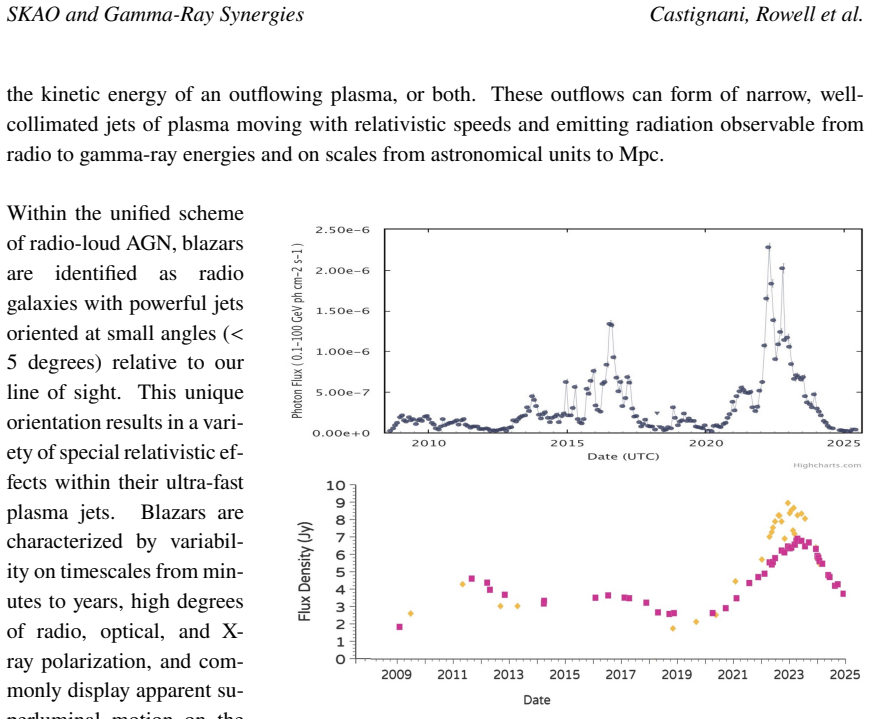
- Understanding of variable sources like blazars and active galactic nuclei.
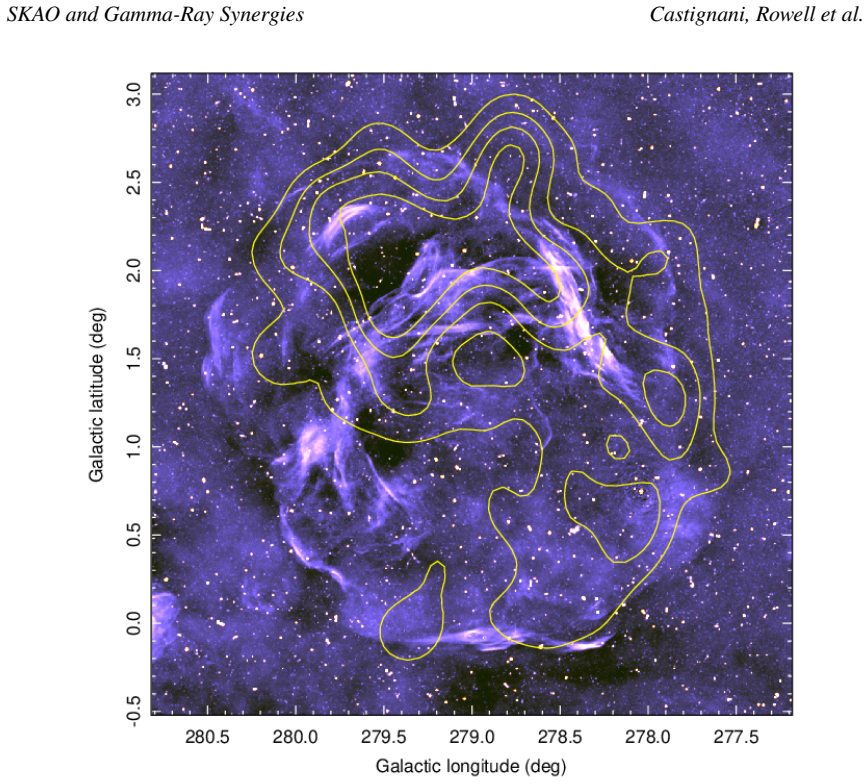
- Clarification for steady emitters including the Galactic centre, supernova remnants, radio galaxies, and galaxy clusters.
- Use of polarization signatures to probe magnetic fields in these sources.
Where Pith is reading between the lines
- If coordination succeeds, it could enable rapid multi-messenger follow-up with neutrino and gravitational-wave detections.
- Data from these synergies might test specific models of particle acceleration in different environments.
- Extending this to other wavelengths could further constrain the broadband spectral energy distributions.
Load-bearing premise
That operational coordination between SKA and gamma-ray facilities will be technically and logistically feasible at the scale needed.
What would settle it
Coordinated observations of multiple sources that fail to distinguish between competing emission models or do not yield new constraints on acceleration mechanisms.
Figures

read the original abstract
A wide variety of Galactic and extragalactic sources are known to emitradiation across the entire electromagnetic spectrum, including both transient and steady-state phenomena. A few hundred of these sources (~300) have been detected even at the highest energies, in the TeV range. The number of known TeV emitters is expected to increase substantially in the coming years with the operation of current and next-generation Cherenkov detectors, such as the Large High Altitude Air Shower Observatory (LHAASO) and the Cherenkov Telescope Array Observatory (CTAO). These sources typically exhibit broad, non-thermal, spectral energy distributions. Explaining such emission requires efficient particle acceleration mechanisms (e.g. Fermi processes, shock acceleration) and radiative processes involving magnetic fields (e.g. synchrotron and inverse Compton radiation), often accompanied by polarization signatures. However, the relative contribution of these emission mechanisms and the underlying physical processes are still debated. In this work, we present an overview of the scientific potential arising from the synergy between the Square Kilometre Array (SKA) and current and upcoming gamma-ray facilities. Combined observations across these energy bands will provide crucial insights into the physical mechanisms driving emission from GeV-TeV sources of both Galactic and extragalactic origin. These include transient events (e.g. gamma-ray bursts, supernovae, fast radio bursts, tidal disruption events, neutrino and gravitational-wave counterparts), variable sources (e.g. blazars, active galactic nuclei), and steady emitters (e.g. the Galactic centre, supernova remnants, radio galaxies, and galaxy clusters). We discuss the prospects for coordinated SKA-gamma-ray observations, including wide-field surveys, monitoring of variable sources, and target-of-opportunity follow-ups.
Editorial analysis
A structured set of objections, weighed in public.
Referee Report
Summary. The manuscript is an overview of the scientific prospects for synergies between the Square Kilometre Array (SKA) and gamma-ray facilities (LHAASO, CTAO) in studying emission mechanisms for Galactic and extragalactic GeV-TeV sources. It covers transients (GRBs, FRBs, SNe, TDEs), variable sources (blazars, AGN), and steady emitters (Galactic centre, SNRs, radio galaxies, clusters), emphasizing coordinated wide-field surveys, monitoring, and target-of-opportunity follow-ups to combine radio and gamma-ray data on particle acceleration and radiative processes.
Significance. If operational coordination proves feasible, the outlined multi-wavelength approach could help resolve debates on the relative roles of synchrotron, inverse Compton, and other processes in non-thermal spectra; however, as a purely qualitative review without new calculations, error budgets, or falsifiable predictions, the work primarily serves to frame future strategies rather than deliver immediate advances.
major comments (1)
- [Abstract] Abstract: the assertion that combined SKA + gamma-ray observations 'will provide crucial insights into the physical mechanisms' is load-bearing for the entire manuscript yet rests on the unexamined premise that wide-field surveys, monitoring programs, and ToO follow-ups can be executed at the required scale; the text supplies no analysis of scheduling constraints, data-volume handling, sensitivity matching, or existing inter-facility protocols.
minor comments (1)
- [Abstract] Abstract: 'emit radiation' is written without a space as 'emit radiation'.
Simulated Author's Rebuttal
We thank the referee for their review. Our manuscript is a qualitative overview of scientific prospects for SKA-gamma-ray synergies, not a technical operations study. We will revise the abstract to moderate its language and clarify scope while preserving the core discussion of scientific potential.
read point-by-point responses
-
Referee: [Abstract] Abstract: the assertion that combined SKA + gamma-ray observations 'will provide crucial insights into the physical mechanisms' is load-bearing for the entire manuscript yet rests on the unexamined premise that wide-field surveys, monitoring programs, and ToO follow-ups can be executed at the required scale; the text supplies no analysis of scheduling constraints, data-volume handling, sensitivity matching, or existing inter-facility protocols.
Authors: We agree the abstract phrasing is assertive for a review paper. The manuscript draws on published facility capabilities and white papers to outline scientific opportunities; it does not claim to solve operational challenges. We will change 'will provide crucial insights' to 'have the potential to provide crucial insights' and insert a brief clause noting that realizing these synergies will require coordinated scheduling and data protocols currently under discussion by the facilities. Detailed quantitative analysis of scheduling, data volumes, or sensitivity matching lies outside the scope of this overview and would need dedicated operations studies. The scientific arguments rest on the documented performance parameters rather than unexamined assumptions about execution. revision: yes
Circularity Check
No circularity; prospective overview with no derivations or fitted quantities
full rationale
The paper is an overview of scientific synergies between SKA and gamma-ray facilities. It contains no equations, no fitted parameters, no predictions, and no derivation chain. The central claim is a forward-looking statement that combined observations will provide insights into emission mechanisms; this is not derived from any internal calculation or self-referential definition. No self-citations are invoked to justify uniqueness or load-bearing premises. The text lists source classes and observational prospects but supplies no quantitative modeling that could reduce to its own inputs. This is a standard non-circular case for a review-style white paper.
Axiom & Free-Parameter Ledger
Reference graph
Works this paper leans on
-
[1]
Quantifying jet interstellar medium interactions in Cyg X-1: Insights from dual-frequency bow shock detection with MeerKAT. , keywords =. doi:10.1051/0004-6361/202452837 , archivePrefix =. 2504.17635 , primaryClass =
-
[2]
arXiv e-prints , keywords =
A newly born spider system at the core of a radio shell: Evidence for a low-energy supernova. arXiv e-prints , keywords =
-
[3]
Possibilities for SETI at High Energy. arXiv e-prints , keywords =. doi:10.48550/arXiv.2506.16351 , archivePrefix =. 2506.16351 , primaryClass =
-
[4]
MeerKAT discovers a jet-driven bow shock near GRS 1915+105: How an invisible large-scale jet sculpts a microquasar's environment. , keywords =. doi:10.1051/0004-6361/202452838 , archivePrefix =. 2504.17425 , primaryClass =
-
[5]
, year = 2010, month = jul, volume =
A 300-parsec-long jet-inflated bubble around a powerful microquasar in the galaxy NGC 7793. , year = 2010, month = jul, volume =. doi:10.1038/nature09168 , adsurl =
-
[6]
The twisted jets of Circinus X-1
The twisted jets of Circinus X-1. , keywords =. doi:10.1093/mnras/stz099 , archivePrefix =. 1901.02631 , primaryClass =
work page internal anchor Pith review Pith/arXiv arXiv doi:10.1093/mnras/stz099 1901
-
[7]
Relativistic precessing jets powered by an accreting neutron star. , keywords =. doi:10.1093/mnrasl/slaf097 , archivePrefix =. 2509.08951 , primaryClass =
-
[8]
A High-Resolution Radio Study of the W50-SS 433 System and the Surrounding Medium. , keywords =. doi:10.1086/300537 , adsurl =
-
[9]
Radio pulsations from a neutron star within the gamma-ray binary LS I +61 303. Nature Astronomy , keywords =. doi:10.1038/s41550-022-01630-1 , archivePrefix =. 2203.09423 , primaryClass =
-
[10]
Bayesian Analysis of Radio Observations of the Be X-Ray Binary LS I +61 303. , keywords =. doi:10.1086/341257 , adsurl =
-
[11]
X-ray and radio observations of RX J1826.2-1450/LS 5039
X-ray and radio observations of RX J1826.2-1450/LS 5039. , keywords =. doi:10.48550/arXiv.astro-ph/9905344 , archivePrefix =. astro-ph/9905344 , primaryClass =
work page internal anchor Pith review Pith/arXiv arXiv doi:10.48550/arxiv.astro-ph/9905344
-
[12]
, keywords =
Observations at 3.6 CM wavelength of the radio light curve of LSI +61 303. , keywords =
-
[13]
A dark jet dominates the power output of the stellar black hole Cygnus X-1
A dark jet dominates the power output of the stellar black hole Cygnus X-1. , keywords =. doi:10.1038/nature03879 , archivePrefix =. astro-ph/0508228 , primaryClass =
work page internal anchor Pith review Pith/arXiv arXiv doi:10.1038/nature03879
-
[14]
A double-sided radio jet from the compact Galactic Centre annihilator 1E1740.7-2942. , keywords =. doi:10.1038/358215a0 , adsurl =
-
[15]
A search for possible interactions between ejections from GRS 1915+105 and the surrounding interstellar medium. , keywords =. doi:10.1051/0004-6361:20000266 , archivePrefix =. astro-ph/0011297 , primaryClass =
work page internal anchor Pith review Pith/arXiv arXiv doi:10.1051/0004-6361:20000266 1915
-
[16]
Radio Lobe Dynamics and the Environment of Microquasars
Radio lobe dynamics and the environment of microquasars. , keywords =. doi:10.1051/0004-6361:20020402 , archivePrefix =. astro-ph/0203295 , primaryClass =
work page internal anchor Pith review Pith/arXiv arXiv doi:10.1051/0004-6361:20020402
-
[17]
Possible hot spots excited by the relativistic jets of Cygnus X-3
Possible hot spots excited by the relativistic jets of Cygnus X-3. , keywords =. doi:10.1051/0004-6361:20053041 , archivePrefix =. astro-ph/0505433 , primaryClass =
work page internal anchor Pith review Pith/arXiv arXiv doi:10.1051/0004-6361:20053041
-
[18]
Electromagnetic radiation initiated by hadronic jets from microquasars in the ISM
Electromagnetic radiation initiated by hadronic jets from microquasars in the ISM. , keywords =. doi:10.1051/0004-6361:20041794 , archivePrefix =. astro-ph/0411508 , primaryClass =
work page internal anchor Pith review Pith/arXiv arXiv doi:10.1051/0004-6361:20041794
-
[19]
Ultra-high-energy gamma-ray bubble around microquasar V4641 Sgr. , keywords =. doi:10.1038/s41586-024-07995-9 , archivePrefix =. 2410.16117 , primaryClass =
-
[20]
Very high energy particle acceleration powered by the jets of the microquasar SS 433
Very-high-energy particle acceleration powered by the jets of the microquasar SS 433. , keywords =. doi:10.1038/s41586-018-0565-5 , archivePrefix =. 1810.01892 , primaryClass =
work page internal anchor Pith review Pith/arXiv arXiv doi:10.1038/s41586-018-0565-5
-
[21]
Ultrahigh-Energy Gamma-ray Emission Associated with Black Hole-Jet Systems. arXiv e-prints , keywords =. doi:10.48550/arXiv.2410.08988 , archivePrefix =. 2410.08988 , primaryClass =
-
[22]
An ultrahigh-energy -ray bubble powered by a super PeVatron. Science Bulletin , keywords =. doi:10.1016/j.scib.2023.12.040 , archivePrefix =. 2310.10100 , primaryClass =
-
[23]
Microquasar interaction with the surrounding medium
Non-thermal emission from microquasar/ISM interaction. , keywords =. doi:10.1051/0004-6361/200810781 , archivePrefix =. 0903.3293 , primaryClass =
work page internal anchor Pith review Pith/arXiv arXiv doi:10.1051/0004-6361/200810781
-
[24]
Gamma-ray binaries and related systems
Gamma-ray binaries and related systems. , keywords =. doi:10.1007/s00159-013-0064-5 , archivePrefix =. 1307.7083 , primaryClass =
work page internal anchor Pith review Pith/arXiv arXiv doi:10.1007/s00159-013-0064-5
-
[25]
A broadband leptonic model for gamma-ray emitting microquasars
A broadband leptonic model for gamma-ray emitting microquasars. , keywords =. doi:10.1051/0004-6361:20053633 , archivePrefix =. astro-ph/0509086 , primaryClass =
work page internal anchor Pith review Pith/arXiv arXiv doi:10.1051/0004-6361:20053633
-
[26]
Acceleration by Pulsar Winds in Binary Systems. , keywords =. doi:10.1086/169009 , adsurl =
-
[27]
Jets from X-ray binaries. Compact stellar X-ray sources , year = 2006, editor =. doi:10.48550/arXiv.astro-ph/0303339 , adsurl =
work page internal anchor Pith review Pith/arXiv arXiv doi:10.48550/arxiv.astro-ph/0303339 2006
-
[28]
International Cosmic Ray Conference , year = 2013, series =
Exploring high-energy processes in binary systems with the Cherenkov Tele- scope Array. International Cosmic Ray Conference , year = 2013, series =. doi:10.48550/arXiv.1307.3048 , archivePrefix =. 1307.3048 , primaryClass =
-
[29]
Discovery of extreme particle acceleration in the microquasar Cygnus X-3
Extreme particle acceleration in the microquasar CygnusX-3. , keywords =. doi:10.1038/nature08578 , archivePrefix =. 0910.5344 , primaryClass =
work page internal anchor Pith review Pith/arXiv arXiv doi:10.1038/nature08578
-
[30]
Particle acceleration in relativistic outflows
Particle Acceleration in Relativistic Outflows. , keywords =. doi:10.1007/s11214-012-9896-y , archivePrefix =. 1205.2208 , primaryClass =
work page internal anchor Pith review Pith/arXiv arXiv doi:10.1007/s11214-012-9896-y
-
[31]
Fermi acceleration in astrophysical jets
Fermi acceleration in astrophysical jets. , keywords =. doi:10.1007/s10509-007-9466-z , archivePrefix =. astro-ph/0610141 , primaryClass =
work page internal anchor Pith review Pith/arXiv arXiv doi:10.1007/s10509-007-9466-z
-
[32]
Evidence for neutrino emission from the nearby active galaxy NGC 1068 , volume=
Evidence for neutrino emission from the nearby active galaxy NGC 1068. Science , keywords =. doi:10.1126/science.abg3395 , archivePrefix =. 2211.09972 , primaryClass =
-
[33]
Radio galaxies - the TeV challenge
Radio Galaxies The TeV Challenge. Galaxies , keywords =. doi:10.3390/galaxies7010023 , archivePrefix =. 1811.00567 , primaryClass =
work page internal anchor Pith review Pith/arXiv arXiv doi:10.3390/galaxies7010023
-
[34]
The TeV-emitting radio galaxy 3C 264. VLBI kinematics and SED modeling
The TeV-emitting radio galaxy 3C 264. VLBI kinematics and SED modeling. , keywords =. doi:10.1051/0004-6361/201935183 , archivePrefix =. 1905.06634 , primaryClass =
work page internal anchor Pith review Pith/arXiv arXiv doi:10.1051/0004-6361/201935183 1905
-
[35]
A wide-field optical polarimeter for VST
The scientific exploitation of VSTPOL. A wide-field optical polarimeter for VST. Experimental Astronomy , year = 2026, note =
2026
-
[36]
Ground-based and Airborne Instrumentation for Astronomy X , year = 2024, editor =
VSTPOL: making the VST a large survey telescope for optical polarimetry. Ground-based and Airborne Instrumentation for Astronomy X , year = 2024, editor =. doi:10.1117/12.3019695 , archivePrefix =. 2505.07113 , primaryClass =
-
[37]
The Radio-Gamma Correlation In Starburst Galaxies
The Radio-Gamma Correlation in Starburst Galaxies. , keywords =. doi:10.3847/0004-637X/821/2/87 , archivePrefix =. 1510.03672 , primaryClass =
work page internal anchor Pith review Pith/arXiv arXiv doi:10.3847/0004-637x/821/2/87
-
[38]
Comptes Rendus Physique , keywords =
Starburst galaxies as seen by gamma-ray telescopes. Comptes Rendus Physique , keywords =. doi:10.1016/j.crhy.2016.04.003 , adsurl =
-
[39]
Radio Galaxies at TeV Energies. Galaxies , keywords =. doi:10.3390/galaxies10030061 , adsurl =
-
[40]
Lewin, W. H. G. and van Paradijs, J. and van den Heuvel, E. P. J. , title =. 1995 , series =
1995
-
[41]
Blowing in the Milky Way wind: neutral hydrogen clouds tracing the Galactic nuclear outflow
Blowing in the Milky Way Wind: Neutral Hydrogen Clouds Tracing the Galactic Nuclear Outflow. , keywords =. doi:10.3847/1538-4357/aaad6a , archivePrefix =. 1802.02152 , primaryClass =
work page internal anchor Pith review Pith/arXiv arXiv doi:10.3847/1538-4357/aaad6a
-
[42]
The Fermi Bubbles: Giant, Multi-Billion-Year-Old Reservoirs of Galactic Center Cosmic Rays
Fermi Bubbles: Giant, Multibillion-Year-Old Reservoirs of Galactic Center Cosmic Rays. , keywords =. doi:10.1103/PhysRevLett.106.101102 , archivePrefix =. 1008.2658 , primaryClass =
work page internal anchor Pith review Pith/arXiv arXiv doi:10.1103/physrevlett.106.101102
-
[43]
A Unified Model of the Fermi Bubbles, Microwave Haze, and Polarized Radio Lobes: Reverse Shocks in the Galactic Center s Giant Outflows. , keywords =. doi:10.1088/0004-637X/808/2/107 , archivePrefix =. 1412.7510 , primaryClass =
work page internal anchor Pith review Pith/arXiv arXiv doi:10.1088/0004-637x/808/2/107
-
[44]
The Fermi/eROSITA bubbles: a look into the nuclear outflow from the Milky Way. , keywords =. doi:10.1007/s00159-024-00152-1 , archivePrefix =. 2403.09824 , primaryClass =
-
[45]
Giant Gamma-ray Bubbles from Fermi-LAT: AGN Activity or Bipolar Galactic Wind?
Giant Gamma-ray Bubbles from Fermi-LAT: Active Galactic Nucleus Activity or Bipolar Galactic Wind?. , keywords =. doi:10.1088/0004-637X/724/2/1044 , archivePrefix =. 1005.5480 , primaryClass =
work page internal anchor Pith review Pith/arXiv arXiv doi:10.1088/0004-637x/724/2/1044
-
[46]
Early-time -ray constraints on cosmic-ray acceleration in the core-collapse SN 2023ixf with the Fermi Large Area Telescope. , keywords =. doi:10.1051/0004-6361/202349061 , archivePrefix =. 2404.10487 , primaryClass =
-
[47]
Upper limits on very-high-energy gamma-ray emission from core-collapse supernovae observed with H.E.S.S. , keywords =. doi:10.1051/0004-6361/201935242 , archivePrefix =. 1904.10526 , primaryClass =
work page internal anchor Pith review Pith/arXiv arXiv doi:10.1051/0004-6361/201935242 1904
-
[48]
The population of TeV pulsar wind nebulae in the H.E.S.S. Galactic Plane Survey
The population of TeV pulsar wind nebulae in the H.E.S.S. Galactic Plane Survey. , keywords =. doi:10.1051/0004-6361/201629377 , archivePrefix =. 1702.08280 , primaryClass =
work page internal anchor Pith review Pith/arXiv arXiv doi:10.1051/0004-6361/201629377
-
[49]
Giant Magnetized Outflows from the Centre of the Milky Way
Giant magnetized outflows from the centre of the Milky Way. , keywords =. doi:10.1038/nature11734 , archivePrefix =. 1301.0512 , primaryClass =
work page internal anchor Pith review Pith/arXiv arXiv doi:10.1038/nature11734
-
[50]
and others , title =
Aharonian, F. and others , title =. Astronomy & Astrophysics , year =
-
[51]
and others , title =
Aharonian, F. and others , title =. Science , year =
-
[52]
and others , title =
Albert, J. and others , title =. Science , year =
-
[53]
38th International Cosmic Ray Conference , year = 2024, month = sep, eid =
Modelling the Gamma-ray Morphology of the Supernova Remnant W28. 38th International Cosmic Ray Conference , year = 2024, month = sep, eid =
2024
-
[54]
38th International Cosmic Ray Conference , year = 2024, month = sep, eid =
Modelling cosmic rays escaping from RXJ1713.7-3946 - Is it a really a PeVatron?. 38th International Cosmic Ray Conference , year = 2024, month = sep, eid =
2024
-
[55]
Gamma rays from the Galactic Centre region: a review
van Eldik, Christopher. Gamma rays from the Galactic Centre region: a review. Astropart. Phys. 2015. doi:10.1016/j.astropartphys.2015.05.002. arXiv:1505.06055
work page internal anchor Pith review Pith/arXiv arXiv doi:10.1016/j.astropartphys.2015.05.002 2015
-
[56]
Crocker, R. M. and Bell, N. F. and Balazs, C. and Jones, D. I. Radio and gamma-ray constraints on dark matter annihilation in the Galactic center. Phys. Rev. D. 2010. doi:10.1103/PhysRevD.81.063516. arXiv:1002.0229
work page internal anchor Pith review Pith/arXiv arXiv doi:10.1103/physrevd.81.063516 2010
-
[57]
Simplified Dark Matter Models Confront the Gamma Ray Excess
Bal\'azs, Csaba and Li, Tong. Simplified Dark Matter Models Confront the Gamma Ray Excess. Phys. Rev. D. 2014. doi:10.1103/PhysRevD.90.055026. arXiv:1407.0174
work page internal anchor Pith review Pith/arXiv arXiv doi:10.1103/physrevd.90.055026 2014
-
[58]
Interpreting the Fermi-LAT gamma ray excess in the simplified framework
Bal \'a zs, Csaba and Li, Tong and Savage, Chris and White, Martin. Interpreting the Fermi-LAT gamma ray excess in the simplified framework. Phys. Rev. D. 2015. doi:10.1103/PhysRevD.92.123520. arXiv:1505.06758
work page internal anchor Pith review Pith/arXiv arXiv doi:10.1103/physrevd.92.123520 2015
-
[59]
Frontiers in Physics , keywords =
Particle dark matter searches in the anisotropic sky. Frontiers in Physics , keywords =. doi:10.3389/fphy.2014.00006 , archivePrefix =. 1312.4835 , primaryClass =
-
[60]
Probing the nature of Dark Matter with the SKA
Colafrancesco, Sergio and Regis, Marco and Marchegiani, Paolo and Beck, Geoff and Beck, Rainer and Zechlin, Hannes and Lobanov, Andrei and Horns, Dieter. Probing the nature of Dark Matter with the SKA. PoS. 2015. doi:10.22323/1.215.0100. arXiv:1502.03738
work page internal anchor Pith review Pith/arXiv arXiv doi:10.22323/1.215.0100 2015
-
[61]
Abe, K. and others. Prospects for dark matter observations in dwarf spheroidal galaxies with the Cherenkov Telescope Array Observatory. 2025. arXiv:2508.19120
arXiv 2025
-
[62]
Abe, S. and others. Dark matter line searches with the Cherenkov Telescope Array. JCAP. 2024. doi:10.1088/1475-7516/2024/07/047. arXiv:2403.04857
-
[63]
Acharyya, A. and others. Sensitivity of the Cherenkov Telescope Array to a dark matter signal from the Galactic centre. JCAP. 2021. doi:10.1088/1475-7516/2021/01/057. arXiv:2007.16129
-
[64]
Bal\'azs, Csaba and Bringmann, Torsten and Kahlhoefer, Felix and White, Martin. A Primer on Dark Matter. Astrophysics. 2026. doi:10.1016/B978-0-443-21439-4.00070-5. arXiv:2411.05062
-
[65]
2019 , eprint=
Anticipated Performance of the Square Kilometre Array -- Phase 1 (SKA1) , author=. 2019 , eprint=
2019
-
[66]
Discovery of a new extragalactic circular radio source with ASKAP: ORC J0102-2450. , keywords =. doi:10.1093/mnrasl/slab041 , archivePrefix =. 2104.13055 , primaryClass =
-
[67]
Discovery of odd radio circles and other peculiars in the first year of the EMU survey using object detection. , keywords =. doi:10.1017/pasa.2025.10061 , archivePrefix =. 2506.08439 , primaryClass =
-
[68]
Are Odd Radio Circles phoenixes of powerful radio galaxies?. , keywords =. doi:10.1017/pasa.2024.11 , archivePrefix =. 2402.09708 , primaryClass =
-
[69]
MeerKAT Science: On the Pathway to the SKA , year = 2016, month = jan, eid =
The MeerKAT Radio Telescope. MeerKAT Science: On the Pathway to the SKA , year = 2016, month = jan, eid =. doi:10.22323/1.277.0001 , adsurl =
-
[70]
LOFAR: The LOw-Frequency ARray
LOFAR: The LOw-Frequency ARray. , keywords =. doi:10.1051/0004-6361/201220873 , archivePrefix =. 1305.3550 , primaryClass =
work page internal anchor Pith review Pith/arXiv arXiv doi:10.1051/0004-6361/201220873
-
[71]
Australian square kilometre array pathfinder: I. system description. , keywords =. doi:10.1017/pasa.2021.1 , archivePrefix =. 2102.01870 , primaryClass =
-
[72]
Science with the Australian Square Kilometre Array Pathfinder (ASKAP)
Science with the Australian Square Kilometre Array Pathfinder (ASKAP). The Low-Frequency Radio Universe , year = 2009, editor =. doi:10.48550/arXiv.0903.4011 , archivePrefix =. 0903.4011 , primaryClass =
work page internal anchor Pith review Pith/arXiv arXiv doi:10.48550/arxiv.0903.4011 2009
-
[73]
On energetics and progenitors of odd radio circles: a causal connection with tidal disruption of stars?. , keywords =. doi:10.1093/mnrasl/slac081 , archivePrefix =. 2204.08427 , primaryClass =
-
[74]
MeerKAT discovery of a double radio relic and odd radio circle: connecting cluster and galaxy merger shocks. , keywords =. doi:10.1093/mnras/stae1254 , archivePrefix =. 2304.11784 , primaryClass =
-
[75]
Simulations of Precessing Jets and the Formation of X-shaped Radio Galaxies. , keywords =. doi:10.3847/1538-4357/acc652 , archivePrefix =. 2301.04343 , primaryClass =
-
[76]
, year = 2024, month = dec, volume =
Magnetic fields in the Large Magellanic Cloud and their connection to the Magellanic System. , year = 2024, month = dec, volume =. doi:10.1093/mnras/stae2416 , adsurl =
-
[77]
Brüns, C. and Kerp, J. and Staveley-Smith, L. and Mebold, U. and Putman, M. E. and Haynes, R. F. and Kalberla, P. M. W. and Muller, E. and Filipovi\'c, M. D. , title =. A&AS , year = 2005, volume = 432, number = 1, pages = "45-67", adsurl =. doi:10.1051/0004-6361:20040321
-
[78]
Mysterious odd radio circle near the large magellanic cloud - an intergalactic supernova remnant?. , keywords =. doi:10.1093/mnras/stac210 , archivePrefix =. 2201.10026 , primaryClass =
-
[79]
The Physalis system: discovery of ORC-like radio shells around a massive pair of interacting early-type galaxies with offset X-ray emission. , keywords =. doi:10.1093/mnras/stae1669 , archivePrefix =. 2404.09522 , primaryClass =
-
[80]
Discovery of peculiar radio morphologies with ASKAP using unsupervised machine learning. , keywords =. doi:10.1017/pasa.2022.44 , archivePrefix =. 2208.13997 , primaryClass =
discussion (0)
Sign in with ORCID, Apple, or X to comment. Anyone can read and Pith papers without signing in.