Learning Topology-Aware Representations via Test-Time Adaptation for Anomaly Segmentation
Pith reviewed 2026-06-29 04:01 UTC · model grok-4.3
The pith
TopoTTA applies multi-level cubical filtration to anomaly maps to create topological pseudo-labels that guide test-time adaptation.
A machine-rendered reading of the paper's core claim, the machinery that carries it, and where it could break.
Core claim
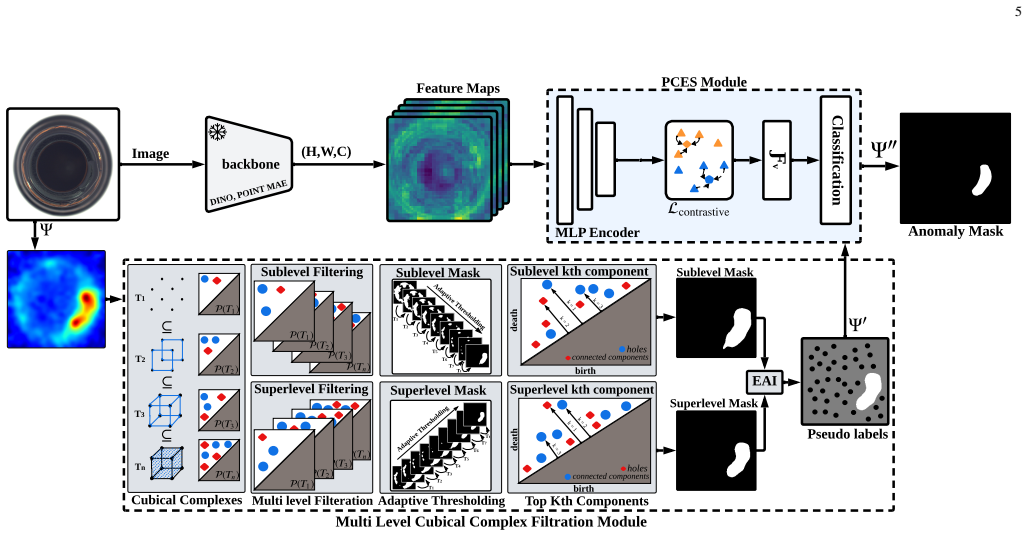
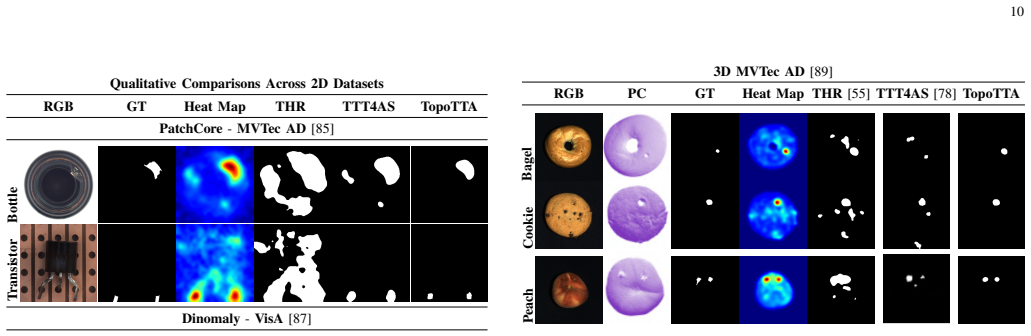
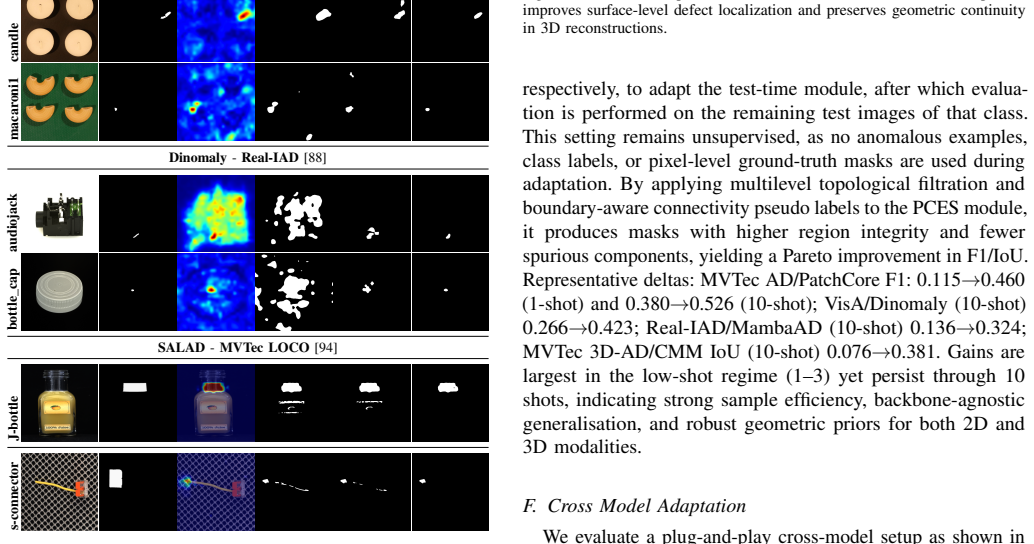
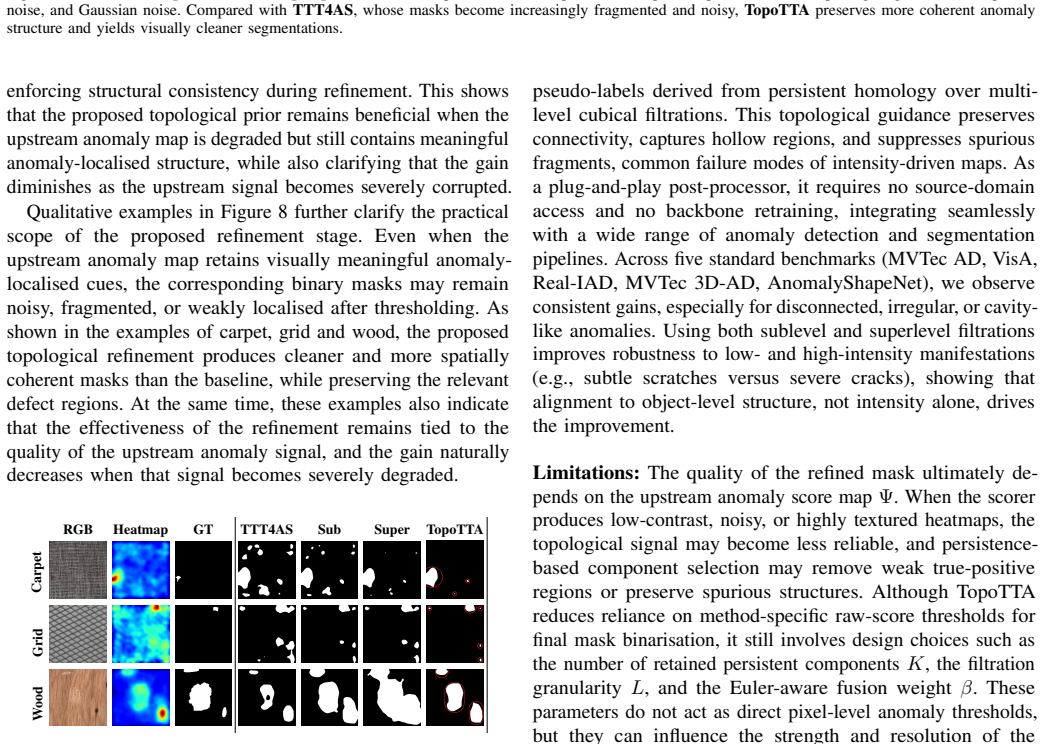
By applying multi-level cubical complex filtration to anomaly score maps, TopoTTA derives robust topological pseudo-labels that guide a lightweight test-time classifier, enhancing segmentation quality without retraining the backbone model. The approach avoids reliance on method-specific raw-score thresholding for mask binarisation, preserves connectivity, and generalises across both 2D and 3D modalities.
What carries the argument
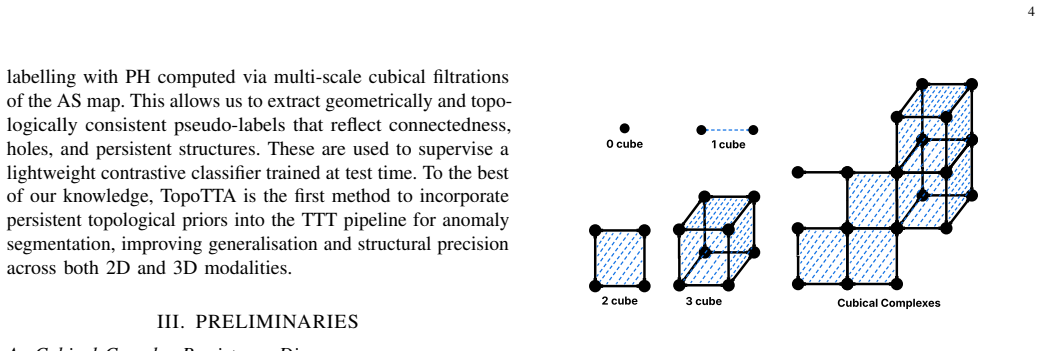
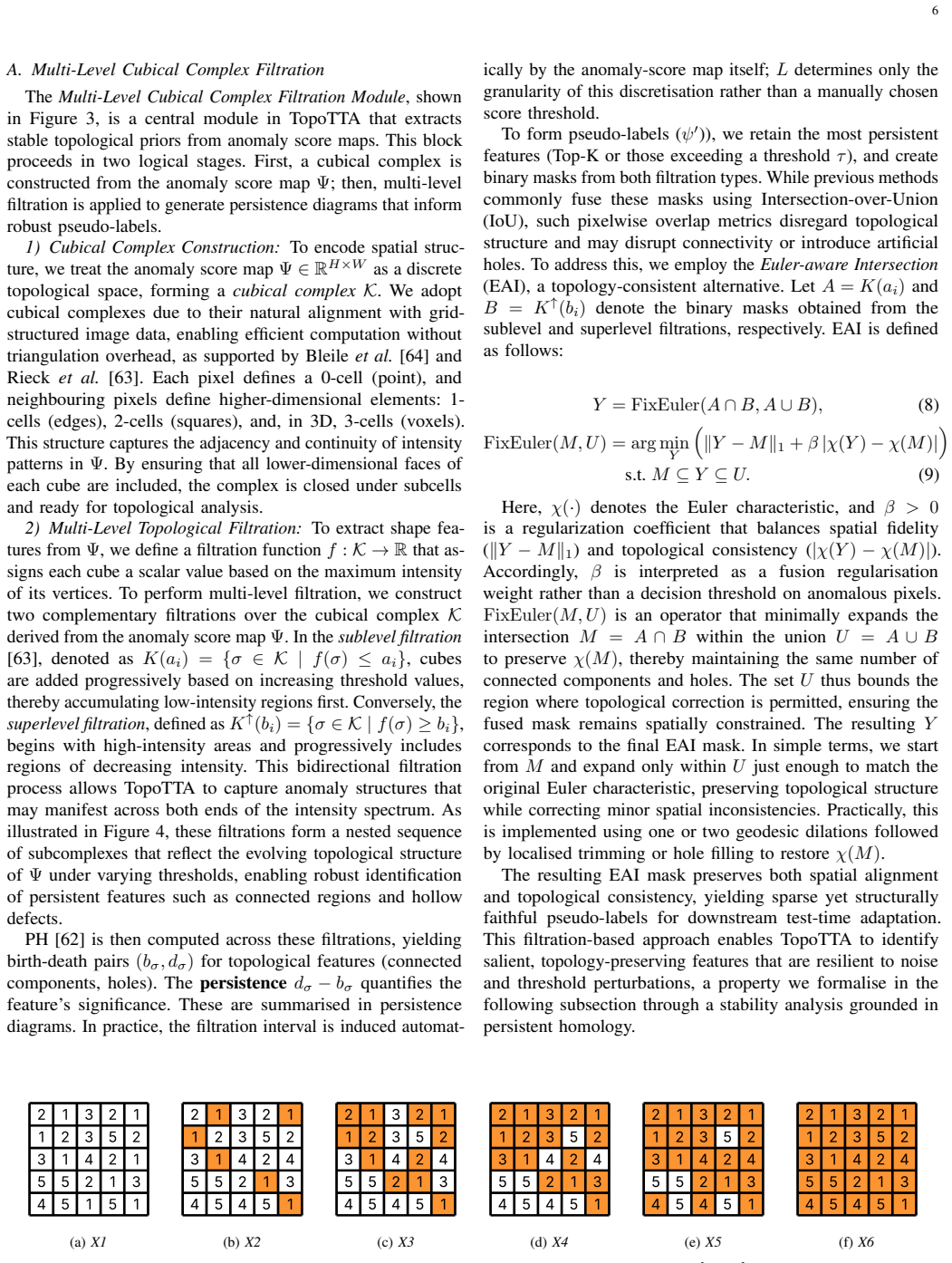
Multi-level cubical complex filtration drawn from persistent homology, applied directly to anomaly score maps to extract topological pseudo-labels that steer adaptation.
If this is right
- The method preserves connectivity and structural coherence that pixel heuristics lose under noise.
- It removes the need for dataset-specific raw-score thresholds when creating final masks.
- Performance gains appear on both 2D and 3D data without changing the backbone.
- Improvements are largest for anomalies that show complex geometric structure.
- Topological reasoning supplies a route to structure-aware generalisation during adaptation.
Where Pith is reading between the lines
- The same filtration step could be tested on other test-time tasks such as semantic segmentation under domain shift.
- Combining the pseudo-labels with persistence diagrams rather than raw labels might yield even richer guidance signals.
- In factory inspection pipelines the approach could lower the cost of collecting new labels when camera or lighting conditions drift.
- Adaptive choice of filtration levels based on the complexity of each anomaly map remains an open direction.
Load-bearing premise
That cubical complex filtration on anomaly score maps will produce pseudo-labels more robust to noise and texture variation than simple pixel-level rules.
What would settle it
An experiment that adds controlled texture noise to the score maps of one benchmark and measures whether the reported F1 advantage over pixel-heuristic TTA methods vanishes or reverses.
Figures

read the original abstract
Test-time adaptation (TTA) has emerged as a promising paradigm for mitigating distribution shifts in deep models. However, existing TTA approaches for anomaly segmentation remain limited by their reliance on pixel-level heuristics, such as confidence thresholding or entropy minimisation, which fail to preserve structural consistency under noise and texture variation. Moreover, they typically treat anomaly maps as flat intensity fields, ignoring the higher-order spatial relationships that characterise complex defect geometries. We introduce TopoTTA (Topological Test-Time Adaptation), a novel framework that integrates persistent homology, a tool from topological data analysis, into the TTA pipeline to enforce geometric and structural coherence during adaptation. By applying multi-level cubical complex filtration to anomaly score maps, TopoTTA derives robust topological pseudo-labels that guide a lightweight test-time classifier, enhancing segmentation quality without retraining the backbone model. The approach avoids reliance on method-specific raw-score thresholding for mask binarisation, preserves connectivity, and generalises across both 2D and 3D modalities. Extensive experiments across six standard benchmarks (MVTec AD, VisA, Real-IAD, MVTec 3D-AD, AnomalyShapeNet, and MVTec LOCO) demonstrate an average 15% F1 improvement over state-of-the-art unsupervised anomaly detection and segmentation methods, with the largest gains on anomalies exhibiting complex geometric or structural variations. These findings suggest that integrating topological reasoning into test-time adaptation provides a principled route to structure-aware generalisation, bridging the gap between geometric learning and robust adaptation.
Editorial analysis
A structured set of objections, weighed in public.
Referee Report
Summary. The paper introduces TopoTTA, a test-time adaptation method for anomaly segmentation that applies persistent homology through multi-level cubical complex filtration to anomaly score maps in order to derive topological pseudo-labels. These labels then supervise a lightweight test-time classifier, with the goal of improving structural consistency over pixel-level heuristics such as confidence or entropy thresholding. The central empirical claim is an average 15% F1-score gain across six benchmarks (MVTec AD, VisA, Real-IAD, MVTec 3D-AD, AnomalyShapeNet, MVTec LOCO) relative to prior unsupervised anomaly detection and segmentation methods, with larger gains on geometrically complex anomalies.
Significance. If the topological component can be shown to produce pseudo-labels that are demonstrably more robust than standard thresholding on identical score maps, the work would provide a concrete bridge between topological data analysis and test-time adaptation, offering a principled mechanism for preserving connectivity and higher-order geometry under distribution shift without backbone retraining.
major comments (2)
- [Experiments / Abstract] The abstract and experimental claims assert that multi-level cubical filtration yields pseudo-labels superior to pixel-level heuristics for guiding adaptation, yet no ablation replaces the filtration step with standard thresholding or entropy minimization applied to the identical anomaly score maps. Without this isolation, the reported 15% F1 improvement cannot be attributed specifically to the topological reasoning rather than the lightweight classifier or other TTA elements.
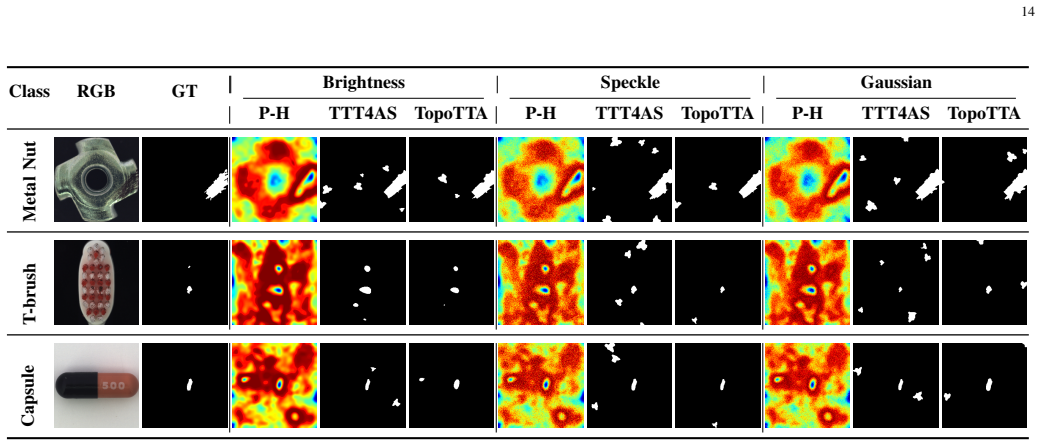
- [Method / Experiments] The motivation states that the approach is robust to noise and texture variation, but the manuscript supplies no controlled experiments that inject synthetic noise or texture perturbations into the score maps and measure stability of the derived topological pseudo-labels versus baseline heuristics. This test is load-bearing for the central claim that cubical filtration preserves structural consistency where pixel-level methods fail.
Simulated Author's Rebuttal
We thank the referee for the constructive feedback on our manuscript. The comments highlight important aspects of experimental validation that we will address to strengthen the attribution of our results to the topological component. We respond to each major comment below.
read point-by-point responses
-
Referee: [Experiments / Abstract] The abstract and experimental claims assert that multi-level cubical filtration yields pseudo-labels superior to pixel-level heuristics for guiding adaptation, yet no ablation replaces the filtration step with standard thresholding or entropy minimization applied to the identical anomaly score maps. Without this isolation, the reported 15% F1 improvement cannot be attributed specifically to the topological reasoning rather than the lightweight classifier or other TTA elements.
Authors: We agree that the current manuscript lacks an explicit ablation that applies standard thresholding or entropy minimization directly to the identical anomaly score maps (i.e., holding the backbone and score maps fixed) before feeding them to the lightweight classifier. Such an isolation experiment would more cleanly attribute gains to the cubical filtration step. We will add this ablation study in the revised manuscript, reporting F1 scores for both the topological pseudo-labels and the baseline heuristics on the same six benchmarks. revision: yes
-
Referee: [Method / Experiments] The motivation states that the approach is robust to noise and texture variation, but the manuscript supplies no controlled experiments that inject synthetic noise or texture perturbations into the score maps and measure stability of the derived topological pseudo-labels versus baseline heuristics. This test is load-bearing for the central claim that cubical filtration preserves structural consistency where pixel-level methods fail.
Authors: The referee correctly notes the absence of controlled synthetic perturbation experiments on the anomaly score maps. While the six benchmarks contain natural texture and geometric variations, they do not constitute the requested synthetic injection protocol. We will incorporate these experiments in the revision by adding controlled noise (e.g., Gaussian, salt-and-pepper) and texture perturbations to the score maps and quantifying stability metrics (e.g., topological feature persistence, F1 variance) for both our method and the pixel-level baselines. revision: yes
Circularity Check
No circularity: procedural method description with no self-referential reductions
full rationale
The paper presents TopoTTA as a framework that applies multi-level cubical complex filtration to anomaly score maps to obtain topological pseudo-labels for guiding a test-time classifier. This is a definitional description of the proposed pipeline rather than a derivation chain in which any claimed prediction or result reduces by construction to fitted inputs or self-citations. No equations appear in the abstract, and the central claims concern empirical F1 gains on benchmarks rather than mathematical predictions that loop back to the method's own parameters. The reader's assessment of score 1.0 aligns with the absence of any load-bearing step matching the enumerated circularity patterns.
Axiom & Free-Parameter Ledger
axioms (1)
- domain assumption Persistent homology computed on multi-level cubical filtrations of anomaly score maps yields robust topological pseudo-labels that preserve connectivity and generalize across modalities.
invented entities (1)
-
TopoTTA framework
no independent evidence
Reference graph
Works this paper leans on
-
[1]
Test-time training with self-supervision for generalization under distribution shifts,
Y . Sun, X. Wang, Z. Liu, J. Miller, A. Efros, and M. Hardt, “Test-time training with self-supervision for generalization under distribution shifts,” inInternational conference on machine learning. PMLR, 2020, pp. 9229–9248
2020
-
[2]
Domain generalization for cross-domain fault diagnosis: An application-oriented perspective and a benchmark study,
C. Zhao, E. Zio, and W. Shen, “Domain generalization for cross-domain fault diagnosis: An application-oriented perspective and a benchmark study,”Reliability Engineering & System Safety, p. 109964, 2024
2024
-
[3]
Deep learning for unsupervised anomaly localization in industrial images: A survey,
X. Tao, X. Gong, X. Zhang, S. Yan, and C. Adak, “Deep learning for unsupervised anomaly localization in industrial images: A survey,” IEEE Transactions on Instrumentation and Measurement, vol. 71, pp. 1–21, 2022
2022
-
[4]
A survey on visual anomaly detection: Challenge, approach, and prospect,
Y . Cao, X. Xu, J. Zhang, Y . Cheng, X. Huang, G. Pang, and W. Shen, “A survey on visual anomaly detection: Challenge, approach, and prospect,” arXiv preprint arXiv:2401.16402, 2024
arXiv 2024
-
[5]
Enhanced multi-scale features mutual mapping fusion based on reverse knowledge distillation for industrial anomaly detection and localization,
G. Tong, Q. Li, and Y . Song, “Enhanced multi-scale features mutual mapping fusion based on reverse knowledge distillation for industrial anomaly detection and localization,”IEEE Transactions on Big Data, vol. 10, no. 4, pp. 498–513, 2024
2024
-
[6]
Aekd: Unsupervised auto-encoder knowledge distillation for industrial anomaly detection,
Q. Wu, H. Li, C. Tian, L. Wen, and X. Li, “Aekd: Unsupervised auto-encoder knowledge distillation for industrial anomaly detection,” Journal of Manufacturing Systems, vol. 73, pp. 159–169, 2024
2024
-
[7]
Msflow: Multiscale flow-based framework for unsupervised anomaly detection,
Y . Zhou, X. Xu, J. Song, F. Shen, and H. T. Shen, “Msflow: Multiscale flow-based framework for unsupervised anomaly detection,”IEEE Transactions on Neural Networks and Learning Systems, 2024
2024
-
[8]
Supervised anomaly detection for complex industrial images,
A. Baitieva, D. Hurych, V . Besnier, and O. Bernard, “Supervised anomaly detection for complex industrial images,” inProceedings of the IEEE/CVF Conference on Computer Vision and Pattern Recognition, 2024, pp. 17 754–17 762
2024
-
[9]
Anomalydiffusion: Few-shot anomaly image generation with diffusion model,
T. Hu, J. Zhang, R. Yi, Y . Du, X. Chen, L. Liu, Y . Wang, and C. Wang, “Anomalydiffusion: Few-shot anomaly image generation with diffusion model,” inProceedings of the AAAI Conference on Artificial Intelligence, vol. 38, 2024, pp. 8526–8534
2024
-
[10]
Anomaly heterogeneity learning for open-set supervised anomaly detection,
J. Zhu, C. Ding, Y . Tian, and G. Pang, “Anomaly heterogeneity learning for open-set supervised anomaly detection,” inProceedings of the IEEE/CVF Conference on Computer Vision and Pattern Recognition, 2024, pp. 17 616–17 626
2024
-
[11]
Catching both gray and black swans: Open-set supervised anomaly detection,
C. Ding, G. Pang, and C. Shen, “Catching both gray and black swans: Open-set supervised anomaly detection,” inProceedings of the IEEE/CVF conference on computer vision and pattern recognition, 2022, pp. 7388–7398
2022
-
[12]
Texems: Texture exemplars for defect detection on random textured surfaces,
X. Xie and M. Mirmehdi, “Texems: Texture exemplars for defect detection on random textured surfaces,”IEEE transactions on pattern analysis and machine intelligence, vol. 29, no. 8, pp. 1454–1464, 2007
2007
-
[13]
A high-efficiency fully convolutional networks for pixel-wise surface defect detection,
L. Qiu, X. Wu, and Z. Yu, “A high-efficiency fully convolutional networks for pixel-wise surface defect detection,”IEEE Access, vol. 7, pp. 15 884–15 893, 2019
2019
-
[14]
A theory of learning from different domains,
S. Ben-David, J. Blitzer, K. Crammer, A. Kulesza, F. Pereira, and J. W. Vaughan, “A theory of learning from different domains,”Machine learning, vol. 79, pp. 151–175, 2010
2010
-
[15]
Self-supervised aggregation of diverse experts for test-agnostic long-tailed recognition,
Y . Zhang, B. Hooi, L. Hong, and J. Feng, “Self-supervised aggregation of diverse experts for test-agnostic long-tailed recognition,”Advances in Neural Information Processing Systems, vol. 35, pp. 34 077–34 090, 2022
2022
-
[16]
Deep face detector adaptation without negative transfer or catastrophic forgetting,
M. A. Jamal, H. Li, and B. Gong, “Deep face detector adaptation without negative transfer or catastrophic forgetting,” inProceedings of the IEEE Conference on Computer Vision and Pattern Recognition, 2018, pp. 5608–5618
2018
-
[17]
On the road to online adaptation for semantic image segmentation,
R. V olpi, P. De Jorge, D. Larlus, and G. Csurka, “On the road to online adaptation for semantic image segmentation,” inProceedings of the IEEE/CVF conference on computer vision and pattern recognition, 2022, pp. 19 184–19 195
2022
-
[18]
Transductive conformal inference with adaptive scores,
U. Gazin, G. Blanchard, and E. Roquain, “Transductive conformal inference with adaptive scores,” inInternational Conference on Artificial Intelligence and Statistics. PMLR, 2024, pp. 1504–1512
2024
-
[19]
Topological deep learning: a review of an emerging paradigm,
A. Zia, A. Khamis, J. Nichols, U. B. Tayab, Z. Hayder, V . Rolland, E. Stone, and L. Petersson, “Topological deep learning: a review of an emerging paradigm,”Artificial Intelligence Review, vol. 57, no. 4, p. 77, 2024
2024
-
[20]
Icml 2023 topological deep learning challenge: design and results,
M. Papillon, M. Hajij, A. Myers, F. Frantzen, G. Zamzmi, H. Jenne, J. Mathe, J. Hoppe, M. Schaub, T. Papamarkouet al., “Icml 2023 topological deep learning challenge: design and results,” inTopological, Algebraic and Geometric Learning Workshops 2023. PMLR, 2023, pp. 3–8
2023
-
[21]
Mambaad: Exploring state space models for multi- class unsupervised anomaly detection,
H. He, Y . Bai, J. Zhang, Q. He, H. Chen, Z. Gan, C. Wang, X. Li, G. Tian, and L. Xie, “Mambaad: Exploring state space models for multi- class unsupervised anomaly detection,”arXiv preprint arXiv:2404.06564, 2024
arXiv 2024
-
[22]
2d-3d feature fusion via cross-modal latent synthesis and attention-guided restoration for industrial anomaly detection,
U. Ali, A. Zia, A. Rehman, U. Ramzan, Z. Hassan, T. Sattar, J. Wang, and W. Xiang, “2d-3d feature fusion via cross-modal latent synthesis and attention-guided restoration for industrial anomaly detection,” in 2025 International Conference on Digital Image Computing: Techniques and Applications (DICTA), 2025, pp. 1–8
2025
-
[23]
Fastrecon: Few- shot industrial anomaly detection via fast feature reconstruction,
Z. Fang, X. Wang, H. Li, J. Liu, Q. Hu, and J. Xiao, “Fastrecon: Few- shot industrial anomaly detection via fast feature reconstruction,” in Proceedings of the IEEE/CVF International Conference on Computer Vision, 2023, pp. 17 481–17 490
2023
-
[25]
A reconstruction-based feature adaptation for anomaly detection with self-supervised multi-scale aggregation,
Z. Zuo, Z. Wu, B. Chen, and X. Zhong, “A reconstruction-based feature adaptation for anomaly detection with self-supervised multi-scale aggregation,” inICASSP 2024-2024 IEEE International Conference on Acoustics, Speech and Signal Processing (ICASSP). IEEE, 2024, pp. 5840–5844
2024
-
[26]
R3d-ad: Reconstruction via diffusion for 3d anomaly detection,
Z. Zhou, L. Wang, N. Fang, Z. Wang, L. Qiu, and S. Zhang, “R3d-ad: Reconstruction via diffusion for 3d anomaly detection,” inEuropean conference on computer vision. Springer, 2024, pp. 91–107
2024
-
[27]
J. Wang, G. Xu, C. Li, G. Gao, and Y . Cheng, “Multi-feature reconstruction network using crossed-mask restoration for unsupervised anomaly detection,”arXiv preprint arXiv:2404.13273, 2024
arXiv 2024
-
[28]
Superpixel masking and inpainting for self-supervised anomaly detection
Z. Li, N. Li, K. Jiang, Z. Ma, X. Wei, X. Hong, and Y . Gong, “Superpixel masking and inpainting for self-supervised anomaly detection.” inBmvc, 2020
2020
-
[29]
Fixing the train-test objective discrepancy: Iterative image inpainting for unsupervised anomaly detection,
H. Nakanishi, M. Suzuki, and Y . Matsuo, “Fixing the train-test objective discrepancy: Iterative image inpainting for unsupervised anomaly detection,”Journal of Information Processing, vol. 30, pp. 495–504, 2022
2022
-
[30]
Reconstruction by inpainting for visual anomaly detection,
V . Zavrtanik, M. Kristan, and D. Sko ˇcaj, “Reconstruction by inpainting for visual anomaly detection,”Pattern Recognition, vol. 112, p. 107706, 2021. 16
2021
-
[31]
Inpainting transformer for anomaly detection,
J. Pirnay and K. Chai, “Inpainting transformer for anomaly detection,” in International Conference on Image Analysis and Processing. Springer, 2022, pp. 394–406
2022
-
[32]
Ami-net: Adaptive mask inpainting network for industrial anomaly detection and localization,
W. Luo, H. Yao, W. Yu, and Z. Li, “Ami-net: Adaptive mask inpainting network for industrial anomaly detection and localization,”IEEE Transactions on Automation Science and Engineering, 2024
2024
-
[33]
Glad: Towards better reconstruction with global and local adaptive diffusion models for unsupervised anomaly detection,
H. Yao, M. Liu, Z. Yin, Z. Yan, X. Hong, and W. Zuo, “Glad: Towards better reconstruction with global and local adaptive diffusion models for unsupervised anomaly detection,” inEuropean Conference on Computer Vision. Springer, 2024, pp. 1–17
2024
-
[34]
Transfusion–a transparency- based diffusion model for anomaly detection,
M. Fu ˇcka, V . Zavrtanik, and D. Sko ˇcaj, “Transfusion–a transparency- based diffusion model for anomaly detection,” inEuropean conference on computer vision. Springer, 2024, pp. 91–108
2024
-
[35]
Cagen: Controllable anomaly generator using diffusion model,
B. Jiang, Y . Xie, J. Li, N. Li, Y . Jiang, and S.-T. Xia, “Cagen: Controllable anomaly generator using diffusion model,” inICASSP 2024-2024 IEEE International Conference on Acoustics, Speech and Signal Processing (ICASSP). IEEE, 2024, pp. 3110–3114
2024
-
[36]
Neural network training strategy to enhance anomaly detection performance: A perspective on reconstruction loss amplification,
Y . Park, S. Kang, M. J. Kim, H. Jeong, H. Park, H. S. Kim, and J. Yi, “Neural network training strategy to enhance anomaly detection performance: A perspective on reconstruction loss amplification,” in ICASSP 2024-2024 IEEE International Conference on Acoustics, Speech and Signal Processing (ICASSP). IEEE, 2024, pp. 5165–5169
2024
-
[38]
Padim: a patch distribution modeling framework for anomaly detection and localization,
T. Defard, A. Setkov, A. Loesch, and R. Audigier, “Padim: a patch distribution modeling framework for anomaly detection and localization,” inInternational Conference on Pattern Recognition. Springer, 2021, pp. 475–489
2021
-
[39]
Structural teacher-student normality learning for multi-class anomaly detection and localization,
H. Deng and X. Li, “Structural teacher-student normality learning for multi-class anomaly detection and localization,”arXiv preprint arXiv:2402.17091, 2024
arXiv 2024
-
[41]
Destseg: Segmentation guided denoising student-teacher for anomaly detection,
X. Zhang, S. Li, X. Li, P. Huang, J. Shan, and T. Chen, “Destseg: Segmentation guided denoising student-teacher for anomaly detection,” inProceedings of the IEEE/CVF Conference on Computer Vision and Pattern Recognition, 2023, pp. 3914–3923
2023
-
[42]
Masked feature regeneration based asymmetric student–teacher network for anomaly detection,
H. Gu, G. Li, and Z. Liu, “Masked feature regeneration based asymmetric student–teacher network for anomaly detection,”Multimedia Tools and Applications, vol. 83, no. 42, pp. 90 573–90 594, 2024
2024
-
[43]
Asymmetric student-teacher networks for industrial anomaly detection,
M. Rudolph, T. Wehrbein, B. Rosenhahn, and B. Wandt, “Asymmetric student-teacher networks for industrial anomaly detection,” inProceed- ings of the IEEE/CVF winter conference on applications of computer vision, 2023, pp. 2592–2602
2023
-
[44]
Hierarchical gaussian mixture normalizing flow modeling for unified anomaly detection,
X. Yao, R. Li, Z. Qian, L. Wang, and C. Zhang, “Hierarchical gaussian mixture normalizing flow modeling for unified anomaly detection,” in European Conference on Computer Vision. Springer, 2024, pp. 92–108
2024
-
[45]
Cflow-ad: Real-time unsupervised anomaly detection with localization via conditional normalizing flows,
D. Gudovskiy, S. Ishizaka, and K. Kozuka, “Cflow-ad: Real-time unsupervised anomaly detection with localization via conditional normalizing flows,” inProceedings of the IEEE/CVF winter conference on applications of computer vision, 2022, pp. 98–107
2022
-
[46]
Pyramidflow: High-resolution defect contrastive localization using pyramid normalizing flow,
J. Lei, X. Hu, Y . Wang, and D. Liu, “Pyramidflow: High-resolution defect contrastive localization using pyramid normalizing flow,” in Proceedings of the IEEE/CVF conference on computer vision and pattern recognition, 2023, pp. 14 143–14 152
2023
-
[47]
Sanflow: semantic-aware normalizing flow for anomaly detection and localization,
D. Kim, S. Baik, and T. H. Kim, “Sanflow: semantic-aware normalizing flow for anomaly detection and localization,” inProceedings of the 37th International Conference on Neural Information Processing Systems, 2023, pp. 75 434–75 454
2023
-
[48]
Zero-shot versus many- shot: Unsupervised texture anomaly detection,
T. Aota, L. T. T. Tong, and T. Okatani, “Zero-shot versus many- shot: Unsupervised texture anomaly detection,” inProceedings of the IEEE/CVF Winter Conference on Applications of Computer Vision, 2023, pp. 5564–5572
2023
-
[49]
Towards scalable 3d anomaly detection and localization: A benchmark via 3d anomaly synthesis and a self-supervised learning network,
W. Li, X. Xu, Y . Gu, B. Zheng, S. Gao, and Y . Wu, “Towards scalable 3d anomaly detection and localization: A benchmark via 3d anomaly synthesis and a self-supervised learning network,” inProceedings of the IEEE/CVF Conference on Computer Vision and Pattern Recognition, 2024, pp. 22 207–22 216
2024
-
[50]
Anomalyx- fusion: Multi-modal anomaly synthesis with diffusion,
J. Hu, Y . Huang, Y . Lu, G. Xie, G. Jiang, and Y . Zheng, “Anomalyx- fusion: Multi-modal anomaly synthesis with diffusion,”arXiv preprint arXiv:2404.19444, 2024
arXiv 2024
-
[51]
A unified anomaly synthesis strategy with gradient ascent for industrial anomaly detection and localization,
Q. Chen, H. Luo, C. Lv, and Z. Zhang, “A unified anomaly synthesis strategy with gradient ascent for industrial anomaly detection and localization,” inEuropean Conference on Computer Vision. Springer, 2024, pp. 37–54
2024
-
[52]
Dinomaly: The less is more philosophy in multi-class unsupervised anomaly detection,
J. Guo, S. Lu, W. Zhang, F. Chen, H. Li, and H. Liao, “Dinomaly: The less is more philosophy in multi-class unsupervised anomaly detection,” inProceedings of the Computer Vision and Pattern Recognition Conference, 2025, pp. 20 405–20 415
2025
-
[53]
Mambaad: Exploring state space models for multi- class unsupervised anomaly detection,
H. He, Y . Bai, J. Zhang, Q. He, H. Chen, Z. Gan, C. Wang, X. Li, G. Tian, and L. Xie, “Mambaad: Exploring state space models for multi- class unsupervised anomaly detection,”Advances in Neural Information Processing Systems, vol. 37, pp. 71 162–71 187, 2024
2024
-
[54]
Multimodal industrial anomaly detection via hybrid fusion,
Y . Wang, J. Peng, J. Zhang, R. Yi, Y . Wang, and C. Wang, “Multimodal industrial anomaly detection via hybrid fusion,” inProceedings of the IEEE/CVF Conference on Computer Vision and Pattern Recognition, 2023, pp. 8032–8041
2023
-
[55]
Multimodal industrial anomaly detection by crossmodal feature mapping,
A. Costanzino, P. Z. Ramirez, G. Lisanti, and L. Di Stefano, “Multimodal industrial anomaly detection by crossmodal feature mapping,” in Proceedings of the IEEE/CVF Conference on Computer Vision and Pattern Recognition, 2024, pp. 17 234–17 243
2024
-
[56]
Po3ad: Predicting point offsets toward better 3d point cloud anomaly detection,
J. Ye, W. Zhao, X. Yang, G. Cheng, and K. Huang, “Po3ad: Predicting point offsets toward better 3d point cloud anomaly detection,” in Proceedings of the Computer Vision and Pattern Recognition Conference, 2025, pp. 1353–1362
2025
-
[57]
Classification of hepatic lesions using the matching metric,
A. Adcock, D. Rubin, and G. Carlsson, “Classification of hepatic lesions using the matching metric,”Computer vision and image understanding, vol. 121, pp. 36–42, 2014
2014
-
[58]
Functional sum- maries of persistence diagrams,
E. Berry, Y .-C. Chen, J. Cisewski-Kehe, and B. T. Fasy, “Functional sum- maries of persistence diagrams,”Journal of Applied and Computational Topology, vol. 4, no. 2, pp. 211–262, 2020
2020
-
[59]
Predicting clinical outcomes in glioblastoma: an application of topolog- ical and functional data analysis,
L. Crawford, A. Monod, A. X. Chen, S. Mukherjee, and R. Rabadán, “Predicting clinical outcomes in glioblastoma: an application of topolog- ical and functional data analysis,”Journal of the American Statistical Association, vol. 115, no. 531, pp. 1139–1150, 2020
2020
-
[60]
Topological data analysis of high resolution diabetic retinopathy images,
K. Garside, R. Henderson, I. Makarenko, and C. Masoller, “Topological data analysis of high resolution diabetic retinopathy images,”PloS one, vol. 14, no. 5, p. e0217413, 2019
2019
-
[61]
A topological representation of branching neuronal morphologies,
L. Kanari, P. Dłotko, M. Scolamiero, R. Levi, J. Shillcock, K. Hess, and H. Markram, “A topological representation of branching neuronal morphologies,”Neuroinformatics, vol. 16, pp. 3–13, 2018
2018
-
[62]
Persistent homology-a survey,
H. Edelsbrunner, J. Hareret al., “Persistent homology-a survey,” Contemporary mathematics, vol. 453, no. 26, pp. 257–282, 2008
2008
-
[63]
Uncovering the topology of time-varying fmri data using cubical persistence,
B. Rieck, T. Yates, C. Bock, K. Borgwardt, G. Wolf, N. Turk-Browne, and S. Krishnaswamy, “Uncovering the topology of time-varying fmri data using cubical persistence,”Advances in neural information processing systems, vol. 33, pp. 6900–6912, 2020
2020
-
[64]
The persistent homology of dual digital image constructions,
B. Bleile, A. Garin, T. Heiss, K. Maggs, and V . Robins, “The persistent homology of dual digital image constructions,” inResearch in Computational Topology 2. Springer, 2022, pp. 1–26
2022
-
[65]
Stability of persistence diagrams,
D. Cohen-Steiner, H. Edelsbrunner, and J. Harer, “Stability of persistence diagrams,”Discrete & Computational Geometry, vol. 37, no. 1, pp. 103–120, 2007
2007
-
[66]
A comprehensive survey on test-time adaptation under distribution shifts,
J. Liang, R. He, and T. Tan, “A comprehensive survey on test-time adaptation under distribution shifts,”International Journal of Computer Vision, vol. 133, no. 1, pp. 31–64, 2025
2025
-
[68]
To adapt or not to adapt? real-time adaptation for semantic segmentation,
M. B. Colomer, P. L. Dovesi, T. Panagiotakopoulos, J. F. Carvalho, L. Härenstam-Nielsen, H. Azizpour, H. Kjellström, D. Cremers, and M. Poggi, “To adapt or not to adapt? real-time adaptation for semantic segmentation,” inProceedings of the IEEE/CVF International Confer- ence on Computer Vision, 2023, pp. 16 548–16 559
2023
-
[69]
Ev-tta: Test-time adaptation for event- based object recognition,
J. Kim, I. Hwang, and Y . M. Kim, “Ev-tta: Test-time adaptation for event- based object recognition,” inProceedings of the IEEE/CVF Conference on Computer Vision and Pattern Recognition, 2022, pp. 17 745–17 754
2022
-
[70]
Evaluating prediction-time batch normalization for robustness under covariate shift,
Z. Nado, S. Padhy, D. Sculley, A. D’Amour, B. Lakshminarayanan, and J. Snoek, “Evaluating prediction-time batch normalization for robustness under covariate shift,”arXiv preprint arXiv:2006.10963, 2020
arXiv 2006
-
[71]
Tipi: Test time adaptation with transformation invariance,
A. T. Nguyen, T. Nguyen-Tang, S.-N. Lim, and P. H. Torr, “Tipi: Test time adaptation with transformation invariance,” inProceedings of the IEEE/CVF Conference on Computer Vision and Pattern Recognition, 2023, pp. 24 162–24 171
2023
-
[72]
Sita: Single image test-time adaptation,
A. Khurana, S. Paul, P. Rai, S. Biswas, and G. Aggarwal, “Sita: Single image test-time adaptation,”arXiv preprint arXiv:2112.02355, 2021
arXiv 2021
-
[73]
Test-time training with self-supervision for generalization under distribution shifts,
Y . Sun, X. Wang, Z. Liu, J. Miller, A. Efros, and M. Hardt, “Test-time training with self-supervision for generalization under distribution shifts,” inInternational conference on machine learning. PMLR, 2020, pp. 9229–9248. 17
2020
-
[74]
Ttt++: When does self-supervised test-time training fail or thrive?
Y . Liu, P. Kothari, B. Van Delft, B. Bellot-Gurlet, T. Mordan, and A. Alahi, “Ttt++: When does self-supervised test-time training fail or thrive?”Advances in Neural Information Processing Systems, vol. 34, pp. 21 808–21 820, 2021
2021
-
[75]
Tent: Fully test-time adaptation by entropy minimization,
D. Wang, E. Shelhamer, S. Liu, B. Olshausen, and T. Darrell, “Tent: Fully test-time adaptation by entropy minimization,”arXiv preprint arXiv:2006.10726, 2020
Pith/arXiv arXiv 2006
-
[76]
Efficient test-time model adaptation without forgetting,
S. Niu, J. Wu, Y . Zhang, Y . Chen, S. Zheng, P. Zhao, and M. Tan, “Efficient test-time model adaptation without forgetting,” inInternational conference on machine learning. PMLR, 2022, pp. 16 888–16 905
2022
-
[77]
Continual test-time domain adaptation,
Q. Wang, O. Fink, L. Van Gool, and D. Dai, “Continual test-time domain adaptation,” inProceedings of the IEEE/CVF conference on computer vision and pattern recognition, 2022, pp. 7201–7211
2022
-
[78]
Test time training for industrial anomaly segmentation,
A. Costanzino, P. Z. Ramirez, M. Del Moro, A. Aiezzo, G. Lisanti, S. Salti, and L. Di Stefano, “Test time training for industrial anomaly segmentation,” inProceedings of the IEEE/CVF Conference on Com- puter Vision and Pattern Recognition, 2024, pp. 3910–3920
2024
-
[79]
X. Xu, Y . Wang, J. Wang, Q. Zhang, X. Lei, G. Xie, G. Jiang, and Z. Lu, “Stage: Segmentation-oriented industrial anomaly synthesis via graded diffusion with explicit mask alignment,”arXiv preprint arXiv:2509.06693, 2025
arXiv 2025
-
[80]
Diffusion-tta: Test-time adaptation of discriminative models via gener- ative feedback,
M. Prabhudesai, T.-W. Ke, A. Li, D. Pathak, and K. Fragkiadaki, “Diffusion-tta: Test-time adaptation of discriminative models via gener- ative feedback,”Advances in Neural Information Processing Systems, vol. 36, pp. 17 567–17 583, 2023
2023
-
[81]
Topo-r1: Detecting topological anomalies via vision- language models,
M. Xu, Q. Hu, X. Hu, S. Abousamra, X. Yu, W. Lyu, K. Qi, D. Samaras, and C. Chen, “Topo-r1: Detecting topological anomalies via vision- language models,”arXiv preprint arXiv:2603.13054, 2026
Pith/arXiv arXiv 2026
-
[82]
A survey of vectorization methods in topological data analysis,
D. Ali, A. Asaad, M.-J. Jimenez, V . Nanda, E. Paluzo-Hidalgo, and M. Soriano-Trigueros, “A survey of vectorization methods in topological data analysis,”IEEE Transactions on Pattern Analysis and Machine Intelligence, vol. 45, no. 12, pp. 14 069–14 080, 2023
2023
-
[83]
Momentum contrast for unsupervised visual representation learning,
K. He, H. Fan, Y . Wu, S. Xie, and R. Girshick, “Momentum contrast for unsupervised visual representation learning,” inProceedings of the IEEE/CVF Conference on Computer Vision and Pattern Recognition (CVPR), 2020, pp. 9729–9738
2020
-
[84]
A simple framework for contrastive learning of visual representations,
T. Chen, S. Kornblith, M. Norouzi, and G. Hinton, “A simple framework for contrastive learning of visual representations,” inInternational conference on machine learning. PmLR, 2020, pp. 1597–1607
2020
discussion (0)
Sign in with ORCID, Apple, or X to comment. Anyone can read and Pith papers without signing in.