JWST observations support the jittering-jets explosion mechanism (JJEM) for the core-collapse supernova remnant SNR 0540-69.3
Pith reviewed 2026-06-29 02:40 UTC · model grok-4.3
The pith
JWST images of SNR 0540-69.3 show point-symmetric inner ejecta shaped by multiple jet pairs launched after the neutron star received its kick.
A machine-rendered reading of the paper's core claim, the machinery that carries it, and where it could break.
Core claim
The inner ejecta of SNR 0540-69.3 display a point-symmetric morphology that was shaped by two and likely three or more pairs of jets launched by the neutron star after it acquired its kick velocity, consistent with the jittering-jets explosion mechanism.
What carries the argument
The point-symmetric morphology of the inner ejecta, identified by visual inspection and a quantitative symmetry-identification method and interpreted as the imprint of multiple jet-launching episodes.
If this is right
- The neutron star launched the jet pairs after it had already received its kick velocity.
- At least three distinct jet pairs are needed to account for the cavities, surrounding clumps, and the additional nozzle pair.
- The remnant morphology matches expectations from three-dimensional hydrodynamical simulations of the jittering-jets mechanism.
- The same jet-launching process can explain point-symmetric features seen in some planetary nebulae.
Where Pith is reading between the lines
- Similar quantitative symmetry searches applied to other young core-collapse remnants could test whether the jittering-jets mechanism operates across multiple events.
- Timing constraints between the neutron-star kick and subsequent jet episodes might be extracted from the offset between symmetry center and current pulsar position in additional remnants.
- If the mechanism is general, future observations of more remnants should reveal a statistical preference for point-symmetric inner ejecta aligned with the pulsar kick direction.
Load-bearing premise
The observed symmetries and cavities result from jet pairs launched by the neutron star rather than from alternative shaping processes or observational effects.
What would settle it
New high-resolution imaging or velocity mapping that demonstrates the claimed rotational symmetry between the northwestern and southeastern ejecta does not exist or arises from unrelated structures.
Figures

read the original abstract
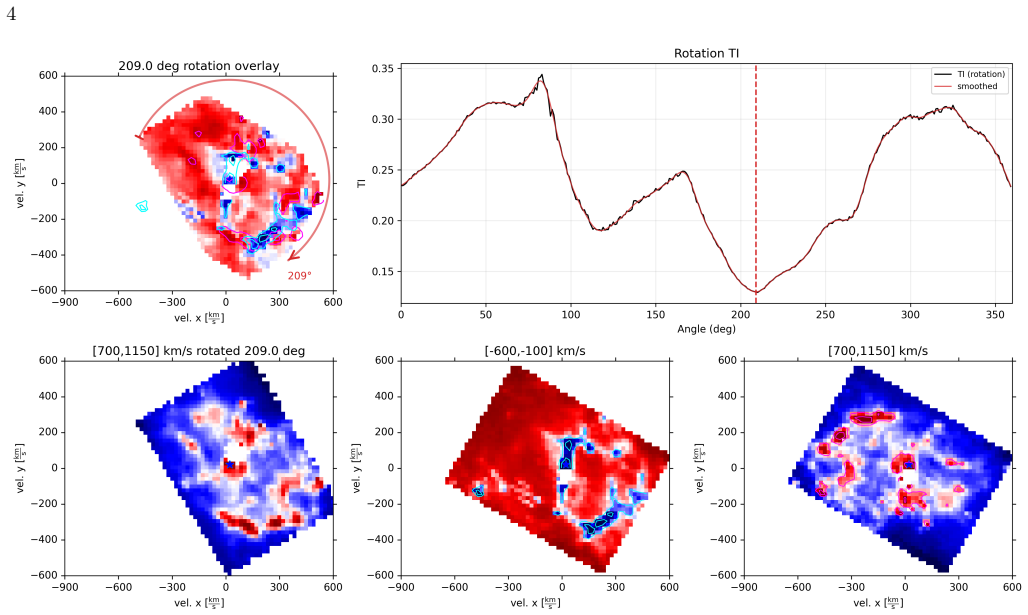
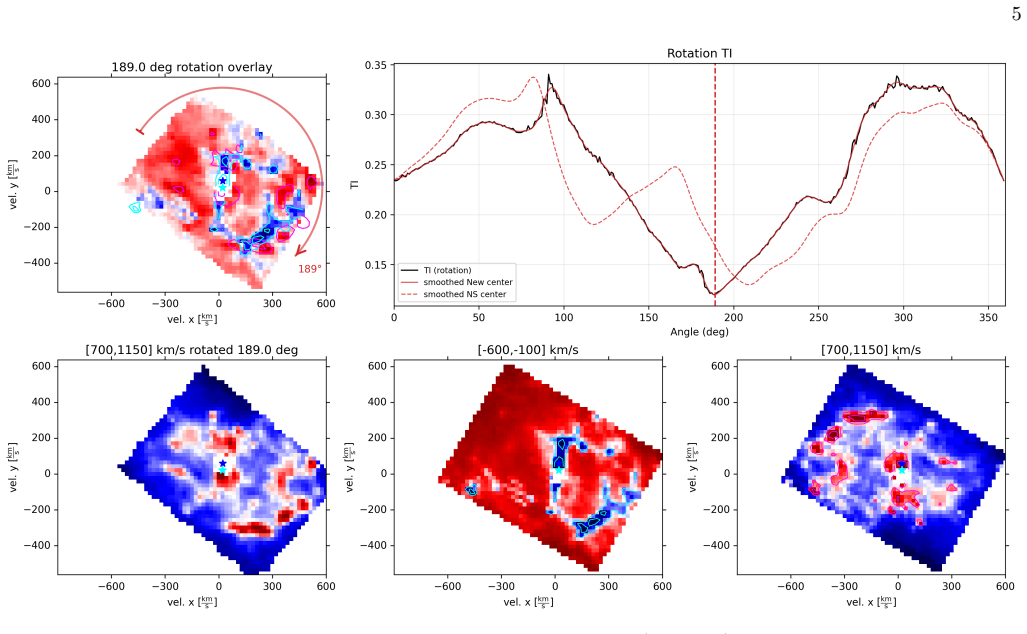
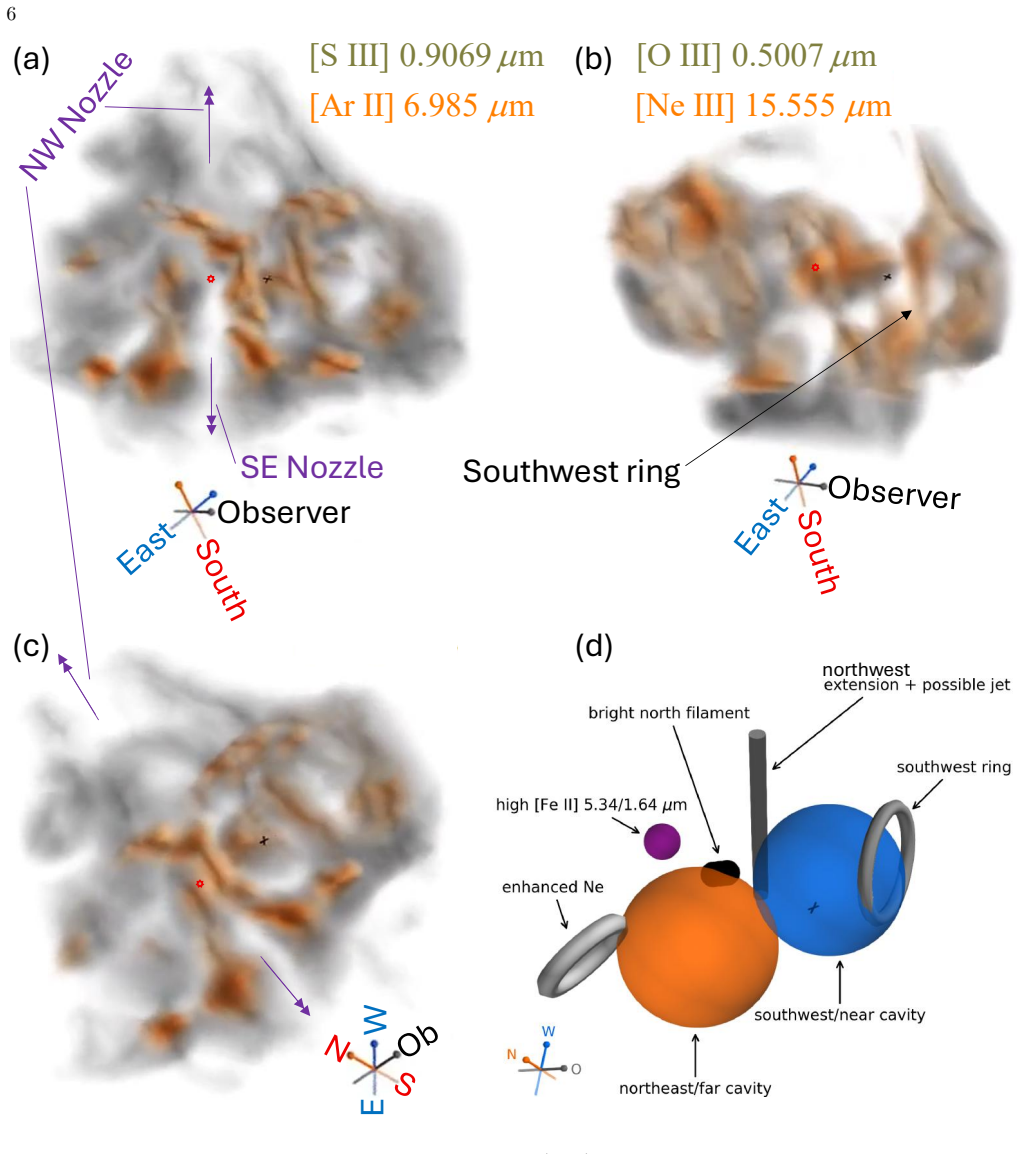
We examine published JWST observations of the core-collapse supernova (CCSN) remnant SNR 0540-69.3 and identify a point-symmetric morphology in its inner ejecta. Within the framework of the jittering jets explosion mechanism (JJEM), we interpret this morphology as evidence that the ejecta were shaped by two, and likely three or more, pairs of jets during the explosion process. Both visual inspection and a recently developed quantitative symmetry-identification method for astrophysical imaging reveal an approximate rotational symmetry between the northwestern redshifted ejecta and the southeastern blueshifted ejecta. Each side contains clumps (knots) surrounding a previously identified cavity, with the best quantitative correspondence obtained for a rotation of 189{\deg}. We further identify a symmetry center that is offset from the current pulsar position, strengthening an earlier claim for a pulsar kick. We interpret the pair of cavities and their surrounding clumpy structures as having been shaped by multiple jet-launching episodes. In addition, we identify a pair of opposing nozzles at a large angle to the cavities, which we attribute to another jet pair. Guided by the similarities to point-symmetric planetary nebulae shaped by jets and by recent three-dimensional hydrodynamical simulations of the JJEM, we conclude that the inner ejecta were shaped by at least three jet pairs launched by the neutron star after it acquired its kick velocity, consistent with the JJEM.
Editorial analysis
A structured set of objections, weighed in public.
Referee Report
Summary. The paper examines JWST observations of the core-collapse supernova remnant SNR 0540-69.3 and identifies a point-symmetric morphology in its inner ejecta. Within the jittering-jets explosion mechanism (JJEM) framework, it interprets this as evidence that the ejecta were shaped by two, and likely three or more, pairs of jets during the explosion. Both visual inspection and a quantitative symmetry-identification method reveal an approximate 189° rotational symmetry between the northwestern redshifted ejecta and the southeastern blueshifted ejecta, along with an offset symmetry center, cavities surrounded by clumps, and a pair of opposing nozzles. The authors conclude that the inner ejecta were shaped by at least three jet pairs launched by the neutron star after it acquired its kick velocity, consistent with the JJEM.
Significance. If the morphological interpretation is robust, the paper would provide observational support for the JJEM by linking specific point-symmetric features in a young CCSN remnant to multiple post-kick jet-launching episodes. The analysis benefits from high-resolution JWST imaging and the application of a quantitative symmetry method, which adds rigor beyond purely visual claims. The offset symmetry center also reinforces an earlier pulsar-kick argument. However, the overall significance remains interpretive and model-dependent.
major comments (2)
- [Symmetry identification and JJEM interpretation] The central claim (abstract and concluding paragraph) that the observed rotational symmetry (~189°), cavities, and nozzles uniquely support shaping by at least three JJEM jet pairs is load-bearing but rests on an interpretation that does not compare the morphology against predictions from alternative mechanisms (e.g., SASI or neutrino-driven convection). Without such differentiation or stated falsifiable predictions, the data are consistent with JJEM but do not exclude other shaping processes that could persist to the ~1000 yr remnant stage.
- [Quantitative symmetry-identification method] The quantitative symmetry method is presented as revealing the best correspondence at a 189° rotation, yet the manuscript supplies no statistical details, error analysis, robustness tests against noise or clump selection, or significance thresholds. This directly affects the reliability of identifying the jet-pair structures that underpin the JJEM conclusion.
minor comments (2)
- The abstract refers to a 'recently developed quantitative symmetry-identification method' without providing a citation or brief description of its algorithm or validation.
- The text states 'two, and likely three or more' jet pairs but concludes 'at least three'; a consistent count should be used throughout.
Simulated Author's Rebuttal
We thank the referee for the constructive comments, which help clarify the scope and robustness of our claims. We address each major point below and will incorporate revisions to strengthen the manuscript.
read point-by-point responses
-
Referee: [Symmetry identification and JJEM interpretation] The central claim (abstract and concluding paragraph) that the observed rotational symmetry (~189°), cavities, and nozzles uniquely support shaping by at least three JJEM jet pairs is load-bearing but rests on an interpretation that does not compare the morphology against predictions from alternative mechanisms (e.g., SASI or neutrino-driven convection). Without such differentiation or stated falsifiable predictions, the data are consistent with JJEM but do not exclude other shaping processes that could persist to the ~1000 yr remnant stage.
Authors: We agree that the manuscript presents the morphology as consistent with the JJEM without direct side-by-side comparisons to alternatives such as SASI or neutrino-driven convection. The central claim is framed as support for JJEM based on the point-symmetric features (multiple jet pairs, offset center) matching expectations from JJEM simulations and analogies to jet-shaped planetary nebulae, rather than a claim of uniqueness. To address the concern, we will revise the discussion to include a new subsection comparing the observed structures to predictions from other mechanisms, noting which features (e.g., the specific ~189° symmetry and post-kick jet activity) are more readily explained by JJEM. We will also articulate falsifiable predictions, such as the expectation of additional jet pairs detectable in deeper observations. This revision will clarify that the data are consistent with JJEM while acknowledging that other processes cannot be ruled out at present. revision: yes
-
Referee: [Quantitative symmetry-identification method] The quantitative symmetry method is presented as revealing the best correspondence at a 189° rotation, yet the manuscript supplies no statistical details, error analysis, robustness tests against noise or clump selection, or significance thresholds. This directly affects the reliability of identifying the jet-pair structures that underpin the JJEM conclusion.
Authors: We acknowledge that the manuscript does not include the requested statistical details on the quantitative symmetry-identification method. Although the method itself is described in a prior publication, the application here requires supporting analysis. We will add a dedicated subsection (or appendix) that provides: (i) the procedure for identifying the optimal 189° rotation, (ii) error estimates on the angle and symmetry center, (iii) robustness tests including variations in clump selection and simulated noise, and (iv) significance thresholds derived from comparisons to randomized rotations. These additions will allow independent assessment of the method's reliability and the identified jet-pair structures. revision: yes
Circularity Check
Morphology-to-JJEM mapping relies on author-associated model framework and self-cited simulations without exclusion of alternatives
specific steps
-
self citation load bearing
[Abstract]
"Within the framework of the jittering jets explosion mechanism (JJEM), we interpret this morphology as evidence that the ejecta were shaped by two, and likely three or more, pairs of jets during the explosion process."
The morphology is mapped to jet pairs only by adopting the JJEM interpretive framework (developed by co-author Soker); the 'evidence' for JJEM is therefore the assumption of JJEM itself rather than an independent derivation.
-
self citation load bearing
[Abstract]
"Guided by the similarities to point-symmetric planetary nebulae shaped by jets and by recent three-dimensional hydrodynamical simulations of the JJEM, we conclude that the inner ejecta were shaped by at least three jet pairs launched by the neutron star after it acquired its kick velocity, consistent with the JJEM."
The guiding simulations are of JJEM (prior work by the same group); the conclusion that the data are 'consistent with the JJEM' therefore traces back to self-cited model outputs rather than an external uniqueness proof.
full rationale
The paper's central claim reduces to interpreting observed point symmetry as multiple post-kick jet pairs 'within the framework of' JJEM and 'guided by' JJEM hydro simulations. This is load-bearing self-citation because JJEM is the model developed by co-author Soker; the interpretation step does not derive the jet-pair attribution from first principles or external benchmarks but adopts it by construction from the model. No independent falsification of alternatives is shown, so the 'support' for JJEM is not an independent test but a re-description inside the model. This qualifies as partial circularity (score 6) rather than full self-definition.
Axiom & Free-Parameter Ledger
axioms (1)
- domain assumption Point-symmetric morphology in ejecta is produced by multiple jet pairs in the JJEM
Reference graph
Works this paper leans on
-
[1]
Reproducing morphological features in the supernova remnant G11.2-0.3 by simulating jittering jets
Akashi, M., & Soker, N. 2026a, arXiv e-prints, arXiv:2603.29527. https://arxiv.org/abs/2603.29527 —. 2026b, arXiv e-prints, arXiv:2605.12356, doi: 10.48550/arXiv.2605.12356
work page internal anchor Pith review doi:10.48550/arxiv.2605.12356
-
[2]
2026, arXiv e-prints, arXiv:2605.04896
Akhmetali, A., Sultan Abylkairov, Y., Orel, D., et al. 2026, arXiv e-prints, arXiv:2605.04896. https://arxiv.org/abs/2605.04896
Pith/arXiv arXiv 2026
-
[3]
Boffin, H. M. J., Miszalski, B., Rauch, T., et al. 2012, Science, 338, 773, doi: 10.1126/science.1225386
-
[4]
2000, Dr
Bradski, G. 2000, Dr. Dobb’s Journal of Software Tools
2000
-
[5]
Brantseg, T., McEntaffer, R. L., Bozzetto, L. M., Filipovic, M., & Grieves, N. 2014, ApJ, 780, 50, doi: 10.1088/0004-637X/780/1/50
-
[6]
2025, PASP, 137, 054201, doi: 10.1088/1538-3873/add08e —
Braudo, J., Michaelis, A., Akashi, M., & Soker, N. 2025, PASP, 137, 054201, doi: 10.1088/1538-3873/add08e —. 2026, arXiv e-prints, arXiv:2606.14364. https://arxiv.org/abs/2606.14364
-
[7]
Chen, C.-H., Lentz, E. J., Hix, W. R., et al. 2026, arXiv e-prints, arXiv:2604.09906. https://arxiv.org/abs/2604.09906 8
Pith/arXiv arXiv 2026
-
[8]
2022, MNRAS, 516, 2711, doi: 10.1093/mnras/stac2375
Clairmont, R., Steffen, W., & Koning, N. 2022, MNRAS, 516, 2711, doi: 10.1093/mnras/stac2375
-
[9]
Derlopa, S., Akras, S., Amram, P., et al. 2024, MNRAS, 530, 3327, doi: 10.1093/mnras/stae1013 Eggenberger Andersen, O., O’Connor, E., Kovalenko, L.,
-
[10]
Andresen, H., & Couch, S. M. 2026, arXiv e-prints, arXiv:2605.01405. https://arxiv.org/abs/2605.01405 Garc´ ıa-Segura, G., Taam, R. E., & Ricker, P. M. 2020, ApJ, 893, 150, doi: 10.3847/1538-4357/ab8006 —. 2021, ApJ, 914, 111, doi: 10.3847/1538-4357/abfc4e
work page internal anchor Pith review Pith/arXiv arXiv doi:10.3847/1538-4357/ab8006 2026
-
[11]
2025, arXiv e-prints, arXiv:2511.11796
Giudici, B., Gabler, M., & Janka, H.-T. 2025, arXiv e-prints, arXiv:2511.11796. https://arxiv.org/abs/2511.11796
arXiv 2025
-
[12]
A., Cazzoli, S., Rechy-Garc´ ıa, J
Guerrero, M. A., Cazzoli, S., Rechy-Garc´ ıa, J. S., et al. 2021, ApJ, 909, 44, doi: 10.3847/1538-4357/abe2aa
-
[13]
Guerrero, M. A., & Manchado, A. 1998, ApJ, 508, 262, doi: 10.1086/306407
-
[14]
Harris, C. R., Millman, K. J., van der Walt, S. J., et al. 2020, Nature, 585, 357, doi: 10.1038/s41586-020-2649-2
-
[15]
Hunter, J. D. 2007, Computing in Science & Engineering, 9, 90, doi: 10.1109/MCSE.2007.55
-
[16]
Janka, H.-T. 2025, Annual Review of Nuclear and Particle Science, 75, 425, doi: 10.1146/annurev-nucl-121423-100945
-
[17]
Larsson, J., Sollerman, J., Lyman, J. D., et al. 2021, ApJ, 922, 265, doi: 10.3847/1538-4357/ac2a41
-
[18]
2026, ApJ, 1004, 3, doi: 10.3847/1538-4357/ae644d
Larsson, J., Tegkelidis, C., Fransson, C., et al. 2026, ApJ, 1004, 3, doi: 10.3847/1538-4357/ae644d
-
[19]
Lundqvist, P., Lundqvist, N., & Shibanov, Y. A. 2022, A&A, 658, A30, doi: 10.1051/0004-6361/202141931
-
[20]
2026, PhRvD, 113, 023024, doi: 10.1103/7ytg-wzl8
Luo, Y., Zha, S., & Kajino, T. 2026, PhRvD, 113, 023024, doi: 10.1103/7ytg-wzl8
-
[21]
Mathewson, D. S., Dopita, M. A., Tuohy, I. R., & Ford, V. L. 1980, ApJL, 242, L73, doi: 10.1086/183406
-
[22]
Self-healing high-dimensional quantum key distribution using hybrid spin-orbit Bessel states
McNamara, B. R., & Nulsen, P. E. J. 2007, ARA&A, 45, 117, doi: 10.1146/annurev.astro.45.051806.110625
work page internal anchor Pith review Pith/arXiv arXiv doi:10.1146/annurev.astro.45.051806.110625 2007
-
[23]
2026, arXiv e-prints, arXiv:2604.24970
Mezzacappa, A. 2026, arXiv e-prints, arXiv:2604.24970. https://arxiv.org/abs/2604.24970
Pith/arXiv arXiv 2026
-
[24]
F., V´ azquez, R., Olgu´ ın, L., Guill´ en, P
Miranda, L. F., V´ azquez, R., Olgu´ ın, L., Guill´ en, P. F., & Mat´ ıas, J. M. 2024, A&A, 687, A123, doi: 10.1051/0004-6361/202348173 Moraga Baez, P., Kastner, J. H., Balick, B., Montez, R., &
-
[25]
2023, ApJ, 942, 15, doi: 10.3847/1538-4357/aca401
Bublitz, J. 2023, ApJ, 942, 15, doi: 10.3847/1538-4357/aca401
-
[26]
1987, PASP, 99, 1115, doi: 10.1086/132089
Morris, M. 1987, PASP, 99, 1115, doi: 10.1086/132089
-
[27]
Morse, J. A., Smith, N., Blair, W. P., et al. 2006, ApJ, 644, 188, doi: 10.1086/503313
-
[28]
D., Brinkman, E., Richardson, C
Murphy, R. D., Brinkman, E., Richardson, C. J., et al. 2026, PhRvD, 113, 084005, doi: 10.1103/2bdz-783t
-
[29]
Neopane, S., Sandoval, M. A., Hix, W. R., et al. 2026, arXiv e-prints, arXiv:2606.19490. https://arxiv.org/abs/2606.19490
Pith/arXiv arXiv 2026
-
[30]
2016, Journal of Plasma Physics, 82, 635820601, doi: 10.1017/S0022377816000957
Mignone, A. 2016, Journal of Plasma Physics, 82, 635820601, doi: 10.1017/S0022377816000957
-
[31]
2026, arXiv e-prints, arXiv:2601.17499, doi: 10.48550/arXiv.2601.17499
Orlando, S. 2026, arXiv e-prints, arXiv:2601.17499, doi: 10.48550/arXiv.2601.17499
-
[32]
2026, arXiv e-prints, arXiv:2603.25846
Pan, K.-C., & Li, Y.-F. 2026, arXiv e-prints, arXiv:2603.25846. https://arxiv.org/abs/2603.25846
arXiv 2026
-
[33]
A., Vallejo, S., & Coughlin, E
Paradiso, D. A., Vallejo, S., & Coughlin, E. R. 2026, ApJ, 1004, 120, doi: 10.3847/1538-4357/ae6b85
-
[34]
Park, S., Hughes, J. P., Slane, P. O., Mori, K., & Burrows, D. N. 2010, ApJ, 710, 948, doi: 10.1088/0004-637X/710/2/948
-
[35]
2017, SSRv, 207, 137, doi: 10.1007/s11214-017-0344-x
Porth, O., Buehler, R., Olmi, B., et al. 2017, SSRv, 207, 137, doi: 10.1007/s11214-017-0344-x
-
[36]
Porth, O., Komissarov, S. S., & Keppens, R. 2014, MNRAS, 443, 547, doi: 10.1093/mnras/stu1082 Rechy-Garc´ ıa, J. S., Guerrero, M. A., Duarte Puertas, S., et al. 2020, MNRAS, 492, 1957, doi: 10.1093/mnras/stz3326 Rechy-Garc´ ıa, J. S., Pe˜ na, M., & Vel´ azquez, P. F. 2019, MNRAS, 482, 1163, doi: 10.1093/mnras/sty2758
-
[37]
2026, ApJ, 1003, 40, doi: 10.3847/1538-4357/ae61ac
Rusakov, A., Burrows, A., Wang, T., & Vartanyan, D. 2026, ApJ, 1003, 40, doi: 10.3847/1538-4357/ae61ac
-
[38]
Campbell, R. D., & Chaffee, F. H. 2005, ApJL, 622, L53, doi: 10.1086/429586
-
[39]
Sahai, R., Morris, M. R., & Villar, G. G. 2011, AJ, 141, 134, doi: 10.1088/0004-6256/141/4/134
-
[40]
Sahai, R., & Trauger, J. T. 1998, AJ, 116, 1357, doi: 10.1086/300504
-
[41]
2024, arXiv e-prints, arXiv:2409.06038
Sahai, R., Alcolea, J., Balick, B., et al. 2024, arXiv e-prints, arXiv:2409.06038. https://arxiv.org/abs/2409.06038
arXiv 2024
-
[42]
Quantifying Symmetry: Transformation Information for Planetary Nebulae and Supernova Remnants
Shishkin, D., & Michaelis, A. 2026, arXiv e-prints, arXiv:2601.07913, doi: 10.48550/arXiv.2601.07913
work page internal anchor Pith review Pith/arXiv arXiv doi:10.48550/arxiv.2601.07913 2026
-
[43]
1990, AJ, 99, 1869, doi: 10.1086/115465 —
Soker, N. 1990, AJ, 99, 1869, doi: 10.1086/115465 —. 2022, Research in Astronomy and Astrophysics, 22, 035019, doi: 10.1088/1674-4527/ac49e6 —. 2024a, Universe, 10, 458, doi: 10.3390/universe10120458 —. 2024b, The Open Journal of Astrophysics, 7, 49, doi: 10.33232/001c.120279 —. 2024c, The Open Journal of Astrophysics, 7, 12, doi: 10.21105/astro.2311.0328...
-
[44]
2025a, PASA, 42, e048, doi: 10.1017/pasa.2025.39 —
Soker, N., & Shishkin, D. 2025a, PASA, 42, e048, doi: 10.1017/pasa.2025.39 —. 2025b, Research in Astronomy and Astrophysics, 25, 035008, doi: 10.1088/1674-4527/adb4cc
-
[45]
Tafoya, D., Orosz, G., Vlemmings, W. H. T., Sahai, R., & P´ erez-S´ anchez, A. F. 2019, A&A, 629, A8, doi: 10.1051/0004-6361/201834632
-
[46]
2025, MNRAS, 542, 2830, doi: 10.1093/mnras/staf1390
Tenhu, L., Larsson, J., Lundqvist, P., et al. 2025, MNRAS, 542, 2830, doi: 10.1093/mnras/staf1390
-
[47]
Tsai, T.-W., & Yang, H.-Y. K. 2026, MNRAS, 548, stag727, doi: 10.1093/mnras/stag727
-
[48]
2026, MNRAS, 548, stag626, doi: 10.1093/mnras/stag626
Varma, V., & M¨ uller, B. 2026, MNRAS, 548, stag626, doi: 10.1093/mnras/stag626
-
[49]
Wang, N. Y. N., Shishkin, D., & Soker, N. 2025, arXiv e-prints, arXiv:2510.02203, doi: 10.48550/arXiv.2510.02203
-
[50]
2026, MNRAS, 548, stag325, doi: 10.1093/mnras/stag325
Wesson, R., Gabler, M., Lyons, M., et al. 2026, MNRAS, 548, stag325, doi: 10.1093/mnras/stag325
discussion (0)
Sign in with ORCID, Apple, or X to comment. Anyone can read and Pith papers without signing in.