Kinematic detection of dusty outflows from AGN: PAH kinematics of type 2 quasars with JWST/MIRI spectroscopy
Pith reviewed 2026-06-29 02:52 UTC · model grok-4.3
The pith
Velocity maps of the 11.3 micron PAH feature detect outflows in three type 2 quasars.
A machine-rendered reading of the paper's core claim, the machinery that carries it, and where it could break.
Core claim
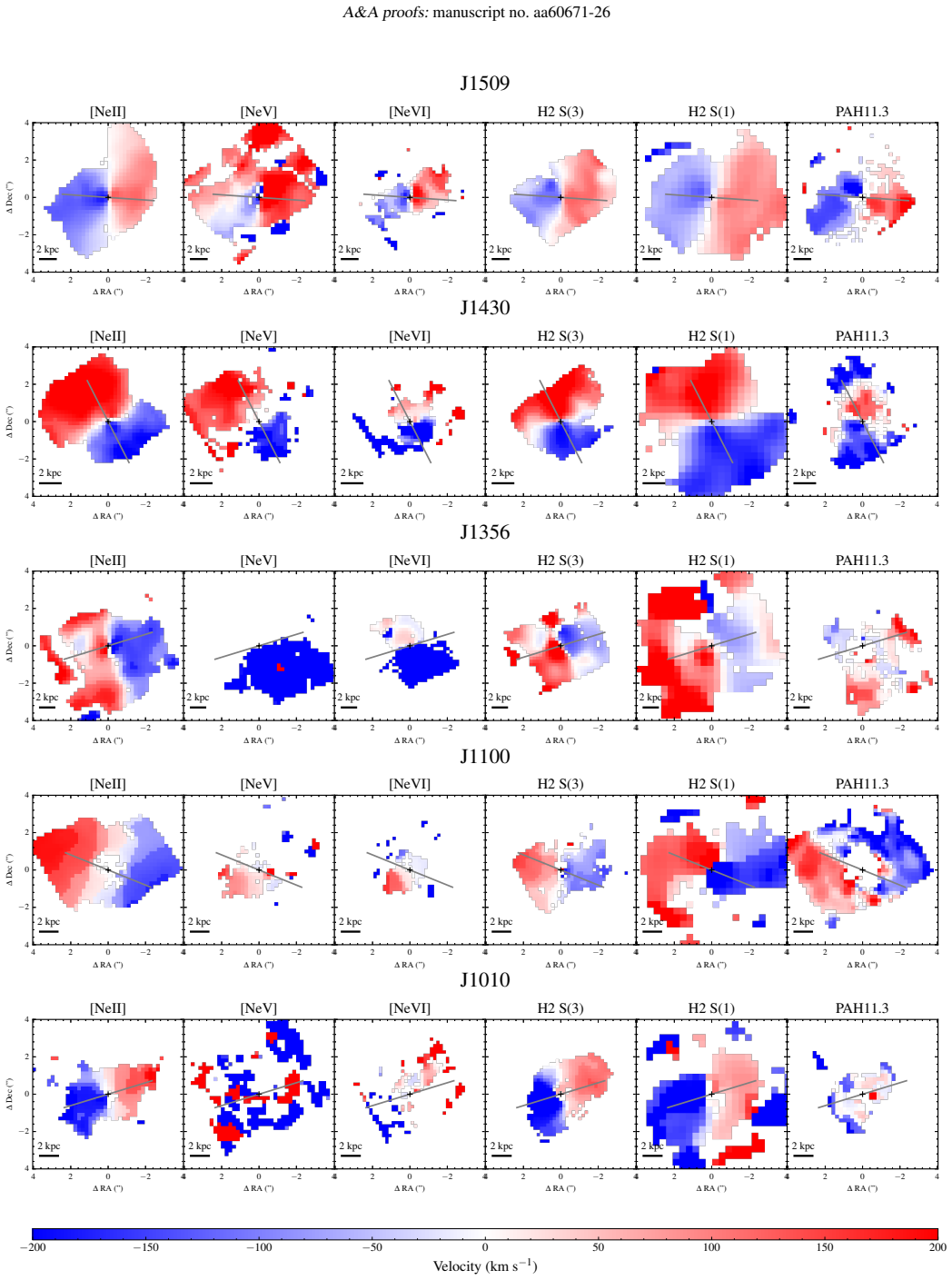
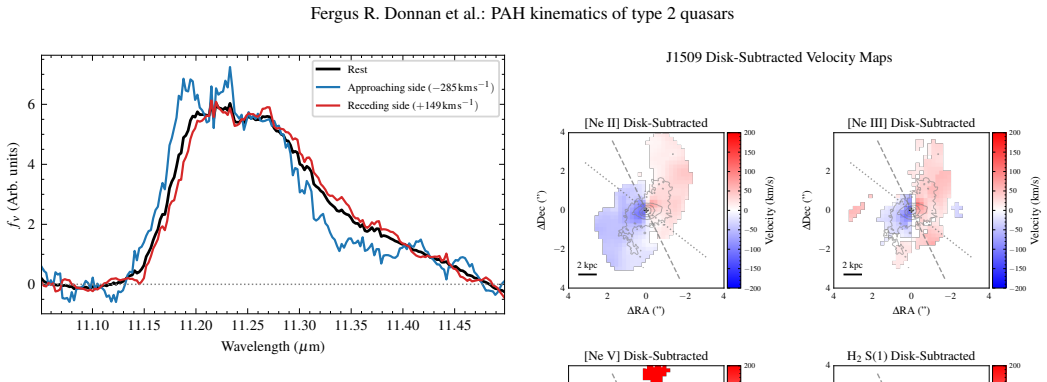
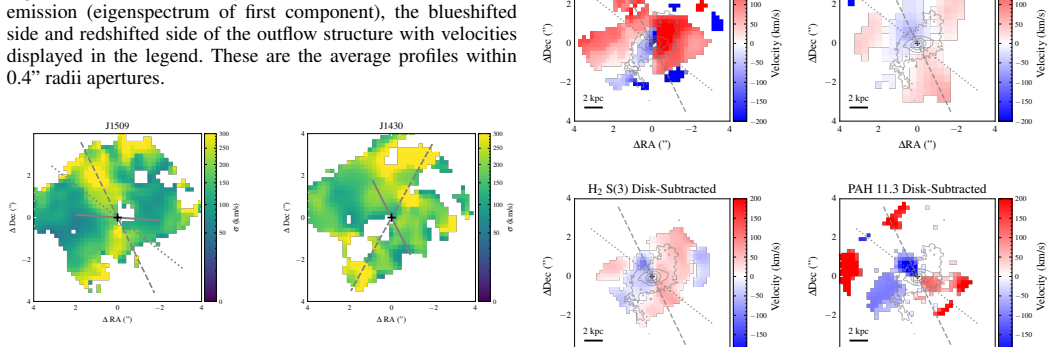
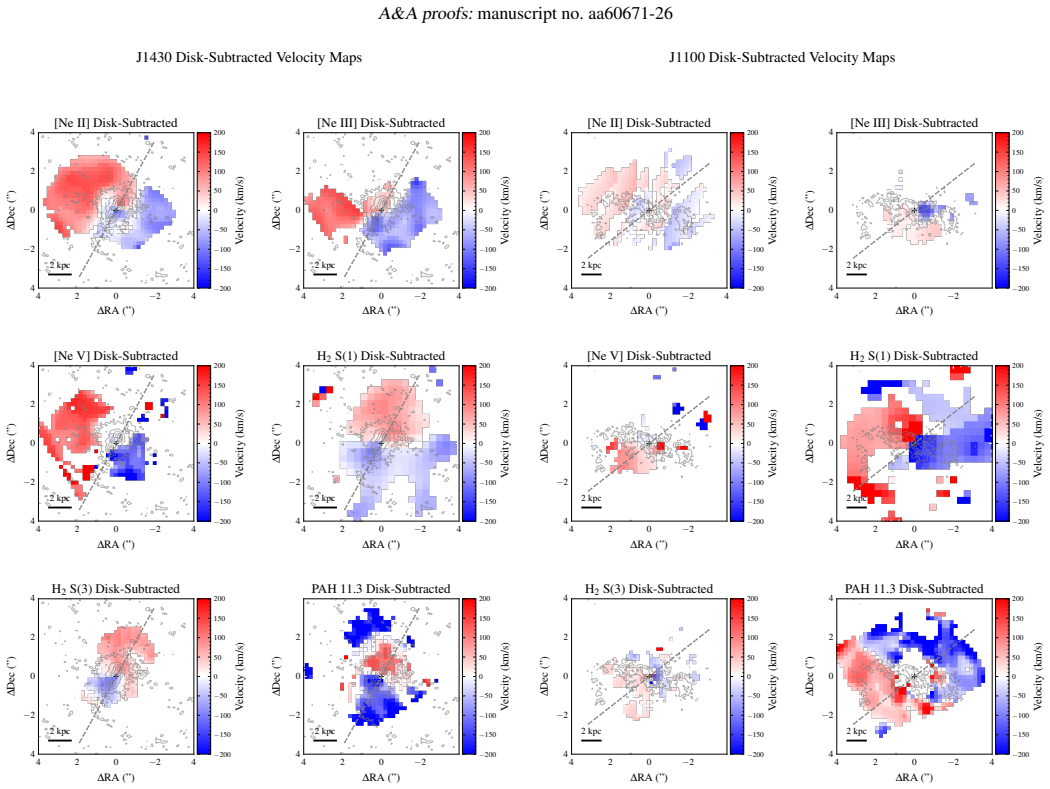
Using PCA tomography on JWST/MIRI spectra of five type 2 quasars, velocity maps of the 11.3 μm PAH feature reveal outflows in three objects. These outflows stand out after disk kinematics are subtracted, and the H2 lines display matching outflow residuals. The 6.2 μm PAH feature could not be mapped, consistent with prior indications of suppression in AGN environments.
What carries the argument
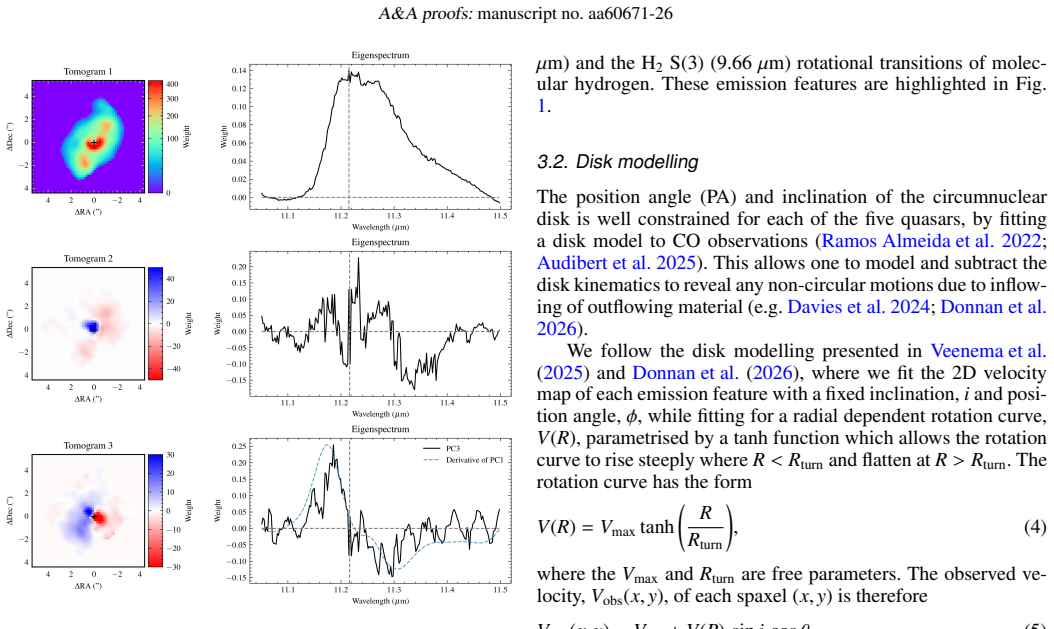
PCA tomography applied to MIRI spectroscopy to produce velocity maps of the 11.3 μm PAH feature tracing large neutral PAHs.
Load-bearing premise
The 11.3 μm PAH feature reliably traces bulk dust motion without major contamination from other emission components or excitation effects, and disk subtraction cleanly isolates the outflow component.
What would settle it
A larger sample of high-Eddington-ratio type 2 quasars showing no velocity residuals in PAH maps or mismatched H2 residuals after identical disk subtraction.
Figures


read the original abstract
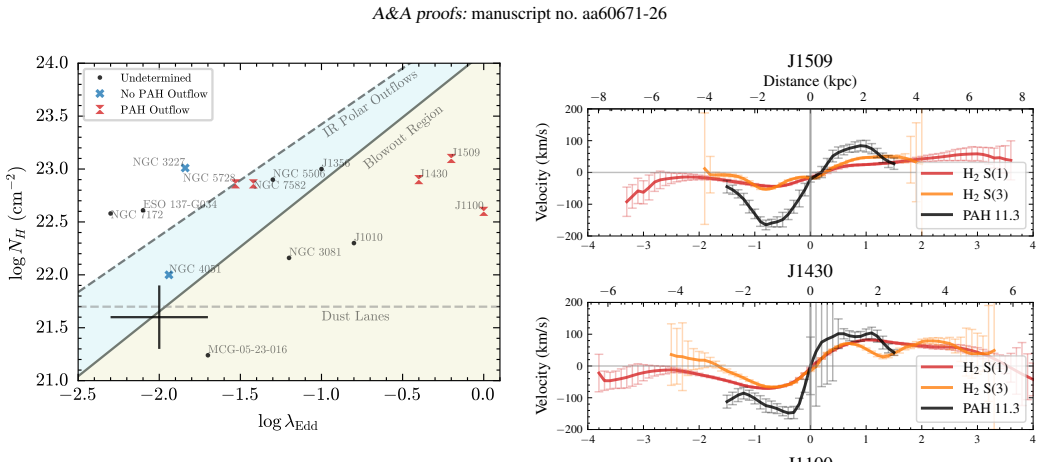
Active galactic nuclei (AGN) are thought to have dusty outflows; however, unlike the gas phase, measuring the kinematics of dust is challenging. We present the detection and analysis of the kinematics of dust in five type 2 quasars (QSO2s) at $z\sim0.1$ from the Quasar Feedback (QSOFEED) sample observed with JWST/MIRI spectroscopy. We use Principal Component Analysis (PCA) tomography to produce velocity maps of Polycyclic Aromatic Hydrocarbon (PAH) features, which are the smallest carbonaceous dust particles. We are then able to compare velocity maps of the PAHs with emission lines of ionised and molecular gas. We are able to produce velocity maps of the 11.3 $\mu$m PAH feature, which traces large and neutral PAHs, for three out of the five objects where all three show the presence of an outflow in the PAH kinematics. This becomes particularly clear after subtracting disk kinematics, where the H$_2$ rotational transitions also show residuals consistent with an outflow. Compared to previous work with Seyfert galaxies, this work suggests that dusty outflows are more common at higher Eddington ratios, $\lambda_{\rm Edd}\gtrsim0.1$, in agreement with previous suggestions, although the sample size is small. We are unable to produce velocity maps for the 6.2 $\mu$m PAH, which traces ionised PAHs, potentially due to differences in the intrinsic profile and/or suppression of the feature in AGN, which was seen previously in Seyfert galaxies. This reflects studies of PAH band ratios where AGN outflows have more neutral PAHs. This work demonstrates that dusty outflows may be common, particularly at high Eddington ratios, and therefore play a key role in the evolution and life cycle of AGN.
Editorial analysis
A structured set of objections, weighed in public.
Referee Report
Summary. The paper claims to detect kinematic signatures of dusty outflows via the 11.3 μm PAH feature in three of five type 2 quasars at z~0.1 observed with JWST/MIRI. Using PCA tomography, velocity maps are produced; after subtracting disk kinematics, residuals consistent with outflows are seen in both PAH and H2 lines. This leads to the suggestion that such outflows are more common at Eddington ratios ≳0.1, while the 6.2 μm feature could not be mapped due to suppression.
Significance. If the PAH isolation and disk subtraction are robust, the work provides novel direct kinematic constraints on dust in AGN outflows at quasar luminosities, extending prior Seyfert results and supporting dust's role in feedback. The PCA tomography approach for complex mid-IR spectra is a methodological asset.
major comments (3)
- [Abstract] Abstract and results section on velocity maps: detections are reported in 3/5 objects with no error bars, statistical significance tests, or quantitative thresholds for the velocity residuals after disk subtraction.
- [PCA tomography description] Methods on PCA tomography: no component-purity metrics, mock-spectrum tests, or blending/excitation-bias quantification are provided for the 11.3 μm feature, despite the noted inability to map the 6.2 μm feature and known AGN effects on PAH profiles.
- [Disk subtraction and residual analysis] Results on disk subtraction: the construction and fitting of the disk kinematic models are not described in sufficient detail to assess whether the reported H2 and PAH residuals uniquely indicate outflows.
minor comments (2)
- [Discussion] Discussion: the small sample size and post-hoc emphasis on the 11.3 μm feature (versus inability to use 6.2 μm) should be stated more explicitly as caveats for the Eddington-ratio trend.
- [Abstract] Abstract: specify the exact selection criteria or signal-to-noise thresholds applied to decide which objects yield usable 11.3 μm maps.
Simulated Author's Rebuttal
We thank the referee for their constructive and detailed comments, which have helped us identify areas where the manuscript can be strengthened. We provide point-by-point responses to the major comments below and will incorporate revisions to address the concerns raised.
read point-by-point responses
-
Referee: [Abstract] Abstract and results section on velocity maps: detections are reported in 3/5 objects with no error bars, statistical significance tests, or quantitative thresholds for the velocity residuals after disk subtraction.
Authors: We agree that quantitative support for the detections would improve the presentation. In the revised manuscript we will add error bars on the velocity maps (derived from the PCA component uncertainties), perform statistical significance tests on the residuals (e.g., Kolmogorov-Smirnov tests against the disk model dispersion), and introduce explicit quantitative thresholds (residual velocities exceeding 2 times the local disk dispersion) for classifying outflow signatures. These additions will appear in both the abstract and the results section. revision: yes
-
Referee: [PCA tomography description] Methods on PCA tomography: no component-purity metrics, mock-spectrum tests, or blending/excitation-bias quantification are provided for the 11.3 μm feature, despite the noted inability to map the 6.2 μm feature and known AGN effects on PAH profiles.
Authors: We will expand the methods section to include component-purity metrics (fraction of variance captured by the kinematic component) and results from mock-spectrum tests that inject known velocity fields into realistic MIRI spectra to quantify blending and excitation biases for the 11.3 μm feature. The discussion of the 6.2 μm feature already notes its suppression in AGN environments, consistent with prior PAH band-ratio studies; the new tests will further address potential biases. revision: yes
-
Referee: [Disk subtraction and residual analysis] Results on disk subtraction: the construction and fitting of the disk kinematic models are not described in sufficient detail to assess whether the reported H2 and PAH residuals uniquely indicate outflows.
Authors: We will revise the results section to provide a full description of the disk model: an arctangent rotation curve fitted via least-squares minimization to the inner velocity field, with the model parameters and goodness-of-fit metrics reported. Residual maps will be shown with the subtracted model overlaid, allowing readers to evaluate whether the residuals are unique to an outflow interpretation when present in both PAH and H2. revision: yes
Circularity Check
No circularity: observational kinematic mapping of PAH features is data-driven and independent of fitted inputs or self-citation chains
full rationale
The paper reports direct application of PCA tomography to JWST/MIRI spectra of five QSO2s to extract velocity maps of the 11.3 μm PAH feature, followed by disk subtraction and comparison to H2 lines. No equations, ansatzes, or predictions are present that reduce the outflow detection to a fitted parameter or prior result by construction. The sample originates from the QSOFEED program, but the kinematic residuals and outflow identification in 3/5 objects constitute an independent observational measurement. Any prior self-citations on Eddington-ratio trends are non-load-bearing commentary and do not define the reported detections. The analysis is therefore self-contained against external spectral data.
Axiom & Free-Parameter Ledger
Reference graph
Works this paper leans on
-
[1]
2014, MNRAS, 443, 2766
Alonso-Herrero, A., Ramos Almeida, C., Esquej, P., et al. 2014, MNRAS, 443, 2766
2014
-
[2]
C., Ferland, G
Arakawa, N., Fabian, A. C., Ferland, G. J., & Ishibashi, W. 2022, MNRAS, 517, 5069
2022
-
[3]
2007, ApJ, 656, 148
Armus, L., Charmandaris, V ., Bernard-Salas, J., et al. 2007, ApJ, 656, 148
2007
-
[4]
2019, MNRAS, 489, 2177
Asmus, D. 2019, MNRAS, 489, 2177
2019
-
[5]
F., & Gandhi, P
Asmus, D., Hönig, S. F., & Gandhi, P. 2016, ApJ, 822, 109
2016
-
[6]
F., Gandhi, P., Smette, A., & Duschl, W
Asmus, D., Hönig, S. F., Gandhi, P., Smette, A., & Duschl, W. J. 2014, MNRAS, 439, 1648
2014
-
[7]
2023, A&A, 671, L12
Audibert, A., Ramos Almeida, C., García-Burillo, S., et al. 2023, A&A, 671, L12
2023
-
[8]
2025, A&A, 699, A83
Audibert, A., Ramos Almeida, C., García-Burillo, S., et al. 2025, A&A, 699, A83
2025
-
[9]
Barro, G., Perez-Gonzalez, P. G., Kocevski, D., et al. 2025, arXiv e-prints, arXiv:2512.15853
arXiv 2025
-
[10]
S., Ramos Almeida, C., Holden, L
Bessiere, P. S., Ramos Almeida, C., Holden, L. R., Tadhunter, C. N., & Canalizo, G. 2024, A&A, 689, A271
2024
-
[11]
2026, arXiv e- prints, arXiv:2604.08239
Bianchin, M., Ramos Almeida, C., González-Martín, O., et al. 2026, arXiv e- prints, arXiv:2604.08239
Pith/arXiv arXiv 2026
-
[12]
J., Neugebauer, G., Matthews, K., et al
Bock, J. J., Neugebauer, G., Matthews, K., et al. 2000, AJ, 120, 2904
2000
-
[13]
G., Gandhi, P., Buchner, J., et al
Boorman, P. G., Gandhi, P., Buchner, J., et al. 2025, ApJ, 978, 118
2025
-
[14]
A., Wilson, A
Braatz, J. A., Wilson, A. S., Gezari, D. Y ., Varosi, F., & Beichman, C. A. 1993, ApJ, 409, L5
1993
-
[15]
2024, JWST Calibration Pipeline
Bushouse, H., Eisenhamer, J., Dencheva, N., et al. 2024, JWST Calibration Pipeline
2024
-
[16]
J., Haidar, H., et al
Campbell, S., Rosario, D. J., Haidar, H., et al. 2025, MNRAS, 544, 648
2025
-
[17]
& Sarre, P
Candian, A. & Sarre, P. J. 2015, MNRAS, 448, 2960
2015
-
[18]
M., Sales, D
Canelo, C. M., Sales, D. A., Avelaneda, V . N., et al. 2026, ApJ, 1000, 171
2026
-
[19]
M., Akins, H
Casey, C. M., Akins, H. B., Kokorev, V ., et al. 2024, ApJ, 975, L4
2024
-
[20]
Chen, K., Li, Z., Inayoshi, K., & Ho, L. C. 2025, ApJ, 994, L42
2025
-
[21]
2024, A&A, 689, A263
Davies, R., Shimizu, T., Pereira-Santaella, M., et al. 2024, A&A, 689, A263
2024
-
[22]
2025, A&A, 704, A313
Delvecchio, I., Daddi, E., Magnelli, B., et al. 2025, A&A, 704, A313
2025
-
[23]
Diamond-Stanic, A. M. & Rieke, G. H. 2010, ApJ, 724, 140
2010
-
[24]
S.-Y ., Finnerty, L., et al
Diaz-Santos, T., Lai, T. S.-Y ., Finnerty, L., et al. 2025, CAFE: Continuum And Feature Extraction tool, Astrophysics Source Code Library, record ascl:2501.001
2025
-
[25]
R., García-Bernete, I., Rigopoulou, D., et al
Donnan, F. R., García-Bernete, I., Rigopoulou, D., et al. 2026, arXiv e-prints, arXiv:2603.12200
Pith/arXiv arXiv 2026
-
[26]
P., Smith, J
Donnelly, G. P., Smith, J. D. T., Draine, B. T., et al. 2024, ApJ, 965, 75
2024
-
[27]
Draine, B. T. & Li, A. 2007, ApJ, 657, 810
2007
-
[28]
C., Celotti, A., & Erlund, M
Fabian, A. C., Celotti, A., & Erlund, M. C. 2006, MNRAS, 373, L16
2006
-
[29]
C., Vasudevan, R
Fabian, A. C., Vasudevan, R. V ., & Gandhi, P. 2008, MNRAS, 385, L43
2008
-
[30]
C., Kraemer, S
Fischer, T. C., Kraemer, S. B., Schmitt, H. R., et al. 2018, ApJ, 856, 102 Gámez Rosas, V ., Isbell, J. W., Jaffe, W., et al. 2022, Nature, 602, 403 García-Bernete, I., Ramos Almeida, C., Acosta-Pulido, J. A., et al. 2016, MN- RAS, 463, 3531 García-Bernete, I., Rigopoulou, D., Alonso-Herrero, A., et al. 2022a, A&A, 666, L5 García-Bernete, I., Rigopoulou, ...
2018
-
[31]
J., Alonso-Herrero, A., et al
Haidar, H., Rosario, D. J., Alonso-Herrero, A., et al. 2024, MNRAS, 532, 4645
2024
-
[32]
Haidar, H., Rosario, D. J., García-Bernete, I., et al. 2026, arXiv e-prints, arXiv:2601.02865
arXiv 2026
-
[33]
M., Alexander, D
Harrison, C. M., Alexander, D. M., Mullaney, J. R., & Swinbank, A. M. 2014, MNRAS, 441, 3306
2014
-
[34]
Harrison, C. M. & Ramos Almeida, C. 2024, Galaxies, 12, 17
2024
-
[35]
M., Thomson, A
Harrison, C. M., Thomson, A. P., Alexander, D. M., et al. 2015, ApJ, 800, 45
2015
-
[36]
Heckman, T. M. & Best, P. N. 2014, ARA&A, 52, 589 Hermosa Muñoz, L., Alonso-Herrero, A., Pereira-Santaella, M., et al. 2024, A&A, 690, A350
2014
-
[37]
Hickox, R. C. & Alexander, D. M. 2018, ARA&A, 56, 625 Hönig, S. F. & Kishimoto, M. 2017, ApJ, 838, L20 Hönig, S. F., Kishimoto, M., Antonucci, R., et al. 2012, ApJ, 755, 149 Hönig, S. F., Kishimoto, M., Tristram, K. R. W., et al. 2013, ApJ, 771, 87
2018
-
[38]
F., Hernquist, L., Cox, T
Hopkins, P. F., Hernquist, L., Cox, T. J., & Kereš, D. 2008, ApJS, 175, 356
2008
-
[39]
E., de Graaff, A., Miller, T
Hviding, R. E., de Graaff, A., Miller, T. B., et al. 2025, A&A, 702, A57
2025
-
[40]
W., Meisenheimer, K., Pott, J.-U., et al
Isbell, J. W., Meisenheimer, K., Pott, J.-U., et al. 2022, A&A, 663, A35
2022
-
[41]
& Fabian, A
Ishibashi, W. & Fabian, A. C. 2018, MNRAS, 481, 4522
2018
-
[42]
F., et al
Kakkad, D., Sani, E., Rojas, A. F., et al. 2022, MNRAS, 511, 2105
2022
-
[43]
& Woo, J.-H
Kang, D. & Woo, J.-H. 2018, ApJ, 864, 124
2018
-
[44]
2023, ApJ, 958, 145
Kim, C., Woo, J.-H., Luo, R., et al. 2023, ApJ, 958, 145
2023
-
[45]
D., Finkelstein, S
Kocevski, D. D., Finkelstein, S. L., Barro, G., et al. 2025, ApJ, 986, 126
2025
-
[46]
Kong, M. & Ho, L. C. 2018, ApJ, 859, 116
2018
-
[47]
Kormendy, J. & Ho, L. C. 2013, ARA&A, 51, 511
2013
-
[48]
Lai, T. S. Y ., Armus, L., Bianchin, M., et al. 2023, arXiv e-prints, arXiv:2307.15169
arXiv 2023
-
[49]
H., Tristram, K
Leftley, J. H., Tristram, K. R. W., Hönig, S. F., et al. 2018, ApJ, 862, 17
2018
-
[50]
2020, Nature Astronomy, 4, 339
Li, A. 2020, Nature Astronomy, 4, 339
2020
-
[51]
& Draine, B
Li, A. & Draine, B. T. 2001, ApJ, 554, 778 López-Gonzaga, N., Burtscher, L., Tristram, K. R. W., Meisenheimer, K., &
2001
-
[52]
2016, A&A, 591, A47 López-Gonzaga, N., Jaffe, W., Burtscher, L., Tristram, K
Schartmann, M. 2016, A&A, 591, A47 López-Gonzaga, N., Jaffe, W., Burtscher, L., Tristram, K. R. W., & Meisen- heimer, K. 2014, A&A, 565, A71
2016
-
[53]
A., Herter, T
Marshall, J. A., Herter, T. L., Armus, L., et al. 2007, ApJ, 670, 129
2007
-
[54]
P., Brammer, G., et al
Matthee, J., Naidu, R. P., Brammer, G., et al. 2024, ApJ, 963, 129
2024
-
[55]
2026, arXiv e-prints, arXiv:2603.17667
Matthee, J., Torralba, A., Pezzulli, G., et al. 2026, arXiv e-prints, arXiv:2603.17667
arXiv 2026
-
[56]
R., Jones, A
Micelotta, E. R., Jones, A. P., & Tielens, A. G. G. M. 2010, A&A, 510, A36
2010
-
[57]
2019, A&A, 622, A146 O’Dowd, M
Mingozzi, M., Cresci, G., Venturi, G., et al. 2019, A&A, 622, A146 O’Dowd, M. J., Schiminovich, D., Johnson, B. D., et al. 2009, ApJ, 705, 885
2019
-
[58]
T., Roche, P
Packham, C., Radomski, J. T., Roche, P. F., et al. 2005, ApJ, 618, L17
2005
-
[59]
2002, A&A, 390, 1089 Pérez-González, P
Peeters, E., Hony, S., Van Kerckhoven, C., et al. 2002, A&A, 390, 1089 Pérez-González, P. G., Barro, G., Carniani, S., et al. 2026, arXiv e-prints, arXiv:2602.20247
arXiv 2002
-
[60]
2019, arXiv e-prints, arXiv:1912.11554
Phan, D., Pradhan, N., & Jankowiak, M. 2019, arXiv e-prints, arXiv:1912.11554
Pith/arXiv arXiv 2019
-
[61]
Pierce, J. C. S., Tadhunter, C., Ramos Almeida, C., et al. 2023, MNRAS, 522, 1736
2023
-
[62]
A., Reeves, J
Pounds, K. A., Reeves, J. N., King, A. R., & Page, K. L. 2004, MNRAS, 350, 10
2004
-
[63]
Raban, D., Jaffe, W., Röttgering, H., Meisenheimer, K., & Tristram, K. R. W. 2009, MNRAS, 394, 1325
2009
-
[64]
T., Packham, C., Levenson, N
Radomski, J. T., Packham, C., Levenson, N. A., et al. 2008, ApJ, 681, 141
2008
-
[65]
T., Piña, R
Radomski, J. T., Piña, R. K., Packham, C., Telesco, C. M., & Tadhunter, C. N. 2002, ApJ, 566, 675 Ramos Almeida, C., Acosta-Pulido, J. A., Tadhunter, C. N., et al. 2019, MNRAS, 487, L18 Ramos Almeida, C., Alonso-Herrero, A., Levenson, N. A., et al. 2014, MNRAS, 439, 3847 Ramos Almeida, C., Asensio Ramos, A., Westerdorp Plaza, C., et al. 2026, A&A, 706, A1...
2002
-
[66]
A., & Siebenmorgen, R
Reunanen, J., Prieto, M. A., & Siebenmorgen, R. 2010, MNRAS, 402, 879
2010
-
[67]
T., Temple, M
Ricci, C., Ananna, T. T., Temple, M. J., et al. 2022, ApJ, 938, 67
2022
-
[68]
J., et al
Ricci, C., Trakhtenbrot, B., Koss, M. J., et al. 2017, Nature, 549, 488
2017
-
[69]
R., García-Bernete, I., et al
Rigopoulou, D., Donnan, F. R., García-Bernete, I., et al. 2024, MNRAS, 532, 1598
2024
-
[70]
P., et al
Rusakov, V ., Watson, D., Nikopoulos, G. P., et al. 2026, Nature, 649, 574
2026
-
[71]
B., Soifer, B
Sanders, D. B., Soifer, B. T., Elias, J. H., Neugebauer, G., & Matthews, K. 1988, ApJ, 328, L35
1988
-
[72]
Shannon, M. J. & Boersma, C. 2019, ApJ, 871, 124
2019
-
[73]
Siebenmorgen, R., Krügel, E., & Spoon, H. W. W. 2004, A&A, 414, 123
2004
-
[74]
Smith, J. D. T., Draine, B. T., Dale, D. A., et al. 2007, ApJ, 656, 770
2007
-
[75]
A., et al
Speranza, G., Ramos Almeida, C., Acosta-Pulido, J. A., et al. 2024, A&A, 681, A63
2024
-
[76]
Spoon, H. W. W., Marshall, J. A., Houck, J. R., et al. 2007, ApJ, 654, L49
2007
-
[77]
Stalevski, M., Asmus, D., & Tristram, K. R. W. 2017, MNRAS, 472, 3854
2017
-
[78]
E., Menezes, R
Steiner, J. E., Menezes, R. B., Ricci, T. V ., & Oliveira, A. S. 2009, MNRAS, 395, 64
2009
-
[79]
Tielens, A. G. G. M. 2008, ARA&A, 46, 289
2008
-
[80]
Tielens, A. G. G. M. 2010, The Physics and Chemistry of the Interstellar Medium
2010
discussion (0)
Sign in with ORCID, Apple, or X to comment. Anyone can read and Pith papers without signing in.