Drift Behavior in a Bounded-Confidence Opinion Model with Media Influence
Pith reviewed 2026-06-29 01:34 UTC · model grok-4.3
The pith
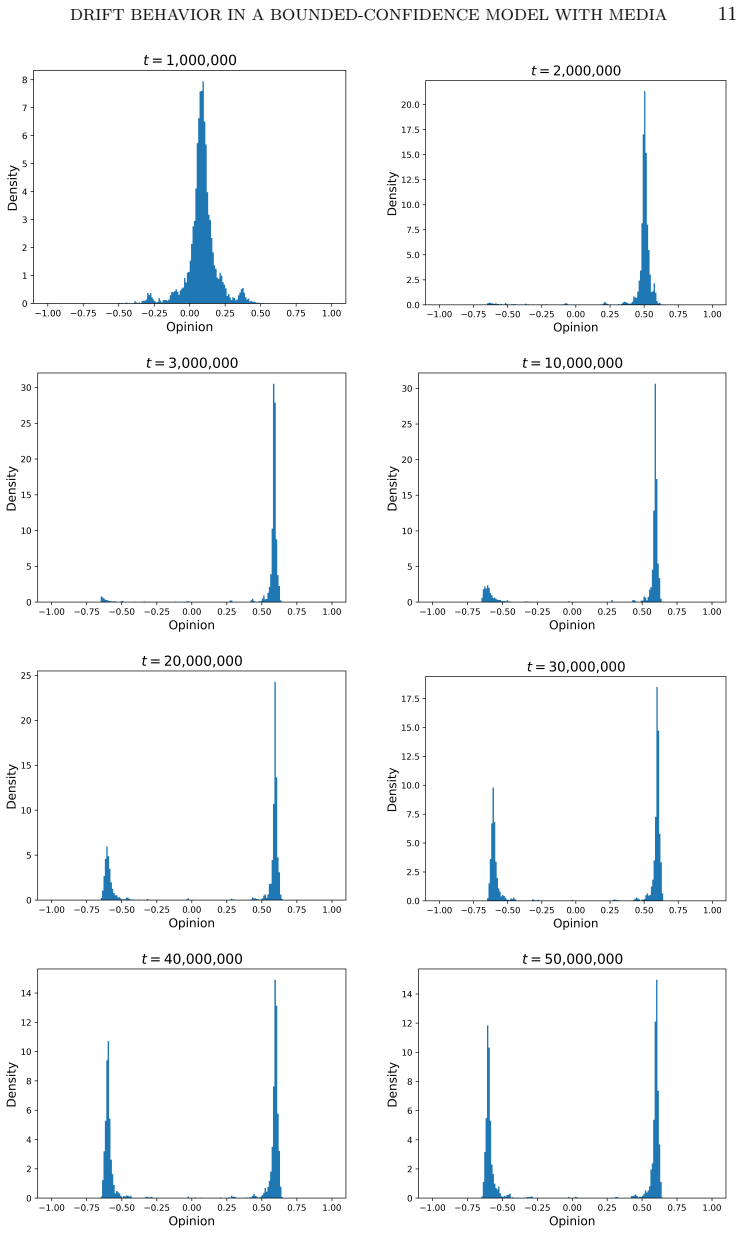
Competing media sources cause large opinion clusters to drift toward one agent in an extended Deffuant-Weisbuch model.
A machine-rendered reading of the paper's core claim, the machinery that carries it, and where it could break.
Core claim
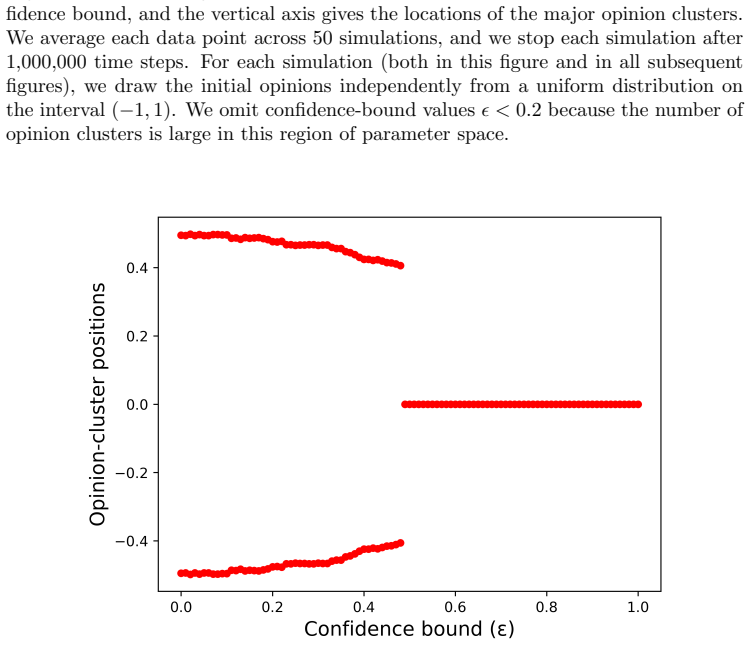
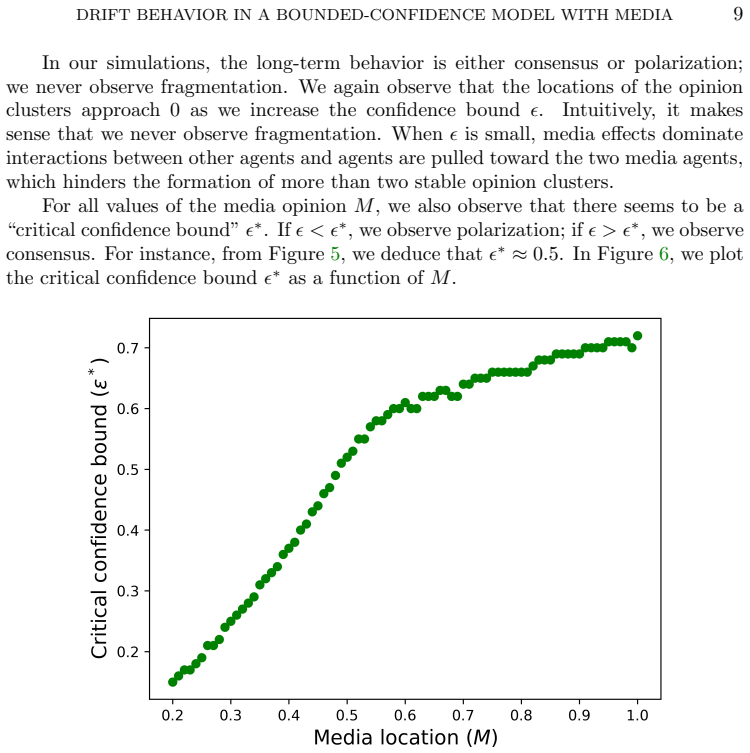
In our extended DW model with two media agents, one positive and one negative, we show both numerically and analytically that the system exhibits drifting behavior in which a large cluster of opinions shifts toward one of the media agents. We analyze the dependence of the drift trajectory and speed on the model parameters and identify conditions under which drift is promoted or suppressed. Our results provide insight into how competing media sources can influence collective opinion formation in social systems.
What carries the argument
The media-interaction term added to the Deffuant-Weisbuch update rule, in which each agent occasionally adopts a convex combination of its opinion and one of the two fixed media values when the opinion difference falls inside the confidence bound.
If this is right
- Drift trajectory and speed vary continuously with the confidence bound, media strength, and initial cluster position.
- Drift is promoted when media values lie outside the initial cluster but inside the effective interaction range.
- Drift is suppressed when the confidence bound is too small or media influence is too weak relative to internal agent interactions.
- The direction of drift is determined by which media source exerts the stronger cumulative pull under the chosen interaction rule.
Where Pith is reading between the lines
- If real populations follow similar bounded-confidence rules, sustained exposure to unbalanced media could produce measurable long-term shifts in survey averages even without changes in interpersonal networks.
- The same media term might be added to other bounded-confidence variants to test whether drift persists when the underlying agent update rule changes.
- Tracking the position of the largest opinion cluster in longitudinal polling data while controlling for media consumption could serve as an empirical test of the predicted dependence on media separation.
- Asymmetric media strengths would be expected to accelerate net drift in one direction, offering a possible route to one-sided polarization without requiring echo chambers.
Load-bearing premise
The specific functional form chosen for how agents interact with the two fixed media sources produces the reported drift; if the media influence rule were altered, the central drifting behavior might disappear.
What would settle it
Numerical integration of the extended model in which the media interaction term is replaced by a symmetric or null rule and the large opinion cluster remains stationary rather than drifting toward either media value.
Figures


read the original abstract
People's opinions can change both from their interactions with each other and from their interactions with media sources. Bounded-confidence models (BCMs) of opinion dynamics provide one framework to study such dynamics. In a BCM, the nodes of a network are agents with continuous-valued opinions, and these agents interact with each other via the edges of the network. In this paper, we extend the original Deffuant--Weisbuch (DW) BCM by incorporating influence from two media sources -- one with a positive value and one with a negative value -- to capture the effects of a polarized media landscape. We show both numerically and analytically that our extended DW model exhibits drifting behavior in which a large cluster of opinions shifts toward one of the media agents. We analyze how the drift trajectory and speed depend on the model parameters, and we identify conditions in which drift is promoted or suppressed. Our results provide insight into how competing media sources can influence collective opinion formation in social systems.
Editorial analysis
A structured set of objections, weighed in public.
Referee Report
Summary. The manuscript extends the Deffuant-Weisbuch bounded-confidence model by adding two fixed media agents with opposing (positive and negative) opinions. It claims to demonstrate, both numerically and analytically, that the extended model produces drifting behavior in which a large opinion cluster shifts toward one of the media agents. The work further examines the dependence of the drift trajectory and speed on model parameters and identifies conditions under which drift is promoted or suppressed.
Significance. If the numerical and analytical results hold, the paper supplies a concrete mechanism by which competing fixed media sources can drive collective opinion drift within a bounded-confidence framework. This is relevant to modeling the effects of polarized media on social opinion dynamics and provides parameter-dependent conditions that could be tested against empirical data.
minor comments (1)
- The abstract states that both numerical and analytical support are provided, but without access to the specific derivations, parameter regimes, or verification steps in the main text, the strength of the central claim cannot be fully assessed from the provided material.
Simulated Author's Rebuttal
We thank the referee for their careful reading and for recognizing the potential significance of our extension of the Deffuant-Weisbuch model with opposing media sources. We note that the recommendation is listed as 'uncertain' but that the report contains no specific major comments or requests for clarification. We are prepared to address any additional points the referee may wish to raise.
Circularity Check
No circularity in derivation chain
full rationale
The paper extends the standard Deffuant-Weisbuch bounded-confidence model by adding two fixed media agents with explicit interaction rules. It reports numerical simulations and analytical derivations of drifting behavior under those rules. No equations, parameter fits, or self-citations are presented that reduce the central claim (drift of a large opinion cluster toward one media source) to a tautology or to a fitted input renamed as a prediction. The media-interaction functional form is an explicit modeling choice whose consequences are then derived; altering the form would simply define a different model. The derivation chain is therefore self-contained against external benchmarks and receives the default non-circularity finding.
Axiom & Free-Parameter Ledger
Reference graph
Works this paper leans on
-
[1]
Amblard and G
F. Amblard and G. Deffuant , The role of network topology on extremism propagation with the relative agreement opinion dynamics , Physica A: Statistical Mechanics and its Applications, 343 (2004), pp. 725--738
2004
-
[2]
J. B. Bak-Coleman, M. Alfano, W. Barfuss, C. T. Bergstrom, M. A. Centeno, I. D. Couzin, J. F. Donges, M. Galesic, A. S. Gersick, J. Jacquet, A. B. Kao, R. E. Moran, P. Romanczuk, D. I. Rubenstein, K. J. Tombak, J. J. Van Bavel, and E. U. Weber , Stewardship of global collective behavior , Proceedings of the National Academy of Sciences of the United State...
2021
-
[3]
A. V. Banerjee , A simple model of herd behavior , The Quarterly Journal of Economics, 107 (1992), pp. 797--817
1992
-
[4]
Barber \'a , J
P. Barber \'a , J. T. Jost, J. Nagler, J. A. Tucker, and R. Bonneau , Tweeting from left to right: I s online political communication more than an echo chamber? , Psychological Science, 26 (2015), pp. 1531--1542
2015
-
[5]
Ben-Naim, P
E. Ben-Naim, P. L. Krapivsky, and S. Redner , Bifurcations and patterns in compromise processes , Physica D: Nonlinear Phenomena, 183 (2003), pp. 190--204
2003
-
[6]
Boulianne , Does internet use affect engagement? A meta-analysis of research , Political Communication, 26 (2009), pp
S. Boulianne , Does internet use affect engagement? A meta-analysis of research , Political Communication, 26 (2009), pp. 193--211
2009
-
[7]
H. Z. Brooks, P. S. Chodrow, and M. A. Porter , Emergence of polarization in a sigmoidal bounded-confidence model of opinion dynamics , SIAM Journal on Applied Dynamical Systems, 23 (2024), pp. 1442--1470
2024
-
[8]
H. Z. Brooks and M. A. Porter , A model for the influence of media on the ideology of content in online social networks , Physical Review Research, 2 (2020), 023041
2020
-
[9]
Caldarelli, O
G. Caldarelli, O. Artime, G. Fischetti, S. Guarino, A. Nowak, F. Saracco, P. Holme, and M. De Domenico , The physics of news, rumors, and opinions , Physics Reports, 1186 (2026), pp. 1--75
2026
-
[10]
Chandler and R
D. Chandler and R. Munday , A Dictionary of Media and Communication , Oxford University Press, Oxford, UK, 2011
2011
-
[11]
W. Chu, Q. Li, and M. A. Porter , Inference of interaction kernels in mean-field models of opinion dynamics , SIAM Journal on Applied Mathematics, 84 (2024), pp. 1096--1115
2024
-
[12]
Clifford and A
P. Clifford and A. Sudbury , A model for spatial conflict , Biometrika, 60 (1973), pp. 581--588
1973
-
[13]
Deffuant, D
G. Deffuant, D. Neau, F. Amblard, and G. Weisbuch , Mixing beliefs among interacting agents , Advances in Complex Systems, 3 (2000), pp. 87--98
2000
-
[14]
M. H. DeGroot , Reaching a consensus , Journal of the American Statistical Association, 69 (1974), pp. 118--121
1974
-
[15]
Dubovskaya, S
A. Dubovskaya, S. C. Fennell, K. Burke, J. P. Gleeson, and D. O'Kiely , Analysis of mean-field approximation for D effuant opinion dynamics on networks , SIAM Journal on Applied Mathematics, 83 (2023), pp. 436--459
2023
-
[16]
S. C. Fennell, K. Burke, M. Quayle, and J. P. Gleeson , Generalized mean-field approximation for the D effuant opinion dynamics model on networks , Physical Review E, 103 (2021), 012314
2021
-
[17]
N. E. Friedkin and E. C. Johnsen , Social influence and opinions , Journal of Mathematical Sociology, 15 (1990), pp. 193--206
1990
-
[18]
Gentzkow and J
M. Gentzkow and J. M. Shapiro , What drives media slant? Evidence from U.S. daily newspapers , Econometrica, 78 (2010), pp. 35--71
2010
-
[19]
Hegselmann and U
R. Hegselmann and U. Krause , Opinion dynamics and bounded confidence models, analysis and simulation , Journal of Artificial Societies and Social Simulation, 5(3) (2002), 2
2002
-
[20]
Hosseinmardi, A
H. Hosseinmardi, A. Ghasemian, A. Clauset, M. Mobius, D. M. Rothschild, and D. J. Watts , Examining the consumption of radical content on YouTube , Proceedings of the National Academy of Sciences of the United States of America, 118 (2021), e2101967118
2021
-
[21]
G. J. Li, J. Luo, and M. A. Porter , Bounded-confidence models of opinion dynamics with adaptive confidence bounds , SIAM Journal on Applied Dynamical Systems, 24 (2025), pp. 994--1041
2025
-
[22]
G. J. Li and M. A. Porter , Bounded-confidence model of opinion dynamics with heterogeneous node-activity levels , Physical Review Research, 5 (2023), 023179
2023
-
[23]
Lorenz , Continuous opinion dynamics under bounded confidence: A survey , International Journal of Modern Physics C, 18 (2007), pp
J. Lorenz , Continuous opinion dynamics under bounded confidence: A survey , International Journal of Modern Physics C, 18 (2007), pp. 1819--1838
2007
-
[24]
McPherson, L
M. McPherson, L. Smith-Lovin, and J. M. Cook , Birds of a feather: H omophily in social networks , Annual Review of Sociology, 27 (2001), pp. 415--444
2001
-
[25]
Mobilia , Does a single zealot affect an infinite group of voters? , Physical Review Letters, 91 (2003), 028701
M. Mobilia , Does a single zealot affect an infinite group of voters? , Physical Review Letters, 91 (2003), 028701
2003
-
[26]
Newman , Networks , Oxford University Press, Oxford, UK, second ed., 2018
M. Newman , Networks , Oxford University Press, Oxford, UK, second ed., 2018
2018
-
[27]
Noorazar, K
H. Noorazar, K. R. Vixie, A. Talebanpour, and Y. Hu , From classical to modern opinion dynamics , International Journal of Modern Physics C, 31 (2020), 2050101
2020
-
[28]
Nyhan, J
B. Nyhan, J. Settle, E. Thorson, M. Wojcieszak, P. Barber \'a , A. Y. Chen, H. Allcott, T. Brown, A. Crespo-Tenorio, D. Dimmery, D. Freelon, M. Gentzkow, S. Gonz \'a lez-Bail \'o n, A. M. Guess, E. Kennedy, Y. M. Kim, D. Lazer, N. Malhotra, D. Moehler, J. Pan, D. R. Thomas, R. Tromble, C. Velasco Rivera, A. Wilkins, B. Xiong, C. Kiewiet de Jonge, A. Franc...
2023
-
[29]
Pineda and G
M. Pineda and G. M. Buend \' a , Mass media and heterogeneous bounds of confidence in continuous opinion dynamics , Physica A: Statistical Mechanics and its Applications, 422 (2015), pp. 195--206
2015
-
[30]
Prior , Post-Broadcast Democracy: H ow Media Choice Increases Inequality in Political Involvement and Polarizes Elections , Cambridge University Press, Cambridge, UK, 2007
M. Prior , Post-Broadcast Democracy: H ow Media Choice Increases Inequality in Political Involvement and Polarizes Elections , Cambridge University Press, Cambridge, UK, 2007
2007
-
[31]
S. F. Railsback and V. Grimm , Agent-Based and Individual-Based Modeling: A Practical Introduction , Princeton University Press, Princeton, NJ, USA, 2019
2019
-
[32]
L. S. Ram \'i rez, F. V \'a zquez, M. S. Miguel, and T. Galla , Ordering dynamics of nonlinear voter models , Physical Review E, 109 (2024), 034307
2024
-
[33]
S \^i rbu, V
A. S \^i rbu, V. Loreto, V. D. P. Servedio, and F. Tria , Opinion dynamics: M odels, extensions and external effects , in Advances in Complex Systems and Applications, A. Mukherjee and J. Chattopadhyay, eds., Springer, 2016, pp. 363--401
2016
-
[34]
V. Sood, T. Antal, and S. Redner , Voter models on heterogeneous networks , Physical Review E, 77 (2008), 041121
2008
-
[35]
Opinion dynamics: Statistical physics and beyond
M. Starnini, F. Baumann, T. Galla, D. Garcia, G. I \ n iguez, M. Karsai, J. Lorenz, and K. Sznajd-Weron , Opinion dynamics: S tatistical physics and beyond , arXiv preprint arXiv:2507.11521, (2026), https://doi.org/https://doi.org/10.1103/j1zg-ddqv. Reviews of Modern Physics (in press)
work page internal anchor Pith review Pith/arXiv arXiv doi:10.1103/j1zg-ddqv 2026
-
[36]
N. J. Stroud , Niche News: T he Politics of News Choice , Oxford University Press, Oxford, UK, 2011
2011
-
[37]
C. R. Sunstein , Republic.com , Princeton University Press, Princeton, NJ, USA, 2001
2001
-
[38]
Volkening , A primer on data-driven modeling of complex social systems , in Mathematical and Computational Methods for Complex Social Systems, H
A. Volkening , A primer on data-driven modeling of complex social systems , in Mathematical and Computational Methods for Complex Social Systems, H. Z. Brooks, M. Feng, M. A. Porter, and A. Volkening, eds., vol. 80 of Proceedings of Symposia in Applied Mathematics, American Mathematical Society, Providence, RI, USA, 2025, pp. 1--39
2025
-
[39]
L. Wang, Y. Xing, and K. H. Johansson , On final opinions of the F riedkin-- J ohnsen model over random graphs with partially stubborn community , in 2024 IEEE 63rd Conference on Decision and Control (CDC), 2024, pp. 4562--4567
2024
-
[40]
J. Xie, S. Sreenivasan, G. Korniss, W. Zhang, C. C. Lim, and B. K. Szymanski , Social consensus through the influence of committed minorities , Physical Review E, 84 (2011), 011130
2011
discussion (0)
Sign in with ORCID, Apple, or X to comment. Anyone can read and Pith papers without signing in.