HyBIRD: Hyperbolic Bridge Retrieval and Diagnosis for Methodology Inspiration Retrieval
Pith reviewed 2026-06-30 10:53 UTC · model grok-4.3
The pith
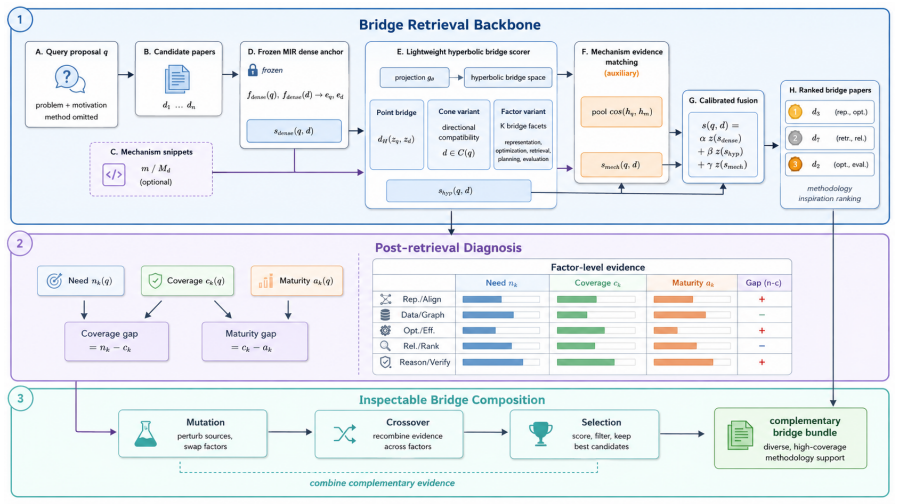
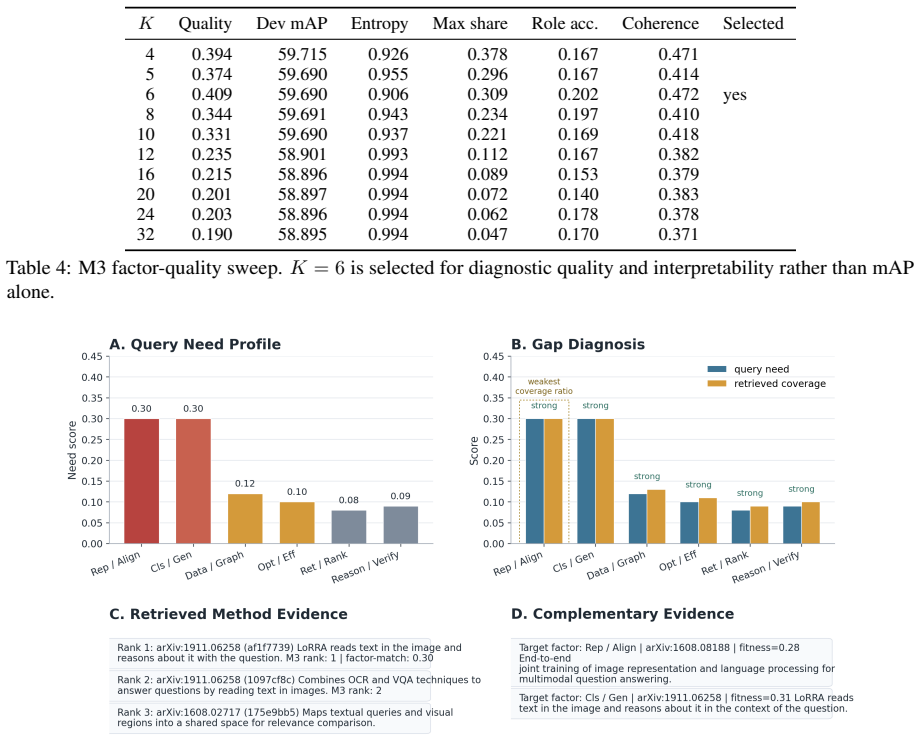
HyBIRD keeps a dense MIR retriever fixed and adds hyperbolic bridges plus LLM diagnosis to expose how methods bridge proposal needs.
A machine-rendered reading of the paper's core claim, the machinery that carries it, and where it could break.
Core claim
The paper establishes that MIR can be reframed as hyperbolic bridge retrieval with post-hoc method diagnosis: a frozen dense retriever supplies the base ranking, lightweight hyperbolic variants learn the bridging geometry, and LLM-extracted method blocks supply inspectable evidence, yielding both competitive mAP and diagnostic outputs that reveal how retrieved methods address specific proposal needs.
What carries the argument
The factorized hyperbolic bridge, which models query-method connections in hyperbolic space over a fixed dense anchor and feeds LLM-derived method blocks into post-hoc profiles and evidence selection.
If this is right
- MIR output can be turned into explicit factor coverage and maturity assessments without retraining the core retriever.
- Complementary evidence bundles can be surfaced directly from ranked papers.
- Hyperbolic geometry can serve as an interpretable overlay rather than a full substitute for dense retrieval.
- Post-hoc diagnosis becomes available for any existing strong MIR dense model.
Where Pith is reading between the lines
- The same frozen-anchor pattern could be tested on other retrieval settings that require both ranking accuracy and human-readable bridging explanations.
- The quality of the LLM method blocks directly limits the reliability of the diagnostic views, suggesting a need for targeted validation of those blocks.
- Researchers might use the resulting need profiles to guide iterative refinement of their own proposals before submission.
Load-bearing premise
The MIR benchmark and the LLM-assisted method block extraction accurately reflect real methodological bridging needs and evidence quality.
What would settle it
A controlled user study in which domain experts judge whether the generated need profiles, factor coverage scores, maturity views, and evidence bundles correctly map retrieved methods onto the methodological gaps stated in the query proposal.
Figures



read the original abstract
Methodology Inspiration Retrieval (MIR) asks a system to retrieve prior papers whose methods can inspire a new research proposal. Unlike general scientific retrieval, the central challenge is not topical similarity but whether a candidate paper provides concrete mechanisms that can instantiate an abstract methodological need. Existing MIR dense retrievers provide strong paper-level rankings, but the returned lists do not expose how proposal needs are bridged by retrieved methods, where evidence is weak, or which complementary snippets may help. We propose HyBIRD, a frozen-anchor framework that treats MIR as hyperbolic bridge retrieval and post-hoc method diagnosis. HyBIRD keeps a strong MIR dense retriever fixed, learns lightweight point, cone, and factorized hyperbolic bridge variants, and uses LLM-assisted method blocks for post-hoc explanation and evidence selection. On the MIR benchmark, the factorized bridge reaches 59.034 mAP while preserving the dense anchor's strong retrieval behavior. More importantly, HyBIRD converts ranked papers into inspectable query need profiles, factor coverage, maturity views, and complementary evidence bundles. The results suggest that hyperbolic geometry is most useful as calibrated structure over a dense anchor, rather than as a standalone replacement for dense retrieval.
Editorial analysis
A structured set of objections, weighed in public.
Referee Report
Summary. The manuscript introduces HyBIRD, a frozen-anchor framework for Methodology Inspiration Retrieval (MIR) that treats the task as hyperbolic bridge retrieval with post-hoc diagnosis. It keeps an existing dense MIR retriever fixed while learning lightweight point, cone, and factorized hyperbolic bridge variants, and employs LLM-assisted method blocks for explanation and evidence selection. On the MIR benchmark the factorized bridge reports 59.034 mAP while preserving the anchor's retrieval behavior; the framework additionally converts rankings into inspectable query need profiles, factor coverage, maturity views, and complementary evidence bundles. The authors conclude that hyperbolic geometry is most useful as calibrated structure over a dense anchor rather than a standalone replacement.
Significance. If the central results hold, the work provides a practical demonstration that hyperbolic geometry can be layered on top of strong dense retrievers to add structured interpretability without sacrificing retrieval performance. The preservation of the anchor and the explicit conversion of rankings into diagnostic outputs address a genuine gap in current MIR systems. The approach also supplies a concrete example of using hyperbolic space for bridging abstract needs to concrete mechanisms, which could inform similar augmentation strategies in other retrieval settings.
major comments (3)
- [Results] Results section: the factorized bridge is reported to reach 59.034 mAP while 'preserving the dense anchor's strong retrieval behavior,' yet no numerical value, standard deviation, or statistical comparison for the anchor itself is supplied, nor are run counts or significance tests given; without these the preservation claim cannot be evaluated.
- [Evaluation] Evaluation / post-hoc diagnosis: the interpretability claims rest on LLM-assisted method block extraction producing faithful evidence bundles and profiles, but no human validation, inter-annotator agreement scores, or error analysis of the LLM outputs is reported; this directly affects whether the 'more importantly' diagnostic contribution follows from the mAP number.
- [§3] §3 (framework description): the three hyperbolic bridge variants are introduced as 'lightweight' additions, yet the manuscript provides no explicit equations, parameter counts, or training objectives that would allow a reader to verify they remain strictly additive to the frozen dense anchor rather than implicitly redefining the ranking.
minor comments (2)
- [Abstract] Abstract: the numeric result 59.034 mAP is given without units, baseline value, or context on the MIR benchmark scale, reducing immediate readability.
- Notation: the distinction between 'point,' 'cone,' and 'factorized' bridges is introduced without a compact table or diagram summarizing their geometric differences and computational costs.
Simulated Author's Rebuttal
We thank the referee for the constructive feedback. The comments highlight important gaps in result reporting, validation of interpretability components, and technical details of the framework. We address each major comment below and commit to revisions where appropriate.
read point-by-point responses
-
Referee: [Results] Results section: the factorized bridge is reported to reach 59.034 mAP while 'preserving the dense anchor's strong retrieval behavior,' yet no numerical value, standard deviation, or statistical comparison for the anchor itself is supplied, nor are run counts or significance tests given; without these the preservation claim cannot be evaluated.
Authors: We agree that the anchor's mAP, standard deviations, run counts, and statistical comparisons are required to substantiate the preservation claim. In the revised manuscript we will report the dense anchor mAP, standard deviations over the same number of runs used for the factorized bridge, and the results of a paired significance test. revision: yes
-
Referee: [Evaluation] Evaluation / post-hoc diagnosis: the interpretability claims rest on LLM-assisted method block extraction producing faithful evidence bundles and profiles, but no human validation, inter-annotator agreement scores, or error analysis of the LLM outputs is reported; this directly affects whether the 'more importantly' diagnostic contribution follows from the mAP number.
Authors: We acknowledge that the lack of human validation and error analysis weakens the interpretability claims. We will add a dedicated error analysis of LLM-generated method blocks on a held-out sample of queries and explicitly discuss observed failure modes. A full human evaluation with inter-annotator agreement lies outside the scope of the present study and will be listed as future work. revision: partial
-
Referee: [§3] §3 (framework description): the three hyperbolic bridge variants are introduced as 'lightweight' additions, yet the manuscript provides no explicit equations, parameter counts, or training objectives that would allow a reader to verify they remain strictly additive to the frozen dense anchor rather than implicitly redefining the ranking.
Authors: We agree that explicit equations, parameter counts, and training objectives are needed to confirm the additive nature of the bridges. The revised §3 will include the mathematical definitions of the point, cone, and factorized bridges, their parameter counts relative to the frozen anchor, and the precise training objective used. revision: yes
Circularity Check
No significant circularity; framework augments fixed external anchor
full rationale
The paper explicitly keeps a pre-existing MIR dense retriever frozen and adds only lightweight hyperbolic bridge variants plus post-hoc LLM blocks. The reported 59.034 mAP is described as preserving the anchor's retrieval behavior rather than being derived from the new components alone. No equation, prediction, or uniqueness claim reduces by construction to a fitted parameter or self-citation chain; the interpretability outputs are presented as downstream diagnostics on the fixed rankings. The derivation chain therefore remains independent of the novel elements.
Axiom & Free-Parameter Ledger
Reference graph
Works this paper leans on
-
[1]
The Library Quarterly , volume=
Undiscovered public knowledge , author=. The Library Quarterly , volume=
-
[2]
uttler, Heinrich and Lewis, Mike and Yih, Wen-tau and Rockt\
Lewis, Patrick and Perez, Ethan and Piktus, Aleksandra and Petroni, Fabio and Karpukhin, Vladimir and Goyal, Naman and K\"uttler, Heinrich and Lewis, Mike and Yih, Wen-tau and Rockt\"aschel, Tim and Riedel, Sebastian and Kiela, Douwe , booktitle=. Retrieval-Augmented Generation for Knowledge-Intensive
-
[3]
Proceedings of EMNLP , year=
Dense Passage Retrieval for Open-Domain Question Answering , author=. Proceedings of EMNLP , year=
-
[4]
Beltagy, Iz and Lo, Kyle and Cohan, Arman , booktitle=
-
[5]
Sentence-
Reimers, Nils and Gurevych, Iryna , booktitle=. Sentence-
-
[6]
, booktitle=
Cohan, Arman and Feldman, Sergey and Beltagy, Iz and Downey, Doug and Weld, Daniel S. , booktitle=
-
[7]
Singh, Amanpreet and Lo, Kyle and Beltagy, Iz and Downey, Doug and Cohan, Arman , booktitle=
-
[8]
doi:10.18653/v1/2022.naacl-main.137 , url=
Lauscher, Anne and Ko, Brandon and Kuehl, Bailey and Johnson, Sophie and Cohan, Arman and Jurgens, David and Lo, Kyle , booktitle=. doi:10.18653/v1/2022.naacl-main.137 , url=
-
[9]
doi:10.18653/v1/2025.acl-long.1390 , url=
Garikaparthi, Aniketh and Patwardhan, Manasi and Kanade, Aditya Sanjiv and Hassan, Aman and Vig, Lovekesh and Cohan, Arman , booktitle=. doi:10.18653/v1/2025.acl-long.1390 , url=
-
[10]
Asai, A., He, J., Shao, R., Shi, W., Singh, A., Chang, J
Ajith, Anirudh and Xia, Mengzhou and Chevalier, Alexis and Goyal, Tanya and Chen, Danqi and Gao, Tianyu , booktitle=. doi:10.18653/v1/2024.emnlp-main.840 , url=
-
[11]
Lo, Kyle and Wang, Lucy Lu and Neumann, Mark and Kinney, Rodney and Weld, Daniel S. , booktitle=. doi:10.18653/v1/2020.acl-main.447 , url=
-
[12]
Content-Based Citation Recommendation , author=. Proceedings of the 2018 Conference of the North American Chapter of the Association for Computational Linguistics: Human Language Technologies, Volume 1 (Long Papers) , address=. doi:10.18653/v1/N18-1022 , url=
-
[13]
Proceedings of the 2018 Conference on Empirical Methods in Natural Language Processing , address=
Multi-Task Identification of Entities, Relations, and Coreference for Scientific Knowledge Graph Construction , author=. Proceedings of the 2018 Conference on Empirical Methods in Natural Language Processing , address=. doi:10.18653/v1/D18-1360 , url=
-
[14]
doi:10.18653/v1/2020.acl-main.670 , url=
Jain, Sarthak and van Zuylen, Madeleine and Hajishirzi, Hannaneh and Beltagy, Iz , booktitle=. doi:10.18653/v1/2020.acl-main.670 , url=
-
[15]
Advances in Neural Information Processing Systems , year=
Poincar\'e Embeddings for Learning Hierarchical Representations , author=. Advances in Neural Information Processing Systems , year=
-
[16]
Proceedings of ICML , year=
Learning Continuous Hierarchies in the Lorentz Model of Hyperbolic Geometry , author=. Proceedings of ICML , year=
-
[17]
Proceedings of ICML , year=
Representation Tradeoffs for Hyperbolic Embeddings , author=. Proceedings of ICML , year=
-
[18]
Proceedings of Graph Drawing , year=
Low Distortion Delaunay Embedding of Trees in Hyperbolic Plane , author=. Proceedings of Graph Drawing , year=
-
[19]
International Conference on Learning Representations , year=
Order-Embeddings of Images and Language , author=. International Conference on Learning Representations , year=
-
[20]
Proceedings of ICML , year=
Hyperbolic Entailment Cones for Learning Hierarchical Embeddings , author=. Proceedings of ICML , year=
-
[21]
Advances in Neural Information Processing Systems , year=
Modeling Heterogeneous Hierarchies with Relation-specific Hyperbolic Cones , author=. Advances in Neural Information Processing Systems , year=
-
[22]
Advances in Neural Information Processing Systems , year=
Hyperbolic Graph Convolutional Neural Networks , author=. Advances in Neural Information Processing Systems , year=
-
[23]
International Conference on Learning Representations , url=
Learning Mixed-Curvature Representations in Product Spaces , author=. International Conference on Learning Representations , url=
-
[24]
Proceedings of ICML , year=
Learning Transferable Visual Models From Natural Language Supervision , author=. Proceedings of ICML , year=
-
[25]
Desai, Karan and Nickel, Maximilian and Rajpurohit, Tanmay and Johnson, Justin and Vedantam, Ramakrishna , journal=
-
[26]
Yoshikawa, Daiki and Matsubara, Takashi , booktitle=
-
[27]
doi:10.18653/v1/2024.acl-long.18 , url=
Wang, Qingyun and Downey, Doug and Ji, Heng and Hope, Tom , booktitle=. doi:10.18653/v1/2024.acl-long.18 , url=
-
[28]
doi:10.18653/v1/2025.naacl-long.342 , url=
Baek, Jinheon and Jauhar, Sujay Kumar and Cucerzan, Silviu and Hwang, Sung Ju , booktitle=. doi:10.18653/v1/2025.naacl-long.342 , url=
-
[29]
Asai, Akari and He, Jacqueline and Shao, Rulin and Shi, Weijia and Singh, Amanpreet and Chang, Joseph Chee and Lo, Kyle and Soldaini, Luca and Feldman, Sergey and D'Arcy, Mike and Wadden, David and Latzke, Matt and Tian, Minyang and Ji, Pan and Liu, Shengyan and Tong, Hao and Wu, Bohao and Xiong, Yanyu and Zettlemoyer, Luke and Neubig, Graham and Weld, Da...
-
[30]
Xu, Tengyue and Qian, Zhuoyang and Liu, Gaoge and Ling, Li and Zhang, Zhentao and Wu, Biao and Zhang, Shuo and Lu, Ke and Shi, Wei and Wang, Ziqi and Feng, Zheng and Luo, Yan and Xu, Shu and Chen, Yongjin and Feng, Zhibo and Chen, Zhuo and Yuan, Bruce and Wang, Harry and Chen, Kris , journal=
-
[31]
Lu, Chris and Lu, Cong and Lange, Robert Tjarko and Foerster, Jakob and Clune, Jeff and Ha, David , journal=. The
-
[32]
Yamada, Yutaro and Lange, Robert Tjarko and Lu, Cong and Hu, Shengran and Lu, Chris and Foerster, Jakob and Clune, Jeff and Ha, David , journal=. The
-
[33]
Si, Chenglei and Yang, Diyi and Hashimoto, Tatsunori , journal=. Can
-
[34]
International Conference on Learning Representations , year=
Adam: A Method for Stochastic Optimization , author=. International Conference on Learning Representations , year=
-
[35]
International Conference on Learning Representations , year=
Decoupled Weight Decay Regularization , author=. International Conference on Learning Representations , year=
discussion (0)
Sign in with ORCID, Apple, or X to comment. Anyone can read and Pith papers without signing in.