Multi-level {π}-junction in a proximitized Ge/SiGe quantum dot probed by an on-chip superconducting microwave resonator
Pith reviewed 2026-06-30 09:06 UTC · model grok-4.3
The pith
In a proximitized Ge/SiGe quantum dot, multiple orbitals produce multilevel π-junctions whose signatures appear in both DC and microwave responses.
A machine-rendered reading of the paper's core claim, the machinery that carries it, and where it could break.
Core claim
When several quantum-dot orbitals contribute simultaneously to superconducting transport in a proximitized Ge/SiGe structure, the Josephson ground state is no longer fixed by any single orbital. DC transport and microwave resonator data together show combinations of sharp and smooth phase transitions versus gate voltage, each carrying distinct inductive and dissipative microwave signatures. The work identifies these features as the qualitative markers of multilevel π-junction behavior.
What carries the argument
The multilevel π-junction formed when multiple QD orbitals participate in Josephson coupling, probed by the frequency shift and dissipation of an on-chip superconducting resonator.
If this is right
- Multilevel π-junction behavior becomes accessible in Ge-based hybrid systems.
- Gate voltage can tune between 0- and π-states through multi-orbital occupation.
- Microwave resonators can distinguish the inductive and dissipative responses of these junctions.
- Gate-defined superconducting devices integrate with high-quality on-chip resonators.
Where Pith is reading between the lines
- The same microwave-probing method could map orbital-dependent pairing symmetries in other proximitized semiconductors.
- Multilevel effects may provide additional control knobs for Andreev bound states in quantum-dot Josephson junctions.
- Integration with resonators suggests a path toward microwave readout of hybrid spin or charge qubits in Ge.
Load-bearing premise
The combinations of sharp or smooth phase transitions and their distinct microwave signatures are caused by multilevel orbital occupation rather than disorder or parallel junctions.
What would settle it
A device engineered so that only one orbital is occupied at a time would show only single-level transitions without the observed combinations of sharp and smooth features.
Figures


read the original abstract
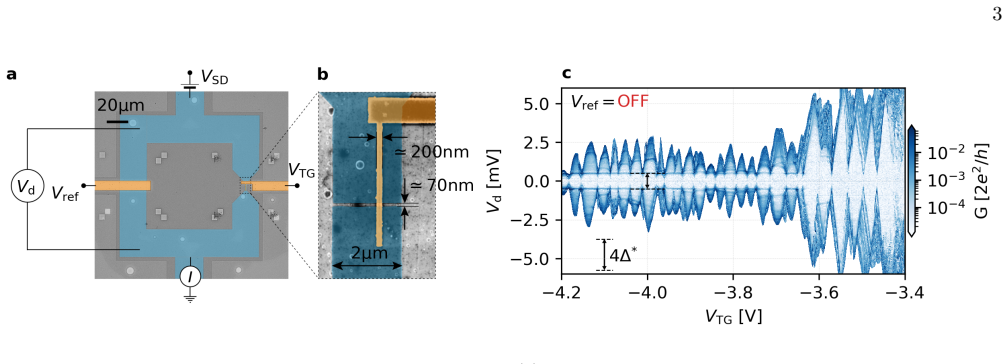
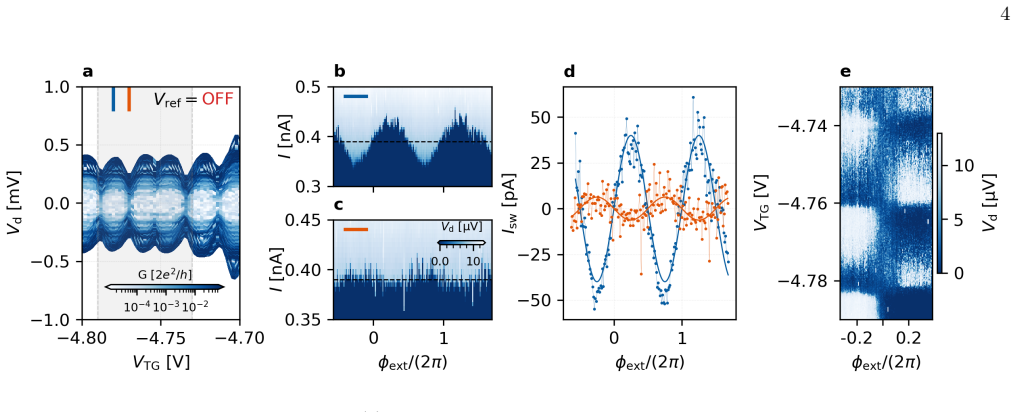
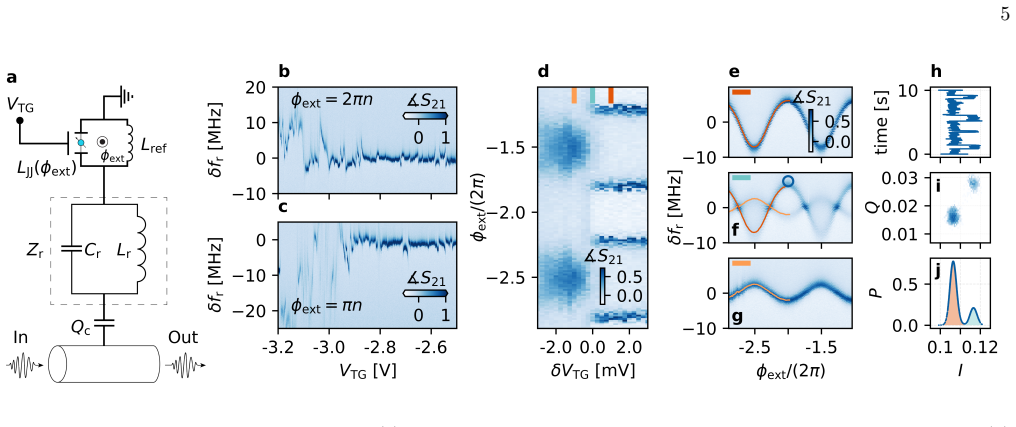
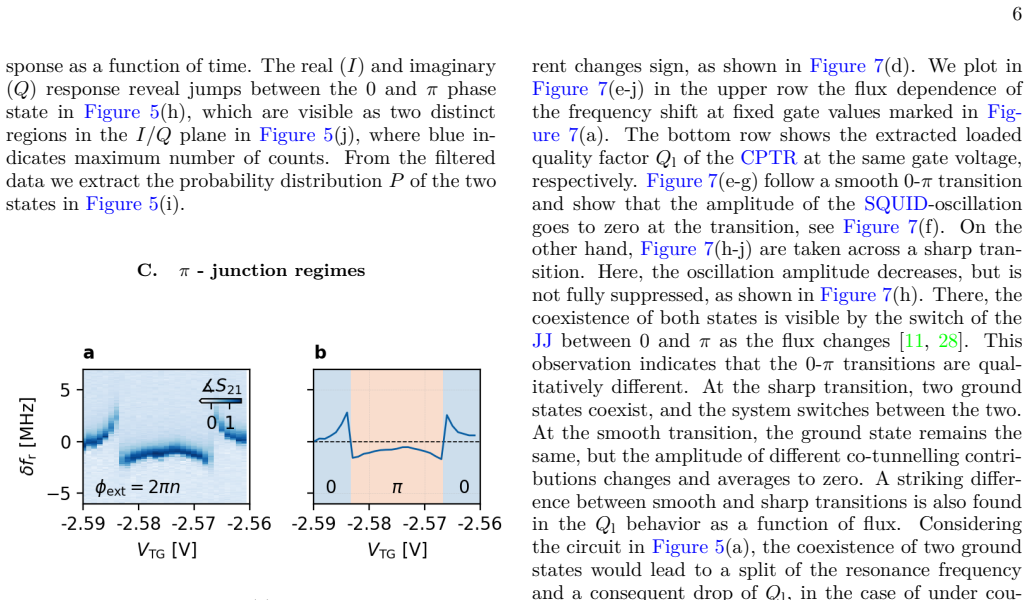
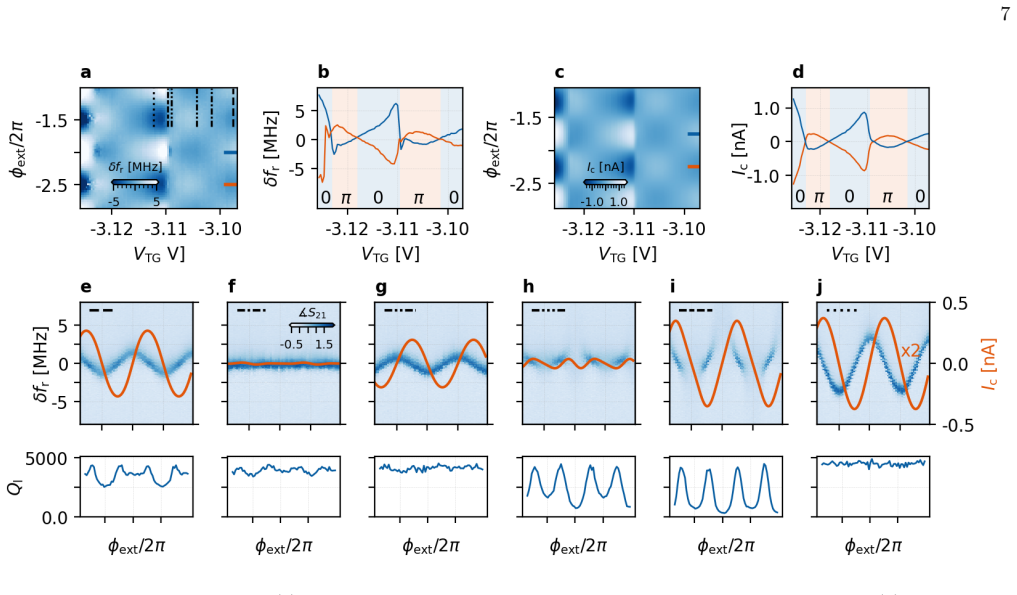
Using on-chip microwave measurements, we investigate multilevel $\pi$-junctions formed by proximitized quantum dot (QD) in a germanium (Ge)/silicon-germanium (SiGe) heterostructure. In the multilevel regime, where several QD orbitals contribute simultaneously to superconducting transport, the Josephson ground state is no longer determined solely by the occupation of a single orbital. By combining DC transport and microwave techniques, we identify the qualitative signatures of multilevel $\pi$-junctions in both their gate-voltage dependence and microwave response. In particular, we observe combinations phase transitions that are sharp or smooth in gate voltage and which exhibit distinct inductive and dissipative signatures. Such multilevel Josephson transport has previously been observed primarily in exceptionally clean systems such as carbon nanotubes. Our results establish proximitized Ge as a platform for investigating hybrid superconductor/semiconductor physics and demonstrate the integration of gate-defined superconducting quantum devices with high-quality on-chip microwave resonators.
Editorial analysis
A structured set of objections, weighed in public.
Referee Report
Summary. The manuscript reports experimental observation of multilevel π-junction behavior in a gate-defined proximitized Ge/SiGe quantum dot. Using combined DC transport and on-chip microwave resonator measurements, the authors identify combinations of sharp or smooth gate-voltage phase transitions that exhibit distinct inductive and dissipative signatures, attributing these to simultaneous contributions from multiple QD orbitals to the Josephson current. They position the result as extending multilevel Josephson physics beyond exceptionally clean systems such as carbon nanotubes and as demonstrating integration of gate-defined superconducting devices with high-quality resonators.
Significance. If the multilevel-orbital interpretation is robustly supported, the work would establish proximitized Ge/SiGe as a viable platform for hybrid superconductor-semiconductor Josephson physics and would provide a concrete demonstration of on-chip resonator integration with gate-defined devices. This could open routes to more accessible experimental systems than carbon nanotubes while enabling microwave readout of hybrid quantum circuits.
major comments (1)
- [Results and Discussion (inferred from abstract description of signatures)] The central claim that the observed combinations of sharp/smooth gate-voltage transitions and their inductive/dissipative microwave signatures arise specifically from multilevel orbital occupation (rather than disorder-induced potential fluctuations or multiple parallel conduction paths) is load-bearing but under-constrained. No quantitative modeling of expected multilevel spectra versus disorder or parallel-junction alternatives is presented, leaving the interpretation open to alternative explanations.
Simulated Author's Rebuttal
We thank the referee for their careful reading of the manuscript and for recognizing the potential significance of demonstrating multilevel Josephson physics in a gate-defined Ge/SiGe platform with integrated microwave readout. We address the major comment below.
read point-by-point responses
-
Referee: [Results and Discussion (inferred from abstract description of signatures)] The central claim that the observed combinations of sharp/smooth gate-voltage transitions and their inductive/dissipative microwave signatures arise specifically from multilevel orbital occupation (rather than disorder-induced potential fluctuations or multiple parallel conduction paths) is load-bearing but under-constrained. No quantitative modeling of expected multilevel spectra versus disorder or parallel-junction alternatives is presented, leaving the interpretation open to alternative explanations.
Authors: We agree that the manuscript relies on qualitative signatures rather than quantitative modeling of the expected spectra. The central experimental observation is that specific combinations of sharp versus smooth gate-voltage transitions appear together with distinct inductive and dissipative responses in the resonator. These patterns are reproducible across multiple devices and gate configurations and match the expected behavior when several QD orbitals contribute simultaneously to the supercurrent, as previously established in cleaner systems such as carbon nanotubes. In contrast, disorder-induced fluctuations or parallel conduction paths would be expected to produce more stochastic or uncorrelated features in both DC and microwave response; the systematic character of the observed transitions and their microwave signatures therefore favors the multilevel-orbital interpretation. While we acknowledge that a quantitative comparison to microscopic simulations would further constrain alternatives, such modeling lies outside the scope of the present experimental work, which focuses on identifying the qualitative signatures accessible with combined DC and on-chip resonator measurements. We are prepared to expand the discussion section to make this distinction more explicit if the editor deems it necessary. revision: no
Circularity Check
No circularity: experimental observation report with no derivation chain
full rationale
The paper reports experimental observations of DC transport and microwave resonator responses in a gate-defined Ge/SiGe quantum dot. No theoretical derivations, first-principles predictions, parameter fitting presented as predictions, or self-citation chains are present in the provided text. The central claims rest on qualitative signatures in gate-voltage dependence and inductive/dissipative responses, interpreted as multilevel π-junction behavior. These are direct measurements without any reduction of outputs to inputs by construction. The work is self-contained as an experimental platform demonstration.
Axiom & Free-Parameter Ledger
Reference graph
Works this paper leans on
-
[1]
De Franceschi, L
S. De Franceschi, L. Kouwenhoven, C. Schönenberger, and W. Wernsdorfer, Nature Nanotechnology 5, 703 (2010)
2010
-
[2]
Cleuziou, W
J.-P. Cleuziou, W. Wernsdorfer, V. Bouchiat, T. On- darçuhu, and M. Monthioux, Nature Nanotechnology 1, 53 (2006), ISSN 1748-3387, 1748-3395
2006
-
[3]
Eichler, M
A. Eichler, M. Weiss, S. Oberholzer, C. Schönenberger, A. Levy Yeyati, J. C. Cuevas, and A. Martín-Rodero, Physical Review Letters 99, 126602 (2007), ISSN 0031- 9007, 1079-7114
2007
-
[4]
Pillet, C
J.-D. Pillet, C. H. L. Quay, P. Morfin, C. Bena, A. L. Yeyati, and P. Joyez, Nature Physics 6, 965 (2010)
2010
-
[5]
E. J. H. Lee, X. Jiang, M. Houzet, R. Aguado, C. M. Lieber, and S. De Franceschi, Nature Nanotechnology 9, 79 (2014), ISSN 1748-3387, 1748-3395
2014
-
[6]
J. Aumentado, M. W. Keller, J. M. Martinis, and M. H. Devoret, Physical Review Letters 92, 066802 (2004), ISSN 0031-9007, 1079-7114, URL https://link.aps. org/doi/10.1103/PhysRevLett.92.066802
-
[7]
P. M. Echternach, J. F. Schneiderman, M. D. Shaw, and P. Delsing, Quantum Information Processing 8, 183 (2009), ISSN 1570-0755, 1573-1332
2009
-
[8]
Y. Shimizu, H. Horii, Y. Takane, and Y. Isawa, Journal of the Physical Society of Japan 67, 1525 (1998), ISSN 0031-9015, 1347-4073, URL http://journals.jps.jp/ doi/10.1143/JPSJ.67.1525
-
[9]
Van Heck, R
B. Van Heck, R. M. Lutchyn, and L. I. Glazman, Physical Review B 93, 235431 (2016), ISSN 2469-9950, 2469-9969
2016
-
[10]
J. A. Van Dam, Y. V. Nazarov, E. P. A. M. Bakkers, S. De Franceschi, and L. P. Kouwenhoven, Nature 442, 667 (2006), ISSN 0028-0836, 1476-4687, URL https:// www.nature.com/articles/nature05018
2006
-
[11]
Delagrange, R
R. Delagrange, R. Weil, A. Kasumov, M. Ferrier, H. Bouchiat, and R. Deblock, Physica B: Con- densed Matter 536, 211 (2018), ISSN 09214526, URL https://linkinghub.elsevier.com/retrieve/pii/ S0921452617306208
2018
-
[12]
Bargerbos, M
A. Bargerbos, M. Pita-Vidal, R. itko, L. J. Splitthoff, L. Grünhaupt, J. J. Wesdorp, Y. Liu, L. P. Kouwen- hoven, R. Aguado, C. K. Andersen, et al., Physical Review Letters 131, 097001 (2023), ISSN 0031-9007, 1079-7114, URL https://link.aps.org/doi/10.1103/ PhysRevLett.131.097001
2023
-
[13]
A. Hofmann, D. Jirovec, M. Borovkov, I. Prieto, A. Ballabio, J. Frigerio, D. Chrastina, G. Isella, and G. Katsaros, Assessing the potential of Ge/SiGe quan- tum dots as hosts for singlet-triplet qubits (2019), arXiv:1910.05841 [cond-mat], URL http://arxiv.org/ abs/1910.05841
-
[14]
A. Nigro, E. Jutzi, F. Oppliger, F. De Palma, C. Olsen, A. Ruiz-Caridad, G. Gadea, P. Scarlino, I. Zardo, and A. Hofmann, ACS Applied Electronic Materials 6, 5094 (2024), URL https://doi.org/10.1021/acsaelm. 4c00654
-
[15]
N. W. Hendrickx, W. I. L. Lawrie, M. Russ, F. van Riggelen, S. L. de Snoo, R. N. Schouten, A. Sam- mak, G. Scappucci, and M. Veldhorst, Nature 591, 580 (2021), ISSN 1476-4687, URL https://www.nature. com/articles/s41586-021-03332-6
2021
-
[16]
Jirovec, A
D. Jirovec, A. Hofmann, A. Ballabio, P. M. Mut- ter, G. Tavani, M. Botifoll, A. Crippa, J. Kukucka, O. Sagi, F. Martins, et al., Nature Materials 20, 1106 (2021), URL https://www.nature.com/articles/ s41563-021-01022-2
2021
-
[17]
N. W. Hendrickx, D. P. Franke, A. Sammak, M. Kouwen- hoven, D. Sabbagh, L. Yeoh, R. Li, M. L. V. Taglia- ferri, M. Virgilio, G. Capellini, et al., Nature Commu- nications 9, 2835 (2018), ISSN 2041-1723, URL https: //www.nature.com/articles/s41467-018-05299-x
2018
-
[18]
Valentini, O
M. Valentini, O. Sagi, L. Baghumyan, T. De Gijsel, J. Jung, S. Calcaterra, A. Ballabio, J. Aguilera Servin, K. Aggarwal, M. Janik, et al., Nature Communications 15, 169 (2024), ISSN 2041-1723, URL https://www. nature.com/articles/s41467-023-44114-0
2024
-
[19]
F. Vigneau, R. Mizokuchi, D. C. Zanuz, X. Huang, S. Tan, R. Maurand, S. Frolov, A. Sammak, G. Scap- pucci, F. Lefloch, et al., Nano Letters 19, 1023 (2019), ISSN 1530-6984, 1530-6992, URL https://pubs.acs. org/doi/10.1021/acs.nanolett.8b04275
-
[20]
K. Aggarwal, A. Hofmann, D. Jirovec, I. Prieto, A. Sam- mak, M. Botifoll, S. Martí-Sánchez, M. Veldhorst, J. Ar- biol, G. Scappucci, et al., Physical Review Research 3, L022005 (2021), ISSN 2643-1564, URL https://link. aps.org/doi/10.1103/PhysRevResearch.3.L022005
-
[21]
L. Ruggiero, C. Ciacca, P. Drexler, V. J. Weibel, C. Olsen, C. Schönenberger, D. Bougeard, and A. Hof- mann, High-quality and field resilient microwave res- onators on Ge/SiGe quantum well heterostructures (2025), URL http://arxiv.org/abs/2512.20238
-
[22]
Lakic, W
L. Lakic, W. I. L. Lawrie, D. Van Driel, L. E. A. Ste- houwer, Y. Su, M. Veldhorst, G. Scappucci, F. Kuem- meth, and A. Chatterjee, Nature Materials 24, 552 (2025), ISSN 1476-1122, 1476-4660, URL https://www. nature.com/articles/s41563-024-02095-5
2025
-
[23]
Fabris, P
G. Fabris, P. Falthansl-Scheinecker, D. Shah, D. M. Pino, M. Borovkov, A. Bubis, K. Roux, D. Sokolova, A. A. Juanes, T. Costanzo, et al., Granular aluminum induced superconductivity in germanium for hole spin-based hy- brid devices (2026)
2026
-
[24]
O. Sagi, A. Crippa, M. Valentini, M. Janik, L. Baghumyan, G. Fabris, L. Kapoor, F. Hassani, J. Fink, S. Calcaterra, et al., Nature Communications 15, 6400 (2024), ISSN 2041-1723, URL https://www.nature. com/articles/s41467-024-50763-6
2024
-
[25]
E. Kiyooka, C. Tangchingchai, L. Noirot, A. Leblanc, B. Brun, S. Zihlmann, R. Maurand, V. Schmitt, . Dumur, J.-M. Hartmann, et al., Nano Letters 25, 562 (2025), ISSN 1530-6984, URL https://doi.org/10.1021/acs. nanolett.4c05539
work page doi:10.1021/acs 2025
-
[26]
M. Hinderling, S. C. Ten Kate, M. Coraiola, D. Hax- ell, M. Stiefel, M. Mergenthaler, S. Paredes, S. Bedell, D. Sabonis, and F. Nichele, PRX Quantum 5, 030357 9 (2024), ISSN 2691-3399, URL https://link.aps.org/ doi/10.1103/PRXQuantum.5.030357
-
[27]
S. C. t. Kate, D. C. Ohnmacht, M. Coraiola, T. An- tonelli, S. Paredes, F. J. Schupp, M. Hinderling, S. W. Bedell, W. Belzig, J. C. Cuevas, et al., Finite Length Effects and Coulomb Interaction in Ge Quantum Well-Based Josephson Junctions Probed with Microwave Spectroscopy (2025), arXiv:2508.06180 [cond-mat], URL http://arxiv.org/abs/2508.06180
-
[28]
M. R. Sahu, F. J. Matute-Cañadas, M. Benito, P. Krogstrup, J. Nygård, M. F. Goffman, C. Urbina, A. L. Yeyati, and H. Pothier, Physical Review B 109, 134506 (2024), ISSN 2469-9950, 2469-9969, URL https: //link.aps.org/doi/10.1103/PhysRevB.109.134506
-
[29]
Debbarma, A
R. Debbarma, A. Tsintzis, M. Aspegren, R. S. Souto, S. Lehmann, K. Dick, M. Leijnse, and C. Thelander, Physical Review Letters 131, 256001 (2023), ISSN 0031- 9007, 1079-7114, URL https://link.aps.org/doi/10. 1103/PhysRevLett.131.256001
2023
-
[30]
E. T. Mannila, V. F. Maisi, H. Q. Nguyen, C. M. Mar- cus, and J. P. Pekola, Physical Review B 100, 020502 (2019), ISSN 2469-9950, 2469-9969, URL https://link. aps.org/doi/10.1103/PhysRevB.100.020502
-
[31]
Hinderling, S
M. Hinderling, S. T. Kate, D. Haxell, M. Coraiola, S. Paredes, E. Cheah, F. Krizek, R. Schott, W. Wegschei- der, D. Sabonis, et al., PRX Quantum 5, 030337 (2024), ISSN 2691-3399, URL https://link.aps.org/doi/10. 1103/PRXQuantum.5.030337
2024
-
[32]
R. Haller, G. Fülöp, D. Indolese, J. Ridderbos, R. Kraft, L. Y. Cheung, J. H. Ungerer, K. Watanabe, T. Taniguchi, D. Beckmann, et al., Physical Review Research 4, 013198 (2022), ISSN 2643-1564, URL https://link.aps.org/ doi/10.1103/PhysRevResearch.4.013198
-
[33]
A. Y. Kitaev, Physics-Uspekhi 44, 131 (2001), ISSN 1468-4780, URL https://www.mathnet.ru/eng/ ufn5648. Supplementary Information Luigi Ruggiero 1, Vera Jo Weibel 1, Pauline Drexler 2, Carlo Ciaccia 1, Christian Olsen1, Dominique Bougeard 2, Christian Schönenberger 3, 4 , and Andrea Hofmann 1, 3, * 1 University of Basel, Klingelbergstrasse 82, 4056 Basel, ...
2001
discussion (0)
Sign in with ORCID, Apple, or X to comment. Anyone can read and Pith papers without signing in.