SKA-VLBI Probes of High-energy Emission Processes in Relativistic Jets
Pith reviewed 2026-06-30 02:30 UTC · model grok-4.3
The pith
SKA-VLBI can deliver milliarcsecond imaging of faint blazars to constrain high-energy jet emission models.
A machine-rendered reading of the paper's core claim, the machinery that carries it, and where it could break.
Core claim
SKA-VLBI offers the opportunity to achieve superior sensitivity at milliarcsecond resolutions, provided by the combination of the phased SKA-Mid and global VLBI arrays. This opens the possibility to perform high-sensitivity and high-angular resolution imaging and polarimetric probes of faint blazars. The resulting high-fidelity spatially resolved parameterizations of structured jets in bright sources will yield key insights to constrain physical models of high-energy photon and particle emission in AGN jets.
What carries the argument
The phased SKA-Mid plus global VLBI array combination that supplies superior sensitivity at milliarcsecond resolutions for imaging and polarimetrically mapping faint blazars.
If this is right
- High-fidelity maps of jet structure in faint HSP BL Lac objects that are TeV emitters.
- Polarimetric data on the same sources to trace magnetic field geometry in the jets.
- Spatially resolved constraints on the location and nature of high-energy emission regions.
- Direct tests of associations between blazar jets and IceCube neutrino events via coincident radio morphology.
Where Pith is reading between the lines
- Polarimetry from these observations could distinguish between competing models of particle acceleration by mapping ordered versus turbulent magnetic fields.
- The same data sets would allow direct comparison of radio jet morphology with gamma-ray and neutrino flare timing to locate emission sites.
- Success on bright sources would justify extending the technique to even fainter objects if array performance meets expectations.
Load-bearing premise
The phased SKA-Mid and global VLBI combination will deliver the required sensitivity and image fidelity for sources at the millijansky level or below.
What would settle it
Quantitative tests or early SKA-VLBI observations that fail to reach the predicted sensitivity and resolution for a sample of millijansky blazars, preventing resolution of jet structures.
Figures

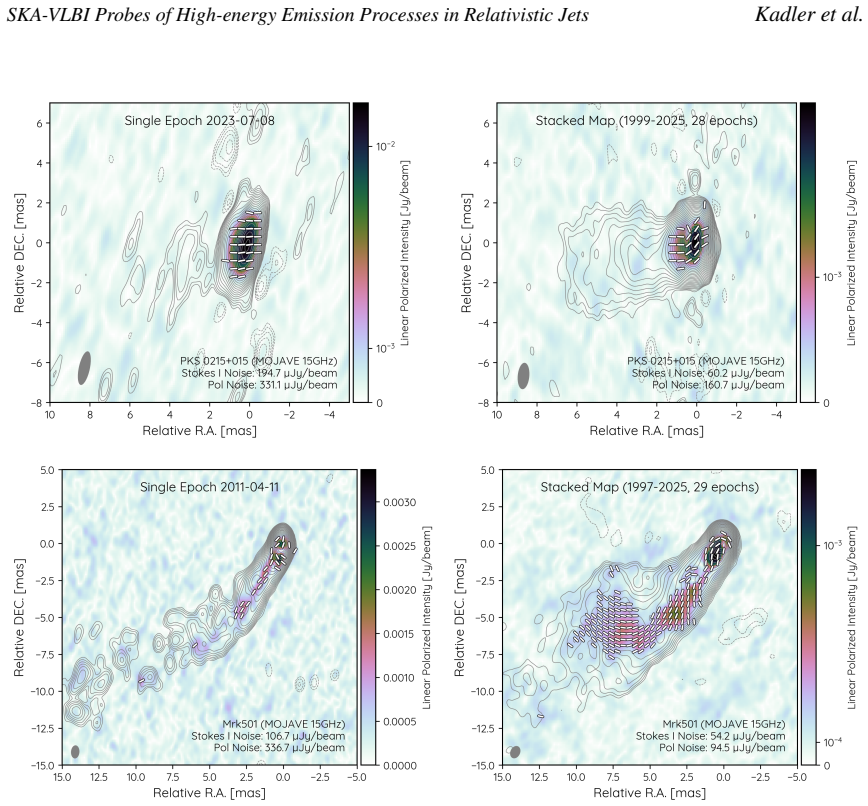
read the original abstract
Relativistic jets in the nuclei of active galaxies are ubiquitous sources of high-energy emission. In particular, blazars represent the most luminous persistent X-ray and gamma-ray sources, whose defining characteristics are small jet inclination angles to the line of sight. Blazars can be detected in many cases up to TeV energies and the largest class of TeV emitting extragalactic AGN is represented by high-synchrotron peaked (HSP) BL Lac objects, which are generally comparably faint radio sources. Moreover, evidence has also been accumulated that high-energy cosmic neutrinos detected by IceCube can be associated with blazars. There is an increasing number of suggested blazar-neutrino associations, along with many cases of coincident flaring radio emission, but in a majority of cases, faint blazars on the level of millijanskies or below have to be considered. These high-energy photon and neutrino emission processes hold many unanswered questions including the unknown source of seed-photons for photo-pion production and the infamous Doppler crisis of TeV-emitting BL Lac objects. SKA-VLBI offers the opportunity to achieve superior sensitivity at milliarcsecond resolutions, provided by the combination of the phased SKA-Mid and global VLBI arrays. This opens the possibility to perform high-sensitivity and high-angular resolution imaging and polarimetric probes of faint blazars. The resulting high-fidelity spatially resolved parameterizations of structured jets in bright sources will yield key insights to constrain physical models of high-energy photon and particle emission in AGN jets.
Editorial analysis
A structured set of objections, weighed in public.
Referee Report
Summary. The manuscript is a forward-looking perspective arguing that SKA-VLBI (phased SKA-Mid combined with global VLBI arrays) will deliver superior sensitivity and milliarcsecond resolution imaging/polarimetry of faint (millijansky or below) blazars. This capability is presented as enabling high-fidelity spatially resolved studies of jet structure that can address open questions in high-energy emission, including the seed-photon field for photo-pion production and the Doppler crisis in TeV-emitting HSP BL Lacs, as well as associations with IceCube neutrinos.
Significance. If the asserted sensitivity and image fidelity are realized, the work could usefully frame observational strategies for constraining jet physics in the SKA era. However, the manuscript contains no new data, derivations, or quantitative predictions; its value is therefore entirely prospective and depends on the validity of the instrumental claims.
major comments (1)
- [Abstract] Abstract (and corresponding discussion in the full text): the central assertion that 'the combination of the phased SKA-Mid and global VLBI arrays' will provide 'superior sensitivity at milliarcsecond resolutions' for sources 'on the level of millijanskies or below' and thereby enable 'high-fidelity spatially resolved parameterizations' is stated without any supporting calculations. No SEFD values, expected rms noise, baseline coverage, dynamic-range estimates, or simulation results are supplied to demonstrate that the resulting images will be adequate for jet-structure or polarization work on HSP BL Lacs. This quantitative gap is load-bearing for the claim that such observations will 'yield key insights to constrain physical models.'
Simulated Author's Rebuttal
We thank the referee for the detailed and constructive report. We address the single major comment below and will incorporate revisions to strengthen the quantitative grounding of our perspective.
read point-by-point responses
-
Referee: [Abstract] Abstract (and corresponding discussion in the full text): the central assertion that 'the combination of the phased SKA-Mid and global VLBI arrays' will provide 'superior sensitivity at milliarcsecond resolutions' for sources 'on the level of millijanskies or below' and thereby enable 'high-fidelity spatially resolved parameterizations' is stated without any supporting calculations. No SEFD values, expected rms noise, baseline coverage, dynamic-range estimates, or simulation results are supplied to demonstrate that the resulting images will be adequate for jet-structure or polarization work on HSP BL Lacs. This quantitative gap is load-bearing for the claim that such observations will 'yield key insights to constrain physical models.'
Authors: We agree that the absence of explicit sensitivity estimates leaves the central claim under-supported. Although the manuscript is a forward-looking perspective and not a technical performance study, we will add a short paragraph (or footnote) in the revised version that cites published SEFD values for phased SKA-Mid and representative VLBI stations, together with order-of-magnitude rms noise estimates for typical integration times on mJy-level sources. Where possible we will also reference existing SKA-VLBI array simulations that address dynamic range and polarization fidelity. This addition will directly address the referee’s concern while preserving the perspective character of the paper. revision: yes
Circularity Check
No circularity; perspective paper with no derivations or self-referential predictions
full rationale
The manuscript is a forward-looking perspective on SKA-VLBI capabilities for blazar observations. It contains no equations, no fitted parameters, no 'predictions' derived from data subsets, and no load-bearing self-citations or uniqueness theorems. The central statements (e.g., 'SKA-VLBI offers the opportunity to achieve superior sensitivity... provided by the combination of the phased SKA-Mid and global VLBI arrays') are direct assertions about array performance rather than results obtained by reducing prior inputs to themselves. No step matches any of the enumerated circularity patterns.
Axiom & Free-Parameter Ledger
Reference graph
Works this paper leans on
-
[1]
M. G. Aartsen et al.ApJ, 835(1):45, Jan. 2017a. doi: 10.3847/1538-4357/835/1/45. 7 SKA-VLBI Probes of High-energy Emission Processes in Relativistic JetsKadler et al. M. G. Aartsen et al.Journal of Instrumentation, 12(3):P03012, Mar. 2017b. doi: 10.1088/ 1748-0221/12/03/P03012. R. Abbasi et al.ApJ, 954(1):75, Sept
-
[2]
doi: 10.3847/1538-4357/acdfcb. A. A. e. a. Abdo.ApJ, 699(1):31–39, Jul
-
[3]
doi: 10.1088/0004-637X/699/1/31. B. S. Acharya et al.Science with the Cherenkov Telescope Array
-
[4]
doi: 10.1142/10986. S. Adrián-Martínez et al.Journal of Physics G Nuclear Physics, 43(8):084001, Aug
-
[5]
doi: 10.1088/0954-3899/43/8/084001. J. Aleksić et al.Science, 346(6213):1080–1084, Nov
-
[6]
doi: 10.1126/science.1256183. V. A. Allakhverdyan et al.MNRAS, 527(3):8784–8792, Jan
-
[7]
doi: 10.1093/mnras/stad3653. E. Angelakis et al.A&A, 626:A60, June
-
[8]
doi: 10.1051/0004-6361/201834363. A.-K. Baczko et al. InAdvancing Astrophysics with the SKA – II (AASKAII)
-
[9]
E.K.Bempong-Manfuletal
arXiv search: Report number AASKAII/Baczko01. E.K.Bempong-Manfuletal. InAdvancingAstrophysicswiththeSKA–II(AASKAII).2026. arXiv search: Report number AASKAII/Bempong-Manful01. P. Benke et al.A&A, 681:A69, Jan
2026
-
[10]
doi: 10.1051/0004-6361/202347823. J. Biteau et al.Nature Astronomy, 4:124–131, Feb
-
[11]
B.Cerutti,A.Philippov,K.Parfrey,andA.Spitkovsky.MNRAS,448(1):606–619,Mar.2015
doi: 10.1038/s41550-019-0988-4. B.Cerutti,A.Philippov,K.Parfrey,andA.Spitkovsky.MNRAS,448(1):606–619,Mar.2015. doi: 10.1093/mnras/stv042. A. Dotson, M. Georganopoulos, E. T. Meyer, and K. McCann.ApJ, 809(2):164, Aug
-
[12]
doi: 10.1088/0004-637X/809/2/164. F. Eppel et al.A&A, 684:A11, Apr
-
[13]
doi: 10.1051/0004-6361/202348262. G. Ghisellini.Astroparticle Physics, 11(1-2):11–18, June
-
[14]
doi: 10.1016/S0927-6505(99) 00018-3. G. Ghisellini, F. Tavecchio, and M. Chiaberge.A&A, 432:401–410, Mar
-
[15]
doi: 10.1093/mnras/staa2082. O. Hervet, D. A. Williams, A. D. Falcone, and A. Kaur.ApJ, 877(1):26, May
-
[16]
doi: 10.1146/annurev.aa.22.090184.002233. T. Hovatta et al.A&A, 650:A83, June
-
[17]
M.Janssenetal.NatureAstronomy,5:1017–1028,July2021
doi: 10.1051/0004-6361/202039481. M.Janssenetal.NatureAstronomy,5:1017–1028,July2021. doi: 10.1038/s41550-021-01417-w. S. G. Jorstad et al.ApJ, 556:738–748, Aug
-
[18]
doi: 10.1086/321605. S. G. Jorstad et al.ApJ, 773(2):147, Aug
-
[19]
doi: 10.1088/0004-637X/773/2/147. M. Kadler et al.A&A, 538:L1, Feb
-
[20]
doi: 10.1051/0004-6361/201118212. M. Kadler et al.Nature Physics, 12(8):807–814, Aug
-
[21]
doi: 10.1038/nphys3715. M. Kadler et al. InAdvancing Astrophysics with the SKA – II (AASKAII)
-
[22]
doi: 10.1051/0004-6361/202348127. P. M. Kouch et al.A&A, 690:A111, Oct
-
[23]
doi: 10.1051/0004-6361/202347624. P. M. Kouch et al.arXiv e-prints, art. arXiv:2510.16585, Oct
work page internal anchor Pith review Pith/arXiv arXiv doi:10.1051/0004-6361/202347624
-
[24]
doi: 10.48550/arXiv.2510. 16585. Y. Y. Kovalev et al.A&A, 700:L12, Aug
-
[25]
8 SKA-VLBI Probes of High-energy Emission Processes in Relativistic JetsKadler et al
doi: 10.1051/0004-6361/202555400. 8 SKA-VLBI Probes of High-energy Emission Processes in Relativistic JetsKadler et al. Y. Y. Kovalev et al.A&A, 709:A50, May
-
[26]
doi: 10.1051/0004-6361/202558005. F. Krauß et al.A&A, 591:A130, June
-
[27]
doi: 10.1051/0004-6361/201628595. E. Kun, P. L. Biermann, and L. Á. Gergely.MNRAS, 483(1):L42–L46, Feb
-
[28]
doi: 10.1051/0004-6361/201116664. E. J. Lindfors et al.A&A, 593:A98, Sept
-
[29]
doi: 10.1051/0004-6361/201628420. M. L. Lister et al.ApJSS, 234(1):12, Jan
-
[30]
doi: 10.3847/1538-4365/aa9c44. M. L. Lister et al.ApJ, 874:43, Mar
-
[31]
doi: 10.3847/1538-4357/ab08ee. N. R. MacDonald, S. G. Jorstad, and A. P. Marscher.ApJ, 850(1):87, Nov
-
[32]
doi: 10.1016/0927-6505(94)00044-4
Mannheim,K.AstroparticlePhysics,3:295–302,May1995. doi: 10.1016/0927-6505(94)00044-4. C. Müller et al.A&A, 530:L11, Jun
-
[33]
doi: 10.1051/0004-6361/201116605. C. Müller et al.A&A, 562:A4, Feb. 2014a. doi: 10.1051/0004-6361/201322827. C. Müller et al.A&A, 569:A115, Sept. 2014b. doi: 10.1051/0004-6361/201423948. C. Müller et al.A&A, 610:A1, Feb
-
[34]
doi: 10.1051/0004-6361/201731455. I. Myserlis et al.Galaxies, 4(4):58, Nov
-
[35]
doi: 10.3390/galaxies4040058. R. Ojha et al.A&A, 519:A45, Sept
-
[36]
doi: 10.1051/0004-6361/200912724. P. Padovani and P. Giommi.ApJ, 444:567, May
-
[37]
P.Padovani, M.Petropoulou, P.Giommi, andE.Resconi.MNRAS,452(2):1877–1887, Sept.2015
doi: 10.1086/175631. P.Padovani, M.Petropoulou, P.Giommi, andE.Resconi.MNRAS,452(2):1877–1887, Sept.2015. doi: 10.1093/mnras/stv1467. B. G. Piner and P. G. Edwards.ApJ, 853:68, Jan
-
[38]
doi: 10.3847/1538-4357/aaa425. B. G. Piner, N. Pant, P. G. Edwards, and K. Wiik.ApJL, 690(1):L31–L34, Jan
-
[39]
doi: 10.1088/0004-637X/690/1/L31. A. Plavin, Y. Y. Kovalev, Y. A. Kovalev, and S. Troitsky.ApJ, 894(2):101, May
-
[40]
doi: 10.3847/1538-4357/ab86bd. A. V. Plavin, Y. Y. Kovalev, and S. V. Troitsky.ApJ, 991(1):33, Sept
-
[41]
doi: 10.1051/0004-6361/201937206. F. Rösch et al.A&A, 704:A143, Dec
-
[42]
doi: 10.1051/0004-6361/202556231. R. Schulz et al.A&A, 588:A146, Apr
-
[43]
doi: 10.1051/0004-6361/201527404. M. Sikora, M. C. Begelman, and M. J. Rees.ApJ, 421:153–162, Jan
-
[44]
doi: 10.1086/173633. F. Tavecchio and G. Ghisellini.MNRAS, 451(2):1502–1510, Aug
-
[45]
F.Tavecchio,G.Ghisellini,andD.Guetta.ApJL,793(1):L18,Sept.2014
doi: 10.1093/mnras/ stv1023. F.Tavecchio,G.Ghisellini,andD.Guetta.ApJL,793(1):L18,Sept.2014. doi: 10.1088/2041-8205/ 793/1/L18. J. Wongphecauxson et al. InAdvancing Astrophysics with the SKA – II (AASKAII)
-
[46]
doi: 10.1103/PhysRevD.103.123018. 9
discussion (0)
Sign in with ORCID, Apple, or X to comment. Anyone can read and Pith papers without signing in.