Radial oscillations of quark stars in light of current astrophysical constraints: A comparative study
Pith reviewed 2026-06-30 02:18 UTC · model grok-4.3
The pith
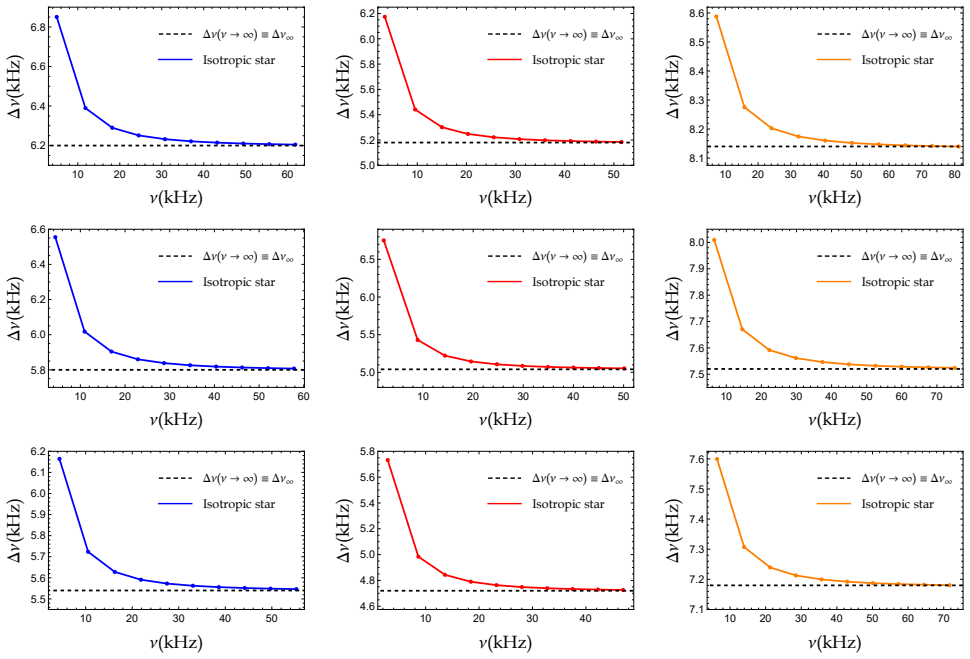
Three equations of state for strange quark stars satisfy current mass, radius, and low-mass constraints while producing radial oscillation frequencies in the four to seven kilohertz range.
A machine-rendered reading of the paper's core claim, the machinery that carries it, and where it could break.
Core claim
All three equations of state for strange quark matter yield maximum masses exceeding two solar masses with canonical mass radii of ten to twelve kilometers. The fundamental radial oscillation frequencies span four to seven kilohertz, with model-dependent asymptotic large separations. These properties satisfy multimessenger constraints and place the oscillation modes in the detection band of gravitational wave observatories, providing potential signatures to identify strange quark stars.
What carries the argument
The Tolman-Oppenheimer-Volkoff equation for stellar equilibrium and the radial perturbation equations in general relativity, applied to the color-flavor-locked, interacting quark matter, and linear causal equations of state.
If this is right
- Quark stars can reach masses above two solar masses while having compact radii of ten to twelve kilometers at one point four solar masses.
- Radial mode frequencies lie in the four to seven kilohertz band accessible to gravitational wave detectors.
- Different equations of state produce distinct asymptotic large frequency separations.
- Self-bound quark matter can account for the low-mass compact object in HESS J1731-347.
- The oscillation properties offer potential asteroseismic signatures to distinguish strange quark stars from hadronic neutron stars in post-merger emission.
Where Pith is reading between the lines
- Observed kHz gravitational wave signals matching these frequencies and separations could favor quark star models in future multimessenger data.
- Extending the models to include slow rotation would test whether the reported frequencies remain stable under more realistic conditions.
- The model-to-model differences in large separations could serve as a diagnostic to select among quark matter equations of state once detections occur.
Load-bearing premise
The three selected equations of state are assumed to sufficiently represent the behavior of strange quark matter in the absence of rotation, magnetic fields, or a nuclear crust.
What would settle it
Detection of a compact object with mass below the minimum allowed by these equations of state or radial oscillation frequencies outside the four to seven kilohertz range in gravitational wave data would challenge the models.
Figures

read the original abstract
We investigate the structural and oscillatory properties of isotropic strange quark stars within General Relativity, focusing on three physically motivated equations of state: the color flavor locked (CFL) phase, an interacting quark matter model, and a linear (causal) equation of state. By numerically solving the Tolman Oppenheimer Volkoff and radial perturbation equations, we construct equilibrium stellar sequences and compute oscillation spectra across three representative masses (0.77, 1.40, and 2.00 solar masses). Our analysis is focused on two diagnostics: (i) mass to radius profiles and (ii) radial mode eigenfrequencies with large frequency separations. We compare theoretical predictions against multimessenger constraints from NICER X ray timing of key pulsars, the massive pulsars at two solar masses, and the low mass compact object in HESS J1731--347. All three equations of state yield maximum masses exceeding 2 solar masses with canonical mass radii of (10--12) km, satisfying current observational bounds. Fundamental mode frequencies span (4--7) kHz, with asymptotic large separations differing among the models. These elevated frequencies lie within the detection band of current and next generation gravitational-wave observatories, offering potential asteroseismic signatures for distinguishing strange quark stars from hadronic neutron stars in post merger emission. Our results demonstrate that self bound quark matter naturally accommodates the sub solar mass configuration of HESS J1731--347, reinforcing the viability of strange quark star interpretations.
Editorial analysis
A structured set of objections, weighed in public.
Referee Report
Summary. The manuscript numerically solves the Tolman-Oppenheimer-Volkoff (TOV) equation and the equations for radial stellar perturbations in general relativity for three equations of state describing strange quark matter: the color-flavor-locked (CFL) phase, an interacting quark matter model, and a linear causal EOS. Equilibrium sequences are constructed and radial mode eigenfrequencies are computed for representative masses of 0.77, 1.40, and 2.00 solar masses. The resulting mass-radius relations and frequency spectra (fundamental modes 4-7 kHz, with model-dependent asymptotic large separations) are compared against multimessenger constraints from NICER, the 2 M⊙ pulsars, and the low-mass object in HESS J1731-347. The central claim is that all three EOS satisfy current bounds (maximum masses >2 M⊙, canonical radii 10-12 km) and that the oscillation properties offer potential asteroseismic signatures for distinguishing strange quark stars in gravitational-wave observations.
Significance. If the numerical results hold, the paper provides a useful comparative benchmark showing that self-bound quark-matter models can accommodate the full range of current observational constraints, including the sub-solar-mass configuration of HESS J1731-347. The reported kHz frequencies lie in the band accessible to current and next-generation gravitational-wave detectors, and the emphasis on large frequency separations supplies a concrete, falsifiable diagnostic. Credit is given for employing standard, externally validated GR equations together with previously published EOS rather than introducing new free parameters or ad-hoc entities.
minor comments (2)
- [Abstract] The abstract states that 'asymptotic large separations differing among the models' but does not quantify the differences or point to the specific table/figure that reports them; a single sentence or parenthetical reference would improve clarity for readers scanning the summary.
- [Methods (assumed §3 or equivalent)] The description of the numerical scheme used to integrate the radial perturbation equations (boundary conditions, shooting method tolerances, or convergence checks) is not detailed in the provided text; adding a short paragraph on numerical accuracy would strengthen reproducibility without altering the central claims.
Simulated Author's Rebuttal
We thank the referee for the positive assessment of our comparative study on radial oscillations in strange quark stars and for recommending minor revision. The report correctly identifies the scope of our numerical work with the TOV and perturbation equations for the three EOS models, as well as the comparison to NICER, 2 M⊙ pulsar, and HESS J1731-347 constraints. No major comments were raised in the report.
Circularity Check
No significant circularity; standard GR equations applied to external EOS models
full rationale
The paper constructs stellar models by numerically integrating the standard Tolman-Oppenheimer-Volkoff equation and the linear radial perturbation equations of general relativity for three externally published equations of state (CFL, interacting quark matter, linear causal). Equilibrium sequences and eigenfrequencies are computed directly from these inputs and compared against independent multimessenger observations (NICER, 2 M⊙ pulsars, HESS J1731-347). No parameter is fitted inside the paper and then relabeled as a prediction, no self-citation supplies a uniqueness theorem or ansatz that the central result depends upon, and the reported frequencies and mass-radius relations do not reduce to the input EOS by algebraic identity. The derivation chain is therefore self-contained against external benchmarks.
Axiom & Free-Parameter Ledger
Reference graph
Works this paper leans on
-
[1]
S. L. Shapiro and S. A. Teukolsky,Black holes, white dwarfs, and neutron stars: The physics of compact objects. 1983. 17
1983
-
[2]
N. K. Glendenning, ed.,Compact stars : nuclear physics, particle physics, and general relativity. Jan., 2000
2000
-
[3]
Haensel, A
P. Haensel, A. Y. Potekhin, and D. G. Yakovlev,Neutron Stars 1: Equation of State and Structure. Springer, 2007
2007
-
[4]
The Nuclear Equation of State and Neutron Star Masses
J. M. Lattimer, “The Nuclear Equation of State and Neutron Star Masses,”Annual Review of Nuclear and Particle Science62no. 1, (Nov., 2012) 485–515,arXiv:1305.3510 [nucl-th]
work page internal anchor Pith review Pith/arXiv arXiv 2012
-
[5]
Neutron stars and the dense matter equation of state,
K. Chatziioannou, H. T. Cromartie, S. Gandolfi, I. Tews, D. Radice, A. W. Steiner, and A. L. Watts, “Neutron stars and the dense matter equation of state,”Reviews of Modern Physics97no. 4, (Oct., 2025) 045007,arXiv:2407.11153 [nucl-th]
-
[6]
J. M. Lattimer and M. Prakash, “The Physics of Neutron Stars,”Science304no. 5670, (Apr., 2004) 536–542,arXiv:astro-ph/0405262 [astro-ph]
work page internal anchor Pith review Pith/arXiv arXiv 2004
-
[7]
The Equation of State of Hot, Dense Matter and Neutron Stars
J. M. Lattimer and M. Prakash, “The equation of state of hot, dense matter and neutron stars,”Phys. Rep.621(Mar., 2016) 127–164,arXiv:1512.07820 [astro-ph.SR]
work page internal anchor Pith review Pith/arXiv arXiv 2016
-
[8]
Neutron Stars and the Nuclear Matter Equation of State,
J. M. Lattimer, “Neutron Stars and the Nuclear Matter Equation of State,”Annual Review of Nuclear and Particle Science71(Sept., 2021) 433–464
2021
-
[9]
Equations of state for supernovae and compact stars
M. Oertel, M. Hempel, T. Kl¨ ahn, and S. Typel, “Equations of state for supernovae and compact stars,”Reviews of Modern Physics89no. 1, (Jan., 2017) 015007, arXiv:1610.03361 [astro-ph.HE]
work page internal anchor Pith review Pith/arXiv arXiv 2017
-
[10]
Neutron stars and the nuclear equation of state,
G. F. Burgio, H.-J. Schulze, I. Vida˜ na, and J.-B. Wei, “Neutron stars and the nuclear equation of state,”Progress in Particle and Nuclear Physics120(Sept., 2021) 103879, arXiv:2105.03747 [nucl-th]
-
[13]
Color-superconducting quarkyonic matter,
C. G¨ artlein, O. Ivanytskyi, V. Sagun, and I. Lopes, “Color-superconducting quarkyonic matter,”arXiv e-prints(Sept., 2025) arXiv:2509.03517,arXiv:2509.03517 [nucl-th]
-
[14]
Rapidly Spinning Massive Pulsars as an Indicator of Quark Deconfinement
C. G¨ artlein, V. Sagun, O. Ivanytskyi, D. Blaschke, and I. Lopes, “Rapidly Spinning Massive Pulsars as an Indicator of Quark Deconfinement,”arXiv e-prints(Dec., 2025) arXiv:2512.07977,arXiv:2512.07977 [nucl-th]. 18
work page internal anchor Pith review Pith/arXiv arXiv 2025
-
[15]
Toward a Unified Classical Model of the Sun: On the Sensitivity of Neutrinos and Helioseismology to the Microscopic Physics,
S. Turck-Chieze and I. Lopes, “Toward a Unified Classical Model of the Sun: On the Sensitivity of Neutrinos and Helioseismology to the Microscopic Physics,”Astrophys. J. 408(May, 1993) 347
1993
-
[17]
Towards gravitational-wave asteroseismology
N. Andersson and K. D. Kokkotas, “Towards gravitational wave asteroseismology,” Monthly Notices of the Royal Astronomical Society299no. 4, (Oct., 1998) 1059–1068, arXiv:gr-qc/9711088 [gr-qc]
work page internal anchor Pith review Pith/arXiv arXiv 1998
-
[18]
Quasi-Normal Modes of Stars and Black Holes
K. D. Kokkotas and B. G. Schmidt, “Quasi-Normal Modes of Stars and Black Holes,” Living Reviews in Relativity2no. 1, (Sept., 1999) 2,arXiv:gr-qc/9909058 [gr-qc]
work page internal anchor Pith review Pith/arXiv arXiv 1999
-
[19]
Nonradial g-mode oscillations of warm neutron stars,
P. N. McDermott, H. M. van Horn, and J. F. Scholl, “Nonradial g-mode oscillations of warm neutron stars,”The Astrophysical Journal268(May, 1983) 837–848
1983
-
[20]
Signatures of hadron-quark mixed phase in gravitational waves
H. Sotani, N. Yasutake, T. Maruyama, and T. Tatsumi, “Signatures of hadron-quark mixed phase in gravitational waves,”Physical Review D83no. 2, (Jan., 2011) 024014, arXiv:1012.4042 [gr-qc]
work page internal anchor Pith review Pith/arXiv arXiv 2011
-
[21]
The stability of relativistic stars and the role of the adiabatic index
C. C. Moustakidis, “The stability of relativistic stars and the role of the adiabatic index,” Gen. Rel. Grav.49no. 5, (2017) 68,arXiv:1612.01726 [gr-qc]
work page internal anchor Pith review Pith/arXiv arXiv 2017
-
[22]
Reliable description of the radial oscillations of compact stars,
F. Di Clemente, M. Mannarelli, and F. Tonelli, “Reliable description of the radial oscillations of compact stars,”Phys. Rev. D101no. 10, (2020) 103003, arXiv:2002.09483 [gr-qc]
-
[23]
Radial oscillations and gravitational wave echoes of strange stars for various equations of state,
J. Bora and U. D. Goswami, “Radial oscillations and gravitational wave echoes of strange stars for various equations of state,”Mon. Not. Roy. Astron. Soc.502no. 2, (2021) 1557–1568,arXiv:2007.06553 [gr-qc]
-
[24]
Radial stability of anisotropic strange quark stars
J. D. V. Arba˜ nil and M. Malheiro, “Radial stability of anisotropic strange quark stars,” JCAP11(2016) 012,arXiv:1607.03984 [astro-ph.HE]
work page internal anchor Pith review Pith/arXiv arXiv 2016
-
[25]
Stellar structure and stability of charged interacting quark stars and their scaling behavior,
C. Zhang, M. Gammon, and R. B. Mann, “Stellar structure and stability of charged interacting quark stars and their scaling behavior,”Phys. Rev. D104no. 12, (2021) 123007,arXiv:2108.13972 [astro-ph.HE]
-
[26]
Anisotropic strange quark stars with a non-linear equation-of-state
I. Lopes, G. Panotopoulos, and ´A. Rinc´ on, “Anisotropic strange quark stars with a non-linear equation-of-state,”Eur. Phys. J. Plus134no. 9, (2019) 454, arXiv:1907.03549 [gr-qc]
work page internal anchor Pith review Pith/arXiv arXiv 2019
-
[27]
Exact solutions for compact stars with CFL quark matter,
L. S. Rocha, A. Bernardo, M. G. B. de Avellar, and J. E. Horvath, “Exact solutions for compact stars with CFL quark matter,”Int. J. Mod. Phys. D29no. 07, (2020) 2050044, arXiv:1906.11311 [gr-qc]. 19
-
[28]
Radial oscillations in neutron stars with delta baryons,
I. A. Rather, K. D. Marquez, G. Panotopoulos, and I. Lopes, “Radial oscillations in neutron stars with delta baryons,”Phys. Rev. D107no. 12, (2023) 123022, arXiv:2303.11006 [nucl-th]
-
[31]
Radial oscillations of dark matter admixed neutron stars,
P. Routaray, H. C. Das, S. Sen, B. Kumar, G. Panotopoulos, and T. Zhao, “Radial oscillations of dark matter admixed neutron stars,”Phys. Rev. D107no. 10, (2023) 103039,arXiv:2211.12808 [nucl-th]
-
[32]
Modeling compact objects with quark matter and dark energy: A comparative study of the radial oscillation modes of HESS J1731-347 and PSR J0740+6620,
C. Sep´ ulveda and G. Panotopoulos, “Modeling compact objects with quark matter and dark energy: A comparative study of the radial oscillation modes of HESS J1731-347 and PSR J0740+6620,”Chin. J. Phys.91(2024) 773–783
2024
-
[33]
Decoupling gravitational sources in general relativity: from perfect to anisotropic fluids
J. Ovalle, “Decoupling gravitational sources in general relativity: from perfect to anisotropic fluids,”Phys. Rev. D95no. 10, (2017) 104019,arXiv:1704.05899 [gr-qc]
work page internal anchor Pith review Pith/arXiv arXiv 2017
-
[34]
Searching Exact Solutions for Compact Stars in Braneworld: a conjecture
J. Ovalle, “Searching exact solutions for compact stars in braneworld: A Conjecture,” Mod. Phys. Lett. A23(2008) 3247–3263,arXiv:gr-qc/0703095
work page internal anchor Pith review Pith/arXiv arXiv 2008
-
[35]
A new family of analytical anisotropic solutions by gravitational decoupling
M. Estrada and F. Tello-Ortiz, “A new family of analytical anisotropic solutions by gravitational decoupling,”Eur. Phys. J. Plus133no. 11, (2018) 453,arXiv:1803.02344 [gr-qc]
work page internal anchor Pith review Pith/arXiv arXiv 2018
-
[36]
Compact Anisotropic Models in General Relativity by Gravitational Decoupling
E. Morales and F. Tello-Ortiz, “Compact Anisotropic Models in General Relativity by Gravitational Decoupling,”Eur. Phys. J. C78no. 10, (2018) 841,arXiv:1808.01699 [gr-qc]
work page internal anchor Pith review Pith/arXiv arXiv 2018
-
[37]
The Gravitational decoupling method: the higher dimensional case to find new analytic solutions
M. Estrada and R. Prado, “The Gravitational decoupling method: the higher dimensional case to find new analytic solutions,”Eur. Phys. J. Plus134no. 4, (2019) 168, arXiv:1809.03591 [gr-qc]
work page internal anchor Pith review Pith/arXiv arXiv 2019
-
[38]
Black holes by gravitational decoupling
J. Ovalle, R. Casadio, R. d. Rocha, A. Sotomayor, and Z. Stuchlik, “Black holes by gravitational decoupling,”Eur. Phys. J. C78no. 11, (2018) 960,arXiv:1804.03468 [gr-qc]
work page internal anchor Pith review Pith/arXiv arXiv 2018
-
[39]
Non-singular black hole by gravitational decoupling and some thermodynamic properties,
M. Misyura, A. Rincon, and V. Vertogradov, “Non-singular black hole by gravitational decoupling and some thermodynamic properties,”Phys. Dark Univ.46(2024) 101717, arXiv:2405.05370 [gr-qc]. 20
-
[40]
Gravitationally decoupled non-Schwarzschild black holes and wormhole space–times,
F. Tello-Ortiz, ´A. Rinc´ on, A. Alvarez, and S. Ray, “Gravitationally decoupled non-Schwarzschild black holes and wormhole space–times,”Eur. Phys. J. C83no. 9, (2023) 796,arXiv:2308.12317 [gr-qc]
-
[41]
Gravitational decoupled anisotropies in compact stars
L. Gabbanelli, ´A. Rinc´ on, and C. Rubio, “Gravitational decoupled anisotropies in compact stars,”Eur. Phys. J. C78no. 5, (2018) 370,arXiv:1802.08000 [gr-qc]
work page internal anchor Pith review Pith/arXiv arXiv 2018
-
[42]
Decoupling gravitational sources in general relativity: the extended case
J. Ovalle, “Decoupling gravitational sources in general relativity: The extended case,” Phys. Lett. B788(2019) 213–218,arXiv:1812.03000 [gr-qc]
work page internal anchor Pith review Pith/arXiv arXiv 2019
-
[43]
Extended quantum portrait of MGD black holes and information entropy
A. Fernandes-Silva, A. J. Ferreira-Martins, and R. da Rocha, “Extended quantum portrait of MGD black holes and information entropy,”Phys. Lett. B791(2019) 323–330, arXiv:1901.07492 [hep-th]
work page internal anchor Pith review Pith/arXiv arXiv 2019
-
[44]
L. Herrera, “New definition of complexity for self-gravitating fluid distributions: The spherically symmetric, static case,”Phys. Rev. D97no. 4, (2018) 044010, arXiv:1801.08358 [gr-qc]
work page internal anchor Pith review Pith/arXiv arXiv 2018
-
[45]
Complexity Factor For Static Anisotropic Self-Gravitating Source in $f(R)$ Gravity
G. Abbas and H. Nazar, “Complexity Factor For Static Anisotropic Self-Gravitating Source inf(R) Gravity,”Eur. Phys. J. C78no. 6, (2018) 510,arXiv:1806.05042 [gr-qc]
work page internal anchor Pith review Pith/arXiv arXiv 2018
-
[46]
Complexity Factor for Charged Spherical System
M. Sharif and I. I. Butt, “Complexity Factor for Charged Spherical System,”Eur. Phys. J. C78no. 8, (2018) 688,arXiv:1808.00903 [gr-qc]
work page internal anchor Pith review Pith/arXiv arXiv 2018
-
[47]
Complexity Factor For Anisotropic Source in Non-minimal Coupling Metric $f(R)$ Gravity
G. Abbas and H. Nazar, “Complexity Factor For Anisotropic Source in Non-minimal Coupling Metricf(R) Gravity,”Eur. Phys. J. C78no. 11, (2018) 957, arXiv:1811.04858 [gr-qc]
work page internal anchor Pith review Pith/arXiv arXiv 2018
-
[48]
Complexity factor for dynamical spherically symmetric fluid distributions in f(R) gravity,
H. Nazar and G. Abbas, “Complexity factor for dynamical spherically symmetric fluid distributions in f(R) gravity,”Int. J. Geom. Meth. Mod. Phys.16no. 11, (2019) 1950170
2019
-
[49]
Anisotropic star models in the context of vanishing complexity,
C. Arias, E. Contreras, E. Fuenmayor, and A. Ramos, “Anisotropic star models in the context of vanishing complexity,”Annals Phys.436(2022) 168671,arXiv:2208.10594 [gr-qc]
-
[50]
A. Rincon, G. Panotopoulos, and I. Lopes, “Anisotropic Quark Stars with an Interacting Quark Equation of State within the Complexity Factor Formalism,”Universe9no. 2, (2023) 72,arXiv:2301.13684 [gr-qc]
-
[51]
Anisotropic stars made of exotic matter within the complexity factor formalism,
´A. Rinc´ on, G. Panotopoulos, and I. Lopes, “Anisotropic stars made of exotic matter within the complexity factor formalism,”Eur. Phys. J. C83no. 2, (2023) 116, arXiv:2302.00125 [gr-qc]
-
[52]
Gravitational metrics of spherical symmetry and class one,
K. R. Karmarkar, “Gravitational metrics of spherical symmetry and class one,” Proceedings of the Indian Academy of Sciences - Section A27no. 1, (1948) 56. https://doi.org/10.1007/BF03173443. 21
-
[53]
A new exact solution for anisotropic compact stars of embedding class one
S. K. Maurya, S. T. T., Y. K. Gupta, and F. Rahaman, “A new exact anisotropic solution of embedding class one,”Eur. Phys. J. A52no. 7, (2016) 191,arXiv:1512.01667 [gr-qc]
work page internal anchor Pith review Pith/arXiv arXiv 2016
-
[54]
A new model for spherically symmetric charged compact stars of embedding class one
S. K. Maurya, Y. K. Gupta, S. Ray, and D. Deb, “A new model for spherically symmetric charged compact stars of embedding class 1,”Eur. Phys. J. C77no. 1, (2017) 45, arXiv:1605.01268 [gr-qc]
work page internal anchor Pith review Pith/arXiv arXiv 2017
-
[55]
A new class of relativistic model of compact stars of embedding class I
P. Bhar, K. N. Singh, and T. Manna, “A new class of relativistic model of compact stars of embedding class I,”Int. J. Mod. Phys. D26no. 09, (2017) 1750090,arXiv:1703.03289 [gr-qc]
work page internal anchor Pith review Pith/arXiv arXiv 2017
-
[56]
Anisotropic relativistic fluid spheres: an embedding class I approach,
F. Tello-Ortiz, S. K. Maurya, A. Errehymy, K. N. Singh, and M. Daoud, “Anisotropic relativistic fluid spheres: an embedding class I approach,”Eur. Phys. J. C79no. 11, (2019) 885
2019
-
[57]
An analytical anisotropic compact stellar model of embedding class I,
L. Baskey, S. Das, and F. Rahaman, “An analytical anisotropic compact stellar model of embedding class I,”Mod. Phys. Lett. A36no. 05, (2021) 2150028,arXiv:2012.14147 [gr-qc]
-
[58]
Discovery of Rapid X-ray Oscillations in the Tail of the SGR 1806-20 Hyperflare
G. Israel, T. Belloni, L. Stella, Y. Rephaeli, D. Gruber, P. G. Casella, S. Dall’Osso, N. Rea, M. Persic, and R. Rothschild, “Discovery of rapid x-ray oscillations in the tail of the SGR 1806-20 hyperflare,”Astrophys. J. Lett.628(2005) L53–L56,arXiv:astro-ph/0505255
work page internal anchor Pith review Pith/arXiv arXiv 2005
-
[59]
Fast X-ray Oscillations During Magnetar Flares
T. E. Strohmayer, “Fast X-ray Oscillations During Magnetar Flares,”AIP Conf. Proc. 968no. 1, (2008) 85–92,arXiv:0710.2475 [astro-ph]. [60]LIGO Scientific, VirgoCollaboration, B. P. Abbottet al., “GW170817: Observation of Gravitational Waves from a Binary Neutron Star Inspiral,”Phys. Rev. Lett.119no. 16, (2017) 161101,arXiv:1710.05832 [gr-qc]
work page internal anchor Pith review Pith/arXiv arXiv 2008
-
[60]
Collapsed nuclei,
A. R. Bodmer, “Collapsed nuclei,”Phys. Rev. D4(1971) 1601–1606
1971
-
[61]
Cosmic Separation of Phases,
E. Witten, “Cosmic Separation of Phases,”Phys. Rev. D30(1984) 272–285
1984
-
[62]
Superhypernuclei in the Quark Shell Model,
H. Terazawa, “Superhypernuclei in the Quark Shell Model,”J. Phys. Soc. Jap.58(1989) 3555–3563
1989
-
[63]
Enforced Electrical Neutrality of the Color-Flavor Locked Phase
K. Rajagopal and F. Wilczek, “Enforced electrical neutrality of the color flavor locked phase,”Phys. Rev. Lett.86(2001) 3492–3495,arXiv:hep-ph/0012039
work page internal anchor Pith review Pith/arXiv arXiv 2001
-
[65]
Constraining color flavor locked strange stars in the gravitational wave era
C. V´ asquez Flores and G. Lugones, “Constraining color flavor locked strange stars in the gravitational wave era,”Phys. Rev. C95no. 2, (2017) 025808,arXiv:1702.02081 [astro-ph.HE]. 22 [67]LIGO Scientific, VirgoCollaboration, R. Abbottet al., “GW190814: Gravitational Waves from the Coalescence of a 23 Solar Mass Black Hole with a 2.6 Solar Mass Compact Ob...
work page internal anchor Pith review Pith/arXiv arXiv 2017
-
[66]
The Radius of PSR J0740+6620 from NICER and XMM-Newton Data
M. C. Milleret al., “The Radius of PSR J0740+6620 from NICER and XMM-Newton Data,”Astrophys. J. Lett.918no. 2, (2021) L28,arXiv:2105.06979 [astro-ph.HE]
work page internal anchor Pith review Pith/arXiv arXiv 2021
-
[67]
T. E. Rileyet al., “A NICER View of the Massive Pulsar PSR J0740+6620 Informed by Radio Timing and XMM-Newton Spectroscopy,”Astrophys. J. Lett.918no. 2, (2021) L27,arXiv:2105.06980 [astro-ph.HE]
-
[69]
A More Precise Measurement of the Radius of PSR J0740+6620 Using Updated NICER Data,
A. J. Dittmann, M. C. Miller, F. K. Lamb, I. M. Holt, C. Chirenti, M. T. Wolff, S. Bogdanov, S. Guillot, W. C. G. Ho, S. M. Morsink, Z. Arzoumanian, and K. C. Gendreau, “A More Precise Measurement of the Radius of PSR J0740+6620 Using Updated NICER Data,”Astrophys. J.974no. 2, (Oct., 2024) 295,arXiv:2406.14467 [astro-ph.HE]
-
[70]
Salmi et al., The Radius of the High-mass Pulsar PSR J0740+6620 with 3.6 yr of NICER Data, Astrophys
T. Salmi, D. Choudhury, Y. Kini, T. E. Riley, S. Vinciguerra, A. L. Watts, M. T. Wolff, Z. Arzoumanian, S. Bogdanov, D. Chakrabarty, K. Gendreau, S. Guillot, W. C. G. Ho, D. Huppenkothen, R. M. Ludlam, S. M. Morsink, and P. S. Ray, “The Radius of the High-mass Pulsar PSR J0740+6620 with 3.6 yr of NICER Data,”Astrophys. J.974no. 2, (Oct., 2024) 294,arXiv:2...
-
[71]
M. C. Milleret al., “PSR J0030+0451 Mass and Radius fromN ICERData and Implications for the Properties of Neutron Star Matter,”Astrophys. J. Lett.887no. 1, (2019) L24,arXiv:1912.05705 [astro-ph.HE]
work page internal anchor Pith review Pith/arXiv arXiv 2019
-
[72]
D. Choudhuryet al., “A NICER View of the Nearest and Brightest Millisecond Pulsar: PSR J0437–4715,”Astrophys. J. Lett.971no. 1, (2024) L20,arXiv:2407.06789 [astro-ph.HE]
-
[73]
A strangely light neutron star within a supernova remnant,
V. Doroshenko, V. Suleimanov, G. P¨ uhlhofer, and A. Santangelo, “A strangely light neutron star within a supernova remnant,”Nature Astron.6no. 12, (2022) 1444–1451
2022
-
[74]
I. A. Rather, G. Panotopoulos, and I. Lopes, “Quark models and radial oscillations: decoding the HESS J1731-347 compact object’s equation of state,”Eur. Phys. J. C83 no. 11, (Nov., 2023) 1065,arXiv:2307.03703 [gr-qc]
-
[75]
Asteroseismology: Radial oscillations of neutron stars with realistic equation of state,
V. Sagun, G. Panotopoulos, and I. Lopes, “Asteroseismology: Radial oscillations of neutron stars with realistic equation of state,”Phys. Rev. D101no. 6, (Mar., 2020) 063025,arXiv:2002.12209 [gr-qc]. 23
-
[76]
I. A. Rather, K. D. Marquez, B. C. Backes, G. Panotopoulos, and I. Lopes, “Radial oscillations of hybrid stars and neutron stars including delta baryons: the effect of a slow quark phase transition,”J. Cosmol. Astropart. Phys.2024no. 5, (May, 2024) 130, arXiv:2401.07789 [gr-qc]
-
[77]
Anisotropic relativistic fluid spheres with a linear equation of state,
A. K. Prasad and J. Kumar, “Anisotropic relativistic fluid spheres with a linear equation of state,”New Astron.95(2022) 101815,arXiv:2103.12583 [gr-qc]
-
[79]
Radial oscillations of zero-temperature white dwarfs and neutron stars below nuclear densities.,
G. Chanmugam, “Radial oscillations of zero-temperature white dwarfs and neutron stars below nuclear densities.,”Astrophys. J.217(Nov., 1977) 799–808
1977
-
[80]
Radial pulsations and stability of protoneutron stars
D. Gondek, P. Haensel, and J. L. Zdunik, “Radial pulsations and stability of protoneutron stars,”Astron. Astrophys.325(1997) 217–227,arXiv:astro-ph/9705157
work page internal anchor Pith review Pith/arXiv arXiv 1997
-
[81]
Asymptotic approximations for stellar nonradial pulsations.,
M. Tassoul, “Asymptotic approximations for stellar nonradial pulsations.,”Astrophys. J. Suppl.43(Aug., 1980) 469–490
1980
-
[82]
Asteroseismology of Solar-Type and Red-Giant Stars
W. J. Chaplin and A. Miglio, “Asteroseismology of Solar-Type and Red-Giant Stars,” Ann. Rev. Astron. Astrophys.51(2013) 353,arXiv:1303.1957 [astro-ph.SR]
work page internal anchor Pith review Pith/arXiv arXiv 2013
-
[83]
D. Capelo and I. Lopes, “The impact of composition choices on solar evolution: age, helio- and asteroseismology, and neutrinos,”Mon. Not. Roy. Astron. Soc.498no. 2, (2020) 1992–2000,arXiv:2010.01686 [astro-ph.SR]
-
[84]
Hydrostatic Equilibrium of Hypothetical Quark Stars,
N. Itoh, “Hydrostatic Equilibrium of Hypothetical Quark Stars,”Prog. Theor. Phys.44 (1970) 291
1970
-
[85]
Baryon Structure in the Bag Theory,
A. Chodos, R. L. Jaffe, K. Johnson, and C. B. Thorn, “Baryon Structure in the Bag Theory,”Phys. Rev. D10(1974) 2599
1974
-
[86]
A New Extended Model of Hadrons,
A. Chodos, R. L. Jaffe, K. Johnson, C. B. Thorn, and V. F. Weisskopf, “A New Extended Model of Hadrons,”Phys. Rev. D9(1974) 3471–3495
1974
-
[87]
The mit bag model,
K. Johnsonet al., “The mit bag model,”Acta Phys. Pol. B6no. 12, (1975) 8
1975
-
[88]
Color-flavor locked strange matter
G. Lugones and J. E. Horvath, “Color-flavor locked strange matter,”Phys. Rev. D66 no. 7, (Oct., 2002) 074017,arXiv:hep-ph/0211070 [hep-ph]
work page internal anchor Pith review Pith/arXiv arXiv 2002
discussion (0)
Sign in with ORCID, Apple, or X to comment. Anyone can read and Pith papers without signing in.