Quantum Eigenvalue Transformation via Linear Combination of Hamiltonian Simulation: A Weyl Calculus Approach
Pith reviewed 2026-06-30 06:09 UTC · model grok-4.3
The pith
Weyl calculus reduces non-normal matrix function approximation to scalar Fourier problems, enabling optimal O(log 1/ε) quantum eigenvalue transformation via LCHS.
A machine-rendered reading of the paper's core claim, the machinery that carries it, and where it could break.
Core claim
Weyl calculus reduces the task of constructing LCHS formulas for f(A), with f analytic on the numerical range of A, to scalar Fourier approximation problems. The resulting quantum algorithm for eigenvalue transformation achieves O(log 1/ε) query complexity. The approach also yields an ansatz-free convex optimization method for discrete LCHS formulas and extends directly to time-dependent dissipative ODE simulation.
What carries the argument
Weyl calculus, which reduces construction of LCHS formulas for non-commuting operators to scalar Fourier approximation problems.
If this is right
- Quantum eigenvalue transformation achieves optimal O(log 1/ε) query scaling.
- An ansatz-free convex optimization framework produces discrete LCHS formulas optimized for coherent quantum implementation.
- Simulation of time-dependent dissipative ODEs achieves a 2.1 times cost reduction.
Where Pith is reading between the lines
- The same reduction technique could be tested on other quantum tasks that involve functions of non-normal operators.
- The convex optimization procedure might be specialized to produce formulas for functions analytic only in smaller regions.
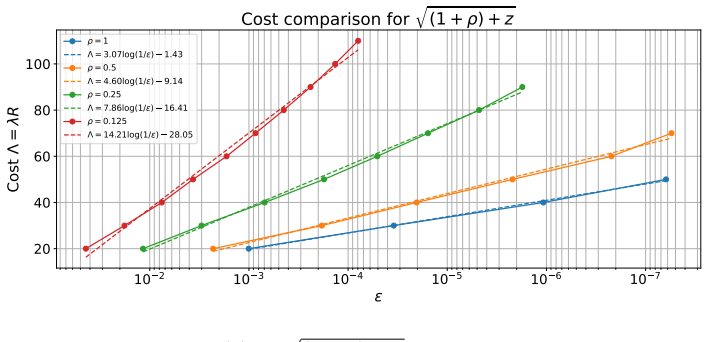
- Numerical experiments on low-dimensional non-normal matrices would directly check whether the claimed complexity holds in practice.
Load-bearing premise
The function f is analytic on the numerical range of A and the Weyl calculus reduction incurs no hidden costs that change the stated query complexity.
What would settle it
A concrete counter-example computation for an analytic f and a non-normal A in which the number of queries needed to reach error ε exceeds O(log 1/ε).
Figures

read the original abstract
Linear combination of Hamiltonian simulation (LCHS) provides an efficient method for implementing matrix exponentials $e^{-tA}$ on quantum computers. In this paper, we develop LCHS formulas for computing general matrix functions $f(A)$ when $f$ is analytic on the numerical range of $A$, with $A$ possibly non-normal. The essential technical tool is Weyl calculus, which reduces the construction of LCHS formulas for noncommuting operators to scalar Fourier approximation problems. Our construction yields a quantum eigenvalue transformation algorithm with optimal $\mathcal{O}(\log\frac{1}{\epsilon})$ query complexity scaling. Furthermore, our Weyl-calculus-based theory gives rise to an ansatz-free convex optimization framework that directly produces discrete LCHS formulas. This circumvents the inefficiencies of traditional quadrature rules and yields formulas highly optimized for coherent implementation on quantum computers. In addition, both our theory and optimization framework apply to the simulation of time-dependent dissipative ODE $\frac{\mathrm{d}}{\mathrm{d} t} \psi(t) = -A(t)\psi(t)$, for which we achieve a $2.1\times$ cost reduction over prior art.
Editorial analysis
A structured set of objections, weighed in public.
Referee Report
Summary. The manuscript develops LCHS formulas for analytic matrix functions f(A) on the numerical range of possibly non-normal A by reducing the problem via Weyl calculus to scalar Fourier approximation. This yields a quantum eigenvalue transformation algorithm with claimed optimal O(log 1/ε) query complexity, an ansatz-free convex optimization framework for discrete LCHS formulas, and a 2.1× cost reduction for simulating time-dependent dissipative ODEs dψ/dt = −A(t)ψ(t).
Significance. If the Weyl reduction achieves the stated complexity with no hidden overheads, the work would deliver an optimal quantum eigenvalue transformation algorithm together with a reproducible convex-optimization route to coherent LCHS formulas; the concrete 2.1× improvement on the time-dependent ODE benchmark is a measurable practical contribution.
major comments (1)
- [Abstract (complexity statement) and the Weyl-calculus reduction section] The optimality claim O(log 1/ε) query complexity rests on the assertion that every term in the Weyl expansion maps to an independent LCHS call whose aggregate cost remains strictly O(log 1/ε) with no extra logarithmic multiplier arising from symbol ordering, numerical-range enlargement, or discretization. The manuscript must supply an explicit bound on the number of LCHS invocations and demonstrate that this bound is independent of the condition number of the numerical range.
minor comments (1)
- The analyticity assumption on the numerical range should be stated with an explicit radius or strip width to make the Fourier-approximation error bounds fully quantitative.
Simulated Author's Rebuttal
We thank the referee for the careful reading and for identifying a point that strengthens the complexity analysis. We address the major comment below.
read point-by-point responses
-
Referee: [Abstract (complexity statement) and the Weyl-calculus reduction section] The optimality claim O(log 1/ε) query complexity rests on the assertion that every term in the Weyl expansion maps to an independent LCHS call whose aggregate cost remains strictly O(log 1/ε) with no extra logarithmic multiplier arising from symbol ordering, numerical-range enlargement, or discretization. The manuscript must supply an explicit bound on the number of LCHS invocations and demonstrate that this bound is independent of the condition number of the numerical range.
Authors: We agree that the manuscript does not yet contain an explicit, self-contained bound isolating the total number of LCHS invocations from the condition number of the numerical range. The Weyl-calculus reduction reduces the problem to scalar Fourier approximation, which in principle yields a term count depending only on the analyticity radius of f, the diameter of the numerical range, and ε. However, this independence is asserted rather than proved in a dedicated lemma. In the revised version we will insert a new lemma (in the Weyl-calculus reduction section) that supplies the required bound: the number of invocations is at most C(log(1/ε) + 1), where C depends only on the analyticity parameters and the numerical-range diameter and is independent of its condition number. Symbol-ordering overhead is absorbed into the Weyl calculus without extra logarithmic factors. We will also add a short remark in the abstract clarifying that the O(log 1/ε) claim is now supported by this explicit bound. revision: yes
Circularity Check
No significant circularity; derivation is self-contained
full rationale
The paper presents Weyl calculus as an external technical tool that reduces non-commuting operator functions to scalar Fourier approximation problems, from which LCHS formulas and the O(log 1/ε) complexity are derived as outputs of the construction. No self-definitional reductions, fitted inputs renamed as predictions, or load-bearing self-citations appear in the provided text. The central claims (optimal query scaling, ansatz-free optimization framework, 2.1× cost reduction) are positioned as consequences of the new method rather than presupposed by definition or prior self-citation chains. The derivation chain remains independent of its target results.
Axiom & Free-Parameter Ledger
axioms (2)
- domain assumption f is analytic on the numerical range of A
- domain assumption Weyl calculus reduces non-commuting operator problems to scalar Fourier approximation
Reference graph
Works this paper leans on
-
[1]
Hestenes, M. R. , TITLE =. Duke Math. J. , FJOURNAL =. 1941 , PAGES =
1941
-
[2]
1950 , PAGES =
Weyl, Hermann , TITLE =. 1950 , PAGES =
1950
-
[3]
Journal of functional analysis , volume=
The Weyl functional calculus , author=. Journal of functional analysis , volume=. 1969 , publisher=
1969
-
[4]
2004 , publisher=
Spectral Properties of Noncommuting Operators Lecture Notes in Mathematics 1843 , author=. 2004 , publisher=
2004
-
[5]
Physical Review Letters , volume=
Linear combination of Hamiltonian simulation for nonunitary dynamics with optimal state preparation cost , author=. Physical Review Letters , volume=. 2023 , publisher=
2023
-
[6]
Communications in Mathematical Physics , volume=
Quantum Algorithm for Linear Non-unitary Dynamics with Near-Optimal Dependence on All Parameters , author=. Communications in Mathematical Physics , volume=. 2026 , publisher=
2026
-
[7]
arXiv preprint arXiv:2506.20760 , year=
Constant-factor improvements in quantum algorithms for linear differential equations , author=. arXiv preprint arXiv:2506.20760 , year=
-
[8]
Quantum Information & Computation , volume=
Hamiltonian simulation using linear combinations of unitary operations , author=. Quantum Information & Computation , volume=
-
[9]
Proceedings of the 51st Annual ACM SIGACT Symposium on Theory of Computing , pages=
Quantum singular value transformation and beyond: exponential improvements for quantum matrix arithmetics , author=. Proceedings of the 51st Annual ACM SIGACT Symposium on Theory of Computing , pages=
-
[10]
Contemporary Mathematics , volume=
Quantum amplitude amplification and estimation , author=. Contemporary Mathematics , volume=
-
[11]
SIAM Journal on Computing , volume=
Laplace Transform--Based Quantum Eigenvalue Transformation via Linear Combination of Hamiltonian Simulation , author=. SIAM Journal on Computing , volume=. 2026 , publisher=
2026
-
[12]
arXiv preprint arXiv:2502.19688 , year=
Infinite-dimensional extension of the linear combination of Hamiltonian simulation: Theorems and applications , author=. arXiv preprint arXiv:2502.19688 , year=
-
[13]
arXiv preprint arXiv:2508.19596 , year=
Fourier transform-based linear combination of Hamiltonian simulation , author=. arXiv preprint arXiv:2508.19596 , year=
-
[14]
arXiv preprint arXiv:2508.19238 , year=
Optimal quantum simulation of linear non-unitary dynamics , author=. arXiv preprint arXiv:2508.19238 , year=
-
[15]
History and modern theory , author=
The logarithmic norm. History and modern theory , author=. BIT Numerical Mathematics , volume=. 2006 , publisher=
2006
-
[16]
Operator theory, functional analysis and applications , pages=
Dilation theory: a guided tour , author=. Operator theory, functional analysis and applications , pages=. 2021 , publisher=
2021
-
[17]
Eine spektraltheorie f
Neumann, Johann Von , journal=. Eine spektraltheorie f. 1950 , publisher=
1950
-
[18]
1987 , PAGES =
Rudin, Walter , TITLE =. 1987 , PAGES =
1987
-
[19]
Quantum , volume=
Hamiltonian simulation by qubitization , author=. Quantum , volume=. 2019 , publisher=
2019
-
[20]
Physical review letters , volume=
Fixed-point quantum search with an optimal number of queries , author=. Physical review letters , volume=. 2014 , publisher=
2014
-
[21]
Physical Review A , volume=
Fast inversion, preconditioned quantum linear system solvers, fast Green's-function computation, and fast evaluation of matrix functions , author=. Physical Review A , volume=. 2021 , publisher=
2021
-
[22]
SIAM Journal on Computing , volume=
Quantum eigenvalue processing , author=. SIAM Journal on Computing , volume=. 2026 , publisher=
2026
-
[23]
arXiv preprint arXiv:2601.11959 , year=
Contour-integral based quantum eigenvalue transformation: analysis and applications , author=. arXiv preprint arXiv:2601.11959 , year=
-
[24]
Souichi Takahira and Asuka Ohashi and Tomohiro Sogabe and Tsuyoshi S. Usuda , title =. doi:10.26421/qic20.1-2-2 , year = 2020, publisher =
-
[25]
Takahira, Souichi and Ohashi, Asuka and Sogabe, Tomohiro and Usuda, Tsuyoshi S. , year=. Quantum algorithms based on the block-encoding framework for matrix functions by contour integrals , volume=. Quantum Information and Computation , publisher=. doi:10.26421/QIC22.11-12-4 , number=
-
[26]
Physical Review Letters , volume=
Quantum algorithm for linear systems of equations , author=. Physical Review Letters , volume=. 2009 , publisher=
2009
-
[27]
Reviews of Modern Physics , volume=
Noisy intermediate-scale quantum algorithms , author=. Reviews of Modern Physics , volume=. 2022 , doi=
2022
-
[28]
2025 , doi=
Quantum Algorithms: A Survey of Applications and End-to-End Complexities , author=. 2025 , doi=
2025
-
[29]
Reports on Progress in Physics , volume=
Quantum algorithms for scientific computing , author=. Reports on Progress in Physics , volume=. 2024 , doi=
2024
-
[30]
Physical review letters , volume=
Optimal Hamiltonian simulation by quantum signal processing , author=. Physical review letters , volume=. 2017 , publisher=
2017
-
[31]
Journal of Physics A: Mathematical and Theoretical , volume=
High-order quantum algorithm for solving linear differential equations , author=. Journal of Physics A: Mathematical and Theoretical , volume=
-
[32]
Communications in Mathematical Physics , volume=
Quantum algorithm for linear differential equations with exponentially improved dependence on precision , author=. Communications in Mathematical Physics , volume=
-
[33]
Communications in Mathematical Physics , volume=
Quantum spectral methods for differential equations , author=. Communications in Mathematical Physics , volume=
-
[34]
Quantum , volume=
Time-marching based quantum solvers for time-dependent linear differential equations , author=. Quantum , volume=
-
[35]
Quantum , volume=
Improved quantum algorithms for linear and nonlinear differential equations , author=. Quantum , volume=
-
[36]
Quantum , volume=
Quantum algorithm for time-dependent differential equations using Dyson series , author=. Quantum , volume=
-
[37]
arXiv preprint arXiv:2212.13969 , year=
Quantum simulation of partial differential equations via Schrodingerisation , author=. arXiv preprint arXiv:2212.13969 , year=
-
[38]
PRX Quantum , volume=
Ground-state preparation and energy estimation on early fault-tolerant quantum computers via quantum eigenvalue transformation of unitary matrices , author=. PRX Quantum , volume=
-
[39]
PRX Quantum , volume=
Generalized quantum signal processing , author=. PRX Quantum , volume=
-
[40]
arXiv preprint arXiv:2312.00723 , year=
Generalized quantum singular value transformation , author=. arXiv preprint arXiv:2312.00723 , year=
-
[41]
Quantum Eigenvalue Transformations for Arbitrary Matrices
Quantum eigenvalue transformations for arbitrary matrices , author=. arXiv preprint arXiv:2604.19688 , year=
work page internal anchor Pith review Pith/arXiv arXiv
-
[42]
Journal of Computational Physics , pages=
An efficient explicit implementation of a near-optimal quantum algorithm for simulating linear dissipative differential equations , author=. Journal of Computational Physics , pages=. 2026 , publisher=
2026
-
[43]
Circuit-efficient randomized quantum simulation of non-unitary dynamics with observable-driven and symmetry-aware designs , author=. arXiv preprint arXiv:2509.08030 , year=
-
[44]
Quantum differential equation solver via hybrid oscillator-qubit linear combination of Hamiltonian simulations , author=. arXiv preprint arXiv:2605.10708 , year=
work page internal anchor Pith review Pith/arXiv arXiv
-
[45]
Physical Review X , volume=
Theory of trotter error with commutator scaling , author=. Physical Review X , volume=. 2021 , publisher=
2021
-
[46]
arXiv preprint arXiv:1811.08017 , year=
A random compiler for fast Hamiltonian simulation , author=. arXiv preprint arXiv:1811.08017 , year=
-
[47]
Physical Review Letters , volume=
Randomized quantum algorithm for statistical phase estimation , author=. Physical Review Letters , volume=. 2022 , publisher=
2022
-
[48]
1990 , month =
Rudin, Walter , title =. 1990 , month =
1990
-
[49]
2000 , publisher=
Strongly elliptic systems and boundary integral equations , author=. 2000 , publisher=
2000
-
[50]
2011 , publisher=
Elliptic problems in nonsmooth domains , author=. 2011 , publisher=
2011
discussion (0)
Sign in with ORCID, Apple, or X to comment. Anyone can read and Pith papers without signing in.