Optimal Posterior E-values with Non-Convex Parameter Sets with Applications to Voting Systems
Pith reviewed 2026-06-30 04:19 UTC · model grok-4.3
The pith
Optimal posterior e-values for non-convex hypothesis sets in sequential testing can be computed using the Frank-Wolfe algorithm.
A machine-rendered reading of the paper's core claim, the machinery that carries it, and where it could break.
Core claim
The paper establishes that posterior optimal e-values can be obtained by solving a reverse information projection problem over composite sets H0 and H1, and that this optimization can be performed efficiently with the Frank-Wolfe algorithm even when H0 is non-convex. This construction yields valid sequential tests that permit early stopping while controlling error rates for outcomes under Condorcet, Borda, and Schulze voting rules.
What carries the argument
The Frank-Wolfe algorithm applied to the reverse information projection optimization that defines posterior optimal e-values.
Load-bearing premise
The Frank-Wolfe algorithm is assumed to locate the global optimum for the e-value optimization problem despite the non-convexity of the parameter sets.
What would settle it
On a small non-convex instance where the true optimal e-value can be found by exhaustive search or convex relaxation, the Frank-Wolfe output differs from that optimum by more than numerical tolerance.
Figures



read the original abstract
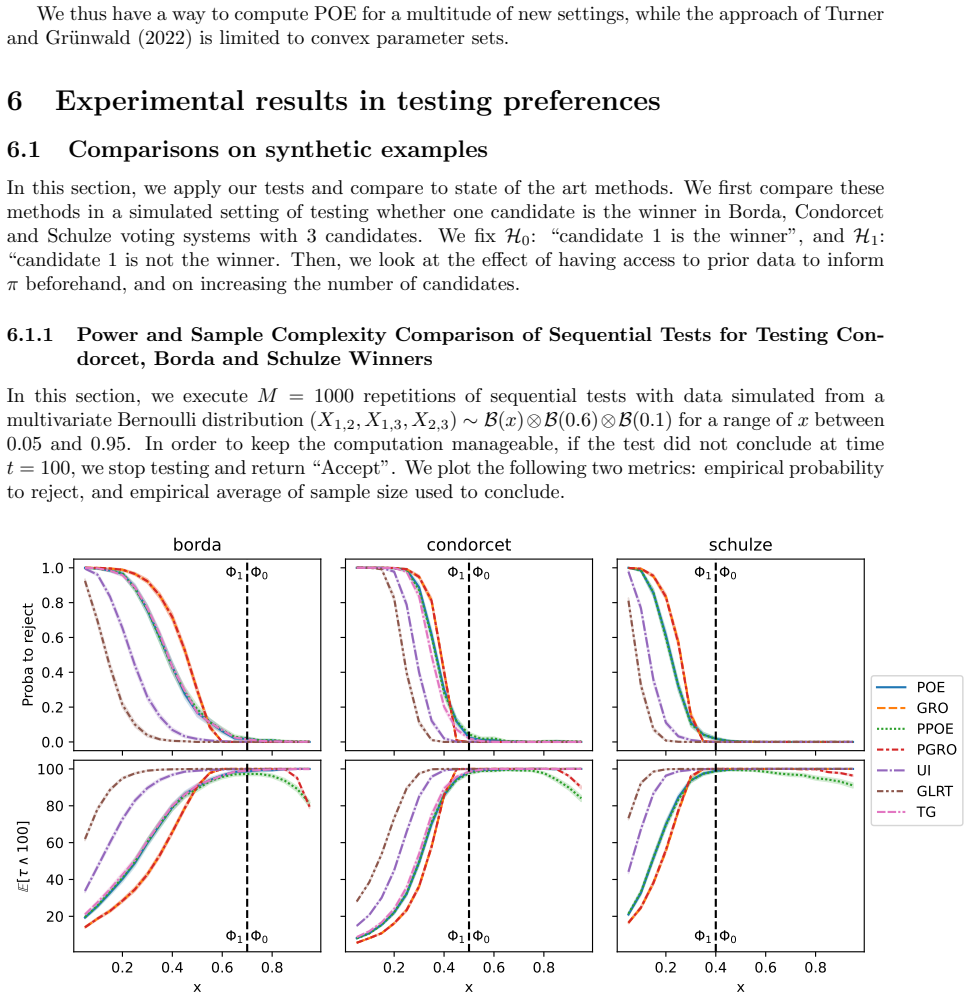
We are interested in conducting political polls sequentially, so that one can stop acquiring data as soon as possible while safely yielding statistically significant results. Building off e-values, which have recently become a useful tool to create sequential testing methods, we develop a theory of posterior optimal e-values. We use voting as a convenient example on which to illustrate our method. First, we design statistical tests for Condorcet and Borda voting system, and also for Schulze voting system which we are the first to tackle statistically. Then, we study the construction of optimal sequential e-values in the deceptively simple setting of multivariate Bernoulli data, with general composite null and alternative hypothesis sets $\mathcal{H}_0$ and $\mathcal{H}_1$. We give a way to compute these e-values using an efficient Frank-Wolfe algorithm, giving a pretty general way to compute Reverse Information Projections, even when $\mathcal{H}_0$ corresponds to a non-convex parameter set. Finally, we illustrate the efficiency, both in terms of power and sample size of our method. We compare with state of the art in both simulated and real data experiments, with application to French 2022 presidential election data.
Editorial analysis
A structured set of objections, weighed in public.
Referee Report
Summary. The manuscript develops a theory of posterior optimal e-values for sequential hypothesis testing with composite hypotheses on multivariate Bernoulli data. It applies the framework to construct statistical tests for Condorcet, Borda, and Schulze voting systems (the latter claimed as a first statistical treatment), proposes an efficient Frank-Wolfe algorithm to compute the associated reverse information projections even when the null parameter set H0 is non-convex, and illustrates the method's efficiency via power and sample-size comparisons on simulated data and French 2022 presidential election data.
Significance. If the central computational claim holds, the work supplies a practical, general-purpose method for obtaining optimal e-values under non-convex hypothesis classes, extending e-value methodology to sequential testing problems with complex geometry. Credit is due for the explicit application to voting systems and the empirical comparisons with existing methods.
major comments (1)
- [Section describing the Frank-Wolfe algorithm] Section describing the Frank-Wolfe algorithm (the paragraph beginning 'We give a way to compute these e-values using an efficient Frank-Wolfe algorithm'): the claim that this procedure computes the globally optimal reverse information projection for arbitrary non-convex H0 lacks supporting analysis. Standard Frank-Wolfe convergence theory requires a convex feasible set to guarantee global optimality via the linear minimization oracle; on non-convex sets the method converges at best to stationary points. No additional structure (hidden convexity, special geometry of the objective, or custom convergence proof) is identified to restore global optimality, which is load-bearing for the headline optimality result.
minor comments (1)
- The abstract states that the Schulze system is tackled 'for the first time' statistically; a brief literature pointer or footnote confirming the absence of prior e-value or sequential tests would strengthen this claim.
Simulated Author's Rebuttal
We thank the referee for their careful reading and constructive feedback on the manuscript. We address the major comment below.
read point-by-point responses
-
Referee: [Section describing the Frank-Wolfe algorithm] Section describing the Frank-Wolfe algorithm (the paragraph beginning 'We give a way to compute these e-values using an efficient Frank-Wolfe algorithm'): the claim that this procedure computes the globally optimal reverse information projection for arbitrary non-convex H0 lacks supporting analysis. Standard Frank-Wolfe convergence theory requires a convex feasible set to guarantee global optimality via the linear minimization oracle; on non-convex sets the method converges at best to stationary points. No additional structure (hidden convexity, special geometry of the objective, or custom convergence proof) is identified to restore global optimality, which is load-bearing for the headline optimality result.
Authors: We agree that the manuscript does not supply a convergence analysis or special structure establishing global optimality of the Frank-Wolfe iterates for arbitrary non-convex H0. Standard theory indeed yields only stationarity in the non-convex case. The algorithm is offered as a practical computational tool whose performance is illustrated empirically on the voting examples; the general claim of global optimality for non-convex sets is not rigorously justified in the current text. We will revise the relevant section to qualify the claim accordingly, stating that the procedure computes a stationary point and that global optimality is not guaranteed without additional assumptions. revision: yes
Circularity Check
No significant circularity
full rationale
The abstract and description present a computational contribution via Frank-Wolfe for reverse information projections on non-convex H0, without any quoted steps that reduce claims to self-definitions, fitted parameters renamed as predictions, or load-bearing self-citations. No equations or derivations are shown that equate outputs to inputs by construction. The method is offered as an independent algorithmic tool, making the derivation self-contained per the provided text.
Axiom & Free-Parameter Ledger
Reference graph
Works this paper leans on
-
[1]
Bubeck, S. Convex. Foundations and Trends. doi:10.1561/2200000050 , urldate =
-
[2]
Naval Research Logistics Quarterly , volume =
An Algorithm for Quadratic Programming , author =. Naval Research Logistics Quarterly , volume =. doi:10.1002/nav.3800030109 , urldate =
-
[3]
Agrawal, Shubhada and Ramdas, Aaditya , year = 2025, month = apr, number =. On. doi:10.48550/arXiv.2504.19952 , urldate =. 2504.19952 , primaryclass =
-
[5]
1999 , publisher=
Elements of information theory , author=. 1999 , publisher=
1999
-
[6]
, year = 2007, publisher =
Robert, Christian P. , year = 2007, publisher =. The
2007
-
[7]
Gr. Beyond. doi:10.48550/arXiv.2205.00901 , urldate =. 2205.00901 , primaryclass =
-
[8]
Contributions to the
Kaufmann, Emilie , year = 2020, institution =. Contributions to the
2020
-
[9]
doi:10.5281/zenodo.10998451 , url =
Delemazure, Théo and Bouveret, Sylvain , title =. doi:10.5281/zenodo.10998451 , url =
-
[10]
Spertus, Jacob V. and Stark, Philip B. , year = 2022, month = jul, number =. Sweeter than. doi:10.48550/arXiv.2207.03379 , urldate =. 2207.03379 , primaryclass =
-
[11]
doi:10.48550/arXiv.2107.11323 , urldate =. 2107.11323 , primaryclass =
-
[12]
Ramdas, Aaditya and Wang, Ruodu , year = 2025, month = jul, journal =. Hypothesis. doi:10.1561/3600000002 , urldate =
-
[13]
Turner, Rosanne J. and Ly, Alexander and Gr. Generic. Journal of Statistical Planning and Inference , volume =. doi:10.1016/j.jspi.2023.106116 , urldate =
-
[14]
Makur, Anuran and Singh, Japneet , year = 2024, month = oct, number =. Minimax. doi:10.48550/arXiv.2410.08360 , urldate =. 2410.08360 , publisher =
-
[15]
Hao, Yunda and Gr. E-. doi:10.48550/arXiv.2409.11134 , urldate =. 2409.11134 , primaryclass =
-
[16]
doi:10.48550/arXiv.2601.11347 , urldate =
Optimal E-Values for Testing the Mean of a Bounded Random Variable against a Composite Alternative , author =. doi:10.48550/arXiv.2601.11347 , urldate =. 2601.11347 , primaryclass =
-
[17]
Gr. Optimal. doi:10.48550/arXiv.2404.19465 , urldate =. 2404.19465 , primaryclass =
-
[18]
2005 , publisher=
Constrained statistical inference: Inequality, order and shape restrictions , author=. 2005 , publisher=
2005
-
[19]
2021 , journal =
Optimal Best-Arm Identification Methods for Tail-Risk Measures , author =. 2021 , journal =
2021
-
[20]
arXiv preprint arXiv:2504.00593 , year=
Power comparison of sequential testing by betting procedures , author=. arXiv preprint arXiv:2504.00593 , year=
-
[21]
Ye, Keying , year =. Reference. Journal of the American Statistical Association , volume =. doi:10.2307/2290732 , urldate =. 2290732 , eprinttype =
-
[22]
The Formal Definition of Reference Priors , author =. 2009 , month = apr, journal =. doi:10.1214/07-AOS587 , urldate =
-
[23]
IEEE Transactions on Information Theory , year=
Reverse information projections and optimal e-statistics , author=. IEEE Transactions on Information Theory , year=
-
[24]
2007 , publisher=
The Bayesian choice: from decision-theoretic foundations to computational implementation , author=. 2007 , publisher=
2007
-
[25]
Koolen and Peter Grünwald , keywords =
Wouter M. Koolen and Peter Grünwald , keywords =. Log-optimal anytime-valid E-values , journal =. 2022 , note =. doi:https://doi.org/10.1016/j.ijar.2021.09.010 , url =
-
[26]
Advances in Neural Information Processing Systems , volume=
Auditing fairness by betting , author=. Advances in Neural Information Processing Systems , volume=
-
[27]
2017 , publisher=
Fundamentals of nonparametric Bayesian inference , author=. 2017 , publisher=
2017
-
[28]
van der Vaart, A. W. , year =. Asymptotic
-
[29]
Statistics and Decisions, Dedewicz , volume=
Information geometry and alternating minimization procedures , author=. Statistics and Decisions, Dedewicz , volume=. 1984 , publisher=
1984
-
[30]
arXiv preprint arXiv:2412.17554 , year=
Growth-Optimal E-Variables and an extension to the multivariate Csisz 'ar-Sanov-Chernoff Theorem , author=. arXiv preprint arXiv:2412.17554 , year=
-
[31]
, title =
Kaufmann, Emilie and Koolen, Wouter M. , title =. J. Mach. Learn. Res. , month = jan, articleno =. 2021 , issue_date =
2021
-
[32]
The. 2007 , series =. doi:10.1007/0-387-71599-1 , urldate =
-
[33]
Bengs, Viktor and. Preference-Based. 2021 , month = jul, number =. doi:10.48550/arXiv.1807.11398 , urldate =. 1807.11398 , primaryclass =
-
[34]
Chen, Wei and Du, Yihan and Huang, Longbo and Zhao, Haoyu , year =. Combinatorial. 37th. doi:10.48550/arXiv.2006.12772 , urldate =. 2006.12772 , primaryclass =
-
[35]
Conitzer, Vincent and Sandholm, Tuomas , year =. Common. 1207.1368 , primaryclass =
-
[36]
Relations between
Dabak, Anand and Johnson, Don , year =. Relations between
-
[37]
Efron, Bradley , year =. Simultaneous Inference:. The Annals of Applied Statistics , volume =. doi:10.1214/07-AOAS141 , urldate =
-
[38]
Garivier, Aur. Non-. 2021 , month = nov, number =. doi:10.48550/arXiv.1905.03495 , urldate =. 1905.03495 , primaryclass =
-
[39]
Gr. Safe. 2023 , month = mar, number =. doi:10.48550/arXiv.1906.07801 , urldate =. 1906.07801 , primaryclass =
-
[40]
Identification of the
Haddenhorst, Bj. Identification of the. Advances in. 2021 , volume =
2021
-
[41]
Testification of
Haddenhorst, Bj. Testification of
-
[42]
and Zhao, Hongyu and Zhou, Harrison H
Hu, James X. and Zhao, Hongyu and Zhou, Harrison H. , year =. False. Journal of the American Statistical Association , volume =. doi:10.1198/jasa.2010.tm09329 , urldate =
-
[43]
Ignatiadis, Nikolaos and Huber, Wolfgang , year =. Covariate. Journal of the Royal Statistical Society Series B: Statistical Methodology , volume =. doi:10.1111/rssb.12411 , urldate =
-
[44]
E-Values as Unnormalized Weights in Multiple Testing , author =. 2023 , month = jul, number =. 2204.12447 , primaryclass =
arXiv 2023
-
[45]
Kaufmann, Emilie and Koolen, Wouter , year =. Mixture. doi:10.48550/arXiv.1811.11419 , urldate =. 1811.11419 , primaryclass =
-
[46]
Kostinger, M. and Hirzer, M. and Wohlhart, P. and Roth, P. M. and Bischof, H. , year =. Large Scale Metric Learning from Equivalence Constraints , booktitle =. doi:10.1109/CVPR.2012.6247939 , urldate =
-
[47]
Lehmann, E.L. and Romano, Joseph P. , year =. Testing. doi:10.1007/978-3-030-70578-7 , urldate =
-
[48]
Lei, Lihua and Fithian, William , year =. 1609.06035 , primaryclass =
-
[49]
Multiple Testing with the Structure Adaptive
Li, Ang and Barber, Rina Foygel , year =. Multiple Testing with the Structure Adaptive. 1606.07926 , primaryclass =
-
[50]
Estimation of
Li, Jonathan , year =. Estimation of
-
[51]
Ramdas, Aaditya and Gr. Game-. 2023 , month = nov, journal =. doi:10.1214/23-STS894 , urldate =
-
[52]
Rastogi, Charvi and Balakrishnan, Sivaraman and Shah, Nihar B. and Singh, Aarti , year =. Two-. doi:10.48550/arXiv.2006.11909 , urldate =. 2006.11909 , primaryclass =
-
[53]
Ren, Zhimei and Cand. Knockoffs with. 2020 , month = jan, number =. 2001.07835 , primaryclass =
arXiv 2020
-
[54]
Saha, Aadirupa and Gopalan, Aditya , year =. From. 1903.00558 , primaryclass =
arXiv 1903
-
[55]
Versatile
Saha, Aadirupa and Gaillard, Pierre , year =. Versatile. Proceedings of the 39th
-
[56]
Wiley.com , urldate =
Sequential. Wiley.com , urldate =
-
[57]
Taplin, Ross H. , year =. The. Journal of the Royal Statistical Society. Series C (Applied Statistics) , volume =. doi:10.1111/1467-9876.00086 , urldate =. 2986359 , eprinttype =
-
[58]
Turner, Rosanne and Gr. Exact. 2022 , month = jun, number =. doi:10.48550/arXiv.2203.09785 , urldate =. 2203.09785 , primaryclass =
-
[59]
Wasserman, Larry , year =. All of. doi:10.1007/978-0-387-21736-9 , urldate =
-
[60]
Wasserman, Larry and Ramdas, Aaditya and Balakrishnan, Sivaraman , year =. Universal. Proceedings of the National Academy of Sciences , volume =. doi:10.1073/pnas.1922664117 , urldate =. 1912.11436 , primaryclass =
-
[61]
Xia, Lirong , year =. Optimal. doi:10.48550/arXiv.2006.11362 , urldate =. 2006.11362 , primaryclass =
-
[62]
Simultaneous
Xu, Austin and Davenport, Mark , year =. Simultaneous. Advances in
-
[63]
A Unified Framework for Bandit Multiple Testing , author =. 2021 , month = nov, number =. doi:10.48550/arXiv.2107.07322 , urldate =. 2107.07322 , primaryclass =
-
[64]
Social Choice and Welfare , volume =
A New Monotonic, Clone-Independent, Reversal Symmetric, and Condorcet-Consistent Single-Winner Election Method , author =. Social Choice and Welfare , volume =. doi:10.1007/s00355-010-0475-4 , urldate =
-
[65]
Boucheron, St. Concentration. doi:10.1093/acprof:oso/9780199535255.001.0001 , urldate =
-
[66]
Sequential
Ghosh, Malay and Mukhopadhyay, Nitis and Sen, Pranab Kumar , year = 1997, publisher =. Sequential
1997
discussion (0)
Sign in with ORCID, Apple, or X to comment. Anyone can read and Pith papers without signing in.