Rectangles, triangles and Schr\"{o}dinger waves
Pith reviewed 2026-06-30 03:35 UTC · model grok-4.3
The pith
Lattice point sets with many rectangles but few isosceles triangles yield explicit counterexamples to the paraboloid Mizohata-Takeuchi conjecture.
A machine-rendered reading of the paper's core claim, the machinery that carries it, and where it could break.
Core claim
Finite sets of lattice points can be chosen to determine many rectangles and few isosceles triangles; through a transference principle relating periodic and Euclidean weighted L2 estimates for Schrödinger solutions, these configurations furnish new explicit combinatorial counterexamples to the paraboloid Mizohata-Takeuchi conjecture.
What carries the argument
Transference between Euclidean and periodic weighted L2 estimates for Schrödinger solutions, linked to the combinatorial counts of rectangles and isosceles triangles formed by lattice point sets.
If this is right
- The periodic estimates fail for the constructed point sets because of the rectangle-triangle imbalance.
- The Euclidean estimates on the paraboloid therefore also fail for the corresponding data.
- The counterexamples are combinatorial and explicit rather than non-constructive.
Where Pith is reading between the lines
- The same rectangle-triangle imbalance might obstruct estimates for other dispersive equations or surfaces.
- The finite-field method used to build the sets could be adapted to produce counterexamples in higher dimensions or for different combinatorial configurations.
Load-bearing premise
The failure of the periodic weighted L2 estimates for these lattice configurations directly transfers to a failure of the Euclidean Mizohata-Takeuchi estimates.
What would settle it
A direct verification that the weighted L2 estimates remain bounded for one of the constructed lattice sets in the periodic model would show the transference does not produce a counterexample.
Figures

read the original abstract
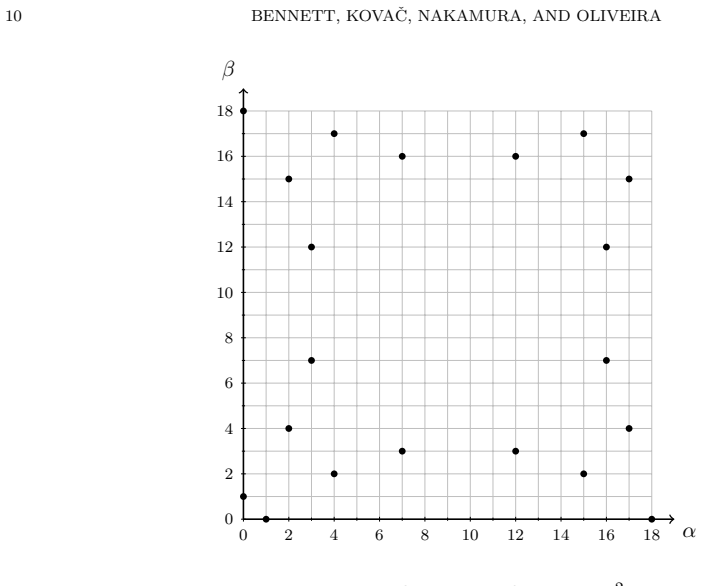
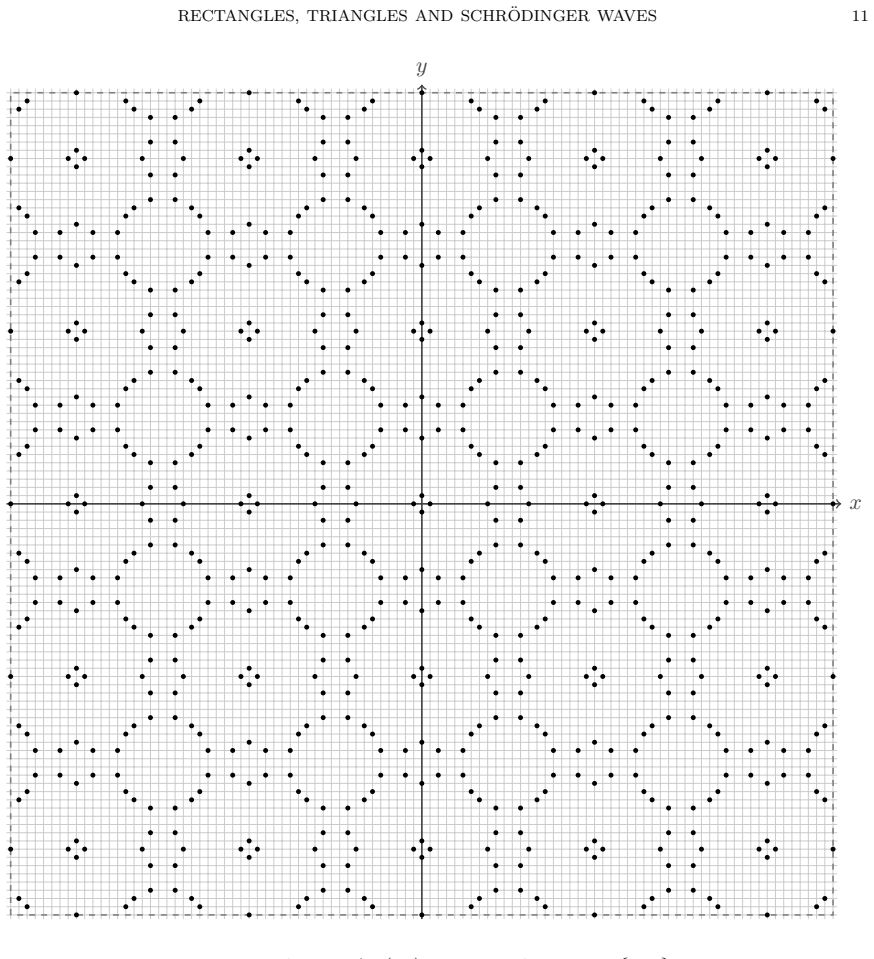
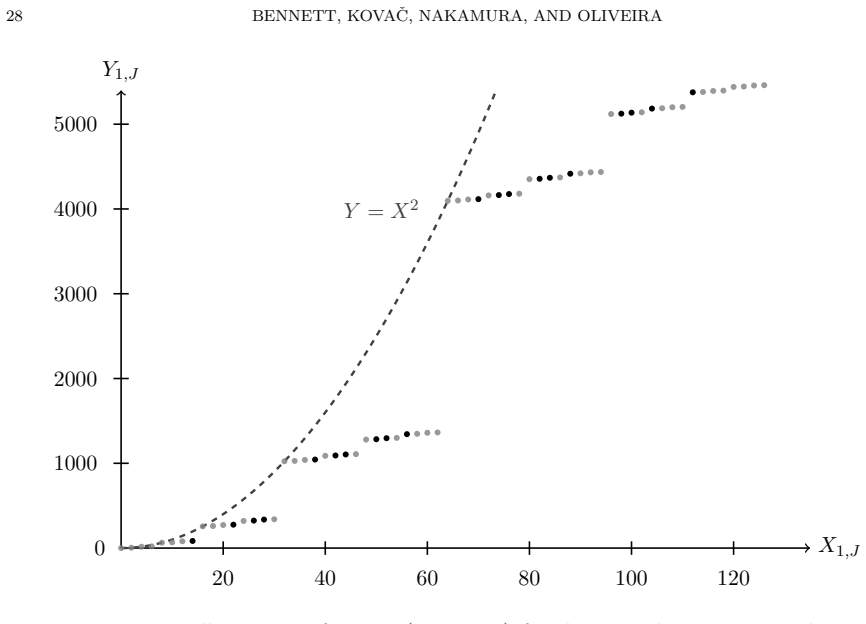
Can a finite set of lattice points determine many rectangles and few isosceles triangles? This turns out to be a surprisingly interesting question in combinatorial geometry that we answer using basic analytic number theory combined with a finite-field construction. The result is useful because it gives obstructions to Mizohata--Takeuchi-type estimates in the setting of the paraboloid. Specifically, we establish transference between Euclidean and periodic weighted $\mathrm{L}^2$ estimates for solutions to the Schr\"{o}dinger equation, and then relate the failure of the latter to quantities tied to combinatorial problems, such as the one above. By completing this programme we give new explicit combinatorial counterexamples to the paraboloid case of the Mizohata--Takeuchi conjecture, which was recently shown to be false by Cairo for curved hypersurfaces.
Editorial analysis
A structured set of objections, weighed in public.
Referee Report
Summary. The paper constructs finite sets of lattice points with many rectangles but few isosceles triangles via finite-field methods combined with analytic number theory. It establishes a transference principle linking Euclidean and periodic weighted L² estimates for Schrödinger solutions, then uses the failure of the periodic estimates (controlled by the combinatorial counts) to produce explicit counterexamples to the paraboloid case of the Mizohata-Takeuchi conjecture.
Significance. If the transference holds with quantitative control, the work supplies explicit combinatorial counterexamples to the Mizohata-Takeuchi conjecture on the paraboloid, complementing Cairo's recent non-constructive result for curved hypersurfaces. The explicit nature of the counterexamples and the link between combinatorial geometry and PDE estimates would be a notable contribution.
major comments (2)
- [Transference section] Transference section (following the combinatorial construction): the claim that periodic weighted L² failure (quantified by rectangle and triangle counts) implies Euclidean Mizohata-Takeuchi failure requires explicit quantitative bounds on how the constants depend on the period, the weight approximation, and the combinatorial parameters; without these, the explicit counterexample may not survive the lift.
- [Finite-field construction and periodic estimate section] Finite-field construction and periodic estimate section: it is unclear whether the constants measuring the weighted L² failure (tied to the number of rectangles minus isosceles triangles) remain bounded independently of the discretization when the finite-field example is lifted to the torus; this is load-bearing for the central claim of an explicit Euclidean counterexample.
minor comments (2)
- The introduction would benefit from a brief numerical example illustrating the rectangle-triangle imbalance before the full construction.
- Notation for the weights in the periodic estimates should be cross-referenced explicitly to the combinatorial quantities.
Simulated Author's Rebuttal
We are grateful to the referee for their thorough review and valuable feedback on our manuscript. The comments regarding the quantitative aspects of the transference principle are well-taken, and we will address them by providing explicit bounds in the revision. Below we respond point by point to the major comments.
read point-by-point responses
-
Referee: [Transference section] Transference section (following the combinatorial construction): the claim that periodic weighted L² failure (quantified by rectangle and triangle counts) implies Euclidean Mizohata-Takeuchi failure requires explicit quantitative bounds on how the constants depend on the period, the weight approximation, and the combinatorial parameters; without these, the explicit counterexample may not survive the lift.
Authors: We agree that explicit quantitative bounds are essential for the validity of the counterexamples. The manuscript establishes the transference but leaves the dependence implicit. We will revise the transference section to include a careful tracking of constants, demonstrating that they depend at most linearly on the logarithm of the period and polynomially on the number of rectangles and triangles. Given that our combinatorial construction yields a superlinear growth in rectangles relative to triangles, the failure will carry over to the Euclidean setting with explicit control. revision: yes
-
Referee: [Finite-field construction and periodic estimate section] Finite-field construction and periodic estimate section: it is unclear whether the constants measuring the weighted L² failure (tied to the number of rectangles minus isosceles triangles) remain bounded independently of the discretization when the finite-field example is lifted to the torus; this is load-bearing for the central claim of an explicit Euclidean counterexample.
Authors: The lifting from the finite-field model to the torus is done with a fixed discretization scale relative to the field size, and the combinatorial counts are preserved up to lower order terms that do not affect the positivity of the failure constant. We will clarify this in the revision by providing the explicit computation of the weighted L² norm in terms of the rectangle and triangle counts, showing the constant is bounded below by c > 0 independent of the discretization parameter as long as it is chosen sufficiently small compared to the field characteristic. revision: yes
Circularity Check
No circularity: derivation rests on new finite-field construction and transference, independent of self-referential fitting or load-bearing self-citation
full rationale
The paper poses a combinatorial question on lattice points with many rectangles but few isosceles triangles, answers it via analytic number theory plus a finite-field construction, links the resulting quantities to failure of periodic weighted L2 estimates for Schrödinger solutions, and invokes an established transference principle to obtain Euclidean counterexamples. None of these steps reduce by definition or by self-citation to the target result; the combinatorial counts are independently constructed, the periodic failure is derived from them, and the transference is presented as a separate established link rather than a fitted or self-defined map. No equations or claims in the abstract exhibit the patterns of self-definition, fitted-input-as-prediction, or uniqueness imported from the authors' prior work. The derivation chain is therefore self-contained against external benchmarks.
Axiom & Free-Parameter Ledger
Reference graph
Works this paper leans on
-
[1]
N. Alon, T. F. Bloom, W. T. Gowers, D. Litt, W. Sawin, A. Shankar, J. Tsimerman, V. Wang, M. M. Wood, Remarks on the disproof of the unit distance conjecture,https://arxiv.org/abs/2605.20695, 2026
work page internal anchor Pith review Pith/arXiv arXiv 2026
-
[2]
J. A. Barcel´ o, A. Ruiz, L. Vega,Weighted estimates for the Helmholtz equation and consequences, Journal of Functional Analysis, Vol.150(1997), 356–382
1997
-
[3]
Bennett, S
J. Bennett, S. Guti´ errez, S. Nakamura, I. Oliveira,A phase-space approach to weighted Fourier extension inequalities, Forum Math. Sigma13(2025), e181, 1–54
2025
-
[4]
Bennett, S
J. Bennett, S. Nakamura,Tomography bounds for the Fourier extension operator and applications, Math. Ann.380(2021), 119–159
2021
-
[5]
Bennett, S
J. Bennett, S. Nakamura, S. Shiraki,Tomographic Fourier extension identities for submanifolds ofR n, Sel. Math. New Ser.30(2024), article 80, 14 pp
2024
-
[6]
Bennett, T
J. Bennett, T. Tao,Adjoint Brascamp–Lieb inequalities, Proc. Lond. Math. Soc.129(2024), no. 4, paper no. e12633, 51 pp
2024
-
[7]
T. F. Bloom, W. Sawin, C. Schildkraut, D. Zhelezov,The sum-product conjecture is false for real numbers, https://arxiv.org/abs/2605.28781, 2026
work page internal anchor Pith review Pith/arXiv arXiv 2026
-
[8]
Bourgain,Fourier transform restriction phenomena for certain lattice subsets and applications to non- linear evolution equations
J. Bourgain,Fourier transform restriction phenomena for certain lattice subsets and applications to non- linear evolution equations. I. Schr¨ odinger Equations, Geom. Funct. Anal.3(1993), no. 2, 107–156
1993
-
[9]
Bourgain,Fourier transform restriction phenomena for certain lattice subsets and applications to nonlinear evolution equations
J. Bourgain,Fourier transform restriction phenomena for certain lattice subsets and applications to nonlinear evolution equations. II. The KdV-equation, Geom. Funct. Anal.3(1993), no. 3, 209–262
1993
-
[10]
Bourgain, C
J. Bourgain, C. Demeter,The proof of theℓ 2 decoupling conjecture, Ann. of Math.182(1) (2015), 351–389
2015
-
[11]
N. Burq, P. G´ erard, N. Tzvetkov,Strichartz inequalities and the nonlinear Schr¨ odinger equation on compact manifolds, Amer. J. Math.126(2004), 569–605
2004
- [12]
- [13]
-
[14]
Carbery,Large sets with limited tube occupancy, J
A. Carbery,Large sets with limited tube occupancy, J. Lond. Math. Soc.79(2) (2009), 529–543
2009
-
[15]
Carbery, M
A. Carbery, M. Iliopoulou, H. Wang,Some sharp inequalities of Mizohata–Takeuchi-type, Rev. Mat. Iberoam. 40(4) (2024), 1387–1418
2024
-
[16]
T. A. C. M. Claasen, W. F. G. Mecklenbr¨ auker,The Wigner distribution – a tool for time-frequency signal analysis. Part II: Discrete-time signals, Philips J. Res.35(1980), 267–300
1980
-
[17]
A combinatorial large sieve for Sidon sets, distances, and norm forms
E. Croot, J. Mao, C. Pohoata, A. Sheffer, C. H. Yip,A combinatorial large sieve for Sidon sets, distances, and norm forms,https://arxiv.org/abs/2606.17487, 2026
work page internal anchor Pith review Pith/arXiv arXiv 2026
-
[18]
S. Dasu, H. Jung, Z. K. Li, J. Madrid,Mixed normℓ 2 decoupling for paraboloids, Int. Math. Res. Not.,20 (2023), 17972–18000
2023
-
[19]
Davenport, Multiplicative number theory
H. Davenport, Multiplicative number theory. Third edition. Revised and with a preface by Hugh L. Mont- gomery, Grad. Texts in Math.74, Springer-Verlag, New York, 2000
2000
-
[20]
Demeter, Fourier Restriction, Decoupling, and Applications, Cambridge University Press 2020
C. Demeter, Fourier Restriction, Decoupling, and Applications, Cambridge University Press 2020. RECTANGLES, TRIANGLES AND SCHR ¨ODINGER WAVES 33
2020
-
[21]
Dendrinos, A
S. Dendrinos, A. Mustata, M. Vitturi,A restricted 2-plane transform related to Fourier Restriction for surfaces of codimension 2, Anal. PDE18(2) (2025), 475–526
2025
-
[22]
Du,Weighted Fourier extension estimates and applications, Proc
X. Du,Weighted Fourier extension estimates and applications, Proc. Int. Cong. Math. 2022,4, pp. 3190–
2022
-
[23]
EMS Press, Berlin, 2023
2023
-
[24]
Dujella, Number theory, ˇSkolska Knjiga, Zagreb, 2021
A. Dujella, Number theory, ˇSkolska Knjiga, Zagreb, 2021
2021
-
[25]
I. G. Fenves,Cusp Excursions, Lattice Points on Manifolds, and the Mizohata–Takeuchi Conjecture,https: //arxiv.org/abs/2606.27020, 2026
work page internal anchor Pith review Pith/arXiv arXiv 2026
-
[26]
Ferrante, PhD thesis, University of Birmingham 2024
M. Ferrante, PhD thesis, University of Birmingham 2024
2024
-
[27]
Fourier restric- tion conjecture and related problems
L. Guth,An enemy scenario in restriction theory. Joint talk for AIM Research Community “Fourier restric- tion conjecture and related problems” and HAPPY network (2022);https://www.youtube.com/watch?v= x-DET83UjFg
2022
-
[28]
S. Herr, B. Kwak,Strichartz estimates and global well-posedness of the cubic NLS onT 2, Forum Math. Pi 12(2024), paper no. e14, 21 pp
2024
-
[29]
Hickman, J
J. Hickman, J. Wright,The Fourier Restriction and Kakeya Problems over Rings of Integers ModuloN, Discrete Anal. 2018, article 11, 54 pp
2018
-
[30]
Iosevich, D
A. Iosevich, D. Koh, M. Lewko,Finite field restriction estimates for the paraboloid in high even dimensions, J. Funct. Anal.278(2020), no. 11, 108450, 16 pp
2020
-
[31]
M. Keel, T. Tao,Endpoint Strichartz estimates, Amer. J. Math.120(5) (1998), 955–980
1998
-
[32]
Kinoshita, S
S. Kinoshita, S. Nakamura, A. Sanwal,Decoupling inequality for paraboloid under shell type restriction and its application to the periodic Zakharov system, Comm. Math. Phys.404(2023), 883–926
2023
-
[33]
Lewko,Counting rectangles and an improved restriction estimate for the paraboloid inF 3 p, Proc
M. Lewko,Counting rectangles and an improved restriction estimate for the paraboloid inF 3 p, Proc. Amer. Math. Soc. 148 (2020), no. 4, 1535–1543
2020
- [34]
-
[35]
F. R. W. M. Manners,Finding a low-dimensional piece of a set of integers, Int. Math. Res. Not. IMRN (2017), no. 15, 4673–4703
2017
-
[36]
Mizohata, On the Cauchy problem, Notes and Reports in Mathematics in Science and Engineering3, Academic Press, 1985
S. Mizohata, On the Cauchy problem, Notes and Reports in Mathematics in Science and Engineering3, Academic Press, 1985
1985
-
[37]
C. S. Morawetz,Time decay for the nonlinear Klein-Gordon equation, Proc. Roy. Soc. Ser. A. Mathematical and Physical Sciences306(1968), 261–296
1968
-
[38]
Mulherkar,Random Constructions for Sharp Estimates of Mizohata–Takeuchi Type, arXiv:2506.05624
S. Mulherkar,Random Constructions for Sharp Estimates of Mizohata–Takeuchi Type, arXiv:2506.05624
-
[39]
Nahmod,The nonlinear Schr¨ odinger equation on tori: Integrating harmonic analysis, geometry, and probability, Bull
A. Nahmod,The nonlinear Schr¨ odinger equation on tori: Integrating harmonic analysis, geometry, and probability, Bull. Amer. Math. Soc.53(2016), 57–91
2016
-
[40]
com/index/model-disproves-discrete-geometry-conjecture/, May 20, 2026
OpenAI blog,An OpenAI model has disproved a central conjecture in discrete geometry,https://openai. com/index/model-disproves-discrete-geometry-conjecture/, May 20, 2026
2026
-
[41]
J. Pach, M. Sharir,Repeated angles in the plane and related problems, J. Combin. Theory Ser. A59(1) (1992), 12–22
1992
-
[42]
J. Pach, G. Tardos,Isosceles triangles determined by a planar point set, Graphs Comb.18(2002), 769–779
2002
-
[43]
Split primes and the Elekes-R\'onyai problem
C. Pohoata,Split primes and the Elekes–R´ onyai problem,https://arxiv.org/abs/2606.13619, 2026
work page internal anchor Pith review Pith/arXiv arXiv 2026
-
[44]
Rudnev, I
M. Rudnev, I. Shkredov,On the restriction problem for discrete paraboloid in lower dimension, Adv. Math. 339(2018), 657–671
2018
-
[45]
Shkredov,Energies and structure of additive sets, Electron
I. Shkredov,Energies and structure of additive sets, Electron. J. Combin.21(2014), no. 3, paper 3.44, 53pp
2014
-
[46]
E. M. Stein,Some problems in harmonic analysis, Proc. Sympos. Pure Math., Williamstown, Mass. (1978), 3–20
1978
-
[47]
Strichartz,Restriction of the Fourier transform to quadratic surfaces and decay of solutions of wave equations
R. Strichartz,Restriction of the Fourier transform to quadratic surfaces and decay of solutions of wave equations. Duke Math. J.44(3)(1977), 705–714
1977
-
[48]
Takeuchi,A necessary condition for the well-posedness of the Cauchy problem for a certain class of evolution equations, Proceedings of the Japan Academy50(2) (1974), 133–137
J. Takeuchi,A necessary condition for the well-posedness of the Cauchy problem for a certain class of evolution equations, Proceedings of the Japan Academy50(2) (1974), 133–137
1974
-
[49]
Takeuchi,On the Cauchy problem for some non-kowalewskian equations with distinct characteristic roots, Journal of Mathematics of Kyoto University20(1) (1980), 105–124
J. Takeuchi,On the Cauchy problem for some non-kowalewskian equations with distinct characteristic roots, Journal of Mathematics of Kyoto University20(1) (1980), 105–124
1980
-
[50]
Tao, Nonlinear Dispersive Equations: Local and Global Analysis, CBMS regional conference series in mathematics, 2006
T. Tao, Nonlinear Dispersive Equations: Local and Global Analysis, CBMS regional conference series in mathematics, 2006
2006
-
[51]
Tao, Higher Order Fourier Analysis, Graduate Studies in Mathematics142, American Mathematical Society 2012
T. Tao, Higher Order Fourier Analysis, Graduate Studies in Mathematics142, American Mathematical Society 2012
2012
-
[52]
T. Tao, V. Vu, Additive Combinatorics, Cambridge Studies in Advanced Mathematics 105, Cambridge University Press 2006
2006
-
[53]
Yang,Some Mizohata–Takeuchi-type estimate for exponential sums,https://arxiv.org/abs/2511
X. Yang,Some Mizohata–Takeuchi-type estimate for exponential sums,https://arxiv.org/abs/2511. 00841, 2025
2025
-
[54]
Wigner,On the Quantum Correction For Thermodynamic Equilibrium, Phys
E. Wigner,On the Quantum Correction For Thermodynamic Equilibrium, Phys. Rev.40(1932), 749–759. 34 BENNETT, KOVA ˇC, NAKAMURA, AND OLIVEIRA (Jonathan Bennett)School of Mathematics, The Watson Building, University of Birmingham, Edgbaston, Birmingham, B15 2TT, England. Email address:J.Bennett@bham.ac.uk (Vjekoslav Kovaˇ c)Department of Mathematics, Faculty...
1932
discussion (0)
Sign in with ORCID, Apple, or X to comment. Anyone can read and Pith papers without signing in.